
I have a new article out, co-authored with Dr Cal Horton. It’s about the incorporation of UN convention rights into Scottish law, and what this should (in theory) mean for trans children in Scotland and beyond. The article is totally open access so anyone can read, download, and share it anywhere. You can peruse a copy right here:
The United National Convention on the Rights of the Child and the Rights of Trans Children in Scotland
The International Journal of Children’s Rights
In recent years I’ve felt increasingly critical of human rights as an artificial framework for behaviour, which is frequently ignored or manipulated by those in power. As Nat Raha and Mijke van der Drift put it, these are “human rights for human resources”. Nevertheless, the UN Convention on the Rights of the Child (UNCRC) is now part of Scottish law, and Scottish children and policymakers alike are being informed that this conveys certain expectations for how young people are to be treated.
Cal and I believe it is important to reflect on what this all means for people seeking to work in a humane way with trans children, in Scotland and beyond. In particular, we emphasise the importance of directly involving young people in conversations and decision-making about their own lives. We draw on the demands of young people themselves in doing so, including groups such as Trans Kids Deserve Better Scotland, who note that policymakers have actively ignored young trans people by “by shutting trans bodies and voices out of every room that matters [and] pretending we don’t exist.”
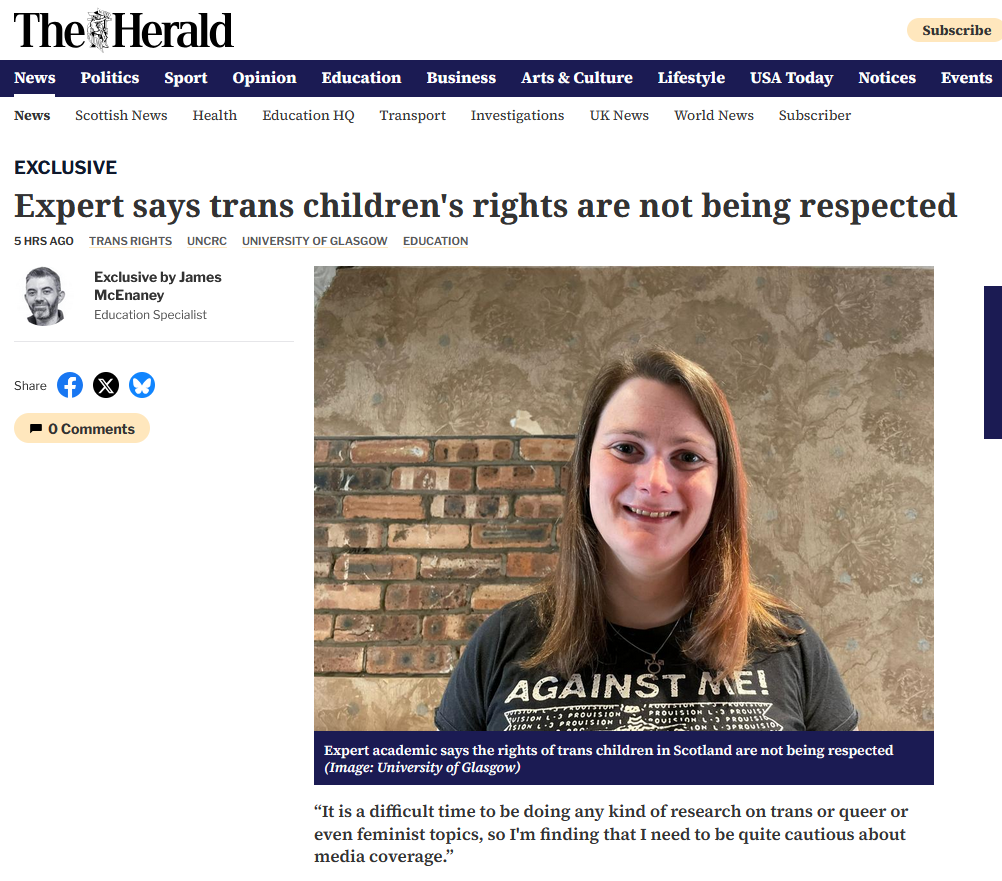
This weekend also sees the publication of an interview I did for the Herald about the UNCRC article. In this, I discuss the findings of my research with Cal. I also reflect more generally on the situation faced by trans studies researchers, in which it is increasingly hard to conduct trans-positive research even as the UK government and funding bodies throw millions of pounds at anti-trans researchers.
We end the interview with key three takeaways regarding what can be done to protect the rights of trans children, in Scotland and beyond:
“Number one would be to genuinely consult with young trans people and ask what they want and need. They deserve real and meaningful consultation.
“Number two is that there is a huge amount of knowledge that already exists, both on young trans people’s experiences and on how to consult with young people. Draw on the knowledge that already exists.
“And number three is to acknowledge that there is a trans-eliminationist movement. Acknowledge that there is an active attempt to stop anyone from doing the first two things.
“There’s an active attempt to stop any anyone taking seriously what young trans people have to say about their own lives, and an active attempt to stop any accessing of existing knowledge, and that comes from a place of prejudice.
“One of your starting points has to be acknowledging that that exists.”
 Dr Ruth Pearce