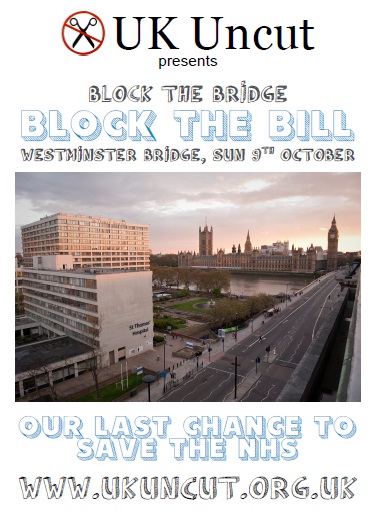
Save the NHS: Block the bridge, block the bill

UK Uncut are planning an unprecedented act of civil disobedience at 1pm on Sunday 9th October in protest against the government’s NHS reforms. Over one thousand people have already announced their intention to participate in the action, which aims to demonstrate the level of public opposition to the Bill and put pressure on sympathetic peers in the House of Lords by occupying Westminster Bridge.

The activist group are also encouraging people to contact peers and ask them to block the bill.

Full details of the demonstration can be found on the UK Uncut website.

There is also a Facebook event page.

Save the NHS, part 2: lobby the Lords

The NHS “reform” bill passed the Commons on its third reading yesterday by 316 votes to 251.* It will now go to the Lords for further scrutiny.

It’s not too late to save the NHS. A number of groups are recommending an unprecedented public lobby of the Lords in order to stop (or at least fundamentally alter) the bill.

The TUC have set up a page to help you do this: Adopt a Peer.

There is also a Facebook page with a fair bit of information.


“This is really important. I don’t think anyone has ever engaged en masse with members of the upper house on an issue like this before. They don’t have constituencies, and they can’t be voted out at an election. Nevertheless, many peers cherish their role in scrutinising bad legislation. They need to know there is a widespread dislike for these changes.”

– Christine Burns

*A grand total of four Liberal Democrat MPs voted against the bill. I can’t comprehend why anyone who cares about public services would ever want to vote Lib Dem again. May the party crash and burn come the next election.

ACT NOW to save the NHS

MPs are currently debating the controversial NHS reform bill. The £2 billion re-haul of our health system will be voted upon after just two days of debate in Parliament in spite of Conservative promises to oppose any “top-down” reorganisation of the NHS. Lawyers have warned that the changes will fundamentally undermine political accountability and further privatise the health system.

We’ve currently got one of the most economically efficient health systems in the world. It’s hardly perfect – and indeed, I strongly believe that the the NHS benefits from criticism – but we’re incredibly lucky to have it.

This is your chance to tell MPs that we can’t and won’t accept them messing with our health system.

Take action now:

Call your MP (via 38 Degrees)

Email your MP (via 38 Degrees)

Sign the e-petition (HM Government e-petition site)

Protect the NHS

Opposition to the government’s ill-conceived NHS reforms is growing. I wrote an angry post about the issue last year, but the argument against the proposals is perhaps best summed up in this video by MC Nxtgen:

Co-ordinated protests are apparently taking place across the UK today, but I haven’t seen much in the way of media coverage on the issue so far. We need to be raising awareness of the issue ourselves and building opposition as a broad movement.

I’m always in favour of a good demonstration, but armchair activism also has its place. As such, here’s a couple of initiatives from 38 Degrees (who were in part responsible for the government’s U-turn on the sale of state-owned forests).

“Save The NHS”: petition

Email your MP

(Guest Post) Turn and Face the Strange

The following was written by Louis, who recently experienced an appointment with “Dr Jiff” that unfolded pretty much as outlined.


But let me tell you, this gender thing is history. You’re looking at a guy who sat down with Margaret Thatcher across the table and talked about serious issues.
George H. W. Bush

One morning, as I awoke from anxious dreams, I discovered that in my bed I had been transformed into exactly the same body as I had been the night before.

Examination of my whole organic structure proved this to be true, and as my mother greeted me normally in the kitchen, my feeling of de-centralised horror was crystallised. Most people, upon waking to find themselves the same, would find reassurance in the stability of their own identity – unchanged by the nights stargazing. To the average man or woman, the roaming of a well-gendered mind at rest is a pleasure. I, however, on that morning, realised that my unprecedented disquiet was the beginning of something. I was right. I have not been quite at home with myself since.

Psychology today is a noble hobby, halfway between a humanity and a science. I tend to lean towards the side of art.

On the 9th December, 2010, I find myself sitting in the office of Dr Jiff in University Hospital Coventry. It’s the psychiatric clinic. I’ve spent half an hour waiting outside, before being beckoned, with a smile, into this room, where I am to give the performance of my life. My part: Myself, as the National Health Service wants to see me. The office is large and sparse, with high, grey windows and navy blue carpet. It’s warm, however, and my chair is comfortable. Not a couch, but a plain lavender seat by the doctor’s desk. Dr Jiff himself is something of a surprise. After all I’ve heard, here is a man in his twilight years: rotund, moustached, with yellow sweat patches under his arms. A fair tie, mind you – M&S perhaps.

He has an affable face, and is delightfully frank in all things… though as usual for a psychiatrist, his eyes are mirrored walls. This is our first meeting. As I write, I expect many more: my performance this day is a surprising success.

To begin to understand the nature of my madness, I would first have to explain what madness actually is, in a social context at least. I’m sure you have your own ideas on the matter, but here’s my take on the state of things. Madness is a state of mind which society as a whole (or perhaps the ideal that society projects of itself, and never seems to actually get to) finds to be outside the bounds of “normal”. Sometimes madness is considered genius. Sometimes geniuses go mad. More often than not, madness is considered a rather dangerous or undesirable thing to have around. The more cutting amongst you may have noticed that I didn’t define what “normal” is. That’s because I truly have no idea.

In Psychology and Psychiatry, different kinds of madness are categorised and given different names. The name for my particular type of madness is Gender Dysphoria. It has an average occurrence, according to the NHS, of about 1 in every 4000 people in the UK – though it is important to note that these are only those individuals seeking treatment. Estimates have been made suggesting that 1 in every 1000 people may experience gender dysphoric feelings, or even 1 in every 120. Some psychiatric organisations have suggested that there are perhaps 500,000 gender dysphoric people in the UK, and 10,000 who have successfully asked for, and received, treatment. Statistically speaking, you’ve probably met at least 3 people with some level of gender dysphoria within the last 5 years of your life. Whether or not you were aware is a moot point.

The treatment of my disorder is seen with some contempt by the general populace – it requires the breaking of ancient rules of civilisation. This sounds more exciting than it really is. In day to day life, I’m perpetually astonished by how seriously people take gender labels, and how violently they will react against those individuals who wish to put their hand up halfway through the lesson, and say “Excuse me, I think you got that bit wrong.”

On the 19th of August 1992, a gender dysphoric person was removed surgically from its mother’s stomach and placed (screaming, purple and bloody) into the world, possessing all the appearance of female genitalia. Because of this, a somewhat tenuous, but deeply historic and traditional, social categorisation was made, and it was assigned the gender role of “female”. However, the gender label which it now identifies with, if it has to at all (and that is a whole other debate), is “male”. Some people interpret this in the following way:

She wants to be someone else” OR “She wants to be a man.

A gender dysphoric person find this degrading and frustrating. As far as they are concerned, they have always been the same person, and will always be the same person, in one form or another. I summarise the following:

He is a man, and if society wishes to hang so much meaning and status on gender pronouns – a figment of language no less – then it can at least have the decency to let people identify themselves, rather than thrusting identity upon them at a stage where they can’t argue back.

Dr Jiff’s office, on the 9th of December, is a pleasant change from the usual hostility. To begin with, he has assured me that there are “unlikely” to be any problems in my referral. I explain the issues I have had when trying to achieve this in the past, and he shrugs off the ignorance of some in his profession with a simple:

“Some people just don’t go to enough conferences.”

Then:

“Do you masturbate?”

(Don’t tell me that wouldn’t knock you off balance a bit.)

“Yes.”

“Any particular fantasies?”

“Hmm.” I pull the face which I always pull when planning to politely lie. “No, just generic men.”

(Really, I have an imagination.)

“How do you identify – put into words?”

“Gay male, polyamorous.”

“Do you dream in colour or black and white?”

“Colour.”

“How do you place yourself within your dreams?”

(I want to say ‘the victim’, but I don’t.)

“Omnipresent.”

“And male or female?”

“I don’t see.”

“Any suicidal tendencies?”

“Nothing unusual. I saw a counsellor, it’s all in my notes and over with.”

And so on.

This stream of banal, sometimes cryptic, often probing questions, will determine the course of the rest of my life. In the end I “perform” so well that I achieve the referral and more: a fast track to a new clinic, with treatment as good as guaranteed in 3 months. The gatekeeper has been defeated. Apparently, the land of maleness is mine for the  exploration, chatting-up, styling, drawing, eating, sucking, dressing, drinking, writing, injecting, rubbing, wanking, fucking, and taking. And the clothes. I’ll be able to wear a pair of trousers on hips that aren’t just-too-wide, and a suit tailored to fit a new figure – simple pleasures hard won. Why choose soft curves when you can have hard lines? I know which I find easier to follow. But I digress.

“What do you know about the surgical options?” Doctor Jiff asks.

“First you have to ‘live the life’ for 2 years.”

“Yes that’s right, how long’s it been for you now?”

“2 months. Facebook proves it.”

“Good. And what were you considering?”

“Phalloplasty looks generally crap. I want top-surgery though.”

“Yes. The success rates for breast reduction and removal are excellent. How big are your boobs?”

(I can’t describe the impact of words like ‘boobs’ leaving this man’s lips.)

“Small.”

“Well it will be a question of finding the right surgeon, but I can help you.”

“Thanks.”

“Phalloplasty, though, is a tricky one. In 2 years time when you’re eligible, things may have changed completely, but at the moment it’s a poor sport. What you really want is to be able to feel and to experience, which as things stand in the field is not particularly attainable, so unless you suddenly become desperate for a penis, it’s worth avoiding for now. I mean, can you have a really good orgasm with what you’ve got?”

“…Yes.”

“Then that’s good, and anyway, there are things you can do with a strap-on, especially anally, that just can’t be done by natural men.”

(It’s only after I leave the room that it occurs to me to laugh and laugh.)

The question of my sexuality is only mentioned in passing. I have heard several, interesting viewpoints on it. My good friend L___ was rather surprised when I suggested that there was any problem. “But 80% of the female population are straight,” he argued, “So surely 80% of transmen are gay? It’s just logic.” I thanked him for this excellent piece of reasoning.

Others, however, have been less supportive. The first psychiatrist I saw to try and obtain a referral was quite obstinate in her belief that a transman couldn’t possibly be gay, because all transmen must surely be lesbians who just couldn’t face up to their sexuality. “I like anal sex,” I told her, just for the hell of it. She didn’t appreciate that. Of course, there lies another minefield of debate: my under-eighteens counsellor pointed out that with my total lack of sexual  experience of any kind, how could I possibly know what I was attracted to? This, to me, seems like a rather foolish question, and leads me to assert a rather controversial fact:

Nobody knows a person as well as they know themself.

That point made, it is interesting to note the breadth of reactions that a trans or gender dysphoric person may receive in their exploration of this idea. Imagine meeting someone you have known since infancy for coffee. The two of you make small talk and enjoy each other’s company, then out of the blue, your friend tells you that they have to say something important: they are not really brunette at all, they are actually blonde. To the evidence of your own eyes, this is ridiculous, and you say so. No, they explain, the brown is dye. I’ve been covering this up for my whole life.

Of course, hair colour is a somewhat less mind-bending issue than gender, but the premise is similar. Imagine the same conversation, but instead your friend reveals that they are homosexual. This is slightly more controversial. To   someone like me it doesn’t matter at all, but of course to many people, this is a genuinely world-altering piece of information. Now, imagine your friend putting down their coffee cup, and telling you that they are actually the opposite gender.

Imagine walking away with that information in your mind.

Surely you know them better than that? Don’t you?

If you need to stick a label on them to understand them, do you really know them at all?

What’s in a consultation?

The media is currently getting itself into a massive tizzy over government proposals to allow gay couples to have civil partnerships in religious buildings. The predictable right-wing wonks are being wheeled out to moan about it being a slippery slope that will end up with any given Christian priest (no-one cares about what Jews, Muslims or (God forbid) Pagans might think, it seems) being forced to marry a couple of scary gay men with Nazi tattoos.

Meanwhile, left-leaning and right-leaning papers are falling over themselves to predict that full gay marriage (and, weirdly, heterosexual civil partnership) will be next, despite the fact that there has been no confirmation of this from anyone in government. I mean, let’s take a look at the actual statement from the equalities minister, Lynne Featherstone:

“Over the past few months I’ve spoken to a lot of lesbian, gay, bisexual and transgender people and campaign groups, and it quickly became clear that there is a real desire to address the differences between civil marriage and civil partnerships. I’m delighted to announce that we are going to be the first British government to formally look at what steps can be taken to address this.”

Yep, there’s certainly a lot in there confirming that gay marriage is around the corner. I’m hoping that it will be (hell, we could immediately take the next logical step and start pushing for legal recognition of polyamory or something!) but have my doubts. After all, the Tories aren’t really that keen on gay marriage. The Liberal Democrats have policy on it and Nick Clegg says that he’s in support, but if you can’t trust the Lib Dems on student fees, trident, detention policies, supporting the poor, the disabled, women or just about anyone else really, then I’m not convinced that you can trust them on equal marriage either.

Moreover, there’s that little issue of the consultation. Government consultations can take forever! I first started campaigning on amendments to the proposed Single Equality Bill (as it was then) back in 2007, and the first consultation was held well before then. The Equality Act eventually emerged in 2010 after being rushed through at the last minute by a desperate Labour party. Ben Summerskill of Stonewall has (for a change) made a pertinent point relating to this:

“If there’s a genuine commitment to making progress in this area, it is painfully slow. Equalities minister Lynne Featherstone has explicitly said she would consult on proposals the government intends to implement in the lifetime of this parliament. If that is to happen by 2015, then consultation should begin now.”

I’d take his word for it: Summerskill knows a thing or two about just how “painfully slow” progress on equal marriage can be.

So this will probably take some time. But it’s interesting that whilst this particular consultation is likely to take ages as civil servants painstakingly gather the views of any given bigot at hand, another important consultation is little more than a formality.

The government is still planning to radically reinvent the NHS despite massive opposition from those who actually understand our health service and care about the welfare state. The “consultation” on this has been minimal to say the least, and health services have already had to start preparing for changes that may have a huge negative impact upon service provision for some of the most vulnerable people.

Funny that the government is so keen to hold a consultation on religious civil partnerships when the relevant law is already there (as part of the Equality Act), but is happy to push ahead with its NHS clusterfuck with as little input from others as possible. Draw your own conclusions.

Why the NHS shake-up leaves me baffled

If you live here in England, you’ve probably noticed that the government has decided to give £80 billion of public money to GPs (read: private companies working with GPs) and scrap primary care trusts. David Cameron claims “We are not reorganising the bureaucracy, we are scrapping the bureaucracy.”

One of my biggest problems with the NHS is that the bureaucracy of the health system is incredibly unwieldy. All too often the left hand doesn’t seem to know where the right hand even is, let along what language it speaks. I’m also usually in favour of devolution and the localisation of services. I can’t conceive of how this particular change will be an improvement though.

We currently have 150 primary care trusts (PCTs) and the government is proposing to replace them with between 500 and 600 GP consortia – in order to save money. Surely though the cost of doing this in the first place is going to be ridiculous?

Surely this move will do nothing to remove the NHS bureaucracy: it’ll just shift it from (publicly owned) PCTs to (privately-owned, but publicly funded) consortia. This will mean that thousands upon thousands of people working in admin will lose their jobs…and thousands of new jobs will be created elsewhere. It’s being claimed that individuals who currently work for a PCT could seek work with a consortium but…this is just stupid. Thousands of admin workers will basically be relocated to new bodies, and this is going to cost a huge amount of money: it’ll cost to close down the PCTs, it’ll cost to make redundancies, it’ll cost to advertise for the new jobs and to run interviews and to basically re-train pretty much all of the non-hospital admin staff for the NHS in England. What planet is Andrew Lansley living on?

Additionally, each PCT tends to have its own individual policies, guidelines, patient booklets and outreach/advertising schemes for various services. It costs money to produce all of this: surely it’s going to cost more money for 500+ variations on a theme than 150?

Okay, so suppose the government is right about how best to save money whilst providing better services on the NHS (hah!) and all of the above will be cancelled out by the long-term savings. How easy will it be to hold all of this hundreds of these new consortia to account?

A few days ago I posted up a new policy for trans name changes we’ve sorted out with the local PCT. Within three years that change is probably going to be a bit pointless, and I won’t be surprised if things regress within the Coventry area. There’s a lot of very decent GPs out there, but others aren’t: a bunch of them are bigoted arseholes who will deny treatment to LGBTQ people at the drop of a hat. If GPs are going to be responsible for deciding who gets funding and hospital referrals, trans people who seek medical treatment could be in a lot of trouble. I’m not just talking about trans people who want to transition medically: I’m talking about any trans person who wants any kind of treatment, since the whole “we don’t serve your kind here” attitude is still highly prevalent. Of course, under current rules the NHS as a whole in the UK has to provide treatment (including aspects of medical transition) for all trans people, but that hasn’t stopped certain areas (such as, say, Wales)  from refusing to provide treatment.

Right now, if we’re lucky enough to have the PCT on our side (as we finally do in Coventry…tentatively, at least) then we can have them pressure the GP to sort it out. This system is far from perfect, since many PCTs simply don’t want to listen (see: Oxfordshire) but I imagine it’s going to be far harder to bring about positive social change in five or six local consortia than it is with a single PCT.

Moreover, one of the biggest problems with the NHS is communication. One of my friends was given a referral to Charing Cross gender clinic by a psychiatrist after years of waiting, but then had to move house and ended up in a different PCT. The PCT refused to acknowledge the referral and made her start again from scratch, effectively postponing her access to hormones by two years. I can’t imagine that this kind of thing will be less common with the NHS split up into more bodies.

So what can we do? Well, I suspect there’s very little we can do, but now is the time to act. We should be fighting on every front: writing to politicians, talking to the media, participating in protests and taking part in any consultation event we can find out about, and at every stage we should be asking awkward questions about how these changes will impact minority groups such as trans people (‘cos I’m pretty certain it will disproportionately screw over others, such as people living in poorer areas).

Finally, a couple of thoughts from The Guardian:

GPs are doctors, not accountants

“Imagine this bedpan is full of money…”

New process for changing name and gender in NHS Coventry

The below document was issued last month following consultation with local trans activists. It should make life a lot easier for people who are changing their name and/or gender with a G.P. or dentist within the Coventry Primary Care Trust. If you’re in the Coventry area and are having problems with changing your name and/or gender, this policy should give you the leverage to sort it out. If you live in another area where the P.C.T. is giving you grief, it might be worth trying to cite this as an example of best practice.

    Process for changing name and gender in Primary Care

The purpose of this document is to clarify and bring together already existing legislation and guidance for primary care providers to change the name and gender of trans people who request it.

Considerable legislation(1) already provides explicit protection and rights for trans people in the areas of employment, goods, facilities and services (including health) and for their legal recognition as ordinary men and women in their acquired gender.

“Gender transition is not embarked upon lightly. There is substantial evidence that many trans people encounter extreme violence and discrimination if their background becomes known within their community(2).”

When trans men and women are planning to live permanently in their preferred gender role, they need to ensure that all of their documentation reflects their new name and gender. This includes their passport, driving licence, credit cards and, of course, their medical documentation.

In the UK, anyone can call themselves by any name and any gender that they want to as long as they are not doing it in order to commit fraud. They do not need to use deed poll to change their name nor do trans people have to have a gender recognition certificate to change their gender on documents(3).

There is a simple process for this, which is accepted by many government departments including the Department of Health (4).

1. The patient tells their GP, or directly informs the PCT, that they are transitioning and that in future they would like to be known by their new name and gender(5). They can write a “statutory declaration”, they may have a deed poll document, or they may simply make the request. This request should be in writing, signed by the patient.

2. The GP writes to the Registration Office at the PCT. The GP may write a letter of support confirming the gender role change and that this change is intended to be permanent, but this is not a requirement.

3. The Registration Office then writes to the Personal Demographics’ Service National Back Office. The National Back Office will create a new identity with a new NHS number and requests the records held by the patient’s GP. These records are then transferred to the new identity and forwarded to the GP.

4. On receipt, the GP surgery changes any remaining patient information including the gender marker, pronouns and names. Trans patients have a legal right to change their name and gender on their NHS records and would be able to bring a civil claim against any GP or practice which refused to accede to their request.

Please contact me if you have any queries on the number below.

Helen Bunter
Head of Equality and Human Rights
NHS Coventry
Tel: 024 76246092

(1) The Sex Discrimination Act 1975 (amended 2008), Sex Discrimination (Gender Reassignment) Regulations 1999, The Equality Act 2006, Gender Recognition Act 2004

(2) http://www.dh.gov.uk/prod_consum_dh/groups/dh_digitalassets/@dh/@en/documents/digitalasset/dh_089939.pdf

(3) http://www.dh.gov.uk/prod_consum_dh/groups/dh_digitalassets/@dh/@en/documents/digitalasset/dh_085013.pdf

(4) Press for Change, 2008: “Name Changing on Personal Documents: A Guide for Organisations

(5) http://www.connectingforhealth.nhs.uk/systemsandservices/demographics/pds/ig/access/gender_reassignment/?searchterm=gender%20reassignment

What’s in a name? (the importance of free deed polls)

This post is part one of my response to misha the Duck of Doom, who commented on this post.

In the United Kingdom we’re pretty lucky: we’re able to change our names for free, as long as it’s not being done to commit fraud. I believe this is not merely a privilege that we’re fortunate enough to have though; it’s an important right.

This applies to anyone who wants to change their name, but is particularly important for many trans people because of the sheer importance a name can have. A name denotes identity, is usually tied to a particular gender role and accompanying gender expectations, and tends to carry a fair amount of personal history with it. No wonder then that a name change can be a key moment for those who transition. A free name change means that everyone has equal access to this right, regardless of age and financial status.

There are several means of changing your name under UK law, but the most simple is to simply announce to the world that you’ve changed your name. You don’t actually need to do anything other than this. It might help, however, to sign a piece of paper as evidence of your doing so. Maybe you could also get someone else to witness it, perhaps a solicitor. This tends to help with getting organisations such as banks, educational institutions and the Inland Revenue to recognise your name change: hence the existence of deed polls and statutory declarations.

Solicitors – and various websites – can charge a pretty penny for preparing your statutory declaration or deed poll. The amount they might ask you for varies, although as a general rule I note that the more fancy-looking the document is, the more it costs. What baffles me is that these individuals and organisations are getting away with this when you can easily make your own document for free. There are some organisations trying to make money from this through advertising, whilst other pages make them available simply out of a desire to help others. My own (free) deed poll was emailed to me by a particularly helpful individual working for the university I was applying for a few years back. I’ve used it to change my details with pretty much every organisation which will ever need to use my name, including the NHS, a Student Union and the Job Centre.

Of course, not everyone who charges for evidence of a name change charges a lot. misha the Duck of Doom suggests:

“Go to a solicitor who swears oaths.
They have the uk courts authority to swear in
a Stat Dec name change.
When doing this, they are recognised as an agent of the court.

It costs £5 IIRC
plus £2 per stamped copy. You need about 15 copies for tax, council, education certificates, utility companies
so they change your name & sex.”

This looks relatively reasonable and not too pricey. I have three major problems with this option though:

1) “Affordable” can be two very different things to different people. The above suggestion actually costs £35 (£5, plus £2 multiplied by 15 is £35). That’s a fair amount of money if you’re a teenager, a student, on minimum wage, unemployed or permanently on incapacity benefit. Of course, many solicitors would provide you with a number of copies for no additional charge, and I’d suggest you could save a lot of that money by creating photocopies and using a stamped, self-addressed envelope when you do need to provide the original, but you’re still spending money. £5 can go a long way towards other things when you’re a teenager, and has to go a long way if you’re on benefits or minimum wage. I can make several days worth of meals on £5. Sure, even the poorest can fork out for this, but would prefer spend money on better things if it’s possible to do so.

2) Trans people are more likely than the general population to have anxiety issues or problems interacting with other people. Transition has given nerves of steel to many of us (and huge amounts of confidence when things are going well), but this doesn’t apply to all. Dealing with this kind of thing via a solicitor or courts could waste a lot of spoons. In this instance, self-created evidence of a name change is clearly preferable.

3) There’s an issue of principle! Regardless of money and spoons, why should we have to spend money on evidence of a name change when, legally speaking, we don’t have to?

This is why it particularly gets my back up when a Gender Clinic decides that it’s above free deed polls, and demands that they’re witnessed by a solicitor. It’s also bizarre that they accepted a free deed poll from a trans woman and then decided to later reject the very same document. I’m glad that Charing Cross no longer seem to be doing this – and in fact have apparently written a new policy to ensure that it doesn’t happen again – but it’s quite telling that they don’t seem to have made this new policy public at all.

Update on the Charing Cross gender clinic deed poll affair

This is a brief update on the entry I wrote about Charing Cross gender clinic getting a bit funny about DIY deed polls. In short: the clinic is once accepting such documents, so hurrah!

I have been reliably informed that the issue was raised at a stakeholder meeting. It was confirmed that was indeed some confusion at the clinic about the status of home-made change of name documents.

The policy at the clinic has now been changed to bring it in line with the advice of the Gender Recognition Panel, which recognises appropriately written change of name documents signed by the person changing their name, and a witness.

Such documents can be found online in a number of locations, such as here.