Of conduct and controversy: trans health activism at EPATH

Here in the UK, health is a key priority for many trans activists. While progress is sometimes painfully slow, numerous debates, protests and consultations have informed gradual change within a range of healthcare settings, and a growing number of health professionals are prepared to actively support trans peoples’ access to affirmative care. However, discussion of trans healthcare in the UK has remained focused largely on the specifics of the UK context, even as important events that influence gender identity services in particular are increasingly taking place on the world stage.

In this post, I look at recent activism at “PATH” (Professional Association for Transgender Health) conferences in Amsterdam and Los Angeles, as background to unfolding events at this week’s EPATH conference in Belgrade.


WPATH Symposium 2016

Last year I wrote briefly about international activism taking place at the World Professional Association for Transgender Health (WPATH) symposium in Amsterdam, the Netherlands. This included two unofficial fringe events: a Global Action for Trans* Equality (GATE) pre-conference, organised primarily by trans activists from the Global South, and the FreePATHH event, run by Dutch trans people living locally who couldn’t afford to attend the expensive WPATH event.

I myself experienced the WPATH symposium as exhausting, inspiring and frustrating. A myriad of positions on trans health care represented amongst the researchers, practitioners and activists present at the event, which is as it should be at any good conference. However, amongst the thought-provoking and challenging interventions, and numerous examples of progressive approaches and good practice, I also found myself overwhelmed by microaggressions from cis attendees, and thrown by the cognitive dissonance of experiences such as emerging from a session on trans-affirmative care only to find myself attempting to retain a professional demeanour whilst walking past individuas such as Kenneth Zucker. Zucker has been accused of subjecting gender questioning children to reparative therapy, and will also be known to UK readers for his participation in a recent BBC documentary (“Transgender Kids: Who Knows Best?”), to which Trans Media Watch responded with an extensively researched letter of complaint.

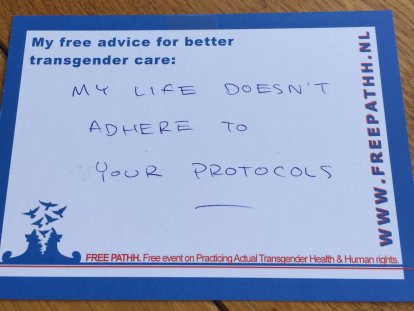
It was in this context that numerous interventions – both formal and informal – were organised by trans attendees at WPATH. GATE held sessions on depathologisation for trans and intersex people. FreePATHH created a range of notes with “free advice for better transgender care”, which were distributed in a social area for conference attendees to read. Someone gender-neutralised the (binary gendered) toilets with holographic signs. I also heard informally about South African trans women confronting a racist presenter on a panel.
ClTZLM9VEAASI-e.jpg large

In this way, the WPATH symposium felt like a sometimes discouraging, sometimes productive site for real debate and contestation, both professional and political. My impression was that the the interventions that took place there would probably have a gradual impact on how trans health is understand and practised in the years of come, particularly following the creation of TPATH, a group for trans people working in trans health.  What I didn’t realise was the extent to which events would accelerate in the coming months.


USPATH Conference 2017

In February the first USPATH (United States Professional Association for Transgender Health) conference took place in Los Angeles, USA. At this event, tensions over the place of pathologising forms of care in general – and Kenneth Zucker’s ideas and practices in particular – came to a head.

In a Twitter thread written during the event, health researcher Zoé Samudzi describes how a number of academics and health practitioners, led by trans women of colour, spoke out against the inclusion of Zucker on the conference programme. One session (the first of two at which Zucker was due to speak) was briefly interrupted by an impromptu speech and later quietly picketed, after which hotel security threatened to call the police on a number of attendees.

The next day, community representatives – again led by trans women of colour – met with USPATH and WPATH organisers to read a list of demands. In the wake of this intervention, Zucker’s second talk was cancelled, and a formal apology for the initial heavy-handed response to protesters was posted to the WPATH website. This post, which also promised action to better involve trans communities in general and trans people of colour in particular in the work of WPATH, was removed from the website just two weeks later.


EPATH Conference 2017

Today (6th April) the EPATH (European Professional Association for Transgender Health) conference will begin in Belgrade, Serbia. This event is likely to be a somewhat more conservative affair than the USPATH conference due to disciplinary differences between trans health practitioners in the US and Europe: however, like the WPATH symposium, the conference programme incorporates a wide range of perspectives.

There will once again be an associated FreePATHH event on Saturday 8th/Sunday 9th, which is being organised by Serbian trans activists in collaboration with some of the Dutch individuals behind last year’s FreePATHH. It will include free talks and panels on trans and intersex issues in the former Yugoslav region, as well as arts performances and a football match. At the EPATH conference itself, TPATH will have a presence, seeking to bring together trans people working in the field.

One point of potential contention at EPATH is a code of conduct which has been drawn up for the event. In many ways, this document reflects standard conference etiquette, through (for instance) condemning individual harassment of attendees. However, there are also a number of points that appear to have been written specifically in response to recent events.

We expect all conference participants to be respectful in person and online towards other delegates, speakers, organisers, staff and volunteers.

We are committed to providing a harassment-free conference and training experience for everyone, regardless of gender, gender identity and expression, sexual orientation, disability, physical appearance, body size, race, or religion.  Harassment of participants, speakers, staff or volunteers in any form will not be tolerated.

 Harassment includes offensive verbal comments, and other forms of using disrespectful and pathologising language inconsistent with human rights standards, deliberate intimidation, stalking, following, harassing, photography or recording without explicit consent, sustained disruption of talks or other events, inappropriate physical contact, and unwelcome sexual attention. Conference participants asked to stop any harassing behaviour are expected to comply immediately.

Upon reading the code of conduct, I was immediately reminded of accounts written by trans woman who have accused controversial practitioners of inappropriately photographing them at past events. This is particularly interesting given that he’s been confirmed to speak at the conference. The reference to “pathologising language” also appears to be a nod to some of the practices at previous conferences that have distressed trans attendees.

However, the question remains about what counts as “offensive verbal comments”, “sustained disruption of talks or events”, or “recording without consent”. If a similarly filmed disruptive event occurs at EPATH as took place at USPATH, it could conceivably be framed as “harassing behaviour” within the context of the of the code of conduct, leading to protesters being ejected from the event. This is concerning because the participation of controversial clinicians such as Zucker is typically defended on the grounds of enabling “free speech” within the context of the conference: however, on these grounds, we might expect that conference attendees wishing to peaceably protest or strongly critique bad science might also be afforded freedom of speech.

I won’t be attending EPATH myself this year; like the FreePATH attendees, I simply can’t afford the expensive conference fees. However, I will be following events with great interest, and encourage other non-attendees with a personal or professional interest in trans health and/or trans activism to do the same.

From blog to academic website

In February, I completely revamped this site, creating a new “look”, and adding information on my academic talks/publications etc.

I’d been about creating a “professional” website and blog for some time, particularly as I intend to move ahead with my academic career. I wanted to use this to the stuff academics are supposed to do, like painstakingly list The Things We’ve Done At, but also wanted a platform from which to share information, ideas, and the odd polemic.

At the same time, I already had a pretty well-established blog, with archives reaching back to 2009. I don’t necessarily still stand by everything I might have once said – both the world and my perspectives on it have changed quite substantially over the last few years – and with time I’d also been blogging less and less as my attentions turned to my PhD thesis. But I don’t want to lose that personal history or sense of continuity in my life and writing.

So rather than officially retire Trans Activist Takes On World (as this site was previously known), I’ve decided to incorporate the old into the new, keeping the blog’s archives as a part of my academic website. To be honest, I’m expecting to continue writing on trans health, trans activism, LGBT issues, feminism, UK politics and the odd bit of punk/metal music. I’m also going to incorporate updates on planned talks (and possibly gigs!), something I previously blogged about at Ruth’s Corner. And this isn’t the first time I’ve changed the title or my approach to the site – I originally wrote anonymously as Trans Youth Takes On World, and also briefly titled the site Writings of a Trans Activist.

cropped-trans-activist-banner

ye olde blog header

I’m still not expecting to write here anything like as often as I used to. The double irony of completing my PhD is that I’ve been writing pretty much constantly ever since, but have also had very little time to do any more creative or reflective pieces for this blog (or any other site). Instead, I’m focusing on two(!) books and a number of book chapters and academic articles, which should be realised gradually over the coming year-and-a-bit.

I’m planning to write some more about all of these as they reach completion. I’m also aiming to make as many of the journal articles as possible freely available, posting non-final versions on this site so people can read them.

So, I hope you’ll stick around for my new journey. As ever, I’m interested in changing the world for the better – academia happens to be my chosen medium at present.

Event: Trans Feminism talk at University of Wolverhampton (10 March)

Friday 10th March, 2017
City Campus, University of Wolverhampton
1.30pm in MD165

I will be talking about some of the key issues and debates in trans feminism as part of the University of Wolverhampton’s International Women’s Week programme, highlighting areas of commonality and difference between the political struggles of trans women and cis women. I will also explore both historical and contemporary disputes over the place of trans issues (including challenges faced by trans men and non-binary people) within a women’s movement.

(Free) registration for the event is available here.

Rest In Power: Deborah Lynn Steinberg

A week ago today I heard that Professor Deborah Lynn Steinberg had died. It was not unexpected – Deborah had been ill for a very long time. Nevertheless, the news hit me hard. Deborah was my PhD supervisor, and before that also supervised my MA dissertation. Together with our colleague Iggi Moon, we organised a seminar series between 2012 and 2014, and more recently have been collaborating on editing a special issue of Sexualities and an edited book.

Through these projects, Deborah has been a hugely important and inspirational figure in my life. I’ve written a piece about this for Discover Society, reflecting on her intellectual generosity and the complexity of her relationships with her students.

In the coming months I’ll be sharing details of the Sexualities special issue (entitled “Trans Genealogies”) and the book, for which we’ve been offered a contract by Routledge. I miss Deborah terribly and it feels very strange to be working on some of her posthumous publications, but I feel very honoured to be in this position. I hope we can do justice to the spirit of her insight and intellect.

deborah-lynn-steinberg-640x300

LGBT+ History Month Talks

I’ll be discussing my research at two public events this month.

16473316_204490776693175_8365624470453169582_nThursday 16th February
Condition or Movement? A Century of Trans Identities
University of Warwick

6:30pm, OC0.02, Oculus Building.

I will be giving a talk about the role of medical discourse and social movements in the emergence of ‘trans’ identities during the 20th and 21st Centuries.


16602955_10210179504518384_1245278100974843955_nTuesday 21st February
Trans experiences of health care panel
Pembroke College, University of Cambridge

6pm, Nihon Room.

I will be taking part in an LGBT+ History Month panel on the British health care system, alongside Morgan Potts, Amy Clark, Ray Filar and Tschan Andrews. Our respective talks will be followed by a Q&A session.

Certifying Equality? A critical perspective on Athena SWAN (17 February)

certifying-equality-posterI’m currently part of a team working on an Athena SWAN submission for the Department of Sociology at the University of Warwick.

Many of us are feminist academics. The process has got us thinking both about how equality accreditation mechanisms such as Athena SWAN can create space for new ways of thinking and tackling sexism, and also about what can go “missing” or get “lost” in such processes. For example, there isn’t much space for an interrogation of intersecting inequalities in Athena SWAN (or Race Equality Mark) submissions.

We’ve therefore decided to organise an event to think about and discuss some of these issues. It will be taking place on Friday 17th February in the Wolfson Research Exchange, University of Warwick Library.

Further details and a registration form can be found here.

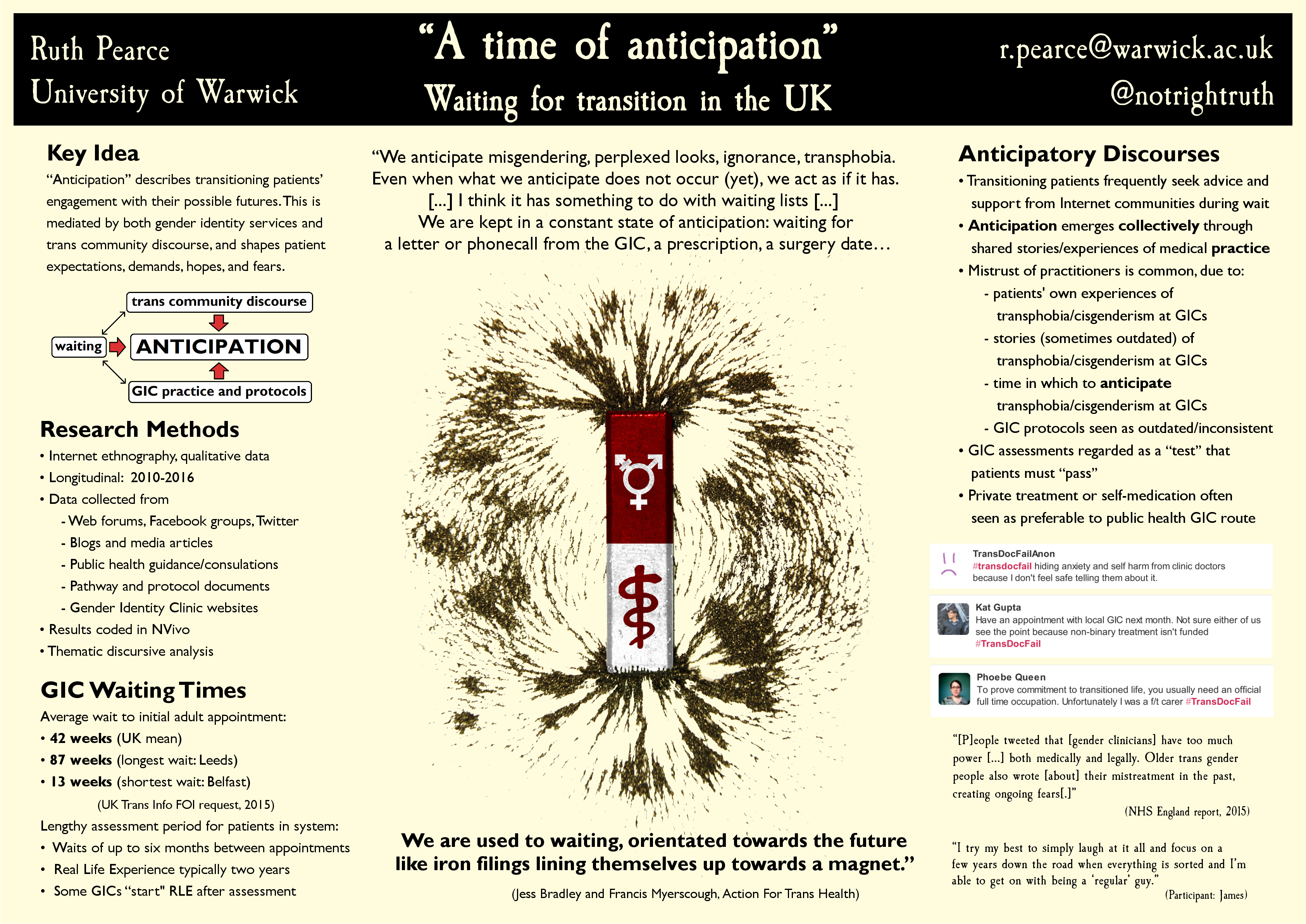
WPATH 2016 poster: “A time of anticipation”

Here’s the poster I presented at this year’s WPATH Symposium:

Anticipation poster.png

You can also download a PDF version here.

The magnet is a metaphor for anticipation, which is both a product of and shapes feelings, emotions and experiences of time. This process is mediated by both trans community discourses and medical systems.

It’s very important to note that the majority of research participants had good things to say about the health professionals who helped with their transition. However, there is also a high prevelance of transphobia and cisgenderism within medical systems and clinical pathways. Anxiety and mistrust of practitioners within the trans patient population is endemic, and this is compounded by long waiting times.

My wider research looks critically at how discourses of trans health are differently understood within and between community/support spaces, activist groups and the professional sphere; however, the purpose of this particular poster was communicate some of the difficult experiences that current patients have with waiting. It sparked some productive conversations and I hope that further work will follow from this.

Sources:

Transitional Demands (Jess Bradley and Francis Myerscough)

Experiences of people from , and working with, transgender communities within the NHS – summary of findings, 2013/14 (NHS England)

Current Waiting Times & Patient Population for Gender Identity Services in the UK (UK Trans Info)


WPATH 2016: the activist fringe

I’m currently in Amsterdam for the World Professional Association for Transgender Health (WPATH) biennial symposium. It’ll be the largest such conference that has ever been run, with 800 participants from across the globe. This will hopefully be the first of several posts exploring my experences at the conference (no promises, though!) – and I’m also planning to occasionally livetweet.

WPATH is an international body best known for publishing the Standards of Care, which offer guidance for practitioners supporting patients seeking to transition. The organisation has undergone a great deal of change over the years, reflecting wider shifts in understanding around trans people and our experiences. At present, the organisation’s wide scope incorporates a considerable range of views on how transition should and could be managed.

I’m here partly to present a poster detailing some of my research findings around patient experiences of waiting in the UK. However, as a sociologist with an interest in the evolution and negotiation of discourse and activism around trans health, I’ve been interested to see that at least two fringe conferences have been organised in Amsterdam to coincide with WPATH. I also thought it would be beneficial to share what’s going on with a wider audience – so, here goes!


GATE pre-conference

Global Action for Trans* Equality (GATE) is a loosely-organised international trans rights organisation: a genuinely diverse multinational network of activists with strong representation from the Global South. One of their key priorities has been to campaign for the depathologisation of trans, although members have also been involved in activism around other issues, such as access to care.

Over the past two days GATE held their own conference in Amsterdam to discuss trans health. The event both stood alone as an independent conference, and provided activists with an opportunity to discuss WPATH. I wasn’t able to attend in person, but have heard that a broad consensus was reached on a couple of issues related to the classification of trans in the World Health Organisation’s International Classification of Diseases (ICD).

The current version of the document – ICD-10, published back in 1992 – classifies ‘Gender Identity Disorder’ and ‘Gender Identity Disorder of Childhood’ as mental health issues. These diagnoses are widely used in gender clinics in countries such as the UK (note: these differ from the diagnosis of ‘Gender Dysphoria’ present in the American Psychiatric Association’s DSM). Recent statements from the World Health Organisation indicate that the long-awaited ICD-11 will replace diagnoses of ‘Gender Identity Disorder’ with ‘Gender Incongruence’, and move these to the sexual health section of the document.

Whilst GATE’s long-term goal is depathologisation, at present they have decided to focus upon pushing for this move from classifying trans diagnoses as mental health issues to regarding them as sexual health issues, as a compromise that should ensure continued funding for transition from insurance companies and public health organisations. In addition, they are arguing against the existence of the category ‘Gender Identity Disorder of Childhood’, on the grounds that this is an unnecessary medicalisation of gender diversity in young children, whilst the ‘adult’ category is sufficient to guide medical interventions for adolescents. This perspective feeds into a wider discussion around the category that is also recognised in the WPATH programme, with time set aside for a formal debate.

GATE activists will be attending WPATH to argue these points, and also to advocate more widely for trans-affirming approaches to treatment.


FREE PATHH

FREE PATHH is an event that will take place this Saturday (18th), concurrently with the first day of the WPATH symposium proper (a handful of formal pre-conferences are taking place on Friday). Hosted by Dutch trans activists, it is a free event that anyone can attend. FREE PATHH organisers argue that the high fees for the WPATH event mean that ordinary Dutch trans people are unable to attend this event held in their own country to learn more about their own health. As such, there is little interaction between WPATH and local Dutch trans communities.

The few transgender people who can afford to be present at this important symposium, are exceptions. They can go, because they have to be present for work or because they have enough personal financial means. (FREE PATHH)

As one of those few trans people who can attend the WPATH symposium (in my case, because I was lucky enough to gain a grant in order to do so), I feel this is a really important point. WPATH undoubtedly exists to share information amongst professionals in a formal setting; at the same time, the issues at hand require input from the very people who are directly impacted. With trans people disproportionately likely to be on low incomes, even early career professionals might find themselves effectively frozen out.

The FREE PATHH programme includes talks and workshops in Dutch and English on a range of issues related to trans health, and will be filmed for later disseminaton. At the end of the day, a panel with individuals who have attended both WPATH and FREE PATHH will summarise both events. This should be a valuable opportunity to share insights from both international and Dutch work on trans health, from professional and community perspectives.

You can read the FREE PATHH programme here.

Video: (Mis)understanding Transgender Health

Regular readers (hi!) will have noticed that I’ve not been posting on this blog much at all over the past year or so. Between part-time jobs and my PhD thesis, I’ve been pretty busy – however, I’m nearing the end of thesis writing, so hopefully that might change in the near future. We’ll see!

One thing I’m hoping to do after I hand in the thesis is to talk about my findings in the public domain as much as possible. So, here’s an initial step towards that – a video from the re:publica TEN conference on Internet and society, where I was invited to talk about trans health.

The talk was aimed at a very general audience, many of whom weren’t familiar with trans issues, so there’s an extensive introduction to some of the basics as well as a discussion of one small area of findings and some related studies.


Gender recognition: where next?

I recently co-wrote a short report for UK Trans Info with CN Lester. Entitled ‘Gender recognition: where next?’, it reports upon the findings of a short survey about possible replacements for the Gender Recognition Act. The survey was created in response to calls for reform of the Gender Recognition Act 2004, in the wake of a Transgender Equality Inquiry conducted by the UK Parliament’s Women and Equalities Committee.

The headlines are as follows:

  • There is strong support for some form of legal gender recognition grounded in self-declaration – comparable perhaps to creating a statutory declaration or deed poll – as opposed to the current system of applying to a ‘Gender Recognition Panel’ with huge amounts of evidence and hoping for the best.
  • We asked what respondents were not prepared to compromise on in any change of law; a considerable majority stated that they regarded non-binary recognition as a red line in any negotiation. This will no doubt be very difficult to achieve due to the lack of any precedent in law for the recognition of non-binary gender identities, but it’s vital that trans advocates make the effort to push for this over coming months, for the sake of solidarity and inclusion.

You can read the report here.