I am genuinely thrilled to be involved in Glasgow’s first ever Trans History Festival, which begins next week.
It’s hosted by our shiny new Glasgow Lab for Intersex, Non-binary, and Trans Studies(GLINTS) plus southside institution Category Is Books. There are a bunch of people making it happen, but credit is due especially to LGBTQ+ historian Sam Rutherford from GLINTS, plus Bug and Fin from Category Is Books.
As part of the festival, you can see me speak with trans studies pioneer Susan Stryker on the afternoon of Friday 23 October. This event will take place at the University of Glasgow and is completely free to attend, but we are asking people to register so we can keep track of numbers.
To celebrate this year’s umpteenth hit-piece on trans equality, I thought I might tell a little story about toilets.
On Friday, The Times reported that the University of Warwick has been “criticised for its ‘capture’ by Stonewall”, as evidenced by guidance asking people to challenge their biases, plus a proliferation of gender-neutral pronouns and toilets.
This coverage struck me as both unsurprising and bizarre. Unsurprising, as Stonewall have recently been subject to a barrage of homophobic and transphobic coverage from the likes of The Times, the BBC, The Guardian, the Telegraph, the Daily Mail etc etc. But also bizarre, as this is simply not news – all of the initiatives described have been underway for many years now, and they were hardly introduced by Stonewall.
As such, this feels like a good opportunity to explore the forgotten history of one of these initiatives: the introduction of all-gender toilets at Warwick, and in UK universities more widely.
I first became involved in campaigning for all-gender toilets in 2007. Using public toilets was a huge fear for me when I first transitioned. Fortunately, it turned out I was able to use women’s toilets without any trouble, but many of my queer siblings were not so lucky. I met and read about many trans people and other gender-nonconforming individuals, especially butch lesbians, who faced abuse and harassment in toilets due to their appearance. All-gender toilets offer a level of safety and access for people who don’t necessarily tick binary gendered boxes.
I was inspired therefore to learn about campaigns for all-gender bathrooms in US universities, through blogs, forums, and the 2004-05 TV documentary TransGeneration. I teamed up with some friends to write a motion for the 2007 National Union of Students (NUS) LGBT conference, calling on the NUS LGBT to campaign for equal toilet access. The motion passed with a near-unanimous vote, and you can see the text of the resulting policy below:
Of course, we were hardly the first people to undertake such campaigns in the UK. In 2002, Benjamin Cohen wrote an (unsuccessful) motion in favour of gender-neutral toilets for the King’s College London Student Representative Council. In 2005, an NUS LGBT briefing stated that ‘ideally a unisex toilet would […] be provided for those who feel uncomfortable defining into male or female’. Plus, throughout the 2000s “unisex” toilets were introduced in many UK nightclubs, although their owners were generally not so interested in the welfare of clubbers.
Buoyed by the success of our NUS LGBT motion, I took a similar proposal to the Students’ Union (SU) Council at the University of Warwick later in 2007. The motion was passed, albeit with an amendment to say that we would “investigate the possibility” of providing accessible toilet facilities for trans people, instead of committing to actually providing them. I invited Riley Coles, a student campaigner from the University of Bradford, down to Coventry to speak in support of the motion as they had recently introduced all-gender toilets at Bradford SU (you can hear Riley’s side of the story here). In turn, I was invited to speak in support of all-gender toilet policies at various Student Unions, including at Manchester and Sheffield as well as Bradford.
What we rapidly realised was that having a policy isn’t the same as achieving an outcome. NUS LGBT introduced numerous policies at its conference every year, and student officers simply didn’t have time to campaign on all of them. Moreover, at the time the campaign was dominated primarily by cis gay men and lesbians. Consequently, all-gender toilets were not to become an NUS LGBT campaign priority until the 2010s.
Similarly, having a policy at Warwick SU did not translate into the immediate introduction of all-gender toilets in the SU building, let alone across the university campus. It took a concerted campaign across many years to make that happen, involving innumerable staff and students. All-gender toilets were first introduced in odd corners of the SU building, then occasionally elsewhere on campus, and then gradually in new buildings before being more widely rolled out. This process took well over a decade.
In opening up new conversations about toilets, we rapidly realised that all-gender toilets were not just beneficial to trans and gender non-conforming people. For example, single parents benefited from being able to accompany young children of a different gender into facilities, and carers could do the same with people they cared for.
Equally, we knew that all-gender toilets were not appropriate for all people. Some women and men do not share gendered spaces for religious reasons. Women and girls who have experienced male harassment and violence may also not wish to share spaces with men. We therefore campaigned for an “additive” approach, with all-gender toilets available alongside women’s and men’s facilities: the approach eventually adopted by the University of Warwick.
Additionally, some service providers sought to introduce all-gender toilets at the expense of disabled people, much to our frustration. If single-cubicle “accessible” toilets are the only all-gender toilets available, it can increase the number of people using these facilities, to the detriment of disabled people who require them. We therefore urged university bodies that this was not an adequate solution.
These issues were explored in detail in a briefing published by West Midlands Area NUS (WMANUS) in 2007. This document also included a series of sample arguments in favour of all-gender toilets, case study examples of their implementation, and model motions for Students’ Unions. I also included a section on toilets in the Under Construction: Trans Studentsguide I wrote for the NUS in 2008.
By 2009 I started my postgraduate studies and took a step back from toilet campaigns. However, there was no shortage of new activists to step into the breach. There are too many to name them all, but one of the key figures has been Sam Parr, who continues to push for more accessible toilets for all on the University of Warwick campus through endless meetings and consultation exercises.
By the mid-2010s, all-gender toilets could be found on many university campuses and other public buildings, including at Warwick. In 2017, when I organised a conference about the gender equality scheme Athena SWAN, I was delighted hear a conversation among a group of cis equality and diversity workers about how best to make the case for all-gender toilet provision at their institution.
Meanwhile, when I spoke to a new generation of student activists, I began to hear complaints around how some campaigners focused too much on toilets as an “easy” campaign priority, rather than tackling issues such as trans healthcare, employment, and housing. Certainly, an all-gender toilet will not put food on your plate or a roof above your head. They must be part of a wider struggle for liberation.
Still, that struggle continues. So I was delighted to hear from colleagues this week that sanitary bins will soon be available in all toilets across campus at the University of Warwick, especially for the benefit of trans and/or disabled men who might require them in men’s facilities. You can see a reference to this idea in our original 2007 policy, albeit with some pretty awkward phrasing!
Trans histories tend to be forgotten. They are frequently not written down, and are often lost due to a lack of intergenerational contact. The only way we can change that is through sharing our stories and building back our history. I hope this post can help with that a little.
–
I have not named numerous individuals involved in the campaigns I describe in this post as I am aware that doing so could result in harassment. However, if you see yourself in this story and would like to be named, please let me know and I will gladly edit this post to credit your work!
In this article we provide a brief history of how certain narratives and expectations around how trans people should behave and be treated have been constructed through the disciplines of psychology, psychiatry, psychotherapy, and psychoanalysis, especially in a US context.
We examine how the interests of cisgender clinicians and transgender patients have variously been opposed and entwined, and contextualise this in relation to wider structures of racism, sexism, colonialism, and binary thinking around sex and gender. We focus especially on how guidance for diagnosing trans people and managing trans healthcare has been contested across various versions of the American Psychiatric Association’s Diagnostic and Statistical Manual of Mental Disorders (the DSM) and the International Harry Benjamin Gender Dysphoria Association (HBIGDA, later WPATH) Standards of Care.
This article does not focus specifically on questions of fertility, pregnancy and childbirth (although we briefly touch very on this topic). Rather, it provides important historical background on the evolution of certain medical services which have help to shape how trans people are treated and percieved. We are also currently writing a number of articles that will report on specific research findings from the Trans Pregnancy project, and I am really looking forward to sharing them also when they are published!
I will be giving a talk about the role of medical discourse and social movements in the emergence of ‘trans’ identities during the 20th and 21st Centuries.
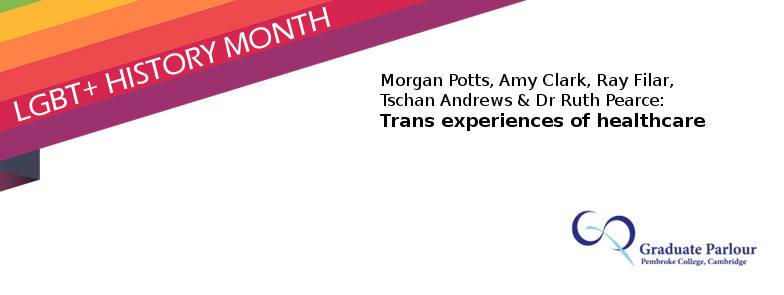
I will be taking part in an LGBT+ History Month panel on the British health care system, alongside Morgan Potts, Amy Clark, Ray Filar and Tschan Andrews. Our respective talks will be followed by a Q&A session.