Passing as cis: why I’d love to stop shaving my legs, but don’t

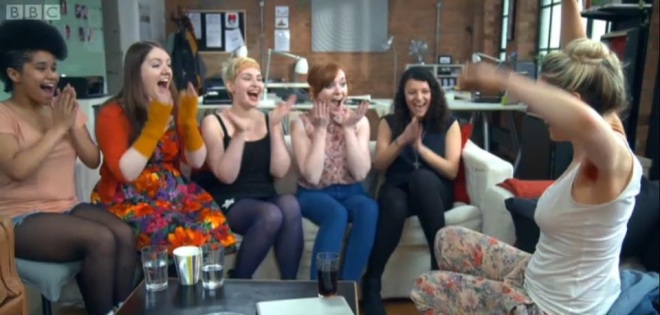
Several months ago, a friend of mine sent out message inviting participation in a new feminist video-blogging project. This seed of an idea grew into Those Pesky Dames, in which five women say awesome things about body autonomy, self-care, inspirations, intersectionality and pop culture. And then this week, the Dames stepped beyond the realm of YouTube (and Facebook, and Twitter and Tumblr…) to appear on the good ol’ fashioned television.

You can watch them talk about body hair on Cherry Healey: How to Get a Life for the next couple of weeks (it’s available on BBC iPlayer until Wednesday 18th July).

The Dames’ contribution to the programme is fantastic: they talk about how body hair is entirely natural, and shouldn’t be regarded as unfeminine. Why should women have to spend hours shaving in order to conform to the beauty myth? Why should we feel bad about baring our natural fluff in public? And why regard hairy women as unhygienic, but not hairy men?

I was so happy not only to see my friends on TV, but to see them discussing a vital feminist issue. Michel Foucault came up with this idea known as “governmentality” to describe the relationship between individual people and social rules. We enforce social norms through self-governance, tailoring our actions and behaviour to uphold the status quo. We police our own conformity through the application of self-esteem (when we conform) and shame (when we fail to conform). I felt that the programme beautifully highlighted the governmentality at play in the maintenance of female body hair: our self-esteem depends greatly upon our lack of hair, and when our legs or armpits are hairy in public we feel shame. In this way, women come to enforce sexist ideals of appropriate female behaviour. We can escape by embracing an alternative, feminist ethic of selfhood whereby shaving is not required. I went to bed reflecting happily upon this liberatory potential.

The next day was warm and sunny, and I planned to see my friends in town. I pulled on my shorts…and then took them off again and wore jeans instead, because I didn’t want the world to see my hairy legs. My boyfriend insisted that my short, very thin crop of leg hair wasn’t even visible and that it really didn’t matter. The rational part of my brain agreed wholeheartedly. I still couldn’t do it.

A great part of this response was no doubt down to your bog-standard governmentality at work. I was ashamed at the thought of being an Inappropriate Woman, and tailored my behaviour accordingly. Knowing that you’re a sucker in this way only gives you so much power! But there was an additional element at play: my fear of not passing.

I feel that being trans greatly complicates body hair issues. I don’t really fear being read as different or somewhat deviant, and happily flaunt my subcultural identity as a rocker on an everyday basis. I don’t worry too much about looking feminine or conforming to female stereotypes. But at the same time, I don’t want anyone thinking I’m not a woman, and I certainly don’t want anyone thinking I’m a man. I spent 18 years of my life being read as male, and those 18 years were quite enough.

My fear is not that people will look at my hairy legs and think “urgh, a hairy woman”. My fear is that people will look at my hairy legs and thinking “urgh, she’s actually a man!” This is somewhat irrational given how well I pass as cis, but the fear is real, and powerful.

The problem is that passing as a cs woman is important to me. Not because I think it’s better to look cis than trans (I most certainly don’t!) Not because I aspire to some outdated, patriarchal ideal of womanhood. It’s because I hate being heckled on the street, and I fear the violence that can come with transphobic responses. I realise that I’m deeply unlikely to suffer an assault in broad daylight in my home town, but past experiences of violence – however minor – can exert a powerful control. I aim to pass for my own mental and physical well-being.

And so I shave my legs and my armpits when I think they’ll be seen in public, because I’d rather be seen as an Acceptable Woman than not be seen as a woman at all.

The thing is, I hope this might change with time. At the start of my transition, I used to wear eye make-up and straighten my hair daily. I used to shun baggy clothes, instead aiming to highlight what curves I had. As time has gone on, I’ve become more and more relaxed about my appearance. This is partly because I’ve become generally more chilled with time: I’m no longer bothered about people who know me being aware of my trans status, and this blog is hardly anonymous these days. But it’s also because of the impact of hormones, meaning that I pass more easily as a cis woman regardless of how I dress. I now wear make-up and dress in a more feminine manner on special occasions, when I want to put on a certain appearance: in this way, I’m now doing these things for me, rather than for others.

One of things I really like about the kind of feminism espoused by Those Pesky Dames is that it leaves room for all these complications. There wasn’t really time for an exploration of this in How to Get a Life, but it’s all there in their vlogs. They argue for a feminism in which you shouldn’t have to shave your body hair…but you should be able to if it’s the appearance you’re going for. A feminism in which you don’t have to wear make-up, but should feel empowered to do so on your own terms. A feminism that accepts that some of us really want to escape the governmentality that leads us to shave our legs, but for now, we remain constrained.

As such, I’m going to keep shaving my legs, despite acknowledging that (in my case) I’m not really doing it for me. Meanwhile, I’m going to celebrate the achievements of those who aim to break down this norm.

To moderate, or not to moderate? (a ramble)

I’ve had some fairly unpleasant comments on my Radfem 2012 post. Until today, these messages have generally taken the form of polite disagreement: the difficulty comes in the content of that disagreement. I, like many other trans people, regard the refusal to recognise my gender (and other trans genders) as valid to be discriminatory and bigoted. Most of the radical feminist commentators who participate in this refusal draw their perspective from feminist theory, and argue that their position naturally follows from this. The conflicting truths explored in my original post were further drawn out, as both “sides” of the argument (and oh, how I wish there weren’t “sides”!) were inevitably hurt by the “other side”‘s refusal to let go and leave them alone.

My partner asks me why I’m spending so much time reading these comments and engaging in this kind of discussion. I’m just hurting myself and making myself angry, he says. It almost feels worth abandoning the whole affair, closing the thread and forgetting about it. There’s a lot of other things going on in my life, after all.

And yet we are essentially fighting it out for the heart of feminism. This matters because these arguments shape our approach to the equality battles of the present and future. When I turn up to a feminist meeting about the pay gap, or sexualisation, or the the gendered impact of austerity, will I be welcome? Can I fight alongside my sisters, and under what circumstances? Can I expect my cis* sisters to stand up for me when I fight for my trans friends who need access to rape crisis centres, women’s shelters, advice and counselling services? Can we all pull together to offer solidarity to intersex people when surgeons who would mutilitate intersex children hold a conference on our shores? How are we to understand sex and gender? What is this feminism, who is it for, and what do we want to achieve?

And so I leave the discussion open, and attempt to engage with individuals whose outlook is so similar and yet so different to mine, in the vague hope that this might contribute in some tiny way to some kind of reconciliation, years down the line. I’ve not yet blocked or deleted a single post.

I’m leaving unmoderated comments that I consider to be blantantly transphobic*, language that reeks of ignorance, if not hate. In a different space, perhaps one with a safe(r) space policy, these would have been deleted long ago. But this is my blog, and I suppose part of me wants to see this discussion happen.

I’m particularly disturbed by some of the more recent comments. DLT states: “I wish harm on every male on the planet. Plain and simple. No matter how you play dress up. If you are male, no thanks.” Take out the transphobia and that’s still horrifying. Surely the systematic empowerment of men at the expense of women (and non-binary individuals!) is the problem, not men. Like, all men. I find the concept of “misandry” somewhat concerning and so-called Men’s Rights Activists downright terrifying, but the moment you start “wishing harm” upon any group of people is the moment you’re straying into serious Godwin territory.

And yet. These comments tell a story, a truth, one that I would prefer to see aired than not. Part of the reason these arguments are so virulant is that so many women and so many trans people (women, men and non-binary alike) are very damaged. Some of us have had truly awful things happen to us, meaning we’re more likely to lash out at others in a storm of emotion. I don’t for a moment agree with the transphobic* perspectives of the many cis* women posting on my blog, and I don’t think unpleasant experiences are an excuse for this, but I’d rather listen than not before wholeheartedly rejecting these discourses.

Finally, I find myself agreeing entirely with smashmisscontest – a radical feminist with whom I disagree so much – on one key point:

The opinion of this Bev Jo noted Radfem, a person which I have never heard about by the way, do not voice the politics of radical feminists as a whole (and certainly not mine), as much as Valerie Solanas does not voice the politics of feminists as a whole by wanting all men exterminated, and as much as the “die cis scum” rhetoric do not represent the feelings of the trans community as a whole, and therefore should be placed in the category of unfortunate extremes I was talking about in my first post.

Obviously extremists, rad-fundamentalists or trans-fundamentalists, are not about politics at all but about hatred which maybe have originated by their personal experiences, and they will not participate in any type of building bridges anyway. But there is the rest of us who want to work on that, and do not identify with hate speech of any kind, so please don’t put me in the same bag. If you are trying to shock the people reading this comments, there are also plenty of examples of hate speech against feminists and women coming from trans individuals, but i do not see the point in getting into that loop type of distressed and non constructive conversation, if its not to create even more hatred and distress.

So let’s acknowledge and listen to the most hateful of comments, but remember that they do not represent the crux of the issue. The problem is a more nuanced one than DLT would have us believe. I still believe that smashmisscontest is, through her brand of radical feminism, promoting (in some senses) and tolerating (in others) a harmful transphobia*, but I believe this arises from a fundamental misunderstanding rather than from hatred. I get the impression she thinks similarly of me. And that gives us something to work with.

I will continue to openly and actively oppose Radfem 2012, because I continue to believe that it effectively promotes views that would harm trans people. But as part of that process, I hope dialogue remains open.

As for my original Radfem 2012 post, I think I’m going to just slap a trigger warning on the end of the post and leave it be – for now, at least.


* I will use these words because this is my blog and I, as part of an oppressed group, have a right to define the nature and actions of those who hold power over me

In praise of Coventry Rape and Sexual Abuse Centre

In the midst of all the comments and thoughts and responses whirling around my previous post, I’ve noticed that someone stumbled across this blog through the search term “uk trans friendly rape crisis“.

And you know what, I have my problems with individuals within feminism, and I certainly have my problems with Rape Crisis in the UK, but I’d really rather be talking about how we can come together and fight for a beautiful feminist future.

So it is with this in mind that I’d like to dedicate this brief post to Coventry Rape and Sexual Abuse Centre (CRASAC). This place offers a brilliant service to the local community – as do most rape crisis centres, women’s shelters and other related services – and as part of that I know through individuals close to me that they have done sterling work to support deeply vulnerable trans women. Because most cis feminists aren’t out to get trans people: they’re our allies and we can rely on them.

Thank you CRASAC. You are the most awesome wonderful feminist heroes.

​My message to those who would attend Radfem 2012

In you, I see the girls who spat in my face as I walked home from school.

In me, you see every man who has ever treated you like a lesser being.

In you, I see the boys who always wanted to pick a fight.

In me, you see someone who just won’t listen.

In you, I see my father, a man I’ve always considered to be wise and thoughtful, telling me that I’ll be outed by the press and kicked out of university for using the women’s toilets if I transition after my A-levels.

In me, you see a forceful male penetration into women’s spaces.

In you, I see a hundred tabloid headlines screaming “tranny”.

In me, you see a blind adherence to the oppressive system of binary gender.

In you, I see the doctor who tells me what I can and can’t do with my body.

In me, you see the stooge of a patriarchal medical system.

In you, I see friends who have been beaten or raped before being told by authority figures that they brought it on themselves.

In me, you see a systematic desire to control and define womanhood.

In you, I see a systematic desire to control and define womanhood.

How do we bridge this impossible divide?

My truth and your truth are both derived from a fierce feminism, but somehow remain diametrically opposed.  How is it that we can disagree so much over the existence of a feminist conference for “women born women living as women”?

I would tell you that my subconscious sex, the mental matrix that somehow marks the flesh I expect to see and feel when I behold myself, maps snugly onto the body I have inhabited since undergoing hormone therapy and genital reconstruction. I would tell you that for the last three years I have been happy and at ease with myself in a way I could never have been before.

I would tell you that I am a woman because I identify as a woman, I move through the world as a woman, and in this sense I have been a woman my entire adult life. I would tell you that I don’t even know what it’s like to be a man because that’s something I’ve simply never experienced. I do know what it’s like to be a teenage trans girl faking it as a boy though, and I can tell you that isn’t a whole lot of fun. I would tell you that trans women who transition later in life tend to encounter more significant challenges than I did, and that they are no less a woman for this.

I would tell you that yes, I agree that gender is a social construct that ascribes hegemonic power to the masculine. I would tell you that I, like you, am forced to negotiate a society where we cannot simply reject gender because we are gendered constantly by others. The body I inhabit, the things I enjoy, the manner in which I communicate, the clothes I prefer to wear fit better into the artificial category of “woman” than the artificial category of “man”.

I would tell you that “trans” is an aspect of my womanhood: womanhood is not an aspect of my transness. I am a woman who happens to be trans.

I would tell you that when I was with a woman, she loved me as a woman. Now I am with a man, he loves me as a man. I am entirely at ease with my bisexuality.

I would tell you that I reject outdated ideals of “appropriate” female behaviour. I don’t see why I should take on a submissive role within society, although I do feel it is important to recognise the voices of others and listen in a sisterly fashion. I  do not see why I should dress in a particular feminine fashion, wear make-up or force myself into uncomfortable shoes, but reserve the right to occasionally dress “femme” when the mood takes me.

I would tell you that I rage against sexism and misogyny at every possible opportunity. I have dedicated a great deal of time fighting in solidarity alongside my feminist sisters for equality, for liberation, for choice.

I would tell you that I, too am subject to sexism and misogyny in many of their vile forms. My transness does not spare me. I would also tell you that I have experienced worse for being trans than I have for being a woman, although these unpleasant experiences have been limited by the privileges that come with my class status and the colour of my skin.

I would tell you that I believe in the importance of women’s spaces. I would argue that no group of women should be rejected from such a space.

I would tell you that this is my truth, and that there is no universal trans truth. That some trans people feel their gender is essential and innate, whilst others reject gender entirely, and so many occupy a myriad of positions between these poles. I would ask you to acknowledge the diversity and complexity of trans truths.

And you would tell me your truth. You would tell me of the pain that comes from growing up as a girl and then a woman in a patriarchal world. You would tell me that I can never know what this is like, that I will always be a man, that my chromosomes and life experience alike cannot be erased. You would tell me that you have a right to organise without me. That I should just leave you alone.

And the argument could roll on for a long time. For instance, I might draw upon the wisdom of black feminist thinkers to argue that there is no universal experience of womanhood. And you might argue that I, nevertheless, will always have with me the male privilege that comes with being raised as a boy. And I would say yes, I accept that, but I seek to acknowledge and check this in the same way I seek to acknowledge and check my other privileges, and moreover this intersects complexly with the oppression I experienced growing up as a young trans person, unable to access hegemonic forms of masculinity.

Where does this leave us?

At the end of the day, we have to draw a line in the sand. So you have your conference, and I am explicitly excluded. But I necessarily object to your conference, because you not only reject me on grounds that trouble me, but you invite a speaker who actively opposes my liberation.

So I am left with no choice but to actively oppose the public manifestation of opinions that will do harm to myself and my friends and my trans sisters and my trans brothers and my queer and/or non-gender-specific trans siblings.

I oppose you not because I hate you, and certainly not because I oppose feminism. I oppose you because you would cause me harm.

And in doing so, you believe that I cause you harm.

And so the dance goes on.

TRIGGER WARNING:comments contain upsetting language, erasure etc.

Genderfork and trans feminism

I’ve just had an academic article published in MP: An Online Feminist Journal:

Inadvertent Praxis: What Can “Genderfork” Tell Us About
Trans Feminism?

The paper explores trans feminist perspectives on self-definition, body sovereignty and intersectionality in the context of the Genderfork community, and is based upon research I undertook for my MA in 2010.

NUS Women’s Campaign recognises gender complexity

I have a special place in my heart for the National Union of Students Women’s Campaign. The Campaign is (broadly speaking) a truly inclusive, progressive body. I met some amazing women and learned a great deal about the contemporary feminist movement during three years as an elected volunteer on the Women’s Campaign national committee.

However, I was disheartened to hear about the Campaign’s poor record on trans issues in the past year; most notably, a female-assigned genderqueer committee member’s very place in the Campaign was called into question after they explained to other committee members that they do not exclusively identify as a woman. The poor manner in which this democratically elected representative was treated flew in the face of both the spirit and the letter of trans-inclusive policy passed in 2009.

I therefore find it heartening to hear that NUS Women’s Conference 2012 today passed new policy to ensure that this never happens again. Delegates voted unanimously for a motion that will change the Women’s Campaign standing orders in order to permanently clarify the membership of this autonomous liberation campaign.

The motion, entitled “Gender complexity and inclusiveness in the NUS Women’s Campaign“, notes that:

That not all those who are oppressed as women necessarily identify exclusively as women, or would choose the word ‘woman’ or ‘female’ to encapsulate their gender identity […]

Whilst the NUS Women’s Campaign does not have a large amount of explicit policy on issues specifically related to people with complex gender identities who self-define into the campaign, it has a duty to make its spaces safe and welcoming for them.

The following is therefore added to the Women’s Campaign standing orders:

The NUS Women’s Campaign is open to all who self-define as women, including (if they wish) those with complex gender identities which include ‘woman’, and those who experience oppression as women. The NUSWC affirms that self-definition is at the sole discretion of the individual in question.

This really should have come about without an individual being treated poorly, but it’s great to see Women’s Conference so ready to address the Campaign’s mistakes. Full credit to everyone who voted through the change!

In a gender liberated world…there would be no moral panic over trans parents or trans children

And so the Bizarrely Busy Month of Trans News rolls on.

On the subject of trans parents, the Daily Mail has effectively outed a trans father; on a slightly brighter note, Green MP Caroline Lucas has tabled an Early Day Motion condemning the ongoing media witch-hunt that’s currently targeting pregnant trans guys. Kudos once again to Trans Media Watch and Jane Fae for their ongoing work on this. Meanwhile, bookmakers Paddy Power are under fire for a transphobic advert, and today saw a five-year-old trans girl splashed all over the tabloids (including front page stories in the Metro and the Sun).

Paddy Power will no doubt defend their advert (basically a “spot the tranny” competition themed around Ladies’ Day at Cheltenham) on the grounds of humour: it’s just a laugh, right? Meanwhile the tabloids will continue to defend their almost fetishistic obsession with the private lives of trans people on the grounds of “public interest”. Both actions serve to dehumanise and objectify trans people even as they build public interest in the queer freak show we supposedly offer.

This is all, of course, of massive concern to the so-called trans community. But we’re not the only ones who are affected.

In today’s front-page article, the Metro quotes “social commentator” Anne Atkins (who?) Atkins – clearly a great expert on gender diversity – says:

“Between the ages of about five and eight, I wanted to be a boy more than anything in the world. Acute though my longing was, it was relatively shortlived. I am grateful to say that there was no one around at the time to diagnose me with GID [Gender Identity Disorder]”

If I had a pound for every well-meaning cis friend who’d told me this at the beginning of my transition…well, I wouldn’t have a huge amount of money, but I’d definitely be able to afford a better toaster. But my problem with this isn’t one of cis privilege. It basically runs as follows:

What’s intrinsically wrong with a kid spending part of their childhood as a “boy” and part of their childhood as a “girl”?

What’s intrinsically wrong with the idea of a man having a baby?

What’s intrinsically wrong with (or, for that matter, funny about)  gender being complex or fluid or aligned with their body in a non-normative fashion?

I’ve not come across a single answer to any of those questions that isn’t inherently sexist in one way or another. We shouldn’t have to subscribe to an ideology of gender difference that necessitates people being placed in boxes that restrict their self-expression. We shouldn’t have to rely on old-fashioned gender roles. At the same time, we shouldn’t have to demand that “gender” be obliterated altogether. Why can’t five-year-old Zach live as a girl? Why couldn’t Anne Atkins live as a boy for a few years before settling into womanhood?

In a gender liberated world, gender expression would be free and fluid. Adults could be men, women, genderqueer, polygendered or non-gendered as they desire. Children could be children, and explore gender as one set of social possibilities amongst many. And everyone benefits, not just trans people. We’d all have more space to be ourselves.

If you think this is hopelessly utopic and ultimately impossible, try dropping by spaces such as Genderfork and Wotever, where users/attendees are pioneering gender liberated approaches to language and social interaction.

We don’t need to do away with gender, but at the same time we don’t need to subscribe to fixed, binary ideals of gender in order to live in a decent world where people value one another’s work and care for one another.

In a gender liberated world, neither the media nor the medical world would care about five-year-old trans girl, a pregnant man or a trans person at Cheltenham because it simply wouldn’t be a big deal.

The trans girl could live out her childhood as she desired and privately transition physically – or not! – at an appropriate point in her teens. The man could access appropriate care during his pregnancy without fearing the consequences of doing so. And at Cheltenham…well, isn’t the very concept of “Ladies’ Day” totally regressive?

Julie Bindel apologises for 2004 article

An interesting little titbit of information has emerged from a controversy over the suitability of nominees and sponsors at Square Peg Media’s sparkly and expensive “European Diversity Awards”. Many of those picketing the award ceremony in London’s Savoy Hotel on Thursday night objected to the nomination of notorious writer Julie Bindel for the Journalist of the Year Award. So far, so 2008…those of us who remember the largest trans protest the UK has seen, which took place outside of a Stonewall Awards ceremony, will no doubt experience a profound sense of deja-vu.

It looked like the usual round of accusations and counter-accusations would soon be in full swing as Julie Bindel vs The Trans Community (whatever that is!) bout 362 kicked off…but then something unprecedented happened. Julie Bindel apologised.

“I apologise unreservedly for both the tone and content of my 2004 article.”

This statement was provided to Square Peg Media, who passed it on to Natacha Kennedy during her correspondence with the company prior to the awards ceremony. It refers to the Guardian article “Gender Benders Beware“, arguably Bindel’s most infamous and direct attack upon trans people.

The fact that I picked this up through Kennedy’s Facebook wall initially suggested that the statement was merely intended to appease the award organisers. However, a nearly identical statement from Bindel could also be found in a news article published yesterday. This was clearly intended as a public apology.

When DIVA contacted Bindel for a statement she said: “I apologise unreservedly for both the tone and content of my 2004 articles.”

The apology is significant because it’s a genuinely new development. Bindel previously apologised for the “tone” of “Gender Benders Beware” on a number of occasions following outrage from trans advocates. These seemed like weasel words: after all, the mocking tone of the article was undeniably offensive, but it was the content – which suggested that trans people should not be taken seriously and that trans women should be denied access to rape crisis services – that was truly dangerous. In contrast, Bindel clearly and explicitly puts a distance between herself and the article in her new statement(s).

Many will argue that this apology was made in bad faith, or say that it comes far too late, but I believe that we should take it quite seriously. I felt some disquiet when the European Diversity Awards protest was initially announced, as it felt like yet another round of Julie Bindel Does Something And We Protest. Yes, she undoubtedly started it, but the whole circus was getting quite tiresomely predictable. Bindel does something offensive (or is invited to speak somewhere, or is nominated for an award). We protest, because we’re sick of being told that we don’t count/don’t deserve liberation/don’t exist. Bindel then makes a fuss in the media and accuses us of bullying her. Some of us refute her arguments, whilst others make quite horrible personal attacks. And then before long, the whole cycle begins anew. Except, on this occasion, Bindel has not immediately lashed back at us. She has said sorry.

I’ve always taken part in this process, but I’d like to take this opportunity to step back and reassess our priorities. At the end of the day, I, like many other trans women, have a lot in common with Julie Bindel. We both object to the sexism found in every part of our society, and the imposition of binary gender norms. We’re both loud, proud and unashamed feminists, and have both slept with other women. That’s quite a lot to work with. I’d far rather concentrate upon marching alongside Bindel at Reclaim the Night than protesting against her latest escapade. Julie, if you’re reading this: please, let’s smash patriarchy together!

However, if this apology is to really mean something, Bindel must go that one step further and demonstrate a genuine commitment to her words. I notice that the Diva apology extends only to “2004 articles”, yet arguably more damaging pieces have since been used to argue against the provision of medical resources for transsexed people and gender-neutral facilities for genderqueer people. Facts have been warped and trans liberation has been ridiculed in articles such as “My Trans Mission” and “The Operation That Can Ruin Your Life“. Bindel has time and time again demonstrated a refusal to listen to our calls for gender liberation and our explanations of trans diversity. This matters a great deal, as such articles influence the perspective of both policymakers and feminist activists. They feed into feeling of self-loathing experienced by vulnerable trans people who come to realise that others hate them because of who they are. This has to stop.

I’m sure there will be some sad, cynical responses to this piece, but Julie: I’d like to have faith in you, and faith in your apology. I genuinely believe you have some level of understanding as to how your hurt us in 2004, otherwise you wouldn’t have bothered to say sorry (after all, why now? This is hardly the first such nomination or controversy). I’d like to believe that although we have at least few more rounds of mutual mistrust and anger to go, at some point in the future we can look back on this intervention and see it as something we productively built on together.

Edit – February 2015
Nice to give someone the benefit of the doubt, isn’t it? Pity this never turned out well in the long term.

Reclaim the Night London to become explicitly trans-inclusive

A rather good article explaining why cis women need to actively oppose transphobia within feminism was published on The F-Word a couple of days ago.

This piece was written by Ray Filar, a member of the steering committee for Reclaim the Night London. The organisers of this annual demonstration against sexist harassment and violence have long maintained a studied ambivalence on the subject of trans inclusion. To my pleasant surprise, the article announced a welcome change in policy:

Every year, the women-only march Reclaim the Night London is questioned on its attitude towards trans women. As one of the members of this year’s steering committee, I’m pleased to say that it will now be made clear on our website that Reclaim the Night welcomes all kinds of women, whether trans, cis, disabled, of colour, lesbian, able-bodied, white, bisexual, Muslim, Jewish, straight or otherwise.

This new approach is echoed by the Reclaim the Night London Facebook page, which includes a picture of last year’s trans inclusion bloc amongst the small number of images used to promote this year’s event. On a more personal note, I’ve also been asked to DJ at the demonstration after-party for the second year running, and I’m not exactly silent about my own trans identity!

So, we’ve “won”, right? Well, not quite. Filar’s post continues:

But the discussion is far from over, and it is a small and rather pathetic step for a group which officially acknowledges that trans women are just as welcome as cis women, but doesn’t really want to say so openly. We still have to appease the transphobes. Their voice is small, but by god it is vocal. The committee that finally agreed to welcome trans women on our website, (but not our flyer, oddly) was split down the middle; a small minority expressed opinions that would make even David Starkey blush.

We still have a long way to go before we eradicate transphobia within the women’s movement. Nevertheless, I feel more progress has been made than Filar perhaps realises.

From a trans perspective, one of the biggest problems with Reclaim the Night has always been that organisers and volunteers who said that they were trans-positive never seemed prepared to actively oppose the transphobic attitudes propagated by their peers. This situation finally seems to have changed, with the shift in policy indicating that a critical mass of cis feminists have decided to act like true allies and stand up for trans inclusion. There’s a lot still to be done, but we’re getting there.

Cis and trans feminists alike need to keep up the pressure in a sisterly fashion. To that end, I hope to see more trans and genderqueer women at this year’s Reclaim the Night march: let us never forget that we fight for trans inclusion within feminism because we ultimately seek to smash patriarchy!

I wrote about why individuals who identify at any intersection of “trans” and “woman” should consider participating in Reclaim the Night last year. This post included a brief discussion of gender policing and genderqueer inclusion.