Boosting the signal: support CeCe

For various reasons I can’t make it down to the Free Cece solidarity demo in London today. So here’s a post to let you know what you can do if you, like me, won’t be there.

CeCe was recently jailed for manslaughter following the death of a man involved in an attack upon herself and her friends. If you haven’t yet come across the case, background information can be found on on the Support CeCe McDonald site (trigger warning: description of racist and transphobic violence), and in this video.

Needless to say, the situation is a sad reflection upon the impact of multiple inequalities faced by individuals who experience intersecting oppression, particularly black trans women.

If you want to support CeCe through writing to her, sending books or anything else, there is plenty of information on how to get involved on her support site.

It’s likely that further UK actions (e.g. a letter-writing campaign) may follow the London demo, so I’ll endeavour to post about that if it happens. A Leeds-based working group can be found on Facebook here.

All change at Press For Change

The long-serving trans campaigning group Press For Change has released a request for new board members and volunteers alongside the announcement of a two-day “organisational development conference” in Manchester at the end of the month.

I’ve been amongst those who have criticised the organisation at one time or another, but it’s undeniable that Press For Change has been a powerful advocate for political change. It played a key role in pushing for the Gender Recognition Act 2004 and trans inclusion in the Equality Act 2010. It has produced huge amounts of guidance and advice for public bodies, private companies and countless individuals (most notably in the groundbreaking Engendered Penalties). At the forefront of much of this has been Professor Stephen Whittle, who is about to step down from his role in managing the organisation.

I’m therefore cross-posting the below message, and urge you to do so also.

Urgently Needed – Board Members and Volunteers

Please re post this request as far and wide as possible

The Future of Press for Change (PFC) has been in the balance for some time, with a lot of uncertainty due to various issues with individual’s health and others been able to commit to the development of the organisation for various reasons.

Press for change are having an organisational development conference in Manchester on the 25th and 26th May to look at how the organisation can be re structured and developed for the benefit of the transgender community.

This is an opportunity for activists to become involved in a well-established organisation with 20 years standing, by helping to develop and run the organisation and get involved with national & local organisations promoting Trans equality.

PFC had intended to look for more board members and volunteers at a conference that will be held at a major health equality & empowerment conference that is in the process of been planned for Feb next year to mark its 21st birthday, once the organisation had been brought up to date and had got some more structure to it, however due to recent circumstances there is a need to get more people involved at an earlier stage if Press for Change is going to continue at all.

Press for Change are looking for individuals to undertake the following:

Management Board
Website development officer
People to attend National and Local meetings and promote trans equality and feedback information/ inelegance to the network on what is going on.
Deliver Trans awareness training
Supporting survivors of Hate Crime and Domestic violence and abuse.
Press and social media officer
Telephone support
Legal case workers

This list is not limited, all ideas welcome and appreciated

If you are interested in getting involved in developing Press for Change and re shaping this organisation to enable it to become fit for purpose and an effective organisation which can advance trans equality, then please e-mail a short statement of how you think you could fit in and what experience and qualifications you have to office@pfc.org.uk and we will get back to you.

Press for change will be able to fund a limited number of individuals to attend the development conference on the 25th and 26th of May.

If you are not invited to the conference it is only due to the lack of funds available to the organisation and should the organisation continue it will be looking for more people to be involved as it moves forward as soon as it is practical as we value any input individuals can give the organisation.

Please re post this request as far and wide as possible

Gender statistic guidelines revised by HESA

The Higher Education Statistics Authority (HESA) have announced a welcome revision of their new gender and sex categories for student records within Higher Education.

I originally posted about this issue after HESA’s original proposed revisions – which appeared to ask about “legal” or “birth” sex and removed any possibility for the recognition of non-binary genders and intersex bodies – caused confusion and concern.

An impressive lobbying campaign in which trans people and allies emailed and tweeted HESA to explain our concerns has now led to a change in policy.

The revised fields contain the following categories:

SEXID (sex identifier)

1 Male
2 Female
3 Other

This replaces the current options (male, female, indeterminate) and the original proposed revision (male, female).

It is important to note that HESA acknowledge for the first time that the “other” category might be used to record non-binary genders in their advice to institutions:

The use of ‘other’ is more appropriate for people who associate with the terms intersex, androgyne, intergender, ambigender, gender fluid, polygender and gender queer.

As Jane Fae explains, this is an enormous step forward.

It’s also worth noting that institutions may, if they wish, institute additional gender options in their student record surveys (e.g. genderqueer, androgyne) and map these options onto the third category (“other”) for the sake of data provision to HESA.

GENDERID (gender identity)

Suggested question:
Is your gender identity the same as the gender you were originally assigned at birth?

01 Yes
02 No
98 Information refused

These revisions are a massive improvement, representing a step forward from the existing guidelines as well as the flawed original revisions. HESA certainly deserve credit for listening carefully and responding positively to the complaints they received.

However, there is still some ambiguity in the SEXID question. No doubt some institutions will title this question “sex” whereas some may title it “gender”, and students may still experience uncertainty when formulating a response. For instance, how are intersex individuals who define as female or genderqueer individuals who wish to note that they have been assigned a male sex meant to respond to such a question?

Moreover, it is important that trans activists based within Higher Education continue to lobby institutions to recognise gender identity within student records purely on the basis of self-definition – a matter that is largely out of HESA’s hands.

Student medics push for trans on the curriculum

We seem to be quietly creeping towards a better situation for trans health.

There’s clearly a major problem. The Home Office’s informal e-surveys of trans experience indicated that the realm of “health” is a key concern for a great many of us, with almost half of respondents saying that they did not think their GP was doing a “good” or “excellent” job in addressing their health needs. Meanwhile the 2007 Engendered Penalties report (created by Press For Change for the Equalities Review) notes that 1 in 6 of respondents reported experiencing discrimination from medical professionals.

Issues of health access aren’t limited to those problems created by the referral and treatment process for medical transition. Many of us are still being treated inappropriately because we are trans, regardless of what treatment we’re seeking at any given time.

It’s heartening then to (finally!) see increasing willingness to do something on the part of medical professionals. Zoe O’ Connell describes the positive outcomes of a recent meeting between trans activists and the General Medical Council. And at the other end of the professional “scale”, last week saw the publication of an article in the Student Lancet calling for teaching on trans issues within the medical curriculum.

The Lancet article isn’t the intervention of one isolated student medic. Its author informs me that there is widespread anger (yes, anger!) about the lack of LGBT material on the curriculum amongst her peers at Warwick Medical School. They’re particularly unimpressed with how trans people are treated. The students in question feel they should be taught properly about all issues they might encounter as doctors, and are taking action to ensure this actually happens.

The staff-student liaison committee reps in my year have decided they want to push having teaching on LGB and especially T stuff added to the curriculum,” explains my informant. “I bashed out a quick petition over breakfast and floated it round my lecture theatre to collect signatures for them so they had a bit more clout – so they now have a petition signed by over half of my cohort telling them they should be teaching trans stuff.

Of course, this is just one small step towards the provision of appropriate health services for trans people. As the Student Lancet article concludes:

“I feel that this is a change which is urgently needed at an institutional level rather than at the level of individual medical schools. Only by taking a unilateral approach will we ever manage to change the perception of the NHS as a discriminatory institution. In order to effectively treat transgender individuals we need to prove to them that we are worthy of their trust.”

It’s about time we listened to intersex people

An article posted yesterday on The Intersex Network highlights intersex erasure* at a recent House of Lords event.

Report on the intersex inclusive House of Lords LGBTI event ‘Human Rights for Sexual Minorities’ on 24th January 2012

Activist Anis Akhtar explains how this “LGBTI” event focused almost exclusively upon the “LGBT”, with LGBT groups speaking and topics of discussion including LGBT History Month, homophobic and transphobic hate crime in the EU, the forced sterilisation of trans people in countries such as Sweden and the complex intersection of LGBTI experiences and religion/faith.

Akhtar concludes:

“I was not surprised that the focus was LGBT but glad that a few people did say LGBTI on the day. What is paramount is that intersex people in the UK now have a voice – the use of the acronym “LGBT+” by the Liberal Democrats may be a good start.

It is extremely important to spread the word of what intersex is and what we experience due to society’s ignorance, negligence and outright discrimination towards any person who supposedly differs from the “norm.”

Intersex people stand up for LGBT and it is time that LGBTs include us as LGBTI, or intersex people stand alone and continue to fight for our own equality globally.”

Akhtar’s experience reminds me of a “trans youth” (25 and under) consultation at the Government Equalities Office during the autumn of last year; part of the process that eventually led to the creation of the trans action plan. A few of us asked why intersex issues were not also on the agenda. We were told that intersex people are “not on the [current government’s] agenda” and the Government Equalities Office did not intend to tackle intersex issues until (at least) 2015.

This is quite frankly unacceptable. Intersex people aren’t about to magically disappear, and people aren’t about to start magically respecting intersex rights.

So how can those of us who aren’t intersex provide solidarity? There’s a long history of the people within the trans rights movement co-opting intersex issues for their own ends or erasing intersex experience by claiming that trans and intersex issues are “basically the same”. This is totally unacceptable and has to stop.

What we can do is be there for intersex activists when they ask for help, just as trans people would like cis allies to stand by us without telling us how we identify or how to run our campaigns.

When UK LGBT organisations attended the House of Lords LGBTI event, why did they not join intersex activists in asking the Government Equalities Office to get its act together? When a conference that promoted infant genital mutilation was held in London during September, where were the trans people, the queers, the feminists who should have been standing shoulder-to-shoulder with the intersex activists who called a demonstration?

We need to get our act together and support others as we’d like to be supported ourselves.

*Edit 16/2/12: I today recieved the below message from a correspondent who prefers to remain anonymous, and have appended it to this post for the sake of balance. I should also clarify that whilst Anis Akhtar’s blog was not my sole source, I was not present at the event myself.

Having read your blog about the UNA House of Lords event, I must point out that intersex identities were not erased, far from it. Intersex was included in the event rationale/publicity, intersex activists were suggested and considered as potential speakers, Oii was included in the mailing list, Anis was in email correspondence with the UNA Chair (David Wardrop) and the speakers before the event, Anis spoke at the event after the Q&A and got a very appreciative thanks from the Chair and a big clap from the audience, and two of the three international speakers explicitly mentioned intersex issues in their addresses. Do you really think that amounts to erasure? I see how you might reach that conclusion if Anis’s report was the only source, so I understand why you might say that, but to be fair I do not think ‘intersex erasure at the House of Lords’ is accurate or helpful. Erasure implies an absence or at least an attempt to censor, which is the opposite of what really happened. It’s a pity you were not there to see for yourself.

I have discussed this with the UNA Vice Chair who assures me that he will support my suggestion of a follow up event where intersex issues are discussed more fully and we get an intersex activist to be a main speaker.

In the meantime, I wonder if you would be so kind as to insert a correction into your blog or remove the ‘intersex erasure’ claim? Anis’s speech was brave and important because of what it took personally for him to get there and speak despite social phobia and visual impairment, and it deserves attention on it’s own terms, not because of some spurious claim that Anis stood up to people who wanted to erase the existence of intersex people. They didn’t – Anis was welcomed and applauded wholeheartedly.

10-year-old trans girl launches petition as Leveson Enquiry tackles transphobia

Jane Fae wrote a powerful post
today
highlighting the connection between two important events this week for trans people in the media.
The first of these events is the launch of a petition that calls upon the press to stop using dehumanising and othering language to describe trans people. The petition was started by the family of Livvy, a 10-year-old girl who became one of the most recent examples of trans children hounded by the news media.

They argue that transphobic language can ultimately kill:

People with gender identity issues are being murdered, beaten, threatened with their lives, bullied, teased, intimidated, disowned and are prone to suicide both attempted and successful and self harm. The Press being an extremely powerful medium has the responsibility to ensure they are not aiding peoples ignorance and hatred and increased lack of self esteem.

Meanwhile, the Leveson Enquiry is due to receive evidence  from Trans Media Watch this afternoon (a live video stream will be available here, as well as an archived video and transcript following the hearing). Josephine Shaw posted the following announcement on the group’s Facebook page:

“[…] Helen Belcher will be representing us at the Inquiry, next Wednesday – February 8th. She’ll be doing so following a detailed written submission made by TMW a few weeks ago, a public version of which is available via the downloads page of the TMW website.

There have been a very large number of written submissions to the Inquiry – only a small number have resulted in Lord Leveson calling witnesses in person. We’re absolutely delighted to be counted in that number […]

TMW’s aim next week is simple. To give voice to the pain and anger of all those trans and intersex people whose lives have been invaded, even ruined, without any cause or warning by the British press. Who deserved accuracy, dignity and respect. Or who simply deserved privacy. And to try and represent our community in calling for a profound change in the attitude of the press and an end to the incessant outrageous and unwarranted intrusion into the lives of innocent trans and intersex people.”

This week therefore sees two significant responses to the ongoing media assault upon trans lives. The two met this morning on the BBC’s Breakfast show, when Livvy and Trans Media Watch’s Paris Lees spoke about transphobia in the media.

It’s really heartening to see all of this happening. I agree with Jane that we have good reason to remain cynical, but equally we have plenty to celebrate at this juncture. For too long, journalists have been getting away with inflaming public opposition to trans liberation, and people in power are finally beginning to listen to our howls of outrage. This is an early step towards a more fair and friendly world, but an important one.

I was fortunate enough to meet Livvy a few months back and was inspired by the sheer determination of both her and her family; we have a lot to learn from them! I was also struck by my own surprise role in Livvy’s story via a sensationalist piece published by the Sun back in September:

But yesterday a row broke out after a parent claimed that kids as young as EIGHT at Livvy’s school were shown a film about sex-change surgery.

In the footage, made for the NHS website, Ruth’s Story describes how she was born a boy — but knew from the age of 16 she wanted to be a woman.

One parent said: “We are not against the child. It’s that the children are being asked to treat her differently and watch a transgender video without parents knowing.

The video in question was made for the NHS a few years back, and at the time I had no idea it could ever be shown to a primary school assembly! I would probably phrase a few things differently now but ultimately I’m still pleased with how it turned out. I became involved in the project by responding to an email from a mass trans mailing list: someone else could just have easily done it.

Ultimately I suppose my point is that every bit of effort counts. Every signature on Livvy’s petition, every angry letter to an editor, every trans awareness workshop and every intervention within public conversations. Let’s keep up the pressure, because it’s the only way we stand a chance of winning!

Update on the HESA gender statistics affair

Some clarification, new information and new developments have emerged since I posted about HESA’s gender statistic fail yesterday.

Background

The Higher Education Statistics Agency (HESA) is currently revising a number of data collection fields. The changes are not yet set in stone. 

Two new fields (student.SEX and student.GENDERID) will effectively replace the one existing field (student.GENDER) which is currently used to collect data on gender within higher education institutes (usually universities) in the United Kingdom.

The existing student.GENDER field has the following categories*:

1 Male
2 Female
9 Indeterminate

In regards to “Indeterminate”, HESA note that:

“Code 9 ‘Indeterminate’ means unable to be classified as either male or female. It should not be used as a substitute or proxy for ‘Not known’. The term ‘indeterminate gender’ is intended to identify those who are ‘intersex’ and is not related in any way to trans-gender.”

However, in practice a number of institutions have effectively mapped answers such as “other” and “prefer not to say” onto this third category within enrolment/re-enrolment forms in order to provide non-binary, genderqueer, intersex and other students to effectively “opt out” of the gender binary.

The new, compulsory student.SEX field has the following categories:

1 Male
2 Female

The new, optional (for institutions) student.GENDERID field has the following categories:

01 Yes
02 No
98 Information refused

A brief analysis of the harm in these changes can be found in my previous post.

Developments

It appears that HESA have received a number of queries and complaints from trans people: it’s uplifting to see so impressive and rapid a response!

The agency initially responded by noting that the changes were the result of “consultation with [the] HE sector and ECU“. Commentators noted that this consultation seemed to at no point involved actual trans students.

However, in the last hour HESA have provided the following statement from their Twitter account:

“Thanks for queries re. sex and gender in next year’s HESA record. Your input will help us get this right.”

The tweet links to correspondence conducted between HESA and trans activist Emma Brownbill – if you have the time, it’s worth a read!

Some key points include the following:

“The phrase ‘legal’ sex is only currently used in the Staff Record. The intention in the Staff Record is to match the data requirements of HMRC, which for tax and pension purposes only accept Female or Male.

The final coding manual and guidance for the Student Record in 2012/13 has not been published. From your own and other queries about the provisional guidance and consultation documents it is clear that the terminology of ‘legal’ sex may not be appropriate for the Student Record.

Similarly the binary choice of Female or Male, originally intended to match the Staff Record, is now the subject of further discussion with regard to the Student Record.”

So let’s keep at this – we’re really getting somewhere!

Also, thanks to everyone who commented on the previous post, your contributions were greatly appreciated.

Edit: the story has now hit Pink News.


*The numbers (e.g. 1, 2, 9, 98) are used within statistical analyses.


Insensitivity from the Department for Work and Pensions

Boosting the signal for a campaign currently being undertaken by Kelly Tonks. If you’ve had in trouble with the “sensitivity” marker when trying to access benefits, please get in contact with her! (kellytonks[at]gmail.com)

I have become aware of a number of instances, including my own, where the safeguards that are being placed to protect Trans folks identities, by the Dept For Work and Pensions, are actually creating major difficulties for Trans individuals.
On applying for pensions or benefits, due to the ‘Sensitivity’ marker that is placed to conceal the individuals Trans history, regular advisors are not able to access claims and individuals records.
Previously, there was at least one individual at each DWP site, including Job Centres, that had the authority to access these ‘Sensitive’ cases. This allowed a relatively seamless service, with maybe a minor delay of a few minutes, to a day or so, while said person was located or an interview slot was found.
Due to, in my view, over-stringent new adherence to Data protection sensibilities, resulting from DWP data security breaches in recent years, this ‘Authority to access’ has been removed from the front line centres/public touch points and has been withdrawn to locations such as Hackney and Newcastle, to name two that I know of. In some cases, such as Hackney, it is impossible to contact them directly and unfortunately their system of ‘Call Backs’ is woefully inadequate.
There is also a difficulty in even recognising this matter at public touch-point level, with staff realising that they are unable to access the individuals details, but having no clue as to why.
These factors are leading to around a 4-6 week delay in benefits such as pensions, jobseekers allowance, income support and so on being paid. There is also an alarming lack of communication from the DWP to local councils with regard to Housing Benefit and Council Tax.
One of our members, upon informing DWP of her name and details change, found that she could no longer access her Jobseekers allowance details through her own Job Centre. This then led to confusion and a cancellation of her JSA payments, cancellation of her Housing benefit and claims for payment of Council Tax. All of these matters had been settled a long time previously and should have continued, unaffected. There was even a stage at which her home was at risk, due to an inability to pay.
This situation is entirely unacceptable. I intend to start to address this problem by making a case, through various agencies and would ask if there is anyone aware of any other such investigation, in order that I am not about to attempt to re-invent the wheel.
I would also ask if you have heard of anyone suffering difficulties of this nature, that you ask if they are able to contact me. All of my contact details are on my facebook page, but the most convenient to me would be by e-mail to: kellytonks[at]gmail.com.
Please can I ask that as much detail is provided, so that I am able to build up a clear picture of the situation and how serious this matter is.
If you are a member of an organisation that has had any of these matters reported to you, could you please let me know what action you took, if any.

Save the NHS: Block the bridge, block the bill

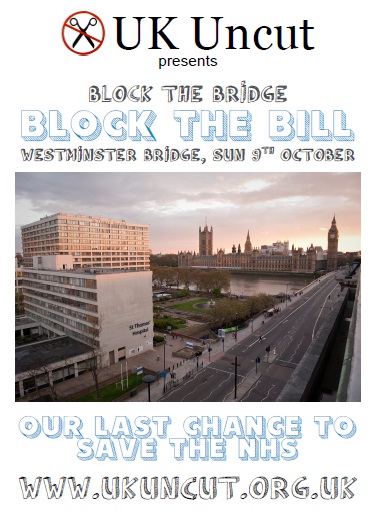
UK Uncut are planning an unprecedented act of civil disobedience at 1pm on Sunday 9th October in protest against the government’s NHS reforms. Over one thousand people have already announced their intention to participate in the action, which aims to demonstrate the level of public opposition to the Bill and put pressure on sympathetic peers in the House of Lords by occupying Westminster Bridge.

The activist group are also encouraging people to contact peers and ask them to block the bill.

Full details of the demonstration can be found on the UK Uncut website.

There is also a Facebook event page.

Save the NHS, part 2: lobby the Lords

The NHS “reform” bill passed the Commons on its third reading yesterday by 316 votes to 251.* It will now go to the Lords for further scrutiny.

It’s not too late to save the NHS. A number of groups are recommending an unprecedented public lobby of the Lords in order to stop (or at least fundamentally alter) the bill.

The TUC have set up a page to help you do this: Adopt a Peer.

There is also a Facebook page with a fair bit of information.


“This is really important. I don’t think anyone has ever engaged en masse with members of the upper house on an issue like this before. They don’t have constituencies, and they can’t be voted out at an election. Nevertheless, many peers cherish their role in scrutinising bad legislation. They need to know there is a widespread dislike for these changes.”

– Christine Burns

*A grand total of four Liberal Democrat MPs voted against the bill. I can’t comprehend why anyone who cares about public services would ever want to vote Lib Dem again. May the party crash and burn come the next election.