Passing as cis: why I’d love to stop shaving my legs, but don’t

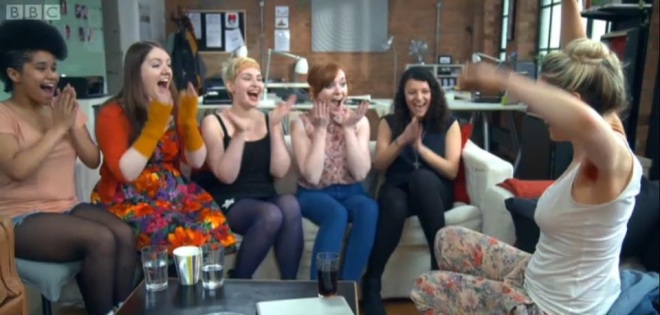
Several months ago, a friend of mine sent out message inviting participation in a new feminist video-blogging project. This seed of an idea grew into Those Pesky Dames, in which five women say awesome things about body autonomy, self-care, inspirations, intersectionality and pop culture. And then this week, the Dames stepped beyond the realm of YouTube (and Facebook, and Twitter and Tumblr…) to appear on the good ol’ fashioned television.

You can watch them talk about body hair on Cherry Healey: How to Get a Life for the next couple of weeks (it’s available on BBC iPlayer until Wednesday 18th July).

The Dames’ contribution to the programme is fantastic: they talk about how body hair is entirely natural, and shouldn’t be regarded as unfeminine. Why should women have to spend hours shaving in order to conform to the beauty myth? Why should we feel bad about baring our natural fluff in public? And why regard hairy women as unhygienic, but not hairy men?

I was so happy not only to see my friends on TV, but to see them discussing a vital feminist issue. Michel Foucault came up with this idea known as “governmentality” to describe the relationship between individual people and social rules. We enforce social norms through self-governance, tailoring our actions and behaviour to uphold the status quo. We police our own conformity through the application of self-esteem (when we conform) and shame (when we fail to conform). I felt that the programme beautifully highlighted the governmentality at play in the maintenance of female body hair: our self-esteem depends greatly upon our lack of hair, and when our legs or armpits are hairy in public we feel shame. In this way, women come to enforce sexist ideals of appropriate female behaviour. We can escape by embracing an alternative, feminist ethic of selfhood whereby shaving is not required. I went to bed reflecting happily upon this liberatory potential.

The next day was warm and sunny, and I planned to see my friends in town. I pulled on my shorts…and then took them off again and wore jeans instead, because I didn’t want the world to see my hairy legs. My boyfriend insisted that my short, very thin crop of leg hair wasn’t even visible and that it really didn’t matter. The rational part of my brain agreed wholeheartedly. I still couldn’t do it.

A great part of this response was no doubt down to your bog-standard governmentality at work. I was ashamed at the thought of being an Inappropriate Woman, and tailored my behaviour accordingly. Knowing that you’re a sucker in this way only gives you so much power! But there was an additional element at play: my fear of not passing.

I feel that being trans greatly complicates body hair issues. I don’t really fear being read as different or somewhat deviant, and happily flaunt my subcultural identity as a rocker on an everyday basis. I don’t worry too much about looking feminine or conforming to female stereotypes. But at the same time, I don’t want anyone thinking I’m not a woman, and I certainly don’t want anyone thinking I’m a man. I spent 18 years of my life being read as male, and those 18 years were quite enough.

My fear is not that people will look at my hairy legs and think “urgh, a hairy woman”. My fear is that people will look at my hairy legs and thinking “urgh, she’s actually a man!” This is somewhat irrational given how well I pass as cis, but the fear is real, and powerful.

The problem is that passing as a cs woman is important to me. Not because I think it’s better to look cis than trans (I most certainly don’t!) Not because I aspire to some outdated, patriarchal ideal of womanhood. It’s because I hate being heckled on the street, and I fear the violence that can come with transphobic responses. I realise that I’m deeply unlikely to suffer an assault in broad daylight in my home town, but past experiences of violence – however minor – can exert a powerful control. I aim to pass for my own mental and physical well-being.

And so I shave my legs and my armpits when I think they’ll be seen in public, because I’d rather be seen as an Acceptable Woman than not be seen as a woman at all.

The thing is, I hope this might change with time. At the start of my transition, I used to wear eye make-up and straighten my hair daily. I used to shun baggy clothes, instead aiming to highlight what curves I had. As time has gone on, I’ve become more and more relaxed about my appearance. This is partly because I’ve become generally more chilled with time: I’m no longer bothered about people who know me being aware of my trans status, and this blog is hardly anonymous these days. But it’s also because of the impact of hormones, meaning that I pass more easily as a cis woman regardless of how I dress. I now wear make-up and dress in a more feminine manner on special occasions, when I want to put on a certain appearance: in this way, I’m now doing these things for me, rather than for others.

One of things I really like about the kind of feminism espoused by Those Pesky Dames is that it leaves room for all these complications. There wasn’t really time for an exploration of this in How to Get a Life, but it’s all there in their vlogs. They argue for a feminism in which you shouldn’t have to shave your body hair…but you should be able to if it’s the appearance you’re going for. A feminism in which you don’t have to wear make-up, but should feel empowered to do so on your own terms. A feminism that accepts that some of us really want to escape the governmentality that leads us to shave our legs, but for now, we remain constrained.

As such, I’m going to keep shaving my legs, despite acknowledging that (in my case) I’m not really doing it for me. Meanwhile, I’m going to celebrate the achievements of those who aim to break down this norm.

To moderate, or not to moderate? (a ramble)

I’ve had some fairly unpleasant comments on my Radfem 2012 post. Until today, these messages have generally taken the form of polite disagreement: the difficulty comes in the content of that disagreement. I, like many other trans people, regard the refusal to recognise my gender (and other trans genders) as valid to be discriminatory and bigoted. Most of the radical feminist commentators who participate in this refusal draw their perspective from feminist theory, and argue that their position naturally follows from this. The conflicting truths explored in my original post were further drawn out, as both “sides” of the argument (and oh, how I wish there weren’t “sides”!) were inevitably hurt by the “other side”‘s refusal to let go and leave them alone.

My partner asks me why I’m spending so much time reading these comments and engaging in this kind of discussion. I’m just hurting myself and making myself angry, he says. It almost feels worth abandoning the whole affair, closing the thread and forgetting about it. There’s a lot of other things going on in my life, after all.

And yet we are essentially fighting it out for the heart of feminism. This matters because these arguments shape our approach to the equality battles of the present and future. When I turn up to a feminist meeting about the pay gap, or sexualisation, or the the gendered impact of austerity, will I be welcome? Can I fight alongside my sisters, and under what circumstances? Can I expect my cis* sisters to stand up for me when I fight for my trans friends who need access to rape crisis centres, women’s shelters, advice and counselling services? Can we all pull together to offer solidarity to intersex people when surgeons who would mutilitate intersex children hold a conference on our shores? How are we to understand sex and gender? What is this feminism, who is it for, and what do we want to achieve?

And so I leave the discussion open, and attempt to engage with individuals whose outlook is so similar and yet so different to mine, in the vague hope that this might contribute in some tiny way to some kind of reconciliation, years down the line. I’ve not yet blocked or deleted a single post.

I’m leaving unmoderated comments that I consider to be blantantly transphobic*, language that reeks of ignorance, if not hate. In a different space, perhaps one with a safe(r) space policy, these would have been deleted long ago. But this is my blog, and I suppose part of me wants to see this discussion happen.

I’m particularly disturbed by some of the more recent comments. DLT states: “I wish harm on every male on the planet. Plain and simple. No matter how you play dress up. If you are male, no thanks.” Take out the transphobia and that’s still horrifying. Surely the systematic empowerment of men at the expense of women (and non-binary individuals!) is the problem, not men. Like, all men. I find the concept of “misandry” somewhat concerning and so-called Men’s Rights Activists downright terrifying, but the moment you start “wishing harm” upon any group of people is the moment you’re straying into serious Godwin territory.

And yet. These comments tell a story, a truth, one that I would prefer to see aired than not. Part of the reason these arguments are so virulant is that so many women and so many trans people (women, men and non-binary alike) are very damaged. Some of us have had truly awful things happen to us, meaning we’re more likely to lash out at others in a storm of emotion. I don’t for a moment agree with the transphobic* perspectives of the many cis* women posting on my blog, and I don’t think unpleasant experiences are an excuse for this, but I’d rather listen than not before wholeheartedly rejecting these discourses.

Finally, I find myself agreeing entirely with smashmisscontest – a radical feminist with whom I disagree so much – on one key point:

The opinion of this Bev Jo noted Radfem, a person which I have never heard about by the way, do not voice the politics of radical feminists as a whole (and certainly not mine), as much as Valerie Solanas does not voice the politics of feminists as a whole by wanting all men exterminated, and as much as the “die cis scum” rhetoric do not represent the feelings of the trans community as a whole, and therefore should be placed in the category of unfortunate extremes I was talking about in my first post.

Obviously extremists, rad-fundamentalists or trans-fundamentalists, are not about politics at all but about hatred which maybe have originated by their personal experiences, and they will not participate in any type of building bridges anyway. But there is the rest of us who want to work on that, and do not identify with hate speech of any kind, so please don’t put me in the same bag. If you are trying to shock the people reading this comments, there are also plenty of examples of hate speech against feminists and women coming from trans individuals, but i do not see the point in getting into that loop type of distressed and non constructive conversation, if its not to create even more hatred and distress.

So let’s acknowledge and listen to the most hateful of comments, but remember that they do not represent the crux of the issue. The problem is a more nuanced one than DLT would have us believe. I still believe that smashmisscontest is, through her brand of radical feminism, promoting (in some senses) and tolerating (in others) a harmful transphobia*, but I believe this arises from a fundamental misunderstanding rather than from hatred. I get the impression she thinks similarly of me. And that gives us something to work with.

I will continue to openly and actively oppose Radfem 2012, because I continue to believe that it effectively promotes views that would harm trans people. But as part of that process, I hope dialogue remains open.

As for my original Radfem 2012 post, I think I’m going to just slap a trigger warning on the end of the post and leave it be – for now, at least.


* I will use these words because this is my blog and I, as part of an oppressed group, have a right to define the nature and actions of those who hold power over me

Genderfork and trans feminism

I’ve just had an academic article published in MP: An Online Feminist Journal:

Inadvertent Praxis: What Can “Genderfork” Tell Us About
Trans Feminism?

The paper explores trans feminist perspectives on self-definition, body sovereignty and intersectionality in the context of the Genderfork community, and is based upon research I undertook for my MA in 2010.

New title for this blog

I’m re-titling this blog ‘Trans Activist’. This has been coming for a while because – whilst I’m still rather young for an ‘out’ trans person – I’m now in my mid-twenties and no longer such an active part of the UK’s trans youth communities.

I’ve updated the header accordingly and intend to also update the “about” page soon, but ultimately it’s the same blog. Don’t expect anything much to change any time soon!

Whilst I’m writing more generally about the blog, I’d like to thank everyone who has started to follow me or has shared one of my entries over the past couple of weeks. A lot has happened and I, like so many others, am very cross about it all; I’m therefore really glad we can come together and discuss massive media failures in a productive way.

Finally, massive kudos to those who have been piling pressure upon everyone from the Press Complaints Commission to The Sun in the last few days! You’re my heroes.

10-year-old trans girl launches petition as Leveson Enquiry tackles transphobia

Jane Fae wrote a powerful post
today
highlighting the connection between two important events this week for trans people in the media.

The first of these events is the launch of a petition that calls upon the press to stop using dehumanising and othering language to describe trans people. The petition was started by the family of Livvy, a 10-year-old girl who became one of the most recent examples of trans children hounded by the news media.

They argue that transphobic language can ultimately kill:

People with gender identity issues are being murdered, beaten, threatened with their lives, bullied, teased, intimidated, disowned and are prone to suicide both attempted and successful and self harm. The Press being an extremely powerful medium has the responsibility to ensure they are not aiding peoples ignorance and hatred and increased lack of self esteem.

Meanwhile, the Leveson Enquiry is due to receive evidence  from Trans Media Watch this afternoon (a live video stream will be available here, as well as an archived video and transcript following the hearing). Josephine Shaw posted the following announcement on the group’s Facebook page:

“[…] Helen Belcher will be representing us at the Inquiry, next Wednesday – February 8th. She’ll be doing so following a detailed written submission made by TMW a few weeks ago, a public version of which is available via the downloads page of the TMW website.

There have been a very large number of written submissions to the Inquiry – only a small number have resulted in Lord Leveson calling witnesses in person. We’re absolutely delighted to be counted in that number […]

TMW’s aim next week is simple. To give voice to the pain and anger of all those trans and intersex people whose lives have been invaded, even ruined, without any cause or warning by the British press. Who deserved accuracy, dignity and respect. Or who simply deserved privacy. And to try and represent our community in calling for a profound change in the attitude of the press and an end to the incessant outrageous and unwarranted intrusion into the lives of innocent trans and intersex people.”

This week therefore sees two significant responses to the ongoing media assault upon trans lives. The two met this morning on the BBC’s Breakfast show, when Livvy and Trans Media Watch’s Paris Lees spoke about transphobia in the media.

It’s really heartening to see all of this happening. I agree with Jane that we have good reason to remain cynical, but equally we have plenty to celebrate at this juncture. For too long, journalists have been getting away with inflaming public opposition to trans liberation, and people in power are finally beginning to listen to our howls of outrage. This is an early step towards a more fair and friendly world, but an important one.

I was fortunate enough to meet Livvy a few months back and was inspired by the sheer determination of both her and her family; we have a lot to learn from them! I was also struck by my own surprise role in Livvy’s story via a sensationalist piece published by the Sun back in September:

But yesterday a row broke out after a parent claimed that kids as young as EIGHT at Livvy’s school were shown a film about sex-change surgery.

In the footage, made for the NHS website, Ruth’s Story describes how she was born a boy — but knew from the age of 16 she wanted to be a woman.

One parent said: “We are not against the child. It’s that the children are being asked to treat her differently and watch a transgender video without parents knowing.

The video in question was made for the NHS a few years back, and at the time I had no idea it could ever be shown to a primary school assembly! I would probably phrase a few things differently now but ultimately I’m still pleased with how it turned out. I became involved in the project by responding to an email from a mass trans mailing list: someone else could just have easily done it.

Ultimately I suppose my point is that every bit of effort counts. Every signature on Livvy’s petition, every angry letter to an editor, every trans awareness workshop and every intervention within public conversations. Let’s keep up the pressure, because it’s the only way we stand a chance of winning!

In praise of trans culture

This post was originally written on Friday 2nd September.

It’s 10:20am. I’m sitting on a train in Marylebone station, marvelling at my memories of the previous evening.

I attended (and contributed a DJ set to) Political: A Gender last night at London’s legendary Royal Vauxhall Tavern. The event was organised by trans/queer promoters The Cutlery Drawer as a one-off fundraiser for trans charity Gendered Intelligence. It featured music, poetry, comedy and cabaret performances from a staggering eleven acts – or thirteen, if you count myself and sound/lighting technician Jo – over seven hours.

One of the most inspiring aspects of this night was the fact that it was, essentially, a celebration of trans art. I choose the word “celebration” quite deliberately: there was a recognition of the pain we experience and the challenges we face, but the overall event was built around an ethos of joy. The whole atmosphere was immensely positive, with the audience receptive to a wide variety of styles and stories, and each performer giving their all. The night seemed something of an arty twin to the Trans* Education and Determination teach-in earlier this year, as many of us came together in a grand articulation of (trans)gendered embodiment.

This was no separatist event though. Our cis friends were very much invited to the party, and could be found both on-stage (in a minority of the acts) and throughout the audience. This celebration of trans culture was open to all, as our music and our comedy and our poems and our stories are relevant to all. Political: A Gender was predominantly about trans lives and trans experiences, but this meant that it was also about hope, love, loss, friendship, feminism, disability, race, resistance, menstruation, velociraptors and moles. I don’t think I met a single person who wasn’t enjoying themselves immensely.

It’s not often that we come together as a community on this scale. There are an increasing number of wonderful conferences, club nights and mini-festivals organised by hard-working and caring people, but they are still few and far between. There are even less events centred around our culture, our art, and this is a real pity. In art, we recognise the reality, the validity and the importance of our experiences. In art, trans lives are not merely worth surviving, but are worth enjoying. In art, trans people do not merely earn tolerance, but instead deserve celebration.

I don’t think I’ve ever experienced such joy as a member of the trans community as I did last night. I certainly hope it won’t be the last time I attend such an event. We must continue to create and to celebrate, and must never forget that we all have so much to offer to one another and to the world.

Safety?

I found myself filling in a campus safety survey for my university’s Student Union yesterday. As I began the form, I thought about how safe I feel on campus.

I have this arguably unhealthy tendency to wander around all kinds of places alone at night, but inevitably feel a bit on edge and on guard in town and city centres. By contrast, I always feel comfortable on campus. I mean, this place is full of busy academic types during the day and feels quiet yet friendly at night. During the early years of my transition in particular the place was like a safe haven.

Moreover, I’ve always felt that I got off pretty lightly compared to many of my trans friends: I’m lucky really. I mean, I don’t get pestered by transphobic morons on a regular basis, and I’ve never been physically or sexually assaulted. At least, not since all those times I was beaten up as a teenager. But that was ages ago, and they had no idea I was trans (…right?)

Yet as I continued with the survey, I began to realise how much being trans causes us to redefine what counts as “lucky”, and, for that matter, what counts as a normal experience.

Firstly, there were the questions on physical attacks. Of course I’ve never been physically attacked! Oh wait, there was that time that someone threw a mysterious object at the back of my head outside the Union nightclub. Yeah, that time when the security guys clearly couldn’t care less and gave me some hassle because I immediately approached them and asked for help. Still, that was just the one time, right?

So, on to harassment. I know some trans people on campus who have had all kinds of horrible experiences in halls and suchforth but again, I’ve been pretty lucky. Except for that time I was subject to some totally inappropriate questioning during a club night at the Union: good thing my friends were there to stand up for me. And that time I was pestered by a chaser. And that time I was kicked off a bus and told to “cut my hair” after I got confused over the fare. And the time a woman refused to sell me a banana because she wouldn’t accept my gender(!) Huh, how these incidents build up…

These incidents are extremely infrequent, leading me to think that I’m lucky. This thought process points to the normalisation of transphobia: I’m entirely used to the idea that people will treat me like crap because of who I am. It’s something we all get used to, to one extent or another.

This normalisation then leads me to redefine safety. A safe place becomes a place where I experience minimal harassment, rather than somewhere I don’t expect to be harassed at all. I suppose I always expect to be harassed to some extent.

Of course, this is all par for course in the UK if you’re not a visibly abled middle-class white guy. Ho hum.

(Guest Post) Our unjust arrests on the royal wedding day

The following was written by fanoffury, who was arrested during the royal wedding on Friday. It is cross-posted with permission from this livejournal entry.


#NOTE#

PLEASE DO NOT TAKE ANY ACTION WITHOUT FIRST CONSULTING ME.

So, regarding the conduct of the met police towards me and my trans friend on the 29th of april 2011, this is my account of the events that took place. Starting with arriving in soho.

To begin, me and my friend arrived in london a little before 10am, to attend a zombie flash mob picnic in the park to raise awareness against the cuts taking place in our country, focusing mainly on the cuts to the NHS, Education and our other public services, organised by Queer Resistance. This was an entirely peaceful protest that was really truly just a bunch of awesome peaceful people sitting around in Soho sq London having tea and dressing as zombies, shame I never got to attend.

At 10am we were in Soho sq looking for the group, seeing none of them around and a few people in bandana’s and hoodies playing up for the camera, we smelled trouble and decided to go elsewhere and try to find everyone else. I know I stick out like a sore thumb and am every coppers wet dream of an easy looking arrest on such a day as the royal wedding.

At around 10.30am we made our way out of the of the sq smelling trouble coming and not wanting any, as we walked out onto one of the a joining roads out of the area heading south we pulled our bandanas up as some paparazzi took our pictures, neither of us wanted our pictures used as part of some media stunt. As we moved further up the road we pulled our bandanas down as to not be concealing our faces, as we knew this would single us out, fat luck really because we had already been spotted by a group of 6 police officers, consisting of five male and 1 female officer who then proceeded to pull us over and use Section 60 to stop and search us.

We were perfectly compliant and didn’t kick up any kind of fuss, in fact were friendly and courteous to them, they searched through our belongings finding between us some zombie makeup, fake blood and a flyer for the zombie flash mob.

But this is not all, when searching my person the female police officer said to me “Okay, I’m going to feel under your bra now” To which I replied “That’s not a bra” At this point her hands were still on my chest “What is it then?!”  ”A binder”  ”Whats a binder?” (At this point, may I point out her hands were STILL on my chest) To this I said “I’m Transgendered”

In this time she was feeling my chest way more than she needed to, this entire conversation took place while her hands were going over and around my chest while she held the same quizzical curious expression on her face, whilst she stared at my chest. I can say I was more than uncomfortable. She then after doing this, and being told I was Transgendered continued to misgender me, as did the rest of the police present. I tried to put their numbers in my phone but they told me to put it away or it would be confiscated and then they took it anyway when they put us in the van.

May I mention at this point, that I am a fully trained security guard? So I know how to do a pat down, that was not a pat down that was a grope and a violation of my privacy, and may I add that when searching a female bodied person you are not allowed to touch their chest, at all with an exception of a running of the backs of the hands down the front, once and nothing more unless you feel something and then you have to ask them to remove it.

She then went to check my waist and lifted my t-shirt a few inches to get a look at my binder, like I wouldn’t notice/it didn’t matter as I would most likely never say anything about it.

They went to talk to their commanding officers to run our details, make sure we had nothing outstanding and then we should be free to go, right?

Wrong, the police officer came back to inform us that we would be being taken to the police station, because if he let us go we would “Disrupt Will and Kate’s big day” and that they needed to get us off the streets, that we would be arrested and charged with a breach of the peace.

“For what?! Possession of a leaflet?!” Me and my friend exclaimed. Their only reply being we can’t take any chances and that the decision had been made and that there was no arguing with them, the officer who told us this did so very aggressively and with a lot of anger considering we had done nothing that was against any law.

May I add that I’m pretty sure he was the same officer talking to the protesters in the sq, see video = “Royalists would be offended: You’ll be arrested” Cannot be 100% sure until I have has a chance to ask my friend if it was the same man, I will get back to you all on that.

Chances of what, us dressing up as zombies, over a kilometer away from the wedding ceremony? Really, is this what this country has come to?

I am entirely convinced that the reason we got arrested was because of the fact that we were both trans and both punks, they weren’t stopping other people for more than a minute or so, one of which who they didn’t even stop, was a man who looked far more suspicious then us, how come we were stopped and he was allowed to walk on by?

We were then left standing on the pavement waiting for arresting officers to come and take us in the van to the police station for well over 20mins, them then getting bored with watching us, stuck us in the back of the police van, where they left us for a further half hour or so before someone came to collect us to take us to arrest us, I said jokingly “Whats the hold up, I can’t wait to sample the famous police hospitality! I truly can not wait to get to my lovely comfortable cell!!”

During all of this I was not once called a male pronoun even though I had told them my gender status, and among the misgendering one of the officers kept calling my friend a “Lad”.

Eventually we went off to the police station, merrily singing “I fought the law and the law won”

When we arrived at the police station we were processed like anyone else I assume, I have never been arrested before, although our arresting officers did not read us our rights.

The “Evidence” Which consisted of a leaflet and a bottle of fake blood was confiscated, they were both put under my name even though one item had been found on each of us, I didn’t see the point in mentioning it to them, after all it’s not my job to do theirs.

I was patted down, luckily this woman did not take any interest in my binder, or even go near my chest for that matter, now as I am not sure if it was the same officer or not as we were now separated, but the female officer who searched my friend cupped her crotch, not just once but three times, as she told me later that day.

I’m pretty sure it was the same officer but I can’t be 100% sure. My crotch remained completely untouched, which seems odd to me considering if there was a possibility of either of us concealing something it would have been me as I was packing and had very baggy trousers on, she on the other hand was wearing tight trousers with a rip up the leg, it would have been incredibly easy to see if she has anything concealed, so I can only assume it was to “Make sure” I will not be saying her identity as she wishes to remain unnamed.

We were then told we were going to be held until the royal wedding was over, so that we couldn’t “Cause trouble” Even though the officers before had told us we were going to be arrested and charged with a breach of the peace, which I can only assume was an in an attempt to intimidate us.

After this our photos were taken, and we were placed in cells, my cell stank of urine and was rather revolting. Whilst in my cell I had to use the toilet which is clearly visible through the camera which made me very uncomfortable as it was, what made it worse was a male police officer looking in at me as I was using said toilet…

After a good 2 1/2, 3 hours of staring at the crime stoppers number on the ceiling, I was getting incredibly frustrated and I knocked on the door to ask them when I and my friend could leave, and he came back to tell me the royal wedding was over and that we would be able to leave… Yea thanks for telling us!

Some people may wonder why I did not disclose the information about the police officers conduct towards me yesterday in the interview with Ruth Pearce, the writer of Lesbilicious when I spoke with her yesterday.

It was quite simply because I wanted to think carefully as it would be putting myself out there as trans, this was something I had to think through. This and the fact that I wasn’t sure if I wanted to take action for the trans stuff aswel as the false arrest. I am not yet sure what my action should be as I am currently seeking advice from various organisations and people, I will be updating here what happens with this.

I’d also like to extend my solidarity to all who were there and all who got arrested.

And thank you to Ruth Pearce and everyone else who has been so helpful and understanding, you people are amazing :)

Feel free to contact me regarding anything to do with my arrest and the protest.

Logan.

Passing as human in “Buffy”

I’m currently re-watching Season 5 of Buffy The Vampire Slayer and it got me thinking about how trans people are perceived by others. The link isn’t a particularly obvious one, I’ll grant you, but bear with me.

In Season 5 of Buffy, a new character is introduced: Dawn Summers, Buffy’s younger sister. Dawn quite literally appears during the first episode of the season, artificially inserted into Buffy’s life by some desperate monks. She is (or was) the Key: a ball of pure energy capable of granting access to a demon dimension. The other characters’ memories are changed to accommodate the idea that Dawn has always been a part of their life, and everyone perceives Dawn as a normal teenage girl.

Everyone, that is, other than those see things differently. On a number of occasions Dawn is approached by men driven mad by demon god Glory. “You’re not real,” they tell her. “You don’t really exist.” Buffy discovers Dawn’s “true nature” in a trance, and even Joyce (the girls’ mother) see that there’s something “wrong” with one of her daughters whilst suffering from the dehabilitating effects of brain cancer.

I thought about this just the other evening after I wandered into the ladies’ to check if a somewhat inebriated woman (who’d been in there for a while) was okay. It turned out she was fine and just about to leave, but she gave me a funny look as I walked in. “This isn’t the men’s, is it?”

I don’t think there’s a single trans woman who hasn’t had this experience, or something very similar. Many have to endure being misgendered every day. I’m very lucky these days: I suspect that I “pass” as a cis woman around 99% of the time. Still, that doesn’t mean I’m always gendered correctly: now and again, there are always those who mistake me for a man.

Those who misgender me are usually either drunk adults, or children. Some might think that sober adults are more likely to figure I’m trans and gender me correctly out of politeness, but I’m not convinced this entirely accounts for it. I’ve been misgendered a number of times in front of people who don’t know I’m trans, and they always greet such incidences with incomprehension and amusement. How could anyone be so stupid as to think I’m a man, they wonder? After all, I’m obviously a woman.

I figure that once you’ve assigned a gender to a person in your head, it takes a lot to overturn this. This is one reason why coming out is so hard for trans people, but it also tends to make life a lot easier for those who wish to successfully pass as cis women or men. Once people have got it into their head that I’m a woman, they tend to think that anyone who sees me as a man is mad.

In “Buffy”, people with mental disabilities perceive Dawn as different, as non-human. Buffy initially dismisses such people as mad and deluded. Drunks and kids aren’t (always) so harsh, but I do think that different ways of thinking affect the chances of perceiving something (or someone!) in a particular way. People who think differently seem more likely to see something in me that others can’t.

Here’s the catch. Dawn is percieved is non-human, but in actual fact she isn’t just passing as a teenage girl: she is a teenage girl. The monks altered memories and created a personal history for Dawn, but at the same time they made her flesh and blood. Buffy reassures Dawn that they are sisters: they share Summers blood. Dawn may not always have been human, and some can see this, but she now is human.

Similarly, the people who perceive me as male are misguided. They’re right in believing that there’s something about me that’s different, but they’re wrong in assuming that I’m therefore not woman. They see my transness, but can’t comprehend this. Sometimes I’m asked “are you a man or a woman”, but far more often my appearance is translated into “effeminate man”. To people who have always known me as a woman, this is very strange!

So there it is. “Passing” trans people are sort of like Dawn: the few who “read” us as trans tend to wrongly leap to the conclusion that we’re therefore not real (real women, real men, real humans, whatever)…but they’re so very wrong.

(Guest Post) Turn and Face the Strange

The following was written by Louis, who recently experienced an appointment with “Dr Jiff” that unfolded pretty much as outlined.


But let me tell you, this gender thing is history. You’re looking at a guy who sat down with Margaret Thatcher across the table and talked about serious issues.
George H. W. Bush

One morning, as I awoke from anxious dreams, I discovered that in my bed I had been transformed into exactly the same body as I had been the night before.

Examination of my whole organic structure proved this to be true, and as my mother greeted me normally in the kitchen, my feeling of de-centralised horror was crystallised. Most people, upon waking to find themselves the same, would find reassurance in the stability of their own identity – unchanged by the nights stargazing. To the average man or woman, the roaming of a well-gendered mind at rest is a pleasure. I, however, on that morning, realised that my unprecedented disquiet was the beginning of something. I was right. I have not been quite at home with myself since.

Psychology today is a noble hobby, halfway between a humanity and a science. I tend to lean towards the side of art.

On the 9th December, 2010, I find myself sitting in the office of Dr Jiff in University Hospital Coventry. It’s the psychiatric clinic. I’ve spent half an hour waiting outside, before being beckoned, with a smile, into this room, where I am to give the performance of my life. My part: Myself, as the National Health Service wants to see me. The office is large and sparse, with high, grey windows and navy blue carpet. It’s warm, however, and my chair is comfortable. Not a couch, but a plain lavender seat by the doctor’s desk. Dr Jiff himself is something of a surprise. After all I’ve heard, here is a man in his twilight years: rotund, moustached, with yellow sweat patches under his arms. A fair tie, mind you – M&S perhaps.

He has an affable face, and is delightfully frank in all things… though as usual for a psychiatrist, his eyes are mirrored walls. This is our first meeting. As I write, I expect many more: my performance this day is a surprising success.

To begin to understand the nature of my madness, I would first have to explain what madness actually is, in a social context at least. I’m sure you have your own ideas on the matter, but here’s my take on the state of things. Madness is a state of mind which society as a whole (or perhaps the ideal that society projects of itself, and never seems to actually get to) finds to be outside the bounds of “normal”. Sometimes madness is considered genius. Sometimes geniuses go mad. More often than not, madness is considered a rather dangerous or undesirable thing to have around. The more cutting amongst you may have noticed that I didn’t define what “normal” is. That’s because I truly have no idea.

In Psychology and Psychiatry, different kinds of madness are categorised and given different names. The name for my particular type of madness is Gender Dysphoria. It has an average occurrence, according to the NHS, of about 1 in every 4000 people in the UK – though it is important to note that these are only those individuals seeking treatment. Estimates have been made suggesting that 1 in every 1000 people may experience gender dysphoric feelings, or even 1 in every 120. Some psychiatric organisations have suggested that there are perhaps 500,000 gender dysphoric people in the UK, and 10,000 who have successfully asked for, and received, treatment. Statistically speaking, you’ve probably met at least 3 people with some level of gender dysphoria within the last 5 years of your life. Whether or not you were aware is a moot point.

The treatment of my disorder is seen with some contempt by the general populace – it requires the breaking of ancient rules of civilisation. This sounds more exciting than it really is. In day to day life, I’m perpetually astonished by how seriously people take gender labels, and how violently they will react against those individuals who wish to put their hand up halfway through the lesson, and say “Excuse me, I think you got that bit wrong.”

On the 19th of August 1992, a gender dysphoric person was removed surgically from its mother’s stomach and placed (screaming, purple and bloody) into the world, possessing all the appearance of female genitalia. Because of this, a somewhat tenuous, but deeply historic and traditional, social categorisation was made, and it was assigned the gender role of “female”. However, the gender label which it now identifies with, if it has to at all (and that is a whole other debate), is “male”. Some people interpret this in the following way:

She wants to be someone else” OR “She wants to be a man.

A gender dysphoric person find this degrading and frustrating. As far as they are concerned, they have always been the same person, and will always be the same person, in one form or another. I summarise the following:

He is a man, and if society wishes to hang so much meaning and status on gender pronouns – a figment of language no less – then it can at least have the decency to let people identify themselves, rather than thrusting identity upon them at a stage where they can’t argue back.

Dr Jiff’s office, on the 9th of December, is a pleasant change from the usual hostility. To begin with, he has assured me that there are “unlikely” to be any problems in my referral. I explain the issues I have had when trying to achieve this in the past, and he shrugs off the ignorance of some in his profession with a simple:

“Some people just don’t go to enough conferences.”

Then:

“Do you masturbate?”

(Don’t tell me that wouldn’t knock you off balance a bit.)

“Yes.”

“Any particular fantasies?”

“Hmm.” I pull the face which I always pull when planning to politely lie. “No, just generic men.”

(Really, I have an imagination.)

“How do you identify – put into words?”

“Gay male, polyamorous.”

“Do you dream in colour or black and white?”

“Colour.”

“How do you place yourself within your dreams?”

(I want to say ‘the victim’, but I don’t.)

“Omnipresent.”

“And male or female?”

“I don’t see.”

“Any suicidal tendencies?”

“Nothing unusual. I saw a counsellor, it’s all in my notes and over with.”

And so on.

This stream of banal, sometimes cryptic, often probing questions, will determine the course of the rest of my life. In the end I “perform” so well that I achieve the referral and more: a fast track to a new clinic, with treatment as good as guaranteed in 3 months. The gatekeeper has been defeated. Apparently, the land of maleness is mine for the  exploration, chatting-up, styling, drawing, eating, sucking, dressing, drinking, writing, injecting, rubbing, wanking, fucking, and taking. And the clothes. I’ll be able to wear a pair of trousers on hips that aren’t just-too-wide, and a suit tailored to fit a new figure – simple pleasures hard won. Why choose soft curves when you can have hard lines? I know which I find easier to follow. But I digress.

“What do you know about the surgical options?” Doctor Jiff asks.

“First you have to ‘live the life’ for 2 years.”

“Yes that’s right, how long’s it been for you now?”

“2 months. Facebook proves it.”

“Good. And what were you considering?”

“Phalloplasty looks generally crap. I want top-surgery though.”

“Yes. The success rates for breast reduction and removal are excellent. How big are your boobs?”

(I can’t describe the impact of words like ‘boobs’ leaving this man’s lips.)

“Small.”

“Well it will be a question of finding the right surgeon, but I can help you.”

“Thanks.”

“Phalloplasty, though, is a tricky one. In 2 years time when you’re eligible, things may have changed completely, but at the moment it’s a poor sport. What you really want is to be able to feel and to experience, which as things stand in the field is not particularly attainable, so unless you suddenly become desperate for a penis, it’s worth avoiding for now. I mean, can you have a really good orgasm with what you’ve got?”

“…Yes.”

“Then that’s good, and anyway, there are things you can do with a strap-on, especially anally, that just can’t be done by natural men.”

(It’s only after I leave the room that it occurs to me to laugh and laugh.)

The question of my sexuality is only mentioned in passing. I have heard several, interesting viewpoints on it. My good friend L___ was rather surprised when I suggested that there was any problem. “But 80% of the female population are straight,” he argued, “So surely 80% of transmen are gay? It’s just logic.” I thanked him for this excellent piece of reasoning.

Others, however, have been less supportive. The first psychiatrist I saw to try and obtain a referral was quite obstinate in her belief that a transman couldn’t possibly be gay, because all transmen must surely be lesbians who just couldn’t face up to their sexuality. “I like anal sex,” I told her, just for the hell of it. She didn’t appreciate that. Of course, there lies another minefield of debate: my under-eighteens counsellor pointed out that with my total lack of sexual  experience of any kind, how could I possibly know what I was attracted to? This, to me, seems like a rather foolish question, and leads me to assert a rather controversial fact:

Nobody knows a person as well as they know themself.

That point made, it is interesting to note the breadth of reactions that a trans or gender dysphoric person may receive in their exploration of this idea. Imagine meeting someone you have known since infancy for coffee. The two of you make small talk and enjoy each other’s company, then out of the blue, your friend tells you that they have to say something important: they are not really brunette at all, they are actually blonde. To the evidence of your own eyes, this is ridiculous, and you say so. No, they explain, the brown is dye. I’ve been covering this up for my whole life.

Of course, hair colour is a somewhat less mind-bending issue than gender, but the premise is similar. Imagine the same conversation, but instead your friend reveals that they are homosexual. This is slightly more controversial. To   someone like me it doesn’t matter at all, but of course to many people, this is a genuinely world-altering piece of information. Now, imagine your friend putting down their coffee cup, and telling you that they are actually the opposite gender.

Imagine walking away with that information in your mind.

Surely you know them better than that? Don’t you?

If you need to stick a label on them to understand them, do you really know them at all?