International Trans Studies Conference, Day 3: getting emotional with political economy

This is the third in a series of blog posts about the 2nd International Trans Studies Conference in Evanston (4-7 September 2024).


Read Part 1 here.
Read Part 2 here.

There is something about seeing your experiences accurately represented in research. This can be very emotional if you are used to seeing people like you ignored, erased, or otherwise grossly mispresented. Much like media representation, research representation can be powerful in putting a mirror to our experiences and suddenly making them a lot more real.

I dislike the vast overuse of the term “valid” in trans discourse, but there is something very important about being actively validated, about being seen, when the entirely of society feels like it’s set up to deny or gaslight you. It’s a consciousness-raising moment, in which you become capable of truly acknowledging or naming what is happening to you. It is meaningful and authentic and it enables action. But it is also very painful.

As a trans health researcher, I think I’ve developed a pretty thick skin. I see a huge amount of bad trans health research, built on cis ignorance and a fundamental inability to engage with the reality of our lives. I also see growing amounts of painfully real research from researchers who are engaging with care. For better and for worse, I feel I’ve learned to carefully manage my emotions and let all of this wash over me, in order to engage consistently and “professionally”.

But on Thursday morning, a series of presentations made me cry.


Global Struggles, Local Solutions: Transgender Perspectives on Economics and Welfare

The morning began with doughnuts, piled high in the reception area of the conference, a very extravagant seeming American breakfast. From there I headed to the first session of the day, which explored trans political economy. This might seem like the dryest topic imaginable, but for me it gets right to the core of how systemic transphobia and cisgenderism operate, how we feel about that, and what we might do about it.

The study of political economy is concerned with how economic systems interface with social and political systems, and vice-versa. The first paper in this session, by Yukari Ishii of Sophia University (Japan), looked at homeless trans people’s access to welfare systems. In Reasons Underlying Gender-diverse Individuals’ Need for Public Social Welfare Support in Japan, Ishii reported on findings from the 2009-2020 consultation records of Moyai, a non-profit voluntary sector welfare provider, plus interviews with service users.

Ishii’s paper mapped in detail how trans people find themselves accessing welfare systems after being failed by heteronormative and cisnormative systems throughout their lives. She described trans people being rejected by their parents, dropping out from school due to the hostility of the heavily gendered environment, which limited their formal educational attainment. Participants in her research struggled to find work, or were otherwise fired for being trans. More tolerant work environments either required skills or an education background that trans people were less likely to have, or were deeply insecure, as in the case of sex work. Trans people who struggled to hold down a job also struggled to find places to live, with many sleeping at friend’s houses, in Internet cafes, or in the streets.

Ishii’s research showed up vulnerability is created through structurally embedded cisgenderism, impacting people from families to schools to workplaces and even to apparent sites of last resort; for example, she described how Internet cafes did not allow trans women to stay overnight if they were sex workers. She further noted that the consultation records at Moyai were limited where consultants didn’t have a lot of knowledge about queer people, or didn’t know what questions to ask about (for example) family violence. She concluded by recommending that welfare professionals gain knowledge of gender and queer issues, to ensure they are best placed to provide advice and support to service users, and keep better records for improving long-term understanding of the problems faced.

The next paper similarly traced the deep context of economic disadvantage, this time looking to history for a deeper context. In Trans-cending Barriers to QTPOC Labor in the South, Anthony Belotti of Virginia Commonwealth University (USA) focused on the US South’s historical legal landscape, linking this to the region’s racism, homophobia, and transphobia.

Belotti argued that “the history of the South has created an environment where QTPOC (queer and trans people of colour) do not have equal access to labour opportunities and class mobility”. Various legislation effectively criminalised queer, trans, and Black existence, including the Jim Crow laws, “decency” laws which banned wearing clothes not associated with sex assigned at birth, and anti-union “right to work” laws. Belotti argued that while there is relatively little archival material on QTPOC experiences in the South, these laws provide an important insight into people’s experiences, especially given the existence of legislation such as the decency laws implies a perceived need for them from authorities. The concrete impact of all this was that QTPOC had difficulties finding and keeping legal employment.

By the time Dan Irving presented, I will admit I was already feeling pretty vulnerable. In Ishii and Belotti’s excellent papers, I heard about contexts both very different to the UK, and remarkably similar. Beyond the broad importance of their findings, I recognised in their accounts the experiences of so many of my friends and colleagues – a meaningful and painful experience that underpins so much of my engagement with good work in trans studies.

Irving, of Carleton University (Canada) presented a paper titled Sensational Disruptions: Affective Economic Justice at Work. Building on his previous work on trans political economy, this presentation reported on findings from two large qualitative research projects on unemployment and underemployment among trans and non-binary people in Canada, conducted in 2012-16 and 2020-24.

Irving’s paper focused on exploring one anticipated finding from these projects in depth: the “I can’t put my finger on it” feeling. This theme involved participants encountering difficulties in the workplace or in attempting to land work, but finding it hard to articulate why they couldn’t get the job, or had hours reduced, or were laid off, even when appropriately skilled – or overqualified. There was something about getting through the door and finding the vibe was off. These experiences were especially likely to be detailed by trans people from racialised minorities, and/or trans women.

I immediately recognised what Irving was describing. How could I not? He had just described years of my experiences in the workplace as a trans woman. And of course, this isn’t really a new insight: the problems he named have been discussed in feminist literature for decades (especially Black feminist and womanist literature), and indeed within the consciousness-raising group I joined shortly after moving to Glasgow. These findings also related to the phenomenon reported by people from many marginalised groups, whereby we always have to be the very best to succeed in a basic manner in the workplace.

What was most useful about Irving’s paper, however, was his theorising of the phenomenon. In a manner that resonated with Nat Raha’s comments on the second day of the conference, Irving turned to affect theory (explanations that centre feeling and emotion) to explore what is happening to us in the workplace.

Irving described how trans people (especially racialised minorities, and women) often find ourselves constantly doing the additional work of ensuring that managers, co-workers, and customers feel comfortable with us. This causes a “sensate disruption” in our lives, shaped by the “corrosive impact of fear, repulsion, anger on the part of cisnormative employers, co-workers and customers and the violent impacts of rage, depression, exhaustion on trans jobseekers and workers”. Even worse, there are few outlets for these emotions: neoliberal discourses of personal responsibility mean that feelings are expected to be quarantined within the body of the (marginalised) worker, for example through us taking responsibility for our transitions and bodies and carefully managing our relations with others.

It was at this point that I started to cry.

I feel so, so tired and alienated in my work, all the time. I have some amazing colleagues and students, but I am still working in a system where I can feel myself being discriminated against while also finding it hard to always articulate the exact ways in which it happens. I am tired of being advised to refocus my energies in the workplace even as an eliminationist movement works against trans existence. I am tired of my research being erased or dismissed, I am tired of being asked to meetings where I am ignored, I am tired of being asked how the institution can best protect me, I am tired of being told that my failed grant applications are the “most impressive unfunded bid” that people have ever seen. I am tired of having little language for these experiences, and of pushing my feelings down every day.

I am tired of seeing as much, and far far worse, happen all the time to my trans colleagues and friends.

Responding to these findings, Irving asked: “how do we begin to grapple with the ‘affective byproducts’ of post-industrial demands for affective labour?” How do we reckon with the unsayable in our felt experiences? And quoting Deborah Gould, “what kind of political context do we need to build that actually listens to what many people are feeling and that cares about people’s disappointment, despair and furies?”

Drawing on the work of Hil Malatino, Irving proposed “infrapolitics” (low-profile, informal, undeclared forms of resistance) and community care as a basis from which to build solutions. Drawing from participant narratives, he argued that this can include political acts of resistance that are “not on the oppressor’s radar”: examples included zines and phone lines distributing information among workers and applicants, building community connections, and forms of entertainment and commentary such as comic strips. Like Ishii, Irving also highlighted the ways in which trans people effectively provide welfare services for one another, for example by providing beds or housing for homeless community members. What this all amounts to are forms of anti-capitalist resistance that amount to a collective recognition and addressing of the problem.

Sticker with trans flag and text that says: read and submit your favourite texts for free. Visit www.transreads.org.
Sticker spotted at the conference. An example of infrapolitical resistance.

The session concluded with another extremely powerful and nuanced presentation, from Pato Laterra of the Interdisciplinary Centre for the Study of Public Policies, and Francisco Fernandez Romero of the University of Buenos Aires (both Argentina), titled A Trans Political Economy from Elsewhere: Reflections from Argentina. Like the other presenters, Laterra and Romero sought to use the concept of political economy to understand how trans lives are embedded in existing political structures, and propose alternatives for survival. They emphasised that in Latin American contexts, there is a strong tradition of research on travesti and trans people’s living conditions, with travesti-trans politics prioritising mutual support and resource distribution. It is within this context that they looked at implementation and impact the travesti-trans labour quota within Argentina’s public sector.

The travesti-trans labour quota is a form of reparative politics, in which 1% of federal jobs are reserved for trans people. This policy represents a response to the deep, systematic discrimination faced by travesti and trans people in Argentina, which reflects that reported from Japan, the USA, and Canada through the rest of the session. It was implemented in response to radical political demands from campaigners, with the presenters sharing a photo of a flag featuring a slogan they translated as “quota and reparation, we want redistribution”.

To understand how effective the travesti-trans labour quota is in practice, Lattera and Romero insisted on a rethinking of trans political economy, going beyond just thinking of trans people as workers or consumers. They wished to emphasise:

  • everyday reproductive and care relationships, in terms of that which sustains life beyond income or the market;
  • social policies that enable or do not enable certain lives, especially for people with an insecure relationship to the market;
  • situated perspectives, for example through acknowledging how labour (and theory!) from the Global South is extracted by the North.

Lattera and Romero argued that the labour quota partially subverts trend towards assimilation regarding trans people’s inclusion in labour markets. This is because the quota aims to achieve economic redistribution, and positions access to work as a human right. Moreover, it supports the employment of the “least employable”, i.e. trans people who are more likely to be without educational qualifications, or have a police record. In this way, it offers a response to many of the issues outlined by the previous presenters, and an alternative to typical liberal capitalist logics that involve capturing the economic benefits of trans labour.

However, as one intervention within a wider network of unequal systems, the labour quota has significant limitations. Lattera and Romero noted that the “right to work” reifies labour normativity: that is, it upholds the idea that our value as human beings is dependent on being able to have paid jobs, and that paid work is more important than unpaid care work, community work, or domestic labour. Moreover, in practice, the trans people actually hired under the labour quota are most often the most privileged, being predominantly young, white, and highly educated; and once in role, they face a significant pressure to assimilate.

Lattera and Romero urged against any simplistic reading of the labour quota’s benefits or drawbacks, in a manner that forced me to reflect on my aforementioned feelings that “other trans people have it worse”. The “more privileged” trans people hired under the labour quota still face significant disadvantage in their lives. For many, this is their first job, and it is not well-paid. Moreover, those who do tend to land these roles within the public sector tend to regard it as a job they are gaining not (just) for themselves, but for their wider community. The introduction of the quota has also resulted in increased trans labour organising and trade unionism, including increased collaboration between trans and cis colleagues in service of their shared interests. This has been especially important given the mass firings of public sector workers by President Javier Milei since his election in 2023.

The presenters concluded by arguing that trans people’s concerns should be understood within transnational political-economic processes. For example the recent firing of trans workers is a part of wider processes of extraction, in which the Argentinian government is “giving away our wealth to the Global North”. At the same time, there are always lessons to be learned from different parts of the world, so long as we properly acknowledge where these ideas come from and show care in doing so. The Argentinian labour movement invites us to imagine other ways of trans participation in the economy, beyond capitalist productivity.


Game studies, visual culture, and transnationalising trans studies

I’ve had a lot to say about trans political economy, and I have had a very specific story to tell about how my own experiences intersect with what I learned. At the same time, this was just the first session I attended on the third day of the Trans Studies Conference. I’ve therefore decided to split my notes on this day across more than one post. I have yet to write about playing games with Giggle, trans photography and archives, or resisting settler colonialism – and that’s before we get onto Day 4. Watch this space!

A slow, painful grind: WPATH 2018 conference report

IWPATH_BuenoAr_Logo_reverse.jpgn the first week of November I attended the 2018 WPATH Symposium in Buenos Aires, Argentina. This biennial event is one of the largest trans studies conferences in the world, with around 800 academics, activists, healthcare practitioners and researchers coming together to exchange knowledge.
Most of the conference consisted of parallel sessions: approximately eight or nine speaker panels occurring simultaneously in different parts of the conference venue. So it is impossible for anyone to take part in the majority of conference events. Nevertheless, I attended as many sessions as possible, and livetweeted from most of these. Links to Twitter summaries of the sessions I attended can be found at the end of this post.

In this post, I comment primarily on my observations of the conference as a sociologist and trans professional.


Opportunities and inclusion

As I anticipated, WPATH 2018 was full of contradictions.

On the one hand, it was exciting to join and learn from so many academics, healthcare practitioners and human rights experts working in the field of trans health. As I report in the Twitter summaries below, the conference provided a great opportunity to participate in debates over new ideas and standards of care, and hear about cutting-edge research findings and advances in clinical practice. It was an especial privilege to learn first-hand about the implementation and impact of Argentina’s pioneering Gender Identity Law, a topic I expand upon later in this post, but hope to write about in more detail in the near future.

I was also glad to have the opportunity to present a paper on research ethics and a poster with initial findings from the Trans Pregnancy project to an international audience.

It was excellent to see that the conference organisers acknowledged and responded to some of the feedback from trans delegates in previous years. Gender-neutral toilet blocks were present on every floor of the conference venue, and pronoun stickers were provided to accompany name badges. The provision of a “trans hospitality suite” enabled trans attendees to relax in a more comfortable environment, and also arrange our own ad-hoc meetings and events. This was inevitably re-branded by its users as an “intersex and trans” room in recognition of the importance of this space also to intersex delegates; I hope conference organisers will learn from this for future events.

This year’s Symposium also benefited from a clear code of conduct and language guide, previously introduced for the 2017 USPATH and EPATH conferences.


Microaggressions and objectification

On the other hand, the cis-centric atmosphere of the event felt like a slow, painful, constant grind. As with previous WPATH conferences, the event was punctuated by constant microaggressions (and, on occasion, outright “macro”aggression); these were damaging to intersex people, people of colour and delegates from the Global South as well as trans attendees. Examples include individuals advocating for intersex genital mutilation, off-colour jokes about trans suicide, the use of outdated language, and misgendering of research participants.

Some research seemed entirely voyeuristic: for example, one poster from the Netherlands purported to report on differing levels of jealousy towards sexual competitors among “mtof and ftom transgenders”. It was often unclear how consent was obtained (if at all) for the use of personal information about research participants and/or patients. This was particularly concerning when numerous posters and powerpoint slides included unnecessary photographs of intersex and/or trans genitalia (a “WPATH conference bingo” grid circulated among intersex and trans attendees of the event included a square for “unexpected genitals”).

As a trans attendee, I felt deeply objectified by the tone and content of this material. It felt dehumanising, and I felt like a thing, subject to the harsh gaze of an abstract, dehumanising curiosity. Yet I was disturbed not only by those engaging in such work, but also in the response of many of their peers. Numerous practitioners and researchers who seemed broadly sympathetic to trans rights and affirmative in their own work often said nothing to counter transphobia, cisgenderism and endosexism in the work of others. It is difficult for intersex and trans people to explain how painful this situation is when most of our colleagues and the senior figures in the field are not intersex or trans; we know that our projects and careers alike may suffer if we speak out too openly or too harshly. I encourage fellow members of WPATH to reflect on their potential complicity in this situation, and consider how we might collectively work to change it.


Tokenism and colonialism

The choice to locate the conference in Buenos Aires felt deeply tokenistic, with numerous attendees from the Global South arguing that this represented a colonial attitude. The vast majority of conference attendees were from the United States or Western Europe. The price of the conference was a significant barrier to many attendees, amounting to the equivalent of the average monthly income in Buenos Aires. The choice to host the event in an expensive Hilton hotel felt like it was taken primarily for the benefit of (the more wealthy) attendees from the West to the detriment of local intersex and trans people, some of whom reported that they risked being profiled by the police if they tried to enter the wealthy area of the city in which the hotel was located.

The sessions on clinical practice in Argentina and human rights in Latin American were some of the most interesting I sat in on, but also least well-attended. I later heard that on one occasion a high-profile lawyer invited to speak on the topic of Argentina’s Gender Identity Law addressed a near-empty room, due to clashes with sessions that focused on Western bioethics, research and medical practice. This sense of tokenism was compounded through the choice to hold the conference in English (the official language of WPATH), with funded translation into Spanish available in a maximum of two rooms at any one time. Some of the conference organisers later stated that they had been worried about the finances of the event, but this felt like a strange claim in the wake of a lavish gala dinner with dancers, DJs, and multiple buffets serving food from various regions of Argentina. As human rights expert and executive director of GATE Mauro Cabral declared in the closing plenary of the conference, “When WPATH decided to come to Argentina, with the most progressive gender identity law in the world, I was excited. But we could only talk among ourselves. You came to this country because of the weather, steak and wine, but not to learn from us”.

While these issues are primarily structural ones that need to be formally addressed by WPATH, the onus is also upon individuals from Western and/or Anglophone countries to take action and reflect upon our relative power and privilege in attending these events. In addition to vocally supporting my colleagues from the Global South, one aspect of my own practice I feel I can address is my use of language in planning talks. For example, I could have undertaken a little extra work to ensure that my slides were bilingual, listing bullet points in Spanish as well as in English. I hope to draw on this lesson in preparing for future international events.


TPATH, human rights monitors, and lessons from Argentina

My experience of WPATH 2018 was improved enormously by the presence of other trans people working in the field of trans health, as well as the intersex activists and human rights experts who came to monitor WPATH’s historic antipathy towards intersex rights. Many of us are members of TPATH (the Transgender Professional Association for Transgender Health), a new and as-yet loosely affiliated group of trans people working in trans health that I helped to co-found during the 2016 WPATH Symposium in Amsterdam. Numerous others were part of a 50-strong delegation of intersex and trans human rights monitors from all parts of the world, who attended in order to conduct a collective human rights audit of the conference.

It was with these individuals that I found myself having the deepest conversations, these individuals with whom I heard the most fascinating research findings and the most rigorous analyses. We also shared a strong sense of solidarity in the face of the many problems apparent at WPATH 2018.

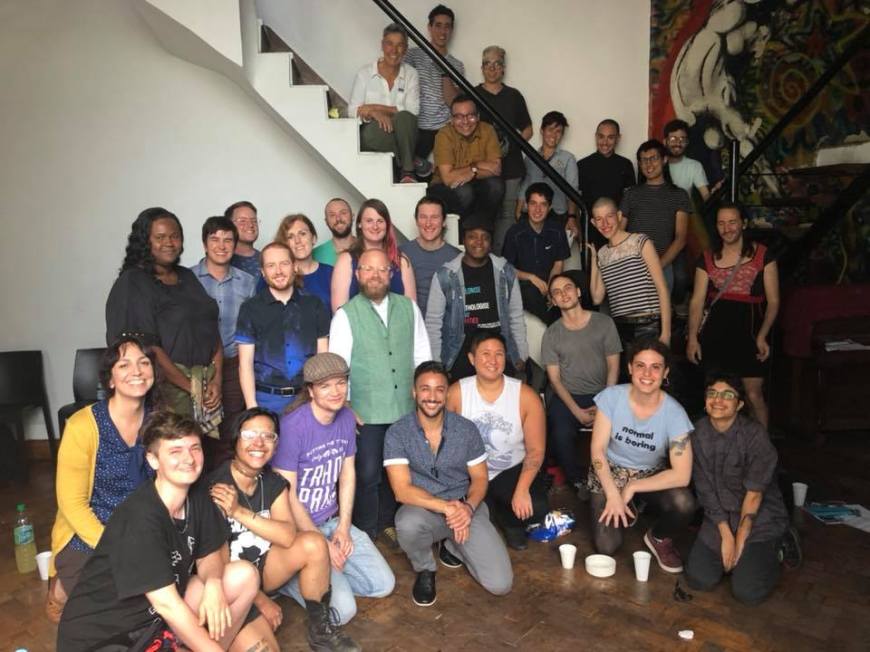
That said, the most important event I attended took place outside of the WPATH event: in Casa Jáuregui, a historic queer cultural centre many blocks away from the Hilton. Here, Frente de Trans Masculinidades (the Transmasculine Front) and other activists based in Buenos Aires hosted a meeting with TPATH members from the Bahamas, Aotearoa/New Zealand, Norway, South Africa, the UK and the USA. We shared information on our various areas of work, and the local activists talked at length about the history, implementation and practical impact of the Gender Recognition Law.

45312673_10156968672567287_3664316683624906752_n.jpg

Argentinian activists host TPATH members at Casa Jáuregui.

While it is important not to deny the significant challenges faced by trans people in Argentina, which include harassment by authorities, economic marginalisation and many forms of violence and discrimination, many of us were struck by how much has been achieved by activists in Argentina and (consequently) how advanced trans rights are in this country. The Gender Identity Law has been carefully written to enable flexibility; this has meant, for example, that it was interpreted to enable non-binary recognition by a judge as recently as last week. It also guarantees access to healthcare, which has meant that every possible medical intervention is available to trans people, either for free or through relatively inexpensive health insurance (in theory, that is: in practice, various legal battles have been necessary). This has been of benefit to cis women and queer people as well as trans people: for instance, through enabling easier access to hysterectomies or breast reductions.

During the meeting, the local activists described gender-affirming medical interventions that most of us had never even considered, such as beard hair implants for transmasculine individuals who cannot or would prefer not to use testosterone. Moreover, while long waiting lists exist for some procedures such as surgeries, those of us attending from European countries and (especially) Aotearoa/New Zealand were astonished by how much shorter they were than equivalent waiting times in our own countries, in part due to the absence of unnecessary gatekeeping procedures and treatment bottlenecks.

I was profoundly moved by the opportunity to attend this meeting, and regretted that so much of my time in Buenos Aires was spent in the sterile environment of the Hilton. However, I was also glad to have the opportunity to work with others to challenge the hierarchies and cisgenderist assumptions inherent in WPATH. We undertook many small interventions: asking questions about ethics, consent and power dynamics in the sessions we attended, raising concerns in private conversations, reporting blatant contraventions of the WPATH code of conduct. I was also pleased to hear many of my colleagues openly critiquing problematic issues identified during an update on the progress of the forthcoming Version 8 WPATH Standards of Care, and take part in attempts to hold our professional body to account during a member’s meeting on the final day.

Overall, I found WPATH 2018 to be a very tiring, draining and frequently unpleasant experience. However, I do not regret attending. I am grateful to have had the opportunity to learn so much from so many. I am also glad to have played a small role in supporting my intersex and trans colleagues and my colleagues from the Global South in attempting to help transform WPATH so it is more transparent, more accountable, and less colonial in attitude and in action.


Session summaries

The following links are to Twitter threads in which I summarise plenaries, talks and mini-symposia I attended at WPATH 2018.

Saturday 3rd November

Opening session and President’s Plenary

Keynote: Employment discrimination against trans people (Sam Winter)

Keynote: Trans legal history in Latin America (Tamara Adrian)


Sunday 4th November

Mini-Symposium: The Argentinian experience of public transgender health after the implantation of the Gender Identity Law

Oral presentations: Services in different parts of the world (Australia, Southern Africa, Scotland)

Mini-Symposium: Trans refugees: escape into invisibility

Mini-Symposium: Latin American perspectives on depathologization of trans and travesti identities

Plenary: Show hospitality to strangers: intersex issues in the time of gender identity laws (Mauro Cabral and respondents)
Note: this was listed as a plenary session in the programme, but actually took place alongside multiple parallel sessions. Consequently, this talk was under-attended by Western healthcare practitioners in much the same way as the Latin American sessions.


Monday 5th November

Oral presentations: Suicidal and non-suicidal behavior

Mini-Symposium: Ethical considerations in transgender health research

Oral presentations: Fertility

Oral presentations: Reproduction


Tuesday 6th November

Mini-Symposium: Child and adolescent medicine Mini-Symposium: Child and adolescent medicine

Plenary: SOC 8 update

Plenary: SOC 8 Q&A

WPATH 2018: learning on multiple levels

Today I arrived in Argentina for the WPATH Symposium in Buenos Aires. It will be my second WPATH Symposium, after I attended the previous event in Amsterdam in 2016.

I’m attending the conference in a number of capacities. Firstly, I will be representing the Trans Pregnancy project. I will be presenting a poster on some of our initial research findings, which I will share on this blog also in the next few days. I am also planning to attend a number of talks by other researchers working on trans people’s experiences of fertility, pregnancy and childbirth. Look out for tweets about two of these sessions from the Trans Pregnancy Twitter account on Monday 5th November.

Secondly, I will be presenting as part of a mini-symposium on research ethics alongside colleagues from Canada, New Zealand and the United States. This will also be on Monday 5th November, and I will be talking about how clinical research can have unintended and undesirable consequences for patients/participants if power dynamics are not taken into account.

Finally, I’m hoping to continue my long term project of learning more about how trans healthcare operates in different parts of the world, and sharing that knowledge with others in turn. In addition to attending sessions on research and clinical practice regarding trans-specific healthcare in various contexts, I also aim to learn more about activism, health advocacy and the law in various parts of the world, especially Argentina and other Latin American countries. I will be writing about this on my personal Twitter account, and hopefully also this blog.

I’m excited and honoured to be at this event, but also trepidatious, as I found the 2016 event pretty overwhelming. I learned an incredible amount in a very short period of time and was inspired by the world of many academics and practitioners from around the world. At the same time, as a trans studies scholar who happens to also be trans myself, I felt that a background hum of cisgenderism permeated the event, sometimes shifting into outright transphobia. Examples include pathologising language and misgendering within conference presentations, binary gendered toilets, and racist presentations that exoticised trans women of colour. A number of intersex conference attendees also protested against a number of surgical posters which graphically depicted infant genital operations.

WPATH itself has a very mixed history and reputation within trans communities. As I examine in my book, WPATH’s Standards of Care have worked to both open up and close down possibilities for people seeking medical interventions to facilitate a medical transition. In recent months, the organisation has issued welcome statements in opposition to both the Trump administration’s attempts to redefine gender and unfounded claims regarding “rapid onset gender dysphoria”. There is also now code of conduct for WPATH events which may help to address some of the worst examples of transphobia (and racism, sexism etc) at conferences. However, WPATH is also highly undemocratic and has recently appointed a treasurer who misgenders trans patients and promotes discredited psuedo-scientific concepts such as “autogynephilia”.

In this context of controversy and heated debate, it is important not simply to understand trans health, but also to understand the processes of knowledge production that inform trans health in theory and in practice. As a sociologist, this is something I will be very interested in at this year’s symposium, and I hope to share my thoughts and reflections in coming days.