Community Development Journal: Issue 59(3) out now

One element of my work I don’t talk about as much on this blog is my role as co-editor of the Community Development Journal. We put out four issues every year featuring amazing research from across the world, so I’m hoping to highlight this a bit more in future posts.

Volume 59, Issue 3 is out now and features articles on a range of topics from violent protest, to public art, to academic/voluntary partnerships – with contributions from South Africa, the Philippines, the UK, India, Canada, Vietnam, Mexico, Portugal, and Italy. As ever, it’s been hugely exciting to work with and learn from such a broad range of insight and expertise.

In addition to overseeing the peer review process, myself and co-editor Kirsty Lohman write an editorial for every issue. This editorial – one of five freely available articles in the latest issue – celebrates the launch of the new CDJ Plus website and reflects on the privileges and limitations of academic publishing. In particular, we discuss the importance and limitations of using our platform to speak out about the ongoing colonial violence in contexts such as Gaza and Ukraine.

You can read that editorial here:

Academic publishing and the privilege of a platform
by Ruth Pearce and Kirsty Lohman

CDJ publishes historic issue on Queer and Trans Community Building in India

Cross-posted from the CDJ Plus blog.

I am very excited to see the publication of the most recent issue of the Community Development Journal (CDJ), which focuses on queer and trans lives and collectivity in India.

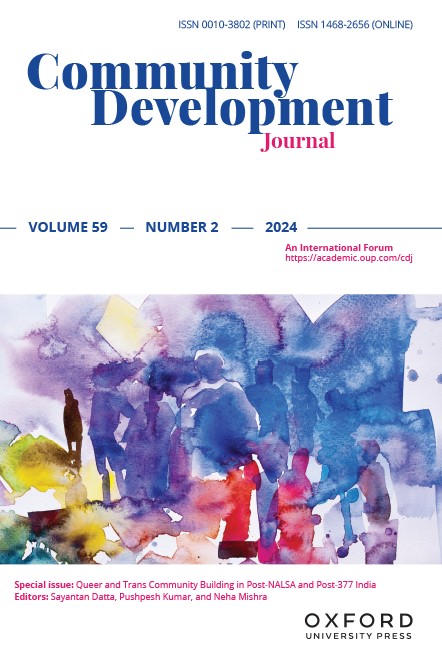
The issue, titled Queer and Trans Community Building in Post-NALSA and Post-377 India, is edited by Pushpesh Kumar, Sayantan Datta, and Neha Mishra. Across the editorial and seven articles, it explores pathways and barriers to community organising across a range of settings, including in families, religious contexts, community health programmes, universities, and the media.

Cover of the Community Development Journal


A one of the editors-in-chief of CDJ, it was an honour to support the hard work of the special issue editors and authors, who have put together a truly groundbreaking collection. LGBTIQ+ organisations, and others with a broader remit who seek to work with LGBTIQ+ people, are increasingly taking community development approaches and (where they can afford to do so) employing community development workers. However, community development research has been slow to catch up, with very little literature examining queer or trans community development theory and practice. This special issue therefore represents an important act of leadership in the field, which I hope will pave the way for more expansive discussions of LGBTIQ+ issues within community development globally.

The issue also representives methodological innovation, bringing literary and media studies methods to consider opportunities and issues for community building in India, alongside the social sciences approaches more typical of research in the field of community development.

The editorial for the issue is free for anyone to read, as is Anannya Dasgupta’s article Queerious communities: building writing centres in Indian universities. The remainder of the issue is available to all individuals and institutions who subscribe to CDJ.