Last month I returned to the fabulous Red Medicine podcast to talk all things Wes Streeting. I joined the socialist writer Jonas Marvin and host Sam Kelly to discuss the UK Secretary of State for Health and Social Care’s political background, possible motivations, and current challenges.
Red Medicine always offers a great deep dive into health-related topics of the day. Streeting’s alignment with transphobic pseudoscience and conversion proponents means that obviously I had a lot to say about his impact on trans healthcare. However, our conversation was offered a great opportunity to grapple with the wider context of Streeting’s ideology and actions, discussing wider matters such as class, party politics, and trade unionism: highly relevant given current discourse around the proposed strike by resident doctors! I also talk a little about my encounters with Streeting in the 2000s, back when I was a campaigner with the National Union of Students’ LGBT and Women’s Campaigns.
You can listen to Red Medicine through all the major podcast platforms – or through the link below.
You can also hear me talking about the Cass Review on a previous episode of the podcast in June 2024.
This week I took the long train down to the south of England for my friend Robyn’s funeral. She died very suddenly three weeks ago, aged just 32.
Robyn gave so much love to the world, and was so loved in turn. Around a hundred and fifty people crammed into a small building for the service. There weren’t enough seats for everyone, so many stood at the back and sides of the room. I sat on the floor. More attended online.
We shared stories from Robyn’s life, learned from each other, cried together. Like many funerals, especially for young trans people, it was absolutely gutwrenching. It also helped move us towards closure. It was good to be in community together, to think and speak not just of Robyn’s past, but of our collective futures. Robyn lived life to the absolute maximum. Surely we could take inspiration from her example.
Robyn at Manchester Punk Festival 2024. Photo by Chris Bethell for The Guardian(!)
After the funeral, I stayed the night with queer friends in rural Surrey. We went for a curry, toasted Robyn, caught up about our lives. We talked about work and about books and about art and about holidays we wanted to take. That evening I felt tentatively more at peace with the world.
And then I looked at my phone. And I learned that another young friend, Jessica, had also just died.
***
It’s a shit time to be trans. Many people are saying this.
But then again, when has it not been a shit time?
Eight years of moral panic have taken an enormous toll. In the UK, as in many other countries, our civil rights and our access to public services, public spaces, and public life are all being rapidly rolled back. Politicians and influencers fall over themselves to promote anti-trans violence and praise one another’s incendiarytakes. We are less safe at work, at home, in hospitals, in schools, and in the streets.
Trans people often die young, including too many of my friends. Sometimes (all too often) we die by suicide, driven to despair in a world full of hate and malice. Sometimes (mercifully less often in the UK) we are murdered, usually in incredibly violent ways. Other times, it’s more complicated. I think of Denise, who died a sudden death from melanoma. I think about Elli, who died of Covid-19. And now I also think about Robyn and Jessica, who each died suddenly of apparently natural or accidental causes.
These days, the high rate of untimely trans death can feel like a consequence of the trans panic. Certainly I believe it’s making things worse. However, this phenomenon pre-dates the current political situation. Trans people disproportionately died young in the 2010s, at the time of the so-called “tipping point“. Trans people disproportionately died young before this too. Sociological theory can tell us why.
A decade or so ago, I worked for a couple of years in Warwick Medical School. I was there to teach medical students about social determinants of health. The basic concept is that our general health is affected enormously by the context in which we live. This includes factors such as the resources and services we do and do not have access to, and barriers we might face in attempting to access healthcare services or otherwise look after ourselves
So, it’s not a coincidence that – for example – life expectancies are shorter in poorer neighbourhoods, or that Black women are more likely to die in childbirth. There is nothing inevitable or biological about any of this, something intrinsically different about poor people or Black people. The issue is that entire groups of people are more likely to experience particular kinds of illness, and more likely to die of things others might survive. This is because of the social disadvantages they face, and because of the discrimination they experience at the hands of bigoted doctors and nurses.
There is a massive scientific literature on social determinants of health. I’ve contributed to it myself, co-authoring a recent study showing an association between transphobic microaggressions and poor mental health among trans people. For this reason, I know it’s no coincidence that so many of my trans friends have died untimely deaths. Trans people are more likely to have worse health because of transphobia. They are less likely to receive timely and effective treatment because of transphobia. This means when trans people are seriously ill, we are on average less likely to survive. I see this when I look at the academic literature, and I see this every day in the lives trans people I know.
I see the impact of transphobia when I look at Robyn’s life and death. Her health deteriorated significantly in her final years. She was afraid to seek help from doctors though: and for good reason, given the discrimination she and many of her friends experienced in NHS services. I wrote my entire goddamn PhD thesis on this problem.
Things were even worse for Jessica. I witnessed so many organisations and institutions in her home city of Coventry failing her time and time again. I could fill whole books with accounts of the violence done against her. She was failed by her school, her church, a political party she gave so much energy to, the council, the local hospital, the psychiatric ward, the housing association. Just last year I sat helplessly on the other end of the phone while she attempted suicide, doing the best I could in this moment to ensure that she was not alone.
The institutional failings experienced by Robyn and Jessica and so many others are the result not just of ignorance, but of actively malicious transphobia and transmisogyny. I believe these factors contributed significantly to their untimely deaths.
How can any of us expect to find hope and purpose in the face of such violence?
***
In recent months I have noticed an uptick in trans doom-posting. By this I mean trans social media posts, blog posts, and videos which dwell entirely on negative feelings and convey a sense of hopelessness.
A prominent example is Shon Faye’s recent essay, well, it’s over, which she describes as “a brief eulogy for the ‘trans rights’ movement”. Shon observes that powerful transphobic movements in the USA and UK are succeeding in many of their aims. They have spread fear and disinformation far and wide, made allies of mainstream politicians and media platforms, and enacted bans on trans healthcare. Now they are attempting to criminaliseour very existence, as part of a campaign to eliminate us altogether.
Shon’s conclusion appears to be: well, that’s it. We’re all fucked.
“Today I doubt I will see another progressive measure (either in legislation or healthcare policy) put in place for trans people in my lifetime. Who knows what may yet be taken away.”
I very much empathise with her account of trying to talk about this in any way with cis friends and family:
“their instinct is to try and generate hope or minimise despair [which] typically minimises the gravity of the situation and the depth of my grief and exhaustion and fear – increasing my resentment.”
Shon concludes that she doesn’t want to hear “fucking platitudes” – “there’s time for hope later”. For now, she wants time to grieve. I’ve seen similar sentiments shared by other authors on various social media platforms, including posts from extremely popular trans meme accounts.
I understand intimately where all of this is coming from. Just look at everything I said earlier about social determinants of health. I recognise the violence we are subject to, and its costs. This post too is written from a place of deep grief.
But there is also the question of where and how we grieve. We do need space to vent and to despair. But we also need space to process, and figure out what happens next. Ideally, we need places and times we can do this collectively, rather than just being isolated as individuals. Robyn’s funeral offered this.
I’m not saying we shouldn’t talk about what is happening to us. What I am concerned about is the individualising effect of public platforms, and the parasocial relations we hold with high-profile accounts. We tend to consume doom-posting on our own, on a phone. We often have no-one to process it with, and little context beyond the content in front of us. In this way, doom-posting offers only a partial account of reality, and no way out from despair.
And there is a way out. We find it in community.
***
Look, I have a great deal of respect for Shon Faye. I have a hard enough time navigating the consequences of my own very minor microcelebrity. Shon has to tackle a great deal more attention: from trans people looking for someone to idolise and/or tear down, from cis readers who project heroic expectations onto her, and from haters who see her as the antichrist or something. She’s great on camera, and a brilliant writer. I would recommend her book The Transgender Issue to literally any cis reader. I also recognise that her blog post comes from a place of incredible pain.
At the same time, I am concerned that many trans people and allies are putting way too much energy into engaging mainstream institutions and liberal systems on their own, individualistic terms, rather than looking to the alternative power and support we can build in our communities. Notably, a lot of Shon’s post talks about civil society, legislation, lobbying, and the role of organisations such as Stonewall. This is definitely a realm in which “trans rights” face a seemingly terminal decline. But it is also not the first place I would look for real, grounded hope.
You can find a similar energy in Jules Gill-Peterson’s dire essay Reject Trans Liberalism, which is referenced by Shon. Jules’ piece simultaneously criticises the trans liberation movement for being about more than transition, while also insisting that preparing ideologically sound documents for the US supreme court is a radical act. It posits a false and ahistorical dichotomy between transsexuals (good, pure, radical) and transgenders (bad, elitist, liberal). The essay does not consider how gender diverse people might work together or support one another across our differences. This contrasts with existing critiques of trans liberalism already advanced by activist-scholars such as Nat Rahaand Mijke van der Drift. Again, don’t get me wrong, I’m a huge fan of Jules’ previous work. But as trans people, and especially as trans women, we owe each other so much more than this.
Now, I’m hardly without fault. This very blog is replete with examples of myself and others putting untold hours into lobbying politicians, participating in public consultations, advising the National Health Service and so on and so forth. In her post Stepping Over The Line, Josie Giles, who once again I admire greatly (look, I just fucking love trans women) argues that:
“Theoretically, an army of well-resourced energetic activists could simultaneously engage in state-centred advocacy and also do grassroots politics. In practice, it doesn’t happen. In practice, state-centred pseudo-organising dominates the social media feeds and the limited energy reserves of an already depleted community, and absorbs what little money is available to pay for the salaried self-licking ice-cream cone of the lobbying profession.”
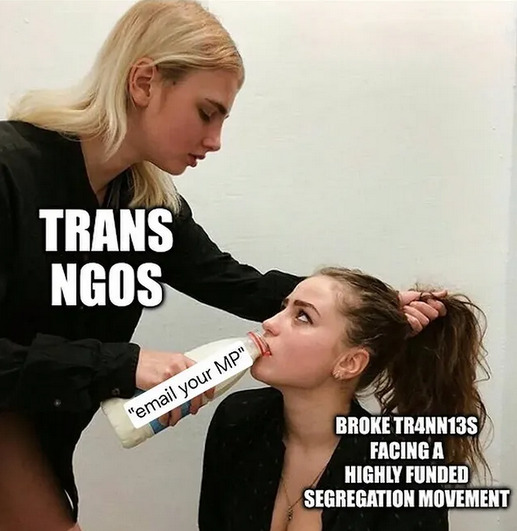
Sick burn!
Meme acquired via one of them social media platforms we’ve all heard so much about.
I do disagree with Josie a little. Unlike Shon and Jules and also Josie, I transitioned in the early 2000s. This was well before the tipping point, and before most trans civil rights even existed in law. I remember how we fought successfully for changes that genuinely improved many people’s lives. I feel it will always be worthwhile to use what levers we can to minimise the harm caused by those who have power over us. Lobbying is the most accessible form of activism for some people. I still have an auto-reply on which encourages every damn cis person who emails me at work to contact their MP.
But Josie is completely right that many if not most trans people can and should be putting a lot more of our energy into grassroots politics. This must necessarily involve re-imagining what our worlds could look like, using what we already have as a basis from which to build. I know from lived experience that we can not only survive in the absence of certain civil rights and recognition, but also see material improvements in our lives when we come together. I met Jessica because we built trans-led community services in Coventry from the ground up.
Similar points are made by Roz Kaveney, who first came out over 50 years ago. In her criminally underrated 2022 poetry collection, The Great Good Time, Roz does reflect on the violence faced by young trans women in her youth. However, she also details the vibrant lives they lived together, the joys they experienced, how they shared housing and clothes and had each others’ backs. In a short forward to the book, she notes:
“I observed a lot of bleakness creeping into trans social media and thought it my job as a community elder to remind young people that things have been, if not worse, then at least as bad in different ways”.
As Josie states in Stepping Over The Line, white, middle-class trans people in particular need to understand in this current moment that we are as disposable to the ruling classes as any other minoritised individual. Our strength lies in practical solidarity with others subject to the violence of corporations, fascist movements, and the state. To once again reiterate the point, we need to be in community with one another.
Both Robyn and Jessica’s lives offered perfect models for this.
***
Every single speaker at Robyn’s funeral talked about how much time and energy she put into punk and folk music, building and fixing things, and caring for others. She was a loud, proud butch who was incredibly committed to sustaining community wherever she went. When she saw a need, she sought to meet it. Many of us only wished that she was better at asking for or accepting help herself.
If a trans person needed somewhere to stay, Robyn would put them up. If a trans person needed to move house, or was being evicted or was fleeing a violent relationship, Robyn would turn up with a van. If a trans person was having trouble at work, Robyn would show up online or in person with sensible advice. This attitude inspired Robyn to volunteer with groups such as Reading Red Kitchen, a grassroots project which provides a social foodbank and free community meals for asylum seekers experiencing food poverty. For Robyn, radical politics could never simply be about slogans and demonstrations: it was about cooking, connecting with others, and washing the dishes.
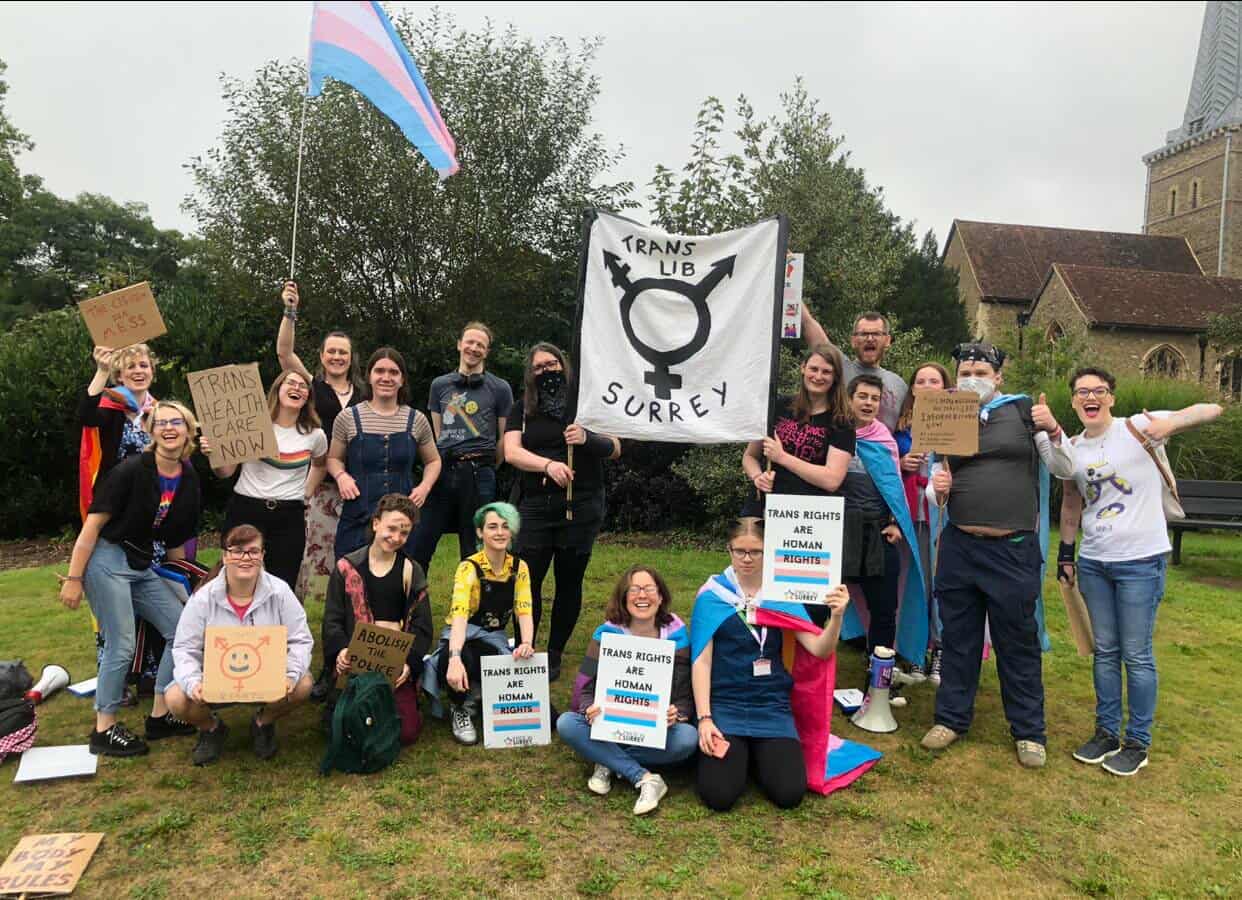
None of this is to say that Robyn was never found at a protest: quite the opposite. When I lived in the south we co-founded Trans Liberation Surrey, a collective which worked to oppose transphobia in a county hardly known for its activist movements. My most treasured memory of Robyn is from this time, when we attended a small anti-fascist demonstration in Wokingham. A coalition of neo-nazis, anti-vaxxers, and climate conspiracists descended on the town to protest a drag queen storytime event for young children. Robyn and I joined other locals outside the library to wave rainbow flags and play upbeat music, enabling families to attend the event without disruption.
Trans Liberation Surrey, at Surrey Pride 2021.
Jessica was also extremely motivated to help others, in spite of her own difficult circumstances. Like Robyn, she was a committed trade unionist. For many years she was also involved in a small political party, before eventually being ejected for challenging the leadership. Her motivation for this was a genuine belief in the possibility of positive political change, and in the potential for people to come together and make that change happen. Later in life she would rediscover her Christian faith as alternative vehicle for community action.
After hearing of Jessica’s death, our mutual friend Charlotte reached out, and we asked one another how we knew her. It turned out Charlotte had also been a member of that political party, and reconnected with Jessica several years later as they both sought new ways to make a difference in the world. In turn, I explained how Jessica and I met while lived in Coventry, and was myself involved in organising trans community social events, meals, and punk nights. Charlotte and I also both knew Robyn. “Christ Ruth,” said Charlotte, “trans lives are so entangled and we often don’t even realise”.
So it is. Right now, Jessica’s Facebook wall is replete with people thanking her for being there as a friend, for providing them with advice, for helping them come out.
In a hostile world, we are everything to one another. In the face of the most horrific hate, our love is so powerful. Such love survives death.
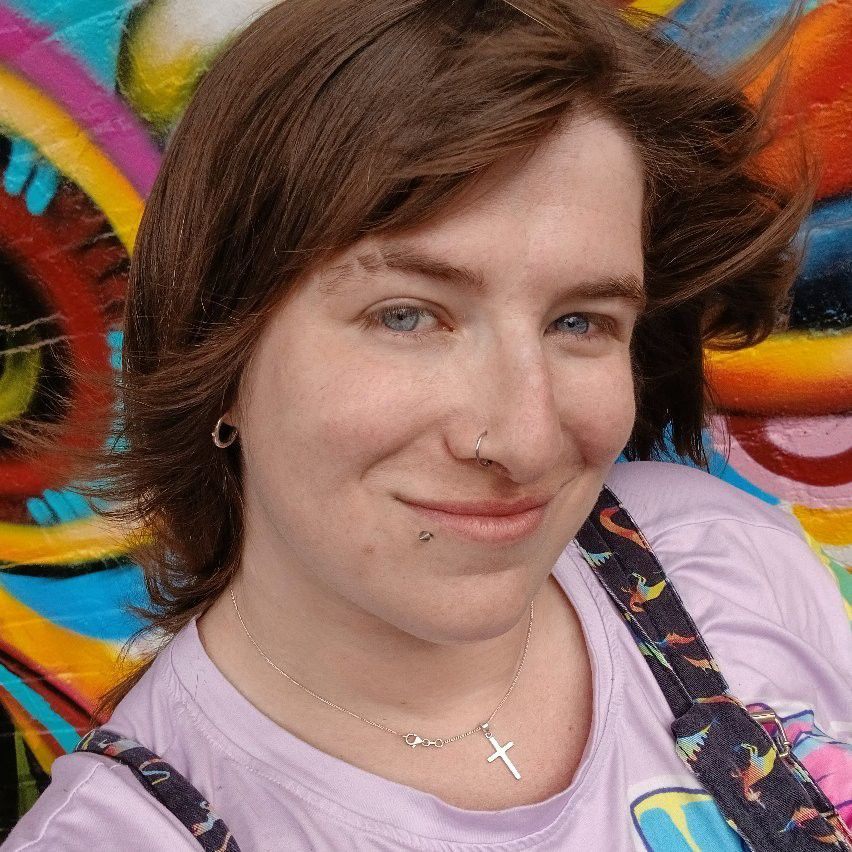
Selfie taken by Jessica.
***
This is where I find hope. At protests and demonstrations, sure, but more importantly in the contexts where we give each other’s lives meaning.
I find hope in community meals, mutual aid, queer bars and queer bookshops and queer gigs. I find hope in small parties, in big Pride events, in quiet meetings at work, in food pantries. I find hope in housing projects and healthcare projects, and in the Glasgow Electrolysis Project, which has created actual jobs for trans women and a vital new service for hundreds of us across the city. We know we are failed constantly by mainstream institutions: rather than seek incremental change, is it not time to re-imagine the clinic, re-think the workplace? Our problems will not be solved by refusing to engage with existing services, nor by creating trans charities that replicate existing hierarchies. We need to find ways to build something new entirely.
I find hope in the fact there are more of us out than ever, more connected than ever. These collective endeavors are all so much more important than anything I personally might write, any research I might do, and certainly any “progressive” policy I might influence.
Doom-posting and finger-pointing cannot deliver any of these things. We need to take the time to connect with one another, especially outside the internet. Yes we need to grieve, but we need so much more than this. We need to actively look after one another, and provide space for rest and recuperation. We need to have each others’ backs. We need to connect across difference, and not (re)create hierarchies of oppression or need.
These are no fucking platitudes. This is my life. This is the lifeblood of our shared communities. This is how we create better social determinants for our goddamn health.
On 8 February 2021, Brighton and Sussex University Hospitals NHS Trust published a series of groundbreaking resources on perinatal care for trans people, written by their Gender Inclusion Midwife team. As of March 2025, the Trust no longer exists, the midwives in question work elsewhere, and the resources page was sadly taken down – a sadly all-too common experience with NHS guidance for working with marginalised peoples.
Given the importance of these materials, for which I was part of a large team of expert reviewers, I am reproducing them on my website today for Trans Day of Visibility 2025, alongside some related resources.
I hope these will be of interest and use to anyone interested in improving perinatal care for trans people, including midwives, nurses, doctors, policymakers, commissioners, advocacy groups, and of course also families and prospective parents.
Professional guidance and protocolsby the Gender Inclusion Midwives
It’s been a long four years since the Gender Inclusion Midwives resources were published. Here, therefore, are a few additional materials that may be of help to people working in this area.
National Maternity Survey data on trans birth parents Since 2021 the Care Quality Commission has collected data on gender modality as part of its annual National Maternity Survey. The most recent findings indicate a significant rise in the number of men and non-binary people giving birth since 2021, with 1.58% of 2024 respondents indicating a gender that differs from the sex they were assigned at birth. This shows that hundreds of trans people are giving birth in England every year. See: Open data > 2024 Maternity survey National tables > page g9.
Improving Trans and Non-Binary Experiences of Maternity Services (ITEMS) 2022 report published by the LGBT Foundation, looking at the findings of an English study on the experiences of 121 trans people who conceived and gave birth. It found that many trans birth parents do not feel safe sharing their identity in perinatal services, with a large proportion not feeling comfortable to access any support at all from an NHS or private midwife.
Trans Pregnancy Project website I reviewed the Gender Inclusion Midwives resources as part of my work on the Trans Pregnancy Project, which was an international study of trans people’s experiences of pregnancy and childbirth. This year we launched a new website. This includes links to all our peer-reviewed publications, on topics including conception, pregnancy loss, midwifery, gender and embodiment, domestic violence, racialisation, and media representation.
Caring for Everyone: Effective and Inclusive Communication in Perinatal Care One of the key recommendations of the Gender Inclusion Midwives’ guidance on Gender Inclusive Language in Perinatal Service is the adoption of “additive” language. This approach acknowledges male and non-binary birth parents alongside mothers, rather than simply replacing woman-centred language with a gender-neutral approach. This 2025 academic article by Matthew Cull, Jules Holroyd, and Fiona Woollard provides advice on a “pluralist” approach to language, which builds upon the additive model by offering a more contextual approach. It includes clear examples of what best practice can look like.
This statement, which I helped to draft, is cross-posted from Spectra.
~
As providers of health and wellbeing services for vulnerable people, we are dismayed by Women and Equality Minister Liz Truss’ poorly-informed comments on transgender issues.
Nobody’s fundamental rights should be subject to ‘checks and balances’, as the Minister suggests. Single-sex spaces are already protected under the Equality Act; trans and non-binary people deserve the same access to relevant services and provisions as everyone else.
Trans and non-binary people face discrimination and exclusion in all areas of life. They are disproportionately likely to experience sexual violence and domestic abuse, plus encounter severe difficulties in accessing healthcare, housing, education, jobs, and benefits. This is especially the case for trans women and girls, plus trans and non-binary people of colour.
Trans and non-binary people of all ages require support in accessing services, and making informed decisions about their own lives and bodies. The Minister’s statement that young people need to be ‘protected’ from making ‘irreversible’ decisions appears to contradict existing legal precedents.
These include the principle of Gillick competence, and the Fraser guidelines, which together protect the rights of minors to make their own decisions around medical treatment, if they can demonstrate appropriate capacity to consent.
Any move to undermine these principles will have deeply concerning implications for all minors. In particular, young people’s confidential access to contraception, sexual health services, abortion services, counselling and therapy will be at risk. Rather than positioning trans and non-binary people as a problem, the Minister, along with the Women and Equalities Committee, should focus on ensuring that the Government delivers on the recommendations of the 2015 Transgender Equality Inquiry.
These include the expansion of healthcare provision, and reform of the Gender Recognition Act 2004 to ensure full legal recognition for trans and non-binary people of all genders, on the basis of self-determination.
~
A brief personal addition. Our communities and activist networks are stronger, louder, and more visible than ever. We will stand resolute against any attempt to roll back the legal rights of trans people and/or young people. If the Minister follows through on her threats, she will find she has severely underestimated us. We will fight and we will win.
During my April/May visit to Aotearoa (New Zealand) I picked up a lot of amazing resources. In this blog post, I share some brief reflections on three great documents which contain an enormous amount of interesting and useful material produced by and for Rainbow communities (takatāpui, lesbian, gay, bi, trans, intersex and queer people), on topics that include disability, Māori experiences of gender and sexuality, and affirmative care.
These documents will be of interest to people who want to know more about rainbow activism, communities and healthcare in Aotearoa, but also clearly have a wider relevance and importance. In writing about them, my intention is to highlight the expert contribution of the authors. As a UK-based scholar and activist, I learned a great deal and it is my hope that readers will too.
“Imagine how engaged our communities would be if we were curious about our strengths and values, rather than our limitations.”
This beautifully illustrated guide addresses topics such as structural stigma, intersectionality, accountability, minority stress and (de)colonialism from the perspective of a queer disabled politics. It promotes a mode of solidarity and understanding that recognises and works with difference.
All of Us was created by Stace Robertson, a queer trans man of Pākehā (European or non-Māori) descent who lives with Cerebral Palsy.
Robertson explains that the project came about after he noticed that people are often not fully included even in minority communities if they experience multiple forms of marginalisation.
He therefore decided to create a resource that shared the perspective of people with these experiences, drawing on that advise of mentors, and advisory group and 14 people from a range of backgrounds who offered to share their stories in the document.
This resource will be of interest to people who want to learn more about experiences of multiple marginalisation. It will be useful to those who are new to this topic, as well as those who want to understand more about factors such as ableism or migrant status impact LGBTIQ experience and vice-versa.
There is also an excellent easy-read version of the guide available in the second half of the document.
“Takatāpui is a traditional term meaning ‘intimate companion of the same sex.’ It has been reclaimed to embrace all Māori who identify with diverse genders and sexualities such as whakawāhine, whakawāhine, lesbian, gay, bisexual, trans, intersex and queer.”
The document was created to provide information and support for takatāpui and their whanau (family), but it will also be of interest to people wanting to learn more about mātauranga Māori (Māori knowledge or wisdom) with regards to sexual and gender diversity. It was written by Dr Elizabeth Kerekere, a renowned takatāpui activist, scholar, and founder/chair of the Tīwhanawhana Trust.
Through colonialism, Aotearoa inherited the sexism and homophobia of the British legal system. Takatāpui narrative were erased through pathologisation, colonial records, and the imposition of the nuclear family model. In light of this, Kerekere highlights the importance of pre-colonial histories, and of contemporary resilience and the importance of pride, family and community support.
In the UK, we have begun to talk more in recent years about how binary gender norms were imposed on many societies by British invaders through colonialism. These conversations can only become deeper and more nuanced through respectful engagement with knowledge produced by Indigenous peoples on this topic, rather than relying on the flawed work of colonial anthropologists. As a white trans woman who experiences both gender marginalisation and unearned privileges afforded by the legacy of colonialism, I am grateful for the opportunity to learn directly from takatāpui perspectives.
“These guidelines are based on the principle of Te Mana Whakahaere; trans people’s autonomy of their own bodies, represented by healthcare provision based on informed consent.”
These guidelines were produced by a coalition of healthcare practitioners, academics and community members, with the support of the Northern Region Clinical and Consumer Advisory Group. They are intended to supplement the World Professional Association for Transgender Health Standards of Care, providing guidance relevant to District Health Boards in providing gender affirming healthcare throughout Aotearoa.
An important feature of the guidelines is the use of Māori health expert Professor Mason Durie’s health framework. The document highlights two key principles for health promotion development: Te Mana Whakahaere (autonomy) and Ngā Manukura (community leadership). There is therefore is an emphasis on trans and gender diverse people having collective control over their own destiny and decisions around healthcare.
Furthermore, Te Whare Tapa Whā, as described by Durie, conceptualises health and wellbeing as the four cornerstones of the wharenui (meeting house). As noted in the guidelines, this model recognises the equal importance of Taha Wairua (spiritual health), Taha Whānau (family health), Taha Hinengaro (mental health) and Taha Tinana (physical health). These four cornerstones provide the structure for the document.
Consequently, the guidelines highlight topics such as Māori and Pasifika genders, minority stress, social transition, health in the family and in schools, and mental health, positioning these as equally important a consideration as physical transition (for those who desire/require medical interventions). This strikes me as a really important move, de-centring hormones and surgery to instead provide a more holistic view on trans health needs.
Like many similar documents, the guidelines are not perfect. I met a number of clinical practitioners in Aotearoa who considered this document to be a good starting point for conversations around improving care, but with some limitations outside of the relatively well-resourced Northern region in which they were primarily written. I have my own concerns around the citation of somewhat inaccurate information produced by cis clinical researchers (for example, Table 5, based on the Endocrine Society Guidelines, underestimates how long it might take for certain bodily changes to take place). I also feel that the definition of “informed consent” used in the document could perhaps benefit from tightening to specify what does and does not constitute appropriate oversight in determining whether or not patients are “adequately prepared” for medical interventions.
Regardless, I am deeply grateful for the work from so many people that goes into producing guidelines such as this, and I hope they can contribute usefully to the ongoing depathologisation of trans health.
I am very grateful to have been awarded a Rockefeller Foundation Travelling Fellowship by the School of Sociology and Social Policy at the University of Leeds. This will be used to fund a research trip to Aotearoa New Zealand.
The object of the Rockefeller Fellowship is to enable early career researchers working in the Social Sciences to make personal contacts and/or visit universities overseas. My aim is to build networks with trans health activists, researchers and practitioners, plus share research findings from the Understanding Trans Health and Trans Pregnancy projects.
I will be in Aotearoa from 18 April to 12 May, visiting Auckland, Wellington, Christchurch and Hamilton. In addition to strengthening existing relationships, I hope to spend time meeting new people and learning more about trans health services and community advocacy. While the UK and Aotearoa differ in many ways, we are both island nations with public health systems that face various forms of privatisation; we are both seeing a rapid growth in the visible trans population; and we are both currently seeing proposals for reform within trans healthcare. I am very much interested in exploring how activists, researchers and practitioners in both countries might be able to exchange ideas and information.
I am excited to been invited to present my work at the University of Waikato, Hamilton during the visit.
On Friday 3 MayI will be speaking about my PhD research in the Department of Psychology at the University of Waikato. My talk, The “Gender Experts”: Clinical Discourses and Becoming Trans, will explore how expertise is contested within and between trans communities and clinical settings, reflecting on what this might mean for patient experience and differing understandings of trans possibility.
On Saturday 4 May I will be describing initial findings from the international Trans Pregnancy project at the Aotearoa New Zealand Trans Health Symposium. In this talk I will look at how and why some trans men and non-binary people choose to conceive and bear children. I shall explore some of the challenges and opportunities that arise for trans birth parents, and explain what kind of support research participants want to see from healthcare providers.
If you are a trans activist, trans health researcher or healthcare provider in Aotearoa and would like to meet during my visit, please do be in contact – I would love to hear from you!
Last month I finished writing my first book, Understanding Trans Health: Discourse, Power and Possibility.
This book reports on the wide-ranging research project I undertook from 2010 to 2017, looking at trans discourses and experiences of healthcare services in the UK. It will be of interest to academics, students, health practitioners and activists working and studying in the field of trans health, and will be published by Policy Press in June 2018.
Understanding Trans Health is available for pre-order it for £21.59 (paperback) or £60.00 (hardback) from the Policy Press website. E-book and Kindle versions will also be available soon. If you work or study at a university or college, it would be really great if you could encourage your library to order in a copy!
I’ll be writing more about the book as the release date approaches. In the meantime, feast your eyes upon the stunning cover commissioned by Policy Press: an image that reflects continuing inequalities of access, the pain of waiting, and patient experiences of anticipation.
In other book news, myself and Igi Moon are still working hard on our co-edited volume, The Emergence of Trans: Essays on Politics, Culture and Everyday Life. We’ve had some really fantastic chapter submissions and I can’t wait to share more about this too in the coming months.
I recently co-authored an article on research ethics for the journal Transgender Health. It’s based on an extensive review of literature on the topic, and written by an international team of scholars and health practitioners with extensive experience of conducting research in this field.
Transgender Health is an open access journal, so the article is freely available for anyone to read and share.
I’ve copied the abstract out below: please click on the title for full access.
The purpose of this review is to create a set of provisional criteria for Institutional Review Boards (IRBs) to refer to when assessing the ethical orientation of transgender health research proposals. We began by searching for literature on this topic using databases and the reference lists of key articles, resulting in a preliminary set of criteria. We then collaborated to develop the following nine guidelines:
(1) Whenever possible, research should be grounded, from inception to dissemination, in a meaningful collaboration with community stakeholders;
(2) language and framing of transgender health research should be non-stigmatizing;
(3) research should be disseminated back to the community;
(4) the diversity of the transgender and gender diverse (TGGD) community should be accurately reflected and sensitively reflected;
(5) informed consent must be meaningful, without coercion or undue influence;
(6) the protection of participant confidentiality should be paramount;
(7) alternative consent procedures should be considered for TGGD minors;
(8) research should align with current professional standards that refute conversion, reorientation, or reparative therapy; and
(9) IRBs should guard against the temptation to avoid, limit, or delay research on this subject.
At the end of October I attended the CPATH 2017 (Canadian Professional Association for Transgender Health) conference in Vancouver. It was a fascinating event from which I learned a great deal. I’m keen to share some of my thoughts and experiences with others, as I feel there is a great deal that trans health researchers, practitioners and activists can learn from the progress that’s been made in Canada, as well as the limitations of that progress.
Poster: “In Our Dream B.C….”, by Drawing Change. Based on Trans Care BC consultation with gender creative, trans, and two-spirit youth and their families..
In this post, I reflect briefly on my impressions of the conference, and link to Twitter threads I wrote during various sessions. You can also read my initial thoughts on the conference here.
CPATH took a broadly holistic approach to trans health
Over 300 people took part in the three-day CPATH 2017 conference and two-day pre-conference. In attendance were GPs, nurses, endocrinologists, psychologists, psychiatrists, therapists and counsellors, social workers, healthcare administrators, peer and parent support group facilitators, academic researchers, lawyers, politicians, and various trans campaigners.
CPATH 2017 treated “health” as a social phenomenon as well as a purely embodied matter, and this made for some very productive conversations. For example, numerous sessions explored how trans healthcare might best be provided in the context of primary health. Gender identity services are frequently provided by GPs with support from external specialists, a model of care that is currently under consideration for England. In some Canadian Provinces, organisations such as Trans Care BC help to connect providers in primary care to relevant specialists, and support trans people in obtaining interventions such as hormone therapy and surgeries.
This approach enables continuity of care in a local context, with family doctors enabled to provide trans-specific care for their patients alongside everyday services. It reduces barriers to access such as waiting times and the necessity of long-distance travel. It also enables GPs to help their trans patients access a wider range of specialist services: for instance, trans people with mental health issues might benefit from a referral to a peer support group as well as or instead of formal therapy (depending on patient desire and need). Many practitioners provide services on the basis of informed consent, rather than using mental health assessments as gatekeeping measures. It was heartening to see generalist and specialist healthcare professionals, social workers, trans activists and others engaged in open discussions about how best to manage care through this kind of system.
I was also particularly struck (and moved) by a session entitled Trans and Two Spirit Youth Speak Back! The 40 or so adults in attendance – mostly healthcare professionals or researchers of one stripe or another – were asked not to speak at all during this workshop. We were instead invited to listen to the stories and experiences of trans and two-spirit young people, who sat dotted around the room and answered pre-prepared questions delivered by a youth group facilitator. This session structurally prioritised the voices of young trans people who are so often silenced, and also offered an opportunity for us to hear how the healthcare needs and challenges faced by these individuals were shaped by their cultural heritage, family life, schools and peer groups.
CPATH took intersectional trans voices seriously
Trans and Two Spirit Youth Speak Back! was just one example of how trans voices were frequently centred at CPATH 2017. As an attendee from the UK, I was very impressed by this! Our trans healthcare conferences, seminars and workshops tend to be organised by and for community groups, researchers or healthcare providers, with relatively little overlap between attendees at these events. Very few practitioners are (openly) trans, meaning that trans people tend to talk to one another at community and research events, but are heard less often at healthcare conferences for doctors, nurses and mental health specialists. Moreover, the speaker line-ups at all these events tend to overwhelmingly prioritise the most privileged individuals, such as white people and men. The only possible exception is cliniQ’s Trans Health Matters conference, and that event too feels like it’s taking the first steps towards something better.
During the opening plenary of the CPATH conference proper, we were informed that around one third of speakers at the event were trans, and around a tenth were Indigenous (i.e. of First Nations heritage). I’m not sure how many people of colour were represented at the event more generally, but the all-white panels which are a norm at UK events seemed few and far between.
Importantly, the trans women, trans men, non-binary and two-spirit platformed as speakers and workshop facilitators were usually also professionals. We weren’t simply present at CPATH to represent a “patient perspective”: rather, we were the experts. This reflects the hard work of individuals in pursuing a career, and the collective work of CPATH in supporting trans professionals; it also reflects the actions of local providers in various parts of Canada who have made an active effort to employ trans people, or secure funding for partnerships with trans-led organisations.
In my previous post I noted that the opening plenary of the conference proper centred Indigenous voices. This included a formal welcome from Musqueam Elder Jewel Thomas, and talks by trans and two-spirit Indigenous educators from different parts of North America. I was happy to see that the plenary session on the second day of the conference continued to centre the voices of individuals who tend to be marginalised within even trans spaces. Two-spirit physician Dr James Makokis and Latina trans activist Betty Iglesias – who discussed issues faced by trans sex workers and migrants – were platformed alongside an Member of Parliament from Canada’s ruling Liberal Party, resulting in a thoughtful and challenging debate.
CPATH (and the rest of us) still have a lot of work still to do
I left CPATH with a very positive impression, but Canada is by no means the promised land for trans health. Professionals and patient representatives alike frequently discussed the challenges they faced in providing gender-affirming services. Transphobia and cisgenderism are still very much prevalent within healthcare provision and legal frameworks, particularly outside of urban areas: there is therefore a great need for better education among trainees and further reform of laws and guidelines. Limited funding and different approaches across the country’s Provinces and Territories also mean that not everyone has the same access to treatment, and waiting lists persist for publicly-funded care. These are challenges that exist across the world, and may benefit from greater international collaboration and strategy-sharing.
At the end of the first day of the conference proper, there was a reception specifically for trans people attending the conference. I later reflected on the experience of attending this reception in conversation with a genderqueer colleague; both of us felt ourselves relaxing enormously upon entering the trans-only space. For all the positives of CPATH, it was a huge relief to step away from cisgenderist expectations and microaggressions that quietly persisted throughout the conference proper. These included a range of unspoken ideas about how we should dress, act, and talk “professionally”, limitations on our ability to name transphobia within healthcare settings without fearing repercussions, and the occasional terrible intervention from self-righteous cis professionals.
As ever, facing down these challenges is hardest for the most marginalised trans people, including (for instance) disabled individuals, sex workers, migrants, and people of colour. I was aware that while CPATH 2017 took a broadly intersectional approach, instances of ableism, racism, sexism and so on persisted: and this could take the form of unexamined prejudices on the part of more privileged trans people too. Moreover, white people were still heavily overrepresented among conference attendees; a phenomenon that was particularly noticeable at an event held in a city as diverse as Vancouver.
What I’m taking from this is a reminder that equality work is never “done”; rather, it is something that we should strive to always “do”. We should aim constant improvement in our relations to one another rather than assuming that solidarity and equality are things that we can simply achieve. It is in this spirit that I’ve attempted to use my own privilege as an academic to bring back lessons from Canada for the UK and beyond.
So, I’ll end this post with a serious of links to Twitter threads from the event. I livetweeted extensively from CPATH 2017, sharing summaries of the numerous talks and workshops I attended. This is by no means a comprehensive summary of any of the sessions I was at, let alone the wider conference (as numerous parallel sessions took place simultaneously). However, I hope the ideas and approaches will be as useful and interesting to you as they are to me.
Last week I joined over a hundred other attendees at the Trans Health Matters conference in London. The event (which takes place on a mostly annual basis) was organised by cliniQ, the city’s holistic trans sexual health clinic.
When I attended the first cliniQ Trans Health Matters conference in 2013, I found it to be immensely valuable and informative, but left with a feeling of deep-seated distress that persisted pretty much ever since. For at that event, I gained a better understanding of the scale of the problems that plague trans healthcare provision.
These include widespread ignorance and often also active discrimination from practitioners, plus enormous (and growing) waiting lists for gender clinics. All things I already knew about, but swapping notes with other researchers and activists helped me realise just how common and severe the issues were. My impressions from the conference were also reflected in the initial findings from my PhD fieldwork, which I was undertaking at the time.
By contrast, I left this year’s event with a greater sense of optimism and hope.
That’s not to say that trans health isn’t still a disaster area. It really is. However, I feel that since 2013, there has been a real growth in community health initiatives, and also in cis practitioners’ active engagement in the issues. This was actively reflected in the conference programme, which focused largely on what is being done and what we can do to make things better.
What is “trans health”?
Interestingly, another positive aspect of the conference for me was that gender clinics and transition processes were barely discussed at Trans Health Matters 2017.
That isn’t to say that these aren’t important things to talk about – they absolutely are – but one of my observations over the last few years has been that discussions of “trans health” focus so overwhelmingly on gender identity services that an outside observer would be forgiven for thinking that transition is the only healthcare issue that really exists for trans people.
Which, of course, would be completely wrong. Trans people face extremely high rates of discrimination, harassment, internalised stigma, poverty, physical violence and domestic abuse. These challenges can be be linked to endemic mental health problems, suicidality, substance abuse, “risky” sexual practices and disability within trans populations. Moreover, there is the matter of everyday transphobia and cisgenderism in everyday encounters with healthcare practitioners.
So it was genuinely refreshing to attend a trans health conference that focused largely on sexual health (particularly HIV prevention, reflecting cliniQ’s role as a sexual health clinic), with some additional discussion of matters such as therapy, sex work, data collection, and intersectionality. These are all deeply important issues that really deserve the attention they received on the day.
Of course, the absence of discussion on gender identity services would be a real issue if these conversations weren’t already happening elsewhere. But they are. This year alone, I’ve attended two UK trans health conferences which centred issues of transition, and I know there have been plenty of other such events that I haven’t been able to go to. This is another cause for optimism: a great increase in activist, academic and professional events looking at trans health from a range of angles, reflecting the rapid growth and increasing visibility of our communities.
Towards inclusive care
While there are a growing number of trans-specific sexual health services available in UK cities, it was really good to see a lot of discussion around how trans people can be included in services (and the promotion of these services) more generally. A great example of this was a short film that’s been made about PrEP, from which extracts were shown at the conference.
I was also really heartened to see that Trans Health Matters was a somewhat more intersectional affair this year. Two of the four speakers on the keynote panel were trans women of colour. We got to hear a particularly inspiring speech from Mexican/US activist Alexandra Rodríguez, who explained how she created a pioneering HIV prevention service for trans Latinas in California after realising there were no existing services, and reflected on the importance of providing care and support for trans migrants.
I also attended an afternoon session on barriers to access and strategies for inclusion for some of the most vulnerable trans populations in the UK: black and minority ethnic trans people, non-British trans people, and economically marginalised trans people (these are, of course, groups that frequently intersect!)
Barriers to healthcare access for BAME and/or non-British trans people.
Photos taken with permission during breakout session.
One of the most important lessons from this session was the importance of reaching out for service providers, rather than expecting that the most marginalised people will feel that a service is necessarily for them. This is particularly the case if a service is normally primarily attended by and promoted to a relatively privileged demographic.
The work of reaching out may involve an element of discomfort for white and/or middle class providers; it can involve sensitively negotiating access to new spaces (e.g. club nights and community groups run by and for people of colour and/or working class people), learning from mistakes and being open to listen and learn with humility. But it is vital to ensure that community services are truly inclusive.
Reproductive health survey
The importance of the work of inclusion really came to the fore in a plenary session where we were shown initial findings from a trans reproductive health survey undertaken by Public Health England.
This is the first major stastical study looking at trans people’s reproductive health and experience of services in the UK. As the survey hasn’t yet closed and the data still requires some additional processing, we were asked not to report on specific figures. However, what I can say is that (unsurprisingly) there were generally high levels of dissatisfaction with existing service providers and sexual health education, reflecting an urgent need for improvement and trans inclusion.
The aspect of the survey that inspired the most discussion and debate amongst conference attendees, however, was the lack of diversity among existing survey respondents. A majority of respondents had received a university education, and an overwhelming number were white. This reflects a wider trend in trans community responses to online surveys: it is the most privileged individuals who are more likely have access to these.
I asked the speaker if there had been a paper version of the survey produced: these can help obtain a greater number of responses from individuals less likely to access an Internet survey, including trans people of colour, working class trans people, and older trans people. He noted that unfortunately the research team (which I believe consists just of himself and a single support worker) are underfunded and are trying to do their best with the resources they have. However, other audience members noted that there were still things that could have been done to increase the response rate from underrepresented groups. For instance, the research team could have reached out to UK Black Pride and asked for help with dissemination.
To me, this conversation really brings home the importance of active inclusion, which was the main thing I have been thinking about since attending Trans Health Matters. We can’t just assume that all members of our communities will be able to access services and research: rather, we need to make the effort to ensure that they are accessible. This can involve additional work, but the real challenge is overcoming the ignorance that can arise from our own privilege, even if we are ourselves marginalised in different ways.