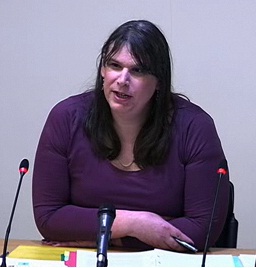
Trans Media Watch at the Leveson Enquiry

Helen Belcher of Trans Media Watch provided an impressive array of evidence in relation to transphobia in the media during the Leveson Enquiry yesterday. Video footage and full transcripts in .pdf and .txt formats can be found here. Trans Media Watch’s full submission to the enquiry can be found here.

Unfortunately – if unsurprisingly – Belcher’s strong performance warranted little comment from the mainstream and “pink” media alike. Notable exceptions included the headline story in Gay Star News (Trans people victims of ‘horrific’ press coverage) and a comment piece in Pink News (Does today mean change for the trans community?). There have been just brief summaries of Belcher’s evidence (with little or nothing in the way of analysis) within articles that tackle Wednesday’s events more widely in The Guardian, The Telegraph and on the BBC website. Even the #Leveson hashtag on Twitter went relatively quiet as the majority of cis commentators lost interest.

Still, this was to be expected, and we shouldn’t underestimate the importance of Trans Media Watch’s role in compiling and presenting evidence to such a major inquiry. Belcher powerfully outlined a number of very important issues:

  • The consequences of negative media coverage can be extremely serious for trans people: examples include loss of work, death threats, and the necessity of relocation in order to avoid prejudice.
  • Dehumanising and Othering language is routinely used within news stories: “The Sun is basically saying trans people elicit horror, trans people are frauds“.
  • Stories (and pictures) are often published without any consultation with the subject, let alone permission.
  • Newspapers often rely upon false information, such as inaccurate figures about the cost of medical transition on the National Health Service.
  • The Press Complaints Commission is considered useless and toothless as complaints are regularly ignored: “The Press Complaints Commission is regarded as a useless joke by trans people”.
  • Victims of negative media coverage tend to let the issue slide: “[…] we find that individuals rarely want to pursue the case because they then become afraid of future
    harassment“.
  • There tends to be no real justification for most articles about trans people on the grounds of “public interest”.
  • The Sun continues to run transphobic pieces (contrary to the claims of Dominic Mohan during his evidence to the Leveson Enquiry on Tuesday).
  • The Daily Mail publishes six times more stories on trans people than any other UK newspaper(!)

Trans Media Watch also identified a number of common themes in confidential complaints they’d received from trans correspondents who had suffered negative media coverage:

“In each case, the subject of the story had their right to privacy grossly breached, often at a very vulnerable time, with no public interest being served whatsoever.

Was put in danger of public abuse and/or violence.

Is left with candid details of their personal affairs, including previous names, pictures, home or work, available on the Internet.

Often these details, including photographs, were acquired without the subject’s permission. Had to fight the press to force them to exercise restraint — often with no effect.”

Finally, Belcher made a number of recommendations:

  • That it should be possible for organisations to issue complaints on the behalf of vulnerable individuals.
  • Anonymity should be granted to all who pursue complaints; we shouldn’t have to rely on the limited protections offered by the likes of the Gender Recognition Act.
  • The complaints process for media malpractice should be free:
    A lot of trans people lose jobs, find it difficult to get jobs. There is evidence that the earnings of a trans person is significantly lower than they could expect if they weren’t trans. That is a further deterrent for them to seek any recompense. It actually pretty much prevents any trans person from pursuing any action against a newspaper in the courts.

10-year-old trans girl launches petition as Leveson Enquiry tackles transphobia

Jane Fae wrote a powerful post
today
highlighting the connection between two important events this week for trans people in the media.

The first of these events is the launch of a petition that calls upon the press to stop using dehumanising and othering language to describe trans people. The petition was started by the family of Livvy, a 10-year-old girl who became one of the most recent examples of trans children hounded by the news media.

They argue that transphobic language can ultimately kill:

People with gender identity issues are being murdered, beaten, threatened with their lives, bullied, teased, intimidated, disowned and are prone to suicide both attempted and successful and self harm. The Press being an extremely powerful medium has the responsibility to ensure they are not aiding peoples ignorance and hatred and increased lack of self esteem.

Meanwhile, the Leveson Enquiry is due to receive evidence  from Trans Media Watch this afternoon (a live video stream will be available here, as well as an archived video and transcript following the hearing). Josephine Shaw posted the following announcement on the group’s Facebook page:

“[…] Helen Belcher will be representing us at the Inquiry, next Wednesday – February 8th. She’ll be doing so following a detailed written submission made by TMW a few weeks ago, a public version of which is available via the downloads page of the TMW website.

There have been a very large number of written submissions to the Inquiry – only a small number have resulted in Lord Leveson calling witnesses in person. We’re absolutely delighted to be counted in that number […]

TMW’s aim next week is simple. To give voice to the pain and anger of all those trans and intersex people whose lives have been invaded, even ruined, without any cause or warning by the British press. Who deserved accuracy, dignity and respect. Or who simply deserved privacy. And to try and represent our community in calling for a profound change in the attitude of the press and an end to the incessant outrageous and unwarranted intrusion into the lives of innocent trans and intersex people.”

This week therefore sees two significant responses to the ongoing media assault upon trans lives. The two met this morning on the BBC’s Breakfast show, when Livvy and Trans Media Watch’s Paris Lees spoke about transphobia in the media.

It’s really heartening to see all of this happening. I agree with Jane that we have good reason to remain cynical, but equally we have plenty to celebrate at this juncture. For too long, journalists have been getting away with inflaming public opposition to trans liberation, and people in power are finally beginning to listen to our howls of outrage. This is an early step towards a more fair and friendly world, but an important one.

I was fortunate enough to meet Livvy a few months back and was inspired by the sheer determination of both her and her family; we have a lot to learn from them! I was also struck by my own surprise role in Livvy’s story via a sensationalist piece published by the Sun back in September:

But yesterday a row broke out after a parent claimed that kids as young as EIGHT at Livvy’s school were shown a film about sex-change surgery.

In the footage, made for the NHS website, Ruth’s Story describes how she was born a boy — but knew from the age of 16 she wanted to be a woman.

One parent said: “We are not against the child. It’s that the children are being asked to treat her differently and watch a transgender video without parents knowing.

The video in question was made for the NHS a few years back, and at the time I had no idea it could ever be shown to a primary school assembly! I would probably phrase a few things differently now but ultimately I’m still pleased with how it turned out. I became involved in the project by responding to an email from a mass trans mailing list: someone else could just have easily done it.

Ultimately I suppose my point is that every bit of effort counts. Every signature on Livvy’s petition, every angry letter to an editor, every trans awareness workshop and every intervention within public conversations. Let’s keep up the pressure, because it’s the only way we stand a chance of winning!

My Cissexist Summer

Channel 4’s latest trans documentary has certainly achieved an impressive amount of commentary from within trans communities. Like it or loathe it, we all have something to say about My Transsexual Summer. I suppose that’s because this particular programme – running unusually as a series rather than a one-off show – has been really pushed by the broadcaster. You can’t really miss that it’s happening, and as such many people are painfully aware of how likely it is to shape the general public’s perception of trans lives and trans issues.

That level of public consciousness has no doubt shaped the fury emerging from some quarters. I’ve seen outrage at the employment of numerous cissexist tropes (as Paris Lees noted in the Guardian, anyone playing the Trans Documentary Drinking Game whilst watching My Transsexual Summer is guaranteed to get utterly sozzled very quickly), the dodgy narration from a clueless cis woman, and the frequent use of the word “tranny” by documentary participants. The latter issue in particular has predictably reignited debates about whether or not (and how) offensive language can be reclaimed.

Others (including Lees) have welcomed the show as a positive step forward. I agree with those who point out that the show breaks new ground in enabling trans people to speak for themselves in a public/media setting. The best parts of episodes one and two do tend to involve group conversations in which the show’s participants have the rare opportunity to discuss their unique challenges within the safety and comfort of a trans space (other good bits included Dr Bellringer’s justification of genital surgery and the revelation that some trans men keep their clitoris post-phalloplasty…imagine, a functioning penis and a functioning clitoris! Dude!)

My own problem with the show is that these moments of brilliance are inevitably compromised by the ciscentric, cissexist editing process. I’ve already mentioned the narrator: the show would be a considerably stronger, warmer portrayal without the presence of her patronising, occasionally transphobic twaddle. Then there’s some of the things the participants are required to do. In the first episode, they’re expected to take pictures of one another (an activity some are clearly uncomfortable with), leading to this gem of a comment:

The photographs are ready. Now they’ll be able to judge themselves, and each other.

Congratulations Channel 4: you’ve managed to touch upon everything that’s wrong with internalised transphobia, judgemental “more stealth-than-thou” attitudes within trans communities and the cissexism within the wider world in one fell swoop!

The worst part of the editing process though is the identity erasure undertaken for the sake of telling a safe, easily digestible story to a cis audience. Maxwell – the jolly Jewish fellow from the show – has written about this process extensively on his blog:

What I see is the inevitable privileging of narratives that do not challenge dominant paradigms of normative gender. What I see is programming that will make you think “oh I feel so sorry for them, maybe I might think about how those people get a tough ride”. What I don’t see is anything that is going to make people think or feel any differently about what gender is or how it limits us all in one way or another.

What we see are lovely endearing transsexuals (who I still consider to be my good friends) struggling though ‘typical’ transitions and don’t get me wrong these stories are hugely important, I do not underestimate how important these stories are but where are all the queers!?

These narratives are totally valid but I believe they need to be seen in context and juxtaposed with a more diverse representation. A representation that was there in the house but somehow didn’t make it to our television screens.

Where is Fox talking about being mixed race, about his art and about how he sees himself as two spirit?

Where is the exploration of Donna’s male and female identities as she navigates the personal relationships that mean so much to her?

Where is the discussion about how I reject gender binary and sexuality and still live an observant Jewish life at the same time?

The film-makers’ approach also ensured that the word “tranny” was employed in a deeply problematic context:

The responsibility was not on us to act or behave in a certain way- our job was to turn up and be ourselves. TwentyTwenty and Channel Four bear the responsibility for broadcasting footage without providing any context whatsoever. Donna ‘I’m pretty manly for a Tranny’ is a superbly articulate young woman who’s reasons for using the T word were not broadcast, instead they used endless footage of her and the other women putting on make up.

Maxwell and the other participants have been attacked extensively for their use of the word, with detractors arguing that they should have been more careful. Maxwell is now wondering if he did the “wrong thing”. Yet I’m inclined to agree with his initial assessment: if the editors had any sense, if they listened to the numerous community members they corresponded with, if they gave a shit, then they would have thought quite seriously about how they used the small amount of footage in which the word is uttered.

I can understand why some feel that My Transsexual Summer represents a step forward, a positive move in spite of its failings. I see hope in the brave, strong participants, and in the few moments when their voices are heard loud and clear. If we’re to have a truly decent, representative mainstream trans documentary though, those voices have to be centred rather than sidelined. We’ll continue to see poor programmes produced as long as cis filmmakers have the power to re-contextualise our stories whilst erasing our gender(s), sexual orientation, and race/ethnicity.

Julie Bindel apologises for 2004 article

An interesting little titbit of information has emerged from a controversy over the suitability of nominees and sponsors at Square Peg Media’s sparkly and expensive “European Diversity Awards”. Many of those picketing the award ceremony in London’s Savoy Hotel on Thursday night objected to the nomination of notorious writer Julie Bindel for the Journalist of the Year Award. So far, so 2008…those of us who remember the largest trans protest the UK has seen, which took place outside of a Stonewall Awards ceremony, will no doubt experience a profound sense of deja-vu.

It looked like the usual round of accusations and counter-accusations would soon be in full swing as Julie Bindel vs The Trans Community (whatever that is!) bout 362 kicked off…but then something unprecedented happened. Julie Bindel apologised.

“I apologise unreservedly for both the tone and content of my 2004 article.”

This statement was provided to Square Peg Media, who passed it on to Natacha Kennedy during her correspondence with the company prior to the awards ceremony. It refers to the Guardian article “Gender Benders Beware“, arguably Bindel’s most infamous and direct attack upon trans people.

The fact that I picked this up through Kennedy’s Facebook wall initially suggested that the statement was merely intended to appease the award organisers. However, a nearly identical statement from Bindel could also be found in a news article published yesterday. This was clearly intended as a public apology.

When DIVA contacted Bindel for a statement she said: “I apologise unreservedly for both the tone and content of my 2004 articles.”

The apology is significant because it’s a genuinely new development. Bindel previously apologised for the “tone” of “Gender Benders Beware” on a number of occasions following outrage from trans advocates. These seemed like weasel words: after all, the mocking tone of the article was undeniably offensive, but it was the content – which suggested that trans people should not be taken seriously and that trans women should be denied access to rape crisis services – that was truly dangerous. In contrast, Bindel clearly and explicitly puts a distance between herself and the article in her new statement(s).

Many will argue that this apology was made in bad faith, or say that it comes far too late, but I believe that we should take it quite seriously. I felt some disquiet when the European Diversity Awards protest was initially announced, as it felt like yet another round of Julie Bindel Does Something And We Protest. Yes, she undoubtedly started it, but the whole circus was getting quite tiresomely predictable. Bindel does something offensive (or is invited to speak somewhere, or is nominated for an award). We protest, because we’re sick of being told that we don’t count/don’t deserve liberation/don’t exist. Bindel then makes a fuss in the media and accuses us of bullying her. Some of us refute her arguments, whilst others make quite horrible personal attacks. And then before long, the whole cycle begins anew. Except, on this occasion, Bindel has not immediately lashed back at us. She has said sorry.

I’ve always taken part in this process, but I’d like to take this opportunity to step back and reassess our priorities. At the end of the day, I, like many other trans women, have a lot in common with Julie Bindel. We both object to the sexism found in every part of our society, and the imposition of binary gender norms. We’re both loud, proud and unashamed feminists, and have both slept with other women. That’s quite a lot to work with. I’d far rather concentrate upon marching alongside Bindel at Reclaim the Night than protesting against her latest escapade. Julie, if you’re reading this: please, let’s smash patriarchy together!

However, if this apology is to really mean something, Bindel must go that one step further and demonstrate a genuine commitment to her words. I notice that the Diva apology extends only to “2004 articles”, yet arguably more damaging pieces have since been used to argue against the provision of medical resources for transsexed people and gender-neutral facilities for genderqueer people. Facts have been warped and trans liberation has been ridiculed in articles such as “My Trans Mission” and “The Operation That Can Ruin Your Life“. Bindel has time and time again demonstrated a refusal to listen to our calls for gender liberation and our explanations of trans diversity. This matters a great deal, as such articles influence the perspective of both policymakers and feminist activists. They feed into feeling of self-loathing experienced by vulnerable trans people who come to realise that others hate them because of who they are. This has to stop.

I’m sure there will be some sad, cynical responses to this piece, but Julie: I’d like to have faith in you, and faith in your apology. I genuinely believe you have some level of understanding as to how your hurt us in 2004, otherwise you wouldn’t have bothered to say sorry (after all, why now? This is hardly the first such nomination or controversy). I’d like to believe that although we have at least few more rounds of mutual mistrust and anger to go, at some point in the future we can look back on this intervention and see it as something we productively built on together.

Edit – February 2015
Nice to give someone the benefit of the doubt, isn’t it? Pity this never turned out well in the long term.

Royal wedding accompanied by political crackdown, arrests and transphobia

I wasn’t really bothered by the royal wedding one way or another until this afternoon. I’m not exactly a royalist, but I feel there’s some value in having a non-elected, ceremonial head of state, at least within our current political system. I was unimpressed that such an extravagant event was occurring at a time of recession and cuts, but didn’t feel that protesting against the event was particularly value.

I have, however, watched the crackdown on dissent unfold today with increasing dismay and disgust.

Firstly, police undertook “pre-emptive” arrests across the country. Then suspected protesters were arrested during the ceremony in a pretty questionable manner.

Then a number of Facebook groups started to disappear. Numerous anti-cuts, socialist and student occupation groups were removed without warning during the day. Rather bizarrely, the Rochdale Law Centre was also targeted. No-one seems to know exactly what sparked this, but it’s pretty darn coincidental that it happened on the day of the royal wedding.

Then it emerged this afternoon that members of Queer Resistance and the Sisters of Perpetual Indulgence had been prevented from holding a “zombie flashmob” in Soho Square, a full kilometre from the nearest point on the wedding procession route. Both Lesbilicious and the Guardian report upon zombie arrests.

At least two of those arrested were trans. I happen to know both of the individuals mentioned in the Lesbilicious article: from what they’ve told me, the situation wasn’t as bad as it could have been but their treatment was pretty damn inappropriate (and arguably in violation of the law).

Why is it that the police need to establish a trans person’s genital status before assigning an officer to perform a search? Whatever happened to the training that Met officers supposedly receive on sensitivity and suchforth, which should ensure that they accept the preferred pronouns declared by those they’re arresting?

Trans-friendly legislation and the hard work of police liasons have got us so far, but the contemptuous attitude of numerous police forces towards protesters is only going to result in more of this. As long as children are being kettled for hours in the freezing cold and peaceful protesters are arrested after being told they’re free to go, trans people are always going to be particularly at risk of mistreatment.

Transphobic conference CANCELLED

The Royal College of Psychiatrists have cancelled “Transgender: Time to Change“. This isn’t just a victory for the trans movement: it’s also a victory for angry blogging, community organising and the threat of peaceful protest.

Pink News have a really positive piece on the cancellation.

RCPsych claim that the cancellation was down to low ticket sales. However, it’s pretty telling that the event was cancelled right after Charing Cross Gender Identity Clinic put out this statement:

The team at the WLMHT Gender Identity Clinic (GIC) at Charing Cross Hospital notes the apparent shift of emphasis in the Royal College of Psychiatrists Gay & Lesbian Special Interest Group conference, ‘Transgender: Time To Change’ on May 20th and feels compelled to withdraw on this basis.

When we were originally asked to take part, GIC clinicians understood that our role was to outline the work we do within our own service and explain the very considerable evidence base which underpins it. We are very happy to do this and our more than 55 years of experience as the country’s leading NHS provider gives us a rich and robust data set from which to draw observations.

It now appears that the conference comes at trans issues from a very specific agenda, namely, to explore the validity or otherwise of gender diagnoses as medical and psychiatric phenomena. So long as this is the case, we feel we can’t support it.

Although we were somewhat wary of engaging in what is essentially a clinical discussion with a predominantly non-trans panel, which, moreover, features a non-clinician whose personal opinion is already well known, we agreed to do so in order that discussion might focus on evidence rather than anecdote.

The Royal College should be aware that there is a great deal of disquiet around this event within the trans community and interested parties should note that the discussion as it now stands will be one-sided at best..”

On the subject of “numbers”, it’s also worth pointing out that registration was meant to be open until 9th May. That suggests that the number of people signing up for the event was really low: an encouraging turn of events! Commentators elsewhere have suggested that many psychs will have been put off by the outdated views held by many of the speakers. I only hope this is the case.

This is well worth celebrating, but the good news shouldn’t be the end of the matter. There’s a few really important lessons we can learn from the whole affair, and some things we need to think about regarding future action.

Trans people are still treated awfully by the medical establishment in general, and the psychiatric establishment in particular. We need to explore how to bring about change: through research and its dissemination, through lobbying, and through protests. The simple threat of a colourful, vibrant protest on the PCPsych doorstep clearly had a massive impact, as did the actions of those who talked to psychs and to Charing Cross.

The gender clinics and gatekeepers of this country have a troubled relationship with the trans community, but it benefits us to work with them. Currently, they’re not particularly accountable: Charing Cross has a patient feedback group, but how many trans people even know of this group? How many know how to contribute to its feedback? How many know the vast majority of groups invited to attend the meetings are London-based? This situation needs to change, but the clinic’s actions on this occasion suggest that it can.

Julie Bindel will probably kick up a fuss. Personally, I feel we should let her get on with it. Any opportunity for us to promote our arguments against the approach taken by the cancelled conference is a good one.

Finally, I’ve been informed that activists are planning to go ahead with the community “teach-in” that was originally planned to coincide with the transphobic conference. After all, there are speakers and facilitators booked, so why not? People are talking about focusing on the continuing problems within trans health in general and psychiatry in particular, and exploring where we might go from here. The venue and timetable are still being arranged, so I’ll post again once there’s news on that front.

Trans Community Conference 2011 announced

Gendered Intelligence have just announced initial details of this year’s Trans Community Conference. I was fortunate enough to attend the conference in 2008 and it was a really great experience with some very valuable contributions. The focus of this year’s conference looks particularly timely in the light of Trans Media Watch’s recently launched Memorandum of Understanding. I thoroughly recommend it to all!

Trans Community Conference 2011

Trans in the Media:
broadcast, journalism, screen & social media
convened by Gendered Intelligence, in association with Trans Media Watch

Friday, 22nd July 2011
9am – 5.30pm
Central School of Speech and Drama,
Eton Avenue, London, NW3
plus:

A SPECIAL EVENING FUNDRAISER EVENT
6.30-8.30pm
Gendered Intelligence Film Night
Programmed by members of the GI Youth Group

Registration will be available from 4th April.

More information will be available shortly on: www.genderedintelligence.co.uk
or you can e mail: admin@genderedintelligence.co.uk

There’s a Facebook event page here.

We must unite behind the student movement

You may have noticed that UK students are pretty damn angry right now.  Protests over rising tuition fees and massive cuts to education budgets for both further and higher education have taken place across the country during the past few weeks.  Thousands of school children, college students, university students, teachers and lecturers are taking to the streets.

The student protests demonstrate the vast power held by ordinary people.  It shows that we have the power to set a media agenda, to shut down the streets of a major city, to pressure our elected representatives, to outwit brutal police set on violence, and to cancel a conference before it even takes place.  The education cuts are just the tip of the iceberg, but the student protests show that we can fight back against ideologically-driven attacks upon our public services.

As trans people, we are very much at risk from the cuts.  We cannot possibly organise on a scale comparable to the student movement: we are too few, too scattered, too divided.  But what we can do is unite with the student movement and other anti-cut alliances.  We can call upon our elected representatives on a local level and our trade unions to take action.  We can petition, we can write letters, we can attend meetings and protests.

Mostly importantly, we can be a part of the student movement.  I’m involved as a student myself, but I’d contribute even if I wasn’t currently studying.  The movement welcomes all support from those who wish to protest in solidarity; in return, it offers the possibility of defeating the government itself.  This is an unlikely outcome, but one which is becoming increasingly possible as the Liberal Democrats buckle under pressure.

If you want to safeguard treatment for transsexed people on the NHS, defend police attempts to actually enagage minority groups rather than treat us like dirt and beat us up, support public sector measures to ensure equality and express solidarity with other minority groups who will be disproportionately impacted by the cuts, support the student movement.  A victory for the students is a victory for us all.

“Fit” comes under further criticism

Events have moved pretty rapidly since I wrote my previous entry about an inappropriate scene within a DVD produced and distributed by Stonewall.

Natacha Kennedy wrote an article on the Guardian website for Comment is Free, in which she addresses many of the recent missteps from Stonewall.

Interestingly, a user under the name of “Stonewall UK” responded to her article in the comment section, stating the following:

Just to clear up a few inaccuracies in this article:

1) Stonewall categorically does not oppose same-sex marriage. We’re currently analysing the results of a consultation with thousands of our supporters on our priorities, which we’ll be reporting back on. These include tackling homophobic bullying in schools, ensuring gay asylum seekers get fair case hearings, and whether the term ‘civil partnership’ should be changed to the word ‘marriage.’ Civil partnerships offer exactly the same rights and responsibilities as marriage – including the right to have a ceremony in a place of worship (Stonewall lobbied for this in the Equality Act 2010). We recognise there are a range of issues on this subject and we’ll be reporting back on our supporter survey soon.

2) It is untrue to say Stonewall does not allow trans people to join. JessicaReed is right to ask – trans people who are lesbian, gay or bisexual are – of course – represented by Stonewall. Anyone can join Stonewall. As a charity it is our objective to represent lesbian, gay and bisexual people. When we were set up in 1989, there were discussions around whether Stonewall should also represent trans people, and it was decided that, for lobbying purposes, the two issues were separate. In England and Wales, there are very effective trans lobbying and campaigning organisations – including Press for Change and The Gender Trust to name but two – who represent trans people and who Stonewall keeps dialogue open with.
In Scotland, Stonewall represents LGBT people because historically there were gaps in provision for trans people when it was set up. There are of course now several organisations campaigning on these issues in Scotland, which we feel is important in progress towards full equality.

3) FIT, Stonewall’s anti-homophobia film for schools, has in fact already been sent to every school in Britain (in February this year). This is public knowledge. It’s also public knowledge that this is an anti-homophobic bullying resource, fitting in with Stonewall’s charitable objectives to tackle homophobia and campaign towards equality for lesbian, gay and bisexual people. We, of course, support equality for trans people and we beleive the trans campaigning organisations are doing very effective work on this, which we fully endorse.

A pretty damn good response to this can be found here on the Why The Silence blog.

I find it pretty telling that in point three, Stonewall don’t even really address the criticisms made by Natacha.  Yes, the DVD has been out for some time (given the issues with it, that’s not necessarily a good thing), and yes, it’s focused on homophobia.  So why have a trans bit at all?  Why “support” our equality and undermine it by being stupid and Othering when talking about our issues?  Why state that trans organisations are doing very good work in the area when – if you had a clue – you’d realise that they have barely any funding at all?  We’re weakened, not strengthened by being divided in this way.

To be perfectly honest, I feel the inappropriate part of the DVD speaks for itself:


Someone please put George Osbourne on Jobseeker’s Allowance

I’m upset, I’m angry, and I’m pretty certain I have nothing to say that you can’t also find in a bunch of other left-wing blogs, forums, twitter and facebook feeds.  Moreover, we’re mere months into a Tory-dominated government so I know there’s plenty more to come.  Still, this is my place to vent, so vent I shall.

George Osborne is to cut a further £4bn from the benefits bill for the jobless, in a hard-talking clampdown on those whose “lifestyle choice” is to “just sit on out-of-work benefits”.

Honestly, the logic here is utterly astounding.  The Conservatives have this brilliant plan:

1) Cut lots of jobs.

2) Punish jobless people and portray them as lazy bums.

Said plan assumes that either there are plenty of jobs still out there or that it’s a doddle to survive on benefits, and cutting them will just deprive the jobless of the odd bit of mindless entertainment that they don’t need anyway.

Get real, George.

The reason why benefits apparently need cutting is that we’re in a recession.  One of the significant side-effects of said recession is increased unemployment, which happens to arise from a decrease in the number of jobs as businesses cut back…and that’s before the government pretty much destroys the public sector.  I thought all of this was pretty obvious.  Hence, less jobs to go around, and more people on benefits.  What the hell else are people meant to do, starve?  Rely on charity?  Maybe beg on the streets.  I’m pretty sure the government wouldn’t be too keen on that either.

In the last year or so alone, the job pages (I say “pages”: these days it’s usually less than a page) in my local paper have shrunk by over two thirds.  Meanwhile, a significant number of the adverts are scams (write on envelopes from your own home!) or hardly offer enough to live on (earn some extra money by delivering papers!)  I live in an area which apparently still has a relatively high number of jobs, at least compared to other parts of the country; that fact disturbs me a great deal.

I know people who have several part-time jobs in order to afford to live.  I know people who have never had a job, and now probably never will…it’s far from impossible to pick something up on the minimum wage, but experience is everything right now.  If someone drops behind due to personal circumstance or whatever, they’re likely to be screwed.  I know people with degrees – with first-class degrees – who consider themselves lucky to get a minimum wage job.  I know people with first-class degrees who can’t even manage that – they’re either “overqualified” (because they have a good degree) or “underqualified” (because no-one will give them a job). It’s benefits or nothing.

Anyone who thinks the benefits system is a doddle probably hasn’t been on benefits.  Either that, or they’re bloody lucky.  The bureaucracy is arcane and complex: even if you’ve got your head around the system, there’s no guarantee that the Job Centre (or any other benefits agency) won’t screw up and leave you without any money for a few days.  Or weeks.  Or months.  I missed out on several months of post-operative incapacity benefit because I was too freakin’ incapacitated to claim it for for the first few weeks, and then spent the following few weeks making the mistake of trying to sort out a back-claim, rather than instead sorting out a claim from that point.  I was lucky: I had money to fall back on.

Then, of course, if you need jobseekers or incapacity or whatever they’ve replaced that with now, you probably also need somewhere to live.  Hence you probably need to apply for housing benefit, which you need to apply for separately.  Same goes for Council Tax benefit.  Sometimes it’s possible to spend weeks chasing all of this up whilst the debt mounts if they manage to miss some of your details or forget a payment.

As for Jobseeker’s allowance itself: fifty quid is probably enough to get by on, if you’re damn good at budgeting.  Oh, and if your housing benefit has come through, and it covers the rent for somewhere that isn’t full of damp and falling apart.  You’d also better hope you don’t need particular medication as well.  That’s more forms to fill in…if you’re able to get it for free at all.  It’s going to be worse for people who need private treatment (trans people in places like Oxfordshire or Wales, for example), or people with mental health issues such as anxiety problems.  The system is utterly blind to the individual.

Sure, some people might be able to budget, or save up to get Sky or something.  That certainly doesn’t go for everyone, however.  Moreover, does the government think we all have to be mindless automata who dedicate all of our time to jobhunting until we manage to find something?  People need time to recharge their batteries, have a rest…and that’s particularly the case if you’re overjoyed to get a rejection letter/call/email, on the grounds that the organisation you applied for a job with actually recognised your existence.

Moreover, if you’re on Jobseeker’s, many Job Centres have this brilliant idea that voluntary work is Bad.  Their logic is that you could be applying for work when you’re dossing around helping people for free.  This ignores the fact that it’s perfectly possible to balance the two activities.  It further fails to take into account that volunteering is a great way to bolster your CV in-between jobs whilst actually giving something to the community.  If the Conservatives wanted to take this Big Society nonsense seriously, they’d be talking about this problem.

Finally, there’s the issue of it feels to be on benefits.  The attitude of the government and the media implies that you’re meant to feel shame for being such an utter failure and a drain on society.  Yeah, right.  Last time I checked, it was bankers, not poor people, who were responsible for the recession in the first place.

Once again, I’m lucky.  I’m at university right now, and hope to continue my education for some time yet.  I can afford this.  I’m not out of touch with reality though, as George Osbourne and others within the government seem to be.  Being on benefits is not a “lifestyle choice” – for many, it’s a soul-destroying ordeal.