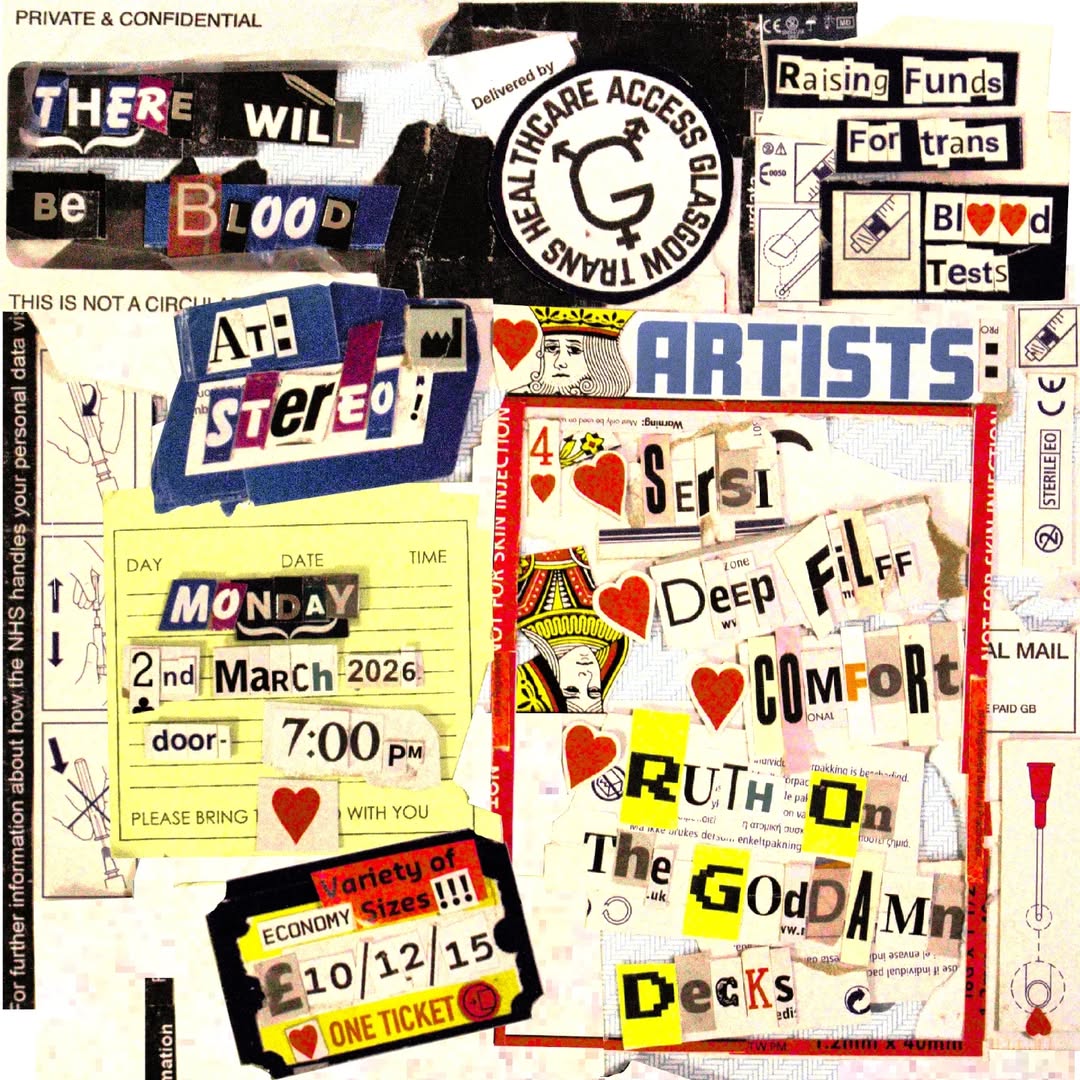
I’m super hyped to announce I will be doing a DJ set at Stereo on 2nd March 2026 – performing for the first time as ROGD.
This will be at a gig for Trans Healthcare Access Glasgow. They are raising money to provide free blood tests for trans people who have otherwise been denied healthcare by the NHS.
Much like the Glasgow Electrolysis Project (who are now running a successful clinicin the city) the very existence of Trans Healthcare Access Glasgow is both an indictment of the NHS and a credit to our community organisers. It’s depressing that the UK’s state healthcare system has so profoundly failed trans people that many GPs are now refusing to even monitor the safety and efficacy of NHS-prescribed medication. But it is also truly excellent that we are building our own new networks of medical support, which offer an alternative to the cis-led medical systems that have abused and exploited us for decades. Through the work of harm reduction groups such as Trans Healthcare Access Glasgow, we are collectively less reliant on these systems than we have ever been.
Meanwhile, I have a long history as a rock DJ but don’t get behind the decks too often these days. While I’m hoping to perform a bit more often again going forward, there’s no guarantee – so snap up those tickets while you can!
This morning I logged into instagram and watched, transfixed in amazement and worry, as a young person scaled the walls of the Department for Education.
The aspiring spiderman is part of the activist group Trans Kids Deserve Better. At the time of writing they are staging a multi-day protest at the Department for Education building in London, for the right to a safe and inclusive education.
Watching the video, I fear for Squirrel, the anonymous activist who is genuinely risking their life to stop government employees from taking the group’s banner. It’s very apparent that Squirrel is a skilled climber who knows what they are doing – equally, one wrong move could result in a deadly drop to the concrete pavement. This is not safe.
But of course, the entire reason this protest is happening is because young trans people are not safe.
Trans Kids Deserve Better launched their campaign for youth autonomy, safety, respect, and inclusion in July, from a dramatically high ledge of an NHS England building. In an interviewwith Jess O’Thompson for Trans Writes, the emergency doctor and children’s TV presenter Dr Ronx Ikharia argued that “our young people deserve better than suffering, and shouldn’t be scaling walls”. But they added that for this to happen, trans kids must be “believed, supported, affirmed, and loved”.
And this is the crux of the issue. Under the Conservative and Labour governments, we have seen a policy environment in which teachers, doctors, therapists and parents are actively discouraged or prevented from believing, supporting, affirming, or loving young trans people. Instead, families face prison sentencesfor supporting young people’s continued access to medication, NHS England is expanding the provision of state-funded conversion clinics, and a growing number of schools are refusing to allow even the discussion of trans experiences.
Trans kids are not safe because they have been entirely failed by the adult world. They have been failed by politicians, failed by civil servants, failed by the NHS, failed by the voluntary sector, failed by researchers, and in many cases also failed by their doctors, teachers, and parents or carers. This is why the activists from Trans Kids Deserve Better are literally scaling walls in their fight for an actual future.
Looking at the challenges facing young trans people, it can be easy to lose hope. But the actions of Trans Kids Deserve Better show that there is a better way. Doomerism helps nobody. The successes of successive liberation struggles have come about because people have continually dared to believe that a better world is possible, and fight for it. The young people currently sat outside the Department of Education are not bemoaning what they have lost: they are insistently demanding change.
Image from Trans Kids Deserve Better
What can we do? In their conversation with O’Thompson, activists from Trans Kids Deserve Better explained that while trans adults often want to “protect” trans youth, they would rather we “amplify” them: “we don’t need sympathy, we need support”. This is a call to action, with a focus on solidarity, rather than trying to speak for young people or bemoan their situation.
Many adult trans people and allies have complained about the lack of mainstream media coverage for the actions of Trans Kids Deserve Better. But we should not simply wait for the papers or news programmes to start caring. It’s up to us to talk about what’s happening. Today’s queer and trans communities only exist at scale because we made our own media, told our own stories, and forced the mainstream to catch up.
So I encourage everyone who reads this to share the story of what is happening. Share it on social media, share it with friends and family, share it in conversations at work and in bars and in cafes and in parks and at gigs and festivals. A few days ago I was at a pub in Bath, fresh from Pride, still holding a placard that read “Ban Wes Streeting” (copied shamelessly from someone else in Glasgow a couple of weeks prior). Someone asked what Wes Streeting had done, so I told her. She was appalled, but grateful to have learned what is happening, and better informed to act. Information spreads when we spread information.
If you, like me, would rather not see young people risking life and limb by climbing public buildings, it is time to fight with them, not “for” them. Together we can build a safer world.
On 12 March 2024, the UK Department of Education consultation on draft guidance on “gender questioning children” for schools and colleges will close. Until that date, we have our best possible chance to fight for the safety and wellbeing of young people.
Last month I wrote a long blog post and zine about this draft guidance: New Year’s Resolution: Smash the New Section 28. I argued that the guidance resembles the notorious anti-gay law Section 28, in that it aims to both directly oppress LGBTIQ+ young people, and create an atmosphere of fear and uncertainty around supporting them. This is to be done by reinforcing a strict sex binary. The guidance directly targets young trans people, but also threatens to enforce sexist and homophobic standards on all students, e.g. through stating that school uniforms should be allocated on the basis of “biological sex”.
I also argued that there are important reasons for hope, and many routes to resistance. One possible option is to take part in the consultation itself, but there are other approaches too, including noncompliance and resistance in schools, contacting politicians and unions to raise the alarm, supporting trans youth groups, and creative forms of protest.
Since I wrote Smash the New Section 28, the situation for young trans people has continued to deteriorate. In the UK, the Government has very quietly introduced a second consultation on proposals to segregate trans college students who are on trips or who would otherwise be sharing accommodation with other students. In the US, the murder of trans student Nex Benedict in a school bathroom shows just how dangerous the UK proposals would be in practice. I have updated my original post to reflect both of these events. Moreover, it’s emerged that the Royal College of GPs are hosting aconference for conversion therapy advocates in London, and the British public are more openly prejudiced towards trans people than they were just five years ago.
However, it’s also been really heartening to see how many people have read the blog post and shared the zine over the last month. I have particularly appreciated the support from the amazing independent Leeds book shop The Bookish Type, who have been giving away loads of free copies of the zine. I have heard from parents and bureaucrats who say they are using what I have written to argue for independent guidance that actually supports trans and gender non-conforming young people in schools and college.
You and the people you know have the resources to take action against the new Section 28. If the guidance is implemented, this will not be our only opportunity to fight back, but it is the best opportunity. Think about what you can do before 12 March: whether it’s writing to school governors or an MP, agitating in your workplace or union, or sharing information with others.
As ever, we can never win freedom alone, but have so much power when we act with others.
I found myself filling in a campus safety survey for my university’s Student Union yesterday. As I began the form, I thought about how safe I feel on campus.
I have this arguably unhealthy tendency to wander around all kinds of places alone at night, but inevitably feel a bit on edge and on guard in town and city centres. By contrast, I always feel comfortable on campus. I mean, this place is full of busy academic types during the day and feels quiet yet friendly at night. During the early years of my transition in particular the place was like a safe haven.
Moreover, I’ve always felt that I got off pretty lightly compared to many of my trans friends: I’m lucky really. I mean, I don’t get pestered by transphobic morons on a regular basis, and I’ve never been physically or sexually assaulted. At least, not since all those times I was beaten up as a teenager. But that was ages ago, and they had no idea I was trans (…right?)
Yet as I continued with the survey, I began to realise how much being trans causes us to redefine what counts as “lucky”, and, for that matter, what counts as a normal experience.
Firstly, there were the questions on physical attacks. Of course I’ve never been physically attacked! Oh wait, there was that time that someone threw a mysterious object at the back of my head outside the Union nightclub. Yeah, that time when the security guys clearly couldn’t care less and gave me some hassle because I immediately approached them and asked for help. Still, that was just the one time, right?
So, on to harassment. I know some trans people on campus who have had all kinds of horrible experiences in halls and suchforth but again, I’ve been pretty lucky. Except for that time I was subject to some totally inappropriate questioning during a club night at the Union: good thing my friends were there to stand up for me. And that time I was pestered by a chaser. And that time I was kicked off a bus and told to “cut my hair” after I got confused over the fare. And the time a woman refused to sell me a banana because she wouldn’t accept my gender(!) Huh, how these incidents build up…
These incidents are extremely infrequent, leading me to think that I’m lucky. This thought process points to the normalisation of transphobia: I’m entirely used to the idea that people will treat me like crap because of who I am. It’s something we all get used to, to one extent or another.
This normalisation then leads me to redefine safety. A safe place becomes a place where I experience minimal harassment, rather than somewhere I don’t expect to be harassed at all. I suppose I always expect to be harassed to some extent.
Of course, this is all par for course in the UK if you’re not a visibly abled middle-class white guy. Ho hum.



 Dr Ruth Pearce