How it feels to be a trans feminist academic in 2018

Trans feminist symbol, designed by Helen GThis piece is based on an email I wrote, in response to a message about “smear campaigns against gender critical academics” on a feminist academic mailing list.

I have updated and posted it here in the final day of the Gender Recognition Act consultation in order to give my cis readers some idea of how the past few months – and especially the last few weeks – have felt.

~

I would like to say something about how it feels to be a trans feminist academic right now, with the emergence of a growing number of “gender critical” voices in academia.

In the wake of Brexit and Trump, and with the renewed growth of far-right movements across the world, it seems that everyone feels empowered to speak out about their own personal prejudice. Trans issues are no exception.

When I first came out and transitioned as a teenager, almost two decades ago, one of the scariest things for me was using public toilets. Let that sink in for a moment. I was scared simply to use the toilet – for fear that people might shout at me, drag me out, maybe even beat me up. While that fear has dissipated for me, I have not been to a public swimming pool since my mid-teens, and have not even been swimming in the sea since my early 20s. This is because I am scared. I am scared of violent men, but I am also scared of violent women. Cis violence against trans people is a reality. I have an enormous amount of admiration and respect for trans people who are able to overcome this fear.

It was hard to come out in the early 2000s. There was an enormous amount of casual transphobia in the media. Guardian columnists wrote pieces such as “Gender Benders Beware”, TV programmes such as Little Britain and the League of Gentlemen were immensely popular, and 90s films such as Silence of the Lambs and Ace Ventura remained popular with my friends. Trans women were variously represented as a pathetic joke, as burly men in self-denial, deceptive liars or outright sexual predators.

Legislation such as the Gender Recognition Act 2004 and Equality Act 2010 was yet to see the right of day. It was therefore legal for employers and service providers to know all about my gender history; it was also legal to refuse to hire me because I was trans, fire me from a job because I was trans, deny me services and kick me out of shops, pubs, post offices, leisure centres (etc etc) because I was trans.

It was not easy to come out in this environment. There were exceptionally few openly trans people involved in public life – and none of them looked, sounded or acted much like me. I certainly hadn’t knowingly met any other trans people. I delayed coming out for years because I wasn’t sure if I was “really trans” (a phenomenon common among participants in my research). I thought that I might ruin my life. It was only the knowledge that my life would likely be ruined regardless, and the sheer awfulness of the alternative – becoming a man – that persuaded me to take the enormous step of coming out.

Consequently, I was very isolated during the first few years of my transition. I find it very hard to express how intensely lonely that experience was. Fortunately, my friends (mostly cis girls my own age) were immensely supportive, but it was difficult not to have any people with similar experiences to talk with. People with a very deep, complex relationship with our gendered movement through the social world, and/or our sexed bodies, such that we knew the assignation we received at birth was not right for us. People who felt a deep, deep relief upon transitioning socially and/or changing our bodies as appropriate.

It wasn’t until my 20s that I began to slowly, gradually meet trans people my own age – and what a relief that was! We could relax completely around one another, talk about our issues and experiences, reflect on our differences as well as our similarities. It was at this time that I encountered the term “trans bladder” – used to refer to the pain and urinary infections that could follow from not being able to use toilets outside of the home. Let that sink in.

I also began to realise the wider extent of the damage caused to other trans people by both external and internalised transphobia.

Many of my trans friends have attempted suicide, sometimes on multiple occasions. The first trans person I knew to take their own life was a member of a trans youth Internet message board I frequented when I was 16. Others would follow, including a housemate, whose body I discovered shortly before I was due to head into work to teach a class. When I see “gender critical” people disputing well-established trans suicide statistics, it feels like gaslighting. I know what happens in our communities when people are not affirmed and don’t have access to adequate support.

Other trans friends have experienced severe sexual violence, often in their youth, often in very public spaces such as school playgrounds. Trans people are at particular risk of various forms of sexual assault, violence, coercion and control – for example, 28% of trans respondents to a large Stonewall survey had experienced domestic abuse within the past year alone. When I see “gender critical” people talking about the supposed violent threat that trans women pose, I think about how when trans friends of mine are raped, our first conversation about accessing support is usually about whether or not it is safe for them to go to the local rape crisis centre. This is not something we can necessarily take for granted.

When academics and journalists “come out” as “gender critical”, scaremongering about changes to the law we have been fighting for for decades, representing trans women and girls as sexual predators, debating our access to legal rights and public spaces and women’s services, I wonder if they know who we are, what our stories are, what our experiences are like. Is it simply that they don’t know any trans people, that they are ignorant? Or is there a deeper cause for their hatred? Do they realise they sound less like feminists, and more like the fundamentalist religious right? (for an example of how fundamentalist Christians and “gender critical” feminists basically employ the same language and discursive anti-trans tropes, I recommend a look at the responses from organisations to the Scottish government’s recent consultation on gender recognition).

As for the notion that anti-trans campaigners are “gender critical”, and my use of inverted commas for this term – I spent an enormous amount of time thinking about gender, sex and sexism even as a teenager. I read about the social construction of gender, and it made sense to me as a concept, but it took me a long time and a lot of theorising to figure out how to make sense of that with relation to my own body and experiences. I began to figure out that sex was a social construct too, reflecting the construction of gender, many years before I would encounter the work of Emi Koyama and Judith Butler. In my 20s, I was heavily involved in the NUS Women’s Campaign, and I am now (among other things) a gender theorist. In recent years I have been interested as a scholar and campaigner in the drawbacks and possible benefits of gender equality schemes such as Athena SWAN, and the fight to tackle staff-on-student sexual misconduct.

People who object to pro-trans legislation and oppose our access to public space do not have a monopoly on being “gender critical”, any more than those who oppose abortion rights have a monopoly on being “pro life”.

The growing number of academics who hold “gender critical” positions wield an enormous amount of power over their trans students, and have the potential to cause an enormous amount of harm. There are more and more of these trans students every year – of course there are. The exponential growth in the visible trans population is an outcome of the assertiveness of trans activists, our increasing visibility in public life, and a more positive legislative environment. It was predicted on multiple occasions many years ago – by Lynn Conway in 2001, by GIRES in 2009 and 2011. This is the outcome of an invisible population gradually becoming visible – just as the number of young people prepared to be out as lesbian, gay and bisexual also continues to rise. This growth will, eventually, flatten out – but it will be a fair while before this happens, especially if the current backlash continues.

I hope that cis people reading this post reflect on what it feels like for me to be involved in feminist and women’s groups at this time, especially as “gender critical” conversations become more common. It feels terrifying. I am petrified about where the discourse is heading within feminism as well as within the wider social world, and I am very scared about what might happen next, what violence might be perpetuated or excused in the supposed name of women’s rights.

I am hardly alone in this: I see trans friends freaking out en-masse every time I sign into social media. We know our history. Some of us survived Section 28. A precious few survived the AIDS crisis and surrounding moral panic. Many are also black, or disabled, or gay, or bi, or Jews or Muslims, or migrants. We know what happens when minority communities are scapegoated, and we know that the rise in transphobia is not an isolated phenomenon. We know that the most vulnerable among us are the easiest targets for hatred.

I worry every time I see a post goes up or message is written on a feminist Facebook group or blog or academic mailing list, every time somebody organises a feminist seminar or conference. I fear that someone will start raising “reasonable” concerns about my existence or civil rights, or lying about the supposed threat that I and others like me pose. For all that I move through the world as a woman, for all that I am a woman and have lived my entire life as a woman, for all that I am subject to sexism by clueless male colleagues and internalise the need to constantly apologise for myself at work, for all that I am harassed in public by men and fear male violence every time I leave work after dark, I start wondering what place I have in these groups. I start to wonder how many cis women think that somehow I am more privileged than them even though I am subject to both sexism and transphobia. I wonder how many feminists hate me.

When “gender critical” blog posts are written or emails are sent, I feel like I have a choice. Either I respond – and it may well take the form of an essay like this – an enormous outflow of nervous energy, fear and anger, energy that I will not get back repeating stories I am quite frankly bored of telling. Or I may attempt to remain cool and rational, encouraging calm and thoughtful debate even as I attempt to stem the rising panic inside. Or I try to ignore the message, even as it plays on my mind for the rest of the day, rest of the week, rest of the month, knowing that the environment has become a little less safe for other trans people – and especially other trans women – and especially other trans women less privileged than myself.

Or I just leave these feminist groups and mailing lists and academic collectives, which is of course what “gender critical” women would like me to do.

But not today. Today I stay. Today I fight. And I do not do this alone. For I know also that the majority of women support our cause.

As ever, I do this with my sisters.

Solidarity.
WE ARE REVOLTING: my first Trans Pride

There are a couple of looks I am very familiar with as a trans person.

One is primarily a look of confusion. It is the kind of look you might expect to receive if you were wearing a boot on your head. You have disrupted the everyday order of things, and people don’t know how to respond.

One is primarily a look of disapproval, communicating a barely-contained sense of disgust or revulsion. It is the kind of look you might expect to receive if you have smeared shit all over your face and are walking down the street as if nothing is wrong. You have disrupted the everyday order of things, and people are very unimpressed, but perhaps aren’t quite yet ready to shout or spit at you. But you imagine that they would quite like to.

I’m very used to these looks because I have received them a lot over the course of my life. More often when I was younger, my face and body as yet unchanged by oestrogen. But I still receive such looks now and again to this day, particularly when I put less effort into conforming to stereotypical expectations about how a woman should look or carry herself. Perhaps I have put on less makeup, or I am wearing baggy clothes, or I haven’t brushed my hair for a couple of hours.

Other trans people – particularly other trans women, and especially trans women of colour – are less fortunate than me. People don’t just look at them. The looks are merely where it starts. Then people shout at them, or spit, or throw stones. People pinch their arses or grope their breasts. I hear these stories from my trans friends pretty regularly. It’s like everyday sexism with the volume turned up.

Other trans people – particularly other trans women, and especially trans women of colour – are less fortunate still. People stalk them. People assault them. People rape them. People kill them.

They do this because we are revolting.

It starts with a look. Call it the cis gaze.

~

Today I saw so many looks of confusion and disapproval. I felt the revulsion. It was visceral. It was contained. It could not harm me. I was amongst hundreds like me.

Today I took part in a Trans Pride march for the first time.

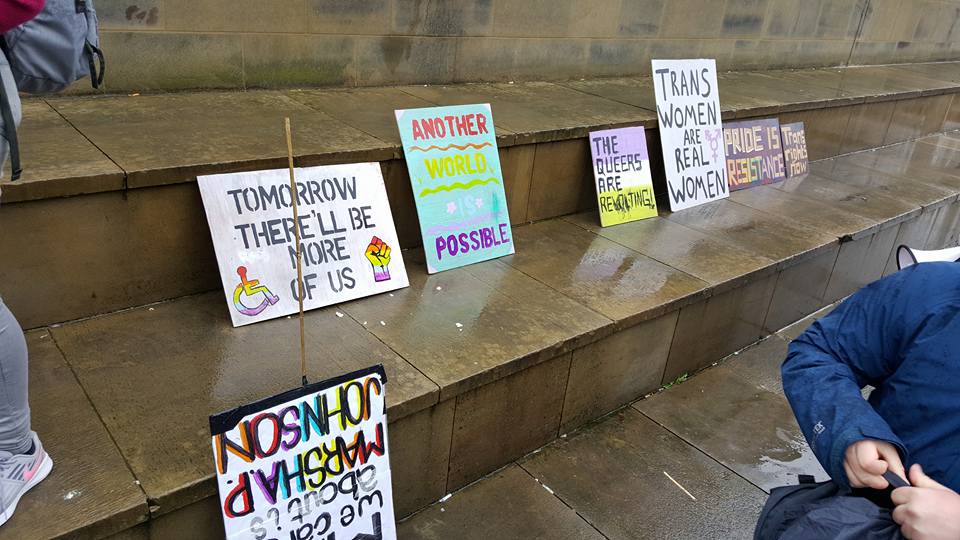
placard

Waiting for a bus before the march. Photo by Sophie Wilson.

Trans people have, of course, taken part in LGBT Pride marches for as long as they have existed. Trans Pride marches, however, are a relatively new phenomenon. The first Trans Pride in the UK took place in Brighton in 2013.  I attended Trans Pride Leeds, which is in its first ever year.

I have previously marched in LGBT Pride parades in Birmingham and London, and attended Pride parties in Coventry and Leamington Spa. On these occasions, people throng the streets. There is a sense of celebration. There is a giant street party. People come out to see the happy gays. They mostly look on with enjoyment. It is a family affair.

At Birmingham Pride one year, I was stopped by a “community safety officer”, who objected to my placard. It was not family friendly, he said. If I didn’t destroy or cover it up, he would call a police officer and I would be arrested. At London Pride one year, some people sought to control entry to a women’s toilet, ejecting at least one trans woman in the process.

Trans people are not necessarily welcome at LGBT Pride events. Or, if we are, we are not as welcome as many of our cis gay, lesbian, bi and queer siblings. Or, if we are, we are not seen or celebrated in the same way. We are not as safely contained.

But: there are a lot more cis gay, lesbian bi and queer people at LGBT Pride than there are trans people. We disappear into the crowd. We cause less confusion. We bring less disapproval. We do not so easily revolt.

This is why Trans Pride is important. This is why Trans Pride is necessary.


~

Today is Trans Day of Visibility, apparently. In the UK, trans people are more visible than ever.

Visibility has brought new dangers. We are currently subject to an unprecedented hate campaign in the media, spearheaded by “respectable” publications such as The Times and The New Statesman. On the Internet, we have attracted the dangerous attentions of a resurgent neo-nazi movement, their anti-trans campaigns bolstered by useful idiots who claim to oppose trans rights in the name of feminism.

Visibility has brought new opportunities. We see more of one another. We are more organised than ever. We have grassroots organisations in every city. We are producing art, music, plays, and films that speak to our own interests and concerns. We are marching in protest, we are marching in Pride. We seek gender liberation.

It will be a very long, very hard fight, but we are going to change the world.

We are revolting.

~

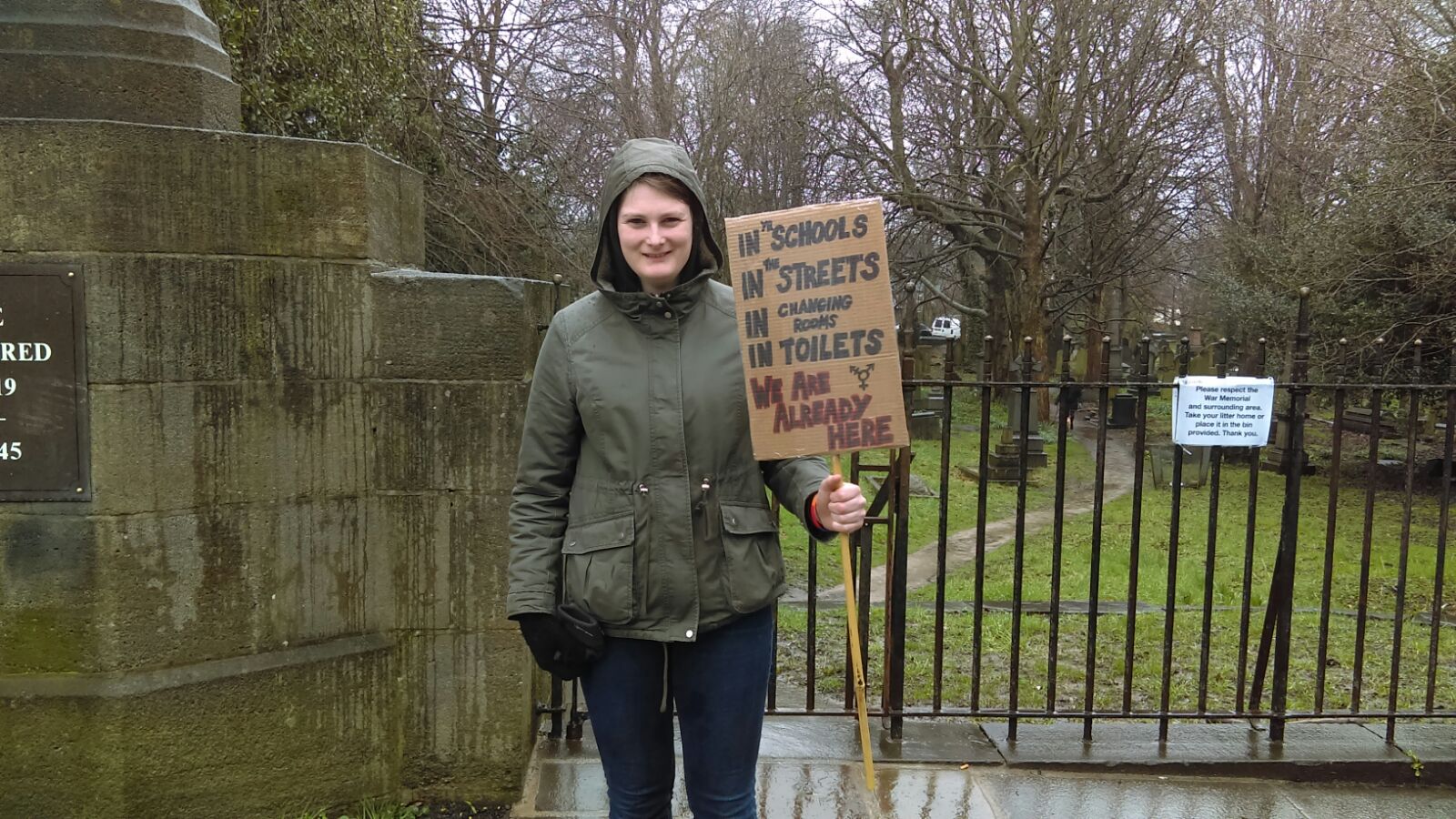
Today I saw so many looks of confusion and disapproval. I returned the gaze. I held my placard high. I shouted, joyously. They could not harm me. I was amongst hundreds like me.

I could not, would not be shamed, for I felt the power of Pride.

29792619_10211128952515449_1837457633094237365_n

Trans Pride placards. Photo by Natasha Handley.


Of memory and mourning: the hidden origins of an academic editorial

Experiences of co-authorship often remain strangely silent, oddly invisible.

In academic publishing, co-authorship is common; and yet, how often do we think about whose voice we are reading, and how a collaborative narrative emerged? How often do we teach students to write together rather than apart? What visions do we have of co-authorship?

I don’t think we talk enough about these experiences and issues.

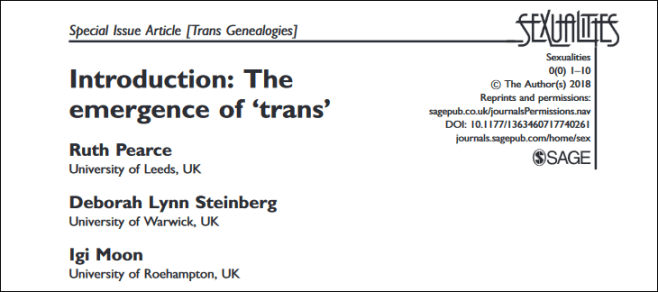
This week, an editorial I co-authored for the forthcoming Sexualities special issue ‘Trans Genealogies’ was published online. For me, this short piece carries a great deal of emotional weight. It was written under pretty unique circumstances, with my fellow author and former PhD supervisor Deborah Lynn Steinberg close to death. In this sense, it was hardly a standard experience of collaborative writing.

Screenshot of the editorial article "Introduction: The Emergence of Trans". The three authors' names are listed underneath the title.

However, in discussing my experiences of this article and others, I hope to offer some insight into an oft-hidden process of co-authorship, while encouraging readers to maybe reflect on their own experiences of collaboration.

~

Some co-authored articles owe their existence primarily to one of their authors. We might hope that this is the lead author, although this is not always the case.

Last year, I contributed to an article on research ethics for the journal Transgender Health. This was an exciting collaboration and a very interesting experience, with an international team of authors working remotely through the Internet to pool our ideas and expertise. It was an honour and a privilege to work with Jaimie Veale, Asa Radix, Danielle Castro, Amrita Sarkar and Kai Cheng Thom, and I learned a great deal from their considerable expertise in doing so. However, at the core of the writing project was lead author Noah Adams. While myself and the other authors did put a great deal of work into the article, Noah initiated the collaboration, produced the original article draft, oversaw the integration of our respective contributions into the piece, and acted as the primary point of contact for our communications with the Transgender Health editorial team. It was only right that he was credited as lead author.

On other occasions, I have seen how this kind of collaboration might be an exploitative one. During my time as a PhD student, I witnessed other postgraduates put this kind of effort into supposedly joint projects with their supervisors, only for the said supervisors to be credited as lead authors (or, on a depressing number of occasions, as the sole author). This was particularly disappointing in the context of social science subjects, where the presumption tends to be that the lead author did the majority of the work.

I had a very different experience of collaboration with Kirsty Lohman. Our article on de/constructive trans DIY music scenes will also be included in the ‘Trans Genealogies’ special issue. We wrote together, in the same room; sometimes taking turns to tackle individual paragraphs, other times constructing sentences together with one of us sat at the keyboard and the two of us almost competing to find the next word. It was a real joint effort in which we both put an equal amount of energy into the work. I am named as lead author only because one of us had to be; at the time the article was accepted, we agreed that it was more beneficial to my career at that point in time than it was to Kirsty’s.

Deborah related a similar history of writing collaborations with a close colleague and friend. She vividly described how she would furiously lay ideas down onto a Word document while her colleague paced the room impatiently, bursting with ideas of her own, before the two would swap places. Whole afternoons, whole days could be spent in fruitful (if sometimes fiery) joint authorship.

~

There was no such option for the ‘Trans Genealogies’ editorial. The special issue was originally Deborah’s idea, a follow-up to our 2012-14 seminar series Retheorising Gender and Sexuality: The Emergence of ‘Trans’. She pitched the series to the editors of Sexualities, wrote the Call For Papers, and provided extensive advice and support to authors who made contact prior to the January 2016 deadline. At the time I was happy for her to take the lead, as I had finished the majority of the data collection for my PhD and was focusing on writing up my thesis.

The deadline came and went, but myself and fellow co-editor Igi Moon didn’t hear from Deborah for weeks, then months. As her cancer advanced, she was increasingly ill and unable to continue leading the editorial work for the journal. Eventually, Igi and I took over the editorial process, overseeing peer review and seeking to ensure that Deborah’s vision could be fulfilled.

By January 2017 we had identified the seven research articles that would comprise the special issue, most of which were provisionally accepted or near completion. Unfortunately, it was also apparent that Deborah would not live to see the publication of the special issue. She was first house-bound, and then bed-bound. We visited her as often as we could, sharing stories from our lives and updating her on the progress of the issue.

I had originally envisaged that Deborah would take the lead on writing the editorial, just as she originally took the lead on editing the issue more generally. By the time we had a firm idea of the issue’s contents, however, it was painfully apparent that this would be impossible.

As it become increasingly clear that Deborah had just weeks (if not days) to live, I became obsessed with writing the editorial while she was still alive. I wanted it to be a true collective work, but how to do this when my collaborator could barely speak, let alone write – when this woman who had dedicated herself utterly to her work was finally unable to enjoy the intellectual pursuits that had been such a driving force in her life?

In the end, I decided to revisit Deborah’s previous writings and reflections, the ones that had inspired and galvanised the editorial project in the first place. I poured over her notes from the Emergence of Trans series, the agendas and essays she wrote for individual events, her introductory talk for the ‘Trans in Popular Culture’ seminar.

I met with Igi to discuss the contents of the special issue: the contributions of the individual articles, and their thematic place in the wider context of the issue and of the wider literatures to which they speak. We listed key ideas and phrases we want to incorporate into the editorial.

I re-immersed myself in the literatures of transgender studies, thinking about recent trends and emerging concerns as well as longstanding debates and histories. I also thought about Sara Ahmed’s comments on the politics of citation, and committed to a centring of insights from trans scholars and/or scholars of colour.

And then I sat down. And I wrote.

~

After finishing the editorial, I visited Deborah one last time. I was excited to tell her that it was completed, and to explain how inspired I had been by working with her ideas, working with her words.

But by this point she was no longer with us. Her body fought on for just a few more days while she restlessly slept.

~

In retrospect, it’s a somewhat flawed piece. The editorial offers a very brief, broad summary of the context in which specifically ‘trans’ discourses have emerged and been contested. It was, in a sense, constrained through the need to address a set of themes originally outlined by Deborah, now a simultaneously absent and ever-present co-author.

When I re-read the editorial, I do what perhaps every author does. I notice every awkward turn of phrase, every moment of repetition, every missing references (perhaps most prominent of these is Stryker, Currah and Moore’s piece ‘Trans-, Trans, or Transgender?‘, which I was unable to access through my institution at the time). Following Deborah’s death, neither Igi nor I had any appetite for further revisions. We sent it off to Sexualities, and thought little more about it.

Yet, perhaps the brief, intense process by which the editorial finally came into being is one of its greatest strengths. I wrote it in a fit of passion, pulling together our collective ideas with a sense of deep love and purpose. In this sense, my commitment to the field, and to the wider promise of trans liberation, was one with my commitment to my fellow authors, my collaborators.

And I feel it is a better piece of writing for that.

~

You can read the special issue editorial ‘Introduction: The Emergence of “Trans”‘ in the following locations:

Sexualities [with institutional access]

My website [free pre-proof version]


I will be writing a follow-up piece about the broader contents of the special issue next week.


From blog to academic website

In February, I completely revamped this site, creating a new “look”, and adding information on my academic talks/publications etc.

I’d been about creating a “professional” website and blog for some time, particularly as I intend to move ahead with my academic career. I wanted to use this to the stuff academics are supposed to do, like painstakingly list The Things We’ve Done At, but also wanted a platform from which to share information, ideas, and the odd polemic.

At the same time, I already had a pretty well-established blog, with archives reaching back to 2009. I don’t necessarily still stand by everything I might have once said – both the world and my perspectives on it have changed quite substantially over the last few years – and with time I’d also been blogging less and less as my attentions turned to my PhD thesis. But I don’t want to lose that personal history or sense of continuity in my life and writing.

So rather than officially retire Trans Activist Takes On World (as this site was previously known), I’ve decided to incorporate the old into the new, keeping the blog’s archives as a part of my academic website. To be honest, I’m expecting to continue writing on trans health, trans activism, LGBT issues, feminism, UK politics and the odd bit of punk/metal music. I’m also going to incorporate updates on planned talks (and possibly gigs!), something I previously blogged about at Ruth’s Corner. And this isn’t the first time I’ve changed the title or my approach to the site – I originally wrote anonymously as Trans Youth Takes On World, and also briefly titled the site Writings of a Trans Activist.

cropped-trans-activist-banner

ye olde blog header

I’m still not expecting to write here anything like as often as I used to. The double irony of completing my PhD is that I’ve been writing pretty much constantly ever since, but have also had very little time to do any more creative or reflective pieces for this blog (or any other site). Instead, I’m focusing on two(!) books and a number of book chapters and academic articles, which should be realised gradually over the coming year-and-a-bit.

I’m planning to write some more about all of these as they reach completion. I’m also aiming to make as many of the journal articles as possible freely available, posting non-final versions on this site so people can read them.

So, I hope you’ll stick around for my new journey. As ever, I’m interested in changing the world for the better – academia happens to be my chosen medium at present.

Rest In Power: Deborah Lynn Steinberg

A week ago today I heard that Professor Deborah Lynn Steinberg had died. It was not unexpected – Deborah had been ill for a very long time. Nevertheless, the news hit me hard. Deborah was my PhD supervisor, and before that also supervised my MA dissertation. Together with our colleague Iggi Moon, we organised a seminar series between 2012 and 2014, and more recently have been collaborating on editing a special issue of Sexualities and an edited book.

Through these projects, Deborah has been a hugely important and inspirational figure in my life. I’ve written a piece about this for Discover Society, reflecting on her intellectual generosity and the complexity of her relationships with her students.

In the coming months I’ll be sharing details of the Sexualities special issue (entitled “Trans Genealogies”) and the book, for which we’ve been offered a contract by Routledge. I miss Deborah terribly and it feels very strange to be working on some of her posthumous publications, but I feel very honoured to be in this position. I hope we can do justice to the spirit of her insight and intellect.

deborah-lynn-steinberg-640x300

This space left unintentionally blank

It’s been quite a while since I last updated!

That’s not to say that it’s been quiet in the world of trans politics – quite the opposite, in fact. In the UK alone we’ve seen #transdocfail, the furore over cissexism/transphobia from Suzanne Moore and Julie Burchill, the tragic death of Lucy Meadows, the publication of various interesting reports and the creation of various worthy campaigns…in the last few months we’ve seen pain, misery and hope.

I’d like to be writing about all of this. But, as always, the update schedule on this blog is less about what I necessarily think is interesting/important, and more about what I have the time and/or motivation to write about. In recent months I’ve been very busy, and I think I’m likely to remain busy for some time to come.

Much of my energy has been focussed on my PhD research, which looks at discourses of trans health. You can read about there here.

I’ve also been busy with playing music in bands (particularly Not Right) and organising academic events (including Spotlight on: Genderqueer and the Emergence of Trans seminar series).

I suspect there will be a time when I update this blog more regularly once again. Until then, feel free to keep checking back – I’ll be here occasionally!

Shameless self-promotion!

I found myself in a studio recently with my Not Right bandmates, recording a number of the songs we’ve written together in the last year. The resulting EP is pretty rough and ready, but we feel it sums up pretty well we are as a band right now.

If you like angry female-fronted punk and/or music with trans themes, you might enjoy it!

Trans Grrrl Riot, part 2: why sing “Rebel Girl”?

Shouting is fun

I’m in a band called Not Right. We’ve been “together” for a little over a year now. I often describe the music we play as “riot grrrl”, because I feel inspired by the ideals and music associated with the term. My bandmates have a somewhat different relationship with “riot grrrl” to me; we’re all pretty cool with this multiplicity of positions.

Bikini Kill’s “Rebel Girl” was the very first song we learned together. At the time, this seemed like a pretty straightforward decision, as it’s a really “easy” piece. But the more I think about it, the more I feel that it’s very interesting that we play this song.

Why riot grrrl?

There’s a fair amount of talk about the idea of a riot grrrl revival floating around the Internet, with an apparent increase in interest from 2010 or so. At the same time, there are words of caution from those involved in the original riot grrrl movement: a recent example can be found in this interview with Kathleen Hanna, published just last week.

She says:

Everyone is always asking me, “How do we restart riot grrrl?” And I’m like, “Don’t.” Because something’s organically going to happen on its own; you can’t force it. Who wants to restart something that’s 20 years old? Start your own fucking thing.

A more nuanced analysis can be found in a blog post from 2010 at Side Ponytail:

I feel like there’s been a lot of talk about how “original” riot grrrls are protective of/territorial about the riot grrrl movement. That they are, perhaps, trying to keep all of the riot grrrl for themselves. I don’t think that is true AT ALL. In fact, I think that they are working to encourage parties who are interested in riot grrrl by telling them, “You are already valuable and should be doing your own thing,” and I don’t think that there’s anything wrong with that message. I think they’re also working to make people who weren’t a part of the original riot grrrl scene more cognizant of some of riot grrrl’s troubled history in the hopes of preventing a scene that blindly and unintentionally reproduces those same failings. While many people speaking out in the interests of having a riot grrrl revival have indicated that they are aware of these issues, there seems to be a general consensus that “we’re all more educated now and these things won’t be problems anymore,” which is an approach that really worries me.

[…]

I’m also a little bit troubled by the general attachment to the riot grrrl name. To me, at this point in time, such an attachment suggests more of a brand name identification than anything else. I can be a girl, play a guitar, make a zine, write letters to friends, engage in community building, etc. all without calling myself a riot grrrl. Naming something is a very loaded act and I wonder, if we’re all so aware of riot grrrl’s problematic history and the bad baggage that the riot grrrl name often carries for working class girls, pocs, and transfolk, why we want to carry that name over into a movement that is supposedly more inclusive and aware.

Okay, so here’s the deal. I’m a white, middle-class trans woman in my mid-20s, writing in 2012. I never had the opportunity to get involved with riot grrrl because I was way too young. But, in spite of its problematic elements (including cissexism and transphobia) I still find the history of riot grrrl, the music, the language, the very sense of challenge inherent in the term itself, deeply inspirational.

I look beyond riot grrrl. For years I’ve been inspired by contemporary female-fronted heavy metal bands such as The Gathering and Within Temptation. I’m also into acts who pre-date riot grrrl, like Joan Jett and Girlschool. But in riot grrrl I find that perfect meeting of punk spirit and feminist politic in the context of furious riffs and brilliantly ragged vocals.

Riot grrrl is fascinating because it was, in a sense, a small local scene that hit well above its weight in terms of international influence. Feminist musicians all around the world remain inspired by it. And in light of this, I do think that it’s possible, and positive, to “revive” riot grrrl: in fact, the revival is well underway, and we are doing it differently.

Riot grrrl in 2012 remains feminist, DIY, largely (but not entirely!) punk. But it’s now international, facilitating conversations between female musicians around the world: a great example of this can be found in the free compilations released by the Riot Grrrl Berlin collective. The political focus has shifted towards an intersectional feminism that takes account of diversity along axes such as race, dis/ability, gender identity and sexuality. We are doing our own thing, but we want to call it “riot grrrl” because of the inspiration we take from the music of a particular time and place.

I’d like to think that most of us are aware of the imperfections as well. We know that riot grrrl didn’t get it right. We know that we’re not going to get it right. Being aware of these limitations is the only way we stand a chance of gradually becoming more awesome over time.

Why Rebel Girl?

As a trans woman, I’m also very aware that both the original riot grrrl movement and many of the original riot grrrls weren’t particularly trans-friendly. Bikini Kill lead singer Kathleen Hanna hasn’t exactly got the greatest record on this front either. So why do I want to sing her song?

For me, “Rebel Girl” is punk as fuck: it’s ridiculously catchy and very powerful (both musically and lyrically) because of its simplicity. It’s accessible for both listeners and musicians (including those musicians who are literally just starting out, as I was last year). If you play it with passion, it can sound fantastic even if you’re technically not particularly great as a singer or on your instrument.

That girl thinks she’s the queen of the neighbourhood
She rides the hottest trike in town
That girl she holds her head up so high
I think I wanna be her best friend yeah

As a woman, I feel that I have the right to claim this song; I have always been inspired by the strength and achievements of my feminist sisters. As a trans woman, I feel that it’s productive to claim art with a problematic history and make it my own.

Rebel girl, rebel girl
Rebel girl you are the queen of my world

“Rebel Girl” becomes about my own relationship with riot grrrl: I celebrate how the song has inspired me. Even better, there’s some pretty blatant subtext acquired by the lyrics when sung by a trans person.

Rebel girl, rebel girl
I think I wanna take you home I wanna try on your clothes oh

I further identify with the song as a bisexual woman, and as an activist. When Not Right play “Rebel Girl”, I feel a connection between queer past and queer future.

When she talks, I hear the revolution
In her hips, there’s revolutions
When she walks, the revolution’s coming
In her kiss, I taste the revolution

The song is also a magnet for lesbionic dancing

There’s more than one studio version of “Rebel Girl”. The differences lie mostly in the recording quality and performance style, but there’s also variation within the lyrics of the third verse. One version labels the titular girl a “slut”, another calls her a “dyke”. At queer events, I’m more likely to sing the latter line. In the light of contemporary political commentary over slut-shaming, I also like to sing the former. This ambiguity fits well with the song’s popularity as a cover: there is no absolute, authoritative version. And that’s as it should be.

That girl thinks she’s the queen of the neighborhood
I got news for you, she is!
They say she’s a slut, but I know
She is my best friend, yeah

I believe that any girl can be a riot grrrl. When I sing “Rebel Girl”, I reclaim a version of riot grrrl for here and now, and for some of those who were marginalised the first time around. Maybe you can find a similar power in such songs?

Trans Grrrl Riot, part 1: Was riot grrrl transphobic?

Edit: 27/11/18.

This post remains remarkably popular! I want to leave it intact because it reflects my perspective as of 2012. However, as trans people and cis women alike face attacks from a resurgent fascism, I continue to believe in a politics that allows for people to learn and grow beyond the prejudices (inadvertant or otherwise) and mistakes of their earlier selves. I therefore feel it important to acknowledge that Kathleen Hanna has explicitly and consistently expressed support for trans rights in recent years, and for this I am grateful.

I also remain a massive Bikini Kill fan.

~

Original post:

Bikini Kill

Bikini Kill

I love Bikini Kill. I love the uncompromising power of their music, the feminist rage in their lyrics, their wider political approach. Bikini Kill who inspired me to finally pick up the bass guitar that had sat forlorn in a corner of my room for several years, and Bikini Kill helped me believe that I could make music.

I realise it’s a bit of a cliché, but they’re the band responsible for getting me into riot grrrl, and from there  began to explore feminist punk music (including that from contemporary UK bands) more widely.

I wanted to be a riot grrrl too, and was sad that the original movement faded away back in in the mid-1990s, well before I was ever aware of its existence.

Trans invisibility

However, riot grrrl doesn’t necessarily have the best reputation amongst trans people familiar with its history. I haven’t come across an account of (or by) a single trans woman who was involved in riot grrrl during its early 90s heyday. We weren’t the only ones to be marginalised either. The original riot grrrls may not have all been as middle-class as the mainstream media would like to make out, but the scene appears to have been predominantly white.

I haven’t come across anything particularly transphobic  within those 1990s riot grrrl recordings and writings that remain in circulation on the Internet today. Still, various high-profile individuals made their views entirely clear through their involvement with the famously trans-exclusive Michigan Womyn’s Music Festival (also known as “Michfest”).

Trans exclusion

In 1999, controversy erupted after queer punks The Butchies played Michfest. Butchies frontwoman Kaia Wilson had previously been a member of riot grrrl band Team Dresch, and at the time was also running Mr Lady Records jointly with Tammy Rae Carland (a zine editor, spoken word performer, and subject of the Bikini Kill song For Tammy Rae).

A number of trans activists approached Mr Lady Records, asking the label – and its bands – to boycott Michfest. Wilson released a statement claiming to support trans rights, but also backing Michfest’s “womyn-born-womyn” policy. A 2010 interview suggests that she has not changed her views on the matter.

In 2001 and 2005, feminist electro-pop act Le Tigre were similarly criticised for playing Michfest. The group were fronted by Kathleen Hanna, former lead singer in Bikini Kill. Like The Butchies, Le Tigre were a sort of post-riot grrrl act: they came into being after the original movement faded away, but have become associated with riot grrrl in the minds of many both because of their politics and because of the involvement of particular musicians. Le Tigre were at one point signed to Mr Lady Records, although the record label dissolved in 2004.

Le Tigre don’t seem to have been in the slightest bit apologetic about playing Michfest. The argument was once again that womyn have a right to organise autonomously, with the unspoken proviso that trans women are (obviously) not womyn. Of course, this perspective couldn’t possibly be transphobic, what with all the gender-bending the band indulged in.

There’s also lot of talk on the Internet about Hanna also supposedly writing transphobic essays during the 1990s, but I’ve yet to see any evidence of these (and it seems I’m not the only one).

It’s interesting that Le Tigre (and, through Hanna, Bikini Kill) remain implicated in all of this, whilst The Butchies, Mr Lady Records, Tammy Rae and Team Dresch do not. As of 2012, trans activists and allies are still quick to condemn Bikini Kill as “problematic” in Tumblr posts and blog comments. This is no doubt down to the wider media profile experienced (although not necessarily enjoyed!) by Hanna and the various bands she’s been involved in. Wider criticisms of transphobia and cissexism within riot grrrl seem confined largely confined to blogs written by somewhat disallusioned veterans of the original movement.

Meanwhile, whilst Hanna doesn’t seem particularly keen to explicitly distance herself from her past actions and/or comments, she does seem to have quietly moved on, at least somewhat. In more recent interviews she can be seen praising “trans activism”, and earlier this year one fan reported receiving an interesting letter about the matter.

…So?

What does this mean for Bikini Kill? Not a great deal, in my opinion. Kathleen Hanna – a woman whose relationship with the media has always been complex – is not a perfect human being, and has said and done some fairly awful things. Her implicit support of Michfest in particular was never acceptable. She appears to be increasingly aware of this, and has clearly made some moves to educate herself. Still, an explicit acknowledgement of her past cissexism would certainly be welcome.

However, Hanna is in no way the totality of  “Bikini Kill”, let alone “riot grrrl”. As her bandmate Tobi Vail pointed out:

We are not in anyway ‘leaders of’ or authorities on the ‘Riot Girl’ movement. In fact, as individuals we have each had different experiences with, feelings on, opinions of and varying degrees of involvement with ‘Riot Girl’ […] As individuals we respect and utilize and subscribe to a variety of different aesthetics, strategies, and beliefs, both political and punk-wise, some of which are probably considered ‘riot girl.’

The very rifts that fractured riot grrrl also gave it strength, for there was no one dogmatic, overriding ideology to bind it. Kaia Wilson, Tammy Rae Carland and Kathleen Hanna were not the movement. As a young woman looking back at a feminist movement I never had the opportunity to be involved with, I’m left with the impression that riot grrrl did not wholly welcome trans people, but did not intentionally reject us either (in spite of the backwards attitude of certain participating individuals). And of course, this situation wasn’t really good enough, but it’s nowhere near as bad as it could have been.

The future

Fast-forward to 2012, and the idea of riot grrrl is once again gaining a certain cultural currency. The mainstream media are arguably rediscovering riot grrrl in the light of Pussy Riot’s magnificently brave actions of personal resistance, but new bands and collectives have been springing up around the world at an impressive rate for the last two or three years.

Doll Fight

Riot grrrl never really went away: whilst former members of the original movement founded started new bands, new record labels, and new approaches to opening up underground music to girls and women (such as Ladyfest and Girls Rock Camp), there were always individuals and bands who clung to the label. Recently, the idea of a “riot grrrl revival” has blossomed into something more vital on a local, national and international level.

In the UK alone there are now local groups such as Riot Grrrl Birmingham emerging; frequent local events such as Riot Grrill in Leeds, Pussy Whipped in Edinburgh and Riots Not Diets in Brighton; and a whole host of new bands, many of whom communicate with one another through means such as the Riot Grrrl UK group on Facebook.

And one of the many wonderful things about all of these groups is that they’re all explicitly trans-inclusive. They’re not only drawing upon trans language and symbolism: they also see trans struggle as feminist struggle. These are groups that seek to understand cissexism and binarism, groups that talk about supporting CeCe McDonald in the same way that they talk about Pussy Riot.

Similarly, the international music compilations released regularly by the Riot Grrrl Berlin collective explicitly welcome trans artists, and ban transphobic language. There are even (shock, horror) riot grrrl bands with trans members emerging.

We should learn from the past, but not be bound by it. Trans-inclusive riot grrrl is finally here. Let’s make the most of it!

A space for our voices

A couple of blog entries posted on the same day earlier this week have been making me think about the power and importance of “trans space”.

CN Lester wrote about Andrew Hodges’ biography of Alan Turing. They picked out a passage that beautifully illustrates the sheer emptiness, isolation and alienation that can come with growing up queer:

“The deprivation was not one of laws but of the spirit – a denial of identity. Heterosexual love, desire and marriage were hardly free from problems and anguish, but had all the novels and songs ever written to express them. The homosexual equivalents were relegated – if mentioned at all – to the comic, the criminal, the pathological, or the disgusting. To protect the self from these descriptions was hard enough, when they were embedded in the very words, the only words, that language offered. To keep the self a complete and consistent whole, rather than split into a facade of conformity, and a secret inner truth, was a miracle. To be able to develop the self, to increase its inner connections and to communicate with others – that was next to impossible.”

Like CN, this resonates with me as I reflect upon my own experiences as a trans teen. It was hard to find any representations of trans people, let alone any that weren’t deeply problematic. It was even harder to come by writings, art and stories by trans people, in which trans lives were rendered intelligible, human, possible. I felt like a freak, I felt like I was broken, ill, wrong. And I suffered largely in private. Needless to say, this wasn’t particularly good for my mental health.

This is why I feel that it’s so important to have trans people who are out, and trans people who produce art. It’s why I agree so strongly with Kat Gupta’s post about the trans tent at Nottinghamshire Pride. Kat writes:

There was something magical about being in a tent and being able to listen and watch people who articulated some of my fears and anxieties and desires. There were trans* people speaking and singing and playing about trans* experiences, and cis performers adapting and selecting their work to speak to us. Not us trying to eke out a trans* interpretation of a song or a poem, but them finding the points where we could understand each other. It was people exploring gender and all that came with it; negotiating the NHS, the harsh realities of genital surgery, the misery and joy we find in our bodies. […] In this tent we were able to do something special, and create a space that was visible and proud and joyful and intersectional and defiant.

In my previous post I waxed lyrical about how wonderful various acts were, and how much fun I had playing there myself as part of a band. Kat captures the totality of this experience, and the importance of having a space in which we can come together to share our stories and develop the self, avoiding the fate of Alan Turing.

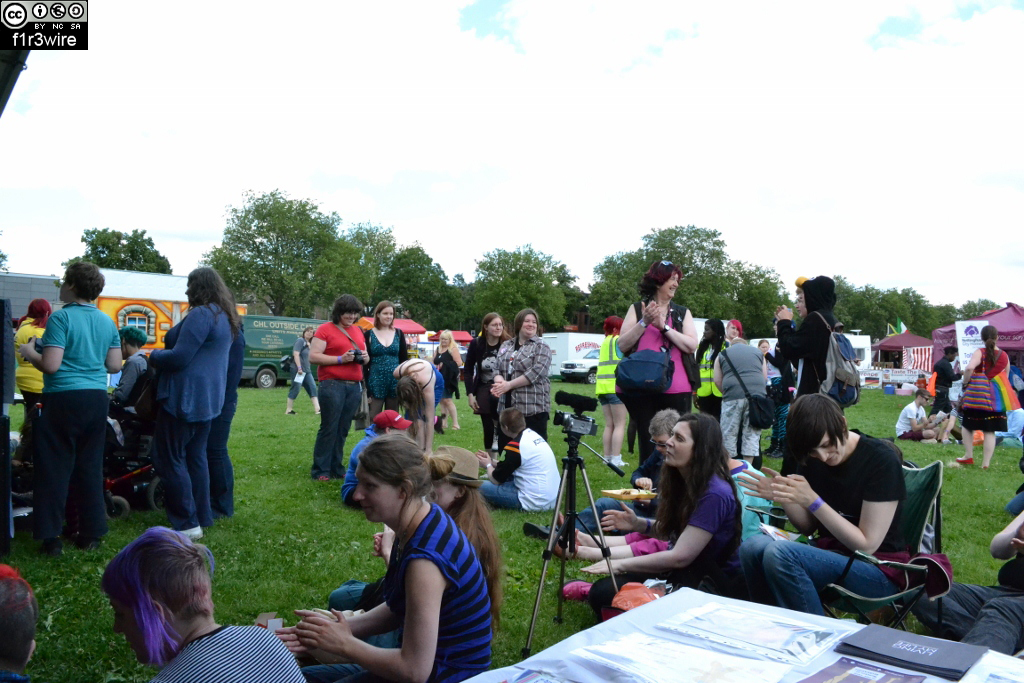
Crowd outside the trans tent at Nottinghamshire Pride. Photo by Eriw Erif

Members of my family occasionally ask why I bother organising or contributing so much to queer or trans spaces. After all, isn’t there a larger audience for events with more of a broad appeal? Plus, since the goal is to achieve equality, surely it doesn’t help to just segregate ourselves?

I think these perspectives completely miss the point. Spaces centred around straight and cis people are everywhere. These spaces are automatically about straight/cis art, straight/cis voices. Queer spaces are relatively rare, and trans spaces rarer still. It means a lot to go to one of these rare, beautiful spaces knowing that your story will be told. This is why I wrote with so much enthusiasm about Poltical: A Gender last year,  and a similar vibe can be found in CN’s post about the Trans* Education and Determination conference (TRED). It would be wonderful if such spaces were less rare.

Moreover, many trans organisers and performers are very aware of the dangers that come with shutting ourselves off from the world. This is why spaces such as the trans tent, Political: A Gender and TRED are very deliberately open to all, and it’s why we are so often open to contributions from cis allies. It’s why trans issues are just one part of the lyrics I write for my band, and it’s why I’m always keen for us to play “straight” venues as often as possible.

So let’s continue to expand the possibilities of trans space and trans art. The trans tent alone featured poetry both epic and personal, acoustic music, hip-hop, opera, burlesque and punk. There’s so much that we can share! It doesn’t matter whether you’re an artist or a consumer of art, an organiser or an attendee, trans or cis. Come and join us in celebration. There’s so much we can build together.