(Guest Post) Draft Protocol Review

A review of England’s draft protocol for gender dysphoria services by CL. You can read a copy of the draft protocol here, respond to the survey here, and read my own analysis here.

Following the lead of an information note published by the department of health, the draft protocol confirms and compounds the problems of treating gender dysphoria on the NHS. It would at least mostly standardise treatment protocols across England, burdening everyone with the same problems: We’re all in this together, right?

The Gender Services Clinical Reference Group is aiming to implement standardised service provision by April 2013 and has given interested groups until September 30 to respond. GIRES has responded, as has Terrence Higgins Trust’s Trans* Women’s Sexual Health and Wellbeing Group, whose submission I contributed to. Our issues with the Department of Health’s Information Note are seen again here, and I’d like to focus on those in particular: the framing, tailoring and requirements of treatment.

Framing Gender Services Treatment

A problem in the protocol that has carried over from the information note and current practice, is the framing of gender dysphoria treatment as the property of psychiatric specialists. Even in updating the condition being treated to ‘gender dysphoria’ from Gender Identity Disorder, which explicitly frames the problem as one with our gender identities rather than our physical characteristics and the dysphoria resulting from them, the protocol places gender dysphoric people under the care of “a mental health professional (eg. psychiatrist or psychologist) who specialises in transsexualism/gender dysphoria and has general clinical competence in diagnosis and treatment of mental or emotional disorders.”

The logic behind this in the current protocol is not forthcoming. Perhaps it is because there’s a likelihood of additional mental health issues due to the stress of dysphoria. Realistically, it’s because dysphoric people have always been treated as mentally ill, and tradition has kept us under the exclusive care of psychiatrists.

Assessment is a large part of the GICs role: confirming that we have Gender Dysphoria and are not merely deluded about our gender identities. Gender Dysphoria strong enough to necessitate transition is rare, certainly, and doctors are warned to be warey of ‘Zebra diagnoses’ (as House of God, the inspiration for ‘Scrubs’ described them). That is, when you hear hooves, think horse, not zebra. That’s sensible advice, but if you’re in southern African plains, thinking Zebra first might not be so unreasonable. In this case, if someone is distressed by their assigned gender and sexed body, identifies strongly as another gender and feels relief when living as that gender, a diagnosis of ‘trans*’ is the most likely answer. Trusting this principle would rob the GICs of hours of questions about your childhood hobbies and masturbatory habits, but it would free up a lot of unnecessary appointments.

Scotland has already moved away from the complete ownership of Gender Services by mental health teams, allowing patients to self refer to a GIC. This saves an appointment with a GP, one with a community mental health team and allows direct access. For those who need a diagnosis, removing these two stages of waiting, where ignorance or prejudice can delay or waylay a patient, can get them that diagnosis quicker. Given the burden on admin staff and funding, a time, appointment and money saving move like that is far better than the protocol’s recommendations.

Tailoring Service

The introduction to the protocol claims that it is ‘informed by the 7th edition of the WPATH Standards of Care’ – sadly, it isn’t based on them. Some key recommendations from the 7th SOC were: HRT could be prescribed without RLE and one assessment, Lower Surgery required only one year of RLE (rather, one year of HRT). None of those recommendations are followed here, so the role of the 7th SOC’s ‘informing’ is not apparent. As Ruth points out, this is essentially just the existing Charing Cross treatment.

The protocol makes references to giving patients time to consider other options, other approaches, time to reflect and, of course, the RLE’s time to consolidate. There can be great value in this and many people seek the GIC to explore and understand their gender identity. Chances to really assess their history, feelings and situation can be very valuable. A friend in this situation said that her diagnosis brought her great relief and confirmation of her feelings.

For others though, this is unnecessary. Many others will have thought, reflected and considered extensively, almost exclusively at times, before seeking a GIC: they know who they are and what they need. For them, the numerous stages to access a GIC, double assessments and arbitrary RLE periods merely delay them, take up clinic time and appointments and cause additonal frustration as they wait for their treatment.

Clinics shouldn’t be forcing surgery on everyone at the first appointment, but the slowest common denominator approach is hardly ideal either, and unnecessary, arbitrary waiting is positively detrimental in many cases.

Requirements

Despite the 7th SOC’s ‘informing’ of the protocol (perhaps they were low on coasters?), RLE remains a key feature of the proposed gender services. The protocol is unclear about RLE requirements for HRT, but indicates that full HRT can be prescribed ‘Dependent on whether an individual has socially transitioned in the sense of living full time’ or is likely to ‘do so immanently’. Top surgery needs a year of RLE, lower surgery needs 2 years.

The problems with this are numerous:

  • It’s arbitrary. There are medical reasons for a year of HRT for lower surgery, but not for living full time in role.
  • Requirements of being employed have nothing to do with a stable, well founded gender identity.
  • Whilst individuals vary greatly, some people have considerably more difficulty being read as their gender prior to HRT, and AMAB people are more likely to recieve certain forms of harassment if people read them incorrectly. Forcing people into public facing roles to get the treatment they need puts them at direct risk of violence, harassment and discrimination.
  • What ‘real life’ is being experienced? From my own and others’ experience, I know that living full time as a woman pre HRT is vastly different to being full-time after a year on HRT. The near daily abuse and marginalisation, with incumbent stress, is not the real life I’m  experiencing now, but was a feature of living as a woman who was visibly trans*. The RLE required is entirely unrepresentative.
  • For all the regional variation and obfustication, the 2 years of RLE for surgery is well known, and patients work to it. The lengthy requirement can prompt patients to ‘start the clock’ running on RLE long before they are ready. Who knows how much suffering has come from that, or from knowing that no help will come before an arbitrary deadline?
  • Patients remain on the GIC’s book during this period: the aforementioned zebras get called in for appointments to needlessly check that they’re still serious, then sent away to wait another 5 months. This takes up appointments that could help patients who are less certain of their needs.

Overall, this protocol standardises existing Charing Cross treatment, which is already behind the times in not adjusting to WPATH’s SOC 7, and seems particularly inadequate when compared to the updated Scottish protocol. Most worryingly, its requirements standardise the appointments that add to the waiting times, administrative burden (which currently means Charing Cross are taking 2-3 months to send appointment summaries) and sense of disempowerment that service users experience. With multiple screenings, assessment and ‘time for reflection’, it is particularly unsuited to those who have a clear understanding of their identity and wish to proceed, and who have thought over their option extensively prior to seeking a referral. If this protocol is to last for any significant time, it will hold service users to standards that are already inadequate – If the next update will last, we need to fight for a protocol that truly moves treatment forward, so make sure to give your views in the protocol’s survey.

A space for our voices

A couple of blog entries posted on the same day earlier this week have been making me think about the power and importance of “trans space”.

CN Lester wrote about Andrew Hodges’ biography of Alan Turing. They picked out a passage that beautifully illustrates the sheer emptiness, isolation and alienation that can come with growing up queer:

“The deprivation was not one of laws but of the spirit – a denial of identity. Heterosexual love, desire and marriage were hardly free from problems and anguish, but had all the novels and songs ever written to express them. The homosexual equivalents were relegated – if mentioned at all – to the comic, the criminal, the pathological, or the disgusting. To protect the self from these descriptions was hard enough, when they were embedded in the very words, the only words, that language offered. To keep the self a complete and consistent whole, rather than split into a facade of conformity, and a secret inner truth, was a miracle. To be able to develop the self, to increase its inner connections and to communicate with others – that was next to impossible.”

Like CN, this resonates with me as I reflect upon my own experiences as a trans teen. It was hard to find any representations of trans people, let alone any that weren’t deeply problematic. It was even harder to come by writings, art and stories by trans people, in which trans lives were rendered intelligible, human, possible. I felt like a freak, I felt like I was broken, ill, wrong. And I suffered largely in private. Needless to say, this wasn’t particularly good for my mental health.

This is why I feel that it’s so important to have trans people who are out, and trans people who produce art. It’s why I agree so strongly with Kat Gupta’s post about the trans tent at Nottinghamshire Pride. Kat writes:

There was something magical about being in a tent and being able to listen and watch people who articulated some of my fears and anxieties and desires. There were trans* people speaking and singing and playing about trans* experiences, and cis performers adapting and selecting their work to speak to us. Not us trying to eke out a trans* interpretation of a song or a poem, but them finding the points where we could understand each other. It was people exploring gender and all that came with it; negotiating the NHS, the harsh realities of genital surgery, the misery and joy we find in our bodies. […] In this tent we were able to do something special, and create a space that was visible and proud and joyful and intersectional and defiant.

In my previous post I waxed lyrical about how wonderful various acts were, and how much fun I had playing there myself as part of a band. Kat captures the totality of this experience, and the importance of having a space in which we can come together to share our stories and develop the self, avoiding the fate of Alan Turing.

Crowd outside the trans tent at Nottinghamshire Pride. Photo by Eriw Erif

Members of my family occasionally ask why I bother organising or contributing so much to queer or trans spaces. After all, isn’t there a larger audience for events with more of a broad appeal? Plus, since the goal is to achieve equality, surely it doesn’t help to just segregate ourselves?

I think these perspectives completely miss the point. Spaces centred around straight and cis people are everywhere. These spaces are automatically about straight/cis art, straight/cis voices. Queer spaces are relatively rare, and trans spaces rarer still. It means a lot to go to one of these rare, beautiful spaces knowing that your story will be told. This is why I wrote with so much enthusiasm about Poltical: A Gender last year,  and a similar vibe can be found in CN’s post about the Trans* Education and Determination conference (TRED). It would be wonderful if such spaces were less rare.

Moreover, many trans organisers and performers are very aware of the dangers that come with shutting ourselves off from the world. This is why spaces such as the trans tent, Political: A Gender and TRED are very deliberately open to all, and it’s why we are so often open to contributions from cis allies. It’s why trans issues are just one part of the lyrics I write for my band, and it’s why I’m always keen for us to play “straight” venues as often as possible.

So let’s continue to expand the possibilities of trans space and trans art. The trans tent alone featured poetry both epic and personal, acoustic music, hip-hop, opera, burlesque and punk. There’s so much that we can share! It doesn’t matter whether you’re an artist or a consumer of art, an organiser or an attendee, trans or cis. Come and join us in celebration. There’s so much we can build together.

Review: the Trans Tent at Notts Pride

Cross-posted from my band’s blog.

I’ve never been to a Pride event quite like the one in Nottingham.

I’m used to large inner-city affairs bounded by concrete, in which ordinary revellers festooned in rainbow clothing rub shoulders with extravagant drag acts, corporate floats, angry activist types, and a whole host of questionable human adverts employed by the big clubs. Vibrant street discos in which almost exclusively male DJs pump out the dance music that’s become synonymous with the scene, lesbian singer-songwriters singing quietly from small tent in a car park, community organisers and charities getting a word in edgeways whenever they can, and that same guy in the flat cap selling whistles on every corner.

I’m also aware that some Pride events are far smaller, less extravagant affairs. Pink picnics in town and city centres, small but powerful marches in areas of tension, and club collaborations between established scene names.

Nottinghamshire Pride was something else entirely. Placed slap-bang in the middle of a massive field, it was more akin to a (largely) family-friendly music festival, albeit one that happened to be really gay. There were many different tents, every kind of act you might imagine, and barely any of the corporate nonsense I’ve come to associate with Pride.

I normally object stridently to the idea of paying for Pride, but at £1 per head the entry cost struck me as entirely reasonable for all. And with an estimated 20,000 visitors, it’s a pretty good way to raise large amounts of money whilst minimising the need for dodgy sponsorship deals.

It was the most chilled-out, friendly and diverse Pride event I’ve ever had the pleasure of attending.

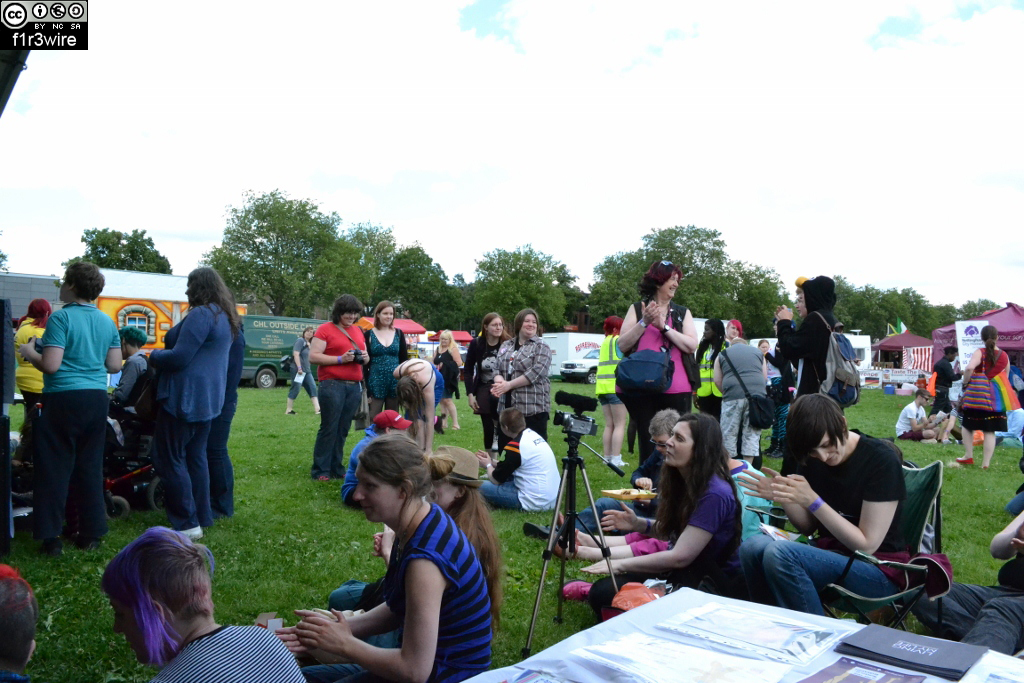
View from the Trans Tent.

We spent most of the day at the Trans Tent, so the content of my review reflects this. The very idea of a Trans Tent was pretty exciting given how marginalised trans people tend to be within the wider LGBTQetc community. Recreation Nottingham – a local support and social group – successfully won both the tent and a pot of money for performers after approaching the Pride organising committee, and proceeded to book a wide range of acts featuring both trans people and allies.

Things didn’t quite run according to plan on the day due to various delays, technical hitches and the like, but the Trans Tent was ultimately a triumph. Every performer was brilliant in their own way, and impromptu stage manager Jennifer of Single Bass did a great job of keeping everything running.

And so without further ado, and in (broadly) chronological order, a review of the acts I managed to see

Solo singer-songwriter Single Bass performed a number of short sets throughout the day. Her songs were accompanied by fluid, evocative basslines rather than the typical acoustic strumming you might expect from such an act. The material was gentle but fun, soft yet strident.

El Dia performed feminist poetry and hip-hop that explored her identity as a queer woman of colour. Her powerful, punchy words tackled the complexity of femme power, gender politics and race in a world full of both oppression and potential.

Elaine O’ Neillwas on form, delivering a typically warm and witty series of poems that examined the intricately silly ways in which trans people (and the process of transition) are understood by the wider world. As always, her puntastic take on the relationship between doctors, surgeries, surgeons and hospitals was a particular delight.

Lashings of Ginger Beer Timeare always a lot of fun, and their three sets during the afternoon were no exception. Highlights included the cabaret act’s tuneful skewering of of Gok Wan, and the sight of Margaret Thatcher performing the Evil Charleston. Unfortunately the orientation of the stage and less-than-intimate environs of an open tent meant that the group’s performance had considerably less emotional impact than I’ve experienced on previous occasions. Nevertheless, they rose impressively to the challenge.

Dieselpunk singer-songwriter Dr Carmilla forsook her normal electric instrumentation for a compelling set of originals and covers on a very shiny ukulele. The dark, evocative tone of her tunes translated surprisingly well to the bright sound of her instrument. Notable moments of genius included a re-imagining of Radiohead’s Creep (“Because I’m a crip…”) and a thoroughly original Rickroll.

Exciting items on the merch stall.

Our own performance was meant to take place near the start of the afternoon (following Elaine’s poetry) but for various reasons we had to rapidly re-arrange everything, and ended up playing two sets.

The first took place around mid-afternoon. We rapidly set up the stage, performed the world’s fastest line check, prevaricated a little over whether or not to swear in front of a potential all-ages audience during our cover of Repeat, and then blasted out a wave of messy noise.

It went pretty well, with an additional benefit of the increased noise drawing in a larger audience. Some got into it; others others seemed to stare in a state of mild confusion. We couldn’t have asked for much more!

We originally assumed that we’d be taking to the stage again shortly afterwards and effectively play the second half of our set. However, it turned out that a whole bunch of acts had to leave early, so we agreed to stick around for the rest of the afternoon and effectively provide the stage’s closing performance.

Sadly we missed a few acts whilst grabbing a much-needed bite to eat: amongst them was the Sensational Sally Outen, who has always made me laugh hysterically whenever I’ve had the pleasure of seeing her live. I could hear her inhuman dinosaur shrieks emerge from the tent in the distance as I queued for jerk chicken.

We returned in time for an astonishingly powerful poetry reading from Roz Kaveney. She opened with an epic account of the Stonewall Riots, reflecting upon the motivations and actions of those who were there and those who might have been there; expounding upon the context of lives both known and unknown in a more difficult, more brutal world. Roz then read a couple of poems about her cunt (and to think we had a brief moment of concern about swearing…). She explored the feeling of feeling, the very experience of living through radical surgeries before growing into your remoulded skin.

A later, second set from Roz was more relaxed, more comedic, as she performed a number of delightfully dirty poems about sex as seen largely through the prism of age. I was familar with much of the material, having previously read many poems on Roz’s LiveJournal, but it was a delight to see it performed live.

George Hadden played a good acoustic set, tales told with feeling. His music was great for a sunny afternoon, and a relief of sorts from the heavy material on offer from some of the other acts!

Fellow punk band Trioxin Cherry also took to the stage in acoustic format as a stripped-back two-piece. Their material was a lot of fun, and certainly a lot more polished than our own! Of note was their cover of a song by The Creepshow, a band favoured by Snowy.

The final performer prior to our second set was Jessie Holder of queer feminist opera group Better Strangers. Now, opera really isn’t my thing, but I’ll readily admit that this was a very special performance. Singing to a backing track, Jessie explored the inherently queer complexities of classic roles, bringing an appropriately different performance to Pride.

We then dived back on stage for our second set. We decided to treat it as an entirely separate performance, writing a new setlist and bringing back a couple of songs we’d played earlier that day.

We were more relaxed than earlier and I think we benefited from this, with our playing more cohesive and direct. Particular highlights for me included a well-received performance of new song This Revolution, the collection of stereotypically lesbionic ladies who turned up to dance during our cover of Rebel Girl, and the amused reaction of the police officers who wandered over during Tory Scum.

There was also this gem of a comment from a friend:

‘Lady at Nottinghamshire Pride walking away with her 6/7 year old son: “So what have we learnt today darling? Tories are scum.”‘

As we packed away our equipment we got a taste of the variety elsewhere on the festival site, as furious folk-punk fiddling erupted from the nearby (and somewhat inaccurately named) Acoustic Stage. The culprits were the incredible Seamus O’Blivion, who I wish I’d had the time (and energy!) to see properly. I’ll certainly be looking into their music.

Apparently our set was filmed, so I’ll see about linking to that when it appears online!

Women and Gender Graduate Seminar Series: Call for Abstracts

Cross-posted due to my own involvement in the seminar series. It really is a lovely series of events. We welcome a wide variety of papers and absolutely anyone is welcome to attend: we tend to have everyone from professors, to undergraduates, to entirely non-academic types turning up.

Call for Abstracts

The Centre for the Study of Women and Gender at the University of Warwick will host a Graduate Seminar Series in the academic year 2012/2013. We would like to invite postgraduate students working in, but not limited to the following areas:

  • Media, Culture and Gender Representations
  • Work and Family
  • (Trans)national Gender
  • Intersections of Gender, ‘Race’, Class, Disability and Age
  • Gender, Transgender and Sexualities
  • Feminism and Women’s Rights
  • Men and Masculinities
  • Feminist Methodologies
  • New Media and Digital Technologies

We welcome submissions both conventional and innovative from any discipline on gender related topics. Seminars will take place on two or three Wednesdays per term in the afternoon (dates and timings TBC). Each presenter will be allocated 30 minutes: 20 minutes presentation and 10 minutes discussion. Attendance is open to everyone.

The seminar series aims to:

  • Foster discussions on topics of gender
  • Provide a safe and comfortable space for students to present their research
  • Create an opportunity to fine-tune presentation skills

Abstracts should be:

  • Maximum 200 words
  • Submitted along with a brief biography of the author; including their institution, department, and research interests
  • Submitted by Friday the 14th of September, 2012

Please email abstracts to cswgseminarseries@gmail.com. Abstracts will be peer reviewed. If successful, you will hear from us by Friday the 28th of September, 2012 and will be allocated to a seminar between October 2012 and June 2013.

If you have any further questions, please do email us.

Yours sincerely,

CSWG Organising Committee
cswgseminarseries@gmail.com

Business as usual? A look at the draft English protocol for gender dysphoria

The main achievement of England’s new draft protocol for transition-related services is not to offer progress, but to codify certain elements of existing practice.

In this sense, it somewhat resembles Scotland’s new protocol, which was published a couple of weeks ago.

The Scottish protocol appears to have been based largely upon the services offered by Sandyford, the nation’s largest gender identity clinic. The English protocol seems rooted in current practice at Charing Cross, which plays a similar role within England and Wales. The differences between the documents hinge largely on the differences between the progressive policies instituted at Sandyford, and the more conservative attitude of Charing Cross.

In this article I’m going to examine some aspects of the draft English protocol that have really struck me, before discussing political elements of difference between the English and Scottish protocols. I also briefly talk about the survey that is being distributed alongside the draft guidance.

The Good

LanguageThe language used within the draft English protocol largely acknowledges the complexity and diversity of trans experience. It encourages a respect for patient identities in terms of correct name, pronoun usage etc. (regardless of legal status). There’s even an explicit acknowledgement of non-binary identities, although this is somewhat undermined by binary assumptions elsewhere in the document, and a focus upon transitions that follow the typical “female to male” or “male to female” routes.

Referrals – The document provides some important clarifications for referral to a gender clinic: that individuals do not have to have lived in their preferred gender role prior to referral, that neuro-diversity and mental/physical health issues should not be a barrier to referral, and that psychotherapy is not a necessary precursor to referral. However, these points are not made as strongly as they could be, leaving some room for (mis)interpretation.

Treatment process The document states that two appointments should be sufficient for a diagnosis of gender dysphoria (to be diagnosed according to the ICD-10 criteria, as opposed to DSM-IV). The prescription of hormones should (if appropriate and desired) follow this diagnosis, and surgery should follow within approximately two years. This might all sound very familiar to Charing Cross patients, but may work to reign in some of the more eccentric practices of smaller gender clinics such as Nottingham.

Overall – It will be beneficial to have this protocol at hand to bring local referral practices and the actions of smaller GICs in line with national standards.

The Bad

Referrals – Referrals must come from a GP or specialist (psychiatrist or psychologist), with clinics able to insist upon referral from a specialist. This means that long-winded battles for referral look set to continue as normal. In contrast, the new Scottish system appears allows individuals or GPs to refer to any clinic.

Treatment process – The protocol states that it is informed by the most recent edition of the WPATH Standards of Care. However, it seems (again, contrary to the Scottish protocol) to ignore large parts of the Standards of Care in favour of current Charing Cross practice.

For instance, FtM spectrum individuals must have been on hormones for at least six months and full-time for at least a year before top surgery is considered, and patients must wait at least two years before being offered genital surgery (although a referral appointment for surgery may take place after 18 months under some circumstances). This last point in particular is justified with reference to ICD-10. Interesting here that guidance for diagnosis from 1992 is given precedence over guidance for care from 2011.

Trans youth– There is an acknowledgement of the benefits of hormone blockers for under-18s, but (unlike the Scottish protocol) no real engagement with the possibility of hormones and surgery for trans people aged between 16 and 18. The protocol continues to relegate all young people to specialised – and limited! – youth services.

Overall – The document pays lip service to the WPATH Standards of Care but does not really live up to the spirit of those guidelines. This is particularly evident when the draft document is compared to the Scottish protocol. Patients are expected to put up with a long-winded, complex system in which treatment is spread out over many years.

The Ugly

Get a job – Patients are still expected to be in education or employment in order to gain a referral for genital surgery. If you don’t have a job or you’re not on a course, you’re expected to be involved in some volunteering role. It’s all about demonstrating your ability to move through the world in your “new” gender prior to irreversible surgery.

This requirement is patronising, stupid, and fetishises trans genitals. What other surgery requires that those who undergo it are in work? Why is it that genital reconstruction is seen such a massive step, but the permanent changes that come with long-term hormone therapy is not? Yes, surgery is a big deal, but it’s clear that clinicians regard this surgery as something else entirely.

I can’t understand how this can possibly be acceptable at the best of times, but at a time of recession and mass unemployment it strikes me as particularly cruel and unreasonable. How to account for individuals who cannot find a volunteering role in their local area? Individuals with anxiety issues? Individuals who are told by the Job Centre not to volunteer, with the threat of benefit withdrawal hanging over this order? And how can this possibly be acceptable when trans people face considerable inequalities in the job market (with trans unemployment estimated at 50% in some European countries).

Physical examination – GPs are apparently “expected” to perform a physical examination of trans patients. Why? No reason is given. The document simply states that: “The GP will be required to carry out a basic physical examination and investigations, as a precursor to those physical treatments which may later be recommended.

I simply cannot comprehend where this idea comes from. For many trans people – particularly those contemplating physical transition – the very idea of a physical examination is extremely unpleasant and can cause severe distress. There are times when pre-operative trans people might require a physical examination: such as immediately prior to surgery, or during a sexual health check-up. These experiences can be deeply unpleasant, but at least they’re necessary.

GPs are not trained to understand the complexities of trans people’s relationships with their bodies. In fact, most GPs don’t receive any training on trans issues whatsoever. What are they meant to be looking out for during such an examination, and how are they supposed to know? An invasive examination such as this should only be performed when necessary, by someone who knows exactly what they’re doing.

Discussion: England vs Scotland

The headlines from the Scottish protocol included a number of moves to bring treatment more in line with the most recent edition of the WPATH Standards of Care. These included provisions for self-referral and referral by GP, less waiting time for surgeries, access to a wider range of treatments (e.g. hair removal) and full access to treatment for individuals aged between 16 and 18.

Whilst representatives from groups such as the Scottish Transgender Network played a vital role in putting provisions such as these on the national agenda, it’s important to recognise that many of them had already been implemented by Sandyford GIC.

The message seems to be that the English clinics – who are almost entirely responsible for the development of this draft protocol – are not interested in developing new practice, let alone conforming with the seventh edition of the WPATH Standards of Care. Instead, they seem keen to maintain a tight control over the processing of patients, an approach that renders the draft protocol even more strict than a new national commissioning policy that is being simultaneously developed.

Survey

The survey that accompanies the draft protocol is extremely short. This makes it quick and easy to fill in, but the form also seems to have been designed to shut down unwanted criticism. The Department of Health appears interested only in how current experiences match up to the proposed protocol, and seems keen to avoid any kind of critical feedback on the document.

It is, however, possible to offer you opinion on the nature of the protocol itself. Here are some tips for doing so:

  • Where your experiences differ from the protocol in a positive manner (e.g. you didn’t receive a physical examination from your GP), emphasise how your experience was more positive than would be the case should the protocol be implemented as-is.
  • Where your experiences differ from the protocol in a negative way, emphasise any manner in which you think the protocol could go further to ensure better treatment.
  • If you have sought care outside of the NHS for necessary treatments (e.g. hair removal for trans women) explain why this treatment should be a necessary part of the protocol

Final thoughts

The introductory text to the survey suggests that current political and financial pressures on the NHS prohibit the introduction of any real changes within the draft protocol:

DH wants the final document to outline the current position for transgender people seeking gender reassignment services through the NHS. The document should outline what support and services a transgender person can expect to receive in the tight financial constraints currently placed on the NHS.

This doesn’t really make a huge amount of sense. Yes, if more trans people have access to services (e.g. laser hair removal), this will cost money. But surely there is a lot more money to be saved through progressive reform?

Insisting on longer real-life tests, longer waits for surgery and so on won’t save a lot of money in the long term. A similar amount of trans people will be accessing services: they’ll just have to wait longer as individuals in order to access the a services. The money will still be spent. So why have such long waiting times?

Insisting on referral through a specialist (i.e. psychiatrist or psychologist) won’t save money. How does the NHS possibly benefit financially from insisting that trans people see more specialists rather than having them directly referred to a gender clinic by their GP? This is particularly the case when specialists decide that they need to assess people over multiple appointments before referring them to a gender clinic. The individuals concerned experience a frustrating delay, and it costs more money because the NHS is paying for all these extra appointments.

This isn’t really about the money. It’s about gatekeepers maintaining a certain level of control over patients, and putting certain ideologies into practice. It’s about picking and choosing which parts of ICD-10 and WPATH SOC 7 fit best with their pre-existing ideas, and using those elements to justify existing practice. It’s about conservativism over progression: a wasted opportunity.

Have your say on England’s “gender dysphoria services”

Following hot on the heels of the new Scottish protocol for transition-related services, the Department of Health has published a draft guide for England.

They’re not holding a formal consultation on the document (meaning that it’s not available on the Department of Health website), but are “seeking the views of stakeholders […] to find out if the ‘journey’ outlined in the document reflects the experience transgender people actually have and, where there are differences, what they are.”

This is a really important opportunity for you to offer feedback on the proposed guide to English services.

A copy of the document is available below:

Gender Dysphoria Services – An English Protocol

When you’ve read the document, you can share your views through the following link:

Survey

I’m planning to post my own analysis of the draft protocol when I’ve had time to read through it properly.

Scotland hands unprecedented power to trans patients

The big news from Scotland today is all about gay marriage. But last week, the Scottish government quietly unveiled an equally important move.

The new NHS Scotland Gender Reassignment Protocol will have a massive impact upon those who seek a medical transition. It dramatically cuts the time required for “real life experience” prior to surgery, confirms the necessity of contested interventions such as hair removal for trans women and chest surgery for trans men, enables teenagers to begin transition from 16, and – crucially – reinforces the right of trans people to refer themselves to Gender Clinics.

Some background
Last year saw the publication of the latest edition of the World Professional Association for Transgender Health (WPATH) Standards of Care (SOC). This seventh edition of the SOC saw a number of important changes that acknowledged critiques from trans communities as well as clinicians, leading to a focus upon gender variant identities and experiences in terms of diversity, rather than pathology.

Treatment is individualized. What helps one person alleviate gender dysphoria might be very different from what helps another person. This process may or may not involve a change in gender expression or body modifications. Medical treatment options include, for example, feminization or masculinization of the body through hormone therapy and/or surgery, which are effective in alleviating gender dysphoria and are medically necessary for many people. Gender identities and expressions are diverse, and hormones and surgery are just two of many options available to assist people with achieving comfort with self and identity. (p.5)

Thus, transsexual, transgender and gender non-conforming individuals are not inherently disordered. Rather, the distress of gender dysphoria, when present, is the concern that might be diagnosable and for which various treatments are available. (p.6)

This emphasis upon individual difference and patient agency differentiates this seventh edition of the SOC from previous editions published by both WPATH and its predecessor, the Harry Benjamin International Gender Dysphoria Association. The change follows decades of lobbying from trans activists, academics and progressive professionals. We’ve gone from a world where post-doctoral researchers who happened to be trans – such as Virginia Prince – could publish research only with the approval of cis clinicians, to a world in which trans professionals like Stephen Whittle are setting the agenda.

WPATH are still far from perfect: see, for instance, the fact that they seem to think they are qualified to speak for intersex people. But, broadly speaking, the latest SOC is a definite step in the right direction.

Competing guidance
When WPATH speaks, medical providers don’t necessarily listen. Trans people are often diagnosed according to criteria set out guidance such as the American Psychological Association’s Diagnostical Statistical Manual of Mental Disorders (DSM), which treats us as mentally ill. Gender clinics in the UK often follow previous editions of the SOC, which encourage a patronising, controlling approach in practitioners.

For instance, a recent Freedom of Information request revealed that Leeds GIC “…follows the stages laid down within The Harry Benjamin International Standards of Care (this differs from the WPATH guidance), as we believe that hormone treatment is best undertaken after real life experience has begun…“: i.e. the clinic is relying upon outdated guidance, under which patients are forced to go “full-time” for some time before they are prescribed hormones. This will clearly cause difficulties for individuals who have trouble passing as cis without hormone therapy, and may leave them open to harassment or violence.

Even less regressive GICs in the UK currently do not comply with with the most recent edition of the SOC. This can be seen in the imposition of binary ideals of gender, the absence of treatment protocols for most trans adolescents, and a “real life test” of at least two years before requests for surgery are considered (as opposed to the 12 months recommended in the new SOC).

Of course, any revision of national medical practice takes time, particularly within a public body such as the NHS. Changes to the NHS care pathway in England and Wales are currently under discussion. Moreover, hormone regimes for teenagers are currently being trialled in London. I don’t know enough about the situation in Northern Ireland to write about what’s happening there.

It is against this backdrop that the new Scottish protocol has been introduced.

NHS Scotland Gender Reassignment Protocol: the headlines
The new Scottish guidance has been shaped by trans activists working with key figures within Scottish equality bodies and NHS Scotland. It won’t have an immediate impact upon the availability of services, with implementation being a long, complicated process. However, it is historic in that the published care pathway clearly empowers trans patients in a number of ways.

The Scottish Transgender Alliance highlight a number of important points from the protocol (emphasis mine):

  • people can self-refer to NHS Gender Identity Clinics (GICs) in Scotland.
  • that psychotherapy/counselling, support and information should be made available to people seeking gender reassignment and their families where needed.
  • that two gender specialist assessments and 12-months experience living in accordance with desired gender role are needed for referral for NHS funded genital surgeries and that arrangements for delivering agreed procedures are under review with the objective of ensuring that an effective, equitable and sustainable service is implemented.
  • only one gender specialist assessment is needed for referral for hair removal, speech therapy, hormone treatment and FtM chest reconstruction surgery and that these can take place in an individualised patient-centred order either prior to starting the 12-month experience or concurrently to the 12-month experience.
  • that, in addition to access to genital surgeries, access to hair removal is regarded as essential to provide for trans women and access to FtM chest reconstruction is regarded as essential to provide for trans men.
  • that surgeries which are not exclusive to gender reassignment, such as breast augmentation and facial surgeries, continue to need to be accessed via the Adult Exceptional Aesthetic Referral Protocol but there will be a more transparent and equitable panel process for making funding decisions in such cases.
  • that young people aged 16 are entitled to be assessed and treated in the same manner as adults in terms of access to hormones and surgeries.
  • that children and young people under age 16 are entitled to child and adolescent specialist assessment and treatment as per the relevant section of the WPATH Standards of Care. NOTE: at the time the protocol was created the staffing of a specialist Under 16s service at the Sandyford GIC in Glasgow was uncertain but it now looks likely that there will be a sustainable Under 16s service provided at the Sandyford GIC in Glasgow and this part of the protocol will soon be updated.

As the Scottish Transgender Alliance note, this protocol isn’t perfect, but it does represent an important step forward. If the protocol is properly implemented, trans people will no longer be forced to spend months (or even years) fighting for a referral, before waiting even longer for treatment as a GIC patient. Trans people will be able to access vital interventions such as hair removal on the NHS, and should be able to access proper counselling and therapy services.

A personal perspective
If a protocol such as this had been in place in England when I came out as a teenager, I could have gained a referral (or even referred myself!) to a GIC at the age of 16. Even with the massive waiting list for the GIC, I might have been on hormones at 17, and had surgery at 18. I wouldn’t have had to undergo anything like so many painful laser hair removal sessions, and those that I did undergo would have been paid for by the NHS.

Instead, my first GIC appointment was at the age of 19. I didn’t go on hormones until I was 20 (causing all kinds of havoc with my university grades during my final year as I underwent a second puberty) and had surgery shortly before my 22nd birthday. I paid for several laser hair removal sessions privately. One day I hope to afford a few more, as I never finished that particular treatment.

And I’m one of the lucky ones.

The future
I can’t really understand why this isn’t already all over the LGBT press, let alone the trans blogosphere. It’s a deeply important development.

The progressive nature of the new Scottish protocol provides a positive precedent for the rest of the UK. We can only hope that NHS protocols for England and Wales and for Northern Ireland follow suit. In the meanwhile, trans activists throughout the UK could do well to pay close attention to the situation in Scotland. The success of organisations such as the Scottish Transgender Alliance provide important lessons for the rest of us.

THT publish sexual health guides for trans people

The Terrence Higgins Trust (THT) has published two groundbreaking booklets on sexual health for trans people. Each one contains basic – yet valuable – information on trans bodies and health needs.

Each booklet tackles a whole bunch of common questions, such as: do post-op trans women still need prostate examinations? and: can trans guys get pregnant after going on T? There’s some trans specific information on HIV prevention, and also some more general health advice.

The language is broadly respectful and acknowledges the great range of trans identities. There isn’t as much of a binary division as might appear to be the case from the titles, with each booklet noting that the information contained within is also relevant to queer or non-binary individuals:

Words matter and in this introduction we are using the term ‘trans* women’ to indicate that this guide is not exclusive and is intended to speak in a  non-evaluative and non-judgemental way. It is aimed at people across the whole spectrum of trans* feminine-identified presentations and behaviours; by this we mean anyone on the gender variant spectrum who was labelled ‘male’ at birth and who identifies as female – including gender queer or otherwise non-binary people labelled ‘male’ at birth.

It’s really great that these booklets have been created – there’s a lot of confusion and misinformation about trans health needs, so this kind of intervention from a respected community organisation is really welcome.

The booklets are available online in PDF format:

Trans Women: Trans Health Matters

Transmen: Trans Health Matters

They’re also both available in physical form via mail order for the very reasonable price of 40p each (to cover postage costs).

A note on the “space” issue

I’ve noticed a lot of questions in social networking spaces about the fact that there’s a space in “trans women” but not in “transmen”. People wonder why there is discrepancy between the two guides, and wonder if a mistake has been made.

A friend of mine was involved in the production of the guides and offered some explanation. Apparently each one was produced by THT with a great deal of input from two steering groups, one for each guide. The “trans women” group was very insistent on having a space between “trans” and “women”, presumably for political reasons. The “transmen” group didn’t want a space.

There will inevitably be arguments over this, and complaints sent to THT. Some favour the space because “trans” stands separately from one’s gender: e.g. I am a “trans woman” because I am trans and a woman. My womanhood is not defined by my transhood. Others favour not having a space because they argue that we should be proud of being trans, and that it is inevitably part of our gender.

We’re never all going to agree on this. I use “trans women” very deliberately within my writing because I broadly subscribe to the first argument, but I recognise that there are plenty of people who have good personal reasons for preferring “transwomen”.

THT aren’t going to please everyone. As such, I think it’s a pity that people are complaining to them about this, particularly as the language came from trans steering groups on this occasion. We should be all means continue to have these conversations about language, because language is important, but there are far more important things to campaign about than a space on a sexual health booklet.