Have your say on England’s “gender dysphoria services”

Following hot on the heels of the new Scottish protocol for transition-related services, the Department of Health has published a draft guide for England.

They’re not holding a formal consultation on the document (meaning that it’s not available on the Department of Health website), but are “seeking the views of stakeholders […] to find out if the ‘journey’ outlined in the document reflects the experience transgender people actually have and, where there are differences, what they are.”

This is a really important opportunity for you to offer feedback on the proposed guide to English services.

A copy of the document is available below:

Gender Dysphoria Services – An English Protocol

When you’ve read the document, you can share your views through the following link:

Survey

I’m planning to post my own analysis of the draft protocol when I’ve had time to read through it properly.

Scotland hands unprecedented power to trans patients

The big news from Scotland today is all about gay marriage. But last week, the Scottish government quietly unveiled an equally important move.

The new NHS Scotland Gender Reassignment Protocol will have a massive impact upon those who seek a medical transition. It dramatically cuts the time required for “real life experience” prior to surgery, confirms the necessity of contested interventions such as hair removal for trans women and chest surgery for trans men, enables teenagers to begin transition from 16, and – crucially – reinforces the right of trans people to refer themselves to Gender Clinics.
Some background
Last year saw the publication of the latest edition of the World Professional Association for Transgender Health (WPATH) Standards of Care (SOC). This seventh edition of the SOC saw a number of important changes that acknowledged critiques from trans communities as well as clinicians, leading to a focus upon gender variant identities and experiences in terms of diversity, rather than pathology.

Treatment is individualized. What helps one person alleviate gender dysphoria might be very different from what helps another person. This process may or may not involve a change in gender expression or body modifications. Medical treatment options include, for example, feminization or masculinization of the body through hormone therapy and/or surgery, which are effective in alleviating gender dysphoria and are medically necessary for many people. Gender identities and expressions are diverse, and hormones and surgery are just two of many options available to assist people with achieving comfort with self and identity. (p.5)

Thus, transsexual, transgender and gender non-conforming individuals are not inherently disordered. Rather, the distress of gender dysphoria, when present, is the concern that might be diagnosable and for which various treatments are available. (p.6)

This emphasis upon individual difference and patient agency differentiates this seventh edition of the SOC from previous editions published by both WPATH and its predecessor, the Harry Benjamin International Gender Dysphoria Association. The change follows decades of lobbying from trans activists, academics and progressive professionals. We’ve gone from a world where post-doctoral researchers who happened to be trans – such as Virginia Prince – could publish research only with the approval of cis clinicians, to a world in which trans professionals like Stephen Whittle are setting the agenda.

WPATH are still far from perfect: see, for instance, the fact that they seem to think they are qualified to speak for intersex people. But, broadly speaking, the latest SOC is a definite step in the right direction.

Competing guidance
When WPATH speaks, medical providers don’t necessarily listen. Trans people are often diagnosed according to criteria set out guidance such as the American Psychological Association’s Diagnostical Statistical Manual of Mental Disorders (DSM), which treats us as mentally ill. Gender clinics in the UK often follow previous editions of the SOC, which encourage a patronising, controlling approach in practitioners.

For instance, a recent Freedom of Information request revealed that Leeds GIC “…follows the stages laid down within The Harry Benjamin International Standards of Care (this differs from the WPATH guidance), as we believe that hormone treatment is best undertaken after real life experience has begun…“: i.e. the clinic is relying upon outdated guidance, under which patients are forced to go “full-time” for some time before they are prescribed hormones. This will clearly cause difficulties for individuals who have trouble passing as cis without hormone therapy, and may leave them open to harassment or violence.

Even less regressive GICs in the UK currently do not comply with with the most recent edition of the SOC. This can be seen in the imposition of binary ideals of gender, the absence of treatment protocols for most trans adolescents, and a “real life test” of at least two years before requests for surgery are considered (as opposed to the 12 months recommended in the new SOC).

Of course, any revision of national medical practice takes time, particularly within a public body such as the NHS. Changes to the NHS care pathway in England and Wales are currently under discussion. Moreover, hormone regimes for teenagers are currently being trialled in London. I don’t know enough about the situation in Northern Ireland to write about what’s happening there.

It is against this backdrop that the new Scottish protocol has been introduced.

NHS Scotland Gender Reassignment Protocol: the headlines
The new Scottish guidance has been shaped by trans activists working with key figures within Scottish equality bodies and NHS Scotland. It won’t have an immediate impact upon the availability of services, with implementation being a long, complicated process. However, it is historic in that the published care pathway clearly empowers trans patients in a number of ways.

The Scottish Transgender Alliance highlight a number of important points from the protocol (emphasis mine):

  • people can self-refer to NHS Gender Identity Clinics (GICs) in Scotland.
  • that psychotherapy/counselling, support and information should be made available to people seeking gender reassignment and their families where needed.
  • that two gender specialist assessments and 12-months experience living in accordance with desired gender role are needed for referral for NHS funded genital surgeries and that arrangements for delivering agreed procedures are under review with the objective of ensuring that an effective, equitable and sustainable service is implemented.
  • only one gender specialist assessment is needed for referral for hair removal, speech therapy, hormone treatment and FtM chest reconstruction surgery and that these can take place in an individualised patient-centred order either prior to starting the 12-month experience or concurrently to the 12-month experience.
  • that, in addition to access to genital surgeries, access to hair removal is regarded as essential to provide for trans women and access to FtM chest reconstruction is regarded as essential to provide for trans men.
  • that surgeries which are not exclusive to gender reassignment, such as breast augmentation and facial surgeries, continue to need to be accessed via the Adult Exceptional Aesthetic Referral Protocol but there will be a more transparent and equitable panel process for making funding decisions in such cases.
  • that young people aged 16 are entitled to be assessed and treated in the same manner as adults in terms of access to hormones and surgeries.
  • that children and young people under age 16 are entitled to child and adolescent specialist assessment and treatment as per the relevant section of the WPATH Standards of Care. NOTE: at the time the protocol was created the staffing of a specialist Under 16s service at the Sandyford GIC in Glasgow was uncertain but it now looks likely that there will be a sustainable Under 16s service provided at the Sandyford GIC in Glasgow and this part of the protocol will soon be updated.

As the Scottish Transgender Alliance note, this protocol isn’t perfect, but it does represent an important step forward. If the protocol is properly implemented, trans people will no longer be forced to spend months (or even years) fighting for a referral, before waiting even longer for treatment as a GIC patient. Trans people will be able to access vital interventions such as hair removal on the NHS, and should be able to access proper counselling and therapy services.

A personal perspective
If a protocol such as this had been in place in England when I came out as a teenager, I could have gained a referral (or even referred myself!) to a GIC at the age of 16. Even with the massive waiting list for the GIC, I might have been on hormones at 17, and had surgery at 18. I wouldn’t have had to undergo anything like so many painful laser hair removal sessions, and those that I did undergo would have been paid for by the NHS.

Instead, my first GIC appointment was at the age of 19. I didn’t go on hormones until I was 20 (causing all kinds of havoc with my university grades during my final year as I underwent a second puberty) and had surgery shortly before my 22nd birthday. I paid for several laser hair removal sessions privately. One day I hope to afford a few more, as I never finished that particular treatment.

And I’m one of the lucky ones.

The future
I can’t really understand why this isn’t already all over the LGBT press, let alone the trans blogosphere. It’s a deeply important development.

The progressive nature of the new Scottish protocol provides a positive precedent for the rest of the UK. We can only hope that NHS protocols for England and Wales and for Northern Ireland follow suit. In the meanwhile, trans activists throughout the UK could do well to pay close attention to the situation in Scotland. The success of organisations such as the Scottish Transgender Alliance provide important lessons for the rest of us.

Transgender action plan: an initial analysis

Advancing transgender equality: a plan for action” was today published on the Home Office website. The document is the latest step in a historic programme of trans engagement undertaken by the current government. So, how does it shape up?

THE GOOD

Regular readers of this blog will be quite aware of how much I distrust and dislike the Conservative-led government. Their work on trans equality (in a purely liberal sense) has, however, been quite impressive on the whole.

Under the leadership of Equalities Minister Lynne Featherstone – who has long been a trans ally in Parliament – the Home Office has pursued a programme of engagement and genuine consultation that quite outstrips anything achieved by the previous Labour government (who generally passed trans equality legislation only when ordered to by the European courts).

The action plan promises a robust response to needs expressed by the trans community on a whole variety of fronts. Most of the government’s promises involve the production guidance for various individuals, organisations and/or sectors: this may not sound like much, but the value of this documentation should not be underestimated. Some of the biggest challenges we face arise simply from the fact that doctors, civil servants and others simply don’t know what they’re doing when confronted with trans issues, so it’s good to see this addressed. Of course, we’ll have to see how these promises actually pan out.

So, what do we have?

The Headlines

  • The big news is arguably the
    introduction of trans hate crime legislation
    . The government plans to amend existing laws in order to provide for:

“[…] sentences to be aggravated for any offencemotivated by hostility towards the victim onthe grounds of being transgender, and for a30 year starting point for murders motivated by hostility towards the victim on the groundsof being transgender.”

  • The government has also promised to “review” how gender identity is represented in passport application forms, and in passports. It’s not inconceivable that this may lead to the introduction of gender-neutral passports, particularly as the IPS admitted in September that they are “considering” this option. The explicit recognition of “non-gendered” individuals in the action plan itself is also an interesting move on this front.

The nitty-gritty

Various government departments are assigned responsibility for a whole host of actions, including:

  • the issuing of statuatory guidance to increase head teachers’ power to tackle bullying (inc. transphobic bullying)
  • further emphasis upon “prejudice-based bullying” (inc. transphobic bullying) in Ofsted inspections*
  • working to build trans equality into existing practices within primary, secondary and further education (e.g. in PSHE lessons, teacher skills programmes, FE equalities training)
  • updating “advice for employers on recruiting and employing transgender employees”
  • revising guidance for Job Centre staff
  • additional “pre-employment support” for marginalised groups (inc. trans people)
  • clear guidance on trans pension rights on the DWP website, and better handling of pension claims
  • guidance on holding public sector bodies to account through the Equality Duty (an aspect of the Equality Act 2010)
  • “clear and concise” guidance  on transition treatment pathways for GPs and PCTs
  • information on trans health (including sexual health) on the NHS Choices website
  • ensuring that health consultations are trans-inclusive
  • updating privacy guidance within government departments (inc. provide better guidance on the use of privacy markers to protect privacy for employers and benefit claimants)
  • a guide to equality legislation and policy for trans people
  • community outreach on the democratic system and relevant government programmes
  • working with housing providers to produce best practice guidance on trans accomodation (inc. advice on tackling transphobic anti-social behaviour)
  • “Work[ing] with the transgender community” during the marriage equality consultation
  • continuing to play an active role in condemning transphobic violence and discrimination through the Council of Europe and the United Nations
  • providing better guidance on gender identity and trans individuals within the asylum system

Moreover, there a number of actions the government has already taken:

  • police forces have been required to collect data on transphobic hate incidences since April 2011
  • trans people are included (just about) in the Charter against homophobia and transphobia in sport
  • a module on gender identity has been launched as part ofthe training course for asylum decision-makers
  • transphobic bullying was included in an anti-bullying guidance for headteachers
  • UK diplomats worked to promote a historic United Nations Human Rights Council resolution condemning homophobic and transphobic violence and discrimination

THE BAD

My general impression of the document – and planned actions within – is broadly positive. However, there were a few items of concern within the action plan:

As part of the Government’s wider work to
develop a new NHS Commissioning System,
ensure greater consistency in commissioning
gender identity services, increased patient choice
and more cost effective treatment plans for
gender dysphoria.

The term “more cost effective treatment plans” certainly rings alarm bells. How many ways can transition become less expensive to the NHS whilst retaining an appropriate level of care? Moreover, “increased patient choice” definitely sounds like it’s part of the government’s dodgy privatization agenda. On the other hand, this point may simply entail a removal of bureaucratic barriers, and the “greater consistency” should, hopefully, be a positive development overall. Time will tell.

Deliver a framework for evaluating the Equality
Act, including the implementation of the
exceptions on gender reassignment.

Will this work to prevent companies from exploiting loopholes in order to discriminate against trans people, or will it help organisations such as Rape Crisis deny access to vital services?

Run a workshop for the transgender community
to increase their understanding of the public
sector Equality Duty and how they can hold
public bodies to account

A single workshop for the “transgender community”? I hope we’re all invited!

Finally, there’s a lot of talk about “considering” and things that might be “possible”. I do wonder how many of these points will be translated into firm action.

THE UGLY

Fortunately, there’s not too much of this, but there’s the odd action point that stinks. There have clearly been Tory spin-doctors at work on this document, because at times it’s clearly attempting to push the government’s agenda in a number of areas rather than, y’know, trans equality. Whether or not you agree with this agenda is up to you (personally, I’m against for all sorts of reasons) but surely this kind of action plan shouldn’t really be about pushing the government’s pet projects?

Some choice quotes (emphasis mine):

“Transgender people, from transsexual to nongendered,
want to be able to participate in and make their contribution to society and the economy.

Wait, I thought this was about equality and fairness, rather than corporate drone culture?

Equality of opportunity in employment is
fundamental to building a strong economy and
a fair society. We know that workplaces that are
more inclusive are also more productive.

Glad to see the government has its priorities sorted.

Take active measures to ensure that the views of
transgender users shape the Government’s Care
and Support White Paper and create a care
market that is more responsive to diverse needs.

Because “care” should be bought and sold, and markets are necessarily efficient.

Promote, via government information portals,
relevant funding streams to the transgender
community to ensure they are aware of funding
available to participate in the localism agenda.

That totally makes up for all the national funding that’s been cut, right?

Ensure that National Citizen Service (NCS) for
16 year olds is an inclusive and safe environment
for all participants, including transgender people,
by encouraging NCS providers to build equality
issues into their information and training for staff.

Another pet project! To be fair, at least they’re putting some effort into ensuring its actually accessible and all.

AND FINALLY…

An absolute howler courtesy of the “headline findings” from the community surveys that fed into the action plan:

Nearly two-thirds of respondents (47%) thought that intervention, such as guidance or training, would be best focussed in secondary school

And if that’s not confirmation that the government needs to invest properly in education, I don’t know what is.

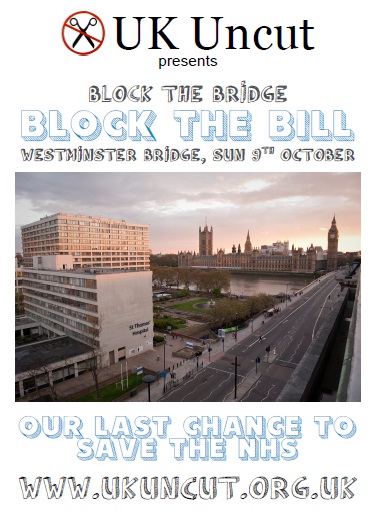
Save the NHS: Block the bridge, block the bill

UK Uncut are planning an unprecedented act of civil disobedience at 1pm on Sunday 9th October in protest against the government’s NHS reforms. Over one thousand people have already announced their intention to participate in the action, which aims to demonstrate the level of public opposition to the Bill and put pressure on sympathetic peers in the House of Lords by occupying Westminster Bridge.

The activist group are also encouraging people to contact peers and ask them to block the bill.

Full details of the demonstration can be found on the UK Uncut website.

There is also a Facebook event page.

Save the NHS, part 2: lobby the Lords

The NHS “reform” bill passed the Commons on its third reading yesterday by 316 votes to 251.* It will now go to the Lords for further scrutiny.

It’s not too late to save the NHS. A number of groups are recommending an unprecedented public lobby of the Lords in order to stop (or at least fundamentally alter) the bill.

The TUC have set up a page to help you do this: Adopt a Peer.

There is also a Facebook page with a fair bit of information.


“This is really important. I don’t think anyone has ever engaged en masse with members of the upper house on an issue like this before. They don’t have constituencies, and they can’t be voted out at an election. Nevertheless, many peers cherish their role in scrutinising bad legislation. They need to know there is a widespread dislike for these changes.”

– Christine Burns

*A grand total of four Liberal Democrat MPs voted against the bill. I can’t comprehend why anyone who cares about public services would ever want to vote Lib Dem again. May the party crash and burn come the next election.

ACT NOW to save the NHS

MPs are currently debating the controversial NHS reform bill. The £2 billion re-haul of our health system will be voted upon after just two days of debate in Parliament in spite of Conservative promises to oppose any “top-down” reorganisation of the NHS. Lawyers have warned that the changes will fundamentally undermine political accountability and further privatise the health system.

We’ve currently got one of the most economically efficient health systems in the world. It’s hardly perfect – and indeed, I strongly believe that the the NHS benefits from criticism – but we’re incredibly lucky to have it.

This is your chance to tell MPs that we can’t and won’t accept them messing with our health system.

Take action now:

Call your MP (via 38 Degrees)

Email your MP (via 38 Degrees)

Sign the e-petition (HM Government e-petition site)

Ruth Pearce at TRED 2011

My talk at the Trans* Education and Determination teach-in.

Part 1:
– Introduction to the teach-in
– My decision to undertake social research
– A brief history of trans academia
– Gender pluralism

Part 2:
– Introduction to my research on experiences of primary health
– Existing research on trans health in the UK
– The role of the internet in trans community
– Methodology and research ethics

Transcription available below.

Continue reading

Transphobic conference CANCELLED

The Royal College of Psychiatrists have cancelled “Transgender: Time to Change“. This isn’t just a victory for the trans movement: it’s also a victory for angry blogging, community organising and the threat of peaceful protest.

Pink News have a really positive piece on the cancellation.

RCPsych claim that the cancellation was down to low ticket sales. However, it’s pretty telling that the event was cancelled right after Charing Cross Gender Identity Clinic put out this statement:

The team at the WLMHT Gender Identity Clinic (GIC) at Charing Cross Hospital notes the apparent shift of emphasis in the Royal College of Psychiatrists Gay & Lesbian Special Interest Group conference, ‘Transgender: Time To Change’ on May 20th and feels compelled to withdraw on this basis.

When we were originally asked to take part, GIC clinicians understood that our role was to outline the work we do within our own service and explain the very considerable evidence base which underpins it. We are very happy to do this and our more than 55 years of experience as the country’s leading NHS provider gives us a rich and robust data set from which to draw observations.

It now appears that the conference comes at trans issues from a very specific agenda, namely, to explore the validity or otherwise of gender diagnoses as medical and psychiatric phenomena. So long as this is the case, we feel we can’t support it.

Although we were somewhat wary of engaging in what is essentially a clinical discussion with a predominantly non-trans panel, which, moreover, features a non-clinician whose personal opinion is already well known, we agreed to do so in order that discussion might focus on evidence rather than anecdote.

The Royal College should be aware that there is a great deal of disquiet around this event within the trans community and interested parties should note that the discussion as it now stands will be one-sided at best..”

On the subject of “numbers”, it’s also worth pointing out that registration was meant to be open until 9th May. That suggests that the number of people signing up for the event was really low: an encouraging turn of events! Commentators elsewhere have suggested that many psychs will have been put off by the outdated views held by many of the speakers. I only hope this is the case.

This is well worth celebrating, but the good news shouldn’t be the end of the matter. There’s a few really important lessons we can learn from the whole affair, and some things we need to think about regarding future action.

Trans people are still treated awfully by the medical establishment in general, and the psychiatric establishment in particular. We need to explore how to bring about change: through research and its dissemination, through lobbying, and through protests. The simple threat of a colourful, vibrant protest on the PCPsych doorstep clearly had a massive impact, as did the actions of those who talked to psychs and to Charing Cross.

The gender clinics and gatekeepers of this country have a troubled relationship with the trans community, but it benefits us to work with them. Currently, they’re not particularly accountable: Charing Cross has a patient feedback group, but how many trans people even know of this group? How many know how to contribute to its feedback? How many know the vast majority of groups invited to attend the meetings are London-based? This situation needs to change, but the clinic’s actions on this occasion suggest that it can.

Julie Bindel will probably kick up a fuss. Personally, I feel we should let her get on with it. Any opportunity for us to promote our arguments against the approach taken by the cancelled conference is a good one.

Finally, I’ve been informed that activists are planning to go ahead with the community “teach-in” that was originally planned to coincide with the transphobic conference. After all, there are speakers and facilitators booked, so why not? People are talking about focusing on the continuing problems within trans health in general and psychiatry in particular, and exploring where we might go from here. The venue and timetable are still being arranged, so I’ll post again once there’s news on that front.

Protect the NHS

Opposition to the government’s ill-conceived NHS reforms is growing. I wrote an angry post about the issue last year, but the argument against the proposals is perhaps best summed up in this video by MC Nxtgen:

Co-ordinated protests are apparently taking place across the UK today, but I haven’t seen much in the way of media coverage on the issue so far. We need to be raising awareness of the issue ourselves and building opposition as a broad movement.

I’m always in favour of a good demonstration, but armchair activism also has its place. As such, here’s a couple of initiatives from 38 Degrees (who were in part responsible for the government’s U-turn on the sale of state-owned forests).

“Save The NHS”: petition

Email your MP

Be the change that you want to see

I’ve written a lot about recently about Why The Government Is Bad. I’ve said less stuff about what we can actually do about it.

There’s not a lot specifically going on in the trans world right now that I’m aware of (although there is some useful information being added to TranzWiki.net, particularly that relating to the government’s Trans Action Plan). However, we can fight indirectly for trans rights by supporting the anti-cuts movement.

Trans people are disproportionately likely to be unemployed, underemployed or poorly paid. Many of us require specialist medical treatment, which we can usually only access on the NHS There are reasons to also believe that a disproportionate number of us are also disabled (the existing evidence on this is somewhat contradictory, however). As a result of this, trans people are particularly likely to suffer because of the government’s ideological obsession with cuts.

So, what can you do about it? Well, there’s plenty of local groups organising against the cuts. It’s worth looking for them on social media: if you use Facebook for instance, just try searching for the name of your area along with “cuts” and you’re likely to find something.

There are also local chapters of national groups. UK Uncut are particularly brilliant because it’s very easy to take part in their actions against tax-dodging shops and banks. They have a comprehensive, regularly updated list of actions, meaning that you can easily see what’s going along and join in if you’re free. Alternatively, you can organise your own event and add details to the site. The group also provide a fair amount of useful information on their blog and in press releases.

There will also be a massive march in London on Saturday 26th March. The March For the Alternative is being organised by the Trade Unions Congress and will also be backed by student groups and numerous anti-cuts organisations. The bigger the march is, the more we can worry the government. Don’t be fooled by the relatively low rate of attendance pledges on the official website: there are over 16,000 participants confirmed on Facebook and this number is constantly growing

Meanwhile, over 2000 people are planning to occupy Hyde Park following the march. Activists are planning to camp in the park, and use it as a base of operation from which to launch protests around central London. Again, there’s a Facebook event page here.

Obviously, radical protests aren’t for everyone, but there’s always something, bombard your elected representatives with letters, share information with others. There’s plenty we can do to resist government attacks on our public services.