A slow, painful grind: WPATH 2018 conference report

IWPATH_BuenoAr_Logo_reverse.jpgn the first week of November I attended the 2018 WPATH Symposium in Buenos Aires, Argentina. This biennial event is one of the largest trans studies conferences in the world, with around 800 academics, activists, healthcare practitioners and researchers coming together to exchange knowledge.

Most of the conference consisted of parallel sessions: approximately eight or nine speaker panels occurring simultaneously in different parts of the conference venue. So it is impossible for anyone to take part in the majority of conference events. Nevertheless, I attended as many sessions as possible, and livetweeted from most of these. Links to Twitter summaries of the sessions I attended can be found at the end of this post.

In this post, I comment primarily on my observations of the conference as a sociologist and trans professional.


Opportunities and inclusion

As I anticipated, WPATH 2018 was full of contradictions.

On the one hand, it was exciting to join and learn from so many academics, healthcare practitioners and human rights experts working in the field of trans health. As I report in the Twitter summaries below, the conference provided a great opportunity to participate in debates over new ideas and standards of care, and hear about cutting-edge research findings and advances in clinical practice. It was an especial privilege to learn first-hand about the implementation and impact of Argentina’s pioneering Gender Identity Law, a topic I expand upon later in this post, but hope to write about in more detail in the near future.

I was also glad to have the opportunity to present a paper on research ethics and a poster with initial findings from the Trans Pregnancy project to an international audience.

It was excellent to see that the conference organisers acknowledged and responded to some of the feedback from trans delegates in previous years. Gender-neutral toilet blocks were present on every floor of the conference venue, and pronoun stickers were provided to accompany name badges. The provision of a “trans hospitality suite” enabled trans attendees to relax in a more comfortable environment, and also arrange our own ad-hoc meetings and events. This was inevitably re-branded by its users as an “intersex and trans” room in recognition of the importance of this space also to intersex delegates; I hope conference organisers will learn from this for future events.

This year’s Symposium also benefited from a clear code of conduct and language guide, previously introduced for the 2017 USPATH and EPATH conferences.


Microaggressions and objectification

On the other hand, the cis-centric atmosphere of the event felt like a slow, painful, constant grind. As with previous WPATH conferences, the event was punctuated by constant microaggressions (and, on occasion, outright “macro”aggression); these were damaging to intersex people, people of colour and delegates from the Global South as well as trans attendees. Examples include individuals advocating for intersex genital mutilation, off-colour jokes about trans suicide, the use of outdated language, and misgendering of research participants.

Some research seemed entirely voyeuristic: for example, one poster from the Netherlands purported to report on differing levels of jealousy towards sexual competitors among “mtof and ftom transgenders”. It was often unclear how consent was obtained (if at all) for the use of personal information about research participants and/or patients. This was particularly concerning when numerous posters and powerpoint slides included unnecessary photographs of intersex and/or trans genitalia (a “WPATH conference bingo” grid circulated among intersex and trans attendees of the event included a square for “unexpected genitals”).

As a trans attendee, I felt deeply objectified by the tone and content of this material. It felt dehumanising, and I felt like a thing, subject to the harsh gaze of an abstract, dehumanising curiosity. Yet I was disturbed not only by those engaging in such work, but also in the response of many of their peers. Numerous practitioners and researchers who seemed broadly sympathetic to trans rights and affirmative in their own work often said nothing to counter transphobia, cisgenderism and endosexism in the work of others. It is difficult for intersex and trans people to explain how painful this situation is when most of our colleagues and the senior figures in the field are not intersex or trans; we know that our projects and careers alike may suffer if we speak out too openly or too harshly. I encourage fellow members of WPATH to reflect on their potential complicity in this situation, and consider how we might collectively work to change it.


Tokenism and colonialism

The choice to locate the conference in Buenos Aires felt deeply tokenistic, with numerous attendees from the Global South arguing that this represented a colonial attitude. The vast majority of conference attendees were from the United States or Western Europe. The price of the conference was a significant barrier to many attendees, amounting to the equivalent of the average monthly income in Buenos Aires. The choice to host the event in an expensive Hilton hotel felt like it was taken primarily for the benefit of (the more wealthy) attendees from the West to the detriment of local intersex and trans people, some of whom reported that they risked being profiled by the police if they tried to enter the wealthy area of the city in which the hotel was located.

The sessions on clinical practice in Argentina and human rights in Latin American were some of the most interesting I sat in on, but also least well-attended. I later heard that on one occasion a high-profile lawyer invited to speak on the topic of Argentina’s Gender Identity Law addressed a near-empty room, due to clashes with sessions that focused on Western bioethics, research and medical practice. This sense of tokenism was compounded through the choice to hold the conference in English (the official language of WPATH), with funded translation into Spanish available in a maximum of two rooms at any one time. Some of the conference organisers later stated that they had been worried about the finances of the event, but this felt like a strange claim in the wake of a lavish gala dinner with dancers, DJs, and multiple buffets serving food from various regions of Argentina. As human rights expert and executive director of GATE Mauro Cabral declared in the closing plenary of the conference, “When WPATH decided to come to Argentina, with the most progressive gender identity law in the world, I was excited. But we could only talk among ourselves. You came to this country because of the weather, steak and wine, but not to learn from us”.

While these issues are primarily structural ones that need to be formally addressed by WPATH, the onus is also upon individuals from Western and/or Anglophone countries to take action and reflect upon our relative power and privilege in attending these events. In addition to vocally supporting my colleagues from the Global South, one aspect of my own practice I feel I can address is my use of language in planning talks. For example, I could have undertaken a little extra work to ensure that my slides were bilingual, listing bullet points in Spanish as well as in English. I hope to draw on this lesson in preparing for future international events.


TPATH, human rights monitors, and lessons from Argentina

My experience of WPATH 2018 was improved enormously by the presence of other trans people working in the field of trans health, as well as the intersex activists and human rights experts who came to monitor WPATH’s historic antipathy towards intersex rights. Many of us are members of TPATH (the Transgender Professional Association for Transgender Health), a new and as-yet loosely affiliated group of trans people working in trans health that I helped to co-found during the 2016 WPATH Symposium in Amsterdam. Numerous others were part of a 50-strong delegation of intersex and trans human rights monitors from all parts of the world, who attended in order to conduct a collective human rights audit of the conference.

It was with these individuals that I found myself having the deepest conversations, these individuals with whom I heard the most fascinating research findings and the most rigorous analyses. We also shared a strong sense of solidarity in the face of the many problems apparent at WPATH 2018.

That said, the most important event I attended took place outside of the WPATH event: in Casa Jáuregui, a historic queer cultural centre many blocks away from the Hilton. Here, Frente de Trans Masculinidades (the Transmasculine Front) and other activists based in Buenos Aires hosted a meeting with TPATH members from the Bahamas, Aotearoa/New Zealand, Norway, South Africa, the UK and the USA. We shared information on our various areas of work, and the local activists talked at length about the history, implementation and practical impact of the Gender Recognition Law.
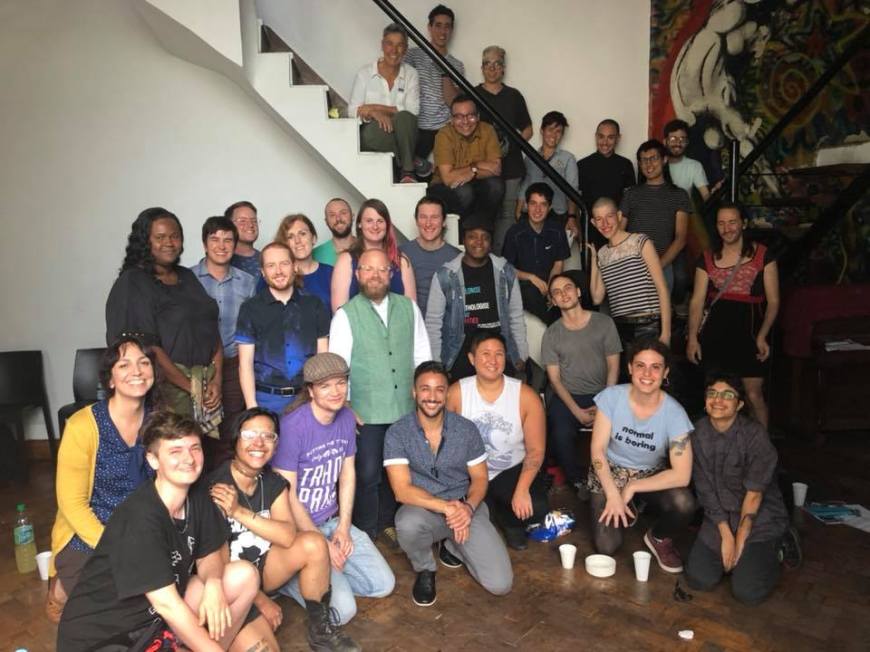
45312673_10156968672567287_3664316683624906752_n.jpg

Argentinian activists host TPATH members at Casa Jáuregui.

While it is important not to deny the significant challenges faced by trans people in Argentina, which include harassment by authorities, economic marginalisation and many forms of violence and discrimination, many of us were struck by how much has been achieved by activists in Argentina and (consequently) how advanced trans rights are in this country. The Gender Identity Law has been carefully written to enable flexibility; this has meant, for example, that it was interpreted to enable non-binary recognition by a judge as recently as last week. It also guarantees access to healthcare, which has meant that every possible medical intervention is available to trans people, either for free or through relatively inexpensive health insurance (in theory, that is: in practice, various legal battles have been necessary). This has been of benefit to cis women and queer people as well as trans people: for instance, through enabling easier access to hysterectomies or breast reductions.

During the meeting, the local activists described gender-affirming medical interventions that most of us had never even considered, such as beard hair implants for transmasculine individuals who cannot or would prefer not to use testosterone. Moreover, while long waiting lists exist for some procedures such as surgeries, those of us attending from European countries and (especially) Aotearoa/New Zealand were astonished by how much shorter they were than equivalent waiting times in our own countries, in part due to the absence of unnecessary gatekeeping procedures and treatment bottlenecks.

I was profoundly moved by the opportunity to attend this meeting, and regretted that so much of my time in Buenos Aires was spent in the sterile environment of the Hilton. However, I was also glad to have the opportunity to work with others to challenge the hierarchies and cisgenderist assumptions inherent in WPATH. We undertook many small interventions: asking questions about ethics, consent and power dynamics in the sessions we attended, raising concerns in private conversations, reporting blatant contraventions of the WPATH code of conduct. I was also pleased to hear many of my colleagues openly critiquing problematic issues identified during an update on the progress of the forthcoming Version 8 WPATH Standards of Care, and take part in attempts to hold our professional body to account during a member’s meeting on the final day.

Overall, I found WPATH 2018 to be a very tiring, draining and frequently unpleasant experience. However, I do not regret attending. I am grateful to have had the opportunity to learn so much from so many. I am also glad to have played a small role in supporting my intersex and trans colleagues and my colleagues from the Global South in attempting to help transform WPATH so it is more transparent, more accountable, and less colonial in attitude and in action.


Session summaries

The following links are to Twitter threads in which I summarise plenaries, talks and mini-symposia I attended at WPATH 2018.

Saturday 3rd November

Opening session and President’s Plenary

Keynote: Employment discrimination against trans people (Sam Winter)

Keynote: Trans legal history in Latin America (Tamara Adrian)


Sunday 4th November

Mini-Symposium: The Argentinian experience of public transgender health after the implantation of the Gender Identity Law

Oral presentations: Services in different parts of the world (Australia, Southern Africa, Scotland)

Mini-Symposium: Trans refugees: escape into invisibility

Mini-Symposium: Latin American perspectives on depathologization of trans and travesti identities

Plenary: Show hospitality to strangers: intersex issues in the time of gender identity laws (Mauro Cabral and respondents)
Note: this was listed as a plenary session in the programme, but actually took place alongside multiple parallel sessions. Consequently, this talk was under-attended by Western healthcare practitioners in much the same way as the Latin American sessions.


Monday 5th November

Oral presentations: Suicidal and non-suicidal behavior

Mini-Symposium: Ethical considerations in transgender health research

Oral presentations: Fertility

Oral presentations: Reproduction


Tuesday 6th November

Mini-Symposium: Child and adolescent medicine Mini-Symposium: Child and adolescent medicine

Plenary: SOC 8 update

Plenary: SOC 8 Q&A

GRA consultation: A guide for feminist and LGBTQ+ academics and allies

The UK’s Government Equality Office is consulting on possible changes to the Gender Recognition Act 2004 (GRA). Anyone can respond. The consultation link is here: https://www.gov.uk/government/consultations/reform-of-the-gender-recognition-act-2004.

The consultation ends at 11pm on 19 October 2018.

There has been a large backlash from people hostile to trans rights. It is important that academics who support trans rights respond to the consultation, ideally with reference to relevant evidence from scholarly research. This guide provides advice on doing so.

(Note: post updated 15/10/18 to include additional links and my full consultation response)


Background

At present, the GRA enables adults to obtain a Gender Recognition Certificate (GRC) and change the gender on their birth certificate from female to male, or vice-versa.

  • This has consequences for the registration of sex/gender upon marriage or civil partnership and affects some insurance and pensions.
  • It is of symbolic importance for many trans people.
  • Non-binary genders and trans people under the age of 18 are not recognised.

The GRA is not relevant to legal changes of name or sex/gender marker in any other arena.

  • Trans people are already able to change their name and sex/gender marker with organisations such as banks, schools, universities, social services, the DVLA and NHS. No medical evidence is required for this process.
  • Trans people are already able to change the sex/gender marker on their passport with a letter from a doctor.

Trans people have criticised the GRA for being unnecessarily bureaucratic and intrusive.

  • Applicants submit evidence – including medical records, letters from mental health specialists, and proof that they have lived in their ‘acquired’ gender for at least two years – to the Gender Recognition Panel.
  • The process costs £140 (plus additional costs) and there is no right to appeal.
  • An official list of people who have changed their sex/gender in this way is kept on a ‘gender recognition register’.

Note: I use the term ‘sex/gender’ as current UK law does not distinguish between ‘sex’ and ‘gender’: the two are used interchangeably.


Backlash

Since the GRA consultation was announced, numerous single-issue anti-trans groups have emerged to oppose amendments to the GRA and argue for a wider push back against the social recognition of trans people’s genders and access to sexed/gendered spaces.

Anti-trans groups have spread misinformation about the GRA.

  • e.g. the purpose and function of the GRA has been conflated with the Equality Act 2010, which governs trans people’s access to sexed/gendered public spaces.

These groups have a powerful voice in the mainstream media.

These groups have access to significant funding that trans groups do not.

  • Tens of thousands of pounds have been spent on billboards and newspaper adverts opposing trans rights.
  • Anti-abortion American fundamentalist groups such as ‘Hands Across the Aisle’ and far-right publications such as Breitbart and The Federalist have extensively promoted the work of ‘feminist’ anti-trans groups and shared crowdfunding pages.

These groups claim to represent feminism.

  • They wrongly argue that gender recognition poses a threat to women’s rights.
  • Trans women are often represented as potential or actual sexual predators.
  • Trans men and non-binary people often are represented as tragic or deluded.
  • By contrast, numerous groups who work with vulnerable women (e.g. Scottish Women’s Aid) have supported trans affirming reforms to gender recognition.

These groups are encouraging their supporters to respond to the GRA consultation.

  • This happened in response to a similar consultation by the Scottish government. While in that instance most respondents supported extending trans rights, thousands of anti-trans responses were also submitted.


Responding to the consultation as academics

As academics, it is important that we support good governance grounded in empirical evidence and the principles of equality and equity for all. As feminists and/or LGBTQ+ people, it is important that we recognise that current attacks on trans rights echo and are linked to similar attacks on women’s and LGBTQ+ rights.

In responding to the consultation:

Concisely reference scholarly evidence where possible.

  • Assert your own expertise where relevant.
  • In the linked PDF below, I have used in-text citations for brevity. However, Government bodies tend to prefer links or full-reference footnotes, so please bear this in mind.

Ensure your response to each question makes sense as a stand-alone comment.

  • Don’t build an argument across the entirety of your consultation response or cross-reference your previous answers.
  • Consultation responses will be analysed on a question-by-question basis.

Responses from organisations are given more weight by the government.

  • If it is possible to submit a response on behalf of your department, school, centre, professional organisation or academic special interest group, please do so in addition to your personal response.

If you have limited time and energy just responding to the tick-box questions will make a difference.

Please share this information with your colleagues to ensure a large, evidence-based trans-positive response to the consultation.


Resources

Here are two documents I have produced to help you and your colleagues in responding to the consultation.

GRA consultation – suggested starting points for responding to consultation questions
This document includes information on each consultation question, including relevant evidence and citations that you might want to use in your submission.

GRA consultation – a guide for feminist and LGBT+ academics
This document includes the full content of this blog post plus the suggested starting points for responding to consultation questions.

For guides to the consultation from non-academic organisations, see:
Amnesty International
LGBT Foundation
Mermaids
Stonewall
National Union of Students
GIRES and TELI (focuses on recognition for trans youth)

You can see my complete personal response to the consultation here: GRA response.

Family Planning workshop at Trans Health Matters (23 October)

In a couple of weeks I will be attending the Trans Health Matters conference, which is held at Resource for London on Tuesday 23 October.

You can read about and book tickets for Trans Health Matters 2018 here.

Co-hosted by holistic sexual health centres cliniQ (London) and Clinic T (Brighton), this event offers an insight into cutting edge practice and research, particularly with regards to sexual and mental health.

I will be speaking at a workshop entitled Trans Family Planning: Contraception, Fertility, Pregnancy and Childbirth, alongside Kate Nambiar, Michael Toze and Francis Ray White.

NSP-RESOURCE0001

Resource for London, Holloway Road

Trans people often find there is a lack of information available on their own fertility, or that they have been misinformed about the reproductive capacity of their own bodies. Similarly, trans people wishing to form families continue to face social, legal and medical barriers to parenthood. The workshop will comprise three short interventions, reflecting on current challenges and opportunities for trans reproductive autonomy, and an opportunity for attendees to reflect on how this might relate to their own work.

Kate Nambiar is a medical doctor and researcher who works at Clinic T. She will be discussing issues around contraception for trans people.

Michael Toze is a Research Fellow in the School of Health and Social Care at the University of Lincoln. He will talk about UK medical practice and law with regards to trans fertility, parenthood, and sterilisation procedures.

Francis Ray White is a Senior Lecturer in Sociology at the University of Westminster, and I am a Research Fellow in the School of Sociology and Social Policy at the University of Leeds. We will be discussing intial findings from the Trans Pregnancy Project.


Video: Transgender Moral Panic – A Brief Social History

In February 2018, I was invited to deliver a guest lecture at the University of Warwick as part of the “Hidden Histories” series.

In the last year there has been an enormous upsurge in media commentary that expresses concern about the role of trans people in public life. Gendered changing rooms, non-binary people, trans children and notions of self-definition have all come under intense scrutiny.

In the talk, I explored the background to the recent wave of media coverage. I argued that the transgender moral panic has been shaped by deep-seated cultural anxieties around sex and gender, taking in trans-exclusionary radical feminism, homophobic discourse, scientific racism, Brexit, and proposed changes to gender recognition laws.


Recommended further reading

Meg-John Barker (2017)
2017 Review: The Transgender Moral Panic

Combahee River Collective (1977)
The Combahee River Collective Statement

Emi Koyama (2000)
Whose Feminism Is It Anyway? The Unspoken Racism of the Trans Inclusion Debate

Emi Koyama (2001)
The Transfeminist Manifesto

C. Riley Snorton (2017)
Black on Both Sides: A Racial History of Trans Identity

Christan Williams and Gillian Frank (2016)
The Politics of Transphobia: Bathroom Bills and the Dialectic of Oppression


Corrections

I made two minor errors in unprepared asides during the talk, which I correct here for the sake of transparency.

  • Lily Madigan was elected to the position of Women’s Office in her constitutency Labour party at the age of 19, not 17.
  • David Davis was a co-founder of Radio Warwick (RaW), not David Davies.


Understanding Trans Health – book launch and mini conference

Understanding trans healthMy research monograph Understanding Trans Health will be published in just over a month! To celebrate, I will be holding an event on Tuesday 5th June at the University of Leeds, where I will be discussing the book and the findings it reports. I have also invited a number of people I admire enormously to talk about what they’re working on at the moment.

The event is FREE but places are limited, so please do register if you want to come!

Register a place here.

 
Talks will include:

‘The Gender Experts’: Clinical Discourse and Becoming Trans
Dr Ruth Pearce (University of Leeds)
https://ruthpearce.net/about/

What is Gender Dysphoria? – at least, in the Literature
Dr Zowie Davy (De Montfort University) and Dr Michael Toze (University of Lincoln)
https://zowiedavy.wordpress.com/about/

Body Parts in Trans Erotica
Dr Kat Gupta (University of Sussex)
http://mixosaurus.co.uk/about-me/

Accessing trans healthcare: what role for medical law?
Dr Chris Dietz (University of Leeds)
http://www.law.leeds.ac.uk/people/staff/dietz

Trans healthcare at Clinic T
Dr Kate Nambiar (Clinic T, Brighton)
https://www.stonewall.org.uk/people/dr-kate-nambiar

The event will be chaired by my colleague Professor Sally Hines.

There will also be plenty of time for questions and discussion. The event will be followed by a reception with free drinks and nibbles.

I hope to see you there!

WE ARE REVOLTING: my first Trans Pride

There are a couple of looks I am very familiar with as a trans person.

One is primarily a look of confusion. It is the kind of look you might expect to receive if you were wearing a boot on your head. You have disrupted the everyday order of things, and people don’t know how to respond.

One is primarily a look of disapproval, communicating a barely-contained sense of disgust or revulsion. It is the kind of look you might expect to receive if you have smeared shit all over your face and are walking down the street as if nothing is wrong. You have disrupted the everyday order of things, and people are very unimpressed, but perhaps aren’t quite yet ready to shout or spit at you. But you imagine that they would quite like to.

I’m very used to these looks because I have received them a lot over the course of my life. More often when I was younger, my face and body as yet unchanged by oestrogen. But I still receive such looks now and again to this day, particularly when I put less effort into conforming to stereotypical expectations about how a woman should look or carry herself. Perhaps I have put on less makeup, or I am wearing baggy clothes, or I haven’t brushed my hair for a couple of hours.

Other trans people – particularly other trans women, and especially trans women of colour – are less fortunate than me. People don’t just look at them. The looks are merely where it starts. Then people shout at them, or spit, or throw stones. People pinch their arses or grope their breasts. I hear these stories from my trans friends pretty regularly. It’s like everyday sexism with the volume turned up.

Other trans people – particularly other trans women, and especially trans women of colour – are less fortunate still. People stalk them. People assault them. People rape them. People kill them.

They do this because we are revolting.

It starts with a look. Call it the cis gaze.

~

Today I saw so many looks of confusion and disapproval. I felt the revulsion. It was visceral. It was contained. It could not harm me. I was amongst hundreds like me.

Today I took part in a Trans Pride march for the first time.

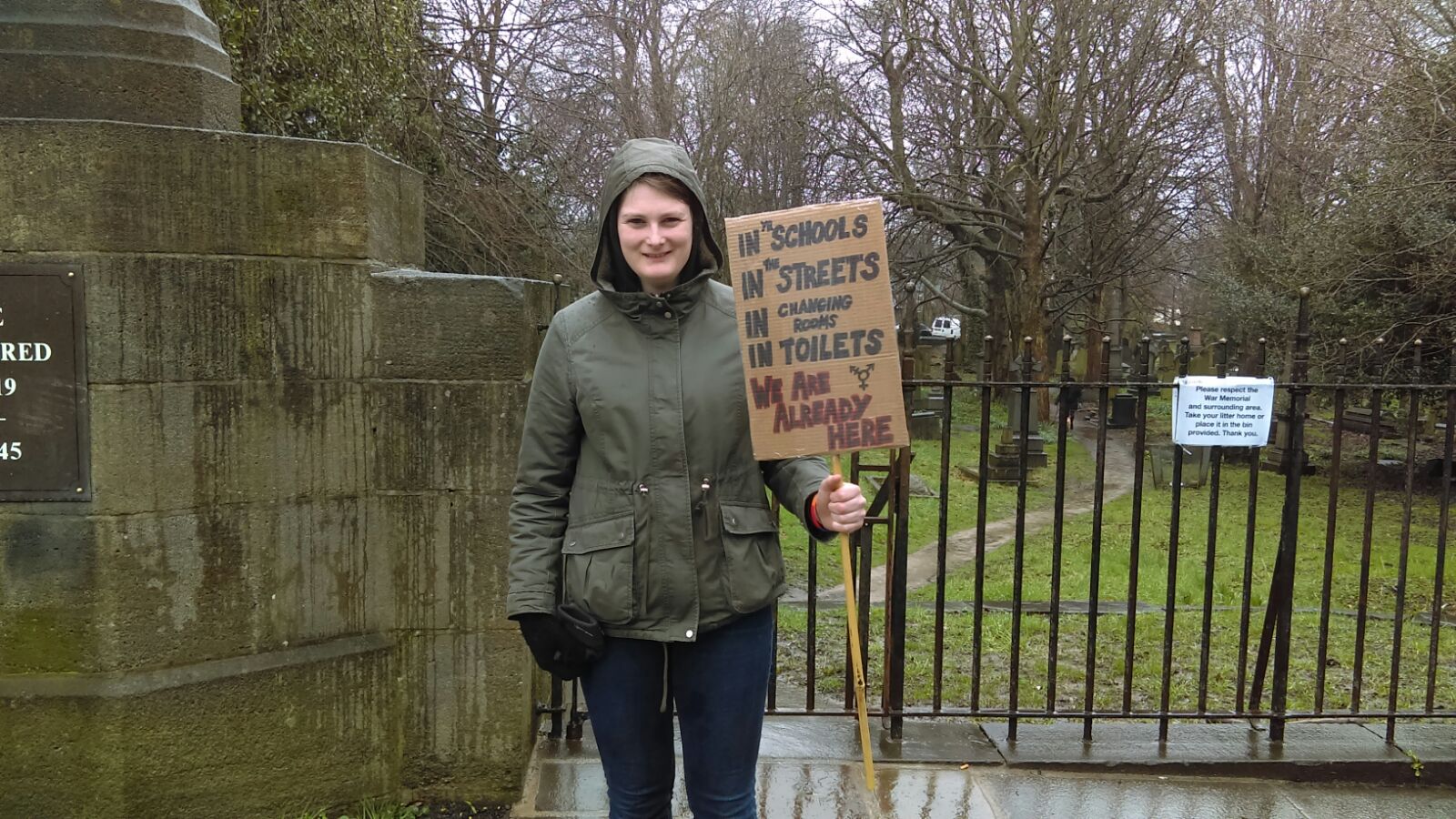
placard

Waiting for a bus before the march. Photo by Sophie Wilson.

Trans people have, of course, taken part in LGBT Pride marches for as long as they have existed. Trans Pride marches, however, are a relatively new phenomenon. The first Trans Pride in the UK took place in Brighton in 2013.  I attended Trans Pride Leeds, which is in its first ever year.

I have previously marched in LGBT Pride parades in Birmingham and London, and attended Pride parties in Coventry and Leamington Spa. On these occasions, people throng the streets. There is a sense of celebration. There is a giant street party. People come out to see the happy gays. They mostly look on with enjoyment. It is a family affair.

At Birmingham Pride one year, I was stopped by a “community safety officer”, who objected to my placard. It was not family friendly, he said. If I didn’t destroy or cover it up, he would call a police officer and I would be arrested. At London Pride one year, some people sought to control entry to a women’s toilet, ejecting at least one trans woman in the process.

Trans people are not necessarily welcome at LGBT Pride events. Or, if we are, we are not as welcome as many of our cis gay, lesbian, bi and queer siblings. Or, if we are, we are not seen or celebrated in the same way. We are not as safely contained.

But: there are a lot more cis gay, lesbian bi and queer people at LGBT Pride than there are trans people. We disappear into the crowd. We cause less confusion. We bring less disapproval. We do not so easily revolt.

This is why Trans Pride is important. This is why Trans Pride is necessary.


~

Today is Trans Day of Visibility, apparently. In the UK, trans people are more visible than ever.

Visibility has brought new dangers. We are currently subject to an unprecedented hate campaign in the media, spearheaded by “respectable” publications such as The Times and The New Statesman. On the Internet, we have attracted the dangerous attentions of a resurgent neo-nazi movement, their anti-trans campaigns bolstered by useful idiots who claim to oppose trans rights in the name of feminism.

Visibility has brought new opportunities. We see more of one another. We are more organised than ever. We have grassroots organisations in every city. We are producing art, music, plays, and films that speak to our own interests and concerns. We are marching in protest, we are marching in Pride. We seek gender liberation.

It will be a very long, very hard fight, but we are going to change the world.

We are revolting.

~

Today I saw so many looks of confusion and disapproval. I returned the gaze. I held my placard high. I shouted, joyously. They could not harm me. I was amongst hundreds like me.

I could not, would not be shamed, for I felt the power of Pride.

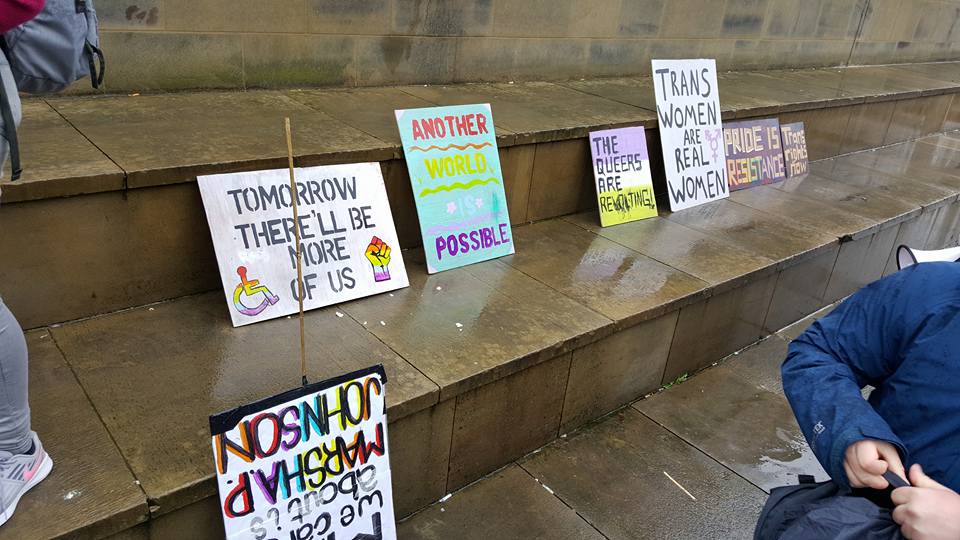
29792619_10211128952515449_1837457633094237365_n

Trans Pride placards. Photo by Natasha Handley.


Forthcoming talk: Hysterical Bodies

event posterWednesday 28 February
7pm – 9pm
Birmingham LGBT Centre
Free entry and food provided.

Bread and Roses for All, and Hormones Too!
A panel discussion with Aquila Edwards and Luke Dukinfield, facilitated by Robin Lynch and hosted by Birmingham Women’s Strike Assembly.

I will be giving a short talk about intersections between trans health and women’s health, focusing on how our bodies have historically been pathologised and disciplined in medical settings.

There will then be a facilitated discussion. I’m honoured to be sharing the panel with some fantastic speakers so it’s sure to be a really interesting event.

Register to attend for free on Eventbrite.

Facebook event page.

Trans Genealogies: special issue articles now online!

trans symbol

Trans symbol by Chris Hubley

[Edit 14/02/19 – the special issue has now formally been published, and is available here.]

I’m delighted to announce that the articles written for the Sexualities special issue ‘Trans Genealogies’ – edited by myself, Deborah Lynn Steinberg and Igi Moon – have now been pre-published on OnlineFirst.

While the creation of this special issue has been a particularly long and difficult affair, it was really fantastic to work with such interesting and thought-provoking articles. I’m really excited that we can now finally share them with the world.

—

The articles will be formally collated and published in a single issue of Sexualities in a few months’ time. This will be available both online and in print format, and I’ll no doubt be using that as an opportunity to once again encourage people to read them.

However, for now you can read the special issue articles here:


Introduction: The Emergence of ‘Trans’
Ruth Pearce, Deborah Lynn Steinberg and Igi Moon
[OnlineFirst] [open access]

Axiomatic: Constituting ‘transexuality’ and trans sexualities in medicine
JR Latham
[OnlineFirst]

Response and responsibility: Mainstream media and Lucy Meadows in a post-Leveson context
Kat Gupta
[OnlineFirst]

Rethinking queer failure: Trans youth embodiments of distress
Katrina Roen
[OnlineFirst]

‘Boying’ the boy and ‘girling’ the girl: From affective interpellation to trans-emotionality
Igi Moon
[OnlineFirst]

Genderqueer(ing): ‘On this side of the world against which it protests’
Zowie Davy
[OnlineFirst]

De/constructing DIY identities in a trans music scene
Ruth Pearce and Kirsty Lohman
[OnlineFirst] [open access]

Mak nyahs and the dismantling of dehumanisation: Framing empowerment strategies of Malaysian male-to-female transsexuals in the 2000s
Joseph N Goh and Thaatchaayini Kananatu
[OnlineFirst]

—

Here’s what we have to say about the special issue content in the editorial introduction:

We open with JR Latham’s ‘Axiomatic: Constituting ‘‘transexuality’’ and trans
sexualities in medicine’. Latham provides a genealogy of medical becoming, draw-
ing the reader’s attention to the manner by which trans identities may be consti-
tuted in and through a pathologising discourse that retains the influence of
pioneering mid-20th century clinician Harry Benjamin. Through his elucidation
of four axioms of transsexualism, Latham also unpacks the role of sexuality in
the becoming/emergence of trans in medical settings, and explores the manner by
which we might arrive into entirely contingent spaces of gender subjectivity and
enactment that we nevertheless take for granted.

A second example of the disciplinary impact of categorical thinking is explored
in Kat Gupta’s article, ‘Response and responsibility: Mainstream media and Lucy
Meadows in a post-Leveson context’. Like Latham, Gupta describes how trans
might ‘emerge’ and ‘become’ through the interventions of non-trans actors: in this context, journalists writing about trans teacher Lucy Meadows after she came out
in the workplace. Meadows’ dreadfully sad fate is only compounded by the con-
tinued construction of an unwanted male identity for her in British newspaper
reporting. However, as Gupta carefully demonstrates, this was not entirely the
outcome of intentional prejudice: rather, the misgendering of Meadows emerges
through the subtle contingencies of repetitious reproduction and metacommentary.

The four articles that follow critique binary thinking from a range of perspec-
tives, and question both cis-normative and trans-normative approaches to categor-
isation. These articles ask how we might think about bodies and psyches in a more
open and ethical manner, informed by ‘trans’ discourse but with wider conse-
quences for understandings of gender and sexuality. They look at how we might
move beyond the axioms described by Latham and the cultural forces analysed by
Gupta, inviting us to consider how we might re-think our approaches to bodies and
identities, avoiding binaries in inhabiting these ideas while building new solidarities
and allowing new possibilities to emerge.

In ‘Rethinking queer failure: Trans youth embodiments of distress’, Katrina
Roen explores how we could seek to break from normative thinking, including
the transnormativities that have emerged with ‘trans’. Noting that trans youth
are frequently associated with narratives of distress and self-harm, Roen draws
upon Jack Halberstam’s concept of queer failure and Sara Ahmed’s feminist cri-
tique of happiness in order to ‘unsettle’ these narratives and imagine new trans
possibilities ‘that do not involve straightening or alignment’.

Igi Moon also looks predominantly at the experiences and narratives of trans youth in ‘‘‘Boying’’ the boy and ‘‘girling’’ the girl: From affective interpellation to trans-emotionality’. In their article, Moon argues that emergent trans discourses offer an important alternative to binary notions of emotionality. Moon describes ‘trans-emotionality’ as a pluralistic approach to understanding gendered feeling that has been made possible through non-binary and genderqueer peoples’ responses to experiences of sexual liminality and dis-orientation.

In ‘Genderqueer(ing): ‘‘On this side of the world against which it protests’’’,
Zowie Davy questions the categorical lines that are frequently drawn between
‘transsexual’ and ‘genderqueer’ trans identities, desires and bodies. Revisiting a
series of interviews from the early 2000s, Davy employs the Deleuzian notion of
‘assemblage’ to question frequently taken-for-granted assumptions around trans
difference. She asks us to be reflexive in our understanding of the terminologies of
trans, transsexualism, transgenderism, genderqueer and non-binary; terminologies
that can be used to help us understand specificity but which can also be used to
close down analyses of connection and similarity. In this way we are effectively
encouraged to be attentive to the limitations of a ‘non-binary’/‘binary’ binary in
our accounts of trans possibility.

An optimistic account of such possibilities is provided by Ruth Pearce and Kirsty Lohman. In ‘De/constructing DIY identities in a trans music scene’, the authors draw upon a case study of an ‘underground’ scene in the UK to explore how trans discourses and everyday political approaches can feed into processes of cultural production. This offers an insight into what possibilities might emerge and flow from ‘trans’ as a pluralistic approach to gender and identification.

The issue closes with an account of Malaysian legal and media advocacy, ‘Mak
nyahs and the dismantling of dehumanisation: Framing empowerment strategies of
Malaysian male-to-female transsexuals in the 2000s’. In this article, Joseph N Goh
and Thaatchaayini Kananatu effectively revisit a range of themes from across the
special issue: processes of becoming and definition (including self-definition
as well as being defined by others) and the manner in which activism intersects with the media and law as well as the medical and political establishments. Like the UK case studies, this account is one of both specific importance and broader relevance. It is vital to acknowledge the particular context of the struggles for gender liberation by mak nyahs in Malaysia: a context shaped both by local law and religion, and the
complex post-colonial impact of Western discourses and political interventions.
The emergent language of mak nyah identity effectively stands in opposition not
only to the cis and binary gender norms of conservative politics and religious
fundamentalism, but also to a homogenised white, Western, Anglophone discourse
of ‘trans’. At the same time, Goh and Kananatu highlight how high the stakes are
and how difficult the battles for liberation can be for gender diverse peoples around
the world, in an important account of the dangers and possibilities that come with
‘trans’ visibility.

I hope readers find the special issue articles as fascinating, challenging, and useful as we did. Enjoy!


Forthcoming talk: The Transgender Moral Panic

I’ve been invited to give a guest lecture at the University of Warwick next week, on Thursday 8th February.

This will be part of the “Hidden Histories” alternative lecture series, organised by Warwick Students’ Union with support from a number of academic departments.

The talk will take place from 7pm in S0.21 (Social Science Building), and is open to all. I will speak for around an hour and there will be time for questions and discussions.

Here’s the blurb from the Facebook event page:

The Transgender Moral Panic: A Brief Social History

Over the last few months, there has been an enormous upsurge in media commentary that expresses concern about the role of trans people in public life. Gendered changing rooms, non-binary people, trans children and notions of self-definition have all come under intense scrutiny, with psychologist Meg-John Barker describing 2017 as “the year of the transgender moral panic”.

For the 2nd lecture in our Hidden Histories series, Ruth Pearce will explore the background to the recent wave of media interest, taking in radical feminist theories, scientific racism and proposed changes to UK law. She will show how the transgender moral panic has been shaped by deep-seated cultural anxieties around sex and gender, brought to the fore by the precarious successes of the trans liberation movement.

Ruth Pearce is a trans feminist scholar. Her research primarily examines discourses, practices and experiences of trans health. Her PhD was awarded by the University of Warwick in 2016. Her thesis looked at how trans health is differently understood within trans communities, activist groups and professional literatures, with a range of meanings and practices contested within and between these spaces.

Come along for what is set to be a fascinating event exploring a topic which is generally erased from mainstream curricula. Refreshments will be provided!

Hidden Histories banner

Understanding Trans Health – available to pre-order!

Last month I finished writing my first book, Understanding Trans Health: Discourse, Power and Possibility.

This book reports on the wide-ranging research project I undertook from 2010 to 2017, looking at trans discourses and experiences of healthcare services in the UK. It will be of interest to academics, students, health practitioners and activists working and studying in the field of trans health, and will be published by Policy Press in June 2018.

Understanding Trans Health is available for pre-order it for £21.59 (paperback) or £60.00 (hardback) from the Policy Press website. E-book and Kindle versions will also be available soon. If you work or study at a university or college, it would be really great if you could encourage your library to order in a copy!

If you live in the Americas, you can buy it through University of Chicago Press.

I’ll be writing more about the book as the release date approaches. In the meantime, feast your eyes upon the stunning cover commissioned by Policy Press: an image that reflects continuing inequalities of access, the pain of waiting, and patient experiences of anticipation.

Understanding trans health

In other book news, myself and Igi Moon are still working hard on our co-edited volume, The Emergence of Trans: Essays on Politics, Culture and Everyday Life. We’ve had some really fantastic chapter submissions and I can’t wait to share more about this too in the coming months.