New article: Misuse of Evidence in Sex and Gender Policy

The UK is currently sweltering through the hottest June on record. The Met Office has issued a “red warning” for much of England and Wales, highlighting an active danger to life. Trains have been cancelled, roads are melting, and we will likely see more deaths in coming days. Yet the media is talking little about climate change. Instead, one of the big stories of the week is that businesses and unions are uniting in opposition to the proposed appointment of Ed Milliband as Chancellor of the Exchequer, due to the belief that he is too committed to “net zero” emission targets.

How did we get here? And why are trans people once again to blame?

I have a new short article out in the International Journal of Feminist Approaches to Bioethics. It is co-authored with a range of international colleagues, variously originating from and/or based in Australia, Canada, Chile, Finland, Germany, the Netherlands, Switzerland, and the USA, as well as the UK. You can read it here:

Official, paywalled version (typeset and hosted by the publisher, University of Toronto Press)
Misuse of Evidence in Sex and Gender Policy

“Accepted” version (free access)
Misuse of Evidence in Sex and Gender Policy

In the article, we examine how evidence is being misused in debates and policy relating to sex and gender. Our authorship team holds expertise in a range of topics and disciplines, including figures such as clinical psychologist Dr Tomás Ojeda, neuroscientist Dr Dori Grijseels, criminologist Professor Sarah Lamble, and the sociologist and former Olympic athlete Dr Madeleine Pape (to name just a few!) We met at last year’s workshop on sex and gender policy at the University of Lausanne, and have been collaborating ever since.

Drawing on examples such as the UK’s Cass Review and Sullivan Review, US state hearings, and the global exclusion of trans women from sports competitions, we collectively identify six common pitfalls in the use of evidence:

  • presenting “expert” opinion as authoritative
  • excluding relevant expertise, especially from trans people
  • discrediting scientific consensus
  • setting unattainable standards
  • deploying decontextualized claims
  • positioning disinformation as science

We focus especially on how this misuse of evidence in sex and gender policy is causing direct harm to trans people. However, we also note the dangers for other contexts. Given the typical misogyny of anti-trans discourse, this of course includes all women, plus intersex people.

We further highlight how the strategies developed for undermining and misusing evidence in sex and gender policy can also inform a more general distrust of scientific endeavour. In the USA, this can be seen in the mass defunding of scientific programmes and institutions, which we note in the article. Here in the UK, examples include widespread disinformation about immigration, which is being used both to fuel and excuse racist policies and fascist riots… and of course, also public attitudes and policies on climate change.

I hope our new article will be a helpful tool for people wishing to identify and understand how evidence is misused and ideology prioritised – in sex and gender policy of course, but also in wider public debates.
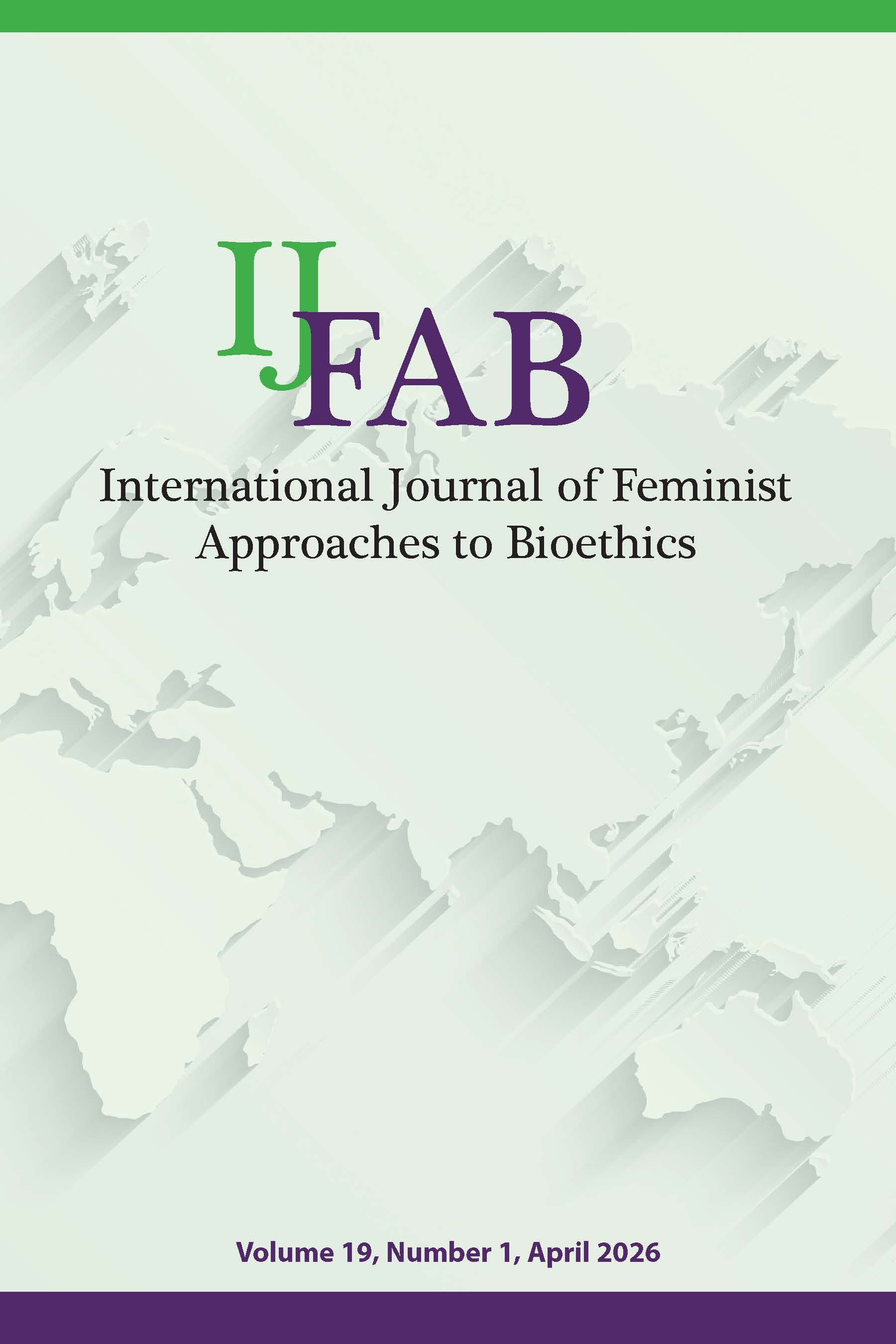
Cover image of the International Journal of Feminist Approaches to Bioethics.


Did you appreciate this post? Want to read more?

Subscribe now to receive new posts for free whenever I write them.
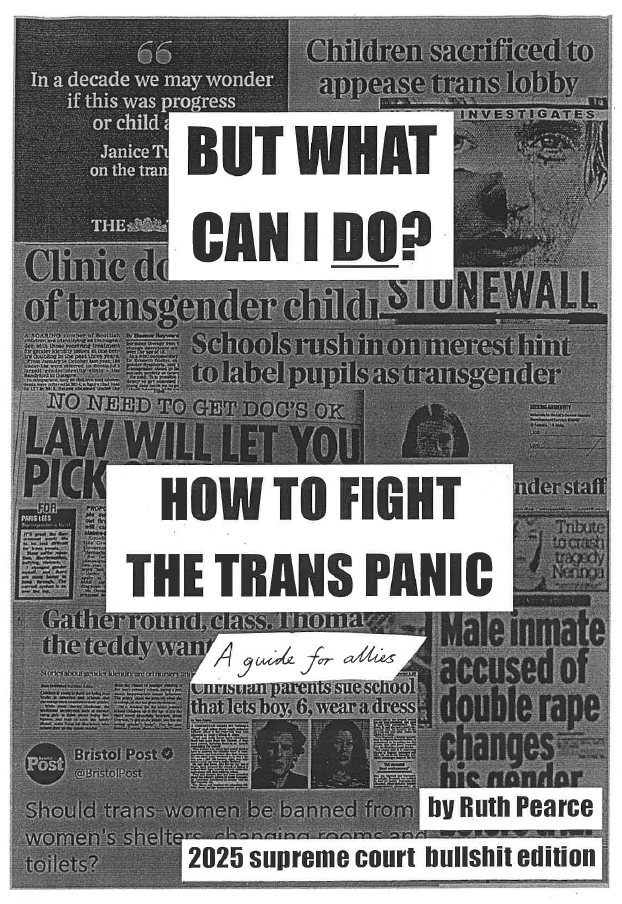
PDF zine: But what can I do? How to fight the trans panic

This is the latest version of a zine I have distributed at wormboys gigs over the last couple of years. I’ve recently updated it to address recent events, including the April 2025 Supreme Court ruling.

The zine is written particularly with allies in mind. It provides some background information on the UK’s anti-trans moral panic, and offers some suggestions for easy things people can do. These include: changing the conversation in everyday settings; making complaints or compliments; writing to politicians; introducing pro-trans policies; refusing to comply with anti-trans policies; supporting small trans organisations; and supporting trans creators.

This zine is intended to be freely copied and distributed. Please feel free to download and share the PDF. If you want to print it as an A5 booklet, simply select “print as booklet” and print onto A4 paper, then fold it in half.

Cover image for the zine, but what can I do? How to fight the trans panic. It contains various images of transphobic newspaper headlines behind the title text.


But What Can I Do? PDF download

You can also download a more accessible simplified version here, which is text-only and will hopefully work with screen readers:

But What Can I do – May 2025 accessible

I am once again distributing the zine at wormboys shows in coming months, as well as queer bookshops such as Category Is Books in Glasgow. However, if you want copies in your area, the best thing to do is to download the PDF and print some off.

Tell your friends!

New article: The association between microaggressions and mental health among UK trans people

I have a new article out in the journal Social Psychiatry and Psychiatric Epidemiology, co-authored with colleagues at University College London. It reports on the findings of a study led by Talen Wright, looking at the mental health impacts of microaggressions on trans people.

You can download and read the full study for free here:

The association between microaggressions and mental health among UK trans people:
a cross-sectional study
by Talen Wright, Gemma Lewis, Talya Greene, Ruth Pearce, and Alexandra Pitman


What did we find out about microaggressions, mental health, and trans people?

Wright designed a survey of 787 trans adults in the UK, asking questions both about participants’ mental health and their experiences of microaggressions. When analysing the findings, we found that experiencing more microaggressions was associated with worse mental health, including increased severity of depressive and anxiety symptoms, and increased odds of lifetime self-harm, suicidal thoughts, and suicide attempts.

We also found evidence indicating an association between specific microaggressions and specific mental health outcomes:

  • Participants who reported more misuse of their pronouns by others were more likely to report increased thoughts of self-harm and suicide.
  • Participants who reported more experiences of their gender being denied by others were more likely to attempt suicide.
  • Participants who reported more experiences of people around them acting uncomfortably around them because of being trans were more likely to report increased symptoms of depression.
  • Participants who reported more experiences of people around them denying the existence of transphobia were more likely to report increased symptoms of anxiety.


Why is this study important?

With apologies to my co-authors, I consider this a form of “cat detector” research. I base this term on an image shared a few years ago by the Facebook page High Impact PhD Memes, purporting to show someone successfully wielding a cat detector:

The meme is labelled as follows: Interviewer: "How would you define your previous works?" Me: "Groundbreaking". Underneath this is an image depicting the researchers' previous works: a person holding a machine in a cat's face. The machine is labelled "cat detector", and has one face lit up green, labelled "Yes", indicating that it has successfully detected a cat.


The meme is funny because, well, it’s obviously a cat. The research is stating the obvious.

And so this research might quite reasonably seem to many trans people. We know that microaggressions are harmful: that when people deny who we are, it hurts. When researchers or journalists or politicians talk about high rates of poor mental health among trans communities, we know that it is because people are harming us, that entire systems are set up in ways that harm us.

At the same time, we live in a political and policy context where trans people’s voices are rarely heard, and disinformation runs rampant. A lot of cis people are getting inaccurate information about our lives and needs, including healthcare commissioners, doctors, nurses, therapists, educators, and civil servants, as well as our families, friends, and colleagues. Trans people are often portrayed as overly sensitive to other people’s transphobic behaviour, or living in denial of reality.

Given this context, I feel it is beneficial to demonstrate empirically – with statistical analyses! – that small actions add up, and “microaggressions” cause real harm.

I hope this research will be useful for countering non-evidenced transphobic policy approaches. For example, the UK government’s current guidance on “Gender Questioning Children” in schools directly encourages educators to undertake actions that are associated with harmful outcomes in our study. As more research is conducted and published in this area, we will have more information available to clearly demonstrate the risks of transphobic policy, and empower advocates fighting for change.

New article: “Child rights in trans healthcare”

Image of the cover for the International Journal of Transgender Health

I’m pleased to announce that Child rights in trans healthcare – a call to action has just been published as an advance article in the International Journal of Transgender Health. I helped to co-author it alongside an international team of expert researchers and clinicians, including Cal Horton, Jaimie Veale, TC Oakes-Monger, Ken Pang, Annie Pullen Sansfaçon, and Sophie Quinney.

This article is an editorial, reflecting on the current landscape of policy and practice regarding children’s rights within trans healthcare:

In this editorial we first call attention to the importance of child-rights informed policy and practice in trans healthcare. We outline critical pillars of rights-respecting healthcare for trans, gender-diverse, and gender non-conforming children. We highlight the importance of embedding rights within service delivery, discussing the need for child participation in healthcare design, evaluation and accountability. In the second section of this editorial we articulate and call attention to a sector-wide ethical duty of care to children, building a sector where child rights violations are no longer tolerated. We highlight the responsibilities of all trans healthcare stakeholders and professionals, including those in adult trans healthcare, in ensuring a sector-wide shift to ethical and rights-respecting practice.

The article can be read for free here.

New job at the University of Leeds

I’m delighted to announce that I’ve just begun Research Fellowship in the School of Sociology and Social Policy at the University of Leeds. I’ll be working as part of an international team on the ESRC-sponsored projected Pregnant Men: An International Exploration of Trans Male Practices of Reproduction, which is being led by Sally Hines. This study will explore the sociological, health care and policy implications of trans men’s reproductive practices.

Some initial information on the scope and plans for this research are currently available on the project website. I’ll be writing more about the project there (and here!) as it progresses.