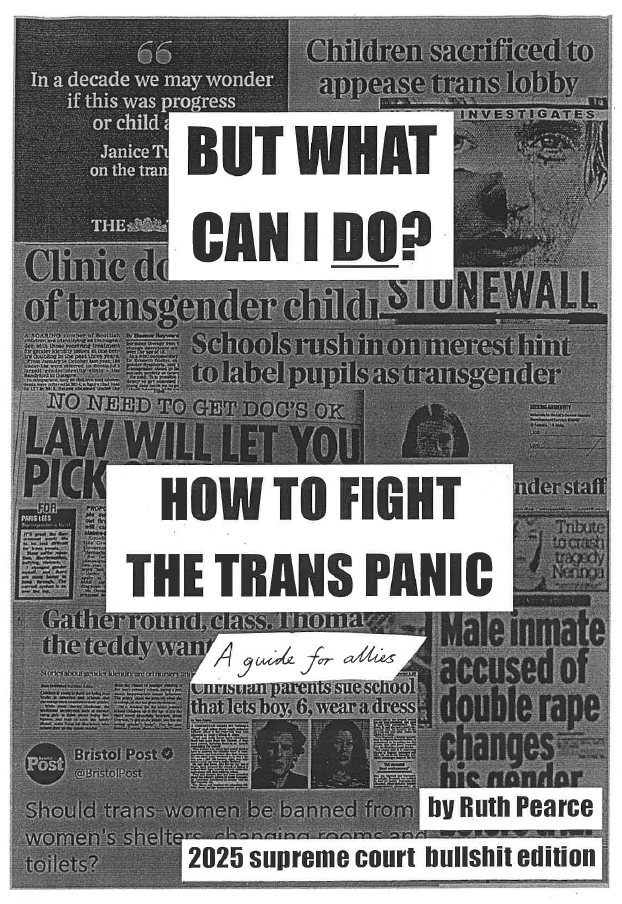
It was the largest trans protest in British history.
We travelled from across the country to central London. We were joined by allies, especially cis gay, lesbian, bisexual, and queer people who recognised the importance of solidarity, of standing together in this moment. Wielding bright flags and banners, we gathered in unprecedented numbers. We to were here to raise our voices against the institutionalisation of transphobic hate and abuse, to oppose calls for exclusionary policies and trans healthcare bans.
I couldn’t possibly miss this, so travelled down on the train from Leamington Spa with my home-made placard. Looking around after I arrived on that cold winter night, I marvelled at the sight. There were so many of us. Maybe as many as 150, or even 200! And my friend Jo even brought a home-made trans flag with them, which was an amazing thing to see outside of the internet.

The year was 2008, and we assembled outside the Victoria and Albert Museum to protest the annual Stonewall Awards. The UK’s largest LGB charity had nominated the Guardian journalist Julie Bindel for an award, despite – or perhaps even because of – her notorious transphobia. The protest was called by the London Transfeminist Group, and supported by a range of other organisations, including Queer Youth Network, Trans Youth Network, and the National Union of Students (NUS) LGBT Campaign.
Afterwards, we gathered at a local pub and talked excitedly. The protest was a massive embarrassment to Stonewall, and through grassroots organising we had shown we could bring trans people and allies together on a scale that never before felt possible.
How could we build on this power, and what might the future bring?
***
It was the largest trans protest in British history.
Trans people travelled from across the country to central London. They were joined by allies, especially cis gay, lesbian, bisexual and queer people, plus parents and family members, trade unionists, and celebrities who recognised the importance of solidarity, of standing together in this moment. Wielding bright flags and banners, they gathered in unprecedented numbers. They were there to raise their voices against the institutionalisation of transphobic hate and abuse, and to oppose exclusionary policies and trans healthcare bans.

I wasn’t in London for Trans Pride 2026. I’m involved in plenty of protests and community events in Glasgow these days, from last year’s noise demonstrations outside the EHRC headquarters, to the incredible Solidarity Pride Hub, which filled the Pyramid at Anderston with amazing talks, workshops, and stalls led by trans and queer organisations. Nevertheless, watching online as the images came in was pretty incredible. A reported 150,000 people took to the streets, just one week after thousands more gathered for Trans Pride Brighton.
How can we build on this power – and what might the future bring?
***
For decades, the trans liberation movement has fought to change the world. We found new ways of being, and created language, art, and culture to name and explore these possibilities. We won new civil rights. We achieved incremental improvements in the provision of healthcare and education. We have made it a fair bit easier for many people to exist in the workplace, and to survive on benefits. We have built community: feeding each other, housing each other, and providing advocacy for each other, and partying together.
As the UK enters a new era of state-mandated segregation, I find myself asking: was it all worth it?
***
For all the achievements of the trans liberation movement, many of us have continued to struggle enormously in the face of interpersonal and institutional violence. This is especially the case for those more likely to be left behind by liberal trans activism, including disabled trans people, trans migrants, trans people of colour, and trans sex workers. Trans communities have also handily replicated the structural misogyny of the wider world. As a result, paid roles in advocacy, charity work, and the arts remain dominated by trans men and transmasculine people.
Meanwhile, through becoming more visible, we have become more vulnerable. Through being acknowledged within institutional frameworks, we have become more identifiable. Through asking for respect, we have become a problem. Through entering political conversations, we have become scapegoats.
Cis “centists” are often swift to blame trans people for our own problems. If we’d just been more polite, more accommodating, and less demanding.
Trans people also frequently assess our movement’s activist strategies. Sometimes this will be helpful. For example, there are lots of productive discussions happening right now about the respective merits of lobbying people in power vs building power in our communities from the ground up. Other times, certain trans people will say we have gone too far, demanded too much. If only we’d been more respectable. If only we’d laid off the pronouns. If only we could agree on a nice, clear definition of “trans”. If only we gave up on those confusing non-binary identities. If only we’d let children be children.
***
I came out to myself and my friends while in school, transitioning as a teenager in the early 2000s. I cannot emphasise enough how unusual this was – and consequently, how lonely and isolating my experiences were. We had so little information. Most out trans people at this time were middle-aged or older, and I didn’t have any opportunity to meet them. Being a trans teenager felt like a complete impossibility.
My transition had three key enablers. The first was my own sheer bloody-mindedness. The second was the support I did find and receive from others. And finally, I benefited from an enormous dose of luck.
After years of fruitless online searches for anything that would explain my feelings and my needs, I found a US web forum run by and for young trans people, providing invaluable advice and a sounding board. I wasn’t sure at the time whether I was a real transsexual, or just one of them fake cross-dressers. The broad, fluid language of transgender identity and experience meant that this artificial distinction didn’t actually matter. The important thing was solidarity: gender diverse people standing together in the name of our shared interests. This enabled me to explore what I might need and desire in an open-ended way with other people my own age, without feeling that I had to transition in any specific way or on any particular timescale.
In the offline world, none of my teen friends understood what I was going through. But they supported me unconditionally. My early romantic partners also had my back. One took me shopping, and helped me figure out my style. Another gave me my name.
I first went to see a doctor for help with medical transition aged 15, but I failed to receive a gender clinic appointment until I was an adult. This didn’t feel lucky at the time, but looking back, it was an enormous stroke of fortune. Through spending years on waiting lists, I avoided the conversion therapists who then – as again now – dominated child and adolescent services.
During these teen years, a schoolteacher – unable to provide me direct advice herself due to Section 28 – referred me to a free counselling service provided by a local charity. I remember my counsellor asking me, “do you think you are part of oppressed minority?” I wasn’t quite sure. Maybe? Probably?
Given the luck I had experienced, I did not understand how much I had already been let down. I did not fully comprehend the sheer void of information on trans existence. I did not realise that my self-hatred and self-denial was the fault of damaging social norms and expectations, rather than something broken in me. Nor did I understand how massively vulnerable I was as a result. The support of my peers meant that unlike many other young trans people, I was not subject to sexual predation: a topic later explored in my research, plus stories such as Paris Lees’ autobiographical book and TV series What It Feels Like For A Girl. I did not see how much my own internalised sexism had already warped my sense of what might be possible for me, leading me to take on a passive role in friendships with male friends who I watched play music and video games. And while I had already been beaten up or groped multiple times in the playground and the street, I was yet to experience much of the targeted transmisogyny that would accompany me into adulthood: the continued sexual assaults, the verbal abuse, the harassment, the stalking.
I didn’t know it at the time, but what I needed was trans community, and feminism.
***
I became an activist in the mid-2000s, during my early 20s. Again, a few chance events spurred me along. But I also benefited from the care and energy of others who wished to change the world.
One of the first trans people I knowingly met in person was the professional speaker and advocate Rikki Arundel. A young gay man had booked them to speak for a student event at the University of Warwick, where I was studying for my undergraduate degree. Rikki took me to a café immediately after the talk. “So”, they asked, “you want to be a trans activist?” I hadn’t asked.
Rikki nevertheless spent some time outlining advice. Get to know people in your area: community members, local politicians, policymakers. Go to meetings and become known. Build a reputation as a helpful and reliable point of contact. At every possible opportunity, leverage this to demand change, positioning it as a sensible, reasonable course of action.
Rikki’s advice was invaluable for working within liberal systems. These days, I am wary of trans liberal approaches, as these can be individualising, and lead to concessions that leave many behind. But you do not need to believe in or support a system of power to work within and against it.
Around this time I also went to my first NUS conferences. Through the NUS LGBT Campaign and later also the NUS Women’s Campaign, I shared knowledge and skills with other young people, and went to my first protests. Through these campaigns I met other young, openly trans people in person for the first time, including Mallory Moore. I learned great deal from organisers such as Mallory. They appeared to have very different beliefs to Rikki, but were, in fundamental ways, doing very similar work. Get to know people. Build connections. Identify points of common interest. Figure out where and how to apply pressure to achieve change. Where Rikki spoke to the local council, Mallory worked with local feminist groups. I found myself doing both.
***
The isolation of my teen years continued into my early adulthood. Encounters with people like Rikki and Mallory were fleeting, one-off events. I would then go entire months without knowingly meeting another trans person.
To break this isolation, I began to travel. I took a day trip to Birmingham to hang out with a slightly older trans youth activist from Queer Youth Network, an internet community I’d recently joined. I travelled to Bradford and Manchester to speak at student union meetings, arguing for the introduction of all-gender toilets. I travelled down to London to attend an event hosted by a new organisation called Gendered Intelligence, and marvelled at being in a room with over a dozen other young trans people. This event wasn’t actually very good: it only happened because it had been funded by cis academics who wanted to do some boring research. But I left to sit in the corridor and chat with other trans girls, who would become lifelong friends.
There were so few of us out because there was still so little information available, and so little in the way of community support for those who did try to come out or transition. Most trans people were spending years, decades, lifetimes stuck in the closet. But this was beginning to change.
Trans communities in the UK were benefiting from a virtuous cycle of coming out. The internet helped a great deal with this, as new resources and information spread online. But the real change came with trans people simply being a visible part of public life. Transphobes like to call this “social contagion”. I prefer Laverne Cox’s term, “possibility model”. You see a trans person getting on with their life, and realise that sex change is possible for you, too.
In so many spaces, I was patient zero for the viral spread of trans possibility. I cracked eggs everywhere I went. Every time I spoke at an event, or attended a conference, or hung out with other queers at the pub, I showed that another world was possible. Young trans people came out all around me, and in turn they became visible to others.
But coming out is just the first step. For trans lives to be liveable, we need support from other people. We need to share resources and information. We need community.
***
I remember speaking in the late 2000s or early 2010s with an older trans woman at an event in Wolverhampton. Following the repeal of Section 28 some years before, she was keen to work with schools to ensure that young trans people were never as isolated and confused as I once was. “We need education at an early age”, she said.
We did this. It was not the action of any one person or group at any moment in time, but the action of a movement across many years. Organisations like Schools OUT produced material and information for schools. Groups like Gendered Intelligence helped support the development of a knowledge base to evidence change. Individuals like myself spoke with our local councils about how they could change their policies. Thousands of teachers across the country quietly changed their curricula, introduced new approaches, and created clubs for trans and queer kids.
Meanwhile, others created blogs, youtube videos, social media posts that circumvented schools entirely, speaking directly to young people. Importantly, much of this material sought to break away from the old binaries that used to divide trans communities: male-to-female vs female-to-male, transsexual vs transvestite. With “trans” we were imagining solidarities across difference, a context in which those who did not seek medical transition sought commonality with those who did, and vice-versa. We were collectively imagining a world in which sex norms and gender stereotypes no longer governed our lives, and in which we might work together to achieve our varying desires and needs.
It is interesting to think about this former progress at a time when the UK government has produced incredibly transphobic new legal guidance for English schools, and when NHS England is actively pushing conversion practices. Trans kids now face an incredibly hostile policy environment: one that refuses to even name their existence even as it demands that they be segregated and abused.
Yet, young trans people continue to come out, to seek support and support one another, in numbers that would have been inconceivable to the protesters gathered in London on that cold night in November 2008.
***
The strange irony of trans life in the 2020s is that there are still more of us than ever. Even as external conditions become more and more hostile, the virtuous cycle continues.
Some of this is about possibility models. You can see this in Trans Pride London 2026. We are talking 150,000 possibility models on the streets in central London in one day alone. Every single one of these people sends a message to those thinking about coming out. That message says: you are valued, you are loved, and support is available. You are not alone.
Some of this is about trans-led support. While the NHS, crisis services, shelters, housing services (etc etc) have variously got better and worse over the years, they have always let many of us down. In light of this, trans people have built mutual aid networks to get vulnerable people out of dangerous accommodation, house those in need, produce and share medication, and disseminate harm reduction resources. In this context, trans diversity is vital: we need strong communities that are more interested in how we might bring our myriad of skills and experiences to bear in caring for one another, rather than obsessing over how our language and identities might differ.
Some of this is about trans art and culture. You can turn on the TV and see trans actors, comedians, politicians, and experts, on shows written or produced by other trans people. You can turn on the radio and hear trans people playing music or speaking about their experiences. In some towns and cities, you can even can go to your local gallery and see work by trans artists, visit your local pub or club or DIY venue and see trans performers, and they might even give out handy little flyers telling you where you can get your hands on HRT.
Some of this is about solidarity work from cis people. All that endless work of education over the past decades has not been in vain, however much the politicians and hateful people of this world would like it to be. Through incessantly speaking out and demanding change, and in joining with others to support their struggles, trans people have made allies everywhere. Teachers and lecturers, doctors and nurses, administrators, hospitality workers, lawyers, and many more are more likely to have access to information through their family or friends or trade unions, which help them in turn to support trans people in a hundred thousand little ways every day.
***
In 2008 we found hope in the possibility of community connection, solidarity, collaboration, and friendship. In 2026, we see what was successfully built from that hope and that possibility.
Over the last two decades and beyond, we have won trans community and connectivity on a scale that was once unthinkable. We have made allies across every part of public life. We have helped hundreds of thousands people to improve their lives. This is a historic achievement.
Today, the trans liberation movement faces off against vicious foes and their allies in the Labour government, who would see us eliminated altogether. Trans people of all ages and backgrounds are forced to navigate laws and policies designed to make our lives more difficult and more dangerous.
It is all too easy to think that the trans activism of the past has failed, that every gain has been reversed in an orgy of hate and bigotry. Yet this is simply not true.
The achievements of the past have helped prepare us collectively for the demands of this moment. There are more of us than ever, and we have successes as well as failures to learn from.
Let’s see what we can do with that.
Some relevant resources:
Trans Actual: Know Your Rights
Trans Actual: Segregation in Practice Report
Trans Learning Partnership: Stronger Voices: Trans Housing, Community, & Livelihood
Good Law Project: We’re supporting a legal challenge against the code of practice
Good Wee Place: EHRC Sex Segregation. Staying safe and responding well. (guidance for venues and individuals)
Gendered Intelligence: EHRC Code of Practice Guidance (guides for Young People, and for Adults)
Good Night Out Campaign: Pee In Peace
Did you appreciate this post? Want to read more?
Subscribe now to receive new posts for free whenever I write them.