It’s a long hard revolution

Lesbian conspiracies in Lausanne

On the evening of Tuesday 15th April 2025, I was widely perceived to be a British lesbian, both legally and socially. By 11am the following day, that was no longer the case, following a ruling by the UK’s Supreme Court.

I was not actually in the UK for this momentous occasion. I was instead in the Swiss city of Lausanne, for a workshop on standards of evidence in sex and gender policy. I was there to consider the very questions the UK’s highest court, in their supreme ignorance, had effectively dismissed. Their ruling determined that the term “sex” in the Equality Act referred to “biological sex”, which in turn should be understood as “the sex of a person at birth”. But what do we actually need to know about when we make policy around sex and gender, and what is the role of evidence in this?

The Tuesday evening found me hanging out in a second-rate Thai restaurant with Professor Sarah Lamble, an esteemed criminologist and fellow dyke. Lamble and I spent some time talking about how conspiracy theories around “disappearing lesbians” highlighted the strange ironies inherent in British anti-trans discourse. The anti-trans movement has been extremely successful in raising “reasonable concerns” around supposed problems that are completely ungrounded in reality, to the point where that reality itself begins to warp.

Mainstream political discourse in the UK increasingly reflects anti-trans claims that lesbians are somehow threatened by trans people, or are even being transed en-masse in gender clinics and youth groups. The true biological attraction between two adult human females is disrupted. Young people are tempted away from lesbianism with promises of luxurious facial hair and male privilege; meanwhile, horrifically manly and/or confusingly attractive trans dykes are introduced to the dating pool.

If these claims were true, we might expect to see some kind of reduction in the number of homosexual females. Instead, the evidence we have indicates quite the opposite. Surveys such as the Annual Population Study show a rising number of lesbians over recent years, part of a wider increase of 1.2 million in the recorded lesbian, gay, and bisexual (LGB) population of the UK. This is driven especially by young people coming out, with over 10% of people aged 16-24 identifying as LGB as of 2023.

But what about the lived reality of queer womanhood? Well, there’s great news here too: we are living in a truly historic time for sapphic culture in the UK. Proudly out lesbian and bisexual women can be found across the pop charts, on TV, and across social media. Queer bookshops are on the rise. Pop-up butch bars and new queer cafes can be found in major cities and small towns.  And, excitingly, even the much-maligned lesbian bar is making a comeback, with three permanent venues and numerous occasional nights now running in London alone. It’s all got so out of hand that in 2024 the Queer Brewing company sold a juicy pale ale named Dyke Renaissance, which conveniently listed an educational series of cultural milestones on the can.

If trans people are trying to disappear lesbians, we’re doing a really bad job of it.
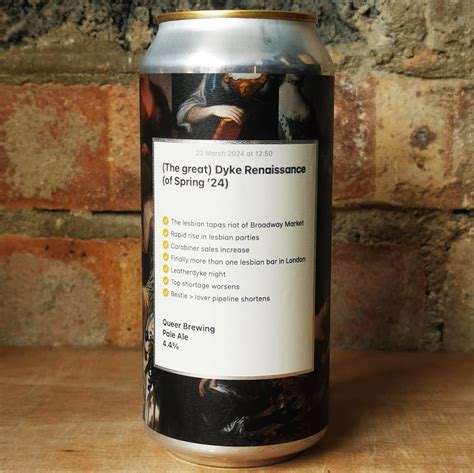
Photo of a beer can. Text on the can reads as follows. The great Dyke Renaissance of Spring 24. The lesbian tapas riot of Broadway Market. Rapid increase in lesbian parties. Carabiner sales increase. Finally more than one lesbian bar in London. Leatherdyke night. Top shortage worsens. Bestie to lover pipeline shortens. Queer Brewing, pale ale, 4.4%.


Meanwhile, queer cis women tend to be pretty supportive of trans people. In fact they’re one of the single most supportive demographics in the UK – which is presumably why the Equality and Human Rights Commission is, right now, attempting to ban trans dykes such as myself from associating with any more than 25 biological lesbians at any one time.

On evidence

As lesbian conspiracy theories show, the very concept of evidence has had a bit of a hard time over the past decade.

In the UK, this was perhaps best encapsulated in 2016 by the Conservative politician Michael Gove. While campaigning for Brexit, he declared that the British people “have had enough of experts”. Gove’s claim is echoed in a growing anti-intellectualism across the globe. From the mass purge of universities in Türkiye, to the post-truth bizarro world of Donald Trump, to Israel’s scholasticide in Gaza, this trend manifests in blunt and brutal ways. Anti-expert authoritarianism doesn’t care about your facts or your feelings.

However, attacks on evidence can also be more subtle. Gove’s comments are widely quoted, but it’s less well-known that he singled out a particular kind of expert for criticism: “people from organisations with acronyms saying that they know what is best and getting it consistently wrong”. While this was gloriously vague in a way that allowed the listener to project all kinds of things onto Gove’s words, in context it was nevertheless evocative of the kind of group that tends to advocate for social justice. LGBTQQIAAP groups, perhaps.

From academic thinktanks, to charities, to campaigning organisations, the implicit problem was any kind of challenge to conservative common sense. The UK’s political mainstream has since doubled-down on this approach. In the run up to the 2024 general election, Tory home secretary Suella Braverman criticised “experts and elites”, while the secretary of state for science, innovation and technology, Michelle Donelan, promised to “kick woke ideology out of science”.

One of Donelan’s targets was the “denial of biology” in research by feminists, social scientists… and biologists. The problem here is that supposedly common sense notions of sex and gender, which assume clean and tidy biological divisions between male and female, collide violently with the beautiful messy reality of the material world. At this point in history, it is well-established that sexual diversity exists throughout nature, that men are not biologically superior to women, that social advantage is not conferred or denied by chromosomes, and that queer, trans, and intersex people exist in the world. The evidence for this is gloriously multifaceted. We find it in laboratories, in systematic reviews, in surveys and questionnaires, in the way that men shout abuse at us in the streets, in how our sexed bodies shift and change under hormonal influence, in the way we feel when we finally have a language that describes our experiences.

Michelle Donelan decided to tackle the thorny problems of feminist science, intersex bodies, and trans existence by commissioning a research project by Alice Sullivan, a supposed sociologist who doesn’t care one jot for any of the evidence outlined above. Published in March 2025, the Sullivan Review insisted that data collection relating to sex and gender should rely on a very narrow definition of biological sex: one that ignores trans and intersex women’s real lives, bodies, and experiences of misogyny, while promoting a sexist model of essentialised womanhood. Her findings were echoed in those of the Supreme Court judges a month later, whose pronouncements on biological sex were made without any reference to relevant social, scientific, or philosophical research on how this might actually be understood or defined in practice. 

To position this as a wholly new trend would, of course, would be inaccurate. Western jurisdictions have long used and abused pseudoscience to oppress minoritised groups, especially in colonial contexts. This can be seen for example in the British state’s shameful embrace of “race science” and eugenics in the 19th and 20th centuries. What we are now witnessing is an example of the imperial boomerang, in which the logics of colonialism are turned inwards, resulting in increasingly fascist domestic politics.


But did you have a nice time in Switzerland, Ruth?

On that fateful week in April, I joined a group of feminist, trans, and lesbian researchers and activists for the workshop at the University of Lausanne. In the face of increasingly ill-informed policymaking across multiple contexts, it provided us a space to think together about the lessons we might learn collectively from our very different work on healthcare, sports, and prisons.

One overarching theme was the importance of evidence in understanding human experience, in terms of rigorous data collection, careful analysis – and accounting for the lived reality of actual people’s actual lives. A powerful account of the latter point was provided by Dinah Bons, a veteran campaigner for HIV prevention. She pointed out that if a sex worker repeatedly attends a community clinic for her STI tests, this provides evidence that the clinic feels safe enough for her to return regularly, which is far from a given. Such matters are often highly evident to service users and providers on the ground, without any need for a survey or interview.

Another key theme at the workshop was the extent to which various principles of evidence are increasingly abused by politicians, journalists, and institutions.

The concept of evidence has not been rejected wholescale by sexist, transphobic, and lesbophobic policymakers. Rather, “evidence” is increasingly a buzzword to justify particular approaches or points of view, rather than something grounded in a commitment to scholarly standards or an acknowledgement of lived experience. At the workshop, we explored how flawed notions of evidence have been used to support misleading statements or outright lies about human bodies or human experiences. We heard about the use and abuse of evidence in justifying invasive sex-testing for woman athletes, misrepresenting research on young people’s ability to engage in informed decision-making, and defending conversion practices. Notably, while most of these abuses arose from a specifically transphobic politics, they have far wider consequences: especially for women, intersex, and queer people, but also for scientific processes, community consultations, and informed advocacy more broadly.

You can see an example of this in the Cass Review. Through successfully performing the aesthetics of acceptable expertise and science to the satisfaction of the British public, the Review has become what one workshop participant described as a black box. By this they meant that it has become an abstracted justification for policy and practice, handily replacing any ongoing discussion of evidence regarding young trans people’s health and wellbeing. You don’t need to know what the Cass Review actually says or how rigorous it actually is, only that it exists. Well-documented criticisms of the review from healthcare practitioners, academic experts, trans community groups, and (most importantly) young trans people themselves are been rendered irrelevant. The Cass Review is the evidence, and no other systematic review, original research, or personal testimony can henceforth count against it. Not, at least, until 2031 at the earliest: the official end-date of a single £10 million study, based on the Cass recommendations and featuring precisely zero trans researchers.

The British establishment is now attempting to repeat this trick with the Sullivan Review – never mind that projects such as MESSAGE have conducted more extensive and nuanced work on the same topic with a far wider group of experts – and, of course, with the Supreme Court judgement.

Beyond doom

As with Cass, as with Sullivan, it is difficult to capture the sheer enormity of harm caused by the Supreme Court’s pronouncement on biological sex. The consequences are still playing out, and will no doubt continue to do so for many awful months and years.

At the time of writing, the Equality and Human Rights Commission have proposed a programme of mass segregation, designed to discriminate against trans people in the workplace, in public services, and in social groups. The guidance they have written is just that: guidance, not law. Nevertheless, major organisations such as the Football Association, the British Transport Police, and Barclays Bank, all of whom shamelessly paraded rainbows through their social media profiles last Pride season, are falling over themselves to comply. We are witnessing the attempted complete exclusion of trans people from public life, in the latest culmination of a transparent attempt to eliminate us altogether.

In such moments, it can be easy to despair. This is in part because it is easy to forget the strength, resources, power held within trans communities and by our allies. That includes the knowledge and evidence we have access to.

Don’t get me wrong. The people who want to eliminate us are better-funded, better-connected, and now have the Labour government on-side as well as the UK’s traditional right-wing parties. We are not going to win trans liberation overnight.

But then, again, we never were.

Everything I said about lesbian culture earlier is true of trans people too. There are more of us publicly creating art and culture, more of us creating events and running nightclubs and playing in bands and writing essays (hi). There are more community groups providing mutual aid and support when charities and state bodies fail us. And, importantly, we are not alone.

Trans women and non-binary people are a part of the dyke renaissance. We are at the butch bars, and bemoaning the top shortage. We are dancing to Le Tigre and to Chappelle Roan. We are reading Gideon the Ninth and watching We Are Lady Parts and having all the feelings. My partner of the last decade was probably the most surprised of all to learn from the Supreme Court that I am not, in fact, a lesbian, as every bit of evidence from our shared personal lives points to quite the contrary.

I will concede that some trans people are not in fact lesbians, or even queer. Nevertheless, there are so many other places to find us in community with others. Trans people are in trade unions. Trans people are in workplaces. Trans people are in schools and colleges and universities. Trans people are in the streets. Trans people are on the bus. Trans people are in families. Trans people are making families. Trans people are playing football (suck it, Football Association). Trans people are eating pizza. Trans people are restoring the countryside. Trans people are hanging out beside Lake Geneva in the glorious sunshine, enjoying a much-needed break.


There are more of us than ever, and it is too damn late to put us back in a box.

Resistance is fertile

I was honoured to present the keynote presentation at the Swiss workshop. I spoke about the findings of the Trans Pregnancy Project, a study that produced enormous amounts of evidence on the experiences, needs, and perspectives of men and non-binary people who conceive, carry, and give birth.

No matter how much our findings are slammed by the media and billionaire children’s authors and washed-up comedy writers, our peer-reviewed work has demonstrated the lived reality of male and non-binary pregnancy over and over again. Most importantly, it has helped people. We are part of a far wider movement of parent groups, midwives, and researchers who are collectively building knowledge. I am constantly hearing from people who describe how much this knowledge has resulted in better care for them and their child. This kind of story drives everything I do.

Towards the end of my talk, I discussed the anti-trans moral panic, and the Supreme Court judgement. I then showed the below table of findings from the National Maternity Survey. This annual survey involves those who have recently given birth every year in many (but not all!) English hospitals, over the course of a few weeks. Since 2021, they have started asking whether the person giving birth has a different gender to the sex they were assigned at birth – i.e. are they trans?

Table showing data in response to the question, is your gender different from the sex you were assigned at birth. It shows a statistically significant increase in the proportion of people answering "yes", which rises from 0.56% in 2021, to 0.65% in 2022, to 0.77% in 2023, to 1.58% in 2024.


Two things leap out from this table for me. Firstly, the 2021 data shows a very similar proportion of people indicating they are trans when compared to the 2021 censuses in Scotland, England, and Wales. This suggests that, contrary to assumptions around trans infertility or undesirability, trans men and non-binary people may well be just as likely to give birth as cis women are to become birth mothers.

Secondly, the number of trans people giving birth has risen dramatically over four years. Even as the anti-trans moral panic has deepened. Even as attacks on even recognising the existence of trans people in perinatal services have increased. As Del La Grace Volcano once it put it: “resistance is fertile!”

In the face of growing oppression, trans people are simply refusing to disappear. In fact, we are doing the opposite.

This, then, is the power that the anti-trans movement, the Labour party, and the Supreme Court cannot possibly take away from us. The more trans people are out and visible to one another, the more trans people come out and become visible to one another. Sure, we will unfortunately need to think more carefully about where and when we are out, and where and when we are visible, if this is something we even have any power over in our specific lives. I am sure that more trans people will be going stealth in future years, if they can. But regardless – there are more of us in community, more of us organising protests, and more of us than ever in the lives of our friends, families, colleagues, and allies, showing that it possible to have a good life while being trans.

In this context, it is important to know that people from many parts of the world gathered in Lausanne this April to pool our knowledge and skills and experiences. It is important to know that we have each returned to our home countries to share what we gained. It is important for people to know that similar meetings are happening across the world, in community centres and on university campuses, in board rooms and in bedrooms, involving trans people, and feminists, and yes, lesbians. We are constantly building a movement for positive change, and you do not have to be an academic or veteran activist to be a part of it. Trans power is for everyone.

There is much to say what needs doing in the current moment. We need allies to continue fighting alongside trans people for our collective liberation. We need to be demonstrating in the streets, funding mutual aid and legal action, actively resisting complicity in Labour’s eliminationist agenda, and encouraging every public body under the sun to do the same.

Evidence will be helpful for this. Evidence from academic research, sure, but also – as Dinah Bons pointed out – testimony from the everyday reality of trans people’s lives. And oh boy, do we have that evidence.

More of us than ever are producing evidence of trans existence, and trans persistence.

And this is how we win.

Free resources: Perinatal care for trans people

On 8 February 2021, Brighton and Sussex University Hospitals NHS Trust published a series of groundbreaking resources on perinatal care for trans people, written by their Gender Inclusion Midwife team. As of March 2025, the Trust no longer exists, the midwives in question work elsewhere, and the resources page was sadly taken down – a sadly all-too common experience with NHS guidance for working with marginalised peoples.

Given the importance of these materials, for which I was part of a large team of expert reviewers, I am reproducing them on my website today for Trans Day of Visibility 2025, alongside some related resources.

I hope these will be of interest and use to anyone interested in improving perinatal care for trans people, including midwives, nurses, doctors, policymakers, commissioners, advocacy groups, and of course also families and prospective parents.

Professional guidance and protocols by the Gender Inclusion Midwives

Perinatal Care for Trans and Non-Binary People

Gender Inclusive Language in Perinatal Services


Information, forms, and materials for birth parents by the Gender Inclusion Midwives

Support for trans and non-binary people during pregnancy, birth and the postnatal period

Referral to Gender Inclusion Midwives

My language preferences

Pronoun stickers

Poster: Gender Inclusive Perinatal Care


Additional materials

It’s been a long four years since the Gender Inclusion Midwives resources were published. Here, therefore, are a few additional materials that may be of help to people working in this area.

National Maternity Survey data on trans birth parents
Since 2021 the Care Quality Commission has collected data on gender modality as part of its annual National Maternity Survey. The most recent findings indicate a significant rise in the number of men and non-binary people giving birth since 2021, with 1.58% of 2024 respondents indicating a gender that differs from the sex they were assigned at birth. This shows that hundreds of trans people are giving birth in England every year. See: Open data > 2024 Maternity survey National tables > page g9.

Inclusive language statement from the Royal College of Midwives
2022 statement affirming both that a majority of RCM members and service users are women, and that diverse gender identities should be recognised in midwifery.

Improving Trans and Non-Binary Experiences of Maternity Services (ITEMS)
2022 report published by the LGBT Foundation, looking at the findings of an English study on the experiences of 121 trans people who conceived and gave birth. It found that many trans birth parents do not feel safe sharing their identity in perinatal services, with a large proportion not feeling comfortable to access any support at all from an NHS or private midwife.

Trans Pregnancy Project website
I reviewed the Gender Inclusion Midwives resources as part of my work on the Trans Pregnancy Project, which was an international study of trans people’s experiences of pregnancy and childbirth. This year we launched a new website. This includes links to all our peer-reviewed publications, on topics including conception, pregnancy loss, midwifery, gender and embodiment, domestic violence, racialisation, and media representation.

Caring for Everyone: Effective and Inclusive Communication in Perinatal Care
One of the key recommendations of the Gender Inclusion Midwives’ guidance on Gender Inclusive Language in Perinatal Service is the adoption of “additive” language. This approach acknowledges male and non-binary birth parents alongside mothers, rather than simply replacing woman-centred language with a gender-neutral approach. This 2025 academic article by Matthew Cull, Jules Holroyd, and Fiona Woollard provides advice on a “pluralist” approach to language, which builds upon the additive model by offering a more contextual approach. It includes clear examples of what best practice can look like.

Image of poster on gender inclusive perinatal care. For version accessible to text reader, see download link above titled Poster: Gender Inclusive Perinatal Care.

New article: Trans Birth Parents’ Experiences of Domestic Violence

Through 2018 and 2019, I travelled across the UK and Germany to speak with trans men and non-binary people about their experiences of pregnancy and childbirth.

These research interviews for the Trans Pregnancy Project took place in kitchens, living rooms, and cafes, next to canals and rivers. We covered topics ranging from conception to pregnancy loss, taking in questions of masculinity and the body, relationships with family, friends, workplaces and social groups, interactions with medical practitioners, and people’s journeys through perinatal services.

I remain deeply honoured to have been trusted by participants to share and analyse their stories. The questions planned by our project team touched on deeply intimate and sometimes traumatic experiences, as well as joyful accounts of kinship and bringing new life into the world. These were by design long, deep discussions, covering a great range of issues that have been rarely discussed in academic literature to date.

And sometimes, an unexpected conversation would happen.

We – the research team – did not plan to study domestic violence. Instead, this topic was introduced by research participants. I will never forget the first time this happened, silently putting aside my planned questions as the man in front of me quietly, carefully disclosed what had happened to him, and how it intimately shaped his experience of pregnancy.

As others shared their stories in turn, I began to realise just how important these narratives are, and the need for peer-reviewed work that explored them in detail. The resulting article is now available following a long gestation period (pun intentional). I hope it will useful to a range of practitioners – educators, crisis workers, midwives, obstetricians, doulas, family doctors – as well as to academics and, most importantly, community members.

Read now for free:
Trans Birth Parents’ Experiences of Domestic Violence
Conditional Affirmation, Cisgenderist Coercion, and the Transformative Potential of Perinatal Care

by Ruth Pearce, Carla Pfeffer, Damien W Riggs, Francis Ray White, and Sally Hines


I am also really pleased that we have published in the “platinum open access” journal Bulletin of Applied Transgender Studies. Launched in 2022 and hosted by Northwestern University Libraries, the journal is free to publish in and free to read, with articles shared under a creative commons license. We found this publication route offered an extremely rigorous double-anonymous peer review that really challenged us, and ultimately strengthened our arguments and use of evidence. Given the exploitation and profiteering that is rife in the academic publishing industry, supporting new journals such as the Bulletin feels like an important political move as well as the right scholarly decision.

Journal logo

Please do share this article in any context you feel it will be helpful to others. Remember, under the license anyone can distribute it as-is for non-commercial reasons: so download, print, and pass it around to your heart’s content.

Video: Reproductive Justice for Trans People

Earlier this year I did a talk for the University of Cambridge Reproductive Justice Research Network alongside my excellent colleague Francis Ray White.

We talked about research findings from the Trans Pregnancy and Improving Trans Experiences of Maternity Services projects, plus reflected on the wider context of reproductive justice for trans people, including media coverage, medical racism, abortion rights, and attacks on young trans people’s bodily autonomy.

You can watch a video of the talk here:

(as a quick aside, I’d like to thank my good friend Harry Tunnicliffe for last use minute of his office so I could do this talk while away from home!)

Upcoming talks: April-May 2022

I am speaking at a series of exciting events over the next few weeks! All are free to attend, you will just need to register in advance if you’d like to come.

Tuesday 26th April – Manchester
Trans Healthcare: Past, Present and What Might Have Been

In-person roundtable discussion, with Ellis J Johnson, Stephen Whittle, Krishna Istha, and Laura Salisbury.

6pm-8pm BST, International Anthony Burgess Foundation
3 Cambridge Street, Manchester, M1 5BY

Wednesday 27th April – Online
Queer and Trans Mobilisations – Possibilities and Challenges

I am incredibly honoured to be giving a keynote talk for this two-day event hosted by the Department of Sociology, University of Hyderabad, and the Centre for Writing and Pedagogy, Krea University. I will be speaking about “Building Queer and Trans Communities in the UK” towards the end of the first day, and am enormously excited to be learning from colleagues in India during the event.

10am-6pm IST, 27-28 April
Register online to attend

Thursday 5 May – Online
UK Workshop in Trans Philosophy

I will be delivering a keynote on the first day of this groundbreaking event hosted by the University of Glasgow. My talk is provisionally titled “Let’s (not!) fight a TERF war: Trans feminism in a time of moral panic”.

9:30am-4:30pm BST, 5-6 May
Register online to attend

Wednesday 11 May – Online
Reproductive Justice Research Network seminar (link to come)

I will be joining colleagues from the Trans Pregnancy project to discuss findings from our international study of trans and non-binary people’s experience of conception, pregnancy, and childbirth. Our talk is provisionally titled “Reproductive Justice for Trans People”.

Full details TBA – watch this space!

Trans inequalities in English perinatal care

About a month ago I participated in the TPATH conference. This groundbreaking online event centred trans healthcare practice, research, and activism by and for trans people.

I was very impressed with the measures taken by TPATH organisers to ensure the conference was accessible to as many people as possible from around the world. They organised live translation to and from English, French, and Spanish, provided live captioning, encouraged presenters to speak slowly and clearly to enable lipreading, and ensured that generous scholarships were available for those who would not otherwise afford to attend. Most of the event was recorded, and videos are gradually being uploaded to the TPATH Youtube channel.

At the conference I joined Tash Oakes-Monger from NHS England to present initial findings from the ITEMS project (Improving Trans Experiences of Maternity Services). The ITEMS team, led by Michael Petch from the LGBT Foundation, ran a survey in early 2021 to explore the experiences of trans people (including non-binary people) who give birth in England. I supported the design and dissemination of the survey through my former role with the Trans Learning Partnership.

Bar chart indicating that increasing numbers of trans and non-binary people are giving birth in England every year.
Bar chart indicating growth in number of trans people giving birth in England each year.


There is some really exciting information emerging from the ITEMS data. For example, it appears that more trans people are giving birth than ever before (see above). However, it was also apparent that trans people face substantial inequalities.

Many of the questions in the ITEMS survey used comparable wording to the CQC Maternity Survey – from this we can see that trans people appear more likely to have negative experiences in NHS maternity services than cis women across the board. Even more disturbing is that 30% of trans respondents gave birth without the support of an NHS or private midwife (rising to 46% among trans people of colour). This indicates a lack of trust in midwifery services among prospective trans birth parents, with potentially lethal consequences for both parent and baby.

To learn more, you can watch our presentation on the TPATH Youtube channel.

A formal report of ITEMS findings should be published in the coming months.

Trans pregnancy study – new article and podcast

Over the last year I have been working on the largest international study of conception, pregnancy and childbirth among trans men and non-binary people: the Trans Pregnancy project. We have now undertaken fifty interviews with trans and non-binary people about their experiences in Australia, Bulgaria, Canada, Germany, the UK and US, plus further interviews and focus groups with young people and healthcare professionals.

In this post, I share a new peer-reviewed commentary and podcast from the project.


Article: Beyond the pregnant man: trans pregnancy in A Deal With The Universe

Our first published academic article is now available in the journal Feminist Media Studies, authored by myself with my colleague Francis Ray White. This is a short commentary on the representation of trans pregnancy in the media, centring on a review of Jason Barker’s autobiographical film A Deal With The Universe.

Click here to read the article in Feminist Media Studies.

If you do not have access to this journal through an institutional login (e.g. through a library) or personal subscription, I have uploaded an “open access” version of the article to this website. Click here to read the article for free.


Podcast: Making Space for Trans Pregnancy

In November 2018, Francis and I presented initial findings from the project at the Gendered Intelligence Transforming Spaces conference in London, UK.

This presentation was recorded, and is now available as part of the Transforming Spaces podcast series.

Topics under discussion include:

  • cultural amnesia around trans pregnancy
  • contradictions in UK law and policy
  • the importance of trans “possibility models”
  • the myth of testosterone and infertility
  • gendering in pregnancy
  • trans birth parents in international guidelines


Looking forward

There is a lot more to come! Over the next few months, we will be undertaking our final interviews and focus groups, conducting an in-depth analysis of these, and publishing a law and policy report focusing on the European Union.

Early next year we will discuss our research findings in a report and free conference. We are also planning to write many more academic articles on a range of topics, which will be published gradually over the next few years.

We are hugely grateful for everyone who has shared their story with us so far – thanks to your contributions, we have an enormous amount of material to work with. We very much look forward to sharing more of our work with you.

This post is based on material originally written for the Trans Pregnancy website.

You can also follow our research through the Trans Pregnancy Twitter account.


British media in a tizzy over pregnant man

It’s finally happened: someone has noticed that a trans man in this country has had a baby. Of course the mainstream media, who between them seem utterly incapable of the slightest act of research, are responding in a predictable storm of inaccuracy and mild hysteria.

The facts appear to be as follows: some fellow – who quite understandably appears to desire anonymity – decided to have a child, and contacted the Beaumont Society for advice. The Beaumont Society don’t have a lot of knowledge in this area as they predominantly help out MtF spectrum individuals and their families, so they quite sensibly referred the individual in question on to GIRES. The grateful father later got back in contact with the Beaumont Society to thank them for their help, and everyone lived happily ever after.

Of course, that really isn’t a very exciting story. So the British media have taken a few steps to spice it up a little:

1) Exoticise trans pregnancy. Apparently this is the first British man to ever give birth. Except, of course, he isn’t. He’s just the first one they’ve noticed. There are a great many trans men in this country with children, but I suppose if you give birth before having a “sex change” (by which I believe the media mean taking hormones and/or having chest surgery) it doesn’t really count. I mean, you’ve got to be covered in hair to be a “real man”, right? There are probably also several trans guys who have had children prior to transition (at least one guy I know is planning this) but if the media doesn’t know about it, it ain’t happened. Even Pink News fall foul of this one.

2) On a related note: emphasise the international significance. Only around two or three men in the world have ever given birth before! I say “around” because there’s some confusion over this. The Telegraph uncritically quotes the Beaumont Society’s Joanna Darrell, who (purportedly) stated that one trans man gave birth in the United States (Thomas Beatie) and another in Spain. Meanwhile, the Metro states that an additional American and a guy in Israel gave birth after Beatie.

3) Highlight the risks. There is no evidence that trans children are in any particular danger from being born to trans parents, but gosh-darn it there might be! Right? According to the Telegraph: “Last night medical ethics experts called for a full inquiry into the issues surrounding transgender births, saying the interests of the child should not be risked to ‘fulfil the rights of an adult’.” At the heart of this is a very topical concern with trans fertility.

4) Finally, think of the children.  A number of sources are citing Trevor Stammers, Director of Medical Ethics at St. Mary’s University College. Stammers clearly isn’t a fan of queer families:  “The fact that the medical profession is facilitating and encouraging this is a serious problem. You are hardly going to end up with a baby that’s going to have a happy, productive and optimal childhood.

Of course, Stammers himself doesn’t appear to be a medical doctor. Now there’s a surprise.

Getting down with The Guardian

The Guardian has suddenly started to cover trans issues on a regular basis. A quick peek at their archives shows a massive increase in articles which profile trans people or explore trans issues: we’re talking about an article every few days as opposed to one every month or two or – before 2009 – one or two per year.

It does make me wonder what’s sparked this. It can’t be a coincidence: there must have been some decision amongst editors to commission more pieces on trans issues and report trans news stories more often. It seems likely that this trend has been deliberately planned to tie in with Juliet Jacques’ excellent series of articles about transition, but that itself wouldn’t be a root cause. Maybe it’s a response to the growing contributions of openly trans people within the Guardian’s comment threads (such as Natacha Kennedy, who has had the opportunity to write a number of fine articles herself). Maybe it’s a deliberate move away from offering a platform to transphobic voices from within the feminist movement, although I’m sure we’ll see another horrific article from Julie Bindel again at some point.

Still, I’m happy to see this spate of trans-friendly articles, regardless of how it happened to come about. The Guardian is well-known for its centre-left approach but hasn’t always portrayed trans issues in the most positive light (see: aforementioned voices from within the feminist movement!). The newspaper’s website is widely-read, so it’s a great way to reach out to people who otherwise might not come across decent articles about trans people.

The problem is…well, the problems are basically many of those I outlined in my previous entry. Where’s the diversity? What we’ve got is a series of excellent articles by and about white trans women (except this one by none other than…Stephen Whittle, who seems to unintentionally vie with Thomas Beatie for the crown of the One Trans Man In The World). Where are the trans men, the non-white trans people, the cross-dressers, the genderqueers, the androgynes? I’m not asking for diversity for the sake of diversity: it’s just that this current level of homogeneity really is somewhat bizarre.

To be fair to The Guardian, it hasn’t been actively erasing the accounts of those it offers a platform to, so kudos to them for going against the trend and allowing individuals such as lesbian goth comedian Bethany Black to tell her story. Moreover, Juliet Jacques has been doing an impressive job of slipping in references to non-binary identities, referencing trans feminism and rubbishing the typical idea that trans people aim to “deceive” others by trying to pass. Still, this particular piece has been coupled with the picture of a woman applying make-up, and there are articles appearing in which terms like “sex change” are thrown about and transsexed people’s old names are mentioned as a matter of course.

What we’re seeing then is a strange mixture of some genuinely progressive pieces alongside the same old transphobic tropes. It seems likely that comments and complaints from trans readers have got us this far…who knows where we might end up if we keep pushing and they keep listening?

Another man gets pregnant; commentators are “confused”

The tabloids are busily latching onto the next big “pregnant man” story. The second one ever, apparently. And this one’s gay! Or is he a lesbian? Maybe he could be a Threat to Gay Equality Itself.

Scott Moore – who is in a relationship with another trans man – acquired some sperm from a friend, became pregnant, and is having a baby. People are inevitably treating this as a big deal, mainly because they really don’t get it. The comments over at Perez Hilton pretty much sum up the “commonsense” attitude: they’re not really men because they have vaginas, testosterone will HURT THE BABY OH GOD THINK OF THE CHILDREN, and how can someone possibly be a Real Transsexual if he wants to be pregnant?

My answer to all of these questions in short is: get over yourself, and then educate yourself.

Since I’m nice though, here’s some pointers:

1) Trans is an entirely real phenomenon, and is not just in people’s minds. Really. You can look at this from a scientific, biological perspective, or a postmodern, agency-driven perspective, but either way there’s plenty of literature out there discussing the subject. Either way, this fellow is male-identified; he’s a man. He also lives as a man, and appears to have a pretty funky beard. Do you have a funky beard?

2) Some cis* men might fancy getting pregnant. Some trans men fancy getting pregnant. He’s got the bits, so why shouldn’t he? It doesn’t make him any less of a man. After all, some men grow massive moobies which, let’s face it, are basically breasts. That doesn’t make them women, just men with massive moobies. Also, did I mention the funky beard?

3) I’m pretty sure this guy has gone off testosterone for the duration of the pregnancy, just like Thomas Beatie. As such, there’s almost definitely no real risk to the child. If he I didn’t take this precaution, I concede that he’s a bit of a dick. I seriously doubt it though.

4) If you think trans people having a choice in how they use their bodies is a threat to LGBT equality because it seems “freakish”, take a good hard look at how homophobes tend to regard anal sex. Moreover, what’s so freakish about someone wanting to give birth? Shouldn’t that be a beautiful thing?

4) Whilst we’re at it, neither Scott Moore nor Thomas Beatie are quite the pioneers that the media is making them out to be. All power for them for drawing attention to the very existence of trans men for a change, but they’re hardly the only such guys who have been banged up. They’re just the ones that others have caught on to.

Now get on with your lives.

* For the newbies: “cis” means something a little like “non-trans”.