Labour’s Section 28 is here – act now

In May 1988, the Conservative government introduced Section 28. This legal measure outlawed support for “homosexuality as a pretended family relationship” across Britain, especially in schools. While Section 28 was eventually repealed between 2000 and 2003, it has had a long legacy of harm. Most LGBTIQ+ people who lived through it have never forgiven the politicians responsible.

In February 2026, following a similar pattern of escalating moral panic and extremist rhetoric against trans people (including non- binary people), the Labour government looks set to introduce its own version of Section 28, in the form of proposed revisions to the guidance on “keeping children safe in education” in England. These proposals seek to erase trans children: through extreme restrictions on social transition, toilet and sports bans, and censorship of the word “trans” itself. Like Section 28, they will most likely also create a wider chilling effect, reducing support for lesbian, gay, bi, and gender-nonconforming young people as well.

There are some important differences between the situation in the 1980s and today. Section 28 provided a strong rallying point for action in part because it was a single, explicitly homophobic, and powerfully impactful legal clause. Labour’s transphobia has been a lot more piecemeal, and complicated by an endless series of messy court cases, including this week’s extremely unclear High Court ruling on proposed segregation measures in the workplace and public services. Meanwhile, many Labour politicians continue to claim that they oppose transphobia, even as they support the most actively transphobic government in British history.

It is for this reason that we need to be loud, clear, and explicit about the active danger posed by Labour government policy. And this danger is explicit in the new proposals for “keeping children safe in education”.

Protest outside EHRC HQ, 2025. Photo from Trans Kids Deserve Better.


What is the new schools guidance?

“Keeping children safe in education” is statutory guidance for schools in colleges in England. As “statutory” guidance, the document effectively operates as part of English law. It is regularly updated by UK governments, and the Labour government is now consulting on proposed revisions for 2026.

It is these proposed revisions that pose a threat to the safety of young trans people.

Importantly, this is not the same as the draft non-statutory guidance on “Gender Questioning Children” introduced by the Conservative government in late 2023. That guidance was not law, and was never formally adopted by the government – although in practice, many schools changed their policies and practice because of it.

However, Labour’s new proposed revisions to the guidance on “keeping children safe” are clearly influenced by that Conservative document, as well as the Cass Review, and the 2025 anti-trans Supreme Court judgement in For Women Scotland vs The Scottish Ministers.

In 2023 I outlined some key issues with the Conservative guidance. Here are those points, with notes on what has changed or been kept the same, as Labour seek to bring the Tory proposals into law.

  • Trans students are presented as an implicit danger to themselves and others. This is still effectively the case in the 2026 proposals, which position a young person coming out as a major safeguarding issue.
  • Schools are told to out trans students. This is still effectively the case in the 2026 proposals, which ban measures to protect trans students’ privacy (see toilets and changing rooms) and encourage schools to tell parents if their child is is “questioning their gender”.
  • Schools are encouraged to intentionally misgender students. This is still effectively the case in the 2026 proposals, which draw on the Cass Review to discourage support for social transition.
  • Schools are told to ban trans girls from girls’ toilets and changing rooms, and ban trans boys from boys’ toilets and changing rooms. This point is made even more strongly in the 2026 proposals, which draw on the 2025 Supreme Court decision to call for a complete trans toilet ban.
  • School uniforms should be worn according to “biological sex”. This is one of the few Tory proposals which has been dropped from the 2026 proposals. The new proposals instead state that schools and colleges “should consider adopting policies across school and college life that maintain flexibility and avoid rigid rules based on gender stereotypes”.
  • For sports, schools are told to “adopt clear rules which mandate separate-sex participation”. This is still the case in the 2026 proposals, which explicitly ban participation “in sports designated for the opposite sex”.
  • The guidance entirely ignores legal protections for young trans people. This is almost entirely the case for the 2026 proposals, which acknowledge possible Equality Act protections on the grounds of “gender reassignment” in one short footnote.
  • The guidance does not actually use the word “trans” once. This is still the case in the 2026 proposals. Young trans people are instead referred to as “gender questioning“. The document also uses the term “LGB” instead of “LGBT”. The language of trans or non-binary identity and experience is entirely erased.

Safeguarding and risk

“Keeping children safe in education” is a safeguarding document. The idea of the guidance is to manage risk, and help prevent harm to young people. Yet the Labour government’s proposed changes will have the opposite effect.

Discrimination and exclusion hurts people, especially young people. If implemented, the new guidelines will ensure that schools cannot possibly be an affirming or safe space for young trans people. This will be especially dangerous for the many young trans people who do not have a safe home environment, due to the transphobia of their parents, carers, or guardians. My own research has shown how an absence of affirmation can put young trans people at risk of sexual exploitation and statutory rape. These risks can be mitigated where people are able to socially transition in a safe, supportive environment.

This leads me on to the biggest issue with the proposed guidelines: their fearmongering and misinformation around social transition.

Social transition

Social transition describes a range of things a person might do to affirm their own gender. These things might include: a change of clothes or haircut, a change of name, and/or a change in pronouns. Social transition describes a series of choices that are linked to coming out as trans or otherwise gender diverse (e.g. non-binary, genderqueer, genderfluid). Social transition can also be a stage of experimentation or questioning, where young people figure out what is right for themselves. The changes we make may be temporary, or permanent: but regardless, these are deeply personal decisions.

In the Labour government’s proposed changes to the “Keeping children safe in education”, social transition is represented as a problem. The document recommends that “Schools and colleges should take a very careful approach”, and that “Primary schools should exercise particular caution, and we would expect support for full social transition to be agreed very rarely”. It further states that “a [school’s] decision relating to social transition may not be the same as a child’s wishes”.

This guidance is justified through reference to the final report of the Cass Review, a document which pathologises social transition by insisting that it should only be undertaken with medical guidance. This recommendation is as dangerous as it is offensive. Social transition is a personal decision linked to coming out. Doctors should have no role in deciding how someone dresses, or what name or pronoun they use.

The Cass Review has been widely discredited and condemned globally by researchers, medical practitioners, and community groups with relevant experience and expertise. This is in part because its most controversial recommendations are informed by pseudoscience and misrepresentation of evidence. For example, the Cass Review found no actual evidence of harm caused by social transition. Instead, it positions transition as a problem in and of itself. Its recommendations have been adopted as part of an eliminationist drive to erase trans existence entirely.

Speaking to the Metro this week, Dr Cal Horton, an expert in trans childhood, explained:

“Trans children need to be supported and respected in order to be safe at school, in order to access their right to education, in order to enjoy their childhood. Instead, we are seeing a complete ban on access to appropriate toilets, PE, accommodation on school trips, a complete erosion of their rights. It will lead to children avoiding the bathroom, avoiding exercise, missing out on school trips, dropping out of school, losing any hope of education, equality, friendship, happiness.”

I agree with Dr Horton. Furthermore, I believe these are the intended outcomes of the new Labour government proposals. As with Section 28, young people are presented with a choice between state-mandated abuse, or staying in the closet. The overall aim is to stop trans children from existing altogether.

As with Section 28, these hateful guidelines will never fully succeed in their aims. If implemented, they will certainly cause enormous harm. Yet trans kids are powerful and know their own minds, and many will continue to come out.

It is incumbent on us to fight with them for liberation.

Act by 22 April

We have two months to fight back against the Labour government’s new Section 28, as a consultation on the proposed guidelines is open until Wednesday 22 April.

One of the most obvious things you can do is respond to the consultation. This will likely be a long and discouraging process, so if you choose to respond, I encourage you to give yourself as much time as possible to work on it. There will also likely be consultation guidance produced by organisations such as Trans Actual and Gendered Intelligence. I will update this post as soon as that is available.

You can find the UK Government’s consultation page here. Note that they are consulting on a series of wider changes to the “Keeping children safe in education” guidance, not just the section on “gender questioning children”. Scroll to the bottom of the page for consultation document, full draft guidance, and a summary document.

At the same time, you may quite reasonably distrust government consultation processes at this point. I know I do. The consultation on the EHRC’s trans segregation plans last summer received approximately 50,000 responses, which were fed into AI instead of being read by human beings. If media reports from the likes of The Times are to be believed, the EHRC then simply produced the same hostile guidelines they were planning to all along.

Fortunately, there are a lot of other things you can do to oppose Labour’s new Section 28, including:

  • Writing to your MP
  • Organising against the proposals within your union
  • Organising against the proposals with other parents or students
  • Asking your local school’s headteacher or board of governors to speak out against it
  • Banning the Labour Party from your local Pride (if they’re not already banned!)
  • Supporting trans youth groups
  • Supporting youth-led campaign groups, especially Trans Kids Deserve Better
  • Planning or supporting protests against the Government, Department for Education, and Labour Party

I’ve written about these ideas and more in two previous blogs posts. Both are also available as downloadable zines, so feel free to share these freely, either as PDFs or through printing them out and sharing them around.

I am hoping to update the first one at some point to more explicitly address the latest proposals. However, I am not realistically sure when I will have the time or capacity. You are therefore welcome to create your own updated version too if you want, as long as you don’t sell it for profit, or misrepresent any of my original words or messages.

If you seek to understand criticisms of the Cass Review, or collate evidence for sharing others, I am maintaining an ever-growing roundup of academic research, commentary from medical experts, and statements from community groups here:

…and if we fail?

The original Section 28 was met with a storm of protest. LGBTQ people rallied across the UK. Ian McKellen came out as gay on live radio to speak out against it. Lesbian activists disrupted the BBC news, and abseiled into the House of Lords. The campaign group Stonewall was founded to oppose the new law.

None of this succeeded in stopping Section 28. But it did provide the initial momentum for a long, gruelling, yet eventually entirely successful campaign for its repeal. In the process, an entirely new wave of campaigning groups and activists emerged – including Queer Youth Network, where I cut my own teeth as a young campaigner.

The Conservative Party, meanwhile, never fully shook off the legacy of Section 28. They are still distrusted by many queer and trans voters for the harm they caused to entire generations.

If the Labour Party similarly proceeds with its plans for trans segregation and erasure in schools and beyond, we must never forget. Their legacy will be one of bigotry and hatred – and it is up to us to ensure their policies fail.

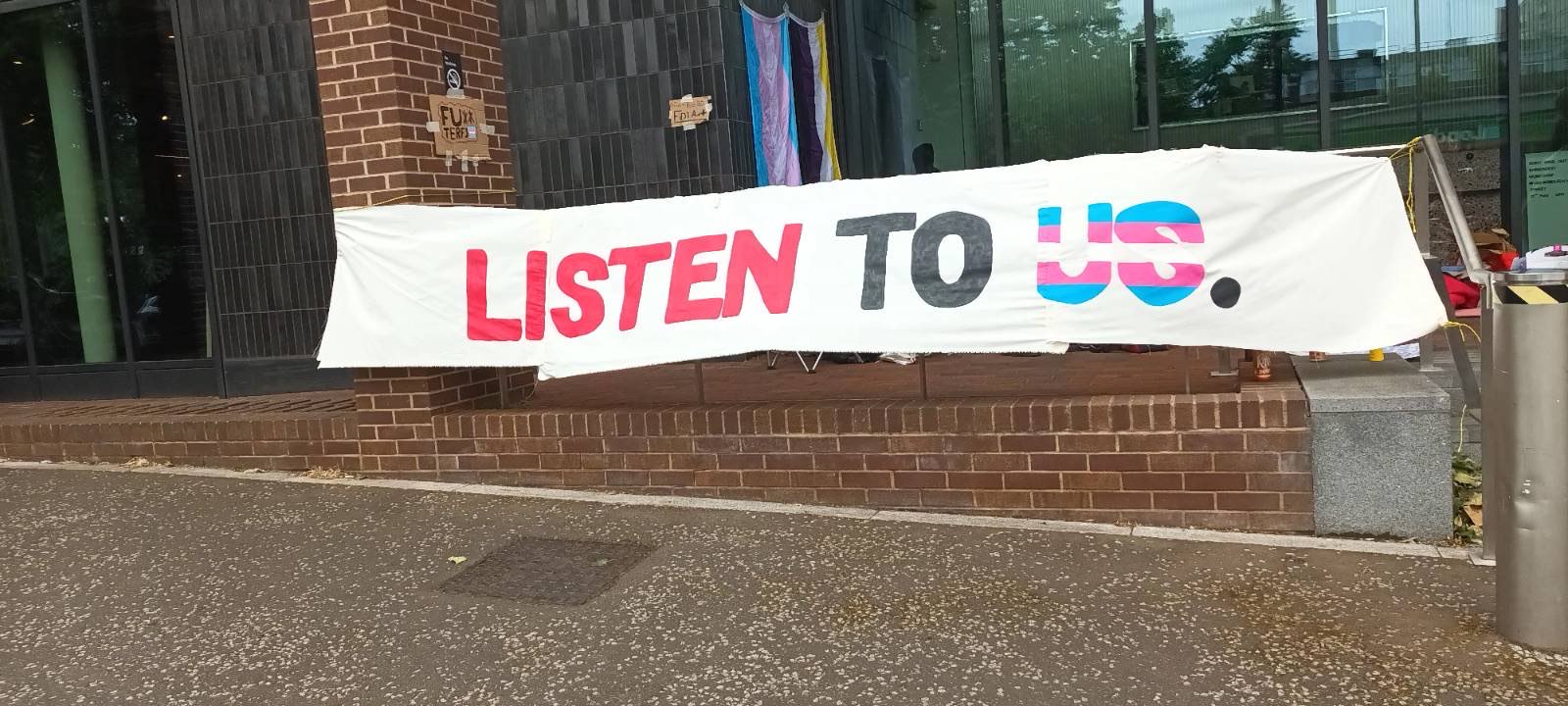
Protest outside the Department for Education, 2025. Photo from Trans Kids Deserve Better.


Trans children’s rights and the UNCRC – new article and interview

I have a new article out, co-authored with Dr Cal Horton. It’s about the incorporation of UN convention rights into Scottish law, and what this should (in theory) mean for trans children in Scotland and beyond. The article is totally open access so anyone can read, download, and share it anywhere. You can peruse a copy right here:

The United National Convention on the Rights of the Child and the Rights of Trans Children in Scotland
The International Journal of Children’s Rights

In recent years I’ve felt increasingly critical of human rights as an artificial framework for behaviour, which is frequently ignored or manipulated by those in power. As Nat Raha and Mijke van der Drift put it, these are “human rights for human resources”. Nevertheless, the UN Convention on the Rights of the Child (UNCRC) is now part of Scottish law, and Scottish children and policymakers alike are being informed that this conveys certain expectations for how young people are to be treated.

Cal and I believe it is important to reflect on what this all means for people seeking to work in a humane way with trans children, in Scotland and beyond. In particular, we emphasise the importance of directly involving young people in conversations and decision-making about their own lives. We draw on the demands of young people themselves in doing so, including groups such as Trans Kids Deserve Better Scotland, who note that policymakers have actively ignored young trans people by “by shutting trans bodies and voices out of every room that matters [and] pretending we don’t exist.”

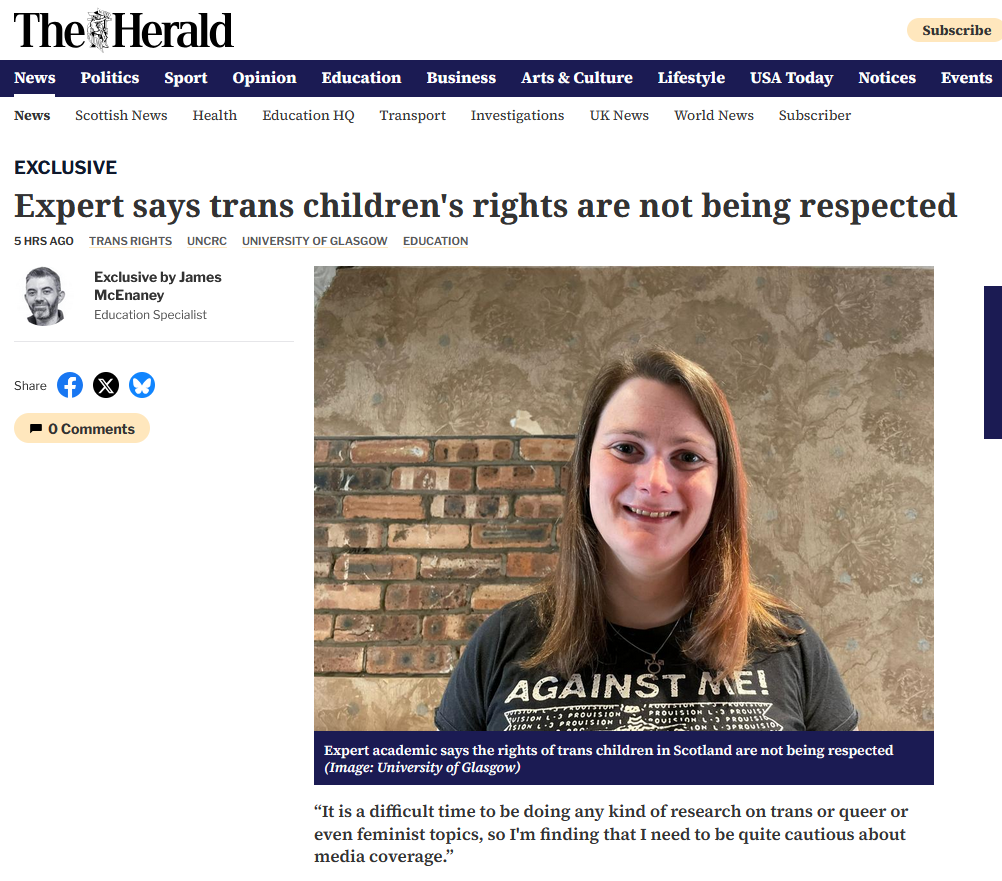
This weekend also sees the publication of an interview I did for the Herald about the UNCRC article. In this, I discuss the findings of my research with Cal. I also reflect more generally on the situation faced by trans studies researchers, in which it is increasingly hard to conduct trans-positive research even as the UK government and funding bodies throw millions of pounds at anti-trans researchers.

Screenshot of the Herald newspaper website. The article header reads: Expert says trans children's rights are not being respected. Exclusive by James McEnaney. There is a photograph of Ruth Pearce, a smiling white woman with shoulder-length brown hair who is wearing an Against Me t-shirt. Below the image is a quote from Ruth: "It is a difficult time to be doing any kind of research on trans or queer or even feminist topics, so I'm finding that I need to be quite cautious about media coverage.


We end the interview with key three takeaways regarding what can be done to protect the rights of trans children, in Scotland and beyond:

“Number one would be to genuinely consult with young trans people and ask what they want and need. They deserve real and meaningful consultation.

“Number two is that there is a huge amount of knowledge that already exists, both on young trans people’s experiences and on how to consult with young people. Draw on the knowledge that already exists.

“And number three is to acknowledge that there is a trans-eliminationist movement. Acknowledge that there is an active attempt to stop anyone from doing the first two things.

“There’s an active attempt to stop any anyone taking seriously what young trans people have to say about their own lives, and an active attempt to stop any accessing of existing knowledge, and that comes from a place of prejudice.

“One of your starting points has to be acknowledging that that exists.”

Conference report: International Trans Studies Conference, Day 1

REPENT.

The messages greeted me as soon as I left the ancient, rattling commuter train from central Chicago, chalked onto the sidewalk all along Church Street on the walk to my hotel. They seemed oddly out of place in Evanston, a leafy college suburb with an extremely chill vibe; a strange contrast to the low-key cool of the bars and restaurants, and turquoise blue calm of the inconceivably vast Lake Michigan.

At first I misread the final word of every message as “repeat”, as in (for example): “Praise the Lord – repeat”. I thought someone was simply very enthusiastic about sharing their values. “Repent”, however, feels a lot more aggressive and also quite pessimistic, assuming the reader’s guilt and their urgent need to make amends.

I am here for the 2nd International Trans Studies Conference, held at Evanston’s Northwestern University, in the original homelands of the Council of Three Fires (the Ojibwe, Potawatomi, and Odawa peoples). In the opening plenary of the conference, the political scientist Paisley Currah argued that we are living in a crisis moment for trans politics: not because we are necessarily facing more discrimination than ever before, but because more people are paying attention to our existence. Many of these people hope we might repent our trans identities, our gender deviance, our very existence. And yet, here we are, gathering from around the world to discuss trans knowledge and trans ideas, and to imagine trans futures.

Over the course of the conference I am attending numerous talks and meetings across a dizzying array of topics and themes, taking in both theory and evidence from researchers based in the humanities, social studies, and physical sciences. I plan to blog regularly, sharing information I have learned as well as critical reflections on the event. There are literally hundreds of talks taking place over up to 11 simultaneous sessions at any one time, so please do not expect an exhaustive account! Still, I hope these posts will be of interest to people unable to attend the conference, as well as fellow attendees.


The opening plenary: ‘The State of the Post-Discipline’

The conference began on the evening of Wednesday 4th September, with a two-hour opening plenary titled ‘State of the Post-Discipline’, reflecting the official theme of the event. Across four talks, this session aimed to set the tone for the conference and introduce a series of key ideas for consideration in the coming days.

I felt the plenary very much reflected the ambition, the importance, and the limitations of this conference. Each of the speakers emphasised the importance of a materialist approach to trans studies, in which our research can speak helpfully to the reality of people’s lives. This necessarily involves grounding our work in practical examples of trans realities, and understanding our histories in order to better tackle the challenges of the present and future. The speakers were perfectly blunt about the enormous harms that trans people have faced across time and in many places, while maintaining an optimism for how we might productively learn together.

At the same time, it felt strange that together, these four opening commentaries reflected a very limited geographic perspective, with three of the speakers being based in the United States. Similarly, it was disappointing to see just one trans woman on the stage, the Mexican biologist and philosopher Siobhan Guerrero Mc Manus.

This unfortunately reflected the wider dynamics at play within trans studies. As conference organiser TJ Billard noted in their opening comments, trans studies has historically been dominated by US and (to a lesser extent) European voices. Moreover, all four of the field’s major journals are effectively based in the United States. The 2nd “International” Trans Studies Conference is inevitably dominated by US scholars and perspectives, even as there are an impressive range of people present from the rest of the world. I’ve also frequently observed the minoritisation of trans women with trans-oriented conferences and research projects, even given the enormous influence of key figures such as Susan Stryker (who will be speaking in a later plenary) and Sandy Stone.

Nevertheless, the conference couldn’t have found a better opening speaker than queer Indigenous historian and literary scholar Kai Pyle. I have long admired Kai’s written work, so it was exciting to finally see them speak.

North American conferences frequently open with a land acknowledgement, in which organisers and/or invited elders of local Indigenous communities recognise the role of Indigenous peoples as the original stewards of lands taken by settler colonists. However, land acknowledgements rarely offer deeper understanding, let alone any form of reparation for the enormous damage wrought by colonialism.

Pyle themself rightly noted that a single talk could not possible begin to account for the violences and erasures of the past and present, and they observed also relative absence of Indigenous academics from the conference space. They further comments that “although I’m speaking on a panel titled ‘The state of the post-discipline’, I’m barely concerned with the discipline at all”: instead Pyle is concerned with a future where indigenous trans people can live.

Nevetheless, it was powerful to begin the event with a talk specifically about the oppression and resistance of Indigenous peoples in the Great Lake region. Pyle also argued that this history is necessary for properly understanding the history of trans studies itself.

Pyle explained that the lands of the Illinois or Inoka people were first invaded by the French in the 17th Century. Subsequent European accounts and travelogues widely reported the presence of gender roles in Inoka society that did not align with European norms: examples included the leadership of women in agriculture, and genders that could not be easily categorised as female or male. The subsequent projection of European understandings and desires onto Indigenous North American peoples informed early pathological accounts of gender ‘deviance’ as physical and mental sickness, which in turn would inform inform diagnostic categories from the 19th century to the present day. Indigenous people themselves, meanwhile, were subject to immense colonial violence, including coercive conversion to Christianity, removal from their homelands through forced marches such as the Trail of Death, and cultural destruction through the Indian residential school system.

Turning to the early 20th century, Pyle told the story of Ralph Kerwineo, an individual of Potawatomi and Black heritage who successfully ‘passed’ as a man and married two women while living in his ancestral homelands. While Kerwineo might today be understood as a trans man, there is no evidence of any engagement with the traditional gender roles of his people. Pyle noted that this stands as evidence of both enormous alienation but also resistance: Kerwineo successfully lived a gender ‘deviant’ life in the Chicago are a hundred years of attempted elimination of his people.

Finally, Pyle reflected on the emergence of the two spirit movement in the early 1990s, in parallel with the emergence of the contemporary US trans movement, as well as trans studies.

The second talk was by Paisley Currah, who argued for theorising “trans rights without a theory of gender”. He posited that trans studies has been increasingly “stepping aside from just doing theory” over the last decade, as seen for example in the creation of the journal Bulletin of Applied Transgender Studies. In this context we can potentially separate questions of social justice from questions of what sex and gender might actually be.

Currah illustrated this argument with the example of campaigns around sex classification policies in New York City. Attempts to introduce a system of self-declaration in the 2000s and early 2010s were complicated the fact that some city bureaucrats supported the proposed changes, and others opposed them. This was summarised by a legal argument made by the city government: “the existence of difference approaches to similar problems does not render an agency’s rule irrational”.

In this context, Currah argued that sex/gender is in practice a “decision informed by law”, and by the needs and interests of lawmakers. For example, in many jurisdictions it is fairly easy to change a sex/gender marker on a driving license. This is because in practice driving licenses are used by the state primarily for tracking and surveillance, and it is therefore in the state’s interest for the license to reflect what people look like and how they live. By contrast, it has historically often been more difficult to change sex/gender for the purpose of marriage: that is because this would entail a disruption of the heteronormative biological logic for property transfer across generations.

Currah concluded by arguing that when we argue for changes to these policies, the existence and diversity of trans people “is enough”. We exist no matter what your theoretical position on sex or gender, and “a world without us cannot be willed into being”. The focus of policy advocacy should therefore be on what we need to flourish, rather than abstract theorisation.

I found Currah’s arguments extremely helpful and well-framed. However, I was surprised to his insights framed as novel, as the approaches he described feel well-established in the UK. Unlike in the US, materialist approaches have been central to trans studies since the 1980s, in the work of key scholars such as Dave King, Stephen Whittle, and Zowie Davy. Meanwhile, the focus on trans people’s practical needs is embodied in the work of organisations such as Trans Safety Network and Trans Kids Deserve Better, who very intentionally centre questions of harm rather than any theorisation around gender. My own PhD thesis (published in 2016!) and later book Understanding Trans Health deliberately set aside the question of sex/gender to focus on how trans healthcare services operate and are experiences in practice. The feminist philosopher Katharine Jenkins has done important work on how what is important about gender varies according to context, and the legal scholar Chris Dietz has extensively considered questions of governmentality in terms of how and why differing aspects of trans people’s lives are managed by different agencies of on the behalf of healthcare systems and the state.

I make this point not to try and undermine Currah or big up UK trans academia specifically. Rather, I want to note how this kind of awareness of what is already being done in different parts of the world highlights why a truly international approach to trans studies is so vital.     

The next talk was by Siobhan Guerrero Mc Manus. Unfortunately I – and many other attendees – missed much of her talk due to an apparent failure by the translation company hired to support the conference. This was an enormous pity given what I did catch felt extremely important, and built on the critiques of Currah that were bubbling away in my brain during his talk.

Guerro Mc Manus emphasised the importance of organising across borders, with the example of taking successful trans liberation strategies from Mexico, adapting these in a Colombian context, and then again in Peru. Conversely, she described the example of how work on reforming the criminal code in Colombia informed trans activism in Mexico. In this kind of organising and exchange of ideas, reflections from the Global South might be combined with insights from the North, without simply reproducing Global North theory in a way that is not necessarily applicable to countries such as Mexico.

I wish I had heard more of these presentation! I feel the International Trans Conference’s investment in both live translators and translation through transcription software is an incredibly important move, and should set the tone for future events in the field (or “post-discipline”, if you prefer). At the same time, it is important to get this right lest non-Anglophone perspectives are further marginalised through technical error. While I just missed large parts of this one talk, attendees who were not fluent in English may have missed much more from the other speakers. I definitely felt for the organisers, speakers, and fellow attendees, and hope these problems will spur future work to further improve our communication across languages and borders.

The plenary closed with a short address from TJ Billard. Billard explained how the choice of conference theme was informed by the “first” International Trans Studies Conference, which took place in Arizona in 2016, “riding the high of the transgender tipping point” just months before the election of Donald Trump. An enormous amount has changed in the last eight years, and the time is ripe for a re-appraisal.

Billard’s use of the term “post-discipline” draws on the work of John David Brewer. Brewer describes post-discipline thinking as knowledge about a phenomena that is detached from disciplinary allegiances, instead emphasising theoretical and methodological pluralism, political investments, and ethical values.

The emphasis is therefore less on academic siloing, and more on real problems facing contemporary society.  This couldn’t be more appropriate for trans studies, especially in the context of the insights shared by the other speakers.


Some final thoughts

The first “day” of the conference was really just an evening: the opening plenary, plus a reception where the in-person attendees got to spend time meeting and catching up with one another (some of the most important academic work!) I am finishing this monster post at the end of the second day of the conference, a true marathon which ran from 8:30am (when registration opened) to 9pm (when a reception and 10th anniversary celebration hosted by the journal Transgender Studies Quarterly theoretically wrapped up). It’s difficult to capture the sheer scope of this event: indeed, this series of posts can only possibly touch upon the vast amount of knowledge and information we are discussing at the conference.

For all that I (and others) have shared several critiques, I am hugely grateful this event is happening, and feel very privileged to attend in person. I couldn’t be happier to be a gender deviant, and hope to repeat the value-based work of resistance over and over.

Amplify trans youth

This morning I logged into instagram and watched, transfixed in amazement and worry, as a young person scaled the walls of the Department for Education.

The aspiring spiderman is part of the activist group Trans Kids Deserve Better. At the time of writing they are staging a multi-day protest at the Department for Education building in London, for the right to a safe and inclusive education.

Watching the video, I fear for Squirrel, the anonymous activist who is genuinely risking their life to stop government employees from taking the group’s banner. It’s very apparent that Squirrel is a skilled climber who knows what they are doing – equally, one wrong move could result in a deadly drop to the concrete pavement. This is not safe.

But of course, the entire reason this protest is happening is because young trans people are not safe.

Trans Kids Deserve Better launched their campaign for youth autonomy, safety, respect, and inclusion in July, from a dramatically high ledge of an NHS England building. In an interview with Jess O’Thompson for Trans Writes, the emergency doctor and children’s TV presenter Dr Ronx Ikharia argued that “our young people deserve better than suffering, and shouldn’t be scaling walls”. But they added that for this to happen, trans kids must be “believed, supported, affirmed, and loved”.

And this is the crux of the issue. Under the Conservative and Labour governments, we have seen a policy environment in which teachers, doctors, therapists and parents are actively discouraged or prevented from believing, supporting, affirming, or loving young trans people. Instead, families face prison sentences for supporting young people’s continued access to medication, NHS England is expanding the provision of state-funded conversion clinics, and a growing number of schools are refusing to allow even the discussion of trans experiences.

Trans kids are not safe because they have been entirely failed by the adult world. They have been failed by politicians, failed by civil servants, failed by the NHS, failed by the voluntary sector, failed by researchers, and in many cases also failed by their doctors, teachers, and parents or carers. This is why the activists from Trans Kids Deserve Better are literally scaling walls in their fight for an actual future.

Looking at the challenges facing young trans people, it can be easy to lose hope. But the actions of Trans Kids Deserve Better show that there is a better way. Doomerism helps nobody. The successes of successive liberation struggles have come about because people have continually dared to believe that a better world is possible, and fight for it. The young people currently sat outside the Department of Education are not bemoaning what they have lost: they are insistently demanding change.

Image from Trans Kids Deserve Better

What can we do? In their conversation with O’Thompson, activists from Trans Kids Deserve Better explained that while trans adults often want to “protect” trans youth, they would rather we “amplify” them: “we don’t need sympathy, we need support”. This is a call to action, with a focus on solidarity, rather than trying to speak for young people or bemoan their situation.

Many adult trans people and allies have complained about the lack of mainstream media coverage for the actions of Trans Kids Deserve Better. But we should not simply wait for the papers or news programmes to start caring. It’s up to us to talk about what’s happening. Today’s queer and trans communities only exist at scale because we made our own media, told our own stories, and forced the mainstream to catch up.

So I encourage everyone who reads this to share the story of what is happening. Share it on social media, share it with friends and family, share it in conversations at work and in bars and in cafes and in parks and at gigs and festivals. A few days ago I was at a pub in Bath, fresh from Pride, still holding a placard that read “Ban Wes Streeting” (copied shamelessly from someone else in Glasgow a couple of weeks prior). Someone asked what Wes Streeting had done, so I told her. She was appalled, but grateful to have learned what is happening, and better informed to act. Information spreads when we spread information.

Trans Kids Deserve Better are also hoping that more people will contribute to their actions. You can sign up as a supporter, stay updated from their Instagram account, or contribute to their fundraiser.

If you, like me, would rather not see young people risking life and limb by climbing public buildings, it is time to fight with them, not “for” them. Together we can build a safer world.

Trans Kids Deserve Better – protest at NHS HQ

Young trans people have been leading an incredible protest at Wellington House, the London headquarters of NHS England. They have been holding space on a ledge of the front facade since London Pride on Saturday 29 June.

The protesters will be coming down today (Tuesday 2 July) and have called for supporters in London to join them at a rally from 4pm.

Photo of a group of people sitting on a ledge of a building, with towering pillars and glass windows behind them. They are holding a large banner which reads "We are not pawns for your politics". They have decorated with the windows of the building with trans flags, placards, and the words "trans kids deserve better".


The action powerfully highlights the repeated failure of UK politicians, the mainstream media, and NHS bodies to truly listen to young trans people about their experiences and needs. This is perhaps most powerfully seen in the Cass Review, which has systematically excluded expertise and evidence from trans people in formulating its recommendations, and in trans healthcare bans implemented for under-18s in England in Scotland. Meanwhile, the Labour party are promising to uphold these bans and implement a range of deeply transphobic policies should they win the election on 4 July.

These concerns are powerfully highlights by the protesters themselves. In Diva, a 17 year old activist explains:

“Decisions are being taken that affect our lives without any trans people in the room, let alone trans young people. Too often trans kids are portrayed as a monolith of confused, depressed teenagers. We are denied choice and robbed of our autonomy. But we should be trusted to make the same decisions about our healthcare that all people are. 

In every other way I am trusted when I tell people what I want to do with my life. But not now. There is so much real anger out there and we hope our actions will encourage others to fight for a voice, and the healthcare and dignity that we are currently denied.”

Another protester explained to Pink News:

“We are staging this protest to remind politicians and voters that we’re real kids, not just political talking points. We may not have a vote, but it is our lives that are at stake. Gender-affirming healthcare is a matter of life and death for us and we hope our actions will bring awareness to this fact and encourage others to fight for the healthcare and dignity we are so shamefully denied.”

As a former youth activist working in this field for almost two years now, I am hugely heartened and inspired by this powerful protest. In the face of institutionalised violence and silencing, young trans people are seizing the narrative. It is up to us adults to listen, learn, and fight alongside them.