Understanding Trans Health – available to pre-order!

Last month I finished writing my first book, Understanding Trans Health: Discourse, Power and Possibility.

This book reports on the wide-ranging research project I undertook from 2010 to 2017, looking at trans discourses and experiences of healthcare services in the UK. It will be of interest to academics, students, health practitioners and activists working and studying in the field of trans health, and will be published by Policy Press in June 2018.

Understanding Trans Health is available for pre-order it for £21.59 (paperback) or £60.00 (hardback) from the Policy Press website. E-book and Kindle versions will also be available soon. If you work or study at a university or college, it would be really great if you could encourage your library to order in a copy!

If you live in the Americas, you can buy it through University of Chicago Press.

I’ll be writing more about the book as the release date approaches. In the meantime, feast your eyes upon the stunning cover commissioned by Policy Press: an image that reflects continuing inequalities of access, the pain of waiting, and patient experiences of anticipation.

Understanding trans health

In other book news, myself and Igi Moon are still working hard on our co-edited volume, The Emergence of Trans: Essays on Politics, Culture and Everyday Life. We’ve had some really fantastic chapter submissions and I can’t wait to share more about this too in the coming months.

Ethical guidance on studying trans health, for researchers and ethics boards

I recently co-authored an article on research ethics for the journal Transgender Health. It’s based on an extensive review of literature on the topic, and written by an international team of scholars and health practitioners with extensive experience of conducting research in this field.

Transgender Health is an open access journal, so the article is freely available for anyone to read and share.

I’ve copied the abstract out below: please click on the title for full access.


Guidance and Ethical Considerations for Undertaking Transgender Health Research and Institutional Review Boards Adjudicating this Research

The purpose of this review is to create a set of provisional criteria for Institutional Review Boards (IRBs) to refer to when assessing the ethical orientation of transgender health research proposals. We began by searching for literature on this topic using databases and the reference lists of key articles, resulting in a preliminary set of criteria. We then collaborated to develop the following nine guidelines:

(1) Whenever possible, research should be grounded, from inception to dissemination, in a meaningful collaboration with community stakeholders;

(2) language and framing of transgender health research should be non-stigmatizing;

(3) research should be disseminated back to the community;

(4) the diversity of the transgender and gender diverse (TGGD) community should be accurately reflected and sensitively reflected;

(5) informed consent must be meaningful, without coercion or undue influence;

(6) the protection of participant confidentiality should be paramount;

(7) alternative consent procedures should be considered for TGGD minors;

(8) research should align with current professional standards that refute conversion, reorientation, or reparative therapy; and

(9) IRBs should guard against the temptation to avoid, limit, or delay research on this subject.

Trans health in Canada: reflections and resources from CPATH

At the end of October I attended the CPATH 2017 (Canadian Professional Association for Transgender Health) conference in Vancouver. It was a fascinating event from which I learned a great deal. I’m keen to share some of my thoughts and experiences with others, as I feel there is a great deal that trans health researchers, practitioners and activists can learn from the progress that’s been made in Canada, as well as the limitations of that progress.
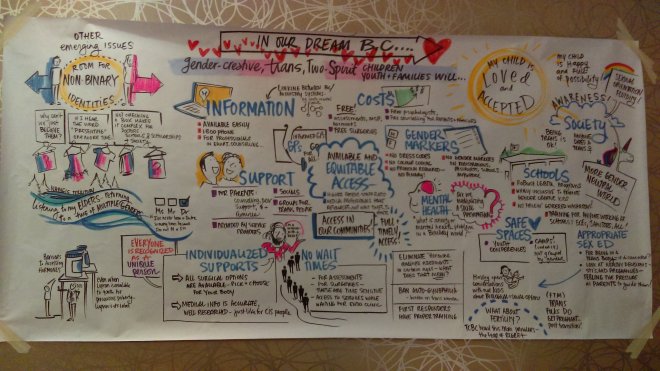
DNF13PxV4AEw4K-.jpg large

Poster: “In Our Dream B.C….”, by Drawing Change. Based on Trans Care BC consultation with gender creative, trans, and two-spirit youth and their families..

In this post, I reflect briefly on my impressions of the conference, and link to Twitter threads I wrote during various sessions. You can also read my initial thoughts on the conference here.


CPATH took a broadly holistic approach to trans health

Over 300 people took part in the three-day CPATH 2017 conference and two-day pre-conference. In attendance were GPs, nurses, endocrinologists, psychologists, psychiatrists, therapists and counsellors, social workers, healthcare administrators, peer and parent support group facilitators, academic researchers, lawyers, politicians, and various trans campaigners.

CPATH 2017 treated “health” as a social phenomenon as well as a purely embodied matter, and this made for some very productive conversations. For example, numerous sessions explored how trans healthcare might best be provided in the context of primary health. Gender identity services are frequently provided by GPs with support from external specialists, a model of care that is currently under consideration for England. In some Canadian Provinces, organisations such as Trans Care BC help to connect providers in primary care to relevant specialists, and support trans people in obtaining interventions such as hormone therapy and surgeries.

This approach enables continuity of care in a local context, with family doctors enabled to provide trans-specific care for their patients alongside everyday services. It reduces barriers to access such as waiting times and the necessity of long-distance travel. It also enables GPs to help their trans patients access a wider range of specialist services: for instance, trans people with mental health issues might benefit from a referral to a peer support group as well as or instead of formal therapy (depending on patient desire and need). Many practitioners provide services on the basis of informed consent, rather than using mental health assessments as gatekeeping measures. It was heartening to see generalist and specialist healthcare professionals, social workers, trans activists and others engaged in open discussions about how best to manage care through this kind of system.

I was also particularly struck (and moved) by a session entitled Trans and Two Spirit Youth Speak Back! The 40 or so adults in attendance – mostly healthcare professionals or researchers of one stripe or another – were asked not to speak at all during this workshop. We were instead invited to listen to the stories and experiences of trans and two-spirit young people, who sat dotted around the room and answered pre-prepared questions delivered by a youth group facilitator. This session structurally prioritised the voices of young trans people who are so often silenced, and also offered an opportunity for us to hear how the healthcare needs and challenges faced by these individuals were shaped by their cultural heritage, family life, schools and peer groups.


CPATH took intersectional trans voices seriously

Trans and Two Spirit Youth Speak Back! was just one example of how trans voices were frequently centred at CPATH 2017. As an attendee from the UK, I was very impressed by this! Our trans healthcare conferences, seminars and workshops tend to be organised by and for community groups, researchers or healthcare providers, with relatively little overlap between attendees at these events. Very few practitioners are (openly) trans, meaning that trans people tend to talk to one another at community and research events, but are heard less often at healthcare conferences for doctors, nurses and mental health specialists. Moreover, the speaker line-ups at all these events tend to overwhelmingly prioritise the most privileged individuals, such as white people and men. The only possible exception is cliniQ’s Trans Health Matters conference, and that event too feels like it’s taking the first steps towards something better.

During the opening plenary of the CPATH conference proper, we were informed that around one third of speakers at the event were trans, and around a tenth were Indigenous (i.e. of First Nations heritage). I’m not sure how many people of colour were represented at the event more generally, but the all-white panels which are a norm at UK events seemed few and far between.

Importantly, the trans women, trans men, non-binary and two-spirit platformed as speakers and workshop facilitators were usually also professionals. We weren’t simply present at CPATH to represent a “patient perspective”: rather, we were the experts. This reflects the hard work of individuals in pursuing a career, and the collective work of CPATH in supporting trans professionals; it also reflects the actions of local providers in various parts of Canada who have made an active effort to employ trans people, or secure funding for partnerships with trans-led organisations.

In my previous post I noted that the opening plenary of the conference proper centred Indigenous voices. This included a formal welcome from Musqueam Elder Jewel Thomas, and talks by trans and two-spirit Indigenous educators from different parts of North America. I was happy to see that the plenary session on the second day of the conference continued to centre the voices of individuals who tend to be marginalised within even trans spaces. Two-spirit physician Dr James Makokis and Latina trans activist Betty Iglesias – who discussed issues faced by trans sex workers and migrants – were platformed alongside an Member of Parliament from Canada’s ruling Liberal Party, resulting in a thoughtful and challenging debate.


CPATH (and the rest of us) still have a lot of work still to do

I left CPATH with a very positive impression, but Canada is by no means the promised land for trans health. Professionals and patient representatives alike frequently discussed the challenges they faced in providing gender-affirming services. Transphobia and cisgenderism are still very much prevalent within healthcare provision and legal frameworks, particularly outside of urban areas: there is therefore a great need for better education among trainees and further reform of laws and guidelines. Limited funding and different approaches across the country’s Provinces and Territories also mean that not everyone has the same access to treatment, and waiting lists persist for publicly-funded care. These are challenges that exist across the world, and may benefit from greater international collaboration and strategy-sharing.

At the end of the first day of the conference proper, there was a reception specifically for trans people attending the conference. I later reflected on the experience of attending this reception in conversation with a genderqueer colleague; both of us felt ourselves relaxing enormously upon entering the trans-only space. For all the positives of CPATH, it was a huge relief to step away from cisgenderist expectations and microaggressions that quietly persisted throughout the conference proper. These included a range of unspoken ideas about how we should dress, act, and talk “professionally”, limitations on our ability to name transphobia within healthcare settings without fearing repercussions, and the occasional terrible intervention from self-righteous cis professionals.

As ever, facing down these challenges is hardest for the most marginalised trans people, including (for instance) disabled individuals, sex workers, migrants, and people of colour. I was aware that while CPATH 2017 took a broadly intersectional approach, instances of ableism, racism, sexism and so on persisted: and this could take the form of unexamined prejudices on the part of more privileged trans people too. Moreover, white people were still heavily overrepresented among conference attendees; a phenomenon that was particularly noticeable at an event held in a city as diverse as Vancouver.

What I’m taking from this is a reminder that equality work is never “done”; rather, it is something that we should strive to always “do”. We should aim constant improvement in our relations to one another rather than assuming that solidarity and equality are things that we can simply achieve. It is in this spirit that I’ve attempted to use my own privilege as an academic to bring back lessons from Canada for the UK and beyond.

So, I’ll end this post with a serious of links to Twitter threads from the event. I livetweeted extensively from CPATH 2017, sharing summaries of the numerous talks and workshops I attended. This is by no means a comprehensive summary of any of the sessions I was at, let alone the wider conference (as numerous parallel sessions took place simultaneously). However, I hope the ideas and approaches will be as useful and interesting to you as they are to me.


Pre-conference (training) Twitter threads

Day 1:

Introduction to Gender-Affirming Practice

Pre-puberty/Puberty: Addressing On-coming Puberty


Day 2:

Adolescence: Moving Forward With Gender-affirming Care for Youth

Cross Country Health Clinic Practice Panel: Models of Care and Clinical Practices


Conference Twitter threads

Day 1:

Plenary: Centering Indigeneity and Decolonizing Gender

Interpersonal Communication Needs of Transgender People

Ethical Guidelines for Research Involving Trans People: Launch of a New Resource

Investigating the Medicalization of Trans Identity

Primary Care Approaches to Caring for Trans Youth


Day 2:

Plenary: Fostering Safety and Inclusion in Service Provision, Systems and Sectors

Non-binary Inclusion in Systems of Care

Trans Data Collection and Privacy

Legal, Ethical, Clinical Challenges: Youth Consent to Gender Affirming Medical Care


Day 3:

Pregnancy and Birth

Plenary: Supporting Older Trans People


CPATH: diversity, inclusion and decolonisation in trans health

I’m currently attending the CPATH (Canadian Professional Association for Transgender Health) conference in Vancouver. It’s a fascinating event which I’m hoping to write about more in the coming days. I’ll also be livetweeting whenever possible.

The first two days of the event are a “pre-conference” training session aimed largely at healthcare professionals, followed by a more standard three-day conference over the weekend. I’m fortunate enough to be attending the whole thing, funded through the ESRC-sponsored Trans Pregnancy project. I’m here to learn about how gender-affirming care is being practiced in North America, and to connect with people working in reproductive health and in supporting transition.

What’s really struck me so far is how much more intersectional and inclusive of actual trans people this event is when compared to professional events in Western Europe, particularly last year’s WPATH conference.

I was struck at the how the first pre-conference session I attended – billed as an introduction to gender-affirming care – had questions of diversity, power, and consent absolutely embedded into the presentations. Attendees were encouraged to reflect critically on their own privilege and social position, and that of key writers and trend-setters in the field. We discussed how social determinants of health (such as wealth, education, citizenship etc) play a huge role in determining inequalities within trans populations as well as between trans people and the cis majority.

These are pretty standard topics within sociology, but even so I felt the session was very well-presented and I learned a lot from the informative but open and deeply self-aware approach taken by the two presenters, Gwen Haworth and Jenn Matsui De Roo. It was immensely refreshing to see this kind of conversation take place in an event attended largely by healthcare providers. Too often, I feel clinical providers and researchers in the UK find themselves at loggerheads with trans patients. Often this may be because they haven’t thought to take a step back and consider the cultural context of their patient’s life and the systemic issues that this person might have encountered, let alone the deeply unequal power dynamic of the clinical encounter.

It was also really important for me as a non-clinician to take the time to listen to the stories and experiences of healthcare professionals, and learn more about the energy and care they put into the vital work that they do. I fear too many sociologists looking into issues around healthcare don’t actually attend medical conferences, and as such miss out from directly hearing about professional views and experiences.

I was also delighted to see that the space is pretty trans-friendly. People are generally sensitive around language, there are gender-neutral toilet blocks, pronoun stickers, and there’s also a “safer space” quiet room. At the WPATH conference last year, a number of trans attendees were attempting to make all of these things happen through forms of quiet guerilla disruption, for instance through putting holographic stickers on the toilets that switched between “male” and “female” images. At CPATH, trans language, trans culture and trans needs feel like part of the fabric of the event.

IMAG0167

My CPATH 2017 Conference name badge.
Under my name is a sticker reading “preferred pronoun: she/her”.

Finally, it’s good to see that there’s a serious decolonial agenda at CPATH. The conference booklet acknowledges that Vancouver is built on unceded lands; there are numerous sessions led by indigenous practitioners, researchers and activists; indigenous perspectives and issues are regularly discussed by non-indigenous attendees; and the introductory plenary for the conference proper on Friday will feature an opening speech and talks from indigenous activists and healthcare providers.

Of course, while all of this looks good for CPATH, the progressive appearance of the conference can hide the struggles that make real inclusion and recognition possible. I’ve heard that the opening plenary was the outcome of a struggle over indigenous representation after a number of papers were rejected. So, however good CPATH looks to me as a (white, British) outsider, it’s important to acknowledge the ongoing, silent (silenced) work that so often takes place behind the scenes to make this happen.

Concerts in Coventry: 24th June, 29th July

I’m involved in organising two exciting events at Coventry’s Tin Music and Arts over the coming month.

This coming Saturday sees the return of feminist club night Revolt, complete with bands, DJs, spoken word, zines and our Feminist Library. I’ll be opening the night with my band Dispute Settlement Mechanism.

For tickets and more info, click here.

Revolt #10
On Saturday 29th July we’ll be treated to a performance by CN Lester, who will be performing songs from their new album Come Home and reading from their great new book Trans Like Me.

For tickets and more info, click here.

CN Lester.png
Entry will also be available on the door on a donations basis (suggested donation £5, but no-one will be turned away for lack of funds).


Forthcoming books!

I’m delighted to announce that I have recently signed not one, but two book contracts. Both books are scheduled for publication in 2018.

My first monograph, provisionally entitled Understanding Trans Health, will be published with Policy Press. This book will draw upon extensive qualitative fieldwork in the UK to examine how trans identities, experiences and healthcare needs are differently understood within community, activist and professional contexts. It shall explore how these different understandings can lead to conflict and mistrust within medical settings, and propose means by which more collaborative relationships might be fostered in the future.

An edited collection, provisionally entitled The Emergence of Trans: Essays on Healthcare, Culture and the Politics of Everyday Life will be published with Routledge. Assembled in collaboration with Dr Iggi Moon and the late Professor Deborah Lynn Steinberg, this book builds on the success of our 2012-2014 seminar series Retheorising Gender and Sexuality: The Emergence of Trans. It will feature international contributions from a range of authors based in different academic disciplines.

Academic books are often unaffordable to lay readers, and unavailable outside of academic libraries. I was therefore really keen that both books would be available in paperback and ebook format as well as the traditional hardback. I’m really pleased to say that both publishers have agreed to print paperback editions in the first run, in recognition of how the book topics are relevant to ordinary people within trans communities.

I’ll be sharing more details on these books as the publication dates approach.

No, I will not help Sundog make a documentary on trans “regret”

This afternoon I received an unsolicited email in my work account from an employee of Sundog Pictures. An excerpt follows:

I’m currently working on an idea alongside Channel 4 following transgender individuals who have come to regret their sex changes and are keen to undergo further treatment / operations to reverse the change. The doc will be insightful and sensitive and will look at the way in which transgender individuals are treated in society and whether the process before someone is permitted an operation is robust enough.

I’m currently looking for real life cases to include in my pitch document and was wondering whether you might be able to recommend people I could speak to, or places I could contact to find individuals who are currently thinking about a reverse sex change. Any help would be really appreciated.

Given the email account used, I feel that I can safely assume that I was contacted because of my academic work, which looks at discourses of trans healthcare provision. Sundog seem to hope that I will (without compensation) draw upon my community contacts and research findings to recommend participants for their television programme.

I couldn’t think of anything more inappropriate.

There’s a lot to be said about research ethics and a duty of care towards participants, but plenty has been written about that elsewhere (the BSA Statement of Ethical Practice offers a decent broad overview). So in this post I focus on the huge problems that come with the proposed topic of the documentary: that of trans “regret”.


The numbers

The mainstream media take an undue interest in trans “regret”. It’s very easy to come across such stories on daytime television and in both tabloid and broadsheet newspapers. The popularity and frequency of such stories suggests that it’s not too unusual for people who have undertaken a physical transition from male to female, or from female to male, to consider or undertake a “reverse sex change”.

In reality, research has shown time and time again that the actual rate of regret is extremely low. For instance, only 2% of respondents in the Trans Mental Health Study (the second-largest trans study undertaken in the UK) reported “major regrets” about the physical changes experienced during transition. Reported regrets from participants included:

“…not having the body that they wanted from birth, not transitioning sooner/earlier, surgery complications (especially loss of sensitivity), choice of surgeon (if surgery required revisions and repairs), losing friends and family, and the impact of transition on others.”

It’s clear therefore that “regret”, when it occurs, is likely to stem from societal and surgical issues rather than the process of physical transition in and of itself. The Trans Mental Health Study also demonstrates a clear link between physical transition and wellbeing in terms of mental health, body confidence and general life satisfaction.

With so few trans people regretting physical transition – and even less considering some kind of “de-transition” – it’s no surprise that sometimes the same individuals are trotted out time and time again to re-affirm a discourse of regret.


What’s missing from this story?

It’s pretty clear from the email I received that that the author has not done their research. Given the existence of organisations such as Trans Media Watch and All About Trans who are entirely keen to offer advice, this does not exactly inspire confidence.

For a start, transition is conflated with “sex change”, a term that is not only most frequently associated with transphobic tabloid headlines, but is also broadly meaningless. At what point can we talk about a “sex change”? When an individual undertakes hormone therapy? Chest surgery? Genital surgery? What about individuals who transition socially, but only undergo some (or even none!) of these processes? It’s not the kind of language that suggest an “insightful and sensitive” documentary can be made.

There’s a couple of more fundamental mistakes in the proposal, however. The first is the question of “whether the process before someone is permitted an operation is robust enough”. My own initial research findings suggest that if anything, the process in question is too robust – in that patients requiring surgery are typically required to wait many years before treatment is available.

The World Professional Association for Transgender Health Standards of Care require patients to undergo at least 12 months of hormone therapy prior to genital surgery. In reality, patients in England and Wales face a substantial waiting list (sometimes lasting years) before they are able to attend an NHS Gender Clinic, where two separate clinicians are required to approve a regime of hormone therapy before it can be undertaken. An additional two opinions are needed at a later date before a referral for genital surgery can take place. There are many, many opportunities and a great deal of time for patients to consider and re-consider their option – and that’s even before we take into account the horrific scale of the current crisis in surgery provision for trans women.

The current system is not constructed to facilitate transition so much as prevent the very possibility of regret. The result is increased suffering – in terms of the mental and physical health impact upon individuals who are forced to wait many years for hormones and surgery, whilst fearing (sometimes with good reason) that they will be denied treatment on spurious grounds. It’s no surprise that the Trans Mental Health Study found that “not transitioning sooner/earlier” is a major cause of “regret”, as individuals who have waited until breaking point to transition soon discover that there is still a long, long road ahead of them.

The second fundamental problem with Sundog’s proposal is their idea that trans people who aren’t too happy with their transition might be “keen to undergo further treatment / operations to reverse the change”. This is a very binaristic notion that both stems from and reinforces the notion that transition is a one-way process, from one (binary) gender to the other. In reality, there are many people for whom transition is a complex, ongoing process. For instance,  an individual who initially transitions from male to female might later feel that their identity is better understood as genderqueer, and may allow or pursue further physical changes to reflect this.


The wider political context

Given the tiny proportion of trans people who “regret” transition and the realities of service provision, the choice of a documentary about the subject appears at best to be somewhat misguided. However, the impact of insensitive coverage on this topic is such that I believe that I believe this documentary could be actively harmful, particularly as Sundog’s email asks “whether the process before someone is permitted an operation is robust enough”.

This is in part because the way in which discourses of regret are handled makes it harder for trans people to get treatment. Gender clinics in the UK require urgent intervention to make life easier for individuals who transition, not harder. Media hysteria over the possibility of regret reinforces the current system’s approach, which is to require people to demonstrate over and over again that they are trans before there is any hope of treatment.

But it’s also because discourses of regret are employed by those who campaign against trans liberation, including conservative commentators and anti-trans radical feminists who would deny funding for transition on the NHS altogether. Writers such as Julie Bindel are all too keen to use any example of individual regret to argue that transition is unnecessary mutilation, undertaken by sad, sick individuals who might have done otherwise if only they’d been given the option of, say, some form of reparative therapy.

The focus on the medical process is therefore politically loaded. Yes, some people do de-transition, and their stories are important and of worth. But these stories have yet to be told by the mainstream media in a non-sensationalised manner, in a way that doesn’t reinforce (intentionally or otherwise) a pernicious anti-trans agenda. Sundog’s proposal appears to feed right into this agenda.

This proposed documentary should not be regarded as a curiosity piece taking place in a cultural vacuum. It draws upon and will contribute to damaging and inaccurate tropes about transition. Ill-informed media accounts ultimately play a part in creating and maintaining a situation where “regret” frequently stems from the responses of friends and family, delays to transition and other negative experiences that come with transitioning in a transphobic society.

I hope therefore that any future attempts to examine trans health issues in this way will involve better research into the topic at the initial stages, and a greater sensitivity to both the personal and political consequences of exposing trans lives to media scrutiny.

Imagining a trans-inclusive Stonewall

“The meeting actually went pretty well, didn’t it?”

I heard a number of variations upon this statement echo around the pub we gathered in yesterday evening, as some 40-odd trans activists digested the day’s work. There was an undertone of incredulity: most of us had managed our expectations carefully in advance of the day. This was due in part to the fractious nature of trans communities, but also stemmed from our difficult history with Stonewall.

Back in 2008, many of us had been present at a loud, colourful demonstration outside the Victoria and Albert Museum as it hosted the annual Stonewall awards. We were there to express our displeasure at an organisation that didn’t simply exclude trans people, but seemed to keep making mistakes that caused harm to us.

A lot can happen in six years. Change has come from two directions: from continued external pressure from trans people, but also from a genuine willingness to reconsider matters from Stonewall following a shift in management in February.

In this post, I outline the themes and outcomes of a meeting held on Saturday to discuss potential options for trans inclusion in Stonewall. I will repeat some of the points made by CN Lester and Zoe O’Connell in their accounts of the day, but recommend you also have a look at what they have to say. For an idea of what is at stake, I recommend posts by Natacha Kennedy and Kat Gupta, as well as my previous writing on the topic.


A meeting with trans activists

The meeting – held in central London – was attended by a large number of trans activists who had been directly invited to the event, as well as three cis attendees: new Stonewall CEO Ruth Hunt, Jan Gooding who is Chair of trustees for the group, and a facilitator (who, incidentally, did a very good job).

A number of us felt that a more open meeting or more transparent means of securing invitation would have been beneficial. I’ve made my own views about this clear (particularly on social media) but in this post I will focus upon what we actually achieved, and what will happen next.

The event was in some ways quite diverse, and in others ways very limited in terms of representation. There were a wide variety of experiences represented, and views from across the political spectrum. There were a great range of gender identities represented, although a particularly large part of the group were trans women. There were attendees from across England and Wales, with James Morton from the Scottish Transgender Alliance present to talk about the situation in Scotland (where Stonewall is an LGBT organisation). The group was overwhelmingly white. There were a number of disabled people present, but not many with experiences of physical impairment.

Several commentators have stated that Stonewall were responsible for the make-up of the meeting, and therefore could have made more effort in terms of inviting a diverse range of participants. This is true, but I feel that trans activists also need to step up and take some responsibility here. Most of our loudest voices are white trans women like myself. We need to keep our own house in order: by reaching out to communities of trans people from under-represented groups, by “boosting the signal” and talking about the work of trans people from under-represented groups, and by ensuring that it’s not just us with places at the table.

It’s worth noting that this event was framed by Ruth as one part of a far wider consultation on Stonewall’s future engagement with trans issues. If you’re trans please ensure that your voice is heard in this. You can do so by writing to Stonewall here, or by emailing: trans@stonewall.org.uk. There will be more about the next steps of consultation later in this post.

The meeting ultimately had two purposes: to move on from the problems of the past, and examine potential options for future collaboration between Stonewall and trans communities.


An apology from Ruth Hunt

The day began with a refreshingly honest admission of fault on the part of Stonewall from Ruth. She offered a point-by-point account of how Stonewall has let trans people down over the past few years, and offered both apology and explanation for these incidents, as well as an account of how these are now being addressed.

This was not the main focus of the day, instead clearing the air from the start to enable a productive discussion. However, I feel it is important to provide a public record of this session: if we are to collectively move on from the past, then we need to remember that Stonewall has demonstrated a commitment to change.

Some of the issues discussed by Ruth included:

  • Nominating transphobic individuals for awards. This was acknowledged as a mistake, and we were assured that nominees are now scrutinised more carefully (not just for transphobia).
  • Insensitive use of language in Fit, Stonewall’s video resource for schools. Ruth explained that the inappropriate section has been removed from the DVD.
  • Stonewall’s campaign with Paddy Power, who were severely rebuked by Advertising Standards Authority for a transphobic advert in 2012. Ruth noted that Stonewall is now using its relationship with Paddy Power feed back on advertising they consider to be offensive (interventions which are not just limited to addressing homophobia) which has resulted in a number of changes being made.
  • Stonewall representatives speaking out inappropriately and/or not speaking out on trans issues whilst lobbying Government and MPs. There’s a long and complex history here that I’m not going into in this post: suffice to say that one aim of Saturday’s meeting was to ensure that this is done better in the future.

There was also significant evidence that Stonewall is undergoing major institutional change in regards to trans issues. I was pleasantly surprised to hear that Ruth had emphasised seeking a solution to the organisation’s difficult relationship with trans people when applying for the position of CEO, and that this was viewed favourably by trustees who considered her job application. Trans employees of Stonewall are reportedly more likely to be “out” and feel comfortable speaking about trans issues and concerns.


What’s on the table?

We then moved onto the main point of the event: to discuss proposals for a new relationship between Stonewall and trans people. There were four options for us to consider in group conversations, with attendees also encouraged to suggest any additional solutions that might not have been considered.

The options were:

  1. A fully inclusive LGBT Stonewall, which considers campaigning on trans issues to be a full part of its remit.
  2. Stonewall becomes nominally LGBT, but also funds and provides resources and guidance for the creation of a new, effectively autonomous trans organisation to work on trans campaigns. This organisation will eventually become independent, but can work closely with Stonewall.
  3. Stonewall remains LGB, and provides grants for a number of trans organisations so they can do their own campaigning work.
  4. Stonewall remains LGB, and works to be better ally.

Ruth explained that option (4) was not really favoured by Stonewall, particularly given the appetite for a closer relationship amongst many trans activists. The general feeling of the room reflected this, and we focussed our discussion upon the first three options.

Option (3) was largely rejected also. Criticisms raised included concerns about who would get the money, the impact of competition between smaller trans organisations, about what the conditions might be for such grants, and the amount of money and energy that would be spent by both Stonewall and trans groups on managing the system and applying for grants – money and energy that could be better spent on actual campaigning. Ruth further pointed out that Stonewall doesn’t actually have a lot of money to spare, outlining how money is currently spent on Stonewall’s employees and existing campaigns.  If the grant scheme was to go ahead, then there would likely be a knock-on effect on (for instance) campaigning in schools, and Stonewall might need to apply for extra money from funding pots that are already used by trans groups.

Options (1) and (2) both had great deal of support from within the room. Several groups suggested variations upon an “option 1.5” that sat between the two – proposals included the creation of a “trans department” within Stonewall, and semi-autonomous “sibling” organisation linked permanently to Stonewall.


Outcomes

There was a pretty clear consensus on the following points at the end of the day:

  • Barring the unexpected (e.g. widespread opposition from trans people contributing to the public consultation) Stonewall will become an LGBT organisation, in one form or another.
  • Any eventual solution should provide for joint ‘LGBT’ campaigning on shared issues, such as homophobia and transphobia in schools.
  • Any eventual solution should provide for campaigning on trans-specific issues, such as on relevant legislation (e.g. the Gender Recognition Act and amendments to the recent Marriage Act) and on addressing issues with health care.
  • Future campaigning work must be intersectional, recognising the diversity of trans experience in areas such as gender identity, race, disability and age.


What happens next?

  • The public consultation will continue for several months. If you’re trans, please make sure your voice is heard!
  • There will be further meetings held with people from under-represented groups. This is a vital opportunity to address the problem of diversity at Saturday’s meeting. Stonewall are planning meetings with people from a number of groups, including intersex people as well as trans people of colour, disabled trans people and young trans people. If you want to attend one of these meetings, please contact Stonewall: trans@stonewall.org.uk
  • There will be a formal proposal for trans inclusion in Stonewall made in January 2015 in the shape of a report. This will then be consulted upon internally (i.e. within Stonewall) and externally (i.e. amongst trans people).
  • A final decision on the future of Stonewall should be made in April 2015. If this involves full trans inclusion and/or the creation of a new trans group, this will take several months to implement.

It’s important to note that this is not a process that can take place overnight! The process of consultation is lengthy in order to take on board the views of as many trans people as possible. We have such a range of perspectives that there is no chance that everyone will be happy, but the aim is for change to be trans-led, and to reflect the desires and interests of as many people as possible.

Once the consultation ends, its results cannot be implement immediately either. Stonewall may need to revise its priorities and work plans, and Ruth noted that a full-scale programme of training on trans issues and awareness will be necessary for the organisation’s staff.


Personal reflections

I feel positive about the future. There is so much unnecessary suffering amongst the trans population that allies are vital, and Stonewall could be a particularly large and powerful ally.

I believe in diversity of tactics to bring about change, and Stonewall takes a particularly centrist, “insider” approach to this. It is vitally important that Stonewall is never the only voice in LGBT activism, and that other groups continue to take more radical approaches to trans campaigning. It is also important that we remain capable of critiquing Stonewall, and holding it to account. Ultimately though, I’d rather be a critical friend than an entrenched foe.