DJ setlist and review: There Will Be Blood! @ Stereo, Glasgow

I’m currently in the middle of a busy fortnight for work-related travel (more on that soon!) But last night, I managed to make the most of a brief return to Glasgow.

The occasion was There Will Be Blood! a fundraiser at Stereo for the brilliant group Trans Healthcare Access Glasgow. They are helping to provide free laboratory testing for bloods. This is really important for trans people on HRT who are increasingly denied monitoring by GPs. If you couldn’t make it but would still like to donate, you can do so here.

The organisers put together a fantastic lineup and there was a great turnout – especially for a Monday night. It was exciting to see so much talent from within our community, and loads of people come out to support both the cause and a pretty eclectic collection of artists. And exciting for me to be a part of it, performing a DJ set as ROGD.
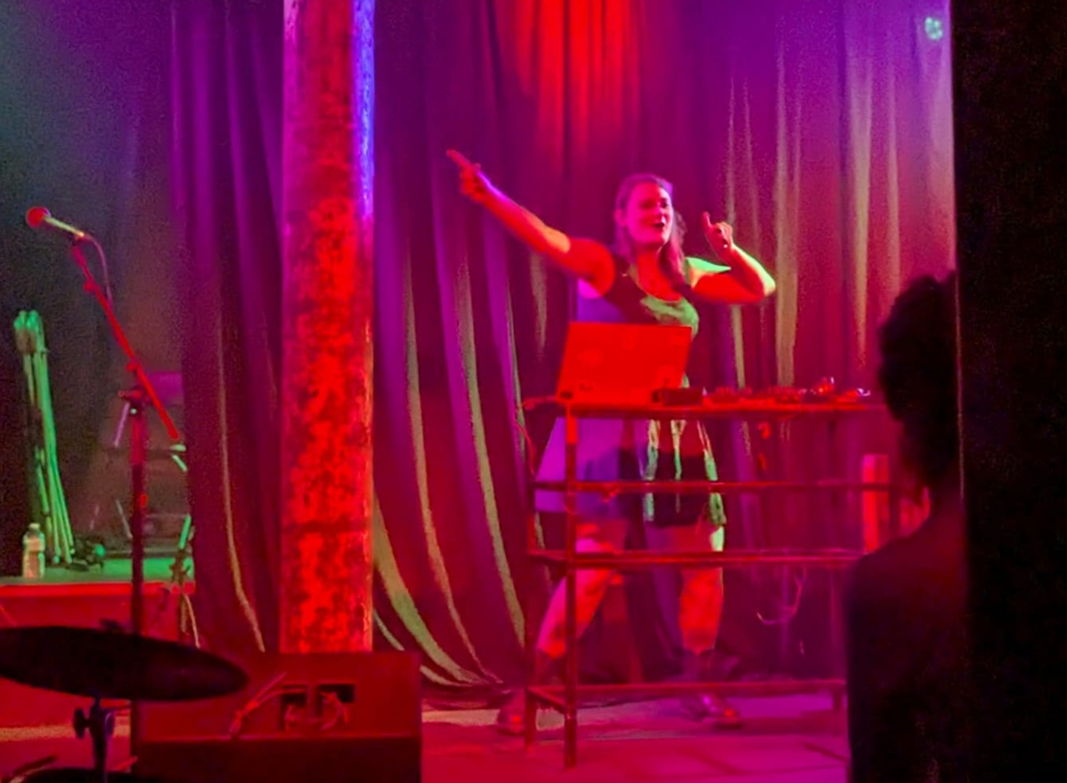
In which I am going for it. Photo by Onni Gust.


The night kicked off with a luscious set from singer-songwriter and drag artist Sersi. He’s probably the first person I’ve ever seen sport a Britney mic at a DIY gig, which was very cool but sadly couldn’t quite capture the sheer dynamic range of his vocals on the night. At the same time, it enabled him to completely own the stage for a series of ballads that were by turns beautiful and strange. Sersi was ably supported by a pal with a laptop, and Johanna Kirkpatrick (of trad folk bands Chanterelle and Madderam) looking dead dykey on acoustic guitar.

Next to take the stage were Deep Filff. I hadn’t had a chance to look them up before the gig so had zero idea what to expect, although they did arrive with an absolutely enormous inflatable swan. Deep Filff turned out to be a two piece, with Nadia Fiffsky playing bass and belting out epic sun-baked vocals, while Jenny Tingle methodically destroyed the drumkit. As purveyors of some of the dirtiest psychedelic grunge-punk riffs I think I’ve ever heard, they were extremely well-named. It was engrossing, hypnotic stuff. Eventually the swan came out and bounced around the audience, most likely representing a serious hazard to some of the important-looking wires and glitterball hanging from the ceiling.

Local heroes comfort never fail to disappoint, and this evening they truly tore up the stage as the final live act of the evening. The sibling duo have a truly unique sound, with Natalie’s staccato vocals punctuating a skitterish soundscape of totally artificial electronic sounds, underpinned by Sean’s assertive drumming. It was impossible not to dance. My favourite moments came whenever the band’s weird, abrasive noise would suddenly gave way to a transcendentally beautiful synth melody for a minute or two, before we all dived collectively back into the tumult.

Finally, following a quick raffle, I was up! The gig was due to end at a remarkably civilised 10pm, so I had a tight half hour DJ set.

I’ve thought a lot since returning to DJing that the landscape of queer and feminist music and activism has completely changed. Back in the day, I used to do quite a few “Women’s Voices” DJ sets, especially for feminist events such as Reclaim The Night afterparties, and the woman-only Women’s Aid and NUS Women’s Conference discos. The idea was that every song played (sometimes for sets of up to four or five hours) had a woman on lead vocals, and ideally women also playing instruments. Finn Mackay always used to refer to me as “feministDJRuthPearce” (all in one breath!) which was never failed to be delightful.

Unfortunately, many of the people who were only too happy to join the dancefloor for those events are now either actively backing trans-exclusionary politics and the grossest forms of transmisogyny, or otherwise failing to speak out again them. (Junior equalities minister Liv Bailey, I’m looking at you – remember when you hoped I’d DJ your wedding one day?!) It’s odd to reflect on just how normal it was for trans women to be involved in woman-only politics spaces in the UK, given the extremity of the post-2017 moral panic.

Anyway, I digress.

Another thing that has happened over the last decade is the enormous influx of excellent trans artists to both underground and mainstream music scenes. We live in an age where I listened to jasmine.4.t for the first time because my mum told me she’d done a good interview with Craig Charles on BBC 6 Music(!) So, while I’d like to do more Women’s Voices DJ sets in the future, for the first time it felt realistic to put together a Trans Voices set, with a mixture of tunes fronted by trans women and men, and/or non-binary, genderqueer, or genderfluid people, that I could reasonably expect a large number of people in the audience to be familiar with.

So, here’s what I played:

Shopping – The Hype
My Chemical Romance – Teenagers
100 gecs – mememe
SOPHIE – Immaterial
underscores – Locals (Girls Like Us) [with gabby start]
Kae Tempest – Move
Ada Rook – BURY YOURSELF
Janelle Monáe – Make Me Feel
jasmine.4.tGuy Fawkes Tesco Dissociation
G.L.O.S.S. – Outlaw Stomp
Against Me! – True Trans Soul Rebel

Obviously I could have kept going a lot longer, but I’ve got to say, it was one heck of a half hour. I have such enormous love for everyone who joined me to dance their arse off on a Monday night. And if you’d like me to DJ your event – I’m officially back behind the decks, so do get in touch!
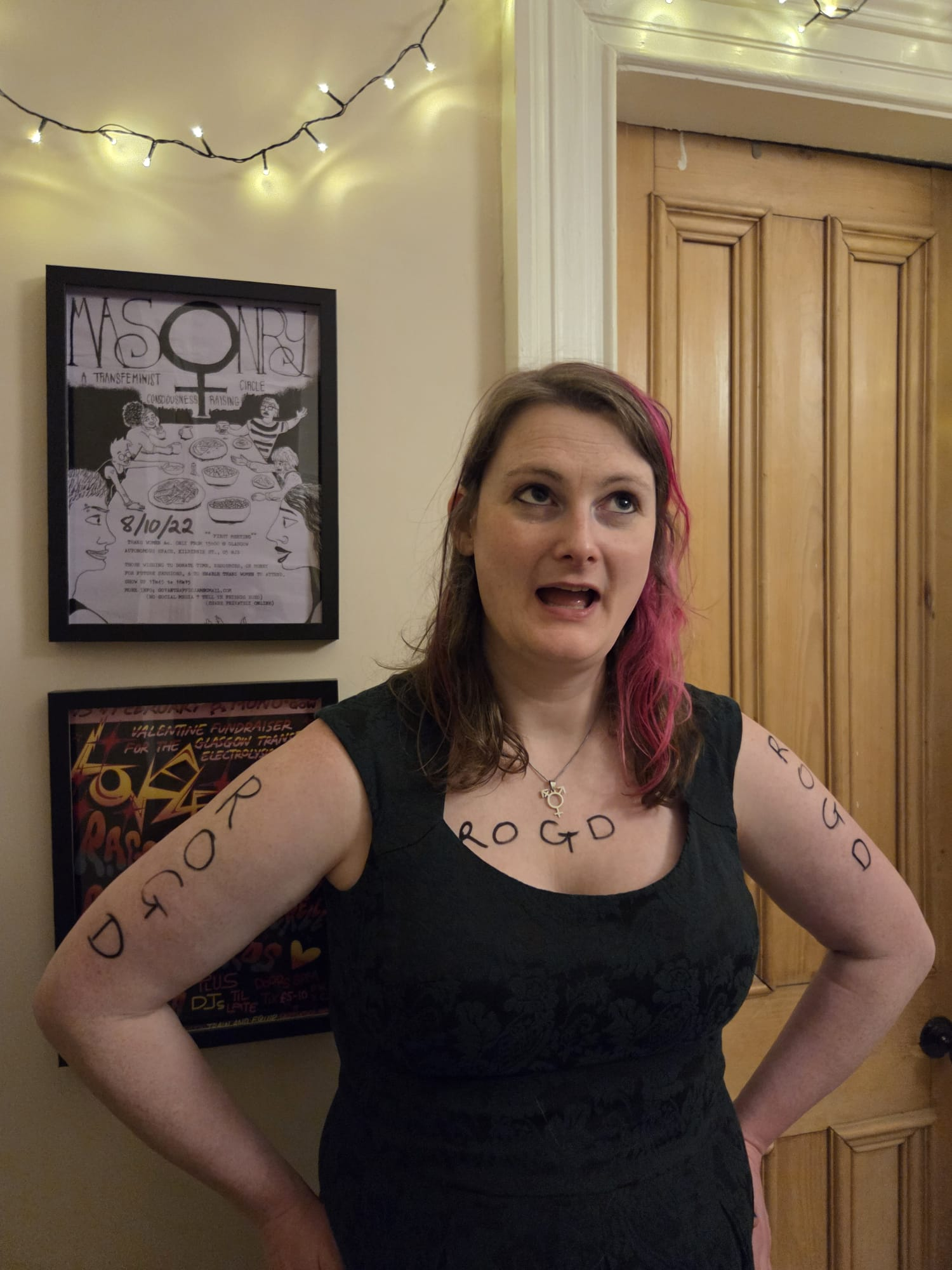
Back home – sweaty and happy!

I have seen the future of feminism, and it is beautiful

Yesterday’s social media furore over a dodgy letter to the Observer left me questioning my place within the women’s movement for the umpteenth time. However, within hours I was powerfully reminded that those who advocate an exclusive feminism are less influential and important than they might like to think.

Last night I joined a room of people committed to building a feminism that is compassionate, reflexive, inclusive of all women and sensitive to our different experiences.

Last night I found myself in a room of brown, black and white faces; gay, bi and straight; cis and trans; working class and middle class; disabled and abled. Last night I heard a teenage Muslim woman speak out about the importance of representing all faiths in activism after a question from a Jewish woman in the audience. Last night I heard from a white middle-class straight woman who has turned up to learn with an open mind. Last night I heard cis women talk about about trans rights, and felt that my identity and experience as a woman was simply not in question.

I had been invited to contribute to a panel discussion at the University of Bristol Students’ Union (UBU). Entitled How do we make the Women’s Movement intersectional?, the panel was was of UBU’s “Festival of Liberation“, which also includes events looking at the challenges faced by LGBT people, disabled people, and people of colour. I was honoured to share a panel with three truly awesome women: Susuana Antubam and Sammi Whitaker of the NUS Women’s Campaign, and Fahma Mohamed of Integrate Bristol.

Panellists at UBU's intersectional feminist event
Last night was promising and encouraging and heartwarming, and was not unusual in being so. I have seen similar scenes repeated across the country over the last few years at talks, workshops, protests and riot grrrl gigs.

This is the new feminism. A feminism that is discarding the model of monolithic female oppression and in its place building a movement around diversity and inclusion. A feminism that seeks to base both theory and action upon what different groups of women have to say about their lives and experiences, rather than imposing a top-down model of liberation drawn from academic theory. A feminism that sees cis and straight women take responsibility for supporting the work of their trans and queer sisters, white women take responsibility for supporting the work of their sisters of colour, abled women take responsibiity for supporting the work of their disabled sisters and so on.

Last night we talked about the importance of intersectionality as feminist praxis: of putting ideas into action. We talked about the importance of education: of sharing the knowledge and tools necessary for women’s liberation with people of all genders. We talked about the importance of representation: of working to ensure that women of all backgrounds feel welcome and able to attend feminist events through the use of accessible venues, ensuring diversity within organising teams and (where relevant) speakers/acts, and thinking about the language we use. We talked about the benefits of building groups around intersectional identities (such as black womanhood); groups that can then work alongside other bodies of people with a broader remit, feeding in ideas and holding them to account.

We talked about calling people out and challenging oppressive behaviour both within wider society and within the feminist movement. We also talked about being kind and prepared to forgive, and allowing people space to learn and grow. We talked about how everyone will make mistakes, because intersectional feminism is a constant experience of doing and being, rather than a closed process where you jump through a series of hoops and then become a Good Feminist who is capable of always passing judgement upon others.

We talked about our experiences of activism. Fahma talked about giving a piece of her mind to a nervous Michael Gove, resulting in a letter to every school in the country about FGM. Sammi talked about productive conversations with working class male friends, and building liberation into the very fabric of Anglia Ruskin’s fledgling Students’ Union. Susuana talked about her work on addressing lad culture as a gendered, racialised and classist phenomenon. I talked about my contributions to trans and non-binary inclusion within the NUS Women’s Campaign, and how we seek a diverse range of performers for Revolt, Coventry’s feminist punk night. We heard stories and ideas and questions from the audience, and I reflected on how we were not “experts” with a monopoly on solutions, but just one part of a wider movement.

These are just some of the things that we talked about.

So why have I been led to question my place within the women’s movement?

Because I see Julie Bindel referring to other feminists as “stupid little bellends” whilst misgendering trans women, arguing that bisexuals do not experience oppression, and stating that Muslim women who wear religious dress are necessarily oppressed. Because I see Rupert Read suggesting that trans women should not be allowed to use public toilets. Because I see Beatrix Campbell repeating and defending these ideas.

When I read things like this, I am repelled by a feminism that is harsh, bitter and exclusionary.

When feminists gaslight me by claiming repeatedly that the individuals who wrote these articles are not transphobic I am saddened and confused.

When I hear about feminists disrupting conversations at events such as AFem in order to promote an agenda that excludes trans people and sex workers, I am disappointed and worried.

When I see exclusionary events like Radfem 2013 and Femifest 2014 promoted within feminist spaces and supported by organisations like Women’s Aid and Reclaim The Night London I am alarmed and concerned.

When I see feminist women and men – including both public figures as well as personal friends and acquaintances – sign a misleading letter that condemns attempts to debate and contest the above, I wonder how voices of those who work for an inclusive and diverse feminism can possibly stand against a “letter mob” representing the discursive might of the liberal Establishment.

The stakes are high. Too many of my friends have considered suicide. Too many of my friends have died. When I talk to my trans friends and fellow activists, I hear about fragile mental health, doctors and shopkeepers refusing to provide services, threats of violence and attacks in the street. All of these things are fuelled by the dehumanisation of trans people, the idea that we require intervention to save us from the misguided path of transition, the implication that we do not deserve to exist within public spaces. These discourses are perpetuated by feminists and defended by liberals in the name of “free speech”.

I don’t believe in historical inevitability and don’t buy into progression narratives. I had a debate about trans-exclusive feminisms with Jack Halberstam recently. Jack echoed my PhD supervisor in arguing that trans-exclusive feminisms are outdated and irrelevant, long-dismissed within the academic world. But the academic world is often divorced from the reality of the feminist movement on the ground. In this reality, exclusive feminisms continue to fester.

In spite of all of this, last night reminded me of the power and appeal of the new, intersectional feminism. It is this feminism that is popular amongst young people who are more interested in working together than apart, and veteran activists with the humility to share their ideas and wisdom with newcomers on an equal footing.

This feminism requires work and nurture, but – as I argued last night – this does not need to be an entirely arduous task. Working together across our differences and ensuring that more people feel welcome and included makes us stronger. Learning new things from others can be interesting and exciting. Having the strength to learn from our mistakes solidifies friendships and alliances. Discovering a more diverse range of feminist histories, activisms and performances can be fun and empowering.

The new feminism is beautiful. Let’s keep building.