I entered the board room with some trepidation, amidst a gaggle of nervous colleagues. We were followed by the LGBT Equality Champion, and the Interim Head of Equality, Diversity, and Inclusion. The room itself was relatively mundane. Some chairs sat around a set of rectangular tables. A blank screen was linked to a computer in the corner. It could have been any room in the institution – if it were not for the view.
We were on the top floor of a shiny new building. Through floor-to-ceiling glass windows we could see a magnificent sweep of the city. I admired the soaring gothic tower of the university, the busy streets nearby, and the new blocks clustered around the river. A long march of tenement buildings to the south was ended by a wide semi-circle of high hills, with wind turbines working busily atop them.
We had gathered in this room to discuss national proposals for the mandatory segregation of trans staff and students. My colleagues had asked for the meeting to explore what – if anything – our employer might be prepared to do to counter these damaging proposals. We had taken time out of our busy schedules. There was no accounting for this in our workload. There was no guarantee we would achieve anything of use. We were concerned about the impact of the proposed segregation scheme on our work lives – but also about the impact of the meeting itself upon our wellbeing.
All of us, aside from the institutional equality leads, were trans ourselves. Many of us had previous experiences of equality schemes, having put countless hours into discussions intended to reshape policy to the benefit of minoritised staff and service users. We often felt isolated and bogged down in such conversations: finding it hard to explain the urgency of action, struggling to translate ideals into action, and fearing that we would be positioned as troublemakers.
As we sat down together, I found myself thinking about Toby Odland’s framing of the second law of thermodynamics:
Some input of energy is required to go between states of non-movement and movement. In large scale systems some of the energy put in to get an object to change state will be dispersed as heat into the environment. Not all of the energy put in is transferred to kinetic or static energy as may be the desire of the one providing the input. In other words, work wastes energy. (29)
In that room with the beautiful view, I was painfully aware of how inequalities can be reproduced in interventions designed to combat them. This phenomenon is a central concern of Toby Odland’s doctoral dissertation, Re-framing in friction: on Trans-inclusive enactment of gender equality aims. The dissertation offers a phenomenological interrogation of how gender inequalities persist for trans people in institutional environments, despite efforts to identify and tackle them.
The above is an extract from my review of Toby Odland’s PhD dissertation Re-framing in friction: on Trans-inclusive enactment of gender equality aims. You can read the full review, published in Tidskrift för genusvetenskap, through either of the links below:
I was asked to write this review after acting as opponent in Toby Odland’s doctoral defence at Linköping University in Sweden, in June 2025. Unlike the UK’s PhD vivas – oral examinations which take place behind closed doors – Swedish doctoral defences are public events, usually taking place at a point where a committee of experts has already supported the provisional completion of the PhD. As such, the dissertation is distributed in print and in digital format ahead of the defence. You can download a free copy of Odland’s dissertation here.
The opponent’s role in a public defence at Linköping University is to present a short summary of the doctoral student’s work to the audience, before asking the student a series of scholarly questions about the work and its implications (you can download my presentation slides here). The student then takes questions from the audience, before an examination committee convenes to (hopefully!) confirm that the PhD should be awarded.
As you’ll see in the full review, I was extremely impressed with Odland’s account of gender equality work in Sweden, and I believe it will be highly relevant reading for people involved in equality work in other countries too.
In January, I received an unexpected message. And at first, I thought I was being scammed.
Actually, I received several unexpected messages, over a couple of weeks. These comprised direct messages to my social media accounts, a comment on this blog, and – eventually – an email to my work account.
The purported person urgently trying to contact me was Mieke Verloo, Professor of Comparative Politics and Inequality Issues at Radboud University in the Netherlands, and Permanent Fellow at the Institute for Human Sciences in Vienna, Austria. I was familiar with her extensive feminist scholarship, especially her work on gender equality policies and anti-gender movements. Given the overlap in our interests, I wasn’t surprised she reached out. I speak with a lot of other researchers and activists on a pretty much daily basis. What was surprising was how keen and persistent she was to speak with me.
As a social researcher, my work is all about people – and our interactions with policy, institutions, and community organisations. To do my job well, I need to speak with people, all the time. Outside of teaching, this can consist of formally conducting a research interview, sharing advice or information, or just having a chat to maintain a relationship. I’m grateful that my research been highly read and impactful: that has happened because I have worked closely with others the whole time, to inform, design, undertake, and share my studies.
The problem is that academic employment does not leave much time and space for this people work. I do it on top of my teaching and administration load, plus reading, planning, writing, and so on. So I squeeze it in: a meeting here, a blether there. It’s increasingly difficult. I have a growing list of people who want to speak with me about their project idea, the latest insider scoop on NHS policy, next steps for their organisation, or their proposed PhD or postdoc. It takes me increasingly long to reply to emails, and I’m booking meetings months in advance. I am, to put it bluntly, overwhelmed.
So that’s a normal academic problem. It’s even worse for those of us working in fields such as gender studies at a time of far-right backlash. I have started to develop a trauma response to opening my emails. I am always anticipating the next terrible news, the next round of harassment, the next legal threat from a “gender critical” scholar who has decided I am a problem. There is, sadly, a reason why my work email can no longer be found on my university profile. Like many minoritised scholars, I have removed it, making it harder for hostile individuals to contact me.
This is a systemic issue, not just a “me” issue. Universities like to say that they value community engagement and impact. But we are never really provided time for it in our workload, especially if we are part of a targeted minority group. I feel like a one-woman gender clinic, gradually amassing my own ridiculous waiting list.
Professor Verloo did not want to wait. Her numerous messages indicated that what she wanted was clearly very important. I wondered, is this actually the real Mieke Verloo? Is this part of some elaborate harassment campaign? Am I being catfished?
Eventually, I set aside a bit of time, and asked Mieke to prove her identity – which, very kindly, she did. As a leading feminist academic who has studied anti-gender movements, she got it.
I had a flexible hour the next day, so I set up a Zoom meeting, to see what I could help her with.
On receiving awards
I don’t do the work I do to win prizes. I am not saying this to be humble – I am saying this because it true, and realistic.
While some of my work is highly-read, I think the most impactful things I’m involved in tend to be invisible. And that’s okay. I organise with others, and share ideas and information with various people and groups, without any of this ever being visible to the wider world (let alone seeing academic publication). This is the work of social movements, and untold millions of us do it.
Meanwhile, on the occasions when I have sought academic awards, it has been very difficult. I’ve really struggled to land research funding, in spite of my profile, in spite of cis mentors pulling baffled faces and saying things like “I have never seen a proposal this strong fail in the first round”, over and over again. Again, this is a systemic issue. I’ve seen enough trans studies scholars go through the same to know that we are being quietly discriminated against. The same is true of other marginalised groups, such as academics who are Black and people of colour.
I have also, very occasionally, won something that feels entirely hollow. A few years ago I received an “LGBT+ Advisor Award” from NHS England. This was announced in a ceremony I wasn’t invited to, and was not publicised outside of a tweet from someone who was there. I received a small badge in the post, which is now displayed on my office pinboard, a focal point for conflicted emotion. For several years, I put enormous amounts of time and energy into working for a more trans-friendly NHS. Now, many of the very NHS commissioners and policymakers I used to meet with are mainstreaming pseudoscienceand conversion practices. It hurts.
So when I asked what I could help Mieke Verloo with, and she said, “we would like to give you a prize”, I went into shock.
Recognition and recovery
I think I have become too acculturated to the idea that there is no external recognition for trans liberation work. This is an important reminder that people outside of trans communities care about us, and care about our role in wider struggles for social justice.
I have been a part of a feminist movements my entire adult life. For many years I have campaigned for and within women’s services and women’s political spaces, and fought back against systemic sexism and misogyny. Nevertheless, as the anti-trans movement has grown more powerful, I have felt the walls closing in. Powerful forces are trying to separate women like me from our sisters in struggle.
In a world of divide-and-rule, it matters that we extend recognition to one another, in whatever ways we can. Often, this means just telling someone that they are seen, and that their work matters. It means so much when I hear this, and I try to make a practice of doing the same for others.
But Mieke Verloo is part of the FLAX Foundation, a Dutch organisation with some funding for Europe-wide feminist research awards. It seems that FLAX seeks to extend recognition in ways that are as useful as possible for prize recipients.
The recognition alone is the most powerful and beautiful thing about the Emma Goldman. I think it will provide me with greater strength going forward, a sense of togetherness with other feminist activist-researchers across Europe.
However, the award also comes with funding. So I will also be considering how best to use this to support my work going forward. My hope is to focus on finding more time and space for restoration and slowing down, for existing collaborations and research dissemination rather than starting something new. I hope to focus on writing up findings from work undertaken with colleagues in the Trans Learning Partnership, and finish my next book. I will also look into paying for services that might help me better manage my experiences of overwhelm, ideally in a way that puts money back into queer and trans communities. It is rare indeed to obtain funding for this purpose.
The Emma Goldman Award
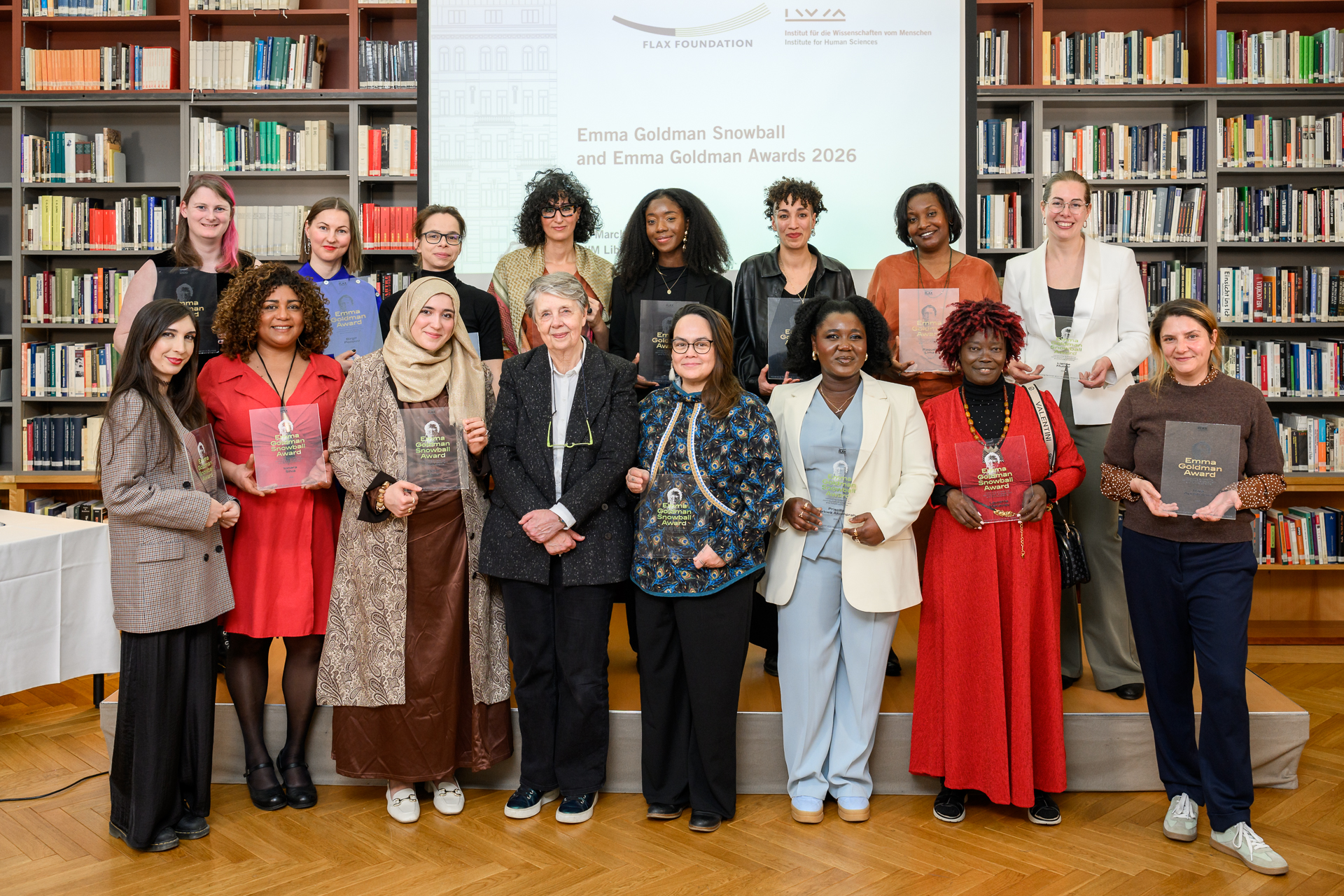
Every year, between five and ten people receive an Emma Goldman Award. Several more can win a different prize given by the FLAX Foundation, the Snowball Award. Two weeks ago, we gathered in Vienna for an awards ceremony, and for a budgeting workshop to support the best use of the funding we have received.
It was quite overwhelming to be in a room with a group of such highly accomplished women. We came from a great range of backgrounds, in terms of nationality, heritage, culture, discipline, field, and medium. It was amazing to hear about the work everyone was doing: as academics, as journalists, as filmmakers, as comic artists – and, inevitability, as collaborators and organisers. Every one of us was involved in community-building in one way or another. And everyone seemed pretty shocked to be receiving an award, because each one of us feels the pain of oppression, and none of us do what we do to win prizes.
The award ceremony was filmed, and I’ve put a link to the youtube video at the bottom of this post. It’s worth a watch simply to hear about the exciting things every single award winner is up to. It expanded my sense of possibility, of what is happening in the world and can happen in the world, and who I might work with or be inspired by going forward.
It meant a great deal just to spend time with each other outside of the formal sessions, speaking and listening and learning together, building new friendships. This is something I have taken away from my time in Vienna, something I will sit with for a long time. I believe this is another intention of the Emma Goldman and Snowball Awards: to go beyond themselves, to support networks of research and activism, to enable new connections and collaborations across borders. In this sense, the prize couldn’t be better named.
The thing that struck me most after the award ceremony – and I mean this in a really good way – is that it made our collective achievements feel unexceptional. I don’t say that to talk down myself, or any other winner. Quite the opposite: I feel that recognising this kind of work collectively reminded me that none of us are alone, that we are part of a movement.
It is enough for any of us to simply do the work – of fighting for a better world.
I’m currently in the middle of a busy fortnight for work-related travel (more on that soon!) But last night, I managed to make the most of a brief return to Glasgow.
The occasion was There Will Be Blood! a fundraiser at Stereo for the brilliant group Trans Healthcare Access Glasgow. They are helping to provide free laboratory testing for bloods. This is really important for trans people on HRT who are increasingly denied monitoring by GPs. If you couldn’t make it but would still like to donate, you can do so here.
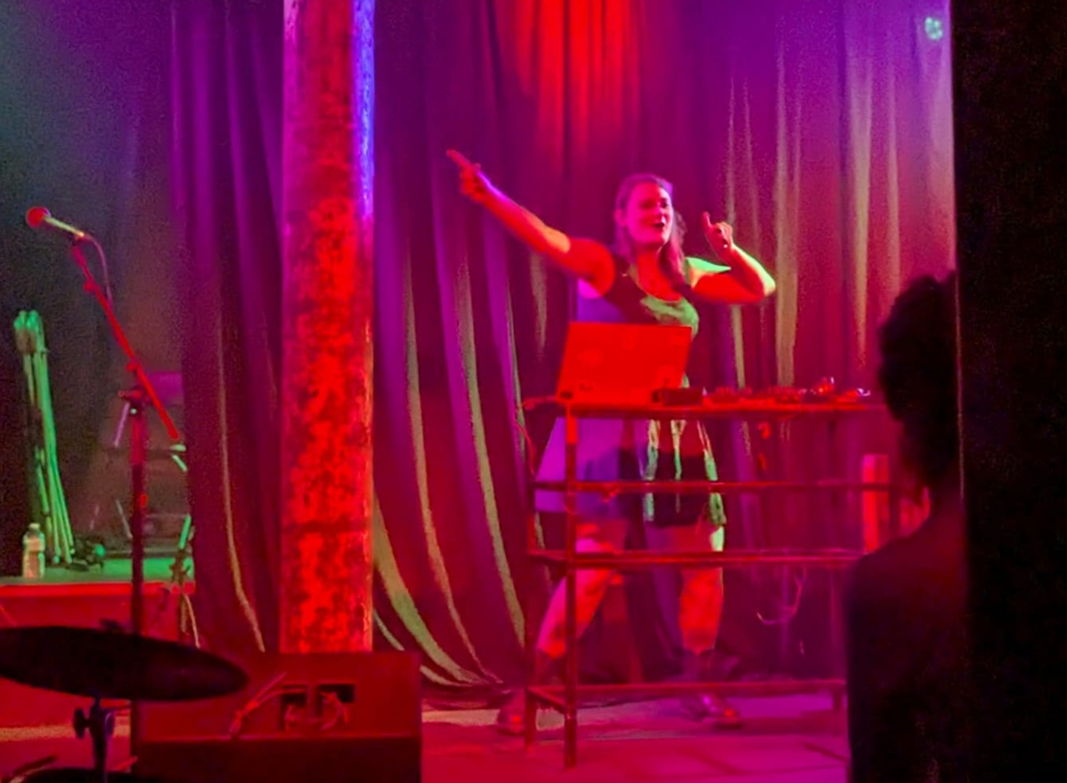
The organisers put together a fantastic lineup and there was a great turnout – especially for a Monday night. It was exciting to see so much talent from within our community, and loads of people come out to support both the cause and a pretty eclectic collection of artists. And exciting for me to be a part of it, performing a DJ set as ROGD.
In which I am going for it. Photo by Onni Gust.
The night kicked off with a luscious set from singer-songwriter and drag artist Sersi. He’s probably the first person I’ve ever seen sport a Britney mic at a DIY gig, which was very cool but sadly couldn’t quite capture the sheer dynamic range of his vocals on the night. At the same time, it enabled him to completely own the stage for a series of ballads that were by turns beautiful and strange. Sersi was ably supported by a pal with a laptop, and Johanna Kirkpatrick (of trad folk bands Chanterelle and Madderam) looking dead dykey on acoustic guitar.
Next to take the stage were Deep Filff. I hadn’t had a chance to look them up before the gig so had zero idea what to expect, although they did arrive with an absolutely enormous inflatable swan. Deep Filff turned out to be a two piece, with Nadia Fiffsky playing bass and belting out epic sun-baked vocals, while Jenny Tingle methodically destroyed the drumkit. As purveyors of some of the dirtiest psychedelic grunge-punk riffs I think I’ve ever heard, they were extremely well-named. It was engrossing, hypnotic stuff. Eventually the swan came out and bounced around the audience, most likely representing a serious hazard to some of the important-looking wires and glitterball hanging from the ceiling.
Local heroes comfortnever fail to disappoint, and this evening they truly tore up the stage as the final live act of the evening. The sibling duo have a truly unique sound, with Natalie’s staccato vocals punctuating a skitterish soundscape of totally artificial electronic sounds, underpinned by Sean’s assertive drumming. It was impossible not to dance. My favourite moments came whenever the band’s weird, abrasive noise would suddenly gave way to a transcendentally beautiful synth melody for a minute or two, before we all dived collectively back into the tumult.
Finally, following a quick raffle, I was up! The gig was due to end at a remarkably civilised 10pm, so I had a tight half hour DJ set.
I’ve thought a lot since returning to DJing that the landscape of queer and feminist music and activism has completely changed. Back in the day, I used to do quite a few “Women’s Voices” DJ sets, especially for feminist events such as Reclaim The Night afterparties, and the woman-only Women’s Aid and NUS Women’s Conference discos. The idea was that every song played (sometimes for sets of up to four or five hours) had a woman on lead vocals, and ideally women also playing instruments. Finn Mackayalways used to refer to me as “feministDJRuthPearce” (all in one breath!) which was never failed to be delightful.
Unfortunately, many of the people who were only too happy to join the dancefloor for those events are now either actively backing trans-exclusionary politics and the grossest forms of transmisogyny, or otherwise failing to speak out again them. (Junior equalities minister Liv Bailey, I’m looking at you – remember when you hoped I’d DJ your wedding one day?!) It’s odd to reflect on just how normal it was for trans women to be involved in woman-only politics spaces in the UK, given the extremity of the post-2017 moral panic.
Anyway, I digress.
Another thing that has happened over the last decade is the enormous influx of excellent trans artists to both underground and mainstream music scenes. We live in an age where I listened to jasmine.4.tfor the first time because my mum told me she’d done a good interview with Craig Charles on BBC 6 Music(!) So, while I’d like to do more Women’s Voices DJ sets in the future, for the first time it felt realistic to put together a Trans Voices set, with a mixture of tunes fronted by trans women and men, and/or non-binary, genderqueer, or genderfluid people, that I could reasonably expect a large number of people in the audience to be familiar with.
So, here’s what I played:
Shopping – The Hype My Chemical Romance – Teenagers 100 gecs – mememe SOPHIE – Immaterial underscores – Locals (Girls Like Us) [with gabby start] Kae Tempest – Move Ada Rook – BURY YOURSELF Janelle Monáe – Make Me Feel jasmine.4.t – Guy Fawkes Tesco Dissociation G.L.O.S.S. – Outlaw Stomp Against Me! – True Trans Soul Rebel
Obviously I could have kept going a lot longer, but I’ve got to say, it was one heck of a half hour. I have such enormous love for everyone who joined me to dance their arse off on a Monday night. And if you’d like me to DJ your event – I’m officially back behind the decks, so do get in touch!