Returning home for Bath Pride

This year saw the city of Bath’s first ever Pride march. It felt long overdue, but also an unthinkable impossibility come to life.

Photo of Bath Pride march


I was born and grew up in Bath, before moving to Coventry for university. While some of my friends were eager to leave Bath for more exciting places, I loved the city deeply – and still do.

I was very ambivalent about moving. Growing up on the outskirts, I felt deeply connected to the landscape: the hills, the woods, the little hidden valleys and streams. Meanwhile, Bath’s deep human history felt ever-present as I dodged tourists in the Georgian streets, sauntered past the Roman Baths, and climbed past Iron Age fortifications on Solsbury Hill. As a teenager, I went to grunge gigs in listed buildings, and wandered down country lanes to parties in distant farm fields.

I have written a few times recently about some of my experiences as a young queer person in Bath. These were the last days of Section 28. My school was a hotbed of homophobia, and I lived in a void of information. In many ways, I felt so incredibly, utterly isolated. At the same time, I received invaluable support at a very vulnerable time in my life: from friends who had my back unconditionally as I came out as trans and bisexual, from teachers who found quiet ways to support me, and from Off The Record‘s free counselling service for young people,. Bath is home to small-town conservative values but also has a strong liberal streak, and this complexity really was reflected in my experiences.

I didn’t really know what Pride was, what Pride was for until years after I left my childhood home. It wasn’t until I was a young adult that I really gained an understanding of queer community, of the healing power of both protest and celebration, and of the sheer joy of mass togetherness. That wasn’t ever something that felt conceivable for me in Bath, let alone possible.

But of course, as I grew older and changed, so did Bath.
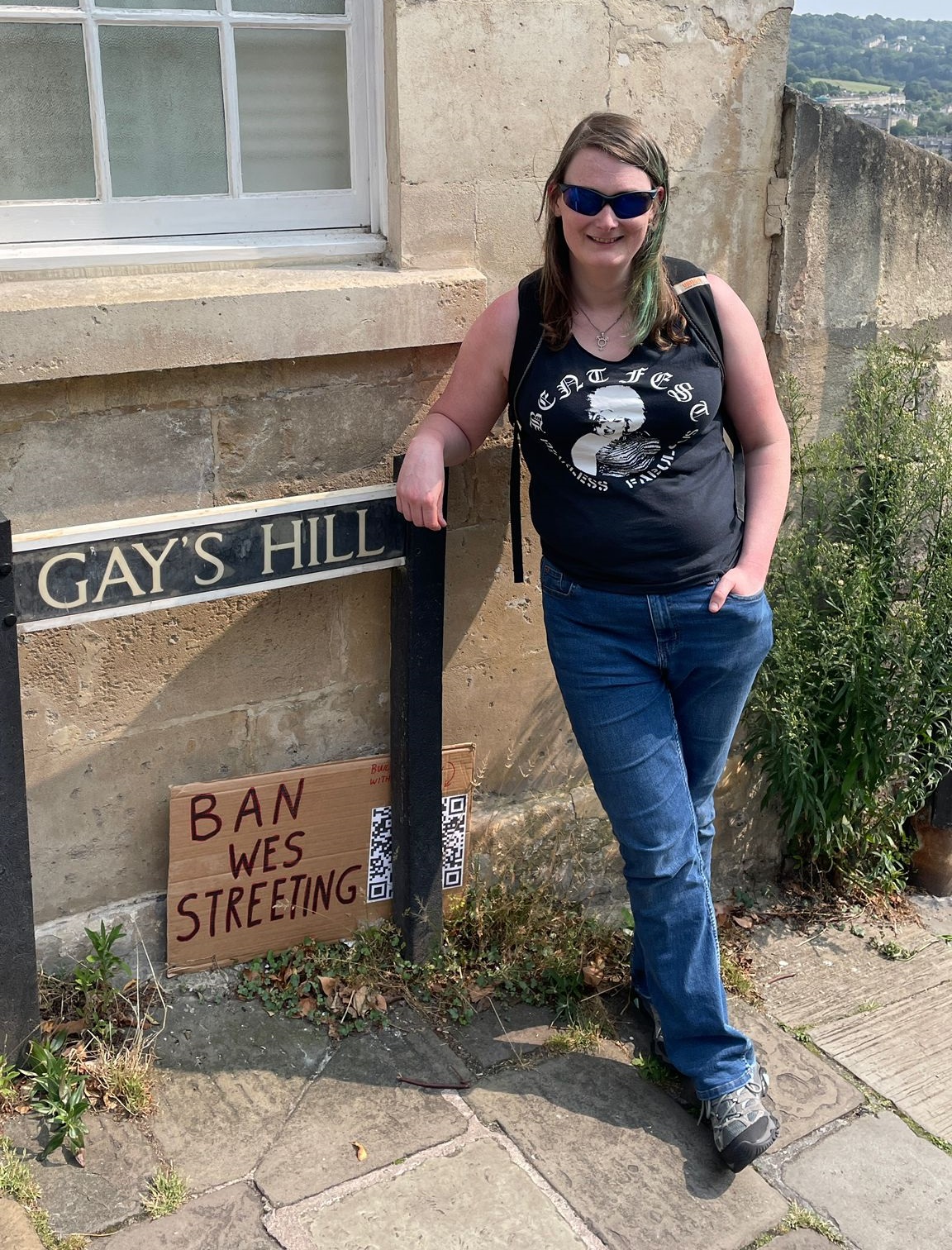
Photo of Ruth posing with a street sign for Gay's Hill, and a placard reading Ban Wes Streeting.


Just like every other part of the UK, more and more young people in Bath came out as lesbian, gay, bi, trans, queer, and/or asexual. Off The Record started up a dedicated LGBTQ+ youth group. In the mid-2010s, Bath had first a gay mayor and later a gay MP. From 2015, students at Bath Spa University organised their own Pride events, and in 2016, Bath Amnesty marked Pride month with a stall. In 2017, a Pride procession block joined the Bath Carnival.

I was nevertheless pretty surprised to see the first major, dedicated Bath Pride celebrations planned for this summer, on Sunday 18 August. For this to happen, you needed a critical mass of dedicated organisers, volunteers, and community members prepared to come together and make it happen. You needed enough people prepared to assemble and loudly celebrate and protest at a time of rising hatred and violence towards us. You needed to take all of this and put it on the streets of city known for its architecture, parks, and landscape, rather than any kind of political organising or protest culture.

So I returned home, to be a part of it.

Photo of four happy people at Pride.


Bath Pride was gentle, Bath Pride was beautiful, and Bath Pride was powerful. Bath Pride was a family picnic in the grounds of the Holburne Museum, a club night at Komedia, and a thousand people marching through the streets to demand our liberation.

Bath Pride was about community. I have so much respect for how much the organisers centred this in everything they did. There were no corporate floats, no major brands, no prioritising of some queer people over others. Most of the people in the march were just ordinary individuals, out solo or with their partners or friends. There was also a significant presence from groups including a local church, the city’s roller derby league, and the LGBTQ+ staff group from the Royal United Hospital. My mum volunteered as a steward.

Bath Pride was radical. It had never been done like this before, and it was done so well. While the overwhelming vibe was one of joy and celebration, this was very much a protest. Home-made placards abounded. NHS staff pointedly wore pro-trans t-shirts. A tall person with a stylish mustache wearing a cowboy hat, open pink cropped jacket and pink shorts waved a Palestinian flag in solidarity with the people of Gaza. This Pride was very Bath, but it was also about moving beyond tolerance, arguing for real liberation in a way that challenged the city’s cosy liberal consensus.

On some streets, people stood and waved or even joined in, with the march swelling as it went. On others, especially in busy shopping areas, I was reminded of the tension and threat inherent in Trans Pride, with confused or hostile looks directed our way. We were challenging people: with loud disco music, with political slogans, with our insistent presence. In the context of Bath’s politely commercial street culture, even thoroughly overbaked chants such as “trans rights are human rights” took on a new resonance. At a time when the NHS, schools, and new Labour government are actively attacking young trans people’s basic access to healthcare, education, and any level of personal autonomy, this kind of visibility couldn’t be more important.


After the march, my partner and I wandered the Holburne grounds. We admired stalls for local queer crafts, as well as community groups such as Bath Welcomes Refugees, The Diversity Trust, B&NES Fostering, and… Off The Record. I took the time to thank the people on this stall for the support I received from their organisation 20 years ago, and learned about what they are doing to support young people today.

And then we left the city centre – walking up Gay’s Hill, before taking time for a drink and apple pie at the Fairfield Arms. The pub, which has been run by a gay couple for many years now, was full of local people enjoying a Sunday roast or just hanging out in the pub garden. We had a chat with one of the landlords, who said he was a bit sad to miss the Pride event, but the weekend was always a busy time for them.

Queer lives are weaved through the very fabric of the city of Bath. We are always and have always been everywhere, quietly getting on with our day to day. But we also deserve love, recognition, community, and visibility on our own terms. That’s why Pride is so important.


Information on supporting or donating to Bath Pride, to ensure independent, and community-centred future events, can be found here.

Amplify trans youth

This morning I logged into instagram and watched, transfixed in amazement and worry, as a young person scaled the walls of the Department for Education.

The aspiring spiderman is part of the activist group Trans Kids Deserve Better. At the time of writing they are staging a multi-day protest at the Department for Education building in London, for the right to a safe and inclusive education.

Watching the video, I fear for Squirrel, the anonymous activist who is genuinely risking their life to stop government employees from taking the group’s banner. It’s very apparent that Squirrel is a skilled climber who knows what they are doing – equally, one wrong move could result in a deadly drop to the concrete pavement. This is not safe.

But of course, the entire reason this protest is happening is because young trans people are not safe.

Trans Kids Deserve Better launched their campaign for youth autonomy, safety, respect, and inclusion in July, from a dramatically high ledge of an NHS England building. In an interview with Jess O’Thompson for Trans Writes, the emergency doctor and children’s TV presenter Dr Ronx Ikharia argued that “our young people deserve better than suffering, and shouldn’t be scaling walls”. But they added that for this to happen, trans kids must be “believed, supported, affirmed, and loved”.

And this is the crux of the issue. Under the Conservative and Labour governments, we have seen a policy environment in which teachers, doctors, therapists and parents are actively discouraged or prevented from believing, supporting, affirming, or loving young trans people. Instead, families face prison sentences for supporting young people’s continued access to medication, NHS England is expanding the provision of state-funded conversion clinics, and a growing number of schools are refusing to allow even the discussion of trans experiences.

Trans kids are not safe because they have been entirely failed by the adult world. They have been failed by politicians, failed by civil servants, failed by the NHS, failed by the voluntary sector, failed by researchers, and in many cases also failed by their doctors, teachers, and parents or carers. This is why the activists from Trans Kids Deserve Better are literally scaling walls in their fight for an actual future.

Looking at the challenges facing young trans people, it can be easy to lose hope. But the actions of Trans Kids Deserve Better show that there is a better way. Doomerism helps nobody. The successes of successive liberation struggles have come about because people have continually dared to believe that a better world is possible, and fight for it. The young people currently sat outside the Department of Education are not bemoaning what they have lost: they are insistently demanding change.

Image from Trans Kids Deserve Better

What can we do? In their conversation with O’Thompson, activists from Trans Kids Deserve Better explained that while trans adults often want to “protect” trans youth, they would rather we “amplify” them: “we don’t need sympathy, we need support”. This is a call to action, with a focus on solidarity, rather than trying to speak for young people or bemoan their situation.

Many adult trans people and allies have complained about the lack of mainstream media coverage for the actions of Trans Kids Deserve Better. But we should not simply wait for the papers or news programmes to start caring. It’s up to us to talk about what’s happening. Today’s queer and trans communities only exist at scale because we made our own media, told our own stories, and forced the mainstream to catch up.

So I encourage everyone who reads this to share the story of what is happening. Share it on social media, share it with friends and family, share it in conversations at work and in bars and in cafes and in parks and at gigs and festivals. A few days ago I was at a pub in Bath, fresh from Pride, still holding a placard that read “Ban Wes Streeting” (copied shamelessly from someone else in Glasgow a couple of weeks prior). Someone asked what Wes Streeting had done, so I told her. She was appalled, but grateful to have learned what is happening, and better informed to act. Information spreads when we spread information.

Trans Kids Deserve Better are also hoping that more people will contribute to their actions. You can sign up as a supporter, stay updated from their Instagram account, or contribute to their fundraiser.

If you, like me, would rather not see young people risking life and limb by climbing public buildings, it is time to fight with them, not “for” them. Together we can build a safer world.

Out now in Scientific American: “The U.K.’s Cass Review Badly Fails Trans Children”

I have co-authored an article with Cal Horton for the science magazine Scientific American. We take a concise look at what the Cass Review is, what it found, why the methods used were troubling, and how it is being used to harm young people.

You can read the article here. I hope it will be helpful as a basic explainer for why trans community groups, academic experts, and clinical specialists are so concerned about the Cass Review.

Screenshot of Scientific American website.

Writing for Scientific American was a really interesting experience. It was of course radically different to publishing in a peer-reviewed journal: we put the piece together in a matter of weeks, and it was not scrutinised by academic experts from our specific field of study. At the same time, there was an extremely rigorous editorial, fact-checking, and copyediting process that also made it very different to publishing in most magazines or newspapers.

I was deeply impressed with the sheer amount of time and care the Sci Am editors put into this piece. On one hand, their contributions ensured the piece is written in accessible language, with an international (and especially US-based) readership in mind. On the other hand, we had extensive discussions to ensure that all points made in the article could be rigorously evidenced, including some very detailed exchanges about the specifics of UK law, and what exactly the Cass Review document does and does not have to say about exponential growth over different periods of time. We had to be able to strongly back up any even slightly contentious point.

It was a challenging experience, but one I felt very held by as an author committed to consciencious research practice. Publishing this piece in Sci Am definitely ensured that it was as good as it could possibly be.

Community Development Journal: Issue 59(3) out now

One element of my work I don’t talk about as much on this blog is my role as co-editor of the Community Development Journal. We put out four issues every year featuring amazing research from across the world, so I’m hoping to highlight this a bit more in future posts.

Volume 59, Issue 3 is out now and features articles on a range of topics from violent protest, to public art, to academic/voluntary partnerships – with contributions from South Africa, the Philippines, the UK, India, Canada, Vietnam, Mexico, Portugal, and Italy. As ever, it’s been hugely exciting to work with and learn from such a broad range of insight and expertise.

In addition to overseeing the peer review process, myself and co-editor Kirsty Lohman write an editorial for every issue. This editorial – one of five freely available articles in the latest issue – celebrates the launch of the new CDJ Plus website and reflects on the privileges and limitations of academic publishing. In particular, we discuss the importance and limitations of using our platform to speak out about the ongoing colonial violence in contexts such as Gaza and Ukraine.

You can read that editorial here:

Academic publishing and the privilege of a platform
by Ruth Pearce and Kirsty Lohman