Ethical guidance on studying trans health, for researchers and ethics boards

I recently co-authored an article on research ethics for the journal Transgender Health. It’s based on an extensive review of literature on the topic, and written by an international team of scholars and health practitioners with extensive experience of conducting research in this field.

Transgender Health is an open access journal, so the article is freely available for anyone to read and share.

I’ve copied the abstract out below: please click on the title for full access.


Guidance and Ethical Considerations for Undertaking Transgender Health Research and Institutional Review Boards Adjudicating this Research

The purpose of this review is to create a set of provisional criteria for Institutional Review Boards (IRBs) to refer to when assessing the ethical orientation of transgender health research proposals. We began by searching for literature on this topic using databases and the reference lists of key articles, resulting in a preliminary set of criteria. We then collaborated to develop the following nine guidelines:

(1) Whenever possible, research should be grounded, from inception to dissemination, in a meaningful collaboration with community stakeholders;

(2) language and framing of transgender health research should be non-stigmatizing;

(3) research should be disseminated back to the community;

(4) the diversity of the transgender and gender diverse (TGGD) community should be accurately reflected and sensitively reflected;

(5) informed consent must be meaningful, without coercion or undue influence;

(6) the protection of participant confidentiality should be paramount;

(7) alternative consent procedures should be considered for TGGD minors;

(8) research should align with current professional standards that refute conversion, reorientation, or reparative therapy; and

(9) IRBs should guard against the temptation to avoid, limit, or delay research on this subject.

Trans health in Canada: reflections and resources from CPATH

At the end of October I attended the CPATH 2017 (Canadian Professional Association for Transgender Health) conference in Vancouver. It was a fascinating event from which I learned a great deal. I’m keen to share some of my thoughts and experiences with others, as I feel there is a great deal that trans health researchers, practitioners and activists can learn from the progress that’s been made in Canada, as well as the limitations of that progress.
DNF13PxV4AEw4K-.jpg large

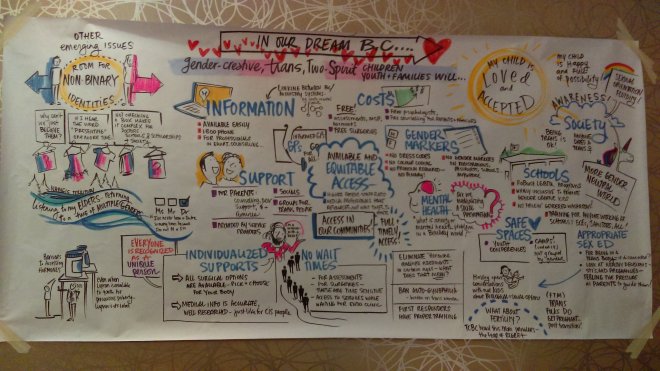
Poster: “In Our Dream B.C….”, by Drawing Change. Based on Trans Care BC consultation with gender creative, trans, and two-spirit youth and their families..

In this post, I reflect briefly on my impressions of the conference, and link to Twitter threads I wrote during various sessions. You can also read my initial thoughts on the conference here.


CPATH took a broadly holistic approach to trans health

Over 300 people took part in the three-day CPATH 2017 conference and two-day pre-conference. In attendance were GPs, nurses, endocrinologists, psychologists, psychiatrists, therapists and counsellors, social workers, healthcare administrators, peer and parent support group facilitators, academic researchers, lawyers, politicians, and various trans campaigners.

CPATH 2017 treated “health” as a social phenomenon as well as a purely embodied matter, and this made for some very productive conversations. For example, numerous sessions explored how trans healthcare might best be provided in the context of primary health. Gender identity services are frequently provided by GPs with support from external specialists, a model of care that is currently under consideration for England. In some Canadian Provinces, organisations such as Trans Care BC help to connect providers in primary care to relevant specialists, and support trans people in obtaining interventions such as hormone therapy and surgeries.

This approach enables continuity of care in a local context, with family doctors enabled to provide trans-specific care for their patients alongside everyday services. It reduces barriers to access such as waiting times and the necessity of long-distance travel. It also enables GPs to help their trans patients access a wider range of specialist services: for instance, trans people with mental health issues might benefit from a referral to a peer support group as well as or instead of formal therapy (depending on patient desire and need). Many practitioners provide services on the basis of informed consent, rather than using mental health assessments as gatekeeping measures. It was heartening to see generalist and specialist healthcare professionals, social workers, trans activists and others engaged in open discussions about how best to manage care through this kind of system.

I was also particularly struck (and moved) by a session entitled Trans and Two Spirit Youth Speak Back! The 40 or so adults in attendance – mostly healthcare professionals or researchers of one stripe or another – were asked not to speak at all during this workshop. We were instead invited to listen to the stories and experiences of trans and two-spirit young people, who sat dotted around the room and answered pre-prepared questions delivered by a youth group facilitator. This session structurally prioritised the voices of young trans people who are so often silenced, and also offered an opportunity for us to hear how the healthcare needs and challenges faced by these individuals were shaped by their cultural heritage, family life, schools and peer groups.


CPATH took intersectional trans voices seriously

Trans and Two Spirit Youth Speak Back! was just one example of how trans voices were frequently centred at CPATH 2017. As an attendee from the UK, I was very impressed by this! Our trans healthcare conferences, seminars and workshops tend to be organised by and for community groups, researchers or healthcare providers, with relatively little overlap between attendees at these events. Very few practitioners are (openly) trans, meaning that trans people tend to talk to one another at community and research events, but are heard less often at healthcare conferences for doctors, nurses and mental health specialists. Moreover, the speaker line-ups at all these events tend to overwhelmingly prioritise the most privileged individuals, such as white people and men. The only possible exception is cliniQ’s Trans Health Matters conference, and that event too feels like it’s taking the first steps towards something better.

During the opening plenary of the CPATH conference proper, we were informed that around one third of speakers at the event were trans, and around a tenth were Indigenous (i.e. of First Nations heritage). I’m not sure how many people of colour were represented at the event more generally, but the all-white panels which are a norm at UK events seemed few and far between.

Importantly, the trans women, trans men, non-binary and two-spirit platformed as speakers and workshop facilitators were usually also professionals. We weren’t simply present at CPATH to represent a “patient perspective”: rather, we were the experts. This reflects the hard work of individuals in pursuing a career, and the collective work of CPATH in supporting trans professionals; it also reflects the actions of local providers in various parts of Canada who have made an active effort to employ trans people, or secure funding for partnerships with trans-led organisations.

In my previous post I noted that the opening plenary of the conference proper centred Indigenous voices. This included a formal welcome from Musqueam Elder Jewel Thomas, and talks by trans and two-spirit Indigenous educators from different parts of North America. I was happy to see that the plenary session on the second day of the conference continued to centre the voices of individuals who tend to be marginalised within even trans spaces. Two-spirit physician Dr James Makokis and Latina trans activist Betty Iglesias – who discussed issues faced by trans sex workers and migrants – were platformed alongside an Member of Parliament from Canada’s ruling Liberal Party, resulting in a thoughtful and challenging debate.


CPATH (and the rest of us) still have a lot of work still to do

I left CPATH with a very positive impression, but Canada is by no means the promised land for trans health. Professionals and patient representatives alike frequently discussed the challenges they faced in providing gender-affirming services. Transphobia and cisgenderism are still very much prevalent within healthcare provision and legal frameworks, particularly outside of urban areas: there is therefore a great need for better education among trainees and further reform of laws and guidelines. Limited funding and different approaches across the country’s Provinces and Territories also mean that not everyone has the same access to treatment, and waiting lists persist for publicly-funded care. These are challenges that exist across the world, and may benefit from greater international collaboration and strategy-sharing.

At the end of the first day of the conference proper, there was a reception specifically for trans people attending the conference. I later reflected on the experience of attending this reception in conversation with a genderqueer colleague; both of us felt ourselves relaxing enormously upon entering the trans-only space. For all the positives of CPATH, it was a huge relief to step away from cisgenderist expectations and microaggressions that quietly persisted throughout the conference proper. These included a range of unspoken ideas about how we should dress, act, and talk “professionally”, limitations on our ability to name transphobia within healthcare settings without fearing repercussions, and the occasional terrible intervention from self-righteous cis professionals.

As ever, facing down these challenges is hardest for the most marginalised trans people, including (for instance) disabled individuals, sex workers, migrants, and people of colour. I was aware that while CPATH 2017 took a broadly intersectional approach, instances of ableism, racism, sexism and so on persisted: and this could take the form of unexamined prejudices on the part of more privileged trans people too. Moreover, white people were still heavily overrepresented among conference attendees; a phenomenon that was particularly noticeable at an event held in a city as diverse as Vancouver.

What I’m taking from this is a reminder that equality work is never “done”; rather, it is something that we should strive to always “do”. We should aim constant improvement in our relations to one another rather than assuming that solidarity and equality are things that we can simply achieve. It is in this spirit that I’ve attempted to use my own privilege as an academic to bring back lessons from Canada for the UK and beyond.

So, I’ll end this post with a serious of links to Twitter threads from the event. I livetweeted extensively from CPATH 2017, sharing summaries of the numerous talks and workshops I attended. This is by no means a comprehensive summary of any of the sessions I was at, let alone the wider conference (as numerous parallel sessions took place simultaneously). However, I hope the ideas and approaches will be as useful and interesting to you as they are to me.


Pre-conference (training) Twitter threads

Day 1:

Introduction to Gender-Affirming Practice

Pre-puberty/Puberty: Addressing On-coming Puberty


Day 2:

Adolescence: Moving Forward With Gender-affirming Care for Youth

Cross Country Health Clinic Practice Panel: Models of Care and Clinical Practices


Conference Twitter threads

Day 1:

Plenary: Centering Indigeneity and Decolonizing Gender

Interpersonal Communication Needs of Transgender People

Ethical Guidelines for Research Involving Trans People: Launch of a New Resource

Investigating the Medicalization of Trans Identity

Primary Care Approaches to Caring for Trans Youth


Day 2:

Plenary: Fostering Safety and Inclusion in Service Provision, Systems and Sectors

Non-binary Inclusion in Systems of Care

Trans Data Collection and Privacy

Legal, Ethical, Clinical Challenges: Youth Consent to Gender Affirming Medical Care


Day 3:

Pregnancy and Birth

Plenary: Supporting Older Trans People


New job at the University of Leeds

I’m delighted to announce that I’ve just begun Research Fellowship in the School of Sociology and Social Policy at the University of Leeds. I’ll be working as part of an international team on the ESRC-sponsored projected Pregnant Men: An International Exploration of Trans Male Practices of Reproduction, which is being led by Sally Hines. This study will explore the sociological, health care and policy implications of trans men’s reproductive practices.

Some initial information on the scope and plans for this research are currently available on the project website. I’ll be writing more about the project there (and here!) as it progresses.


Report: “Certifying Equality? A critical reflection on Athena SWAN”

Certifying EqualityEarlier this year I organised an event on Athena SWAN and equality accreditation for the Centre for the Study of Women and Gender at the University of Warwick. It was a really great opportunity for attendees from a range of HE institutions to reflect on the benefits and limitations of equality accreditation schemes, and share thoughts on our experiences of Athena SWAN.

I’ve now completed a report on the event, which I hope will be helpful for galvanising discussions in universities that participate in the Athena SWAN charter mark.

You can download the report here.

It includes reflections and insights from the Certifying Equality event, including:

  • Background to Athena SWAN
  • Athena SWAN as a catalyst for change
  • The contradictions of equality accreditation
  • Proposals for change
  • Presentation summaries

If you find this document helpful and interesting, please do help distribute it by sharing with your colleagues!


Forthcoming books!

I’m delighted to announce that I have recently signed not one, but two book contracts. Both books are scheduled for publication in 2018.

My first monograph, provisionally entitled Understanding Trans Health, will be published with Policy Press. This book will draw upon extensive qualitative fieldwork in the UK to examine how trans identities, experiences and healthcare needs are differently understood within community, activist and professional contexts. It shall explore how these different understandings can lead to conflict and mistrust within medical settings, and propose means by which more collaborative relationships might be fostered in the future.

An edited collection, provisionally entitled The Emergence of Trans: Essays on Healthcare, Culture and the Politics of Everyday Life will be published with Routledge. Assembled in collaboration with Dr Iggi Moon and the late Professor Deborah Lynn Steinberg, this book builds on the success of our 2012-2014 seminar series Retheorising Gender and Sexuality: The Emergence of Trans. It will feature international contributions from a range of authors based in different academic disciplines.

Academic books are often unaffordable to lay readers, and unavailable outside of academic libraries. I was therefore really keen that both books would be available in paperback and ebook format as well as the traditional hardback. I’m really pleased to say that both publishers have agreed to print paperback editions in the first run, in recognition of how the book topics are relevant to ordinary people within trans communities.

I’ll be sharing more details on these books as the publication dates approach.

Tickbox diagnosis: can you measure trans feeling?

Nottingham Centre for Transgender Health are currently developing a “Gender Dissonance Severity Scale”.

Gender Dissonance Severity Scale

I can see why some practitioner-researchers might think this is a good idea. The clinical protocols at GICs such as Nottingham currently require trans patients to demonstrate that they can cope with living a “trans” life in order to access “irreversible” treatments such as hormone therapy. At present, this is demonstrated through patients’ adherance to the “Real Life Test”.

“[I]t is the view of many clinicians working in the field – including some of whom are transgender themselves – that living as their experienced gender allows individuals to test their gender identity in the real world before the initiation of potentially irreversible treatments […] transgender people who have poor social and interpersonal skills may be more likely to encounter difficulties when socially transitioning.. […] In order for an individual to be accepted for treatment, they need to socially transition first, which includes not only living as their experienced gender but also changing their name and most legal documents.

(Arcelus et al., 2017)

Wouldn’t it make life easier for clinicians though, if they could also ascertain whether or not their patients feel sufficiently trans?

Enter the Gender Dissonance Severity Scale, which aims to explore “how people feel about their gender, body and quality of life”.


What is being measured?

There are a number of problems with the concept of the Gender Dissonance Severity Scale. The most fundamental is the question of how far you can adequately and consistently measure feeling.

This is a particularly a problem for nebulous concepts such as “gender dysphoria” and “gender dissonance”. That these phenomena exist is not in doubt – many trans and non-binary people across the world can attest to the reality of dysphoric feelings in relation to our bodies and/or gender roles. But these experiences vary greatly from individual to individual, mediated by collective factors such as social context and culture as well as individual differences.

Moreover, dysphoria varies within people as well as between people. A person might feel less dysphoric one day, and more on dysphoric another – depending on factors such as where they’re going, who they’re seeing, how their bodies look, how their bodies feel. A person might feel more dysphoric, for instance, if their facial hair looks particularly thick, if they’re having their period, or if they’re about to attend an appointment at a clinic that assesses their transness. Or they might feel less dysphoric, for instance, if their hair looks great today, if their gender identity feels more aligned with their body, or if they’re about to attend an appointment at a clinic that might grant them access to hormones.

So any attempt to measure gender dysphoria or dissonance may be thwarted by the ever-shifting nature of the thing that is supposed to be measured. One person’s dysphoria can be another person’s euphoria. And a measurement that is “accurate” for a patient on one day might be “inaccurate” on the next.


Who is doing the measuring?

In recruiting participants to assist them in developing the scale, researchers based at Nottingham GIC have argued that the scale will help measure the “effectiveness” of treatment: i.e. how interventions such as hormone therapy and surgeries improve patients’ quality of life. This is no doubt an admirable goal, and will expand upon existing evidence that trans people benefit from having transitioned.

However, there is another proposed use for the scale, as described in the following excerpt from a request for research participants.

From the findings, we hope to develop a new outcome measure that could be used by GP’s to make referrals to transgender health services.

This is a very troubling proposal. It suggests that the Gender Dissonance Severity Scale could perhaps be used as a form of screening mechanism before trans patients are even referred to a gender clinic. Patients could perhaps be refused treatment altogether if they don’t appear to be “dissonant enough” according to the blunt measure of the scale.

Pre-prepared questionnaires are already being used to assess patient distress for those needing to access NHS mental health services through IAPT. Patients are often invited to answer questions on the phone, with access to services depending on how well they meet the questionnaire criteria.

It seems therefore that the Gender Dissonance Severity Scale could potentially be used as an additional layer of gatekeeping, reducing referrals to gender clinics (which are currently seeing a record number of patients) at the expense of those in need of care who happen not to meet the specific criteria of the test.


Subverting measurement

Of course, trans patients have a long-standing approach to dealing with barriers to care: we share information amongst ourselves, learning the “right answers” to give in clinical contexts. This is great for the individual trans person who wants to jump through the necessary hoops in order to access care, but an awful situation for clinical research, where supposedly firm findings might be built upon the decidedly shaky foundation of trans people making up the answers that they think clinicians want to hear.


Towards collaboration?

There is already a lot of mistrust between many trans patients and gender identity specialists. The development of flawed measures such as the Gender Dissonance Severity Scale may only compound this.

While Nottingham GIC does have at least one trans clinician involved in developing their research programme, they have yet to engage more widely with the trans research community. Moreover, few opportunities exist for clinicians to learn about their patients’ desires and interests outside of a context where they have a great deal of power over said patients’ healthcare. But these are issues that can be addressed: through better community outreach, communication, and collaboration, as well as reflexivity and humility on the part of researchers.

Of conduct and controversy: trans health activism at EPATH

Here in the UK, health is a key priority for many trans activists. While progress is sometimes painfully slow, numerous debates, protests and consultations have informed gradual change within a range of healthcare settings, and a growing number of health professionals are prepared to actively support trans peoples’ access to affirmative care. However, discussion of trans healthcare in the UK has remained focused largely on the specifics of the UK context, even as important events that influence gender identity services in particular are increasingly taking place on the world stage.

In this post, I look at recent activism at “PATH” (Professional Association for Transgender Health) conferences in Amsterdam and Los Angeles, as background to unfolding events at this week’s EPATH conference in Belgrade.


WPATH Symposium 2016

Last year I wrote briefly about international activism taking place at the World Professional Association for Transgender Health (WPATH) symposium in Amsterdam, the Netherlands. This included two unofficial fringe events: a Global Action for Trans* Equality (GATE) pre-conference, organised primarily by trans activists from the Global South, and the FreePATHH event, run by Dutch trans people living locally who couldn’t afford to attend the expensive WPATH event.

I myself experienced the WPATH symposium as exhausting, inspiring and frustrating. A myriad of positions on trans health care represented amongst the researchers, practitioners and activists present at the event, which is as it should be at any good conference. However, amongst the thought-provoking and challenging interventions, and numerous examples of progressive approaches and good practice, I also found myself overwhelmed by microaggressions from cis attendees, and thrown by the cognitive dissonance of experiences such as emerging from a session on trans-affirmative care only to find myself attempting to retain a professional demeanour whilst walking past individuas such as Kenneth Zucker. Zucker has been accused of subjecting gender questioning children to reparative therapy, and will also be known to UK readers for his participation in a recent BBC documentary (“Transgender Kids: Who Knows Best?”), to which Trans Media Watch responded with an extensively researched letter of complaint.

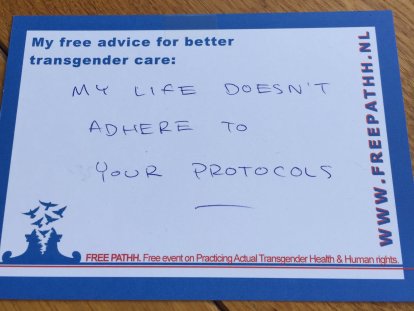
It was in this context that numerous interventions – both formal and informal – were organised by trans attendees at WPATH. GATE held sessions on depathologisation for trans and intersex people. FreePATHH created a range of notes with “free advice for better transgender care”, which were distributed in a social area for conference attendees to read. Someone gender-neutralised the (binary gendered) toilets with holographic signs. I also heard informally about South African trans women confronting a racist presenter on a panel.

ClTZLM9VEAASI-e.jpg large

In this way, the WPATH symposium felt like a sometimes discouraging, sometimes productive site for real debate and contestation, both professional and political. My impression was that the the interventions that took place there would probably have a gradual impact on how trans health is understand and practised in the years of come, particularly following the creation of TPATH, a group for trans people working in trans health.  What I didn’t realise was the extent to which events would accelerate in the coming months.


USPATH Conference 2017

In February the first USPATH (United States Professional Association for Transgender Health) conference took place in Los Angeles, USA. At this event, tensions over the place of pathologising forms of care in general – and Kenneth Zucker’s ideas and practices in particular – came to a head.

In a Twitter thread written during the event, health researcher Zoé Samudzi describes how a number of academics and health practitioners, led by trans women of colour, spoke out against the inclusion of Zucker on the conference programme. One session (the first of two at which Zucker was due to speak) was briefly interrupted by an impromptu speech and later quietly picketed, after which hotel security threatened to call the police on a number of attendees.

The next day, community representatives – again led by trans women of colour – met with USPATH and WPATH organisers to read a list of demands. In the wake of this intervention, Zucker’s second talk was cancelled, and a formal apology for the initial heavy-handed response to protesters was posted to the WPATH website. This post, which also promised action to better involve trans communities in general and trans people of colour in particular in the work of WPATH, was removed from the website just two weeks later.


EPATH Conference 2017

Today (6th April) the EPATH (European Professional Association for Transgender Health) conference will begin in Belgrade, Serbia. This event is likely to be a somewhat more conservative affair than the USPATH conference due to disciplinary differences between trans health practitioners in the US and Europe: however, like the WPATH symposium, the conference programme incorporates a wide range of perspectives.

There will once again be an associated FreePATHH event on Saturday 8th/Sunday 9th, which is being organised by Serbian trans activists in collaboration with some of the Dutch individuals behind last year’s FreePATHH. It will include free talks and panels on trans and intersex issues in the former Yugoslav region, as well as arts performances and a football match. At the EPATH conference itself, TPATH will have a presence, seeking to bring together trans people working in the field.

One point of potential contention at EPATH is a code of conduct which has been drawn up for the event. In many ways, this document reflects standard conference etiquette, through (for instance) condemning individual harassment of attendees. However, there are also a number of points that appear to have been written specifically in response to recent events.

We expect all conference participants to be respectful in person and online towards other delegates, speakers, organisers, staff and volunteers.

We are committed to providing a harassment-free conference and training experience for everyone, regardless of gender, gender identity and expression, sexual orientation, disability, physical appearance, body size, race, or religion.  Harassment of participants, speakers, staff or volunteers in any form will not be tolerated.

 Harassment includes offensive verbal comments, and other forms of using disrespectful and pathologising language inconsistent with human rights standards, deliberate intimidation, stalking, following, harassing, photography or recording without explicit consent, sustained disruption of talks or other events, inappropriate physical contact, and unwelcome sexual attention. Conference participants asked to stop any harassing behaviour are expected to comply immediately.

Upon reading the code of conduct, I was immediately reminded of accounts written by trans woman who have accused controversial practitioners of inappropriately photographing them at past events. This is particularly interesting given that he’s been confirmed to speak at the conference. The reference to “pathologising language” also appears to be a nod to some of the practices at previous conferences that have distressed trans attendees.

However, the question remains about what counts as “offensive verbal comments”, “sustained disruption of talks or events”, or “recording without consent”. If a similarly filmed disruptive event occurs at EPATH as took place at USPATH, it could conceivably be framed as “harassing behaviour” within the context of the of the code of conduct, leading to protesters being ejected from the event. This is concerning because the participation of controversial clinicians such as Zucker is typically defended on the grounds of enabling “free speech” within the context of the conference: however, on these grounds, we might expect that conference attendees wishing to peaceably protest or strongly critique bad science might also be afforded freedom of speech.

I won’t be attending EPATH myself this year; like the FreePATH attendees, I simply can’t afford the expensive conference fees. However, I will be following events with great interest, and encourage other non-attendees with a personal or professional interest in trans health and/or trans activism to do the same.

From blog to academic website

In February, I completely revamped this site, creating a new “look”, and adding information on my academic talks/publications etc.

I’d been about creating a “professional” website and blog for some time, particularly as I intend to move ahead with my academic career. I wanted to use this to the stuff academics are supposed to do, like painstakingly list The Things We’ve Done At, but also wanted a platform from which to share information, ideas, and the odd polemic.

At the same time, I already had a pretty well-established blog, with archives reaching back to 2009. I don’t necessarily still stand by everything I might have once said – both the world and my perspectives on it have changed quite substantially over the last few years – and with time I’d also been blogging less and less as my attentions turned to my PhD thesis. But I don’t want to lose that personal history or sense of continuity in my life and writing.

So rather than officially retire Trans Activist Takes On World (as this site was previously known), I’ve decided to incorporate the old into the new, keeping the blog’s archives as a part of my academic website. To be honest, I’m expecting to continue writing on trans health, trans activism, LGBT issues, feminism, UK politics and the odd bit of punk/metal music. I’m also going to incorporate updates on planned talks (and possibly gigs!), something I previously blogged about at Ruth’s Corner. And this isn’t the first time I’ve changed the title or my approach to the site – I originally wrote anonymously as Trans Youth Takes On World, and also briefly titled the site Writings of a Trans Activist.

cropped-trans-activist-banner

ye olde blog header

I’m still not expecting to write here anything like as often as I used to. The double irony of completing my PhD is that I’ve been writing pretty much constantly ever since, but have also had very little time to do any more creative or reflective pieces for this blog (or any other site). Instead, I’m focusing on two(!) books and a number of book chapters and academic articles, which should be realised gradually over the coming year-and-a-bit.

I’m planning to write some more about all of these as they reach completion. I’m also aiming to make as many of the journal articles as possible freely available, posting non-final versions on this site so people can read them.

So, I hope you’ll stick around for my new journey. As ever, I’m interested in changing the world for the better – academia happens to be my chosen medium at present.

Event: Trans Feminism talk at University of Wolverhampton (10 March)

Friday 10th March, 2017
City Campus, University of Wolverhampton
1.30pm in MD165

I will be talking about some of the key issues and debates in trans feminism as part of the University of Wolverhampton’s International Women’s Week programme, highlighting areas of commonality and difference between the political struggles of trans women and cis women. I will also explore both historical and contemporary disputes over the place of trans issues (including challenges faced by trans men and non-binary people) within a women’s movement.

(Free) registration for the event is available here.

Rest In Power: Deborah Lynn Steinberg

A week ago today I heard that Professor Deborah Lynn Steinberg had died. It was not unexpected – Deborah had been ill for a very long time. Nevertheless, the news hit me hard. Deborah was my PhD supervisor, and before that also supervised my MA dissertation. Together with our colleague Iggi Moon, we organised a seminar series between 2012 and 2014, and more recently have been collaborating on editing a special issue of Sexualities and an edited book.

Through these projects, Deborah has been a hugely important and inspirational figure in my life. I’ve written a piece about this for Discover Society, reflecting on her intellectual generosity and the complexity of her relationships with her students.

In the coming months I’ll be sharing details of the Sexualities special issue (entitled “Trans Genealogies”) and the book, for which we’ve been offered a contract by Routledge. I miss Deborah terribly and it feels very strange to be working on some of her posthumous publications, but I feel very honoured to be in this position. I hope we can do justice to the spirit of her insight and intellect.

deborah-lynn-steinberg-640x300