Video: (Mis)understanding Transgender Health

Regular readers (hi!) will have noticed that I’ve not been posting on this blog much at all over the past year or so. Between part-time jobs and my PhD thesis, I’ve been pretty busy – however, I’m nearing the end of thesis writing, so hopefully that might change in the near future. We’ll see!

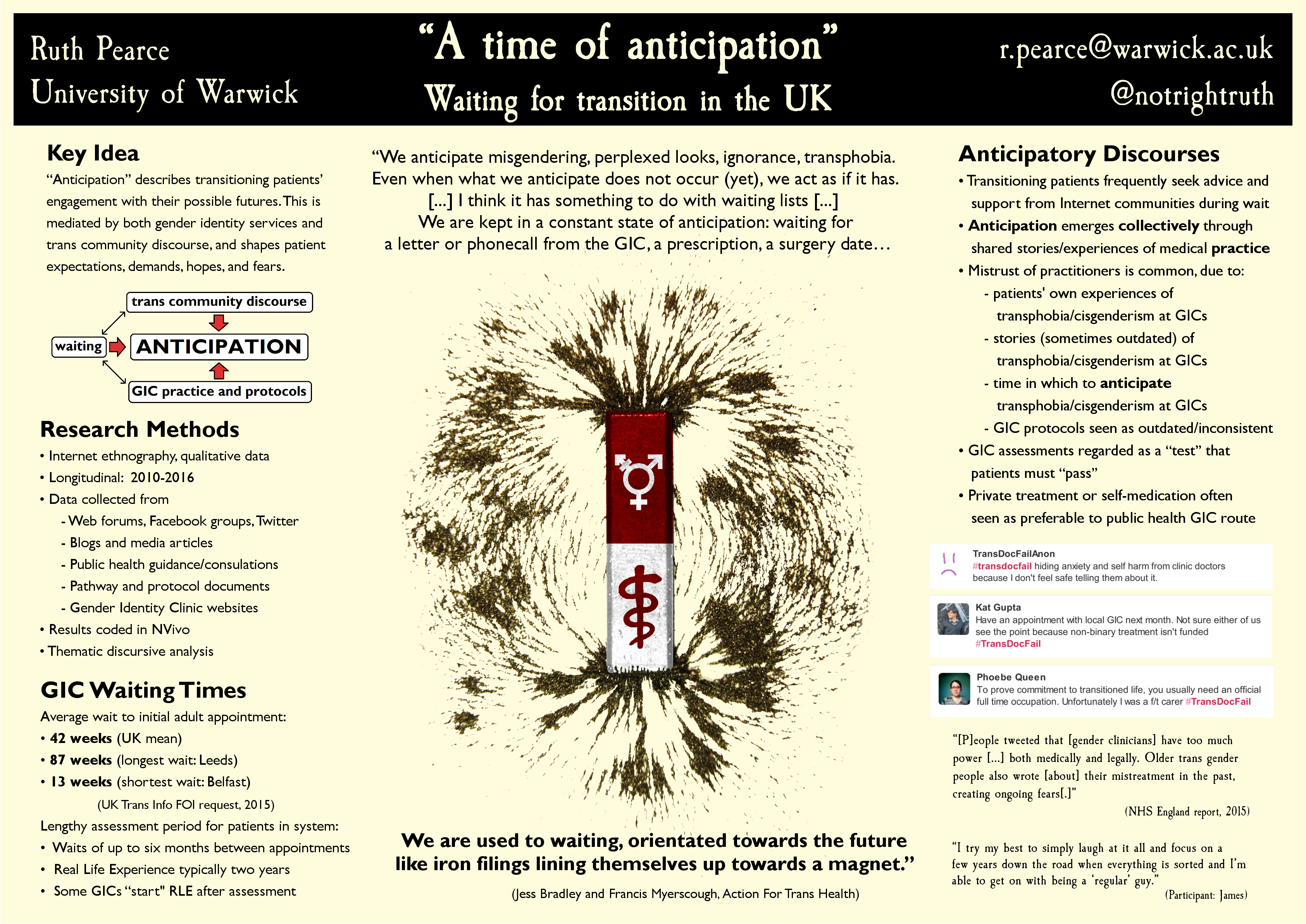
One thing I’m hoping to do after I hand in the thesis is to talk about my findings in the public domain as much as possible. So, here’s an initial step towards that – a video from the re:publica TEN conference on Internet and society, where I was invited to talk about trans health.

The talk was aimed at a very general audience, many of whom weren’t familiar with trans issues, so there’s an extensive introduction to some of the basics as well as a discussion of one small area of findings and some related studies.


Women and Gender Graduate Seminar Series: Call for Abstracts

Cross-posted due to my own involvement in the seminar series. It really is a lovely series of events. We welcome a wide variety of papers and absolutely anyone is welcome to attend: we tend to have everyone from professors, to undergraduates, to entirely non-academic types turning up.

Call for Abstracts

The Centre for the Study of Women and Gender at the University of Warwick will host a Graduate Seminar Series in the academic year 2012/2013. We would like to invite postgraduate students working in, but not limited to the following areas:

  • Media, Culture and Gender Representations
  • Work and Family
  • (Trans)national Gender
  • Intersections of Gender, ‘Race’, Class, Disability and Age
  • Gender, Transgender and Sexualities
  • Feminism and Women’s Rights
  • Men and Masculinities
  • Feminist Methodologies
  • New Media and Digital Technologies

We welcome submissions both conventional and innovative from any discipline on gender related topics. Seminars will take place on two or three Wednesdays per term in the afternoon (dates and timings TBC). Each presenter will be allocated 30 minutes: 20 minutes presentation and 10 minutes discussion. Attendance is open to everyone.

The seminar series aims to:

  • Foster discussions on topics of gender
  • Provide a safe and comfortable space for students to present their research
  • Create an opportunity to fine-tune presentation skills

Abstracts should be:

  • Maximum 200 words
  • Submitted along with a brief biography of the author; including their institution, department, and research interests
  • Submitted by Friday the 14th of September, 2012

Please email abstracts to cswgseminarseries@gmail.com. Abstracts will be peer reviewed. If successful, you will hear from us by Friday the 28th of September, 2012 and will be allocated to a seminar between October 2012 and June 2013.

If you have any further questions, please do email us.

Yours sincerely,

CSWG Organising Committee
cswgseminarseries@gmail.com

An observation on the growing importance of social media

I’m currently working on a document that explores the methodological approach I am planning for my research into trans experiences of (primary) health provision.

In the paragraph I’m currently working on, I note the increased importance of social media to activism within trans communities. I cite Trans Media Watch as an example, noting the popularity of their Facebook page and Twitter feed. I compare the number of people they can reach directly through social media (approximately 1000 “like” on Facebook, approximately 3500 “followers” on Twitter, acquired since the group was established in 2009) to the number of people on the mailing list Press For Change spent around a decade building (approximately 2000 members as of 2007, according to Engendered Penalties).

The point isn’t to praise Trans Media Watch for reaching a lot of people very quickly (although their impact in this respect has been very impressive!) and nor do I intend to critique Press For Change. Instead I note these figures to highlight how social media has helped transform the nature (and level of participation in) trans activism.

But then pace of change appears to be accelerating still. The figures I cite above for participation in Trans Media Watch were accurate a couple of weeks ago or so, when I last worked on this particular document (what can I say, it’s been a busy fortnight!) However, they’re now inaccurate: the group has gained around 100 Facebook “likes” and around 300 Facebook followers during this time.

No doubt the exposure Trans Media Watch have gained as a result of their participation in the Leveson Enquiry has contributed to this situation, but my first set of figures was taken some time after the group provided evidence. For all kinds of reasons Trans Media Watch is of increasing interest to an increasing number of people, and it’s social media that’s facilitating this.

I don’t really have any kind of real analysis to offer right now. I’d love to take a good look at what’s happening, but it’s sadly tangential to the general thrust of my own work. But gosh, isn’t this interesting?

Update on the HESA gender statistics affair

Some clarification, new information and new developments have emerged since I posted about HESA’s gender statistic fail yesterday.

Background

The Higher Education Statistics Agency (HESA) is currently revising a number of data collection fields. The changes are not yet set in stone. 

Two new fields (student.SEX and student.GENDERID) will effectively replace the one existing field (student.GENDER) which is currently used to collect data on gender within higher education institutes (usually universities) in the United Kingdom.

The existing student.GENDER field has the following categories*:

1 Male
2 Female
9 Indeterminate

In regards to “Indeterminate”, HESA note that:

“Code 9 ‘Indeterminate’ means unable to be classified as either male or female. It should not be used as a substitute or proxy for ‘Not known’. The term ‘indeterminate gender’ is intended to identify those who are ‘intersex’ and is not related in any way to trans-gender.”

However, in practice a number of institutions have effectively mapped answers such as “other” and “prefer not to say” onto this third category within enrolment/re-enrolment forms in order to provide non-binary, genderqueer, intersex and other students to effectively “opt out” of the gender binary.

The new, compulsory student.SEX field has the following categories:

1 Male
2 Female

The new, optional (for institutions) student.GENDERID field has the following categories:

01 Yes
02 No
98 Information refused

A brief analysis of the harm in these changes can be found in my previous post.

Developments

It appears that HESA have received a number of queries and complaints from trans people: it’s uplifting to see so impressive and rapid a response!

The agency initially responded by noting that the changes were the result of “consultation with [the] HE sector and ECU“. Commentators noted that this consultation seemed to at no point involved actual trans students.

However, in the last hour HESA have provided the following statement from their Twitter account:

“Thanks for queries re. sex and gender in next year’s HESA record. Your input will help us get this right.”

The tweet links to correspondence conducted between HESA and trans activist Emma Brownbill – if you have the time, it’s worth a read!

Some key points include the following:

“The phrase ‘legal’ sex is only currently used in the Staff Record. The intention in the Staff Record is to match the data requirements of HMRC, which for tax and pension purposes only accept Female or Male.

The final coding manual and guidance for the Student Record in 2012/13 has not been published. From your own and other queries about the provisional guidance and consultation documents it is clear that the terminology of ‘legal’ sex may not be appropriate for the Student Record.

Similarly the binary choice of Female or Male, originally intended to match the Staff Record, is now the subject of further discussion with regard to the Student Record.”

So let’s keep at this – we’re really getting somewhere!

Also, thanks to everyone who commented on the previous post, your contributions were greatly appreciated.

Edit: the story has now hit Pink News.


*The numbers (e.g. 1, 2, 9, 98) are used within statistical analyses.


Gender recognition under threat in UK universities

I read a very disturbing internal email this afternoon. I’m not going to quote the majority of it in order to preserve anonymity, but the central content is of concern to any current or future trans student in Higher Education.

Earlier this year, HESA [Higher Education Statistics Agency] confirmed a series of changes that they would be making to the HESA Student Record for the 2012/13 academic year, which would have an impact on some of the questions that students are asked during the application and enrolment process. A number of these changes relate to equality issues and the 2010 Equality Act and I thought it would be prudent for us to consult […]

The key changes of relevance are as follows:

(1) There is an existing field Student.GENDER which will from 2012/13 be replaced with Student.SEX. The new Student.SEX field will reflect ‘legal’ biological sex at birth and we have been advised that there will be only two valid entries for this field, either Male or Female.

(2) To complement the new Student.SEX field there will also be an additional field, Student.GENDERID, which is intended to reflect the student’s gender identity based on their own self-assessment. A response to this question, should we choose to ask it, would be optional for students. The ‘suggested question’ from the Equality Challenge Unit for eliciting this information is “Is your gender identity the same as the gender you were originally assigned at birth?” and it would be possible for students to respond with ‘Yes’, ‘No’, or ‘Information Refused’.

At my university, the current student.GENDER field allows students to identify as “female”, “male”, “other” or “prefer not to say” following intervention from trans activists and past Students’ Union welfare officers. This system, and any similarly progressive approach from other institutions, will be overturned by the new HESA guidelines.

My concerns are as follows:

1) What is “legal” sex? Is it:
(a) my birth sex? (in which case I’m male)
(b) what’s on my passport? (in which case I’m female)
(c) whether or not I have a gender recognition certificate? (in
which case I’m male)

[edit: a skim of the HESA guidelines shows that (a) is not the case, with the university apparently using the phrase “sex at birth” in error]

2) If (a) or (c), then the University is going to revert my “sex” on its forms. This will disclose I am trans to anyone using their records.


3) If (b), then anyone wishing to update their gender will have to out themselves by walking into the university administrative building and presenting their passport.
I had to do this in 2005 and it caused all kinds of weird issues with the Students’ Union and my records. We changed the system in two stages (the last one is referred to in the letter) in order to prevent this from happening to anyone else.

4) The new system erases intersex people.

5) The new system erases people with a non-binary identity.

6) This whole approach has an extremely flawed methodology that will only invalidate the desired data!

I suspect my university doesn’t have much of a choice about how this is carried about, and neither will others. We urgently need to lobby HESA to reverse their policy on this.

I’ll aim to write a more coherent analysis of the situation (inc. the complex role of the Gender Recognition Act) when I’m feeling more coherent.

EDIT: HESA notes changes to the student.GENDER field here. Information on the new (binary) gender identity code can be found here.

There is never enough research

This morning I’ve found myself reading a new Equalities and Human Rights Commission (EHRC) research review about “identity-based” bullying in schools (as you do!) The report summarises statistics and qualitative data from research into racist, sexist, disabilist, homophobic and transphobic bullying in British schools. Yep, you read that right: the “T” word is very much in there. I suppose all that hot air from government departments and quangos about “equality strands” has to be good for something.

To my dismay, the section on transphobic bullying was tiny. Not because the EHRC didn’t put any effort into it – I’m pretty certain they were giving it their best shot – but because there was so little for them to write about. My heart sank when I came across that that classic phrase…

“there is little existing literature”

As in:

“Transphobia is an understudied area and there are very few UK-based studies which have explored this, especially in relation to transgender young people”

…and:

“In terms of preventing and responding to transphobic bullying, there is little existing literature highlighting particular issues for transphobic individuals”

…meaning that:

further research is needed to help identify young people who may be most at risk of experiencing transphobic bullying and the specific support needs they may have.

This is how it always goes. It doesn’t matter if the research is about bullying in school, access to health care, access to employment and/or benefits, experiences in the street or in the home: it almost always boils down to “further research is needed”. This is the case in pretty much any field (how else would academics gain gainful employment, after all?) but so much more the case with particularly marginalised groups, including travellers and asylum seekers as well as trans people.

There are a few utterly fantastic pieces of research out there dealing with trans experiences of discrimination and harassment, but in the broad scheme of things there’s very little for activists and public sector bodies to draw upon when trying to get a realist picture of what’s going on.

The thing is, there’s very few people doing trans research, and even less people prepared to fund it. With government-backed research councils being massively scaled down because of the cuts, this is only going to get worse. This is pretty disastrous if you’re trying to get public bodies to tackle transphobia, and even more disastrous if you’re trying to get the government to pass trans-friendly legislation. For instance, the Labour government refused to budge on the exclusion of non-binary gender identities from the Equality Act because there was “no evidence” of such people even existing.

Research reviews are all very well and good, but we’re being told over and over again that there isn’t much to say about transphobia: not because it doesn’t happen, but because not enough people have looked at it. It’s time for organisations such as the EHRC and NHS to put their money where their mouth is and actually back some thoughtful, in-depth trans research projects.