Returning home for Bath Pride

This year saw the city of Bath’s first ever Pride march. It felt long overdue, but also an unthinkable impossibility come to life.

Photo of Bath Pride march


I was born and grew up in Bath, before moving to Coventry for university. While some of my friends were eager to leave Bath for more exciting places, I loved the city deeply – and still do.

I was very ambivalent about moving. Growing up on the outskirts, I felt deeply connected to the landscape: the hills, the woods, the little hidden valleys and streams. Meanwhile, Bath’s deep human history felt ever-present as I dodged tourists in the Georgian streets, sauntered past the Roman Baths, and climbed past Iron Age fortifications on Solsbury Hill. As a teenager, I went to grunge gigs in listed buildings, and wandered down country lanes to parties in distant farm fields.

I have written a few times recently about some of my experiences as a young queer person in Bath. These were the last days of Section 28. My school was a hotbed of homophobia, and I lived in a void of information. In many ways, I felt so incredibly, utterly isolated. At the same time, I received invaluable support at a very vulnerable time in my life: from friends who had my back unconditionally as I came out as trans and bisexual, from teachers who found quiet ways to support me, and from Off The Record‘s free counselling service for young people,. Bath is home to small-town conservative values but also has a strong liberal streak, and this complexity really was reflected in my experiences.

I didn’t really know what Pride was, what Pride was for until years after I left my childhood home. It wasn’t until I was a young adult that I really gained an understanding of queer community, of the healing power of both protest and celebration, and of the sheer joy of mass togetherness. That wasn’t ever something that felt conceivable for me in Bath, let alone possible.

But of course, as I grew older and changed, so did Bath.
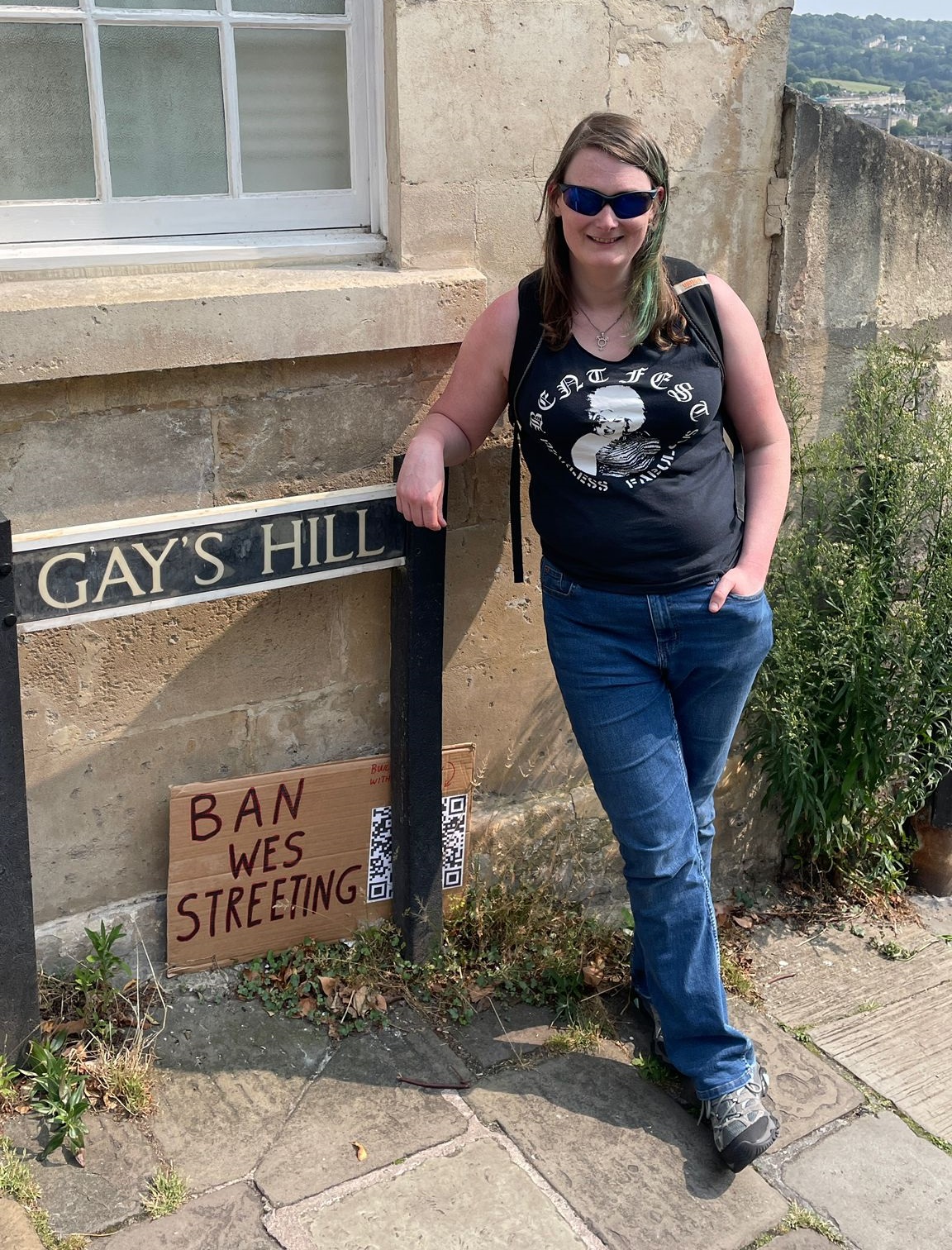
Photo of Ruth posing with a street sign for Gay's Hill, and a placard reading Ban Wes Streeting.


Just like every other part of the UK, more and more young people in Bath came out as lesbian, gay, bi, trans, queer, and/or asexual. Off The Record started up a dedicated LGBTQ+ youth group. In the mid-2010s, Bath had first a gay mayor and later a gay MP. From 2015, students at Bath Spa University organised their own Pride events, and in 2016, Bath Amnesty marked Pride month with a stall. In 2017, a Pride procession block joined the Bath Carnival.

I was nevertheless pretty surprised to see the first major, dedicated Bath Pride celebrations planned for this summer, on Sunday 18 August. For this to happen, you needed a critical mass of dedicated organisers, volunteers, and community members prepared to come together and make it happen. You needed enough people prepared to assemble and loudly celebrate and protest at a time of rising hatred and violence towards us. You needed to take all of this and put it on the streets of city known for its architecture, parks, and landscape, rather than any kind of political organising or protest culture.

So I returned home, to be a part of it.

Photo of four happy people at Pride.


Bath Pride was gentle, Bath Pride was beautiful, and Bath Pride was powerful. Bath Pride was a family picnic in the grounds of the Holburne Museum, a club night at Komedia, and a thousand people marching through the streets to demand our liberation.

Bath Pride was about community. I have so much respect for how much the organisers centred this in everything they did. There were no corporate floats, no major brands, no prioritising of some queer people over others. Most of the people in the march were just ordinary individuals, out solo or with their partners or friends. There was also a significant presence from groups including a local church, the city’s roller derby league, and the LGBTQ+ staff group from the Royal United Hospital. My mum volunteered as a steward.

Bath Pride was radical. It had never been done like this before, and it was done so well. While the overwhelming vibe was one of joy and celebration, this was very much a protest. Home-made placards abounded. NHS staff pointedly wore pro-trans t-shirts. A tall person with a stylish mustache wearing a cowboy hat, open pink cropped jacket and pink shorts waved a Palestinian flag in solidarity with the people of Gaza. This Pride was very Bath, but it was also about moving beyond tolerance, arguing for real liberation in a way that challenged the city’s cosy liberal consensus.

On some streets, people stood and waved or even joined in, with the march swelling as it went. On others, especially in busy shopping areas, I was reminded of the tension and threat inherent in Trans Pride, with confused or hostile looks directed our way. We were challenging people: with loud disco music, with political slogans, with our insistent presence. In the context of Bath’s politely commercial street culture, even thoroughly overbaked chants such as “trans rights are human rights” took on a new resonance. At a time when the NHS, schools, and new Labour government are actively attacking young trans people’s basic access to healthcare, education, and any level of personal autonomy, this kind of visibility couldn’t be more important.


After the march, my partner and I wandered the Holburne grounds. We admired stalls for local queer crafts, as well as community groups such as Bath Welcomes Refugees, The Diversity Trust, B&NES Fostering, and… Off The Record. I took the time to thank the people on this stall for the support I received from their organisation 20 years ago, and learned about what they are doing to support young people today.

And then we left the city centre – walking up Gay’s Hill, before taking time for a drink and apple pie at the Fairfield Arms. The pub, which has been run by a gay couple for many years now, was full of local people enjoying a Sunday roast or just hanging out in the pub garden. We had a chat with one of the landlords, who said he was a bit sad to miss the Pride event, but the weekend was always a busy time for them.

Queer lives are weaved through the very fabric of the city of Bath. We are always and have always been everywhere, quietly getting on with our day to day. But we also deserve love, recognition, community, and visibility on our own terms. That’s why Pride is so important.


Information on supporting or donating to Bath Pride, to ensure independent, and community-centred future events, can be found here.

Remembering Lynn Conway

Lynn Conway in 2006. Photo by Charles Rogers.

I was sad to hear last week of Lynn Conway’s passing, at the age of 86. Equally, I’m extremely glad she got to live such a long and impactful life. She was an important pioneer in the field of computer science, where her innovations contributed to the development of the microchips we use in so much of our technology. She also played a vital role in promoting women’s careers in STEM, and in providing information for trans people at the turn of the century.

During the early 2000s, Conway uploaded a substantial amount of information about trans lives and transition to her personal website. This material was hugely important to a great number of people, while also reproducing certain forms of transnormativity and stereotypical notions of “success”.

For example, while there was some diversity among the women listed on her pages of “transsexual women’s successes“, most are white, cis-passing, and occupied middle-class professions.

I came across Conway’s site around the time I was coming out to myself as a teenage trans girl. Having grown up in a void of information about trans people’s lives, her website both created a sense of possibility, and made transition seem more fantastical and distant.

Nevertheless, I’ll always remain grateful for what Conway did for trans people, as well as so many others. The resources she put online, for free, were created with love, care, and hope for the future. That’s an example I am committed to following through my own life.

My speech on the Cass Review and Scotland’s trans healthcare ban (with footnotes!)

This post shares a video and transcript of my speech at the emergency demonstration in George Square, Glasgow, on 18 April 2024, against the decision from NHS Greater Glasgow and Clyde to ban endocrine treatments for trans people aged under 18. The speech was unplanned and made without notes, so I have made some small corrections in the transcript, plus minor amendments for clarity. I have also added references for some key points. Thank you to @transprotestglasgow for the video.

Readers seeking more detailed evidence and academic critiques may find my previous blog post helpful: What’s wrong with the Cass Review?

TRANSCRIPT

Hi, I’m Ruth Pearce.

I’m a Lecturer in Community Development at the University of Glasgow, and I’m a researcher on trans healthcare.

And I was a trans child.

I want to talk about that for a moment. Because I came out to myself circa 2001, when I was 15, when not many people did that. And it was hard for us. And there was trans community, and there was information, but it was very difficult because we felt very, very alone. I was mostly only able to connect with other trans people my age through the internet, through blogs, and they were mostly Americans. The Brits were there; a lot of us connected later as we grew older. But we were so isolated.

A really important thing to remember, in a moment like this where we are seeing a return to the kind of medical policies that were in place when I was a kid: there are so many more of us, and we are so much more powerful than we have ever been.1 Never forget that strength we have together.

One of the things Hilary Cass says in her report is that the meaning of the word “trans” has changed since 2020.2 She says, and there is no evidence for this, that “trans” in 2020 meant something quite rigid and specific, and only now in 2024 it’s become an umbrella term for lots of identities. Tell that to me coming out as a trans teenager in 2001!

So here’s the thing. We’ve always been here, and we are more powerful now, but we are seeing this backlash. That’s been a long time coming and transphobia changes its face over time. One of the things I wanted to do to deal with my loneliness and the experiences I had was that I wanted to become an activist. And when I started doing activism, when I got into meetings with people in government, and with the Equality and Human Rights Commission, they said “there’s no evidence” for the discrimination we faced. So I was like, “fine: let’s see what evidence I can find”.

So I did a PhD in trans healthcare.3 And I found what you often find when you do research; you often find things you don’t expect. So I did find some things I expected to find. About waiting lists and how hard they are. About how hard appointments can be when you’re meeting with sexist and transphobic clinicians who are asking you, as a young person, how you masturbate and who you’re attracted to. But what I didn’t expect was the sheer level of pain from the waiting. And I talk about that in my work. And the anticipation, where we are anticipating all the time. When is it going to happen? When are we going to get to live our lives? And that happens on every level of our lives.

I was also shocked by the level, and detail, and complexity of the ignorance of healthcare practitioners. It ranges: it’s not just that they all hate us, right? It’s that some people are trying to control us, some people want to help but don’t understand how, and some people don’t want to know. There’s different kinds of ignorance.4

So I published my work, and other people have followed. Other people were there before me of course, because “trans” was not new, and trans research wasn’t new either. There is now a lot of published research on what it is like to go through a gender clinic, and what it is like for a young person to go through a gender clinic. There’s people like Cal Horton5 and Natacha Kennedy6 who are writing on this, and Harvey Humphrey7 who works here in Glasgow. There’s a lot of people doing work on this.

We are saying, time and time again, “we need services that meet our needs”. For some people, that is access to puberty blockers, and that is access to hormones. For other people, that is access to counselling, and therapy, and community support. What we call “trans-affirmative” or “gender-affirmative” care is flexibility, meeting a person where they are at, and based on what they want to do with their lives.8 You don’t have to change your body – but you can.

It’s our body, it’s our right: we can do what we want with our own bodies.

This is what is disgusting about the decision by NHS Greater Glasgow and Clyde. They have not addressed the years and years of mistreatment and abuse in their child and adolescent clinic at Sandyford. It is not a great place that we are trying to save. It is a clinic that has repeatedly refused to treat young people, and made people hold on for care. It has helped a handful of people. Dozens of people – only dozens – have accessed treatment in the last few years.9 Now they are proposing to stop doing the very little they are doing to support young trans people.

People who get a referral to a child and adolescent gender clinic are not necessarily seeking access to counselling and therapy, because you can get that elsewhere.10 They are not seeking access to community, because you will find no community at Sandyford. They are most likely seeking access to endocrine treatments: puberty blockers and hormone therapy. And that’s what they are going to stop doing.

Sandyford say they are still accepting new referrals. But what is the point of a gender clinic that does not offer people medical treatment?

NHS Greater Glasgow and Clyde have based their decision on the final report of the Cass Review. Let’s talk a bit about the Cass Review.

I’m an academic researcher. If the Cass Review was submitted by an undergraduate student, the first thing I would say is: “That’s nearly 400 pages long! No-one’s going to have time to mark that”.11 And you’ll notice that all the people in the media, all the Labour politicians, all the Tory politicians, all the people saying we should immediately implement the findings of the report: none of them read nearly 400 pages in one day. Neither did the journalists at the BBC, the Telegraph, the Times, the Daily Mail, the Observer, the Independent. We expect better! And now the Scottish media: it’s all over the Scotsman, the National, the Herald. None of them have bothered to read the report, or think about it critically.

So here’s a bit of information about the Cass Review. The Cass Review was undertaken by a group of people who, from the very start, excluded trans people from oversight of the project. That was in their terms of reference.12 They didn’t want people who had experienced services having a formal part in the report. They excluded healthcare experts. If you were someone who had worked in a gender clinic you were excluded from being part of that.13 You know, I have lots of disagreements with many people who work in gender clinics, but you would have thought they might get a say.

You can see that ignorance, that intentional ignorance, playing out in the final report of the Cass Review. You can see, if you read the Cass report, that they looked at over 100 studies, most of which show that puberty blockers and hormone therapy can help young trans people. And they just ignored them.14 Intentionally. They say that the majority were not “high quality evidence”.15

What else is not high-quality evidence in healthcare? Paracetamol for back pain.16 There is no high quality evidence for that, in the terms of the Cass Review. Anti-psychotics.17 ADHD medication.18 All these medications that are in regular use. You know what else? Puberty blockers for young people with precocious puberty – if they’re cis.19 That is direct discrimination. 20

The thing is, that’s the Cass Review being serious. Let’s think about when it gets weird.

There’s a graph in there, where they show referrals to a gender clinic (the Gender Identity and Development Service in England) rising year on year, with “an exponential rise in 2014”. But they cut the graph off at 2017. But if you look at 2017-2020 the referral rate flattens off. It’s deliberate removal of evidence.21

We know why this is happening. Experts – medical experts, and experts by experience have been cut out of the Cass Review process. If you are trans, that’s you. You are an expert by experience. You know what it’s like. We have been cut out the process!

And the NHS have done that here in Scotland. There was no consultation on the ban that’s come in.

Who did they consult? We know there are people who are proponents of conversion therapy who were on the Cass Review team.22 That is what they are proposing.

They are proposing conversion therapy. Not just for trans kids, because they want to deal with all gender-questioning and non-conforming kids. This is going to be conversion therapy for queer kids. Little boys who want to wear a dress, they might not be trans, but they deserve to have the space to explore. That is not going to be what happens in clinics where people are referred which are being informed by conversion therapists.23

So consequently you have other weird stuff in the Cass Review. They’re dismissing all the evidence about why puberty blockers and hormones can benefit people within particular contexts, but they’re relying on other evidence for their recommendations. Let me give you one citation. “Thoughts on Things and Stuff, 2023”. That is a citation from the Cass Review: Thoughts on Things and Stuff.24

What is “Thoughts on Things and Stuff”? It’s a right-wing Youtube channel run by anti-trans bigots,25 featuring contributors such as “Gays Against Groomers”.26 This is the level of evidence that is informing NHS Greater Glasgow and Clyde.

And I’ll tell you what else is in the Cass report. They say that little girls are likely biologically inclined to play with dolls. It’s right in there, in the Cass report.27 And little boys are probably biologically inclined to play with trucks. Why is this? It’s not just an anti-trans agenda. It’s an anti-feminist agenda. Its an anti-woman agenda.

Why is this happening? It’s happening because trans people are an easy target.

If you want to stop young people accessing contraception as teenagers, you remove trans people’s right to consent to care as young people. If you want to prevent young people – teenage girls – from having abortions, and you’re failing time and time again in the courts, you instead target puberty blockers, because that way you can set a precedent for preventing people from being able to make decisions as young people. You are undermining the idea that young people might have the capacity to consent to care and make an informed decision about their own bodies.28

So I will end on this. I’m a woman, I’m a trans person, and I think it’s really important we think about allies. I had the parent of a trans child contact me and say, “thank you for being an ally”. I want to think her for being an ally. The thing about allies is, we talk a lot about an “ally” being someone who supports somebody else. But no: allies are people who stand by each other and work together.

That’s why we need a trans feminist movement. A trans feminist movements gives people autonomy over their own bodies, space to make their own decisions, and enables people to stand together when we are all at risk.

So I’ll leave you with a chant I want to hear more of at protests:

“Trans rights, women’s rights: one struggle, one fight”.

FOOTNOTES

  1. My statement here is intended to highlight that more people are out as trans than ever before. Contrary to narratives of “social contagion”, there have always been people with gender diverse or sex nonconforming experiences. What has changed is that there is greater access to information and community, which makes it easier for people to come out. ↩︎
  2. “During the lifetime of the Review, the term trans has moved from being a quite narrow definition to being applied as an umbrella term to a broader spectrum of gender diversity. This clearly has implications for conceptualisations of detransition” (Cass et al., 2024, p.187). This claim is demonstrably false, as “trans” (and before that, “transgender”) has been used as an umbrella term for decades. This is shown in my own previous work as well as writing dating back to at least the 1980s by individuals such as Leslie Feinberg. ↩︎
  3. https://wrap.warwick.ac.uk/88285/ ↩︎
  4. For an excellent, more recent and more detailed analysis on this topic in the context of trans youth healthcare, see Magdalena Mikulak’s (2021) article “For whom is ignorance bliss? Ignorance, its functions and transformative potential in trans health“. ↩︎
  5. https://growinguptransgender.com/evidence/ ↩︎
  6. https://www.gold.ac.uk/educational-studies/staff/kennedy-natasha/ ↩︎
  7. https://www.gla.ac.uk/schools/socialpolitical/staff/harveyhumphrey/ ↩︎
  8. “Our stance, as gender-affirming practitioners, is that children should be helped to live as they are most comfortable. For a gender-nonconforming child, determining what is most comfortable is often a fluid process, and can modify over time. Therefore, in a gender affirmative model, gender identity and expression are enabled to unfold over time, as a child matures, acknowledging and allowing for fluidity and change” (Hidalgo et al., 2013). ↩︎
  9. “Since 2018, around 1.77% of young people who are referred to the gender care services at Sandyford have gone on to be prescribed puberty blockers”: https://www.thenational.scot/news/24262271.many-young-people-scotland-given-puberty-blockers/. ↩︎
  10. Although in practice, trans people are often also turned away from mental health services due to “trans broken arm syndrome“. ↩︎
  11. In my original speech, I inaccurately stated that the report was “500 pages long”. However, my point about requiring time to carefully consider its contents remains. ↩︎
  12. “The original published Terms of Reference (ToR) for the Cass Review’s assurance group explicitly excluded trans expertise, stating that it “deliberately does not contain subject matter experts or people with lived experience of gender services” [Report 1, version 1]. The current (updated) assurance group ToR is worded less clearly, yet still conveys exclusion of those with expertise or lived experience, as such individuals would naturally be expected to have an interest in the outcome of the review” (Horton, 2024: p.7) ↩︎
  13. One former gender clinician was involved in the research process: Tilly Langton, formely of England’s Gender Identity Development Service (GIDS). Langton’s recent activities include promoting conversion therapy materials in training for NHS psychiatrists and lobbying Kemi Badenoch about the UK government’s conversion therapy ban, alongside proponents of conversion practices. ↩︎
  14. Hilary Cass has contested this claim in reporting for the BBC. Her argument is that of the 103 studies analysed for the review, 60% were included in the synthesis of evidence. However, my argument here is specifically that the findings of these papers were broadly ignored in the writing of the report’s recommendations, while less robust material was instead prioritised. As Simon Whitten argues, “The majority of moderate certainty studies were included in the results section but then arbitrarily ignored in the conclusion entirely”. ↩︎
  15. I have removed a statement I made about randomised control trials from the transcript here as my point was unclear and therefore potentially misleading (as can happen when you do an unplanned speech on a complex topic!) Unlike the Cass Review team, I am keen to correct my errors. See the links in the above footnotes above for more detailed information on inclusion/exclusion criteria for the Cass Review. ↩︎
  16. See e.g. https://www.nps.org.au/news/is-paracetamol-effective-for-low-back-pain. ↩︎
  17. The landscape of evidence anti-psychotics is a complex one. There is “high-quality” evidence that anti-psychotic drugs work better than placebos in addressing various conditions, but the evidence for use of multiple drugs, reducing or increasing doses at particular junctures in treatment, or taking one drug rather than another in treating specific conditions is often of a similar (or lower) quality than the evidence for benefits of endocrine interventions assessed by the Cass Review (see e.g. https://www.sciencedirect.com/science/article/pii/S0890856716319992). ↩︎
  18. Specifically in the long-term, see e.g.: https://www.nationalelfservice.net/mental-health/adhd/adhd-medications-effective-safe/. ↩︎
  19. https://onlinelibrary.wiley.com/doi/10.1111/cen.14410 ↩︎
  20. At this point, somebody stuck their hand up in the audience. I responded: “Someone stuck their hand up and might give me a footnote on that! I totally approve of that. I might invite you up later because I like evidence and I’m obsessed with it. [person indicates they were just waving to their friend, crowd laughs] Oh that’s grand! There we go, we haven’t even had a footnote.” Well, here is the footnote. ↩︎
  21. p.24 of the Cass Review final report. The rationale for this within the report is that the figure is adapted from a 2018 paper published in Archives of Sexual Behaviour. However, as Trans Actual observe: “The number of referrals to GIDS is known until 2020/21 […] the last 3 years for which data is available, shows that the number of referrals has recently plateaued. Such data is inconvenient for a narrative that relies on an inexplicable explosion in need[.]” ↩︎
  22. https://transsafety.network/posts/gender-exploratory-nhs-training/ ↩︎
  23. A historical example of treatment that “tries to make the child comfortable with the sex he or she was born with” within a gender clinic context can be found here: https://www.npr.org/2008/05/07/90247842/two-families-grapple-with-sons-gender-preferences. ↩︎
  24. p.70, used to evidence the activities of GIDS’ research team at a WPATH conference. They could have instead cited the conference website. ↩︎
  25. A good summary of the channel can be found in this piece by What The Trans: “When citing a recording from the WPATH 2016 conference, Cass uses a YouTube channel called Thoughts on Things and Stuff. This appears to be the associated channel of a now-defunct blog largely focussed on criticising the Mormon Church. Why this was relevant to Cass is unclear, although titles of recent uploads at the time of the WPATH video include “Dr. Stephen Levine: 13 Untruths Behind Gender Affirmative Therapies for Kids” (Levine is an advisor to Genspect) and “Gays Against Groomers: stop the indoctrination and medicalization of children. 2023 Florida testimony.”, which perhaps provides a clue to how Hilary Cass ended up citing a channel with only 22.4K subscribers. It thus seems that, in addition to being advised by and networked with a variety of prominent anti-trans figures and organisations, Hilary Cass appears to be getting her professional news from homophobic and transphobic YouTube channels.”  ↩︎
  26. Anti-gay campaigners have long attempted to position LGBTIQ+ people as a danger to children. In recent years this tactic has seen a resurgence, through positioning trans and queer campaigners as “groomers”. GLAAD have described Gays Against Groomers as a group who intentionally use “ambiguous messaging about characterizing LGBTQ+ people as pedophiles falsely and maliciously with the absolutely clear intent of driving fear.” ↩︎
  27. pp.100-101 ↩︎
  28. https://transsafety.network/posts/bell-v-tavistock/ ↩︎

In memory of Ellinore Wilson

i.

I discovered recently that my friend Elli had passed away. She was just a few years older than me. I believe she lived a difficult life, but was always true to herself, and was good and kind to others. And meeting her as a teenager changed my world.

I first encountered Elli during the long, messy process of coming out to myself. We were both members of a small online community, created by a young trans person for other young trans people. There were a few of us there in our mid-late teens and early 20s, most of us struggling to imagine what it would be like to live authentically. There were a small handful of “allies” (at least two of whom would later coming out as trans and/or genderqueer themselves). And there were a couple of people who had already transitioned, including Elli.

I don’t think there is a word for people like Elli in the straight world, which can make it hard to express how important she was, even to myself. She was my not-very-much-older Elder. She was my possibility model. She helped to crack my egg. She was a nexus of social contagion, a superspreader in the psychic epidemic, a key trigger for my rapid onset.

Elli was a friendly, patient, community-minded person who showed up for others. She showed us that it was possible to be true to ourselves, to build a life on another side of the sex divide. She was honest and realistic about how difficult things could be, and full of constant reminders that there was, is, and will always be more to life than being queer. She loved ferrets and cats and anime, especially Naruto, because she was a massive nerd.

Elli wasn’t famous or well known. She wasn’t involved in any significant moment of history. She had small friendship circles online and offline. This, though, is how we build queer and trans community: through countless acts of care and mutual aid, rather than grand gestures.

ii.

I found out Elli had died through a mutual friend from the same old community. She had found out through Facebook – she went to look at Elli’s profile, and realised Elli had died months before.

I was horrified. I had spoken with Elli regularly while she was severely ill with covid, reaching out to tell her how much I cared about her, and share numerous pictures of my cat. We hadn’t spoken that regularly for the last decade, but it felt like every now and then we would touch base and check in on one another. I don’t use Facebook very often these days, but it can be a good way to find where long-term, long-distance friends like Elli are doing. After a lot of hardship, I’d been really excited to find out she had a new job where she felt happy and fulfilled, and a new apartment which she made into a real home. And when got sick, I decided to message her until she recovered.

Except. After she started getting better, after she got home from the hospital, I stopped messaging. I was busy and distracted, getting ready to start my new job at Glasgow. I’m aware that I’m a possibility model myself, now, and there’s a lot that comes with that. I regularly receive messages from people who say I helped then to come out, to be themselves, through being a visibly trans woman, and visibly “successful” in my chosen fields of work and activism. I am perpetually busy, and tired, and distracted.

I saw the occasional Facebook update from Elli suggesting a gradual recovery. And so, like before, I dropped contact, assuming that we’d chat again in a few weeks or months.

And of course, the algorithm never told me that she was no longer with us.

I’m not sure if there is a clear moral to all of this. I am trying not to blame myself – how could I know? And Facebook was the very medium by which we remained in touch long after our original community was no longer active.

These days I feel pulled in all directions by friends from different times and places, people I once knew well, people I wish I was better at staying in touch with, people who assume some kind of parasocial relationship with me on the basis of my public profile. Social media feels like the only reasonable way to stay on top of it all. Yet I regret relying on social media – and especially the exceptionally unreliable medium of the feed – to keep up with Elli. I could have just…messaged her, or checked how she was doing.

iii.

It feels like there are two stories here. But perhaps they are the same story.

My experiences of trans community life are pierced through with chance and tragedy: life-changing encounters, terrible losses, and the all-encompassing importance of the Internet. Elli is far, far from the first trans friend of mine to die young. I also know she won’t be the last. When you live in a community where healthcare and socio-economic inequalities are endemic, you are always surrounded by people who are very ill. That’s an inevitable consequence of the forces stacked against us. The least we can do for one another is to collectively find joy and meaning in the life we have, using whatever tools we have at our disposal.

I want to live up to Elli’s memory, and to everything that she gave me. I hope I can be a better friend to others, but also forgive myself for being just one person, in one place, with a limited amount of time available to me. And while I’m at it, you’d better believe I’m going to keep cracking eggs.

Photograph of four hen's eggs sitting in a straw nest.

How it feels to be a trans feminist academic in 2018

Trans feminist symbol, designed by Helen GThis piece is based on an email I wrote, in response to a message about “smear campaigns against gender critical academics” on a feminist academic mailing list.

I have updated and posted it here in the final day of the Gender Recognition Act consultation in order to give my cis readers some idea of how the past few months – and especially the last few weeks – have felt.

~

I would like to say something about how it feels to be a trans feminist academic right now, with the emergence of a growing number of “gender critical” voices in academia.

In the wake of Brexit and Trump, and with the renewed growth of far-right movements across the world, it seems that everyone feels empowered to speak out about their own personal prejudice. Trans issues are no exception.

When I first came out and transitioned as a teenager, almost two decades ago, one of the scariest things for me was using public toilets. Let that sink in for a moment. I was scared simply to use the toilet – for fear that people might shout at me, drag me out, maybe even beat me up. While that fear has dissipated for me, I have not been to a public swimming pool since my mid-teens, and have not even been swimming in the sea since my early 20s. This is because I am scared. I am scared of violent men, but I am also scared of violent women. Cis violence against trans people is a reality. I have an enormous amount of admiration and respect for trans people who are able to overcome this fear.

It was hard to come out in the early 2000s. There was an enormous amount of casual transphobia in the media. Guardian columnists wrote pieces such as “Gender Benders Beware”, TV programmes such as Little Britain and the League of Gentlemen were immensely popular, and 90s films such as Silence of the Lambs and Ace Ventura remained popular with my friends. Trans women were variously represented as a pathetic joke, as burly men in self-denial, deceptive liars or outright sexual predators.

Legislation such as the Gender Recognition Act 2004 and Equality Act 2010 was yet to see the right of day. It was therefore legal for employers and service providers to know all about my gender history; it was also legal to refuse to hire me because I was trans, fire me from a job because I was trans, deny me services and kick me out of shops, pubs, post offices, leisure centres (etc etc) because I was trans.

It was not easy to come out in this environment. There were exceptionally few openly trans people involved in public life – and none of them looked, sounded or acted much like me. I certainly hadn’t knowingly met any other trans people. I delayed coming out for years because I wasn’t sure if I was “really trans” (a phenomenon common among participants in my research). I thought that I might ruin my life. It was only the knowledge that my life would likely be ruined regardless, and the sheer awfulness of the alternative – becoming a man – that persuaded me to take the enormous step of coming out.

Consequently, I was very isolated during the first few years of my transition. I find it very hard to express how intensely lonely that experience was. Fortunately, my friends (mostly cis girls my own age) were immensely supportive, but it was difficult not to have any people with similar experiences to talk with. People with a very deep, complex relationship with our gendered movement through the social world, and/or our sexed bodies, such that we knew the assignation we received at birth was not right for us. People who felt a deep, deep relief upon transitioning socially and/or changing our bodies as appropriate.

It wasn’t until my 20s that I began to slowly, gradually meet trans people my own age – and what a relief that was! We could relax completely around one another, talk about our issues and experiences, reflect on our differences as well as our similarities. It was at this time that I encountered the term “trans bladder” – used to refer to the pain and urinary infections that could follow from not being able to use toilets outside of the home. Let that sink in.

I also began to realise the wider extent of the damage caused to other trans people by both external and internalised transphobia.

Many of my trans friends have attempted suicide, sometimes on multiple occasions. The first trans person I knew to take their own life was a member of a trans youth Internet message board I frequented when I was 16. Others would follow, including a housemate, whose body I discovered shortly before I was due to head into work to teach a class. When I see “gender critical” people disputing well-established trans suicide statistics, it feels like gaslighting. I know what happens in our communities when people are not affirmed and don’t have access to adequate support.

Other trans friends have experienced severe sexual violence, often in their youth, often in very public spaces such as school playgrounds. Trans people are at particular risk of various forms of sexual assault, violence, coercion and control – for example, 28% of trans respondents to a large Stonewall survey had experienced domestic abuse within the past year alone. When I see “gender critical” people talking about the supposed violent threat that trans women pose, I think about how when trans friends of mine are raped, our first conversation about accessing support is usually about whether or not it is safe for them to go to the local rape crisis centre. This is not something we can necessarily take for granted.

When academics and journalists “come out” as “gender critical”, scaremongering about changes to the law we have been fighting for for decades, representing trans women and girls as sexual predators, debating our access to legal rights and public spaces and women’s services, I wonder if they know who we are, what our stories are, what our experiences are like. Is it simply that they don’t know any trans people, that they are ignorant? Or is there a deeper cause for their hatred? Do they realise they sound less like feminists, and more like the fundamentalist religious right? (for an example of how fundamentalist Christians and “gender critical” feminists basically employ the same language and discursive anti-trans tropes, I recommend a look at the responses from organisations to the Scottish government’s recent consultation on gender recognition).

As for the notion that anti-trans campaigners are “gender critical”, and my use of inverted commas for this term – I spent an enormous amount of time thinking about gender, sex and sexism even as a teenager. I read about the social construction of gender, and it made sense to me as a concept, but it took me a long time and a lot of theorising to figure out how to make sense of that with relation to my own body and experiences. I began to figure out that sex was a social construct too, reflecting the construction of gender, many years before I would encounter the work of Emi Koyama and Judith Butler. In my 20s, I was heavily involved in the NUS Women’s Campaign, and I am now (among other things) a gender theorist. In recent years I have been interested as a scholar and campaigner in the drawbacks and possible benefits of gender equality schemes such as Athena SWAN, and the fight to tackle staff-on-student sexual misconduct.

People who object to pro-trans legislation and oppose our access to public space do not have a monopoly on being “gender critical”, any more than those who oppose abortion rights have a monopoly on being “pro life”.

The growing number of academics who hold “gender critical” positions wield an enormous amount of power over their trans students, and have the potential to cause an enormous amount of harm. There are more and more of these trans students every year – of course there are. The exponential growth in the visible trans population is an outcome of the assertiveness of trans activists, our increasing visibility in public life, and a more positive legislative environment. It was predicted on multiple occasions many years ago – by Lynn Conway in 2001, by GIRES in 2009 and 2011. This is the outcome of an invisible population gradually becoming visible – just as the number of young people prepared to be out as lesbian, gay and bisexual also continues to rise. This growth will, eventually, flatten out – but it will be a fair while before this happens, especially if the current backlash continues.

I hope that cis people reading this post reflect on what it feels like for me to be involved in feminist and women’s groups at this time, especially as “gender critical” conversations become more common. It feels terrifying. I am petrified about where the discourse is heading within feminism as well as within the wider social world, and I am very scared about what might happen next, what violence might be perpetuated or excused in the supposed name of women’s rights.

I am hardly alone in this: I see trans friends freaking out en-masse every time I sign into social media. We know our history. Some of us survived Section 28. A precious few survived the AIDS crisis and surrounding moral panic. Many are also black, or disabled, or gay, or bi, or Jews or Muslims, or migrants. We know what happens when minority communities are scapegoated, and we know that the rise in transphobia is not an isolated phenomenon. We know that the most vulnerable among us are the easiest targets for hatred.

I worry every time I see a post goes up or message is written on a feminist Facebook group or blog or academic mailing list, every time somebody organises a feminist seminar or conference. I fear that someone will start raising “reasonable” concerns about my existence or civil rights, or lying about the supposed threat that I and others like me pose. For all that I move through the world as a woman, for all that I am a woman and have lived my entire life as a woman, for all that I am subject to sexism by clueless male colleagues and internalise the need to constantly apologise for myself at work, for all that I am harassed in public by men and fear male violence every time I leave work after dark, I start wondering what place I have in these groups. I start to wonder how many cis women think that somehow I am more privileged than them even though I am subject to both sexism and transphobia. I wonder how many feminists hate me.

When “gender critical” blog posts are written or emails are sent, I feel like I have a choice. Either I respond – and it may well take the form of an essay like this – an enormous outflow of nervous energy, fear and anger, energy that I will not get back repeating stories I am quite frankly bored of telling. Or I may attempt to remain cool and rational, encouraging calm and thoughtful debate even as I attempt to stem the rising panic inside. Or I try to ignore the message, even as it plays on my mind for the rest of the day, rest of the week, rest of the month, knowing that the environment has become a little less safe for other trans people – and especially other trans women – and especially other trans women less privileged than myself.

Or I just leave these feminist groups and mailing lists and academic collectives, which is of course what “gender critical” women would like me to do.

But not today. Today I stay. Today I fight. And I do not do this alone. For I know also that the majority of women support our cause.

As ever, I do this with my sisters.

Solidarity.

New coming out guide for young trans people

LGBT Youth Scotland have produced a fantastic new booklet with advice on coming out for trans people. Some of the information and language is a little Scottish-specific but there’s some good stuff in there that could be useful to anyone.

Contents include general advice on coming out to friends, family and in school/college/uni etc, as well as links to further resources in terms of general advice and UK law.

You can download the guide in PDF format here:

Coming Out: a coming out guide for young trans people

(Guest Post) Turn and Face the Strange

The following was written by Louis, who recently experienced an appointment with “Dr Jiff” that unfolded pretty much as outlined.


But let me tell you, this gender thing is history. You’re looking at a guy who sat down with Margaret Thatcher across the table and talked about serious issues.
George H. W. Bush

One morning, as I awoke from anxious dreams, I discovered that in my bed I had been transformed into exactly the same body as I had been the night before.

Examination of my whole organic structure proved this to be true, and as my mother greeted me normally in the kitchen, my feeling of de-centralised horror was crystallised. Most people, upon waking to find themselves the same, would find reassurance in the stability of their own identity – unchanged by the nights stargazing. To the average man or woman, the roaming of a well-gendered mind at rest is a pleasure. I, however, on that morning, realised that my unprecedented disquiet was the beginning of something. I was right. I have not been quite at home with myself since.

Psychology today is a noble hobby, halfway between a humanity and a science. I tend to lean towards the side of art.

On the 9th December, 2010, I find myself sitting in the office of Dr Jiff in University Hospital Coventry. It’s the psychiatric clinic. I’ve spent half an hour waiting outside, before being beckoned, with a smile, into this room, where I am to give the performance of my life. My part: Myself, as the National Health Service wants to see me. The office is large and sparse, with high, grey windows and navy blue carpet. It’s warm, however, and my chair is comfortable. Not a couch, but a plain lavender seat by the doctor’s desk. Dr Jiff himself is something of a surprise. After all I’ve heard, here is a man in his twilight years: rotund, moustached, with yellow sweat patches under his arms. A fair tie, mind you – M&S perhaps.

He has an affable face, and is delightfully frank in all things… though as usual for a psychiatrist, his eyes are mirrored walls. This is our first meeting. As I write, I expect many more: my performance this day is a surprising success.

To begin to understand the nature of my madness, I would first have to explain what madness actually is, in a social context at least. I’m sure you have your own ideas on the matter, but here’s my take on the state of things. Madness is a state of mind which society as a whole (or perhaps the ideal that society projects of itself, and never seems to actually get to) finds to be outside the bounds of “normal”. Sometimes madness is considered genius. Sometimes geniuses go mad. More often than not, madness is considered a rather dangerous or undesirable thing to have around. The more cutting amongst you may have noticed that I didn’t define what “normal” is. That’s because I truly have no idea.

In Psychology and Psychiatry, different kinds of madness are categorised and given different names. The name for my particular type of madness is Gender Dysphoria. It has an average occurrence, according to the NHS, of about 1 in every 4000 people in the UK – though it is important to note that these are only those individuals seeking treatment. Estimates have been made suggesting that 1 in every 1000 people may experience gender dysphoric feelings, or even 1 in every 120. Some psychiatric organisations have suggested that there are perhaps 500,000 gender dysphoric people in the UK, and 10,000 who have successfully asked for, and received, treatment. Statistically speaking, you’ve probably met at least 3 people with some level of gender dysphoria within the last 5 years of your life. Whether or not you were aware is a moot point.

The treatment of my disorder is seen with some contempt by the general populace – it requires the breaking of ancient rules of civilisation. This sounds more exciting than it really is. In day to day life, I’m perpetually astonished by how seriously people take gender labels, and how violently they will react against those individuals who wish to put their hand up halfway through the lesson, and say “Excuse me, I think you got that bit wrong.”

On the 19th of August 1992, a gender dysphoric person was removed surgically from its mother’s stomach and placed (screaming, purple and bloody) into the world, possessing all the appearance of female genitalia. Because of this, a somewhat tenuous, but deeply historic and traditional, social categorisation was made, and it was assigned the gender role of “female”. However, the gender label which it now identifies with, if it has to at all (and that is a whole other debate), is “male”. Some people interpret this in the following way:

She wants to be someone else” OR “She wants to be a man.

A gender dysphoric person find this degrading and frustrating. As far as they are concerned, they have always been the same person, and will always be the same person, in one form or another. I summarise the following:

He is a man, and if society wishes to hang so much meaning and status on gender pronouns – a figment of language no less – then it can at least have the decency to let people identify themselves, rather than thrusting identity upon them at a stage where they can’t argue back.

Dr Jiff’s office, on the 9th of December, is a pleasant change from the usual hostility. To begin with, he has assured me that there are “unlikely” to be any problems in my referral. I explain the issues I have had when trying to achieve this in the past, and he shrugs off the ignorance of some in his profession with a simple:

“Some people just don’t go to enough conferences.”

Then:

“Do you masturbate?”

(Don’t tell me that wouldn’t knock you off balance a bit.)

“Yes.”

“Any particular fantasies?”

“Hmm.” I pull the face which I always pull when planning to politely lie. “No, just generic men.”

(Really, I have an imagination.)

“How do you identify – put into words?”

“Gay male, polyamorous.”

“Do you dream in colour or black and white?”

“Colour.”

“How do you place yourself within your dreams?”

(I want to say ‘the victim’, but I don’t.)

“Omnipresent.”

“And male or female?”

“I don’t see.”

“Any suicidal tendencies?”

“Nothing unusual. I saw a counsellor, it’s all in my notes and over with.”

And so on.

This stream of banal, sometimes cryptic, often probing questions, will determine the course of the rest of my life. In the end I “perform” so well that I achieve the referral and more: a fast track to a new clinic, with treatment as good as guaranteed in 3 months. The gatekeeper has been defeated. Apparently, the land of maleness is mine for the  exploration, chatting-up, styling, drawing, eating, sucking, dressing, drinking, writing, injecting, rubbing, wanking, fucking, and taking. And the clothes. I’ll be able to wear a pair of trousers on hips that aren’t just-too-wide, and a suit tailored to fit a new figure – simple pleasures hard won. Why choose soft curves when you can have hard lines? I know which I find easier to follow. But I digress.

“What do you know about the surgical options?” Doctor Jiff asks.

“First you have to ‘live the life’ for 2 years.”

“Yes that’s right, how long’s it been for you now?”

“2 months. Facebook proves it.”

“Good. And what were you considering?”

“Phalloplasty looks generally crap. I want top-surgery though.”

“Yes. The success rates for breast reduction and removal are excellent. How big are your boobs?”

(I can’t describe the impact of words like ‘boobs’ leaving this man’s lips.)

“Small.”

“Well it will be a question of finding the right surgeon, but I can help you.”

“Thanks.”

“Phalloplasty, though, is a tricky one. In 2 years time when you’re eligible, things may have changed completely, but at the moment it’s a poor sport. What you really want is to be able to feel and to experience, which as things stand in the field is not particularly attainable, so unless you suddenly become desperate for a penis, it’s worth avoiding for now. I mean, can you have a really good orgasm with what you’ve got?”

“…Yes.”

“Then that’s good, and anyway, there are things you can do with a strap-on, especially anally, that just can’t be done by natural men.”

(It’s only after I leave the room that it occurs to me to laugh and laugh.)

The question of my sexuality is only mentioned in passing. I have heard several, interesting viewpoints on it. My good friend L___ was rather surprised when I suggested that there was any problem. “But 80% of the female population are straight,” he argued, “So surely 80% of transmen are gay? It’s just logic.” I thanked him for this excellent piece of reasoning.

Others, however, have been less supportive. The first psychiatrist I saw to try and obtain a referral was quite obstinate in her belief that a transman couldn’t possibly be gay, because all transmen must surely be lesbians who just couldn’t face up to their sexuality. “I like anal sex,” I told her, just for the hell of it. She didn’t appreciate that. Of course, there lies another minefield of debate: my under-eighteens counsellor pointed out that with my total lack of sexual  experience of any kind, how could I possibly know what I was attracted to? This, to me, seems like a rather foolish question, and leads me to assert a rather controversial fact:

Nobody knows a person as well as they know themself.

That point made, it is interesting to note the breadth of reactions that a trans or gender dysphoric person may receive in their exploration of this idea. Imagine meeting someone you have known since infancy for coffee. The two of you make small talk and enjoy each other’s company, then out of the blue, your friend tells you that they have to say something important: they are not really brunette at all, they are actually blonde. To the evidence of your own eyes, this is ridiculous, and you say so. No, they explain, the brown is dye. I’ve been covering this up for my whole life.

Of course, hair colour is a somewhat less mind-bending issue than gender, but the premise is similar. Imagine the same conversation, but instead your friend reveals that they are homosexual. This is slightly more controversial. To   someone like me it doesn’t matter at all, but of course to many people, this is a genuinely world-altering piece of information. Now, imagine your friend putting down their coffee cup, and telling you that they are actually the opposite gender.

Imagine walking away with that information in your mind.

Surely you know them better than that? Don’t you?

If you need to stick a label on them to understand them, do you really know them at all?