Call for abstracts: World Community Development Conference

In summer 2026 the World Community Development Conference will be coming to Scotland! I am part of a group of lecturers from the Community Development programmes at the University of Glasgow who are helping to organise this event.

Running from 29 June to 2 July 2026, the conference will be a space for connection, critical reflection, creative exchange, and global solidarity. It will be rooted in the values of justice, participation, community empowerment and human rights and underpinned by Community Development’s emphasis on collective initiatives for collective outcomes.

Conference Themes and Guiding Questions

We invite submissions aligned with one or more of the following core themes. To support your thinking, we offer the following open questions:

1. Challenge

This theme centres on critiquing and confronting systems of injustice and advocating for policy and funding to support rights-based Community Development.

  • What are the most urgent challenges facing communities and how is Community Development responding?
  • How are issues of power, inequality, technology, marginalisation or oppression being confronted and addressed?
2. Change

This theme is about co-creating new approaches through collaboration and future-focused dialogue, while strengthening the resilience of practitioners and communities in complex environments.

  • What new ideas, or practices are driving meaningful change in your work?
  • How is resilience being built in communities facing political oppression, social or economic inequality, or the ill effects of climate change?
  • How are human rights and Community Development being used as tools for accountability?
3. Collective Action

This theme explores community organising through inclusive, participatory, and justice-driven practices and connecting across borders to build solidarity.

  • How are people coming together to organise, mobilise, and demand justice?
  • What examples of effective collective action can you share, and what impact is it having?
  • How can we ensure that Community Development is oriented towards collective justice rather than exclusion?

Presentation Formats

We welcome a wide range of formats, including:

  • Conference Paper: Research or practice-based presentations (20 minutes)
  • Facilitated or creative workshop: Participatory, performative or creative workshops by individuals or groups (1 hour)
  • Lightning talk: A concise presentation highlighting a key issue or insight (5 minutes)
  • Poster presentation: Digital or multimedia posters showcasing projects or research
  • Creative and participatory formats: Including book launches, exhibitions, and cultural events

Submission Requirements

Please submit a 300-word abstract or a 3-minute video of your proposed contribution, including:

  • The topic and framing of your contribution
  • The format of your presentation
  • The relevance to one or more of the conference themes
  • Author/s name(s), organisation/institution, contact information (e.g. email address, mobile/telephone number).

Submissions should be submitted via this page.

Logo for the Glasgow World Community Development Conference 2026.

Call for new Editorial Board members for the Community Development Journal

Application deadline: Friday 17 January 2025, 24.00 UTC/GMT

We are currently recruiting to the editorial board of the Community Development Journal (CDJ), for which I’m currently one of the co-editors. This is a normal enough practice for many publications, but a bit of a historic moment for CDJ, which has historically relied on recommendations from an existing board member over the past 59 years(!) of the journal’s existence.

The current CDJ editorial board takes a very constructive and democratic approach to decision-making, so I’m really excited for the potential to reach beyond our existing networks to expand our diversity of knowledge and skills. Moreover, as Kirsty Lohman and I note in our editorial for issue 60.1, this will be (as far as we are aware) the first time we have ever recruited beyond the UK and Ireland – something that I feel is long overdue.

The full call can be found below, cross-posted from the CDJ Plus website. If you are at all interested, please do apply! Importantly, we are seeking to recruit practitioners as well as researchers, so you do not need to hold any kind of academic post in order to apply.


The Community Development Journal is seeking to appoint up to five new Editorial
Board members to join us from March 2025. We welcome applications from
academics and practitioners globally, particularly encouraging those from under-
represented groups.

About the Community Development Journal (CDJ)
Established in 1966, the CDJ is the leading international journal in its field, covering
a wide range of topics, reviewing significant developments and providing a forum for
cutting-edge debates about theory and practice. It adopts a broad definition of
community development to include policy, planning and action as they impact on the
life of communities. We particularly seek to publish critically-focused articles that
challenge received wisdom, report and discuss innovative practices, and relate
issues of community development to questions of social justice, diversity and
ecological sustainability.

The journal is published in partnership with Oxford University Press on a profit-share
basis. The income received from the journal is managed by a charitable trust linked
to the journal, of which editorial board members are also trustees. The trust can fund
initiatives such as conferences, seminars and other activities that support its mission.
The strategic objectives of CDJ are currently:

  • To produce the leading international journal in the field;
  • To develop critical reflection and theoretical learning on community development;
  • To promote international learning and exchange;
  • To promote informed critical debate on community development theory and practice;
  • To develop and support appropriate relationships, partnerships and networks to further these objectives;
  • To ensure that CDJ is well governed and financially viable to achieve the above objectives.

With several long-standing board members retiring, we are looking to refresh the
membership with active and engaged people committed to promoting community
development scholarship.

About the role
Board member responsibilities include:

  • Attending board meetings (virtually or in person) as required. There are currently two full-day board meetings per year, including one residential.
  • Contributing as a peer reviewer to the journal at the request of the journal editors. This may include reviewing up to four articles per year.
  • Supporting and participating in our events and initiatives.
  • Promoting the Community Development Journal and encouraging submissions.

We ask that Editorial Board members commit to minimum of three years.

Who are we looking for?
The Community Development Journal is committed to equality, diversity, and
inclusion. We actively seek to create an Editorial Board that reflects the diversity of
the communities we serve and study.

Skills and experiences we would particularly welcome include some of the following:

  • Good links to practitioner networks;
  • Experience as a community development practitioner/academic;
  • Financial management;
  • Familiarity with UK charity governance;
  • Interest in editorial roles;
  • Supporting people to build capacity for writing;
  • Organisation of community development focused events;
  • Knowledge and/or experience of democratic publishing models.

    How to apply
    Please submit your application including:
  1. A brief statement outlining the knowledge, skills and experience you would bring
    and explaining why you are interested in becoming a member of the CDJ Editorial
    Board
  2. A two-page CV

    Send your application to secretarycdj@gmail.com with the subject line “Editorial
    Board Application.”

    Application deadline: Friday 17 January 2025, 24.00 UTC/GMT
    For any queries, please contact secretarycdj@gmail.com

Community Development Journal: Issue 59(3) out now

One element of my work I don’t talk about as much on this blog is my role as co-editor of the Community Development Journal. We put out four issues every year featuring amazing research from across the world, so I’m hoping to highlight this a bit more in future posts.

Volume 59, Issue 3 is out now and features articles on a range of topics from violent protest, to public art, to academic/voluntary partnerships – with contributions from South Africa, the Philippines, the UK, India, Canada, Vietnam, Mexico, Portugal, and Italy. As ever, it’s been hugely exciting to work with and learn from such a broad range of insight and expertise.

In addition to overseeing the peer review process, myself and co-editor Kirsty Lohman write an editorial for every issue. This editorial – one of five freely available articles in the latest issue – celebrates the launch of the new CDJ Plus website and reflects on the privileges and limitations of academic publishing. In particular, we discuss the importance and limitations of using our platform to speak out about the ongoing colonial violence in contexts such as Gaza and Ukraine.

You can read that editorial here:

Academic publishing and the privilege of a platform
by Ruth Pearce and Kirsty Lohman

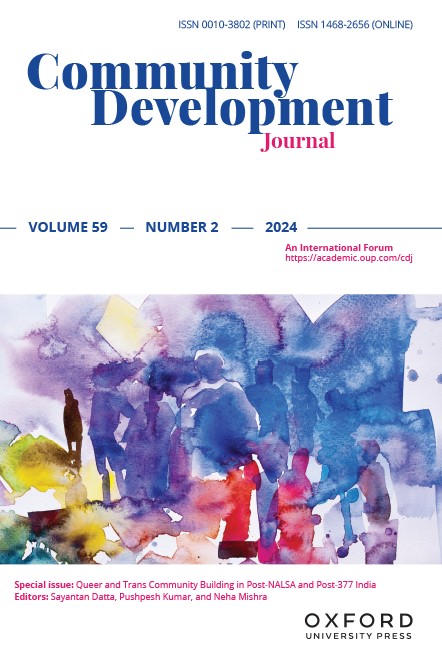
CDJ publishes historic issue on Queer and Trans Community Building in India

Cross-posted from the CDJ Plus blog.

I am very excited to see the publication of the most recent issue of the Community Development Journal (CDJ), which focuses on queer and trans lives and collectivity in India.

The issue, titled Queer and Trans Community Building in Post-NALSA and Post-377 India, is edited by Pushpesh Kumar, Sayantan Datta, and Neha Mishra. Across the editorial and seven articles, it explores pathways and barriers to community organising across a range of settings, including in families, religious contexts, community health programmes, universities, and the media.

Cover of the Community Development Journal


A one of the editors-in-chief of CDJ, it was an honour to support the hard work of the special issue editors and authors, who have put together a truly groundbreaking collection. LGBTIQ+ organisations, and others with a broader remit who seek to work with LGBTIQ+ people, are increasingly taking community development approaches and (where they can afford to do so) employing community development workers. However, community development research has been slow to catch up, with very little literature examining queer or trans community development theory and practice. This special issue therefore represents an important act of leadership in the field, which I hope will pave the way for more expansive discussions of LGBTIQ+ issues within community development globally.

The issue also representives methodological innovation, bringing literary and media studies methods to consider opportunities and issues for community building in India, alongside the social sciences approaches more typical of research in the field of community development.

The editorial for the issue is free for anyone to read, as is Anannya Dasgupta’s article Queerious communities: building writing centres in Indian universities. The remainder of the issue is available to all individuals and institutions who subscribe to CDJ.

Free essays! Queer punk, trans-inclusive midwifery, and trans health law

In recent years I have co-authored numerous peer-reviewed essays for edited collections. I have just made three of these freely available, from books originally published in 2020 and 2021.

Why is this happening now? Well, it’s basically due to moves toward so-called “open access” within the bizarro world of academic publishing. I try and publish my work in places that will also let me share my work for free. For book chapters, publishers usually impose an embargo period of 2-3 years, after which authors are allowed to share the post-peer-review version on our own website. The essays I have recently uploaded have all had their embargo end, so I’m excited to now share them more widely.

You can download the essays by clicking on the links below.

Queering Community Development in DIY punk spaces
Also published in the book: Arts, Culture and Community Development (Policy Press)
Written with my long-running collaborator Kirsty Lohman, this essay looks at grassroots community organising within queer, feminist, and anti-racist punk spaces. We argue that this organising is often prefigurative: that is, it actively models and enacts the changes that punks want to see in the world. Looking at events such as First Timers and Decolonise Fest, plus bands such as Big Joanie, we explore what happens when marginalised people create their own cultural spaces, and seek to facilitate access to these spaces for others who are often denied artistic and political expression.

Men transmasculine and non-binary people and midwifery care
Also published in the book: Midwifery Essentials (Elsevier)
I contributed to this essay as part of the Trans Pregnancy research project team. Our project spoke with over 50 men, transmasculine, and non-binary people who experienced pregnancy and childbirth in Australia, Bulgaria, Canada, Germany, the UK, and the USA, plus a handful of midwives who have supported people from this group. In this short essay, we briefly outline the positive and negative experiences that trans birth parents reported having with midwives, plus challenges reported by midwives themselves. On this basis we make 8 recommendations for developing best practice with trans people in midwifery services.

Depathologising Gender: Vulnerability in Trans Health Law
Also published in the book: A Jurisprudence of the Body (Palgrave Macmillan)
I co-wrote this essay with Chris Dietz, a scholar of Law at the University of Leeds. Drawing on feminist and trans critiques of human rights models, plus an analysis of gender recognition laws in countries including Argentina, Denmark, and the UK, we argue for a new approach to understanding the fight for depathologisation in law and medicine.

These three essays are just some of the many peer-reviewed academic publications I make freely accessible on this website. For more work on a range of topics relating to trans studies, feminism, and/or community development, see my publications page.

Event: Participatory recovery and reconstruction: Lessons from Ukraine

Alongside colleagues from the Community Development Journal, I am organising this hybrid event which is taking place in Glasgow’s Advanced Research Centre from 6pm-8pm on Monday 26th February.

For a free ticket to attend either in-person or online, please book via Eventbrite.

As the conflict in Ukraine enters its third year, how are community development workers building participatory approaches to recovery and reconstruction?

This event will see Nataliya Drozd (Dobrochyn Centre) and Oleksandr Pidhorniy (Chernihiv Centre for Human Rights) in conversation with peacebuilding expert Professor Sinéad Gormally (School of Education, University of Glasgow).

We will hear first-hand about democratic activism, local self-governance, and integration of internally displaced peoples from civil society experts based on the ground in Ukraine. Attendees will also have space to reflect on how we can apply insights from their knowledge and experience within our own communities in Scotland.

This will be a hybrid event – when you book your (free) ticket, please state whether you will be joining online. We will circulate a link to join the event on the afternoon of 26th February.

Upcoming talks: April-May 2022

I am speaking at a series of exciting events over the next few weeks! All are free to attend, you will just need to register in advance if you’d like to come.

Tuesday 26th April – Manchester
Trans Healthcare: Past, Present and What Might Have Been

In-person roundtable discussion, with Ellis J Johnson, Stephen Whittle, Krishna Istha, and Laura Salisbury.

6pm-8pm BST, International Anthony Burgess Foundation
3 Cambridge Street, Manchester, M1 5BY

Wednesday 27th April – Online
Queer and Trans Mobilisations – Possibilities and Challenges

I am incredibly honoured to be giving a keynote talk for this two-day event hosted by the Department of Sociology, University of Hyderabad, and the Centre for Writing and Pedagogy, Krea University. I will be speaking about “Building Queer and Trans Communities in the UK” towards the end of the first day, and am enormously excited to be learning from colleagues in India during the event.

10am-6pm IST, 27-28 April
Register online to attend

Thursday 5 May – Online
UK Workshop in Trans Philosophy

I will be delivering a keynote on the first day of this groundbreaking event hosted by the University of Glasgow. My talk is provisionally titled “Let’s (not!) fight a TERF war: Trans feminism in a time of moral panic”.

9:30am-4:30pm BST, 5-6 May
Register online to attend

Wednesday 11 May – Online
Reproductive Justice Research Network seminar (link to come)

I will be joining colleagues from the Trans Pregnancy project to discuss findings from our international study of trans and non-binary people’s experience of conception, pregnancy, and childbirth. Our talk is provisionally titled “Reproductive Justice for Trans People”.

Full details TBA – watch this space!