Activist pasts and imagined futures

Back in October I caught the train down to Coventry to visit my old stomping grounds at the University of Warwick. The occasion was the 20th Anniversary of Warwick Anti-Sexism Society (WASS), a student campaigning group at the university. Technically WASS was 21 this year, but whoever let technicalities get in the way of a good celebration?

Co-hosted by the Centre for the Study of Women and Gender, the event brought current WASS members, including WASS president Izie Lopez-Scott and Students’ Union sabbatical officer Ananya Sreekumar, together with former students and feminist academics, including founders Sam Lyle and Cath Lambert, and early member Maria do Mar Pereira.

As I arrived on campus, it occurred to me that I must have been one of longest-running members of WASS. In contrast to the likes of Sam and Cath, I never played an organising role, instead on volunteering my time with Warwick Pride (the LGBTUA+ society), Rocksoc (for the metalheads), and later also Bandsoc (for whom I still occasionally judge the university’s annual Warwick Battle of the Bands). Nevertheless, after originally joining WASS way back in the academic year of 2005-2006, I maintained an on-and-off membership through my undergraduate, masters, and PhD degrees, finally leaving in 2016. During that time I attended numerous talks, workshops, protests, and occupations as a member of WASS, and joined fellow members as a delegate to Women’s Conferences hosted by the National Union of Students.

I wasn’t quite sure how it would feel to participate in the anniversary event. I anticipated it would be somewhat nostalgic.

Certainly the event served me nostalgia in spades. A WASS exhibition featured numerous t-shirts, hoodies, zines, posters, and pamphlets produced by the society from 2004 to the present day. I brought along a couple of zines from the 2010s – Sam brought along a huge amount of old material, much of which dated back to my undergraduate days. In a panel discussion, we reflected together on the context in which WASS was formed, why it felt so difficult and important to name yourself as a feminist in the early 2000s, and how the society’s early campaigns reflected the priorities and debates of the day (lads’ mags! feminism for men! Page 3!)


But my main takeaway was the way in which our actions can echo through time, informing and influencing others in ways we might never be aware of.

When Sam and Cath founded WASS, they were focused on the present. They didn’t think much about how it might provide a way into activism and feminist thought for hundreds of people over two decades. Looking at the exhibition, speaking in a session about what had changed and what happened, it felt clear to me that we are living in a world shaped hugely be the world of 00s feminism, even amidst an enormous misogynist backlash.

There is something here about the complexity of wins, and the importance of work over time. It is not simply the case that the world gets better or worse. At the event, we discussed the growing cultural impact of violent misogynists from the manosphere. Sam highlighted how rates of femicide remain extremely high, half a century after the second-wave feminist movement kicked into gear. Equally, we reflected on how there is far more mainstream acknowledgement, understanding, and support for survivors domestic violence than there used to be even 20 years ago. This matters: it provides more people with a way out, a route into rebuilding their lives with the support of their families and communities.

Similarly, even as racist rhetoric dominates mainstream political discourse, feminist movements have increasingly learned from the difficult discussions around intersectionality that have taken place across years, decades. Meanwhile, other social movements have got better at acknowledging sexism, and embracing feminist ideals. WASS was originally an all-white, all-cis, non-disabled collective, which struggled to build alliances with other student liberation groups. This has not been the case for years. Key issues for student feminists at Warwick in 2025 include the genocide in Gaza, and fighting back against the university’s attempts to implement anti-trans policies. Warwick’s liberation movements frequently collaborate and cross-advertise events, and current students described how activists were often involved simultaneously in anti-sexist, anti-racist, and pro-queer groups.

A young man at the event asked me how campaigners stay motivated when there is so much rollback. I said I was inspired by the fact that we can still help people, that we can still create ideas and resources that it turns out are useful to others years, decades later. This was illustrated perfectly by the most unexpected story I heard that day, from an early career academic who thanked me for my old writing on TeachHigher.

A decade ago, TeachHigher was the University of Warwick’s attempt to advance insecure employment on campus, and undermine trade unionism. Branded as “a more consistent approach to the employment of hourly paid staff who work in different departments”, TeachHigher would provide a framework specifically for casual teaching contracts, offering an alternative to full-time, salaried lectureships. As a “wholly-owned subsidiary” of Warwick, it would technically be a separate company, while still funneling profits directly back into the university. This meant workers contracted through TeachHigher would be unable to benefit from collective bargaining with the University and College Union (UCU). The intention was to expand the model already used by Unitemps, another Warwick-owned subsidiary which “offers flexible staffing solutions” (often zero-hour contracts) across the higher education sector.

An enormous struggle over TeachHigher happened in 2015. The scheme was pushed aggressively by management, and opposed vociferously by hourly-paid teaching staff: the very people TeachHigher intended to contract. In subsequent years, I spoke and wrote about how this model for internal outsourcing was defeated through collective action on the part of students and staff. Workers such as myself carefully scrutinised the university’s proposals, identified pressure points within our own departments, found allies amongst more securely employed faculty, and organised accordingly. We effectively took over our local UCU branch, while also planning outside of its structures. Loopholes in existing casualised contracts enabled us to circumvent the UK’s anti-union laws, through moves such as departmental teaching boycotts. Multiple departments declared that they would refuse to participate in the TeachHigher pilot. The final straw came when UCU announced a national demonstration on a University of Warwick open day, which would have been an enormous embarrassment to the institution.

The successful campaign against TeachHigher brought student groups such as WASS and Warwick Anti-Racism Society together with staff bodies such as UCU. Due to the unequal impacts of casualisation, we recognised – as my late, great colleague Christian Smith put it – that “TeachHigher is sexist, and TeachHigher is racist”. We built on tactics developed in previous years. For example, the idea of protesting on an open day was developed by the 2013 Protect the Public University campaign, which grew out of the 2011 Occupy Warwick encampment. WASS members, naturally, were involved in both.

The defeat of TeachHigher was an enormous win for campaigners. Not only was the scheme withdrawn: we also negotiated pay rises, better terms and conditions for all casualised staff, and pathways towards more secure contracts for some.

Photograph of trees with yellowed leaves lining a road on an autumnal day

Yet by 2025, there was very little institutional memory of TeachHigher. For all that we won, many teaching staff remained on casualised contracts, and Unitemps continued to prosper. Meanwhile, the vast majority of those involved in the struggle have moved on, to live and work elsewhere. The university was largely under new management, and there had been an enormous turnover within human resources as well as student bodies. For those who even know the dispute happened, it can be hard to find concrete information. News platforms delete old stories, and enshittification makes it harder to use search engines to find those that remain.

At the WASS Anniversary, I learned that a key source of information on TeachHigher today can be found in my past blog posts.

Old wins echo down the years. Temporary gains are gains nonetheless. I would guess that every one of us who benefited from the TeachHigher defeat is better off now as a result. Personally, I found myself in a better place financially to finish my PhD and continue an academic career. I also learned an enormous amount about the practicalities of collective organising. I know I have draw on those gains repeatedly over the last decade to continue supporting others in turn.

Even if pay rises for casualised staff were eroded over time, the fact that we fought and that we won can continue to inspire workers facing similar struggles. Just as TeachHigher was inspired by Protect the Public University, which was inspired by Occupy Warwick, which was inspired by the Red Warwick occupations of the 1970s as well as the US-led Occupy Movement, the Spanish Indignados Movement, and the Arab Spring. These long influences don’t just happen: they rely on people writing things down, saving artifacts, and remembering together.

The funny thing is, I had no idea anyone might find my old blog posts on TeachHigher useful after so many years. I was one small part of a far larger movement, and have been involved in so many other campaigns since. Nevertheless, through chronicling events it turns out that I created a resource that remains useful to this day.

At the WASS Anniversary, I was reminded how important it is to commemorate our local histories of activism, and to share what we have learned along the way. Social progress is neither linear, nor guaranteed. But if we imagine there might be a better future around the corner, and act accordingly, then we might change the world in ways we cannot possibly anticipate.

Photo of a poster with bold text and a small picture of a sapling plant. Text reads as follows "By choosing a feminist politics, you are making a commitment to a world that has not yet been built" - Lola Olufemi. Warwick Anti Sexism Society. Campaigning for gender liberation. @warwickantisexismsociety


Reject Trans Doom-Posting

This week I took the long train down to the south of England for my friend Robyn’s funeral. She died very suddenly three weeks ago, aged just 32.

Robyn gave so much love to the world, and was so loved in turn. Around a hundred and fifty people crammed into a small building for the service. There weren’t enough seats for everyone, so many stood at the back and sides of the room. I sat on the floor. More attended online.

We shared stories from Robyn’s life, learned from each other, cried together. Like many funerals, especially for young trans people, it was absolutely gutwrenching. It also helped move us towards closure. It was good to be in community together, to think and speak not just of Robyn’s past, but of our collective futures. Robyn lived life to the absolute maximum. Surely we could take inspiration from her example.

Photo of a punk crowd having a good time. In the centre of the image, a white butch woman exclaims and points with delight.
Robyn at Manchester Punk Festival 2024. Photo by Chris Bethell for The Guardian(!)


After the funeral, I stayed the night with queer friends in rural Surrey. We went for a curry, toasted Robyn, caught up about our lives. We talked about work and about books and about art and about holidays we wanted to take. That evening I felt tentatively more at peace with the world.

And then I looked at my phone. And I learned that another young friend, Jessica, had also just died.

***

It’s a shit time to be trans. Many people are saying this.

But then again, when has it not been a shit time?

Eight years of moral panic have taken an enormous toll. In the UK, as in many other countries, our civil rights and our access to public services, public spaces, and public life are all being rapidly rolled back. Politicians and influencers fall over themselves to promote anti-trans violence and praise one another’s incendiary takes. We are less safe at work, at home, in hospitals, in schools, and in the streets.

Trans people often die young, including too many of my friends. Sometimes (all too often) we die by suicide, driven to despair in a world full of hate and malice. Sometimes (mercifully less often in the UK) we are murdered, usually in incredibly violent ways. Other times, it’s more complicated. I think of Denise, who died a sudden death from melanoma. I think about Elli, who died of Covid-19. And now I also think about Robyn and Jessica, who each died suddenly of apparently natural or accidental causes.

These days, the high rate of untimely trans death can feel like a consequence of the trans panic. Certainly I believe it’s making things worse. However, this phenomenon pre-dates the current political situation. Trans people disproportionately died young in the 2010s, at the time of the so-called “tipping point“. Trans people disproportionately died young before this too. Sociological theory can tell us why.

A decade or so ago, I worked for a couple of years in Warwick Medical School. I was there to teach medical students about social determinants of health. The basic concept is that our general health is affected enormously by the context in which we live. This includes factors such as the resources and services we do and do not have access to, and barriers we might face in attempting to access healthcare services or otherwise look after ourselves

So, it’s not a coincidence that – for example – life expectancies are shorter in poorer neighbourhoods, or that Black women are more likely to die in childbirth. There is nothing inevitable or biological about any of this, something intrinsically different about poor people or Black people. The issue is that entire groups of people are more likely to experience particular kinds of illness, and more likely to die of things others might survive. This is because of the social disadvantages they face, and because of the discrimination they experience at the hands of bigoted doctors and nurses.

There is a massive scientific literature on social determinants of health. I’ve contributed to it myself, co-authoring a recent study showing an association between transphobic microaggressions and poor mental health among trans people. For this reason, I know it’s no coincidence that so many of my trans friends have died untimely deaths. Trans people are more likely to have worse health because of transphobia. They are less likely to receive timely and effective treatment because of transphobia. This means when trans people are seriously ill, we are on average less likely to survive. I see this when I look at the academic literature, and I see this every day in the lives trans people I know.

I see the impact of transphobia when I look at Robyn’s life and death. Her health deteriorated significantly in her final years. She was afraid to seek help from doctors though: and for good reason, given the discrimination she and many of her friends experienced in NHS services. I wrote my entire goddamn PhD thesis on this problem.

Things were even worse for Jessica. I witnessed so many organisations and institutions in her home city of Coventry failing her time and time again. I could fill whole books with accounts of the violence done against her. She was failed by her school, her church, a political party she gave so much energy to, the council, the local hospital, the psychiatric ward, the housing association. Just last year I sat helplessly on the other end of the phone while she attempted suicide, doing the best I could in this moment to ensure that she was not alone.

The institutional failings experienced by Robyn and Jessica and so many others are the result not just of ignorance, but of actively malicious transphobia and transmisogyny. I believe these factors contributed significantly to their untimely deaths.

How can any of us expect to find hope and purpose in the face of such violence?

***

In recent months I have noticed an uptick in trans doom-posting. By this I mean trans social media posts, blog posts, and videos which dwell entirely on negative feelings and convey a sense of hopelessness.

A prominent example is Shon Faye’s recent essay, well, it’s over, which she describes as “a brief eulogy for the ‘trans rights’ movement”. Shon observes that powerful transphobic movements in the USA and UK are succeeding in many of their aims. They have spread fear and disinformation far and wide, made allies of mainstream politicians and media platforms, and enacted bans on trans healthcare. Now they are attempting to criminalise our very existence, as part of a campaign to eliminate us altogether.

Shon’s conclusion appears to be: well, that’s it. We’re all fucked.

Today I doubt I will see another progressive measure (either in legislation or healthcare policy) put in place for trans people in my lifetime. Who knows what may yet be taken away.

I very much empathise with her account of trying to talk about this in any way with cis friends and family:

“their instinct is to try and generate hope or minimise despair [which] typically minimises the gravity of the situation and the depth of my grief and exhaustion and fear – increasing my resentment.”

Shon concludes that she doesn’t want to hear “fucking platitudes” – “there’s time for hope later”. For now, she wants time to grieve. I’ve seen similar sentiments shared by other authors on various social media platforms, including posts from extremely popular trans meme accounts.

I understand intimately where all of this is coming from. Just look at everything I said earlier about social determinants of health. I recognise the violence we are subject to, and its costs. This post too is written from a place of deep grief.

But there is also the question of where and how we grieve. We do need space to vent and to despair. But we also need space to process, and figure out what happens next. Ideally, we need places and times we can do this collectively, rather than just being isolated as individuals. Robyn’s funeral offered this.

I’m not saying we shouldn’t talk about what is happening to us. What I am concerned about is the individualising effect of public platforms, and the parasocial relations we hold with high-profile accounts. We tend to consume doom-posting on our own, on a phone. We often have no-one to process it with, and little context beyond the content in front of us. In this way, doom-posting offers only a partial account of reality, and no way out from despair.

And there is a way out. We find it in community.

***

Look, I have a great deal of respect for Shon Faye. I have a hard enough time navigating the consequences of my own very minor microcelebrity. Shon has to tackle a great deal more attention: from trans people looking for someone to idolise and/or tear down, from cis readers who project heroic expectations onto her, and from haters who see her as the antichrist or something. She’s great on camera, and a brilliant writer. I would recommend her book The Transgender Issue to literally any cis reader. I also recognise that her blog post comes from a place of incredible pain.

At the same time, I am concerned that many trans people and allies are putting way too much energy into engaging mainstream institutions and liberal systems on their own, individualistic terms, rather than looking to the alternative power and support we can build in our communities. Notably, a lot of Shon’s post talks about civil society, legislation, lobbying, and the role of organisations such as Stonewall. This is definitely a realm in which “trans rights” face a seemingly terminal decline. But it is also not the first place I would look for real, grounded hope.

You can find a similar energy in Jules Gill-Peterson’s dire essay Reject Trans Liberalism, which is referenced by Shon. Jules’ piece simultaneously criticises the trans liberation movement for being about more than transition, while also insisting that preparing ideologically sound documents for the US supreme court is a radical act. It posits a false and ahistorical dichotomy between transsexuals (good, pure, radical) and transgenders (bad, elitist, liberal). The essay does not consider how gender diverse people might work together or support one another across our differences. This contrasts with existing critiques of trans liberalism already advanced by activist-scholars such as Nat Raha and Mijke van der Drift. Again, don’t get me wrong, I’m a huge fan of Jules’ previous work. But as trans people, and especially as trans women, we owe each other so much more than this.

Now, I’m hardly without fault. This very blog is replete with examples of myself and others putting untold hours into lobbying politicians, participating in public consultations, advising the National Health Service and so on and so forth. In her post Stepping Over The Line, Josie Giles, who once again I admire greatly (look, I just fucking love trans women) argues that:

Theoretically, an army of well-resourced energetic activists could simultaneously engage in state-centred advocacy and also do grassroots politics. In practice, it doesn’t happen. In practice, state-centred pseudo-organising dominates the social media feeds and the limited energy reserves of an already depleted community, and absorbs what little money is available to pay for the salaried self-licking ice-cream cone of the lobbying profession.

Sick burn!

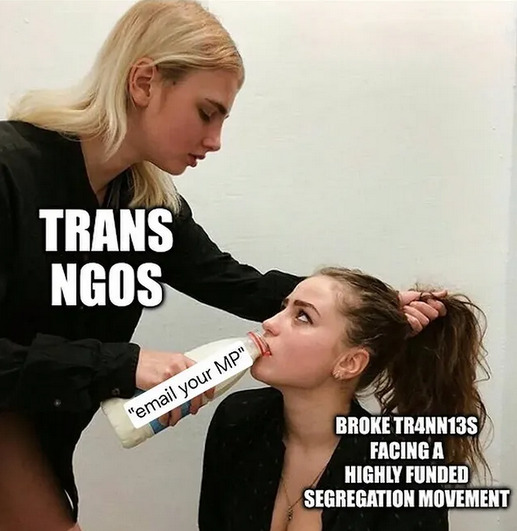
Meme depicting two femme white women. One is labelled "trans NGOs", and is holding the other woman firmly by her hair. The second woman is labelled "broke trannies facing a highly funded segregation movement". The first woman is force-feeding the second woman a bottle of milk, labelled "email your MP".
Meme acquired via one of them social media platforms we’ve all heard so much about.


I do disagree with Josie a little. Unlike Shon and Jules and also Josie, I transitioned in the early 2000s. This was well before the tipping point, and before most trans civil rights even existed in law. I remember how we fought successfully for changes that genuinely improved many people’s lives. I feel it will always be worthwhile to use what levers we can to minimise the harm caused by those who have power over us. Lobbying is the most accessible form of activism for some people. I still have an auto-reply on which encourages every damn cis person who emails me at work to contact their MP.

But Josie is completely right that many if not most trans people can and should be putting a lot more of our energy into grassroots politics. This must necessarily involve re-imagining what our worlds could look like, using what we already have as a basis from which to build. I know from lived experience that we can not only survive in the absence of certain civil rights and recognition, but also see material improvements in our lives when we come together. I met Jessica because we built trans-led community services in Coventry from the ground up.

Similar points are made by Roz Kaveney, who first came out over 50 years ago. In her criminally underrated 2022 poetry collection, The Great Good Time, Roz does reflect on the violence faced by young trans women in her youth. However, she also details the vibrant lives they lived together, the joys they experienced, how they shared housing and clothes and had each others’ backs. In a short forward to the book, she notes:

“I observed a lot of bleakness creeping into trans social media and thought it my job as a community elder to remind young people that things have been, if not worse, then at least as bad in different ways”.

As Josie states in Stepping Over The Line, white, middle-class trans people in particular need to understand in this current moment that we are as disposable to the ruling classes as any other minoritised individual. Our strength lies in practical solidarity with others subject to the violence of corporations, fascist movements, and the state. To once again reiterate the point, we need to be in community with one another.

Both Robyn and Jessica’s lives offered perfect models for this.

***

Every single speaker at Robyn’s funeral talked about how much time and energy she put into punk and folk music, building and fixing things, and caring for others. She was a loud, proud butch who was incredibly committed to sustaining community wherever she went. When she saw a need, she sought to meet it. Many of us only wished that she was better at asking for or accepting help herself.

If a trans person needed somewhere to stay, Robyn would put them up. If a trans person needed to move house, or was being evicted or was fleeing a violent relationship, Robyn would turn up with a van. If a trans person was having trouble at work, Robyn would show up online or in person with sensible advice. This attitude inspired Robyn to volunteer with groups such as Reading Red Kitchen, a grassroots project which provides a social foodbank and free community meals for asylum seekers experiencing food poverty. For Robyn, radical politics could never simply be about slogans and demonstrations: it was about cooking, connecting with others, and washing the dishes.

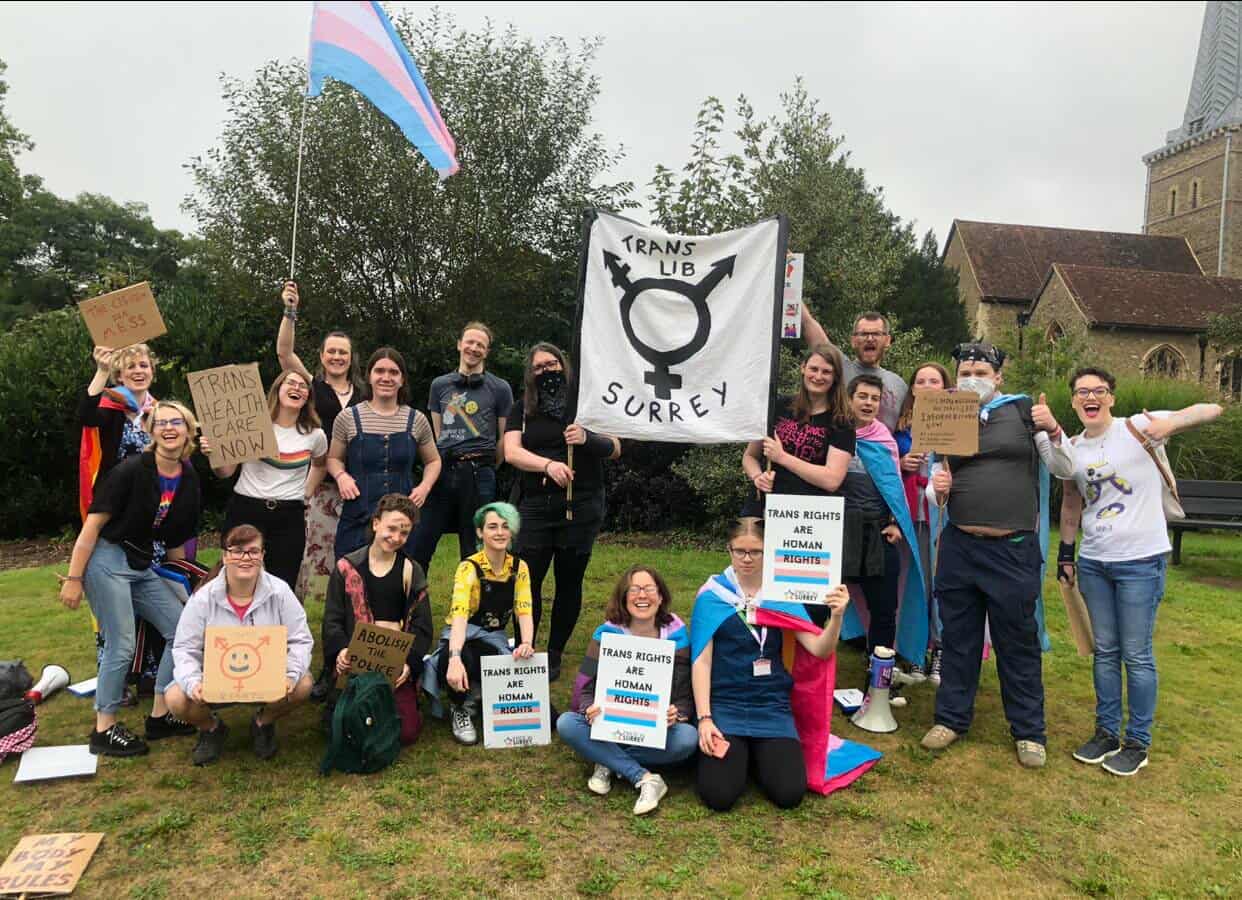
None of this is to say that Robyn was never found at a protest: quite the opposite. When I lived in the south we co-founded Trans Liberation Surrey, a collective which worked to oppose transphobia in a county hardly known for its activist movements. My most treasured memory of Robyn is from this time, when we attended a small anti-fascist demonstration in Wokingham. A coalition of neo-nazis, anti-vaxxers, and climate conspiracists descended on the town to protest a drag queen storytime event for young children. Robyn and I joined other locals outside the library to wave rainbow flags and play upbeat music, enabling families to attend the event without disruption.

Photo of people with placards around a banner labelled Trans Lib Surrey.
Trans Liberation Surrey, at Surrey Pride 2021.


Jessica was also extremely motivated to help others, in spite of her own difficult circumstances. Like Robyn, she was a committed trade unionist. For many years she was also involved in a small political party, before eventually being ejected for challenging the leadership. Her motivation for this was a genuine belief in the possibility of positive political change, and in the potential for people to come together and make that change happen. Later in life she would rediscover her Christian faith as alternative vehicle for community action.  

After hearing of Jessica’s death, our mutual friend Charlotte reached out, and we asked one another how we knew her. It turned out Charlotte had also been a member of that political party, and reconnected with Jessica several years later as they both sought new ways to make a difference in the world. In turn, I explained how Jessica and I met while lived in Coventry, and was myself involved in organising trans community social events, meals, and punk nights. Charlotte and I also both knew Robyn. “Christ Ruth,” said Charlotte, “trans lives are so entangled and we often don’t even realise”.

So it is. Right now, Jessica’s Facebook wall is replete with people thanking her for being there as a friend, for providing them with advice, for helping them come out.

In a hostile world, we are everything to one another. In the face of the most horrific hate, our love is so powerful. Such love survives death.

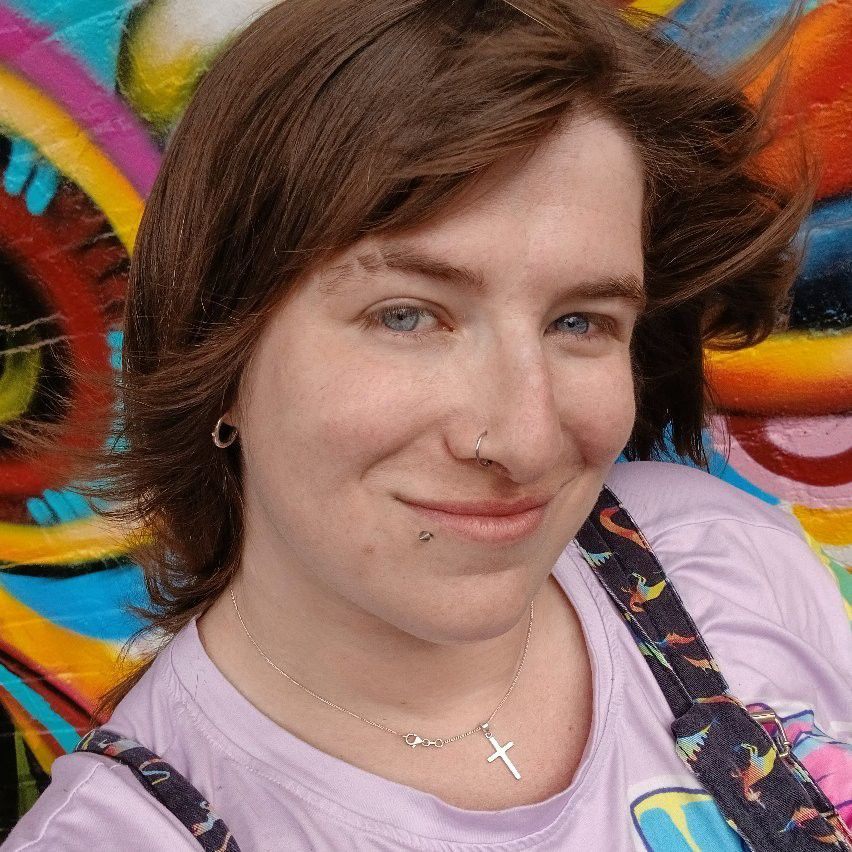
Selfie photo taken by a white woman with shoulder-length brown hair. She is wearing colourful clothes and a cross around her neck, and smiling at the camera.
Selfie taken by Jessica.

***

This is where I find hope. At protests and demonstrations, sure, but more importantly in the contexts where we give each other’s lives meaning.

I find hope in community meals, mutual aid, queer bars and queer bookshops and queer gigs. I find hope in small parties, in big Pride events, in quiet meetings at work, in food pantries. I find hope in housing projects and healthcare projects, and in the Glasgow Electrolysis Project, which has created actual jobs for trans women and a vital new service for hundreds of us across the city. We know we are failed constantly by mainstream institutions: rather than seek incremental change, is it not time to re-imagine the clinic, re-think the workplace? Our problems will not be solved by refusing to engage with existing services, nor by creating trans charities that replicate existing hierarchies. We need to find ways to build something new entirely.

I find hope in the fact there are more of us out than ever, more connected than ever. These collective endeavors are all so much more important than anything I personally might write, any research I might do, and certainly any “progressive” policy I might influence.

Doom-posting and finger-pointing cannot deliver any of these things. We need to take the time to connect with one another, especially outside the internet. Yes we need to grieve, but we need so much more than this. We need to actively look after one another, and provide space for rest and recuperation. We need to have each others’ backs. We need to connect across difference, and not (re)create hierarchies of oppression or need.

These are no fucking platitudes. This is my life. This is the lifeblood of our shared communities. This is how we create better social determinants for our goddamn health.

Long may we live together.  

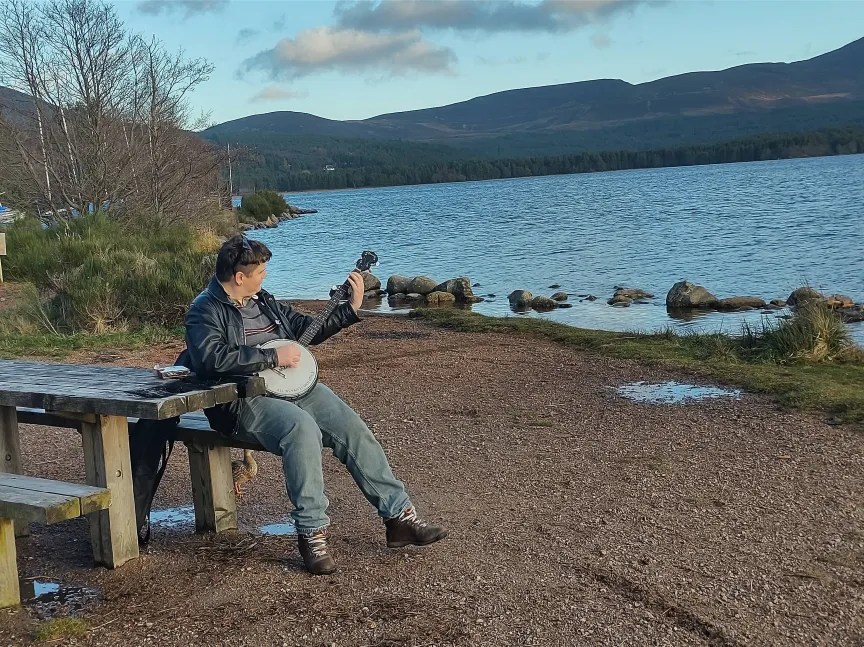
Photo of a butch white woman playing a banjo next to a Scottish loch.
Robyn in the Highlands. Photo by Elaine O’Neill.

DJ set list: Killer Queen @ Grrrls Night Out, Coventry, 08/03/24

Photograph of a home-made DJ booth designed to look like an ancient Celtic chariot, with the name Boudica embossed on the front.

Back in the day, I had another blog where I posted all my DJ set lists. That blog no longer exists outside of the Wayback Machine because it was hosted by the University of Warwick and universities hate to host websites for too long, it seems (see also: Leeds and Sheffield taking down the trans pregnancy project websites once that sweet, sweet UKRI money stopped coming in).

However, I still like archiving things, so for the sake of posterity, here is my headline set from last night’s amazing party for International Women’s Day at the Tin in Coventry, hosted by the awesome women at Boudica Festival.

Blondie – Atomic
The Selecter – Missing Words
Azealia Banks – 212
underscores feat. gabby start – Locals (Girls Like Us)
100 gecs – mememe
Hole – Celebrity Skin
The Cardigans – My Favourite Game
Indigo Girls – Closer To Fine
Dolly Parton – 9 to 5
Beyoncé – Texas Hold ‘Em
Le Tigre – TKO
The Ting Tings – That’s Not My Name
Miss Eaves – Thunder Thighs
St Vincent – Digital Witness
SOPHIE – Immaterial
Annie Lennox – Walking on Broken Glass
Wet Leg – Wet Dream
Mitski – Washing Machine Heart
Gloria Jones – Tainted Love
Bananarama – Venus
Belinda Carlisle – Heaven Is A Place On Earth
Courtney Barnett – Pedestrian At Best
Black Dresses – In My Mouth (request)
Wargasm – Do It So Good
Nova Twins – Antagonist
Janelle Monae – Make Me Feel
Billie Eilish – bad guy
Aretha Franklin – Think
Skunk Anansie – Weak
Kate Bush – Running Up That Hill
Evanescence – Bring Me To Life
Nightwish – Over The Hills and Far Away

I believe this was my first DJ set in almost nine years and I will admit I was pretty nervous! Even worse, most of my old equipment is buried in a box somewhere due to multiple moves over the last few years, so I really had to wing it. At the same time, I used to play a lot back in the day. Between that, a usb stick stuffed with days’ worth of music, and some hard work in preparation, it all felt very natural once I was on stage in Boudica’s amazing home-made Iceni chariot booth. I really enjoy figuring out what an audience wants to hear and then taking them on a ridiculous journey with that, and once the adrenaline kicks in it’s one hell of a trip.

I’m hugely grateful to Boudica for inviting me back to Coventry and providing such a supportive environment. It was exciting to dance to brilliant sets from new DJs before stepping up myself, reflecting Boudica’s commitment to supporting women and non-binary people in picking up new instruments and skills. Most of all, I’m thankful to everyone who turned up to party.

DJ set in Coventry for IWD – 8 March

I’m excited to announce that I will be headlining Boudica Festival‘s party for International Women’s Day on Friday 8th March!

The event will take place from 8pm to late at at The Tin in Coventry.

Here’s the blurb from Boudica:

Poster for the Grrrls Night Out event at the Tin Music and Arts, Coventry, on Friday 8th March, 8pm to late. The poster features a disco ball with waving arms, feet, and an open mouth. It states that the event will feature DJs spinning pop, rock, riot grrrl and more, plus visuals and crafts.

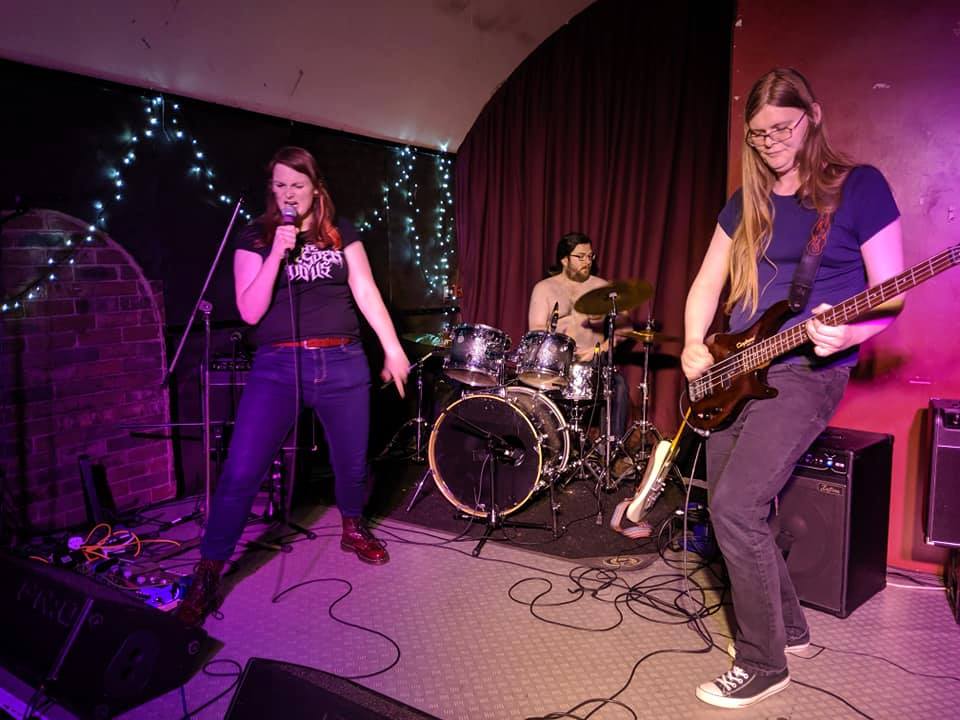
Killer Queen returns to the Tin for one night only! Killer Queen aka Ruth Pearce is a Glasgow-based trans feminist DJ, known for genre-bending rock and pop sets that bring together classic tunes and contemporary hits. Ruth has been previously spotted spinning the decks at queer clubs, protest after-parties, and activist conferences across the country, including Reclaim the Night, Women’s Aid, Queer Fest Leeds, Birmingham pride, and Nine Worlds Geekfest. In Coventry she founded and performed at the Killer Queen queer rock club from 2009-2013, and was part of the Revolt! collective which ran riot grrrl nights at the Tin from 2012-2017. These days, Ruth can usually be found found shouting in the rock trio Dispute Settlement Mechanism, playing bass in the noise pop band wormboys, and/or moonlighing as a professional scholar in the field of transgender studies.

This will be my first DJ set in several years(!) However, I’ve been constantly listening to new music, so am very excited to be once again getting behind the decks – especially in my old stomping ground of Coventry.

You can buy your tickets here.

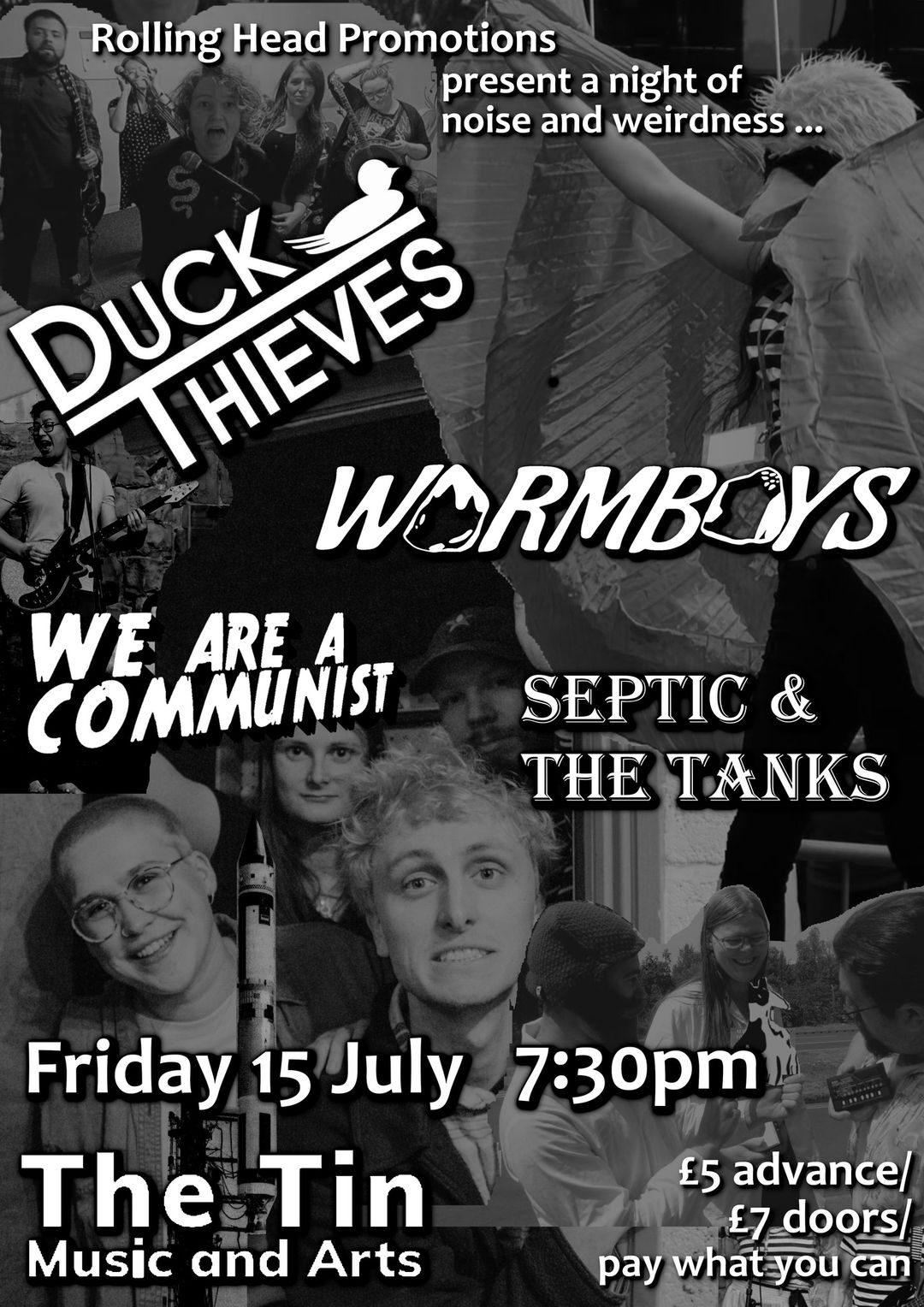
So much to see! wormboys tour Midlands

I’m playing Leamington, Coventry, and Derby with wormboys this week!

I kept back posting about this after contracting a nasty bout of covid, but since I am now (mercifully!) better, our mini-tour is going ahead.

The dates are:

14th July – St Patrick’s Irish Club, Leamington. Doors 8pm.
15th July – Tin Music and Arts, Coventry. Doors 7:30pm. Advance tickets here.
16th July – Dubrek Studios, Derby.

We’d love it if you came to share the joy of noisy pop music with us! However, there is still a global pandemic on (no matter what the assorted mess of Conservative leadership candidates might like us to think) – so if you’re coming, please look after each other by testing before the gig and wearing a mask.

QUEERPOCALYPSE

QUEERPOCALYPSE

Today is Trans Day of Visibility, apparently. I have felt very strange about this day since it became a Thing over the last decade, as visibility is double-edged sword for many of us. With visibility comes community, and increased access to trans and queer arts, culture, politics, ideas. But in the last few years this has met with a cultural and ideological backlash. We are more visible to those who hate us, those who fear us, those who would cause us harm.

Last year I wrote some lyrics about this dichotomy, which are now part of a new song from noise/punk band Dispute Settlement Mechanism. It’s called Queerpocalypse.


One of the great things about being in a band is that the process of creation is always  collaborative. I like that this enables us to express ourselves, be that as queer, as trans, as woman, as people, in different ways that come together as a whole. Communicating through riffs and percussion which tell their own stories alongside lyrics and vocal performance.

This, at least as much as my research and formal writing, is the visibility that matters to me in 2020.

I fear your hate inside
I fear the turning tide
I fear your time will come
I fear you think you’ve won

moral panic
moral panic
moral panic
moral panic

you fear with desperate pride
you fear the turning tide
you fear our time will come
you fear that we have won

well guess what?

this world is ours
this world is ours
this world is ours
this world
is ours

Queerpocalypse is available as part of the compilation album Songs From The Vaults. All proceeds from digital sales of the album (available from £5) go towards supporting important Coventry venue and community centre The Tin Music and Arts through the COVID-19 crisis.

Gigs in March and April

I’m playing some super cool gigs with my two bands over the next couple of months! You should totally come and see us play.

85063535_2769728823121741_5866758282172956672_nSunday 8th March
Tin Music and Arts, Coventry

I’ll be shouting at Boudica Festival’s International Women’s Day event with the noise rock/punk experience Dispute Settlement Mechanism.

We’ll be sharing a stage with Human Resources, Paradise of the Titans, Jen Haigh, Nyotaa, and the Yap Collective.

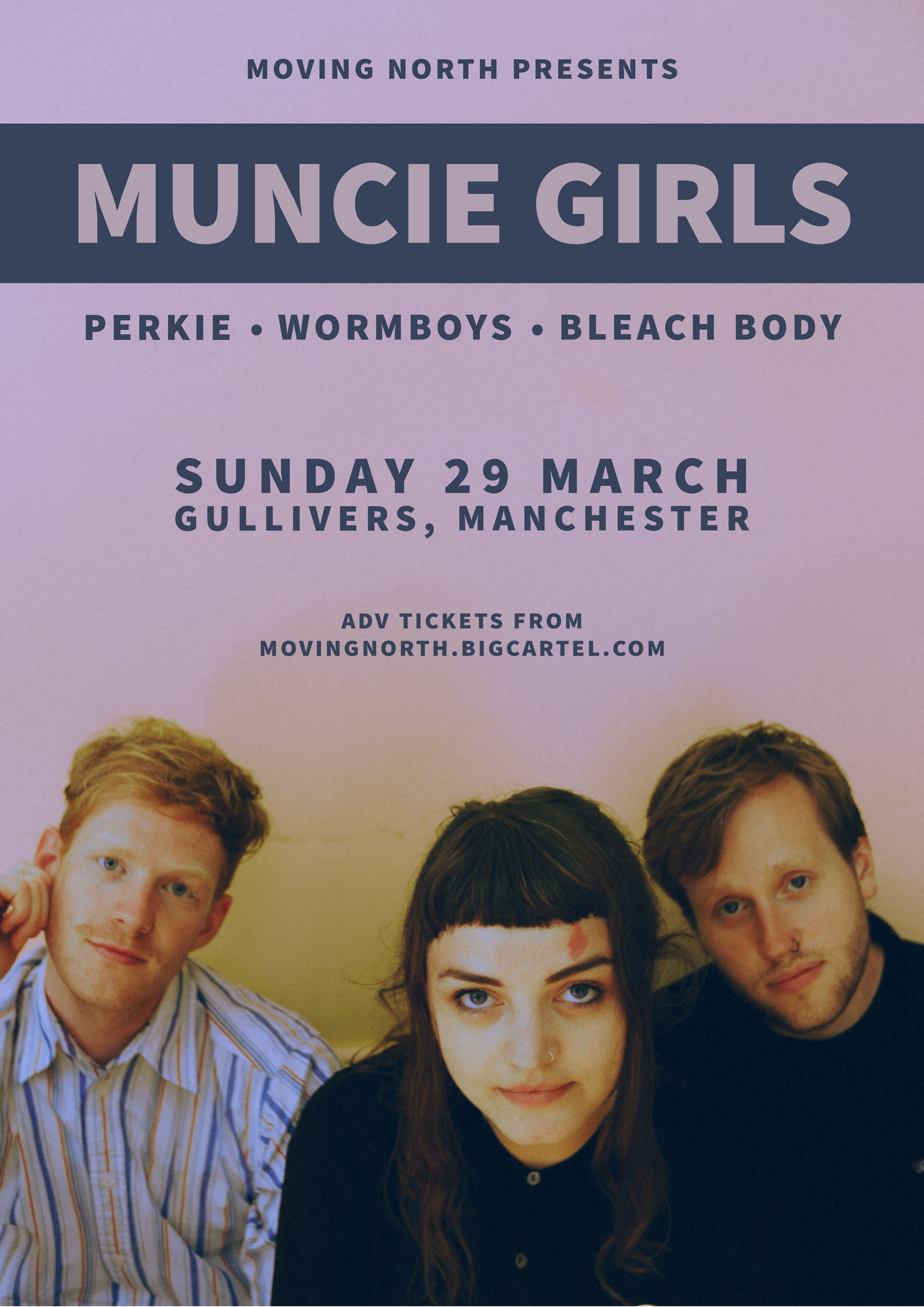
Muncie Girls poster
Sunday 29th March
Gullivers, Manchester

I’ll be playing bass in fuzzy pop rockers wormboys at this super cool gig where we are supporting Muncie Girls!

We’ll also be playing alongside the awesome Perkie and Bleach Body.


Wednesday 22nd April
Wharf Chambers, Leeds

Another exciting wormboys gig – we will be supporting DIY supergroup Somnia on their UK tour.


Concerts in Coventry: 24th June, 29th July

I’m involved in organising two exciting events at Coventry’s Tin Music and Arts over the coming month.

This coming Saturday sees the return of feminist club night Revolt, complete with bands, DJs, spoken word, zines and our Feminist Library. I’ll be opening the night with my band Dispute Settlement Mechanism.

For tickets and more info, click here.

Revolt #10
On Saturday 29th July we’ll be treated to a performance by CN Lester, who will be performing songs from their new album Come Home and reading from their great new book Trans Like Me.

For tickets and more info, click here.

CN Lester.png
Entry will also be available on the door on a donations basis (suggested donation £5, but no-one will be turned away for lack of funds).