Podcast: Who Who Is Wes Streeting and Why Is He Like That?

Last month I returned to the fabulous Red Medicine podcast to talk all things Wes Streeting. I joined the socialist writer Jonas Marvin and host Sam Kelly to discuss the UK Secretary of State for Health and Social Care’s political background, possible motivations, and current challenges.

Red Medicine always offers a great deep dive into health-related topics of the day. Streeting’s alignment with transphobic pseudoscience and conversion proponents means that obviously I had a lot to say about his impact on trans healthcare. However, our conversation was offered a great opportunity to grapple with the wider context of Streeting’s ideology and actions, discussing wider matters such as class, party politics, and trade unionism: highly relevant given current discourse around the proposed strike by resident doctors! I also talk a little about my encounters with Streeting in the 2000s, back when I was a campaigner with the National Union of Students’ LGBT and Women’s Campaigns.

You can listen to Red Medicine through all the major podcast platforms – or through the link below.


You can also hear me talking about the Cass Review on a previous episode of the podcast in June 2024.

Free resources: Perinatal care for trans people

On 8 February 2021, Brighton and Sussex University Hospitals NHS Trust published a series of groundbreaking resources on perinatal care for trans people, written by their Gender Inclusion Midwife team. As of March 2025, the Trust no longer exists, the midwives in question work elsewhere, and the resources page was sadly taken down – a sadly all-too common experience with NHS guidance for working with marginalised peoples.

Given the importance of these materials, for which I was part of a large team of expert reviewers, I am reproducing them on my website today for Trans Day of Visibility 2025, alongside some related resources.

I hope these will be of interest and use to anyone interested in improving perinatal care for trans people, including midwives, nurses, doctors, policymakers, commissioners, advocacy groups, and of course also families and prospective parents.

Professional guidance and protocols by the Gender Inclusion Midwives

Perinatal Care for Trans and Non-Binary People

Gender Inclusive Language in Perinatal Services


Information, forms, and materials for birth parents by the Gender Inclusion Midwives

Support for trans and non-binary people during pregnancy, birth and the postnatal period

Referral to Gender Inclusion Midwives

My language preferences

Pronoun stickers

Poster: Gender Inclusive Perinatal Care


Additional materials

It’s been a long four years since the Gender Inclusion Midwives resources were published. Here, therefore, are a few additional materials that may be of help to people working in this area.

National Maternity Survey data on trans birth parents
Since 2021 the Care Quality Commission has collected data on gender modality as part of its annual National Maternity Survey. The most recent findings indicate a significant rise in the number of men and non-binary people giving birth since 2021, with 1.58% of 2024 respondents indicating a gender that differs from the sex they were assigned at birth. This shows that hundreds of trans people are giving birth in England every year. See: Open data > 2024 Maternity survey National tables > page g9.

Inclusive language statement from the Royal College of Midwives
2022 statement affirming both that a majority of RCM members and service users are women, and that diverse gender identities should be recognised in midwifery.

Improving Trans and Non-Binary Experiences of Maternity Services (ITEMS)
2022 report published by the LGBT Foundation, looking at the findings of an English study on the experiences of 121 trans people who conceived and gave birth. It found that many trans birth parents do not feel safe sharing their identity in perinatal services, with a large proportion not feeling comfortable to access any support at all from an NHS or private midwife.

Trans Pregnancy Project website
I reviewed the Gender Inclusion Midwives resources as part of my work on the Trans Pregnancy Project, which was an international study of trans people’s experiences of pregnancy and childbirth. This year we launched a new website. This includes links to all our peer-reviewed publications, on topics including conception, pregnancy loss, midwifery, gender and embodiment, domestic violence, racialisation, and media representation.

Caring for Everyone: Effective and Inclusive Communication in Perinatal Care
One of the key recommendations of the Gender Inclusion Midwives’ guidance on Gender Inclusive Language in Perinatal Service is the adoption of “additive” language. This approach acknowledges male and non-binary birth parents alongside mothers, rather than simply replacing woman-centred language with a gender-neutral approach. This 2025 academic article by Matthew Cull, Jules Holroyd, and Fiona Woollard provides advice on a “pluralist” approach to language, which builds upon the additive model by offering a more contextual approach. It includes clear examples of what best practice can look like.

Image of poster on gender inclusive perinatal care. For version accessible to text reader, see download link above titled Poster: Gender Inclusive Perinatal Care.

New article: ‘Why Is the Chubby Guy Running?’

2024 has been a good year for the publication of articles I’ve been working on with colleagues for a long time. Hot on the heels of recent pieces on microaggressions and domestic violence comes the latest peer-reviewed work from the Trans Pregnancy Project, published in the Journal of Applied Philosophy. It’s open access, which means you can read it for free or download a copy to share here:

‘Why Is the Chubby Guy Running?’: Trans Pregnancy, Fatness, and Cultural Intelligibility
by Francis Ray White, Ruth Pearce, Damien W. Riggs, Carla A. Pfeffer, Sally Hines

The article opens with the titular question, “why is the chubby guy running?” – drawn from a story shared by a research participant who ran a 5k race while thirty-nine weeks pregnant. We use this as the starting point for exploring the topic of fatness in respect to trans men and non-binary people who experience pregnancy, addressing the gendering of both pregnancy and fatness, stereotypes associated with fat men, and how certain bodies become legible or intelligible.

Cover of the Journal of Applied Philosophy.

A lot of research participants in the project described complex relationships to fatness during their pregnancy, especially where their bump was inaccurately read as a “beer belly”. The writing of this article was led by fat studies expert Francis Ray White; I really appreciated the opportunity to work with them on making sense of these stories, and thinking through what they might mean both for trans birth parents and for our understanding of gender and pregnancy more widely.

This is likely to be one of the last published works from the Trans Pregnancy Project (although we do have at least one more article on the way!)

The project originally wrapped in 2020, but we had such an enormous amount of data that we’ve been writing it up ever since since, addressing topics including media representation, midwifery, conception, pregnancy loss, sperm donors, testosterone use and cessation, racialisation and whiteness, partner abuse, and young people’s views about possible pregnancy. I’m grateful as ever for the trust offered to us by the research participants, and hope we can continue to expand and evidence society’s understanding of their experiences.

International Trans Studies Conference Day 3: gaming, representation, and transnationalism

This is the fourth in a series of blog posts about the 2nd International Trans Studies Conference in Evanston (4-7 September 2024).

Read Part 1 here.
Read Part 2 here.
Read Part 3 here.

I started writing this posted back in bonnie Scotland! Back to work, back to endless emails, back to doing my absolute best that all the masters dissertations are marked in good time. I finished it on an aeroplane to Lisbon, for my second major international event of September: the 2024 World Professional Association for Transgender Health Scientific Symposium, and am posting it from a conference centre in Lisbon.

As such, and as you might have noticed, I have slowed down with my writeup from the International Trans Studies Conference. Still, I have plenty more notes and reflections, and hope to continue writing these up over the next week or two.

My conference account left off halfway through the morning of the third day. After the sheer emotional onslaught of the session on political economy (no, really) I decided to slow the heck down and not rush off to the next talk. I went to the front desk where I managed to catch two of the conference organisers, Avery Everhart and Erique Zhang. I’ve known Avery and Eri online for years and long admired their work from afar, but we’d never previously met in person. I have really, really missed making these deeper human connections at conferences. Much as the organisers were clearly exhausted from firefighting technical and access issues to keep the conference running, it was wonderful to meet them and take time for a chat.

I therefore missed the first two papers from the next session I attended. This was a bit of pity given how amazing the rest of the session was, but self-care is important, and I regret nothing!


B{ending} Trans Game Studies

I don’t really do any work in game studies, so chose this session mostly because it seemed fun, and interesting. An opportunity to expand my horizons. This was the right choice – I had an incredible time. 

I turned up partway through a presentation from Madison Schmalzer of Ringling College of Art and Design (USA), titled Circuit Bending, Trans Play, and the Death of Game(!) Schmalzer introduced circuit bending as a practice of “tinkering and seeing what happens”. Examples from her art, research, and teaching included rebuilding children’s keyboards, and messing with old Mario games to create something entirely new. Controls shifted, the sky changed colour, characters ran unexpectedly across the screen. Through the destruction and reconstruction of corporate entertainment products, students discovered entirely new modes of play.

Analysing this process, Schmalzer drew parallels between digital games and social constructs including gender and race. She argued that circuit bending raises important questions about digital products, such as: why does this game exist? whose interest does it serve? And finally: how might we “bend” other social systems in the same way that we might do with games?

Some possible responses to these questions were offered in the next paper: “We Can A̶l̶w̶a̶y̶s̶ Never Tell”: Giggling Faces, Gender Machines, And Un-Recognizing Play, by PS Berge of the University of Albert (Canada). Berge introduced the concept of “ludoarsony”, which variously refers to breaking, burning, or destroying a game (including technical or cultural rule sets), or to playing with fire, creating and playing through the act of destruction. Berge posited that ludoarsony, like play more generally, is a trans thing to do: “play and transness are of kin: both are transformational movements that weave in and out of rigid cultural and computational systems that they are ultimately ambivalent to”.

Berge’s paper drew on a number of case studies in which trans people play with the claim commonly made by transphobes that “we can always tell”: the notion that trans people are inherently clockable as such, that we are always reducible in behaviour and appearance to our sex assigned at birth. The first of these was Giggle for Girls, the now-defunct trans-exclusionary social networking app “for females” (recently central to the groundbreaking discrimination case Tickle vs Giggle…no, really).

Giggle’s verification system for female users relied on so-called gender-recognition technologies. Berge observed that on launch, Giggle was not simply criticised by trans people, but also played with. Examples included trans women testing the verification system (“I’m proud to announce that apparently I’m cis now. I’d like to thank Satan”), and revelling in negative reviews from cis women who were not recognised as such (e.g. “I can’t even access this app […] I was so looking forward to a female-only space, but now I just feel alienated. Thanks for that.”).

Further undermining the logic of “we can always tell”, Berge discussed the work of algorithmic artist Ada Ada Ada, showing us an example of a video in which the artist changes the response of facial recognition software in real time by pulling different expressions. Ada Ada Ada followed this up with “The Misgendering Machine”, an app available to anyone with a phone camera or webcam, which encourages people to play with how they are gendered by the machine.

Berge concluded by arguing that there is play in the unmaking, and to find play in the unplayable helps us find life in the unliveable: “we do not play in spite of the world being on fire – we play because the world is on fire”. Central to this is a project of mutual recognition: “we can never tell”, an acknowledgement of the ways in which we are all fundamentally unknowable, a promise not to rat each other out.

My horizons suitably expanded, I headed out to grab lunch.


Picturing Trans: Studies of Trans Visual Culture

In the afternoon I again wanted to attend a session that offered a different perspective to the material I normally encounter in my work on trans healthcare, both to expand my horizons and take something of a break from the slow creeping horror of my own area. So I want to a session on trans visual culture.

The first two talks offered radically different perspectives on trans people’s self-representation: one looked at self-portraits of trans bodies, and the other very intentionally looked at why we might avoid portraying our own bodies. The third talk then looked at how we might be represent and be represented by other trans people.

In Beyond Representation: Photographic Methods in Trans Myth-making, June Saunders of Washington State University (USA) offered a beautiful, poetic reflection on trans photography and representation that elides direct representations of our bodies. Saunders presented numerous images of landscapes, buildings, and everyday medical paraphernalia to accompany her talk. She encouraged us to be present in the moment without our devices, reflecting the themes of the presentation.

Sanders focused on how we might sit within and create photography that captures specific experiences and moments in time, without simply using this to produce commodifiable content. She examined the tension between the power of self-representation and exploration on the one hand, and the use of images in the service of surveillance and control on the other.

Ace Lehner of the University of Vermont (USA) looked instead at bodily self-portraiture in Transing Identity in Contemporary Photography: Zackary Drucker and Rhys Ernst’s Relationship. Noting that trans visual culture has played a crucial role in political representation and social change since the 1990s, Lehner looked at the “accidental” historic art project undertaken by Zackary Drucker and Rhys Ernst as they depicting their transition and relationship. Echoing Berge’s morning presentation on trans play, Lehner argued that trans visual culture can enable us to challenge dominant cultural logics that assume seeing is uncomplicated, and that we can easily read gender, sexuality, and race onto images.

Given the enormous number of contemporary visual transition diaries posted online by transmasculine people, it was interesting to hear Lehner argue for the importance of work by artists such as Drucker and Ernst in the 1990s, when transmasculine individuals were often ignored or erased in the media. Of course, as Lehner noted, transfeminine people have hardly benefited from historical media interest in bodies, which are sensationalised as objects of heightened sexualisation, and non-consensually aligned with dominant cultural ideologies.

The final presentation in this session was by AC Panella of Santa Rosa Junior College (USA), titled I Got 99 problems and Objects of Trans Memory Are Some of Them. Panella asked what we are teaching each other about what it means to be trans and “do” transness, especially given the limitations of existing trans archives. Said archives are typically derivative of lesbian and gay archives in their approach, and/or subsumed within wider LGBT collections, leading to misguided ideas about trans history. They can also contribute to US-dominated approaches to trans history, with celebrations of Pride (for instance) often marking Stonewall, rather than localised celebrations of trans uprising. These issues are compounded by the economic insecurities experienced by many trans people, with housing issues (for example) meaning individuals are less likely to hold on to items from their past. This spoke to a conversation I recently had with a fellow activist who lost much of her personal archive during a period of homelessness.

Panella outlined how these issues might be addressed through localised community projects, and the involvement of artists. The presentation included several examples of Latinx trans projects in Mexico and the west coast of the USA. They incorporated approaches including community storytelling through writing and arts workshops, intimate portraits of people in their homes, and memorial or celebratory pieces (e.g. fashion displays) based on the lives of community members that activists felt were important to remember. In this way, it is possible to create archival material which captures the complexity and nuance of local experiences, tying these both to cultural history and to contemporary struggles.

Transnationalizing Trans Studies: Building a Truly Global Field

The final session of the day was a plenary panel in the main conference hall. Titled “Transnationalizing Trans Studies”, it offered a refreshing alternative to the North American perspectives that dominated much of the conference, but also once again highlighted the limitations of the conference’s internationalism. We were meant to hear from a scholar-activist in Zambia – the only planned plenary speaker from Africa – but unfortunately she was unable to join us due to energy shortages. I truly hope future events can address this oversight: a matter addressed by the chair, Francisco Fernandez Romero (University of Buenos Aires, Argentina) in his introduction.

The panel therefore featured three speakers who responded to questions from Romero: Madi Day of Macquerie University (located in what they intentionally highlighted as the occupied territories named “Australia”), Alyosxa Tudor of the School of African and Oriental Studies, University of London (UK), and Michelle Ho of the National University of Singapore (Singapore).

The discussion opened with a question from Romero about what trans studies looks like across these contexts. Day began by explaining that, as an Indigenous scholar, they approach the field from an Indigenous studies perspective. They emphasised that Indigenous studies should not be understood as the study of Indigenous people, but rather as a critical examination of the colonised world. This approach understands settler colonialism as a global apparatus, with some Indigenous lands directly occupied (as with Australia), and others exporting their resources to the colonial centre (as Romero described earlier in the day with reference to Argentina). In this context, “colonialism is the condition of possibility”. Day therefore distinguished between white settler trans studies in Australia, and Indigenous trans studies. They spoke to the importance of drawing (appropriately and with due credit) on Indigenous approaches in trans studies, to better address the problem of material from the Global South being always used as data, and never as theory.

Tudor spoke to their context as an academic of Eastern European heritage living in the UK. They argued for a transnational approach to trans studies that goes beyond the “national” in understanding global-local connections, and embraces anti-nationalist principles, insisting that transnationalism is “not about all the small nations sitting down with the big ones for a nice chat!” This is important for interrogating discourses of Eastern European exclusion in trans studies: simply creating a series of national sub-fields is not an adequate solution. Relatedly, Tudor emphasised that a transnational trans studies cannot escape the current moment of genocide in Gaza, and must name the violence inflicted on the Palestinian people.

Ho discussed questions of multiple marginalisation. Citing the TSQ: Transgender Studies Quarterly special issue “Trans in Asia, Asia in Trans”, she observed that trans studies remains marginal in Asian studies, just as Asian experiences are marginal within in US-dominated trans studies. She also emphasised the difficulties of difficulty of translation in terms of both language and experience, with an enormous diversity of “trans” possibilities present across the Asian continent.

Romero followed these comments with questions that followed up on the topics of translation and transnationalism. Day argued that if trans studies is to be truly transnational, the goals and ambitions should be determined the global Southern majority. The problem in only calling on Indigenous knowledge when it’s directly relevant to Indigenous experiences is that you maintain a colonial viewpoint: if you are a white settler leading a research project, group, or institution and are not actively resisting settler colonialism, you are conducting a white settler project.

Day highlighted how shared experiences across Indigenous communities in different parts of the world have informed shared resistance and productive modes of thinking, and asked: “what would happen if we started thinking of transness as an identity rather than an identity?” But to be in a community, you need to act like a community. Community is non-extractive, and if you have more of something, you need to use it to help others.

Tudor returned to the question of nationalism. Contrasting with Day’s account of community, Tudor argued that nationalism rests on logics of opposition and competition, and resists complexity. In additional to critiquing white, Western nationalisms, they observed that decolonial, diasporic, and minoritised nationalisms also deserve scrutiny, as contemporary counter-hegemonies may become future hegemonies. That is to say: a people’s historic experiences of violence and oppression may not present future violence against others in the name of a new nation, as seen in the example of Israel. Tudor suggested that queer and trans studies might offer a vehicle to highlight the violence of nationalism, through challenging and deconstructing categories, from gender to nation. In this context is important that decolonialism is a mode of action, not a metaphor. Tudor noted they have used their platform as an academic speaker to highlight the growing death toll on Gaza, but this kind of speech act alone is insufficient: “it is clear none of my previous papers have saved a single life”

Ho focused especially on the topic of translation, exploring what might get lost through simply assuming that the language of one context might adequately explain another. She emphasised that to be adequately in conversation with a context, we need to learn their language and culture. This creates real problems for “international” publishing in the English language. Echoing Day’s comments earlier in the plenary, Ho noted the pressure to use Western theory to analyse Asian case studies, and described how a peer reviewer insisted that there were too many “non-English words” in her manuscript: the implication being, “can you do something to avoid alienating your largely US readership?”

Ho concluded by reflecting on the difficulties in attempting transnational approaches to trans studies in Singapore. What compromises are necessary in a very conservative society? She described the example of trying to get funding to bring in a trans studies scholar to speak at her institution, noting that the question is in part one of framing: “I could invite Jack Halberstam to come, and say ‘Jack Halberstam is an established scholar in cultural studies’”. However, given how Western-centric “transnational” scholarship is, this strategy is more effective with US academics than, for example, experts from India. Ho ended with two open questions for us to consider: if trans studies is effectively underground in a specific context, can it be considered trans studies? And how can Western scholars learn from people in these contexts?

The following Q&A session included some interesting reflections on the binary of Global North / Global South given the experiences of Indigenous people in settler-colonial nations. On this note, Day stated their appreciation for the Trans Studies Conference operating within established protocols for Indigenous engagement, for example through inviting Indigenous contributors to speak first: this could be seen both in Kai Pyle’s opening statementson the first day of the event, and in the structure of this very plenary.

New article: Trans Birth Parents’ Experiences of Domestic Violence

Through 2018 and 2019, I travelled across the UK and Germany to speak with trans men and non-binary people about their experiences of pregnancy and childbirth.

These research interviews for the Trans Pregnancy Project took place in kitchens, living rooms, and cafes, next to canals and rivers. We covered topics ranging from conception to pregnancy loss, taking in questions of masculinity and the body, relationships with family, friends, workplaces and social groups, interactions with medical practitioners, and people’s journeys through perinatal services.

I remain deeply honoured to have been trusted by participants to share and analyse their stories. The questions planned by our project team touched on deeply intimate and sometimes traumatic experiences, as well as joyful accounts of kinship and bringing new life into the world. These were by design long, deep discussions, covering a great range of issues that have been rarely discussed in academic literature to date.

And sometimes, an unexpected conversation would happen.

We – the research team – did not plan to study domestic violence. Instead, this topic was introduced by research participants. I will never forget the first time this happened, silently putting aside my planned questions as the man in front of me quietly, carefully disclosed what had happened to him, and how it intimately shaped his experience of pregnancy.

As others shared their stories in turn, I began to realise just how important these narratives are, and the need for peer-reviewed work that explored them in detail. The resulting article is now available following a long gestation period (pun intentional). I hope it will useful to a range of practitioners – educators, crisis workers, midwives, obstetricians, doulas, family doctors – as well as to academics and, most importantly, community members.

Read now for free:
Trans Birth Parents’ Experiences of Domestic Violence
Conditional Affirmation, Cisgenderist Coercion, and the Transformative Potential of Perinatal Care

by Ruth Pearce, Carla Pfeffer, Damien W Riggs, Francis Ray White, and Sally Hines


I am also really pleased that we have published in the “platinum open access” journal Bulletin of Applied Transgender Studies. Launched in 2022 and hosted by Northwestern University Libraries, the journal is free to publish in and free to read, with articles shared under a creative commons license. We found this publication route offered an extremely rigorous double-anonymous peer review that really challenged us, and ultimately strengthened our arguments and use of evidence. Given the exploitation and profiteering that is rife in the academic publishing industry, supporting new journals such as the Bulletin feels like an important political move as well as the right scholarly decision.

Journal logo

Please do share this article in any context you feel it will be helpful to others. Remember, under the license anyone can distribute it as-is for non-commercial reasons: so download, print, and pass it around to your heart’s content.

My speech on the Cass Review and Scotland’s trans healthcare ban (with footnotes!)

This post shares a video and transcript of my speech at the emergency demonstration in George Square, Glasgow, on 18 April 2024, against the decision from NHS Greater Glasgow and Clyde to ban endocrine treatments for trans people aged under 18. The speech was unplanned and made without notes, so I have made some small corrections in the transcript, plus minor amendments for clarity. I have also added references for some key points. Thank you to @transprotestglasgow for the video.

Readers seeking more detailed evidence and academic critiques may find my previous blog post helpful: What’s wrong with the Cass Review?

TRANSCRIPT

Hi, I’m Ruth Pearce.

I’m a Lecturer in Community Development at the University of Glasgow, and I’m a researcher on trans healthcare.

And I was a trans child.

I want to talk about that for a moment. Because I came out to myself circa 2001, when I was 15, when not many people did that. And it was hard for us. And there was trans community, and there was information, but it was very difficult because we felt very, very alone. I was mostly only able to connect with other trans people my age through the internet, through blogs, and they were mostly Americans. The Brits were there; a lot of us connected later as we grew older. But we were so isolated.

A really important thing to remember, in a moment like this where we are seeing a return to the kind of medical policies that were in place when I was a kid: there are so many more of us, and we are so much more powerful than we have ever been.1 Never forget that strength we have together.

One of the things Hilary Cass says in her report is that the meaning of the word “trans” has changed since 2020.2 She says, and there is no evidence for this, that “trans” in 2020 meant something quite rigid and specific, and only now in 2024 it’s become an umbrella term for lots of identities. Tell that to me coming out as a trans teenager in 2001!

So here’s the thing. We’ve always been here, and we are more powerful now, but we are seeing this backlash. That’s been a long time coming and transphobia changes its face over time. One of the things I wanted to do to deal with my loneliness and the experiences I had was that I wanted to become an activist. And when I started doing activism, when I got into meetings with people in government, and with the Equality and Human Rights Commission, they said “there’s no evidence” for the discrimination we faced. So I was like, “fine: let’s see what evidence I can find”.

So I did a PhD in trans healthcare.3 And I found what you often find when you do research; you often find things you don’t expect. So I did find some things I expected to find. About waiting lists and how hard they are. About how hard appointments can be when you’re meeting with sexist and transphobic clinicians who are asking you, as a young person, how you masturbate and who you’re attracted to. But what I didn’t expect was the sheer level of pain from the waiting. And I talk about that in my work. And the anticipation, where we are anticipating all the time. When is it going to happen? When are we going to get to live our lives? And that happens on every level of our lives.

I was also shocked by the level, and detail, and complexity of the ignorance of healthcare practitioners. It ranges: it’s not just that they all hate us, right? It’s that some people are trying to control us, some people want to help but don’t understand how, and some people don’t want to know. There’s different kinds of ignorance.4

So I published my work, and other people have followed. Other people were there before me of course, because “trans” was not new, and trans research wasn’t new either. There is now a lot of published research on what it is like to go through a gender clinic, and what it is like for a young person to go through a gender clinic. There’s people like Cal Horton5 and Natacha Kennedy6 who are writing on this, and Harvey Humphrey7 who works here in Glasgow. There’s a lot of people doing work on this.

We are saying, time and time again, “we need services that meet our needs”. For some people, that is access to puberty blockers, and that is access to hormones. For other people, that is access to counselling, and therapy, and community support. What we call “trans-affirmative” or “gender-affirmative” care is flexibility, meeting a person where they are at, and based on what they want to do with their lives.8 You don’t have to change your body – but you can.

It’s our body, it’s our right: we can do what we want with our own bodies.

This is what is disgusting about the decision by NHS Greater Glasgow and Clyde. They have not addressed the years and years of mistreatment and abuse in their child and adolescent clinic at Sandyford. It is not a great place that we are trying to save. It is a clinic that has repeatedly refused to treat young people, and made people hold on for care. It has helped a handful of people. Dozens of people – only dozens – have accessed treatment in the last few years.9 Now they are proposing to stop doing the very little they are doing to support young trans people.

People who get a referral to a child and adolescent gender clinic are not necessarily seeking access to counselling and therapy, because you can get that elsewhere.10 They are not seeking access to community, because you will find no community at Sandyford. They are most likely seeking access to endocrine treatments: puberty blockers and hormone therapy. And that’s what they are going to stop doing.

Sandyford say they are still accepting new referrals. But what is the point of a gender clinic that does not offer people medical treatment?

NHS Greater Glasgow and Clyde have based their decision on the final report of the Cass Review. Let’s talk a bit about the Cass Review.

I’m an academic researcher. If the Cass Review was submitted by an undergraduate student, the first thing I would say is: “That’s nearly 400 pages long! No-one’s going to have time to mark that”.11 And you’ll notice that all the people in the media, all the Labour politicians, all the Tory politicians, all the people saying we should immediately implement the findings of the report: none of them read nearly 400 pages in one day. Neither did the journalists at the BBC, the Telegraph, the Times, the Daily Mail, the Observer, the Independent. We expect better! And now the Scottish media: it’s all over the Scotsman, the National, the Herald. None of them have bothered to read the report, or think about it critically.

So here’s a bit of information about the Cass Review. The Cass Review was undertaken by a group of people who, from the very start, excluded trans people from oversight of the project. That was in their terms of reference.12 They didn’t want people who had experienced services having a formal part in the report. They excluded healthcare experts. If you were someone who had worked in a gender clinic you were excluded from being part of that.13 You know, I have lots of disagreements with many people who work in gender clinics, but you would have thought they might get a say.

You can see that ignorance, that intentional ignorance, playing out in the final report of the Cass Review. You can see, if you read the Cass report, that they looked at over 100 studies, most of which show that puberty blockers and hormone therapy can help young trans people. And they just ignored them.14 Intentionally. They say that the majority were not “high quality evidence”.15

What else is not high-quality evidence in healthcare? Paracetamol for back pain.16 There is no high quality evidence for that, in the terms of the Cass Review. Anti-psychotics.17 ADHD medication.18 All these medications that are in regular use. You know what else? Puberty blockers for young people with precocious puberty – if they’re cis.19 That is direct discrimination. 20

The thing is, that’s the Cass Review being serious. Let’s think about when it gets weird.

There’s a graph in there, where they show referrals to a gender clinic (the Gender Identity and Development Service in England) rising year on year, with “an exponential rise in 2014”. But they cut the graph off at 2017. But if you look at 2017-2020 the referral rate flattens off. It’s deliberate removal of evidence.21

We know why this is happening. Experts – medical experts, and experts by experience have been cut out of the Cass Review process. If you are trans, that’s you. You are an expert by experience. You know what it’s like. We have been cut out the process!

And the NHS have done that here in Scotland. There was no consultation on the ban that’s come in.

Who did they consult? We know there are people who are proponents of conversion therapy who were on the Cass Review team.22 That is what they are proposing.

They are proposing conversion therapy. Not just for trans kids, because they want to deal with all gender-questioning and non-conforming kids. This is going to be conversion therapy for queer kids. Little boys who want to wear a dress, they might not be trans, but they deserve to have the space to explore. That is not going to be what happens in clinics where people are referred which are being informed by conversion therapists.23

So consequently you have other weird stuff in the Cass Review. They’re dismissing all the evidence about why puberty blockers and hormones can benefit people within particular contexts, but they’re relying on other evidence for their recommendations. Let me give you one citation. “Thoughts on Things and Stuff, 2023”. That is a citation from the Cass Review: Thoughts on Things and Stuff.24

What is “Thoughts on Things and Stuff”? It’s a right-wing Youtube channel run by anti-trans bigots,25 featuring contributors such as “Gays Against Groomers”.26 This is the level of evidence that is informing NHS Greater Glasgow and Clyde.

And I’ll tell you what else is in the Cass report. They say that little girls are likely biologically inclined to play with dolls. It’s right in there, in the Cass report.27 And little boys are probably biologically inclined to play with trucks. Why is this? It’s not just an anti-trans agenda. It’s an anti-feminist agenda. Its an anti-woman agenda.

Why is this happening? It’s happening because trans people are an easy target.

If you want to stop young people accessing contraception as teenagers, you remove trans people’s right to consent to care as young people. If you want to prevent young people – teenage girls – from having abortions, and you’re failing time and time again in the courts, you instead target puberty blockers, because that way you can set a precedent for preventing people from being able to make decisions as young people. You are undermining the idea that young people might have the capacity to consent to care and make an informed decision about their own bodies.28

So I will end on this. I’m a woman, I’m a trans person, and I think it’s really important we think about allies. I had the parent of a trans child contact me and say, “thank you for being an ally”. I want to think her for being an ally. The thing about allies is, we talk a lot about an “ally” being someone who supports somebody else. But no: allies are people who stand by each other and work together.

That’s why we need a trans feminist movement. A trans feminist movements gives people autonomy over their own bodies, space to make their own decisions, and enables people to stand together when we are all at risk.

So I’ll leave you with a chant I want to hear more of at protests:

“Trans rights, women’s rights: one struggle, one fight”.

FOOTNOTES

  1. My statement here is intended to highlight that more people are out as trans than ever before. Contrary to narratives of “social contagion”, there have always been people with gender diverse or sex nonconforming experiences. What has changed is that there is greater access to information and community, which makes it easier for people to come out. ↩︎
  2. “During the lifetime of the Review, the term trans has moved from being a quite narrow definition to being applied as an umbrella term to a broader spectrum of gender diversity. This clearly has implications for conceptualisations of detransition” (Cass et al., 2024, p.187). This claim is demonstrably false, as “trans” (and before that, “transgender”) has been used as an umbrella term for decades. This is shown in my own previous work as well as writing dating back to at least the 1980s by individuals such as Leslie Feinberg. ↩︎
  3. https://wrap.warwick.ac.uk/88285/ ↩︎
  4. For an excellent, more recent and more detailed analysis on this topic in the context of trans youth healthcare, see Magdalena Mikulak’s (2021) article “For whom is ignorance bliss? Ignorance, its functions and transformative potential in trans health“. ↩︎
  5. https://growinguptransgender.com/evidence/ ↩︎
  6. https://www.gold.ac.uk/educational-studies/staff/kennedy-natasha/ ↩︎
  7. https://www.gla.ac.uk/schools/socialpolitical/staff/harveyhumphrey/ ↩︎
  8. “Our stance, as gender-affirming practitioners, is that children should be helped to live as they are most comfortable. For a gender-nonconforming child, determining what is most comfortable is often a fluid process, and can modify over time. Therefore, in a gender affirmative model, gender identity and expression are enabled to unfold over time, as a child matures, acknowledging and allowing for fluidity and change” (Hidalgo et al., 2013). ↩︎
  9. “Since 2018, around 1.77% of young people who are referred to the gender care services at Sandyford have gone on to be prescribed puberty blockers”: https://www.thenational.scot/news/24262271.many-young-people-scotland-given-puberty-blockers/. ↩︎
  10. Although in practice, trans people are often also turned away from mental health services due to “trans broken arm syndrome“. ↩︎
  11. In my original speech, I inaccurately stated that the report was “500 pages long”. However, my point about requiring time to carefully consider its contents remains. ↩︎
  12. “The original published Terms of Reference (ToR) for the Cass Review’s assurance group explicitly excluded trans expertise, stating that it “deliberately does not contain subject matter experts or people with lived experience of gender services” [Report 1, version 1]. The current (updated) assurance group ToR is worded less clearly, yet still conveys exclusion of those with expertise or lived experience, as such individuals would naturally be expected to have an interest in the outcome of the review” (Horton, 2024: p.7) ↩︎
  13. One former gender clinician was involved in the research process: Tilly Langton, formely of England’s Gender Identity Development Service (GIDS). Langton’s recent activities include promoting conversion therapy materials in training for NHS psychiatrists and lobbying Kemi Badenoch about the UK government’s conversion therapy ban, alongside proponents of conversion practices. ↩︎
  14. Hilary Cass has contested this claim in reporting for the BBC. Her argument is that of the 103 studies analysed for the review, 60% were included in the synthesis of evidence. However, my argument here is specifically that the findings of these papers were broadly ignored in the writing of the report’s recommendations, while less robust material was instead prioritised. As Simon Whitten argues, “The majority of moderate certainty studies were included in the results section but then arbitrarily ignored in the conclusion entirely”. ↩︎
  15. I have removed a statement I made about randomised control trials from the transcript here as my point was unclear and therefore potentially misleading (as can happen when you do an unplanned speech on a complex topic!) Unlike the Cass Review team, I am keen to correct my errors. See the links in the above footnotes above for more detailed information on inclusion/exclusion criteria for the Cass Review. ↩︎
  16. See e.g. https://www.nps.org.au/news/is-paracetamol-effective-for-low-back-pain. ↩︎
  17. The landscape of evidence anti-psychotics is a complex one. There is “high-quality” evidence that anti-psychotic drugs work better than placebos in addressing various conditions, but the evidence for use of multiple drugs, reducing or increasing doses at particular junctures in treatment, or taking one drug rather than another in treating specific conditions is often of a similar (or lower) quality than the evidence for benefits of endocrine interventions assessed by the Cass Review (see e.g. https://www.sciencedirect.com/science/article/pii/S0890856716319992). ↩︎
  18. Specifically in the long-term, see e.g.: https://www.nationalelfservice.net/mental-health/adhd/adhd-medications-effective-safe/. ↩︎
  19. https://onlinelibrary.wiley.com/doi/10.1111/cen.14410 ↩︎
  20. At this point, somebody stuck their hand up in the audience. I responded: “Someone stuck their hand up and might give me a footnote on that! I totally approve of that. I might invite you up later because I like evidence and I’m obsessed with it. [person indicates they were just waving to their friend, crowd laughs] Oh that’s grand! There we go, we haven’t even had a footnote.” Well, here is the footnote. ↩︎
  21. p.24 of the Cass Review final report. The rationale for this within the report is that the figure is adapted from a 2018 paper published in Archives of Sexual Behaviour. However, as Trans Actual observe: “The number of referrals to GIDS is known until 2020/21 […] the last 3 years for which data is available, shows that the number of referrals has recently plateaued. Such data is inconvenient for a narrative that relies on an inexplicable explosion in need[.]” ↩︎
  22. https://transsafety.network/posts/gender-exploratory-nhs-training/ ↩︎
  23. A historical example of treatment that “tries to make the child comfortable with the sex he or she was born with” within a gender clinic context can be found here: https://www.npr.org/2008/05/07/90247842/two-families-grapple-with-sons-gender-preferences. ↩︎
  24. p.70, used to evidence the activities of GIDS’ research team at a WPATH conference. They could have instead cited the conference website. ↩︎
  25. A good summary of the channel can be found in this piece by What The Trans: “When citing a recording from the WPATH 2016 conference, Cass uses a YouTube channel called Thoughts on Things and Stuff. This appears to be the associated channel of a now-defunct blog largely focussed on criticising the Mormon Church. Why this was relevant to Cass is unclear, although titles of recent uploads at the time of the WPATH video include “Dr. Stephen Levine: 13 Untruths Behind Gender Affirmative Therapies for Kids” (Levine is an advisor to Genspect) and “Gays Against Groomers: stop the indoctrination and medicalization of children. 2023 Florida testimony.”, which perhaps provides a clue to how Hilary Cass ended up citing a channel with only 22.4K subscribers. It thus seems that, in addition to being advised by and networked with a variety of prominent anti-trans figures and organisations, Hilary Cass appears to be getting her professional news from homophobic and transphobic YouTube channels.”  ↩︎
  26. Anti-gay campaigners have long attempted to position LGBTIQ+ people as a danger to children. In recent years this tactic has seen a resurgence, through positioning trans and queer campaigners as “groomers”. GLAAD have described Gays Against Groomers as a group who intentionally use “ambiguous messaging about characterizing LGBTQ+ people as pedophiles falsely and maliciously with the absolutely clear intent of driving fear.” ↩︎
  27. pp.100-101 ↩︎
  28. https://transsafety.network/posts/bell-v-tavistock/ ↩︎

Book publication and launch

Today sees the publication of my book Understanding Trans Health. I’m really happy to be finally sharing it with the world.

Yesterday I hosted a launch event at the University of Leeds. I felt really strongly that this was an opportunity not only to celebrate the book, but also to explore some of the other fantastic work happening in the field of trans health. One of the things I write about in the penultimate chapter of Understanding Trans Health is the importance of collaboration and building one another up – I wanted to help start a conversation that encompassed more than my own work, and give something back to others from whom I have learned so much.

De7WApQX0AQEM6r.jpg large

Photo by Rob Noon.

Zowie Davy and Michael Toze opened the event with a discussion of the term “gender dysphoria”. They have conducted a systematic review of literature on the topic, and found that there are huge conceptual differences in how the term is deployed and understood. This can lead to diagnostic confusion and issues with empirical claims, especially given the continued contemporaneous influence of alternative and older diagnostic languages. Davy and Toze have written an academic article based on this work which is currently under peer review; I very much recommend watching out for its publication. [Twitter thread]

Chris Dietz offered a fascinating insight into gender recognition reform in Denmark. He noted that the positive international press afforded to the country’s new gender recognition law contrasted with the views of many actual trans people in Denmark. Concerns were raised in particular about the contrast between the liberal provisions of the law, which enables a form of self-declaration, and the strict requirements of the Sexological Clinic, which has a monopoly on gender identity services. [Twitter thread]

Kate Nambiar argued for the importance of trans-led healthcare services. She touched upon the inspiring history of pioneering women doctors in the 19th century, before offering a nuanced analysis of what we do and don’t know about trans sexual health and why trans-led services offer an opportunity to address endemic issues. I was particularly inspired by the description of her work as part of the Clinic T team. While my own work has primarily explored the problems that exist within the provision of healthcare services for trans people, I feel it is deeply important to explore possible options for a better future. [Twitter thread]

My own talk offered a broad overview of my book’s central ideas and themes, as well as some illustrative examples from research participants, healthcare literatures and resources. I also touched upon what it means to become an “expert” from my own experience as a trans academic, and the sometimes severe challenges that come with this. Several attendees tweeted summaries of my talk, which I have linked below.One attendee also very kindly filmed sections of my talk, so these may be uploaded to the Internet at a later date.

Summary from @K_A_Longhurst

Summary from @Chican3ry

Summary from @LilithBrouwers

You can read more about the event on the Twitter hashtag #transhealthleeds. But ultimately, to learn more about my work, I encourage you to buy the book!

The success of Understanding Trans Health will depend in part on word of mouth, so if you find the book interesting or useful, please do write a review to share your thoughts! Similarly, if you work or study at a university, please do talk to your subject librarian to see if they can order in a copy.

As for the event, I would like to offer a huge amount of thanks to everyone who came, as well as to the School of Sociology and Social Policy at the University of Leeds for supporting the event, and to Sally Hines for her warm contributions as a fantastic chair.

Understanding Trans Health – available to pre-order!

Last month I finished writing my first book, Understanding Trans Health: Discourse, Power and Possibility.

This book reports on the wide-ranging research project I undertook from 2010 to 2017, looking at trans discourses and experiences of healthcare services in the UK. It will be of interest to academics, students, health practitioners and activists working and studying in the field of trans health, and will be published by Policy Press in June 2018.

Understanding Trans Health is available for pre-order it for £21.59 (paperback) or £60.00 (hardback) from the Policy Press website. E-book and Kindle versions will also be available soon. If you work or study at a university or college, it would be really great if you could encourage your library to order in a copy!

If you live in the Americas, you can buy it through University of Chicago Press.

I’ll be writing more about the book as the release date approaches. In the meantime, feast your eyes upon the stunning cover commissioned by Policy Press: an image that reflects continuing inequalities of access, the pain of waiting, and patient experiences of anticipation.

Understanding trans health

In other book news, myself and Igi Moon are still working hard on our co-edited volume, The Emergence of Trans: Essays on Politics, Culture and Everyday Life. We’ve had some really fantastic chapter submissions and I can’t wait to share more about this too in the coming months.

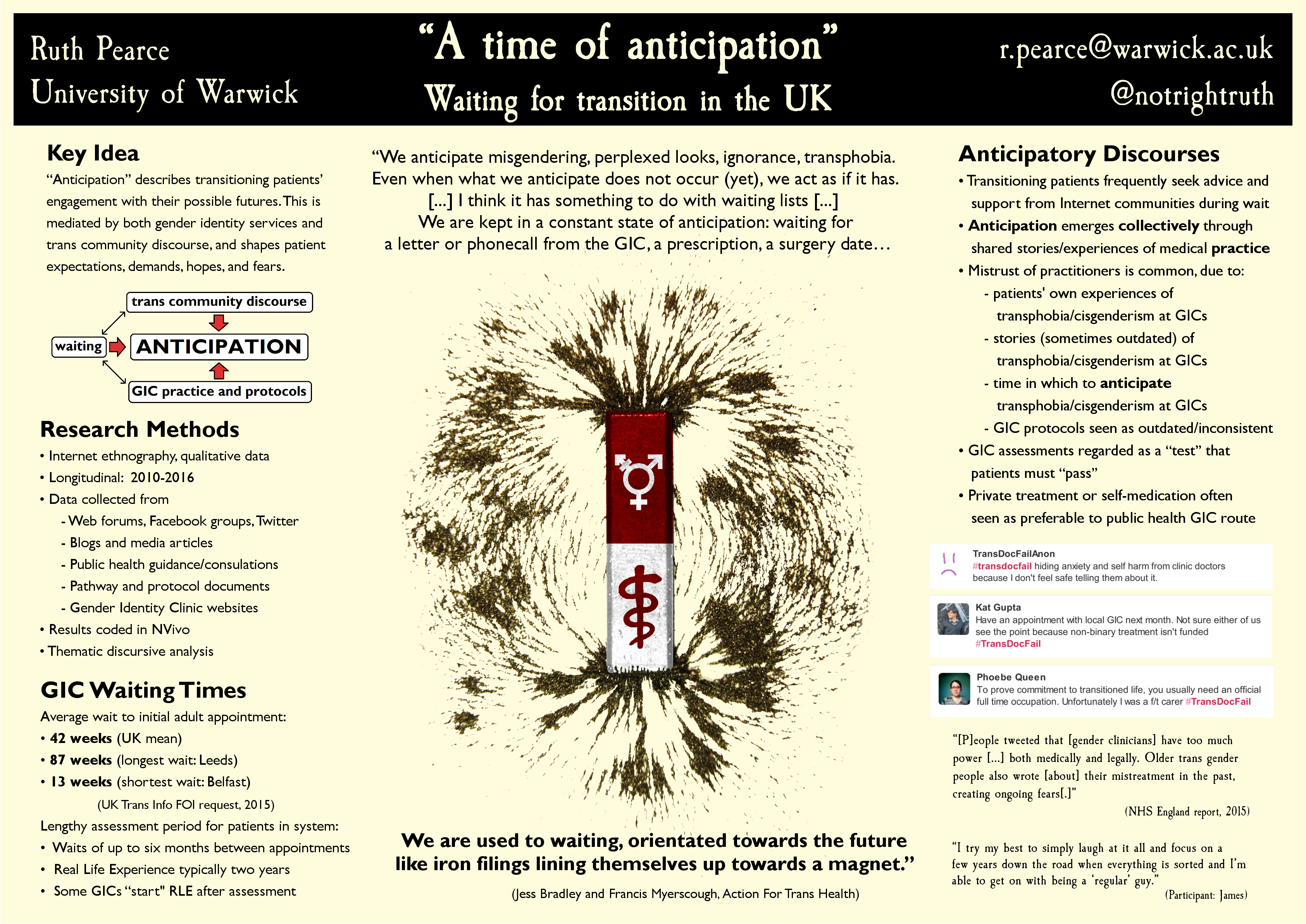
WPATH 2016 poster: “A time of anticipation”

Here’s the poster I presented at this year’s WPATH Symposium:

Anticipation poster.png

You can also download a PDF version here.

The magnet is a metaphor for anticipation, which is both a product of and shapes feelings, emotions and experiences of time. This process is mediated by both trans community discourses and medical systems.

It’s very important to note that the majority of research participants had good things to say about the health professionals who helped with their transition. However, there is also a high prevelance of transphobia and cisgenderism within medical systems and clinical pathways. Anxiety and mistrust of practitioners within the trans patient population is endemic, and this is compounded by long waiting times.

My wider research looks critically at how discourses of trans health are differently understood within and between community/support spaces, activist groups and the professional sphere; however, the purpose of this particular poster was communicate some of the difficult experiences that current patients have with waiting. It sparked some productive conversations and I hope that further work will follow from this.

Sources:

Transitional Demands (Jess Bradley and Francis Myerscough)

Experiences of people from , and working with, transgender communities within the NHS – summary of findings, 2013/14 (NHS England)

Current Waiting Times & Patient Population for Gender Identity Services in the UK (UK Trans Info)


Some tips on opposing Kenneth Zucker’s new article on trans children

This morning it came to my attention that notorious child psychologist Kenneth Zucker has co-written a chapter on trans issues for the new (6th) edition of Rutter’s Child and Adolescent Psychiatry. The chapter, entitled “Gender dysphoria and paraphilic sexual disorders” effectively draws upon flawed and outdated research to promote reparative therapy for trans children. You can read most of it via Google Books here.

Cover of Rutter's Child and Adolescent Psychiatry

Abusing children – for science!

This is a big deal because Zucker draws upon harmful theories (including Ray Blanchard’s deeply reductive typology of transsexualism) to promote the idea that issues faced by gender variant children are due to a problem with the child, rather than societal gender norms. He therefore promotes a form of treatment that (to quote his new article) encourages parents to “set limits with regard to cross-gender behaviour, and encourage same-sex peer relations and gender-typical activities” in an attempt to cure them of difference. This is the kind of treatment that leads children to internalise the idea that non-normative gendered expression is shameful or wrong.

Rutter’s Child and Adolescent Psychiatry, meanwhile, is a widely-used textbook and can be found in university libraries and on reading lists in many countries.

I’m not sure what the best way is to stop this article from influencing practice. However, some ideas could include:

  • Write to professional organisations and ask them to explicitly oppose reparative therapy for trans youth
  • Write to University libraries and courses, asking them to consider sticking with the 5th edition of Rutter’s
  • Write to University departments and ask them to teach critical texts alongside the 6th edition of Rutter’s, and/or avoid putting the new edition on reading lists
  • Borrow the book from a local library if it becomes available, and write critical comments in the margins
  • Write to the book’s editors and/or publisher and question why Zucker has been given a platform for his outdated ideas
  • Comment on this post and/or join this new Facebook page to discuss possible ways forward.

The new edition isn’t yet widely available in libraries, so now is a good time to act.

If you’re writing letters or raising awareness of this as an issue, here is some useful information on opposing the article:

  • Zucker’s approach to treatment can seriously harm children
  • Zucker’s Gender Identity Service at the Toronto-based Centre for Addiction and Mental Health was recently suspended pending investigation in the wake of a large number of complaints – his approach to treatment is now also arguably illegal in the province of Ontario
  • Zucker’s new article represents poor academic practice. He cites himself 17 times, relies upon papers at least 20 years out-of-date to make many of his arguments, and also draws strong inferences from statistically insignificant quantitative findings
  • Zucker’s considerable academic position is based in part upon a small “invisible college” of academics who regularly peer-review and cite one another, thereby gaining many publications with a high profile whilst avoiding external criticism
  • There is a considerable evidence-based case to be made against Blanchard’s work. See for instance “The Case Against Autogynephilia“, a peer reviewed article by Julia Serano.

Thanks and respect to Peter Le C for raising awareness of this issue, and to oatc for suggested edits.