
Trans feminist scholar Dr Ruth Pearce honoured with prestigious Emma Goldman Award
Scene Magazine
In January, I received an unexpected message. And at first, I thought I was being scammed.
Actually, I received several unexpected messages, over a couple of weeks. These comprised direct messages to my social media accounts, a comment on this blog, and – eventually – an email to my work account.
The purported person urgently trying to contact me was Mieke Verloo, Professor of Comparative Politics and Inequality Issues at Radboud University in the Netherlands, and Permanent Fellow at the Institute for Human Sciences in Vienna, Austria. I was familiar with her extensive feminist scholarship, especially her work on gender equality policies and anti-gender movements. Given the overlap in our interests, I wasn’t surprised she reached out. I speak with a lot of other researchers and activists on a pretty much daily basis. What was surprising was how keen and persistent she was to speak with me.
As a social researcher, my work is all about people – and our interactions with policy, institutions, and community organisations. To do my job well, I need to speak with people, all the time. Outside of teaching, this can consist of formally conducting a research interview, sharing advice or information, or just having a chat to maintain a relationship. I’m grateful that my research been highly read and impactful: that has happened because I have worked closely with others the whole time, to inform, design, undertake, and share my studies.
The problem is that academic employment does not leave much time and space for this people work. I do it on top of my teaching and administration load, plus reading, planning, writing, and so on. So I squeeze it in: a meeting here, a blether there. It’s increasingly difficult. I have a growing list of people who want to speak with me about their project idea, the latest insider scoop on NHS policy, next steps for their organisation, or their proposed PhD or postdoc. It takes me increasingly long to reply to emails, and I’m booking meetings months in advance. I am, to put it bluntly, overwhelmed.
So that’s a normal academic problem. It’s even worse for those of us working in fields such as gender studies at a time of far-right backlash. I have started to develop a trauma response to opening my emails. I am always anticipating the next terrible news, the next round of harassment, the next legal threat from a “gender critical” scholar who has decided I am a problem. There is, sadly, a reason why my work email can no longer be found on my university profile. Like many minoritised scholars, I have removed it, making it harder for hostile individuals to contact me.
This is a systemic issue, not just a “me” issue. Universities like to say that they value community engagement and impact. But we are never really provided time for it in our workload, especially if we are part of a targeted minority group. I feel like a one-woman gender clinic, gradually amassing my own ridiculous waiting list.
Professor Verloo did not want to wait. Her numerous messages indicated that what she wanted was clearly very important. I wondered, is this actually the real Mieke Verloo? Is this part of some elaborate harassment campaign? Am I being catfished?
Eventually, I set aside a bit of time, and asked Mieke to prove her identity – which, very kindly, she did. As a leading feminist academic who has studied anti-gender movements, she got it.
I had a flexible hour the next day, so I set up a Zoom meeting, to see what I could help her with.
On receiving awards
I don’t do the work I do to win prizes. I am not saying this to be humble – I am saying this because it true, and realistic.
While some of my work is highly-read, I think the most impactful things I’m involved in tend to be invisible. And that’s okay. I organise with others, and share ideas and information with various people and groups, without any of this ever being visible to the wider world (let alone seeing academic publication). This is the work of social movements, and untold millions of us do it.
Meanwhile, on the occasions when I have sought academic awards, it has been very difficult. I’ve really struggled to land research funding, in spite of my profile, in spite of cis mentors pulling baffled faces and saying things like “I have never seen a proposal this strong fail in the first round”, over and over again. Again, this is a systemic issue. I’ve seen enough trans studies scholars go through the same to know that we are being quietly discriminated against. The same is true of other marginalised groups, such as academics who are Black and people of colour.
I have also, very occasionally, won something that feels entirely hollow. A few years ago I received an “LGBT+ Advisor Award” from NHS England. This was announced in a ceremony I wasn’t invited to, and was not publicised outside of a tweet from someone who was there. I received a small badge in the post, which is now displayed on my office pinboard, a focal point for conflicted emotion. For several years, I put enormous amounts of time and energy into working for a more trans-friendly NHS. Now, many of the very NHS commissioners and policymakers I used to meet with are mainstreaming pseudoscience and conversion practices. It hurts.
So when I asked what I could help Mieke Verloo with, and she said, “we would like to give you a prize”, I went into shock.
Recognition and recovery
I think I have become too acculturated to the idea that there is no external recognition for trans liberation work. This is an important reminder that people outside of trans communities care about us, and care about our role in wider struggles for social justice.
I have been a part of a feminist movements my entire adult life. For many years I have campaigned for and within women’s services and women’s political spaces, and fought back against systemic sexism and misogyny. Nevertheless, as the anti-trans movement has grown more powerful, I have felt the walls closing in. Powerful forces are trying to separate women like me from our sisters in struggle.
In a world of divide-and-rule, it matters that we extend recognition to one another, in whatever ways we can. Often, this means just telling someone that they are seen, and that their work matters. It means so much when I hear this, and I try to make a practice of doing the same for others.
But Mieke Verloo is part of the FLAX Foundation, a Dutch organisation with some funding for Europe-wide feminist research awards. It seems that FLAX seeks to extend recognition in ways that are as useful as possible for prize recipients.
The recognition alone is the most powerful and beautiful thing about the Emma Goldman. I think it will provide me with greater strength going forward, a sense of togetherness with other feminist activist-researchers across Europe.
However, the award also comes with funding. So I will also be considering how best to use this to support my work going forward. My hope is to focus on finding more time and space for restoration and slowing down, for existing collaborations and research dissemination rather than starting something new. I hope to focus on writing up findings from work undertaken with colleagues in the Trans Learning Partnership, and finish my next book. I will also look into paying for services that might help me better manage my experiences of overwhelm, ideally in a way that puts money back into queer and trans communities. It is rare indeed to obtain funding for this purpose.
The Emma Goldman Award
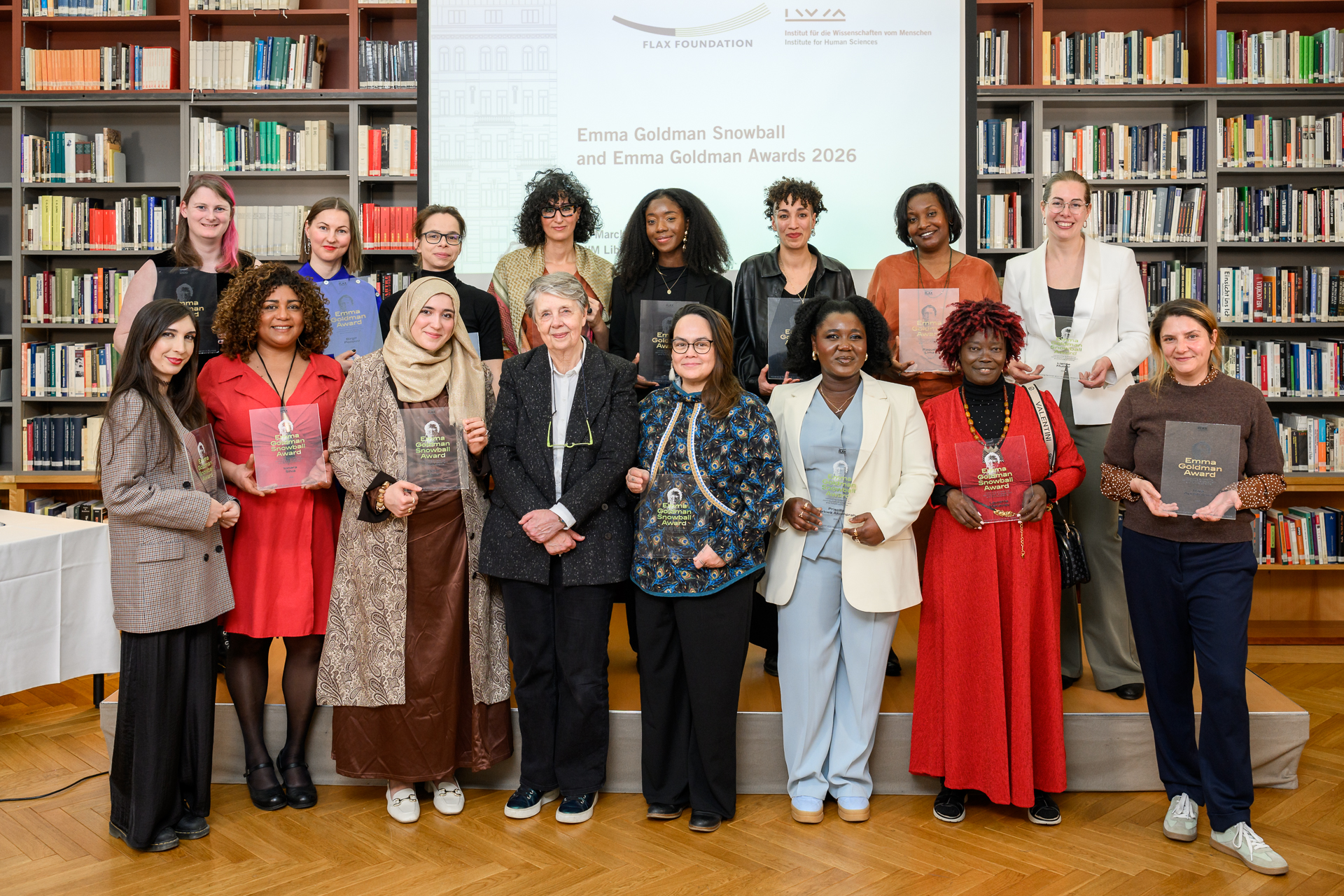
Every year, between five and ten people receive an Emma Goldman Award. Several more can win a different prize given by the FLAX Foundation, the Snowball Award. Two weeks ago, we gathered in Vienna for an awards ceremony, and for a budgeting workshop to support the best use of the funding we have received.
It was quite overwhelming to be in a room with a group of such highly accomplished women. We came from a great range of backgrounds, in terms of nationality, heritage, culture, discipline, field, and medium. It was amazing to hear about the work everyone was doing: as academics, as journalists, as filmmakers, as comic artists – and, inevitability, as collaborators and organisers. Every one of us was involved in community-building in one way or another. And everyone seemed pretty shocked to be receiving an award, because each one of us feels the pain of oppression, and none of us do what we do to win prizes.
The award ceremony was filmed, and I’ve put a link to the youtube video at the bottom of this post. It’s worth a watch simply to hear about the exciting things every single award winner is up to. It expanded my sense of possibility, of what is happening in the world and can happen in the world, and who I might work with or be inspired by going forward.
It meant a great deal just to spend time with each other outside of the formal sessions, speaking and listening and learning together, building new friendships. This is something I have taken away from my time in Vienna, something I will sit with for a long time. I believe this is another intention of the Emma Goldman and Snowball Awards: to go beyond themselves, to support networks of research and activism, to enable new connections and collaborations across borders. In this sense, the prize couldn’t be better named.
The thing that struck me most after the award ceremony – and I mean this in a really good way – is that it made our collective achievements feel unexceptional. I don’t say that to talk down myself, or any other winner. Quite the opposite: I feel that recognising this kind of work collectively reminded me that none of us are alone, that we are part of a movement.
It is enough for any of us to simply do the work – of fighting for a better world.

 Dr Ruth Pearce