Trans Grrrl Riot, part 1: Was riot grrrl transphobic?

Edit: 27/11/18.

This post remains remarkably popular! I want to leave it intact because it reflects my perspective as of 2012. However, as trans people and cis women alike face attacks from a resurgent fascism, I continue to believe in a politics that allows for people to learn and grow beyond the prejudices (inadvertant or otherwise) and mistakes of their earlier selves. I therefore feel it important to acknowledge that Kathleen Hanna has explicitly and consistently expressed support for trans rights in recent years, and for this I am grateful.

I also remain a massive Bikini Kill fan.

~

Original post:
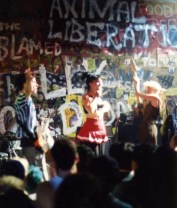
Bikini Kill

Bikini Kill

I love Bikini Kill. I love the uncompromising power of their music, the feminist rage in their lyrics, their wider political approach. Bikini Kill who inspired me to finally pick up the bass guitar that had sat forlorn in a corner of my room for several years, and Bikini Kill helped me believe that I could make music.

I realise it’s a bit of a cliché, but they’re the band responsible for getting me into riot grrrl, and from there  began to explore feminist punk music (including that from contemporary UK bands) more widely.

I wanted to be a riot grrrl too, and was sad that the original movement faded away back in in the mid-1990s, well before I was ever aware of its existence.

Trans invisibility

However, riot grrrl doesn’t necessarily have the best reputation amongst trans people familiar with its history. I haven’t come across an account of (or by) a single trans woman who was involved in riot grrrl during its early 90s heyday. We weren’t the only ones to be marginalised either. The original riot grrrls may not have all been as middle-class as the mainstream media would like to make out, but the scene appears to have been predominantly white.

I haven’t come across anything particularly transphobic  within those 1990s riot grrrl recordings and writings that remain in circulation on the Internet today. Still, various high-profile individuals made their views entirely clear through their involvement with the famously trans-exclusive Michigan Womyn’s Music Festival (also known as “Michfest”).

Trans exclusion

In 1999, controversy erupted after queer punks The Butchies played Michfest. Butchies frontwoman Kaia Wilson had previously been a member of riot grrrl band Team Dresch, and at the time was also running Mr Lady Records jointly with Tammy Rae Carland (a zine editor, spoken word performer, and subject of the Bikini Kill song For Tammy Rae).

A number of trans activists approached Mr Lady Records, asking the label – and its bands – to boycott Michfest. Wilson released a statement claiming to support trans rights, but also backing Michfest’s “womyn-born-womyn” policy. A 2010 interview suggests that she has not changed her views on the matter.

In 2001 and 2005, feminist electro-pop act Le Tigre were similarly criticised for playing Michfest. The group were fronted by Kathleen Hanna, former lead singer in Bikini Kill. Like The Butchies, Le Tigre were a sort of post-riot grrrl act: they came into being after the original movement faded away, but have become associated with riot grrrl in the minds of many both because of their politics and because of the involvement of particular musicians. Le Tigre were at one point signed to Mr Lady Records, although the record label dissolved in 2004.

Le Tigre don’t seem to have been in the slightest bit apologetic about playing Michfest. The argument was once again that womyn have a right to organise autonomously, with the unspoken proviso that trans women are (obviously) not womyn. Of course, this perspective couldn’t possibly be transphobic, what with all the gender-bending the band indulged in.

There’s also lot of talk on the Internet about Hanna also supposedly writing transphobic essays during the 1990s, but I’ve yet to see any evidence of these (and it seems I’m not the only one).

It’s interesting that Le Tigre (and, through Hanna, Bikini Kill) remain implicated in all of this, whilst The Butchies, Mr Lady Records, Tammy Rae and Team Dresch do not. As of 2012, trans activists and allies are still quick to condemn Bikini Kill as “problematic” in Tumblr posts and blog comments. This is no doubt down to the wider media profile experienced (although not necessarily enjoyed!) by Hanna and the various bands she’s been involved in. Wider criticisms of transphobia and cissexism within riot grrrl seem confined largely confined to blogs written by somewhat disallusioned veterans of the original movement.

Meanwhile, whilst Hanna doesn’t seem particularly keen to explicitly distance herself from her past actions and/or comments, she does seem to have quietly moved on, at least somewhat. In more recent interviews she can be seen praising “trans activism”, and earlier this year one fan reported receiving an interesting letter about the matter.

…So?

What does this mean for Bikini Kill? Not a great deal, in my opinion. Kathleen Hanna – a woman whose relationship with the media has always been complex – is not a perfect human being, and has said and done some fairly awful things. Her implicit support of Michfest in particular was never acceptable. She appears to be increasingly aware of this, and has clearly made some moves to educate herself. Still, an explicit acknowledgement of her past cissexism would certainly be welcome.

However, Hanna is in no way the totality of  “Bikini Kill”, let alone “riot grrrl”. As her bandmate Tobi Vail pointed out:

We are not in anyway ‘leaders of’ or authorities on the ‘Riot Girl’ movement. In fact, as individuals we have each had different experiences with, feelings on, opinions of and varying degrees of involvement with ‘Riot Girl’ […] As individuals we respect and utilize and subscribe to a variety of different aesthetics, strategies, and beliefs, both political and punk-wise, some of which are probably considered ‘riot girl.’

The very rifts that fractured riot grrrl also gave it strength, for there was no one dogmatic, overriding ideology to bind it. Kaia Wilson, Tammy Rae Carland and Kathleen Hanna were not the movement. As a young woman looking back at a feminist movement I never had the opportunity to be involved with, I’m left with the impression that riot grrrl did not wholly welcome trans people, but did not intentionally reject us either (in spite of the backwards attitude of certain participating individuals). And of course, this situation wasn’t really good enough, but it’s nowhere near as bad as it could have been.

The future

Fast-forward to 2012, and the idea of riot grrrl is once again gaining a certain cultural currency. The mainstream media are arguably rediscovering riot grrrl in the light of Pussy Riot’s magnificently brave actions of personal resistance, but new bands and collectives have been springing up around the world at an impressive rate for the last two or three years.

Doll Fight

Riot grrrl never really went away: whilst former members of the original movement founded started new bands, new record labels, and new approaches to opening up underground music to girls and women (such as Ladyfest and Girls Rock Camp), there were always individuals and bands who clung to the label. Recently, the idea of a “riot grrrl revival” has blossomed into something more vital on a local, national and international level.

In the UK alone there are now local groups such as Riot Grrrl Birmingham emerging; frequent local events such as Riot Grrill in Leeds, Pussy Whipped in Edinburgh and Riots Not Diets in Brighton; and a whole host of new bands, many of whom communicate with one another through means such as the Riot Grrrl UK group on Facebook.

And one of the many wonderful things about all of these groups is that they’re all explicitly trans-inclusive. They’re not only drawing upon trans language and symbolism: they also see trans struggle as feminist struggle. These are groups that seek to understand cissexism and binarism, groups that talk about supporting CeCe McDonald in the same way that they talk about Pussy Riot.

Similarly, the international music compilations released regularly by the Riot Grrrl Berlin collective explicitly welcome trans artists, and ban transphobic language. There are even (shock, horror) riot grrrl bands with trans members emerging.

We should learn from the past, but not be bound by it. Trans-inclusive riot grrrl is finally here. Let’s make the most of it!
Business as usual? A look at the draft English protocol for gender dysphoria

The main achievement of England’s new draft protocol for transition-related services is not to offer progress, but to codify certain elements of existing practice.

In this sense, it somewhat resembles Scotland’s new protocol, which was published a couple of weeks ago.

The Scottish protocol appears to have been based largely upon the services offered by Sandyford, the nation’s largest gender identity clinic. The English protocol seems rooted in current practice at Charing Cross, which plays a similar role within England and Wales. The differences between the documents hinge largely on the differences between the progressive policies instituted at Sandyford, and the more conservative attitude of Charing Cross.

In this article I’m going to examine some aspects of the draft English protocol that have really struck me, before discussing political elements of difference between the English and Scottish protocols. I also briefly talk about the survey that is being distributed alongside the draft guidance.

The Good

LanguageThe language used within the draft English protocol largely acknowledges the complexity and diversity of trans experience. It encourages a respect for patient identities in terms of correct name, pronoun usage etc. (regardless of legal status). There’s even an explicit acknowledgement of non-binary identities, although this is somewhat undermined by binary assumptions elsewhere in the document, and a focus upon transitions that follow the typical “female to male” or “male to female” routes.

Referrals – The document provides some important clarifications for referral to a gender clinic: that individuals do not have to have lived in their preferred gender role prior to referral, that neuro-diversity and mental/physical health issues should not be a barrier to referral, and that psychotherapy is not a necessary precursor to referral. However, these points are not made as strongly as they could be, leaving some room for (mis)interpretation.

Treatment process The document states that two appointments should be sufficient for a diagnosis of gender dysphoria (to be diagnosed according to the ICD-10 criteria, as opposed to DSM-IV). The prescription of hormones should (if appropriate and desired) follow this diagnosis, and surgery should follow within approximately two years. This might all sound very familiar to Charing Cross patients, but may work to reign in some of the more eccentric practices of smaller gender clinics such as Nottingham.

Overall – It will be beneficial to have this protocol at hand to bring local referral practices and the actions of smaller GICs in line with national standards.

The Bad

Referrals – Referrals must come from a GP or specialist (psychiatrist or psychologist), with clinics able to insist upon referral from a specialist. This means that long-winded battles for referral look set to continue as normal. In contrast, the new Scottish system appears allows individuals or GPs to refer to any clinic.

Treatment process – The protocol states that it is informed by the most recent edition of the WPATH Standards of Care. However, it seems (again, contrary to the Scottish protocol) to ignore large parts of the Standards of Care in favour of current Charing Cross practice.

For instance, FtM spectrum individuals must have been on hormones for at least six months and full-time for at least a year before top surgery is considered, and patients must wait at least two years before being offered genital surgery (although a referral appointment for surgery may take place after 18 months under some circumstances). This last point in particular is justified with reference to ICD-10. Interesting here that guidance for diagnosis from 1992 is given precedence over guidance for care from 2011.

Trans youth– There is an acknowledgement of the benefits of hormone blockers for under-18s, but (unlike the Scottish protocol) no real engagement with the possibility of hormones and surgery for trans people aged between 16 and 18. The protocol continues to relegate all young people to specialised – and limited! – youth services.

Overall – The document pays lip service to the WPATH Standards of Care but does not really live up to the spirit of those guidelines. This is particularly evident when the draft document is compared to the Scottish protocol. Patients are expected to put up with a long-winded, complex system in which treatment is spread out over many years.

The Ugly

Get a job – Patients are still expected to be in education or employment in order to gain a referral for genital surgery. If you don’t have a job or you’re not on a course, you’re expected to be involved in some volunteering role. It’s all about demonstrating your ability to move through the world in your “new” gender prior to irreversible surgery.

This requirement is patronising, stupid, and fetishises trans genitals. What other surgery requires that those who undergo it are in work? Why is it that genital reconstruction is seen such a massive step, but the permanent changes that come with long-term hormone therapy is not? Yes, surgery is a big deal, but it’s clear that clinicians regard this surgery as something else entirely.

I can’t understand how this can possibly be acceptable at the best of times, but at a time of recession and mass unemployment it strikes me as particularly cruel and unreasonable. How to account for individuals who cannot find a volunteering role in their local area? Individuals with anxiety issues? Individuals who are told by the Job Centre not to volunteer, with the threat of benefit withdrawal hanging over this order? And how can this possibly be acceptable when trans people face considerable inequalities in the job market (with trans unemployment estimated at 50% in some European countries).

Physical examination – GPs are apparently “expected” to perform a physical examination of trans patients. Why? No reason is given. The document simply states that: “The GP will be required to carry out a basic physical examination and investigations, as a precursor to those physical treatments which may later be recommended.

I simply cannot comprehend where this idea comes from. For many trans people – particularly those contemplating physical transition – the very idea of a physical examination is extremely unpleasant and can cause severe distress. There are times when pre-operative trans people might require a physical examination: such as immediately prior to surgery, or during a sexual health check-up. These experiences can be deeply unpleasant, but at least they’re necessary.

GPs are not trained to understand the complexities of trans people’s relationships with their bodies. In fact, most GPs don’t receive any training on trans issues whatsoever. What are they meant to be looking out for during such an examination, and how are they supposed to know? An invasive examination such as this should only be performed when necessary, by someone who knows exactly what they’re doing.

Discussion: England vs Scotland

The headlines from the Scottish protocol included a number of moves to bring treatment more in line with the most recent edition of the WPATH Standards of Care. These included provisions for self-referral and referral by GP, less waiting time for surgeries, access to a wider range of treatments (e.g. hair removal) and full access to treatment for individuals aged between 16 and 18.

Whilst representatives from groups such as the Scottish Transgender Network played a vital role in putting provisions such as these on the national agenda, it’s important to recognise that many of them had already been implemented by Sandyford GIC.

The message seems to be that the English clinics – who are almost entirely responsible for the development of this draft protocol – are not interested in developing new practice, let alone conforming with the seventh edition of the WPATH Standards of Care. Instead, they seem keen to maintain a tight control over the processing of patients, an approach that renders the draft protocol even more strict than a new national commissioning policy that is being simultaneously developed.

Survey

The survey that accompanies the draft protocol is extremely short. This makes it quick and easy to fill in, but the form also seems to have been designed to shut down unwanted criticism. The Department of Health appears interested only in how current experiences match up to the proposed protocol, and seems keen to avoid any kind of critical feedback on the document.

It is, however, possible to offer you opinion on the nature of the protocol itself. Here are some tips for doing so:

  • Where your experiences differ from the protocol in a positive manner (e.g. you didn’t receive a physical examination from your GP), emphasise how your experience was more positive than would be the case should the protocol be implemented as-is.
  • Where your experiences differ from the protocol in a negative way, emphasise any manner in which you think the protocol could go further to ensure better treatment.
  • If you have sought care outside of the NHS for necessary treatments (e.g. hair removal for trans women) explain why this treatment should be a necessary part of the protocol

Final thoughts

The introductory text to the survey suggests that current political and financial pressures on the NHS prohibit the introduction of any real changes within the draft protocol:

DH wants the final document to outline the current position for transgender people seeking gender reassignment services through the NHS. The document should outline what support and services a transgender person can expect to receive in the tight financial constraints currently placed on the NHS.

This doesn’t really make a huge amount of sense. Yes, if more trans people have access to services (e.g. laser hair removal), this will cost money. But surely there is a lot more money to be saved through progressive reform?

Insisting on longer real-life tests, longer waits for surgery and so on won’t save a lot of money in the long term. A similar amount of trans people will be accessing services: they’ll just have to wait longer as individuals in order to access the a services. The money will still be spent. So why have such long waiting times?

Insisting on referral through a specialist (i.e. psychiatrist or psychologist) won’t save money. How does the NHS possibly benefit financially from insisting that trans people see more specialists rather than having them directly referred to a gender clinic by their GP? This is particularly the case when specialists decide that they need to assess people over multiple appointments before referring them to a gender clinic. The individuals concerned experience a frustrating delay, and it costs more money because the NHS is paying for all these extra appointments.

This isn’t really about the money. It’s about gatekeepers maintaining a certain level of control over patients, and putting certain ideologies into practice. It’s about picking and choosing which parts of ICD-10 and WPATH SOC 7 fit best with their pre-existing ideas, and using those elements to justify existing practice. It’s about conservativism over progression: a wasted opportunity.

There’s something oddly reassuring about Radfem Hub

A (cis, feminist) friend of mine posted in horror on Facebook this afternoon. Said friend had just visited Radfem Hub for the first time. “UNBELIEVABLE,” she exclaimed.

I’m fairly certain I had a similar reaction when I first went to the site. It’s always unpleasant to stumble across a series of staggeringly unpleasant attacks upon your being and personhood; as such, I recommend that any readers approach Radfem Hub with extreme caution.

At the same time, I don’t find it particularly threatening any more.

I mean, let’s take a look at what Radfem Hub actually stands for. It’s described as “a radical feminist collective blog”, and as such you might expect to find articles on all kinds of different subjects related to patriarchy and the oppression of women. Instead, the current front page of the site displays article after article dedicated to the evils of trans people, trans activists, trans allies, and the insidious influence of trans ideology upon the wider feminist world. You have to scroll way down the page before there’s even mention of a pro-choice agenda and a now-obligatory potshot at  50 Shades of Grey*. And then the transphobic posts start up again.

Radfem Hub isn’t really a radical feminist site. It’s an anti-trans hate site.

I don’t say this because I’m interested in redefining radical feminism. I say this because, surely, a radical feminist site – even a radical feminist site populated by transphobes – would have something else to talk about beyond hating on trans people. There are so many other things to worry about in the world! I mean, take for example the London Feminist Network yahoo group: it’s pretty clear that trans people aren’t welcome there unless they toe a particular line, but the group’s members at least have far more to discuss than whatever it is we’ve done to annoy them lately. In contrast, the population of Radfem Hub seem to have little to do other than hate on trans people.

Ultimately, it’s not that threatening. Sure, the actions of those such as bugbrennan (who has a nasty habit of publicly outing trans people) are pretty disturbing, but the site itself is bound to only ever appeal to a small group of bigots. There’s no way it’s going to appeal to the radical feminist mainstream, who are way too busy tackling stuff like the gender pay gap, capitalist exploitation of women’s bodies, nasty propaganda from “pro-life” groups and the like.

In a way, I’m reminded of The Christian Institute. This lot are a non-denominational group who state that they exist for “the furtherance and promotion of the Christian religion in the United Kingdom”.  Their actual activities seem to consist largely of posting homophobic witterings on the Internet and shouting in vain at the government to do something about that awful homosexual agenda.

The Christian Institute cast their net a little wider than Radfem Hub (going for Muslims and pro-choice activists almost as much as they go for LGBT people) but it’s pretty obvious what they are. They’re a hate group. And as such, they’re never going to gain too much sway within the world of mainstream Christianity, even as the Catholic and Anglican churches desperately try to block the government’s plans for the legalisation of gay marriage.

So here’s the thing. As long as groups like Radfem Hub and the Christian Institute remain dedicated to hate, they’re only going to gain so much traction. I’d be much, much more worried if they had much to say on issues that might actually interest anyone beyond their core audience.

* For the record, I agree with Radfem Hub that 50 Shades of Grey is deeply dodgy, although I dislike their predictable “kink is necessarily bad!” approach to the issue.

Boosting the signal: support CeCe

For various reasons I can’t make it down to the Free Cece solidarity demo in London today. So here’s a post to let you know what you can do if you, like me, won’t be there.

CeCe was recently jailed for manslaughter following the death of a man involved in an attack upon herself and her friends. If you haven’t yet come across the case, background information can be found on on the Support CeCe McDonald site (trigger warning: description of racist and transphobic violence), and in this video.

Needless to say, the situation is a sad reflection upon the impact of multiple inequalities faced by individuals who experience intersecting oppression, particularly black trans women.

If you want to support CeCe through writing to her, sending books or anything else, there is plenty of information on how to get involved on her support site.

It’s likely that further UK actions (e.g. a letter-writing campaign) may follow the London demo, so I’ll endeavour to post about that if it happens. A Leeds-based working group can be found on Facebook here.

Royal wedding arrests: Judicial Review update

The Pageantry & Precrime site has been updated with details of Judicial Reviews awarded to a number of people arrested during last year’s royal wedding. A four-day hearing at the Royal Courts of Justice encompassed four separate reviews:

  • one Judicial Review into the pre-emptive arrests  for ‘breach of the peace’ on the day of the royal wedding
  • one Judicial Review into the pre-emptive arrest of a minor for ‘criminal damage’ the police believed he would cause (evidence: two pens)
  • one Judicial Review into the raid on the Grow Heathrow squat the day before the royal wedding – for which a supposed link to republican extremism was the excuse
  • one Judicial Review into another raid on a squat in Camberwell for which – again – a supposed link to left wing extremism was the excuse given.

The first two reviews addressed the arrest of “zombie flashmob” members, including Queer Resistance activists. Two trans attendees alleged that they were sexually assaulted by police officers following their arrest.

The hearing aims to address broad police tactics and behaviour rather than individual acts of intimidation or violence. As such, the relevant Judicial Review will not (for instance) lead to any action against the officers accused of committing sexual assault. However, I have been informed that one of the trans arrestees is pursuing a separate legal case against the officer(s) concerned.

Judgement on the case has been deferred until July. A claimant explained that: “judgement is deferred because between 20-odd claimants over four JRs the evidence and other submitted papers amount to several thousand pages that the judges must read.”

A full account of the hearing can be found at the following links:

Day 1:
May Karon Monaghan QC, representing individuals who were pre-emptively arrested, set out her arguments

Day 2:
Barristers representing the plaintiffs provided evidence for each Judicial Review.

Day 3:
Final evidence for the fourth Judicial Review. Response to all evidence from barrister representing the commissioner of the Metropolitan Police.

Day 4:
Further evidence from police barrister Sam Grodzinski. Concluding remarks from claimants’ barristers in response to police evidence.

“The hearing has encompassed everything from the absurd to the Orwellian,” said Hannah Eiseman-Renyard, one of the claimants who was arrested for zombie fancy dress. “In the past four days the court has seen the police use an article from the Sunas evidence and heard how a raid on a squat ostensibly for stolen goods saw the police take all the toothbrushes for DNA.”

“The Met argues that every breach of the peace arrest was done for our own good before we provoked an inevitable violent reaction from royalists. Personally, I wasn’t even protesting anything. I went along for the zombie flashmob and I wound up in a police cell. It would be laughable if it weren’t so scary.”

Sam Grodzinski, the police’s barrister, said less intrusive policing, such as confiscating the flyer from one claimant wasn’t an option as “handing it over would not cleanse her of those intentions”. In the case of a minor arrested pre-emptively for ‘criminal damage’ because of two marker pens in his backpack, Mr Grodzkinski said confiscating the pens was not an option as “he could have bought more.”

To moderate, or not to moderate? (a ramble)

I’ve had some fairly unpleasant comments on my Radfem 2012 post. Until today, these messages have generally taken the form of polite disagreement: the difficulty comes in the content of that disagreement. I, like many other trans people, regard the refusal to recognise my gender (and other trans genders) as valid to be discriminatory and bigoted. Most of the radical feminist commentators who participate in this refusal draw their perspective from feminist theory, and argue that their position naturally follows from this. The conflicting truths explored in my original post were further drawn out, as both “sides” of the argument (and oh, how I wish there weren’t “sides”!) were inevitably hurt by the “other side”‘s refusal to let go and leave them alone.

My partner asks me why I’m spending so much time reading these comments and engaging in this kind of discussion. I’m just hurting myself and making myself angry, he says. It almost feels worth abandoning the whole affair, closing the thread and forgetting about it. There’s a lot of other things going on in my life, after all.

And yet we are essentially fighting it out for the heart of feminism. This matters because these arguments shape our approach to the equality battles of the present and future. When I turn up to a feminist meeting about the pay gap, or sexualisation, or the the gendered impact of austerity, will I be welcome? Can I fight alongside my sisters, and under what circumstances? Can I expect my cis* sisters to stand up for me when I fight for my trans friends who need access to rape crisis centres, women’s shelters, advice and counselling services? Can we all pull together to offer solidarity to intersex people when surgeons who would mutilitate intersex children hold a conference on our shores? How are we to understand sex and gender? What is this feminism, who is it for, and what do we want to achieve?

And so I leave the discussion open, and attempt to engage with individuals whose outlook is so similar and yet so different to mine, in the vague hope that this might contribute in some tiny way to some kind of reconciliation, years down the line. I’ve not yet blocked or deleted a single post.

I’m leaving unmoderated comments that I consider to be blantantly transphobic*, language that reeks of ignorance, if not hate. In a different space, perhaps one with a safe(r) space policy, these would have been deleted long ago. But this is my blog, and I suppose part of me wants to see this discussion happen.

I’m particularly disturbed by some of the more recent comments. DLT states: “I wish harm on every male on the planet. Plain and simple. No matter how you play dress up. If you are male, no thanks.” Take out the transphobia and that’s still horrifying. Surely the systematic empowerment of men at the expense of women (and non-binary individuals!) is the problem, not men. Like, all men. I find the concept of “misandry” somewhat concerning and so-called Men’s Rights Activists downright terrifying, but the moment you start “wishing harm” upon any group of people is the moment you’re straying into serious Godwin territory.

And yet. These comments tell a story, a truth, one that I would prefer to see aired than not. Part of the reason these arguments are so virulant is that so many women and so many trans people (women, men and non-binary alike) are very damaged. Some of us have had truly awful things happen to us, meaning we’re more likely to lash out at others in a storm of emotion. I don’t for a moment agree with the transphobic* perspectives of the many cis* women posting on my blog, and I don’t think unpleasant experiences are an excuse for this, but I’d rather listen than not before wholeheartedly rejecting these discourses.

Finally, I find myself agreeing entirely with smashmisscontest – a radical feminist with whom I disagree so much – on one key point:

The opinion of this Bev Jo noted Radfem, a person which I have never heard about by the way, do not voice the politics of radical feminists as a whole (and certainly not mine), as much as Valerie Solanas does not voice the politics of feminists as a whole by wanting all men exterminated, and as much as the “die cis scum” rhetoric do not represent the feelings of the trans community as a whole, and therefore should be placed in the category of unfortunate extremes I was talking about in my first post.

Obviously extremists, rad-fundamentalists or trans-fundamentalists, are not about politics at all but about hatred which maybe have originated by their personal experiences, and they will not participate in any type of building bridges anyway. But there is the rest of us who want to work on that, and do not identify with hate speech of any kind, so please don’t put me in the same bag. If you are trying to shock the people reading this comments, there are also plenty of examples of hate speech against feminists and women coming from trans individuals, but i do not see the point in getting into that loop type of distressed and non constructive conversation, if its not to create even more hatred and distress.

So let’s acknowledge and listen to the most hateful of comments, but remember that they do not represent the crux of the issue. The problem is a more nuanced one than DLT would have us believe. I still believe that smashmisscontest is, through her brand of radical feminism, promoting (in some senses) and tolerating (in others) a harmful transphobia*, but I believe this arises from a fundamental misunderstanding rather than from hatred. I get the impression she thinks similarly of me. And that gives us something to work with.

I will continue to openly and actively oppose Radfem 2012, because I continue to believe that it effectively promotes views that would harm trans people. But as part of that process, I hope dialogue remains open.

As for my original Radfem 2012 post, I think I’m going to just slap a trigger warning on the end of the post and leave it be – for now, at least.


* I will use these words because this is my blog and I, as part of an oppressed group, have a right to define the nature and actions of those who hold power over me

Judicial review for zombie flashmob arrestees

Just under a year ago I wrote a report for Lesbilicious on the alleged sexual assault of two trans people following their arrest. They were apparently detained for the crime of carrying facepaint and flyers within just over a kilometre of the Royal Wedding.

It has been announced that the pair – along with others who were arrested on the day ahead of a planned “zombie flashmob” in Soho Square – are now pursuing legal action. They are seeking to bring sexual assault charges against the officers involved, and have also been awarded a judicial review.

From the Pageantry and Precrime web page:

Private or Civil Law claims would have likely resulted in an offer of compensation money before the case ever got to a judgement, but the claimants wanted a proper investigation and a judgement at the end of it to set a precedent for future policing. The claimants want to make sure that what happened to them cannot happen again.

Those involved hope to prove that there was (as the evidence seems to indicate) an over-arching policy of pre-emptive arrest that day. It is hoped that the Judicial Review will clarify that the Met’s policing of the royal wedding was illegal and that similar actions cannot be repeated.

It is especially concerning as it is believed in some circles that the royal wedding was used as a ‘dry-run’ for the policing tactics which will be used during the olympics and the jubilee in 2012.

Student medics push for trans on the curriculum

We seem to be quietly creeping towards a better situation for trans health.

There’s clearly a major problem. The Home Office’s informal e-surveys of trans experience indicated that the realm of “health” is a key concern for a great many of us, with almost half of respondents saying that they did not think their GP was doing a “good” or “excellent” job in addressing their health needs. Meanwhile the 2007 Engendered Penalties report (created by Press For Change for the Equalities Review) notes that 1 in 6 of respondents reported experiencing discrimination from medical professionals.

Issues of health access aren’t limited to those problems created by the referral and treatment process for medical transition. Many of us are still being treated inappropriately because we are trans, regardless of what treatment we’re seeking at any given time.

It’s heartening then to (finally!) see increasing willingness to do something on the part of medical professionals. Zoe O’ Connell describes the positive outcomes of a recent meeting between trans activists and the General Medical Council. And at the other end of the professional “scale”, last week saw the publication of an article in the Student Lancet calling for teaching on trans issues within the medical curriculum.

The Lancet article isn’t the intervention of one isolated student medic. Its author informs me that there is widespread anger (yes, anger!) about the lack of LGBT material on the curriculum amongst her peers at Warwick Medical School. They’re particularly unimpressed with how trans people are treated. The students in question feel they should be taught properly about all issues they might encounter as doctors, and are taking action to ensure this actually happens.

The staff-student liaison committee reps in my year have decided they want to push having teaching on LGB and especially T stuff added to the curriculum,” explains my informant. “I bashed out a quick petition over breakfast and floated it round my lecture theatre to collect signatures for them so they had a bit more clout – so they now have a petition signed by over half of my cohort telling them they should be teaching trans stuff.

Of course, this is just one small step towards the provision of appropriate health services for trans people. As the Student Lancet article concludes:

“I feel that this is a change which is urgently needed at an institutional level rather than at the level of individual medical schools. Only by taking a unilateral approach will we ever manage to change the perception of the NHS as a discriminatory institution. In order to effectively treat transgender individuals we need to prove to them that we are worthy of their trust.”

The Sun’s hypocrisy laid bare

The Sun is in trouble. Years of journalistic malpractice are finally catching up with the venerable tabloid, with employees arrested en-masse on “suspicion” of corruption and bribery.

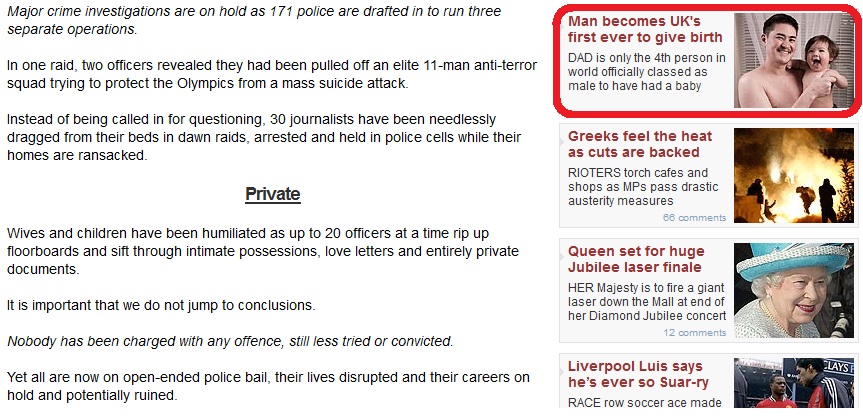
Associate editor Trevor Kavanagh is upset about this.  “Witch-hunt has put us behind ex-Soviet states on Press Freedom”, his editorial thunders. It goes on to detail the humiliation experienced by Sun journalists and their families:

Instead of being called in for questioning, 30 journalists have been needlessly dragged from their beds in dawn raids, arrested and held in police cells while their homes are ransacked. […]

Wives and children have been humiliated as up to 20 officers at a time rip up floorboards and sift through intimate possessions, love letters and entirely private documents. […]

Nobody has been charged with any offence, still less tried or convicted.

Yet all are now on open-ended police bail, their lives disrupted and their careers on hold and potentially ruined.

How awful! And it’s not like Sun journalists would ever do such a thing to others, is it?

But wait! what’s this we see next to Kavanagh’s article in the online edition?

(click image for full size)

That’s right, it’s the Pregnant Man! Let’s take a look at his story.

Don’t forget kids, private lives are for News International employees, not for proles! Particularly queer proles.

Of course, it could be that the Sun is simply asking for contributions because all their journalists have been arrested…

(For more constructive commentary, see this powerful post by Ralph Francis Fox, as well as analyses from Jane Fae and Christine Burns.)