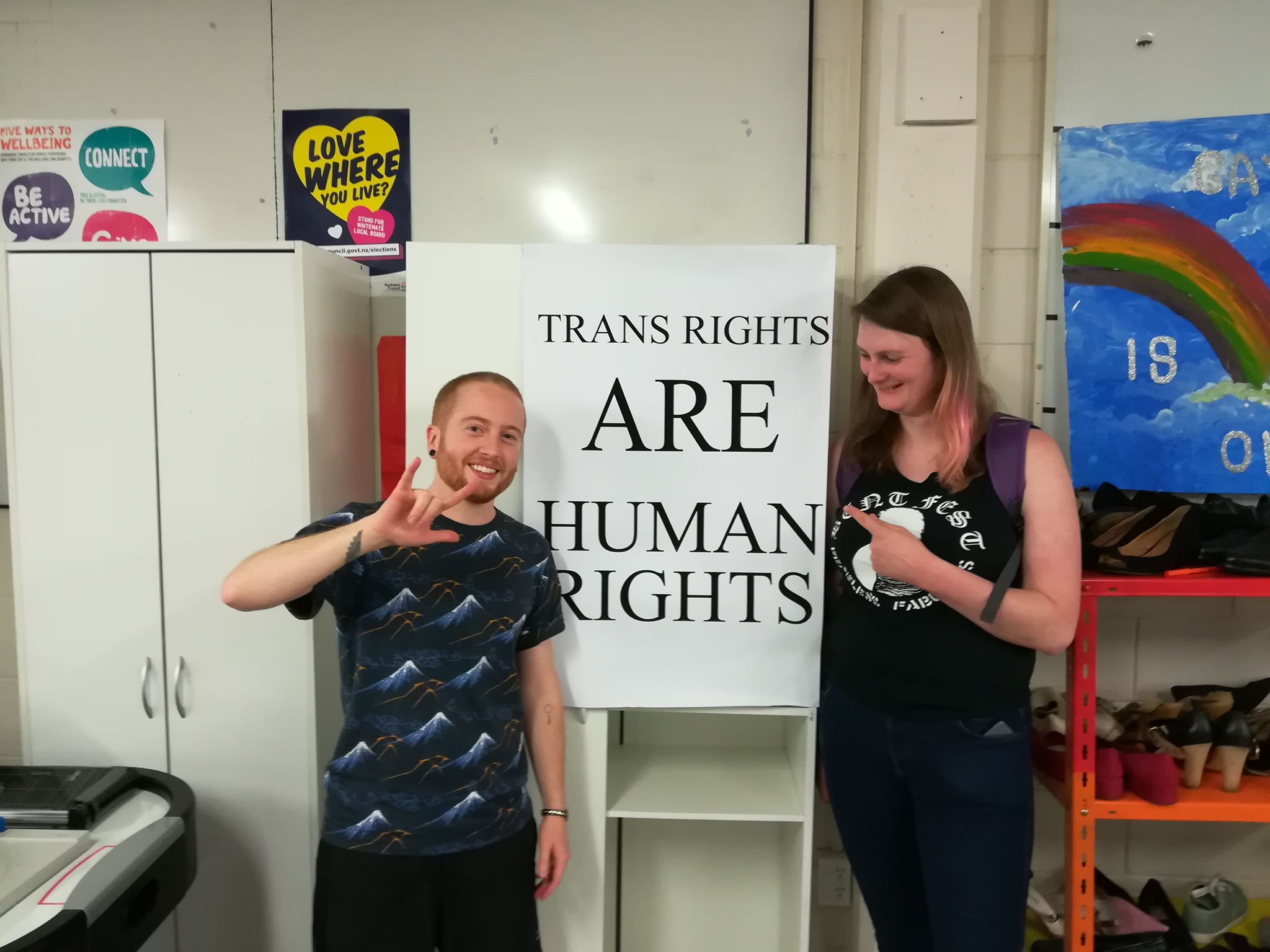
DJ setlist and review: There Will Be Blood! @ Stereo, Glasgow

I’m currently in the middle of a busy fortnight for work-related travel (more on that soon!) But last night, I managed to make the most of a brief return to Glasgow.

The occasion was There Will Be Blood! a fundraiser at Stereo for the brilliant group Trans Healthcare Access Glasgow. They are helping to provide free laboratory testing for bloods. This is really important for trans people on HRT who are increasingly denied monitoring by GPs. If you couldn’t make it but would still like to donate, you can do so here.

The organisers put together a fantastic lineup and there was a great turnout – especially for a Monday night. It was exciting to see so much talent from within our community, and loads of people come out to support both the cause and a pretty eclectic collection of artists. And exciting for me to be a part of it, performing a DJ set as ROGD.
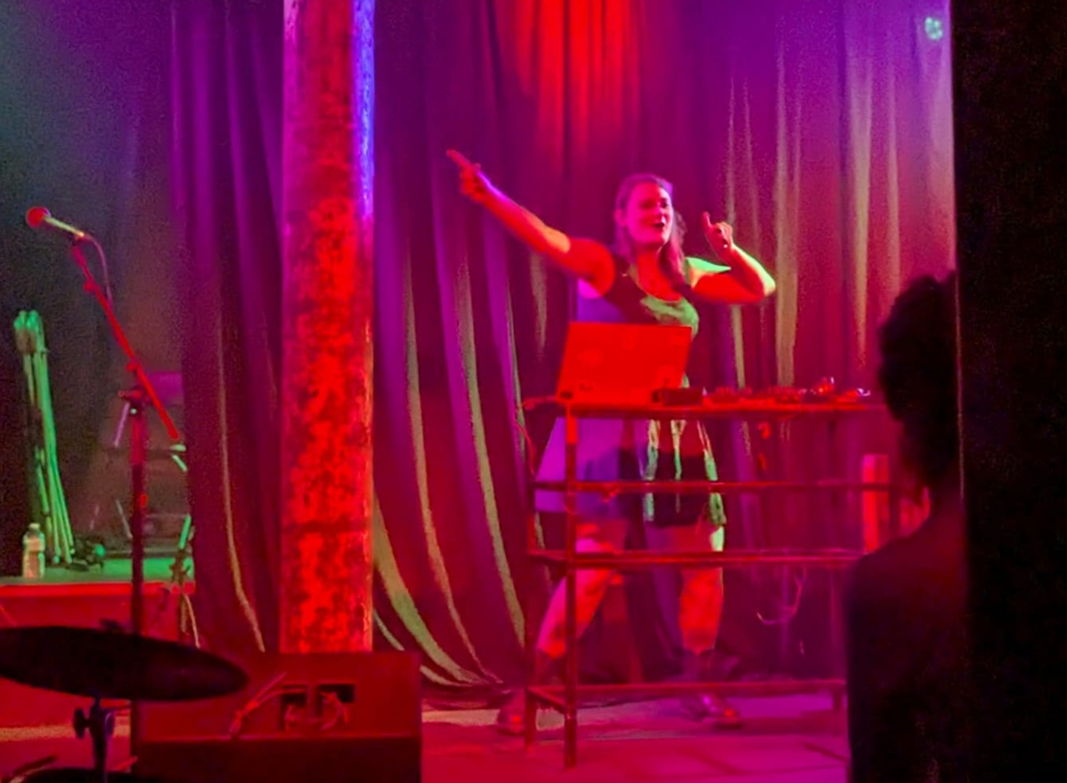
In which I am going for it. Photo by Onni Gust.


The night kicked off with a luscious set from singer-songwriter and drag artist Sersi. He’s probably the first person I’ve ever seen sport a Britney mic at a DIY gig, which was very cool but sadly couldn’t quite capture the sheer dynamic range of his vocals on the night. At the same time, it enabled him to completely own the stage for a series of ballads that were by turns beautiful and strange. Sersi was ably supported by a pal with a laptop, and Johanna Kirkpatrick (of trad folk bands Chanterelle and Madderam) looking dead dykey on acoustic guitar.

Next to take the stage were Deep Filff. I hadn’t had a chance to look them up before the gig so had zero idea what to expect, although they did arrive with an absolutely enormous inflatable swan. Deep Filff turned out to be a two piece, with Nadia Fiffsky playing bass and belting out epic sun-baked vocals, while Jenny Tingle methodically destroyed the drumkit. As purveyors of some of the dirtiest psychedelic grunge-punk riffs I think I’ve ever heard, they were extremely well-named. It was engrossing, hypnotic stuff. Eventually the swan came out and bounced around the audience, most likely representing a serious hazard to some of the important-looking wires and glitterball hanging from the ceiling.

Local heroes comfort never fail to disappoint, and this evening they truly tore up the stage as the final live act of the evening. The sibling duo have a truly unique sound, with Natalie’s staccato vocals punctuating a skitterish soundscape of totally artificial electronic sounds, underpinned by Sean’s assertive drumming. It was impossible not to dance. My favourite moments came whenever the band’s weird, abrasive noise would suddenly gave way to a transcendentally beautiful synth melody for a minute or two, before we all dived collectively back into the tumult.

Finally, following a quick raffle, I was up! The gig was due to end at a remarkably civilised 10pm, so I had a tight half hour DJ set.

I’ve thought a lot since returning to DJing that the landscape of queer and feminist music and activism has completely changed. Back in the day, I used to do quite a few “Women’s Voices” DJ sets, especially for feminist events such as Reclaim The Night afterparties, and the woman-only Women’s Aid and NUS Women’s Conference discos. The idea was that every song played (sometimes for sets of up to four or five hours) had a woman on lead vocals, and ideally women also playing instruments. Finn Mackay always used to refer to me as “feministDJRuthPearce” (all in one breath!) which was never failed to be delightful.

Unfortunately, many of the people who were only too happy to join the dancefloor for those events are now either actively backing trans-exclusionary politics and the grossest forms of transmisogyny, or otherwise failing to speak out again them. (Junior equalities minister Liv Bailey, I’m looking at you – remember when you hoped I’d DJ your wedding one day?!) It’s odd to reflect on just how normal it was for trans women to be involved in woman-only politics spaces in the UK, given the extremity of the post-2017 moral panic.

Anyway, I digress.

Another thing that has happened over the last decade is the enormous influx of excellent trans artists to both underground and mainstream music scenes. We live in an age where I listened to jasmine.4.t for the first time because my mum told me she’d done a good interview with Craig Charles on BBC 6 Music(!) So, while I’d like to do more Women’s Voices DJ sets in the future, for the first time it felt realistic to put together a Trans Voices set, with a mixture of tunes fronted by trans women and men, and/or non-binary, genderqueer, or genderfluid people, that I could reasonably expect a large number of people in the audience to be familiar with.

So, here’s what I played:

Shopping – The Hype
My Chemical Romance – Teenagers
100 gecs – mememe
SOPHIE – Immaterial
underscores – Locals (Girls Like Us) [with gabby start]
Kae Tempest – Move
Ada Rook – BURY YOURSELF
Janelle Monáe – Make Me Feel
jasmine.4.tGuy Fawkes Tesco Dissociation
G.L.O.S.S. – Outlaw Stomp
Against Me! – True Trans Soul Rebel

Obviously I could have kept going a lot longer, but I’ve got to say, it was one heck of a half hour. I have such enormous love for everyone who joined me to dance their arse off on a Monday night. And if you’d like me to DJ your event – I’m officially back behind the decks, so do get in touch!
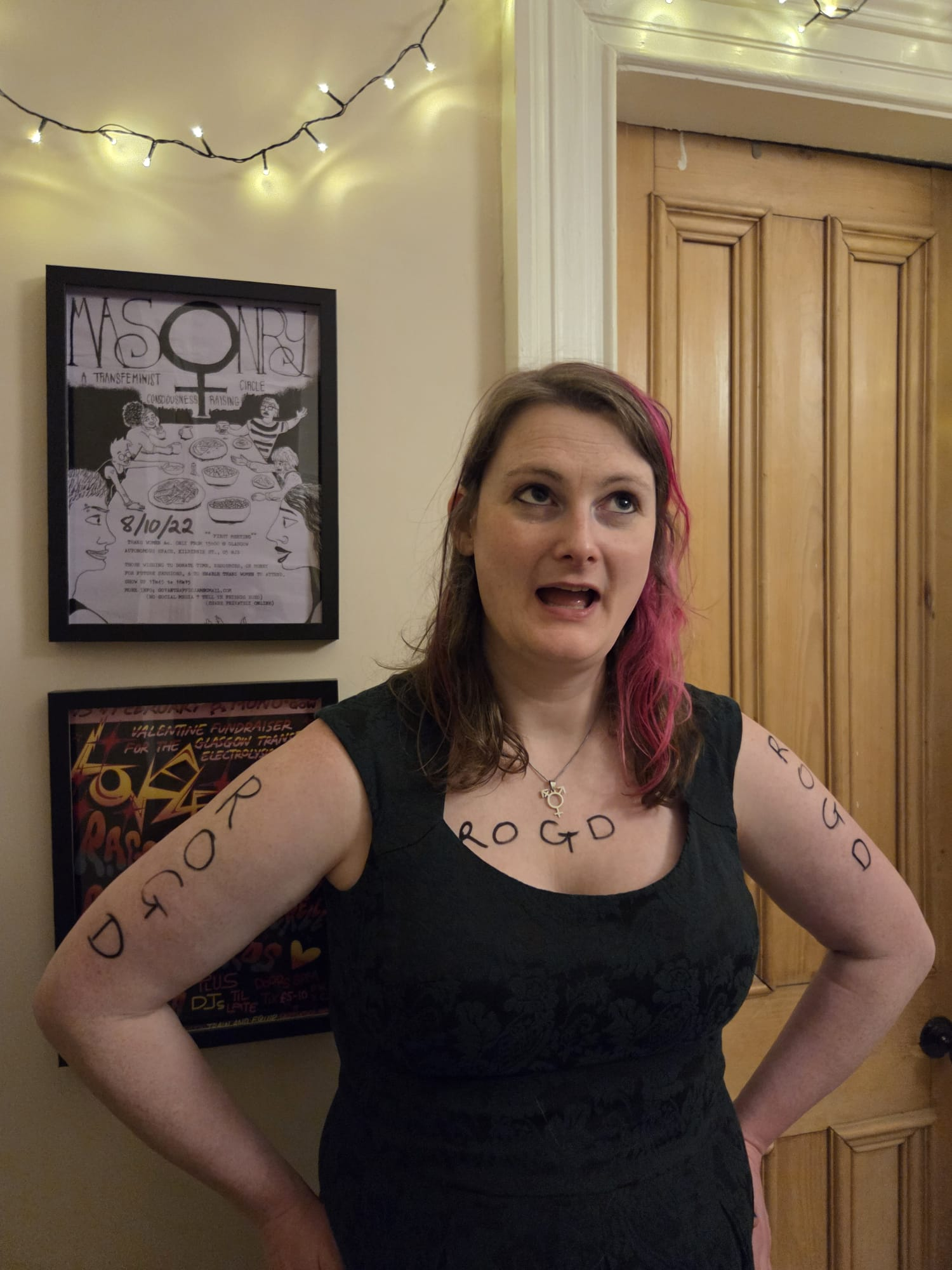
Back home – sweaty and happy!

In memory of Ellinore Wilson

i.

I discovered recently that my friend Elli had passed away. She was just a few years older than me. I believe she lived a difficult life, but was always true to herself, and was good and kind to others. And meeting her as a teenager changed my world.

I first encountered Elli during the long, messy process of coming out to myself. We were both members of a small online community, created by a young trans person for other young trans people. There were a few of us there in our mid-late teens and early 20s, most of us struggling to imagine what it would be like to live authentically. There were a small handful of “allies” (at least two of whom would later coming out as trans and/or genderqueer themselves). And there were a couple of people who had already transitioned, including Elli.

I don’t think there is a word for people like Elli in the straight world, which can make it hard to express how important she was, even to myself. She was my not-very-much-older Elder. She was my possibility model. She helped to crack my egg. She was a nexus of social contagion, a superspreader in the psychic epidemic, a key trigger for my rapid onset.

Elli was a friendly, patient, community-minded person who showed up for others. She showed us that it was possible to be true to ourselves, to build a life on another side of the sex divide. She was honest and realistic about how difficult things could be, and full of constant reminders that there was, is, and will always be more to life than being queer. She loved ferrets and cats and anime, especially Naruto, because she was a massive nerd.

Elli wasn’t famous or well known. She wasn’t involved in any significant moment of history. She had small friendship circles online and offline. This, though, is how we build queer and trans community: through countless acts of care and mutual aid, rather than grand gestures.

ii.

I found out Elli had died through a mutual friend from the same old community. She had found out through Facebook – she went to look at Elli’s profile, and realised Elli had died months before.

I was horrified. I had spoken with Elli regularly while she was severely ill with covid, reaching out to tell her how much I cared about her, and share numerous pictures of my cat. We hadn’t spoken that regularly for the last decade, but it felt like every now and then we would touch base and check in on one another. I don’t use Facebook very often these days, but it can be a good way to find where long-term, long-distance friends like Elli are doing. After a lot of hardship, I’d been really excited to find out she had a new job where she felt happy and fulfilled, and a new apartment which she made into a real home. And when got sick, I decided to message her until she recovered.

Except. After she started getting better, after she got home from the hospital, I stopped messaging. I was busy and distracted, getting ready to start my new job at Glasgow. I’m aware that I’m a possibility model myself, now, and there’s a lot that comes with that. I regularly receive messages from people who say I helped then to come out, to be themselves, through being a visibly trans woman, and visibly “successful” in my chosen fields of work and activism. I am perpetually busy, and tired, and distracted.

I saw the occasional Facebook update from Elli suggesting a gradual recovery. And so, like before, I dropped contact, assuming that we’d chat again in a few weeks or months.

And of course, the algorithm never told me that she was no longer with us.

I’m not sure if there is a clear moral to all of this. I am trying not to blame myself – how could I know? And Facebook was the very medium by which we remained in touch long after our original community was no longer active.

These days I feel pulled in all directions by friends from different times and places, people I once knew well, people I wish I was better at staying in touch with, people who assume some kind of parasocial relationship with me on the basis of my public profile. Social media feels like the only reasonable way to stay on top of it all. Yet I regret relying on social media – and especially the exceptionally unreliable medium of the feed – to keep up with Elli. I could have just…messaged her, or checked how she was doing.

iii.

It feels like there are two stories here. But perhaps they are the same story.

My experiences of trans community life are pierced through with chance and tragedy: life-changing encounters, terrible losses, and the all-encompassing importance of the Internet. Elli is far, far from the first trans friend of mine to die young. I also know she won’t be the last. When you live in a community where healthcare and socio-economic inequalities are endemic, you are always surrounded by people who are very ill. That’s an inevitable consequence of the forces stacked against us. The least we can do for one another is to collectively find joy and meaning in the life we have, using whatever tools we have at our disposal.

I want to live up to Elli’s memory, and to everything that she gave me. I hope I can be a better friend to others, but also forgive myself for being just one person, in one place, with a limited amount of time available to me. And while I’m at it, you’d better believe I’m going to keep cracking eggs.

Photograph of four hen's eggs sitting in a straw nest.

Statement on Equality Minister’s comments

This statement, which I helped to draft, is cross-posted from Spectra.

~

As providers of health and wellbeing services for vulnerable people, we are dismayed by Women and Equality Minister Liz Truss’ poorly-informed comments on transgender issues.

Nobody’s fundamental rights should be subject to ‘checks and balances’, as the Minister suggests. Single-sex spaces are already protected under the Equality Act; trans and non-binary people deserve the same access to relevant services and provisions as everyone else.

Trans and non-binary people face discrimination and exclusion in all areas of life. They are disproportionately likely to experience sexual violence and domestic abuse, plus encounter severe difficulties in accessing healthcare, housing, education, jobs, and benefits. This is especially the case for trans women and girls, plus trans and non-binary people of colour.

Trans and non-binary people of all ages require support in accessing services, and making informed decisions about their own lives and bodies. The Minister’s statement that young people need to be ‘protected’ from making ‘irreversible’ decisions appears to contradict existing legal precedents.

These include the principle of Gillick competence, and the Fraser guidelines, which together protect the rights of minors to make their own decisions around medical treatment, if they can demonstrate appropriate capacity to consent.

Any move to undermine these principles will have deeply concerning implications for all minors. In particular, young people’s confidential access to contraception, sexual health services, abortion services, counselling and therapy will be at risk. Rather than positioning trans and non-binary people as a problem, the Minister, along with the Women and Equalities Committee, should focus on ensuring that the Government delivers on the recommendations of the 2015 Transgender Equality Inquiry.

These include the expansion of healthcare provision, and reform of the Gender Recognition Act 2004 to ensure full legal recognition for trans and non-binary people of all genders, on the basis of self-determination.

~

A brief personal addition. Our communities and activist networks are stronger, louder, and more visible than ever. We will stand resolute against any attempt to roll back the legal rights of trans people and/or young people. If the Minister follows through on her threats, she will find she has severely underestimated us. We will fight and we will win.


New article: Transnormativity in the psy disciplines

Today sees the publication of the first full article from the Trans Pregnancy project team, in the journal American Psychologist:

Transnormativity in the psy disciplines: Constructing pathology in the Diagnostic and Statistical Manual of Mental Disorders and Standards of Care

[click here to read in American Psychologist]

[click here to read free open access version]

In this article we provide a brief history of how certain narratives and expectations around how trans people should behave and be treated have been constructed through the disciplines of psychology, psychiatry, psychotherapy, and psychoanalysis, especially in a US context.

It is part of a great new special issue on Histories of psychology after Stonewall, edited by Peter Hegarty and Alexandra Rutherford.

We examine how the interests of cisgender clinicians and transgender patients have variously been opposed and entwined, and contextualise this in relation to wider structures of racism, sexism, colonialism, and binary thinking around sex and gender. We focus especially on how guidance for diagnosing trans people and managing trans healthcare has been contested across various versions of the American Psychiatric Association’s Diagnostic and Statistical Manual of Mental Disorders (the DSM) and the International Harry Benjamin Gender Dysphoria Association (HBIGDA, later WPATH) Standards of Care.

This article does not focus specifically on questions of fertility, pregnancy and childbirth (although we briefly touch very on this topic). Rather, it provides important historical background on the evolution of certain medical services which have help to shape how trans people are treated and percieved. We are also currently writing a number of articles that will report on specific research findings from the Trans Pregnancy project, and I am really looking forward to sharing them also when they are published!


Of trans fathers and male mothers – the importance of centering experience

By Ruth Pearce, Sally Hines, Carla Pfeffer, Damien W Riggs, Elisabetta Ruspini and Francis Ray White. Cross-posted from the Trans Pregnancy blog. An article based on this piece has been published in The Conversation.

On Wednesday 25th September the UK’s High Court ruled that Freddy McConnell, a man who gave birth to his child, does not have the right to be registered as a “father” on his child’s birth certificate. The court also ruled out the possibility of registering him simply as the “parent”. McConnell, who is trans, has indicated his intention to appeal.

We feel that this is a disappointing outcome, with concerning consequences for the dignity of trans parents and the safety of their children. The law will continue to require that people who give birth to a child in the UK are always registered as the “mother” – even if they are legally men. For example, McConnell’s legal team noted that, “Freddy is legally a man and his legal papers display the same.”

Most importantly, the verdict wrongs the human rights of the complainant and his child, through failing to provide them with consistent legal documentation and intruding on their privacy. More widely it is wrong in terms of its failure to legally recognise diverse family forms and contemporary practices of intimacy, which question traditional gendered reproductive certainties.

Yet, paradoxically, the ruling brings into being a new legal category of “mother”, which is based on reproductive experience, rather than the traditionally sex/gendered body. From today, a ‘mother’ is not defined through binary sexed characteristics. And so, a man may be a a mother as much as a woman.

Judge Sir Andrew McFarlane is explicit on this point in his ruling. For example, in his concluding comments, he states that, “the term ‘mother’ is free-standing and separate from consideration of legal gender, thus in law there can be male mothers and female fathers” (noteably, there is no distinction between “sex” and “gender” in UK law).

This is why legal cases around gender recognition are so important. Even when they seem to fail the individuals who bring them to court, they very often also radically chip away at normative understandings of gender in unforeseen and unintended ways. Such paradoxes and contradictions are subsequently brought to light, unpacked and, very often, readdressed at appeal stages.

McFarlane’s ruling, then, may be seen as the first step in the legal undoing of binary understandings of reproduction and gender, sex and the body, wherein all families of all genders and all bodies will be recognised.

This is particularly important for the trans and non-binary birth parents we have spoken with for this research project, who seek forms of legal recognition that are consistent with how they experience gender in their everyday life.

Promotional image from the film Seahorse. Photo by Mark Bushnell.

Continue reading

“The Emergence of Trans” – out now, read the introduction!

Emergence of Trans finalThis book is intended as a statement of hope, and of possibility. It is about the context and consequences of trans emergence. It is about how “trans” becomes, and how we “become” trans. It is about how trans people are changed by the experience of emergence, and how trans emergence might change our worlds.

I’m delighted to announce that The Emergence of Trans was published last week!

The book includes essays, poetry and a comic strip on topics such as monsters, eugenics, performativity, epiphanies, music, relationships, language, pronouns, picture books, robots, research methods and ethics.

It was edited by myself, Igi Moon, Kat Gupta and the late Deborah Lynn Steinberg.

If you want to learn more about the book, there is no better way to start than through the introductory chapter. I have uploaded a copy to this website, which you can read for free here:

The Many-Voiced Monster:
collective determination and the emergence of trans

by Ruth Pearce, Kat Gupta and Igi Moon

 
In addition to this introduction (and a number of short editorial essays) the contents of the book are:

Chapter 1: In the Shadow of Eugenics: Transgender Sterilization Legislation and the Struggle for Self-determination
by Julian Honkasalo

Chapter 2: Reconceiving the Body: A Surgical Genealogy of Trans-Therapeutics
by Eric Plemons

Chapter 3: Becoming: Discourses of Trans Emergence, Epiphanies and Oppositions
by Natacha Kennedy

Chapter 4: the seam of skin and scales
by Elena Rose Vera

Chapter 5: Creating a Trans Space
by Kat Gupta

Chapter 6: DIY Identities in a DIY Scene: Trans Music Events in the UK
by Kirsty Lohman and Ruth Pearce

Chapter 7: On Being a ‘Wife’: Cis Women Negotiating Relationships with a Trans Partner
by Clare Beckett-Wrighton

Chapter 8: Sticks and Stones Break Our Bones, and Words Are Damaging: How Language Erases Non-binary People
by stef m shuster and Ellen Lamont

Chapter 9: Response and Responsibility: Mainstream Media and Lucy Meadows in a Post-Leveson Context
by Kat Gupta

Chapter 10: ‘Girl Brain…Boy Body’: Representations of Trans Characters in Children’s Picture Books
by Clare Bartholomaeus and Damien Riggs

Chapter 11: Make Yourself
by Rami Yasir

Chapter 12: Co-producing Trans Ethical Research
by Rhi Humphrey, Bróna Nic Giolla Easpaig and Rachael Fox

Chapter 13: Nonnormative Ethics: The Ensouled Formation of Trans
by Mijke van der Drift

Chapter 14: A Genealogy of Genealogies – Retheorising Gender and Sexuality: The Emergence of ‘Trans’ (ESRC Seminar Series 2012-2014)
by Igi Moon


The book is now available in paperback and hardback formats from many bookstores, including publisher Routledge. Ebook and Kindle versions will also be released soon.

Trans health and rainbow futures: learning from Aotearoa New Zealand

This will be the first in a short series of posts on my recent trip to Aotearoa. See also: Part 2: Rainbow resources from Aotearoa.

20190510_171124

Poster in the RainbowYOUTH centre

I recently returned from a month-long journey to Aotearoa New Zealand. This trip was funded by a Rockefeller Foundation Fellowship with the School of Sociology and Social Policy at the University of Leeds.

My aim was to learn more about trans health services and community advocacy, while also sharing findings from my own research in a European context. I feel deeply privileged to have had the opportunity to meet many amazing people, who are doing a great deal of incredible work.

In this post, I share a number of resources and reflections from the trip. However, this is just the tip of the iceberg – I have no doubt that will no doubt that the experiences from the Fellowship will inform my research and thinking for many years to come.

Before I begin, I should quickly acknowledge that many readers of this blog will be unfamiliar with the word “Aotearoa”. This is a term from te reo Māori (the Māori language): it’s the current name for the islands known as “New Zealand” in English. Both are official names for the country that governs this land. For simplicity (and out of respect Māori history and culture, which long predates the arrival of Pākehā, or white European settlers) I use mostly use Aotearoa alone for the remainder of this post.


Whanganui-a-Tara / Wellington: the Gender Centre and Aunty Dana’s Op Shop

20190426_141647After a brief visit to Auckland (where I recovered from the long flight) I began my trip in earnest with a visit to the capital city of Aotearoa New Zealand, on the south-west tip of the North Island. I was told that you can’t beat Wellington on a good day – certainly, the bay of Whanganui-a-Tara is one of the mostly stunningly beautiful places I’ve ever had the fortune to visit.

My first priority was a visit to the Gender Centre. This amazing new community resource, which was founded only last year and is currently based the front room of the 128 Radical Social Centre. It is run by members of Gender Minorities Aotearoa, a group who campaign and provide information for transgender, takatāpui, and intersex people. Takatāpui is a term in te reo which “embraces all Māori with diverse gender identities and sexualities“.

Photos of 128 Radical Social Centre and the Gender Centre, taken with permission.

The Gender Centre includes a small office space, where people working for Gender Minorities Aotearoa can work on current campaigns and meet with visitors. Anyone can drop by to ask for advice or support, or pick up information. For example, the organisation has recently started running a free binder scheme. Materials on display included forms for name and gender changes, advice on accessing healthcare services, and information on the BDMRR bill.

BDMRR stands for Births, Deaths, Marriages, and Relationships Registration. Groups such as Gender Minorities Aotearoa are campaigning for non-binary recognition, and to make it possible for people to legally change the gender marker on their birth certificate without going through an expensive process involving medical oversight. Unfortunately, proposed changes have been delayed by the actions of anti-trans hate groups. UK readers will recognise the similarities with the campaign of misinformation waged against proposed changes to the Gender Recognition Act. This is not a coincidence. Anti-trans groups in Aotearoa are directly influenced by the language, aesthetics and (in some cases) the direct interventions of UK anti-trans campaigners, in what can be understood as a form of neo-colonialism.

While I was at the 128 Radical Social Centre I also visited Aunty Dana’s Op Shop. This is a second-hand clothing and accessories store run by trans and non-binary volunteers and open to people of all genders, with proceeds donated to Gender Minorities Aotearoa. It’s such a great way to raise money for campaigning, while providing an important resource and social space. It can also serve as a less scary space than the Gender Centre for people who are just coming out and looking for support. I had a great time browsing the shelves and chatting with the volunteer who was working there that afternoon.

Photos of Aunty Dana’s Op Shop. Taken with permission.

You can watch a fantastic video about the Op Shop here:


While I was in Whanganui-a-Tara I also took the opportunity to visit a trans and non-binary artists showcase at the NZ Games Festival and meet with some brilliant academics and students working on LGBTIQ research at Victoria University of Wellington. I will be sure to share their work as it is published!


Ōtautahi / Christchurch: queer art and affirmative care

I next travelled to Ōtautahi / Christchurch, taking a train down the east coast of the South Island. During this trip I began to understand the extent of the damage caused by 2010 and 2011 Canterbury earthquakes. There was evidence of huge landslides and roads were still being rebuilt. Several metres of new coastline were visible for many miles, clearly identifiable through rocks bleached white by dead organisms that once lived under the waves. The city itself is still being rebuilt. Huge building projects and areas of empty land can be found throughout the central business district, a reminder of the unforgiving power of the Earth.

Photos: day and night – urban art and public protest.

It was apparent that the people of Ōtautahi were still recovering from tragedy even before the horror of the recent neo-Nazi mosque shootings. Nevertheless, the city struck me as a great centre of culture. I am grateful to have had the opportunity to meet some amazing queer and feminist artists and heard about both radical public interventions and commissioned works. If you want to learn more about this, the websites of Jennifer Shields and Audrey Baldwin are great places to start.

During this visit, I learned about a fantastic initiative to build and publicise new public health pathways for gender-affirming care in the Canterbury region. Until recently, services such as specialist counselling, hormone therapy and surgical referrals were only available on an ad-hoc basis, and information was not easy to find. Relevant information on what services are available and how they can be accessed is now easily available, thanks to the work of the Ko Awatea gender-affirming care co-design group.

These services are still not perfect – several interventions are not publicly funded, and they still involve a certain level of medical gatekeeping. However, they represent an important step forward. Notably, I was informed that these achievements can be credited to the willingness of particularly motivated medical providers, who were prepared to put energy into working directly with trans community representatives to work for reform.


Tāmaki Makaurau / Auckland: RainbowYOUTH

20190511_140445

The next stage in my journey was a visit Kirikiriroa / Hamilton, back on the north island. I was here for the Aotearoa New Zealand Trans Health Symposium. This will be the subject of a future blog post, so I am going to finish this piece with a look at an organisation based in Aotearoa’s largest city.

In finish my journey with a return to Tāmaki Makaurau / Auckland, meeting a number of community workers, activists and academics living and working in the city. I was especially honoured to visit the RainbowYOUTH offices and drop-in centre: a spacious explosion of colour located in an otherwise unobtrusive side street on the edge of the queer distract around K Road.

RainbowYOUTH are an organisation run by and for queer and gender diverse youth, with a remarkably long and successful history. They are currently celebrating their 30th anniversary, having been founded in 1989. The organisation’s members and executive board are all aged 27 or under. Executive advisors aged over 27 are invited to attend and speak at board meetings, but do not have voting rights. I was really impressed by this commitment to centring youth perspectives in support work and activism, something which has been missing from the UK since the dissolation of Queer Youth Network.

I was also interested in how common the language of “rainbow” community was in Aotearoa, as an addition and alternative to acronyms such as LGBTIQ. I like the way this word avoids the “alphabet soup” and potential exclusions tone of the acronym. I can also see how – like the term “gender minorities” – it can work to be inclusive both of intersex people and of takatāpui in a way that is more expansive than just attempting to rework the Western/anglophone framework of “LGBT”.

Photos of the RainbowYOUTH centre. Taken with permission.

The RainbowYOUTH centre was a wonderful building. For a long time, the organisation ran out of a very small office on Karangahape Road, but in recent years an increase in income and activity enabled a move to the new space. This features several offices, a therapy room, a large social space with a TV and gaming consoles, a library, a community wardrobe, free hygiene packs for people in difficult circumstances, and once again a whole range of resources and information. I can see how the very existence of this space is helping to create new possibilities for a generation of young people who I hope will achieve things that currently remain unthinkable.

I left Aotearoa incredibly inspired by the work and imagination of everyone I met, and am hugely grateful to everyone who helped with advice and organisation, made time to speak with me, and shared ideas and information. Ngā mihi nui!

59691782_1996458760649278_9127576502169239552_n


Clinical research with trans patients: a critique

WPATH_BuenoAr_Logo_reverseIn November I participated in a panel on research ethics at the 2018 WPATH Symposium in Buenos Aires, “Ethical Considerations in Transgender Health Research Practice”.

I presented a talk based on work I have undertaken with Dr Michael Toze (who sadly could not join us at the conference). Entitled Trans Health Research at a Gender Identity Clinic, the talk critiqued clinical research methods employed at a UK gender clinic, using the example of published research on video gaming.

I argued that clinical researchers should be mindful of the power dynamic that exists between them and their patient/participants. I also presented evidence that methodological and ethical issues have resulted in harm to participants, and undermined the validity of empirical claims.

This talk was kindly recorded by Ellen Murray, and you can listen to it below.


I have also uploaded produced a transcript of the talk:

Trans Health Research at a Gender Identity Clinic

And you can download the slides here.

Please do feel free to download and share this talk with anyone you think might find it interesting or useful, as long as myself and Dr Toze are credited.

The talk followed a remote presentation by Ali Harris, and preceded a talk by Noah Adams, who discussed the paper we wrote in collaboration with Jaimie Veale, Asa Radix, Danielle Castro, Amrita Sarkar and Kai Cheng Thom: Guidance and Ethical Considerations for Undertaking Transgender Health Research and Institutional Review Boards Adjudicating this Research.

Trans Pregnancy poster: initial findings presented at WPATH

Cross-posted from the Trans Pregnancy blog. Image shows a woman standing in front of a poster display board, smiling.

In early November, I presented a poster at the 2018 World Professional Association for Transgender Health (WPATH) Symposium in Buenos Aires, Argentina. The poster outlined a number of initial findings from our first research interviews, which have so far been conducted in Australia, Canada, the United Kingdom and the United States.

The WPATH Symposium is attended primarily by healthcare professionals working specifically in the field of trans health, so the poster was designed especially with this audience in mind. Our future work will also speak to the needs and interests of trans people who become pregnant as well as professionals specialising in fertility and reproductive health. Plus, we will be exploring what trans pregnancy means for understandings of sex and gender.

You can click on the poster image below to read and download a copy for yourself, or click here for a PDF version.

Through our Twitter account I also reported on two sessions at the WPATH conference which were all about trans fertility and reproduction. You can read these Twitter threads by clicking on the links below:

WPATH oral presentations: Fertility

WPATH oral presentations: Reproduction

To find out more about the context of trans pregnancy and people’s experiences, please do explore our website. We have already published a series of law and policy reviews and are adding more resources all the time.

We are also still recruiting research participants from Australia, European Union countries (including the UK) and the USA. If you are a trans person who has been pregnant and you would like to talk confidentially with us about your experiences, please click here to find out more.

Trans Temporalities and Non-Linear Ageing

Transgender lives may require mixed strategies—not only healing and an achieved coherence but also the ability to represent and to inhabit temporal, gendered, and conceptual discontinuities.’
– Kadji Amin

I’ve recently ha9781138644939d a chapter published in a new book about LGBT ageing: Older Lesbian, Gay, Bisexual and Trans People: Minding the Knowledge Gaps, edited by Andrew King, Kathryn Almack, Yiu-Tung Suen and Sue Westwood. My essay is titled Trans Temporalities and Non-Linear Ageing.

This blog post includes an extract from the introduction to the chapter (updated slightly to reflect my advanced age from the time of writing – what temporal webs we academics weave), along a link at the end where you can download and read a free version of the entire essay.

At the time of writing, I am 12 years old, 16 years old, and 32 years old.
I was born 30 years ago; in chronological terms, I have lived for 32 years. Chronological time is, however, just one means by which ageing might be understood (Baars, 1997). When we talk about age in terms of chronological time, we make a number of assumptions. Most importantly, we assume that our journey through the life course is linear, progressing from birth (at the beginning of the journey) to death (at the end). But my age can also be understood in terms of trans time. As a trans woman, I have experienced non-linear temporalities of disruption, disjuncture, and discontinuity.

By temporality, I refer to ‘the social patterning of experiences and understandings of time’ (Amin, 2014: 219, emphasis mine). Through conceptualising time as a social phenomenon, we might think about other beginnings and other ends, as well as wider temporal shifts and discontinuities across the lifecourse. It is not unusual for trans people do this: for example, through talking about age in terms of trans years in addition to years since birth. What if we were to regarding my coming out at the age of 16 as a beginning (and, for that matter, as an end to my ‘previous’ life)? In this case, I might say that I am 16 years old in trans years. This does not, of course, change my chronological age: I am both 16 and 32. Or, we might regard my commencement of hormone therapy as a beginning, in which case I am 12 (but also 16 and 32, still).

Importantly, trans years are not necessarily linked to chronological years. For instance, two different trans people who are both aged 80 in chronological years might have aged quite differently in trans years: perhaps one of them came out many decades ago, while the other has only been out for a couple of years. These individuals are likely to have had vastly different trans temporal experiences, which belie their apparently similar chronological age.

In this chapter I explore the consequences of trans temporalities for ageing. Non-linear ageing is not simply a matter of theory, but an approach which can enable us to ‘do justice to the complex ways in which people inhabit gender variance’ (Amin, 2014: 219). As Louis Bailey, Jay McNeil and Sonja J Ellis note in chapter 4 of Older Lesbian, Gay, Bisexual and Trans People, ‘Mental Health and Well-Being amongst Older Trans People’, trans people tend to face a range of specific challenges as they age, and may fear accessing mainstream forms of care, such as mental health services. It is therefore vital that academics and service providers alike understand how temporal phenomena such as trans years can shape trans identities and experiences.

I begin by outlining theories of queer and trans temporality that help to make sense of community terminology such as ‘trans years’. I then show how trans people may experience ageing in a variety of quite different ways, drawing on a range of literature as well as findings from two qualitative research projects. Finally, I detail two common features of non-linear trans ageing:anticipation, and delayed adolescence. These discussions draw primarily on evidence, issues and challenges that have been identified in Western European and North American research.

Read the full essay here.

This is an open-access version of my book chapter – you are welcome to read and share it freely. However, if you are a student or academic, please do cite the published version of the essay, and encourage your library to purchase a copy of the book if they have not already done so.

For further reading, I recommend Trans Temporalities, a 2017 special issue of the journal Somatechnics. You can also read more from me on the topic in Chapter 5 of my book, Understanding Trans Health.