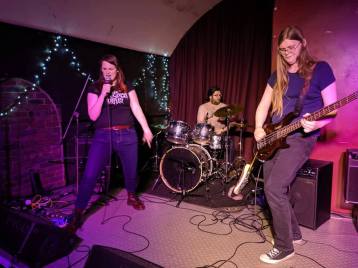
Earlier this year I took part in an interview for Acadames, a super-cool podcast “that explores whether being a woman in academia is a dream, game, or scam”. The episode is now available! I really enjoyed speaking with Whitney Robinson about my work, and hope you will enjoy our conversation just as much.
Today Whitney speaks with Dr. Ruth Pearce, a social researcher and feminist scholar based at the University of Leeds in the United Kingdom. Ruth discusses her current work with the Trans Pregnancy project, why gender equity schemes are so important in academia, and offers tips for resiliency when facing online harassment and political backlash. Along the way, she shares stories of her life as a trans woman, how academic institutions in the UK differ from those in the US, and the similarities between organizing a concert and organizing a conference.
Hyde Park Picture House are hosting a screening of the documentary film Seahorse tomorrow evening (Tuesday 27 August), in association with Leeds Queer Film Festival. I will be participating in a live Q&A session afterwards, representing the Trans Pregnancy project.
The film follows the experiences of Freddy as he becomes a father:
Freddy is 30 and yearns to start a family but this poses unique challenges. He is a gay transgender man. Deciding to carry his own baby took years of soul searching, but he was unprepared for the reality of pregnancy, both physically and challenging society’s fundamental understanding of gender and family. To him what feels pragmatic, to others feels confronting; this was not part of his plan.
Against a backdrop of increasing hostility towards trans people the world over, Freddy is forced to confront his own naivety, mine unknown depths of courage and lean on every friend and family member who will stand by him.
For the Q&A, I will be joining Freddy, director Jeanie Finlay, and Yuval Topper-Erez, a member of the Trans Pregnancy project Advisory Board who became famous in Israel following his own experience of giving birth. The discussion will be chaired by BAFTA-nominated producer Mia Bays.
Over the last year I have been working on the largest international study of conception, pregnancy and childbirth among trans men and non-binary people: the Trans Pregnancy project. We have now undertaken fifty interviews with trans and non-binary people about their experiences in Australia, Bulgaria, Canada, Germany, the UK and US, plus further interviews and focus groups with young people and healthcare professionals.
In this post, I share a new peer-reviewed commentary and podcast from the project.
Article: Beyond the pregnant man: trans pregnancy in A Deal With The Universe
Our first published academic article is now available in the journal Feminist Media Studies, authored by myself with my colleague Francis Ray White. This is a short commentary on the representation of trans pregnancy in the media, centring on a review of Jason Barker’s autobiographical film A Deal With The Universe.
If you do not have access to this journal through an institutional login (e.g. through a library) or personal subscription, I have uploaded an “open access” version of the article to this website. Click here to read the article for free.
Podcast: Making Space for Trans Pregnancy
In November 2018, Francis and I presented initial findings from the project at the Gendered Intelligence Transforming Spaces conference in London, UK.
There is a lot more to come! Over the next few months, we will be undertaking our final interviews and focus groups, conducting an in-depth analysis of these, and publishing a law and policy report focusing on the European Union.
Early next year we will discuss our research findings in a report and free conference. We are also planning to write many more academic articles on a range of topics, which will be published gradually over the next few years.
We are hugely grateful for everyone who has shared their story with us so far – thanks to your contributions, we have an enormous amount of material to work with. We very much look forward to sharing more of our work with you.
This book is intended as a statement of hope, and of possibility. It is about the context and consequences of trans emergence. It is about how “trans” becomes, and how we “become” trans. It is about how trans people are changed by the experience of emergence, and how trans emergence might change our worlds.
The book includes essays, poetry and a comic strip on topics such as monsters, eugenics, performativity, epiphanies, music, relationships, language, pronouns, picture books, robots, research methods and ethics.
If you want to learn more about the book, there is no better way to start than through the introductory chapter. I have uploaded a copy to this website, which you can read for free here:
Chapter 13: Nonnormative Ethics: The Ensouled Formation of Trans
by Mijke van der Drift
Chapter 14: A Genealogy of Genealogies – Retheorising Gender and Sexuality: The Emergence of ‘Trans’ (ESRC Seminar Series 2012-2014)
by Igi Moon
The book is now available in paperback and hardback formats from many bookstores, including publisher Routledge. Ebook and Kindle versions will also be released soon.
During my April/May visit to Aotearoa (New Zealand) I picked up a lot of amazing resources. In this blog post, I share some brief reflections on three great documents which contain an enormous amount of interesting and useful material produced by and for Rainbow communities (takatāpui, lesbian, gay, bi, trans, intersex and queer people), on topics that include disability, Māori experiences of gender and sexuality, and affirmative care.
These documents will be of interest to people who want to know more about rainbow activism, communities and healthcare in Aotearoa, but also clearly have a wider relevance and importance. In writing about them, my intention is to highlight the expert contribution of the authors. As a UK-based scholar and activist, I learned a great deal and it is my hope that readers will too.
“Imagine how engaged our communities would be if we were curious about our strengths and values, rather than our limitations.”
This beautifully illustrated guide addresses topics such as structural stigma, intersectionality, accountability, minority stress and (de)colonialism from the perspective of a queer disabled politics. It promotes a mode of solidarity and understanding that recognises and works with difference.
All of Us was created by Stace Robertson, a queer trans man of Pākehā (European or non-Māori) descent who lives with Cerebral Palsy.
Robertson explains that the project came about after he noticed that people are often not fully included even in minority communities if they experience multiple forms of marginalisation.
He therefore decided to create a resource that shared the perspective of people with these experiences, drawing on that advise of mentors, and advisory group and 14 people from a range of backgrounds who offered to share their stories in the document.
This resource will be of interest to people who want to learn more about experiences of multiple marginalisation. It will be useful to those who are new to this topic, as well as those who want to understand more about factors such as ableism or migrant status impact LGBTIQ experience and vice-versa.
There is also an excellent easy-read version of the guide available in the second half of the document.
“Takatāpui is a traditional term meaning ‘intimate companion of the same sex.’ It has been reclaimed to embrace all Māori who identify with diverse genders and sexualities such as whakawāhine, whakawāhine, lesbian, gay, bisexual, trans, intersex and queer.”
The document was created to provide information and support for takatāpui and their whanau (family), but it will also be of interest to people wanting to learn more about mātauranga Māori (Māori knowledge or wisdom) with regards to sexual and gender diversity. It was written by Dr Elizabeth Kerekere, a renowned takatāpui activist, scholar, and founder/chair of the Tīwhanawhana Trust.
Through colonialism, Aotearoa inherited the sexism and homophobia of the British legal system. Takatāpui narrative were erased through pathologisation, colonial records, and the imposition of the nuclear family model. In light of this, Kerekere highlights the importance of pre-colonial histories, and of contemporary resilience and the importance of pride, family and community support.
In the UK, we have begun to talk more in recent years about how binary gender norms were imposed on many societies by British invaders through colonialism. These conversations can only become deeper and more nuanced through respectful engagement with knowledge produced by Indigenous peoples on this topic, rather than relying on the flawed work of colonial anthropologists. As a white trans woman who experiences both gender marginalisation and unearned privileges afforded by the legacy of colonialism, I am grateful for the opportunity to learn directly from takatāpui perspectives.
“These guidelines are based on the principle of Te Mana Whakahaere; trans people’s autonomy of their own bodies, represented by healthcare provision based on informed consent.”
These guidelines were produced by a coalition of healthcare practitioners, academics and community members, with the support of the Northern Region Clinical and Consumer Advisory Group. They are intended to supplement the World Professional Association for Transgender Health Standards of Care, providing guidance relevant to District Health Boards in providing gender affirming healthcare throughout Aotearoa.
An important feature of the guidelines is the use of Māori health expert Professor Mason Durie’s health framework. The document highlights two key principles for health promotion development: Te Mana Whakahaere (autonomy) and Ngā Manukura (community leadership). There is therefore is an emphasis on trans and gender diverse people having collective control over their own destiny and decisions around healthcare.
Furthermore, Te Whare Tapa Whā, as described by Durie, conceptualises health and wellbeing as the four cornerstones of the wharenui (meeting house). As noted in the guidelines, this model recognises the equal importance of Taha Wairua (spiritual health), Taha Whānau (family health), Taha Hinengaro (mental health) and Taha Tinana (physical health). These four cornerstones provide the structure for the document.
Consequently, the guidelines highlight topics such as Māori and Pasifika genders, minority stress, social transition, health in the family and in schools, and mental health, positioning these as equally important a consideration as physical transition (for those who desire/require medical interventions). This strikes me as a really important move, de-centring hormones and surgery to instead provide a more holistic view on trans health needs.
Like many similar documents, the guidelines are not perfect. I met a number of clinical practitioners in Aotearoa who considered this document to be a good starting point for conversations around improving care, but with some limitations outside of the relatively well-resourced Northern region in which they were primarily written. I have my own concerns around the citation of somewhat inaccurate information produced by cis clinical researchers (for example, Table 5, based on the Endocrine Society Guidelines, underestimates how long it might take for certain bodily changes to take place). I also feel that the definition of “informed consent” used in the document could perhaps benefit from tightening to specify what does and does not constitute appropriate oversight in determining whether or not patients are “adequately prepared” for medical interventions.
Regardless, I am deeply grateful for the work from so many people that goes into producing guidelines such as this, and I hope they can contribute usefully to the ongoing depathologisation of trans health.
I recently returned from a month-long journey to Aotearoa New Zealand. This trip was funded by a Rockefeller Foundation Fellowship with the School of Sociology and Social Policy at the University of Leeds.
My aim was to learn more about trans health services and community advocacy, while also sharing findings from my own research in a European context. I feel deeply privileged to have had the opportunity to meet many amazing people, who are doing a great deal of incredible work.
In this post, I share a number of resources and reflections from the trip. However, this is just the tip of the iceberg – I have no doubt that will no doubt that the experiences from the Fellowship will inform my research and thinking for many years to come.
Before I begin, I should quickly acknowledge that many readers of this blog will be unfamiliar with the word “Aotearoa”. This is a term from te reo Māori (the Māori language): it’s the current name for the islands known as “New Zealand” in English. Both are official names for the country that governs this land. For simplicity (and out of respect Māori history and culture, which long predates the arrival of Pākehā, or white European settlers) I use mostly use Aotearoa alone for the remainder of this post.
Whanganui-a-Tara / Wellington: the Gender Centre and Aunty Dana’s Op Shop
After a brief visit to Auckland (where I recovered from the long flight) I began my trip in earnest with a visit to the capital city of Aotearoa New Zealand, on the south-west tip of the North Island. I was told that you can’t beat Wellington on a good day – certainly, the bay of Whanganui-a-Tara is one of the mostly stunningly beautiful places I’ve ever had the fortune to visit.
Photos of 128 Radical Social Centre and the Gender Centre, taken with permission.
The Gender Centre includes a small office space, where people working for Gender Minorities Aotearoa can work on current campaigns and meet with visitors. Anyone can drop by to ask for advice or support, or pick up information. For example, the organisation has recently started running a free binder scheme. Materials on display included forms for name and gender changes, advice on accessing healthcare services, and information on the BDMRR bill.
BDMRR stands for Births, Deaths, Marriages, and Relationships Registration. Groups such as Gender Minorities Aotearoa are campaigning for non-binary recognition, and to make it possible for people to legally change the gender marker on their birth certificate without going through an expensive process involving medical oversight. Unfortunately, proposed changes have been delayed by the actions of anti-trans hate groups. UK readers will recognise the similarities with the campaign of misinformation waged against proposed changes to the Gender Recognition Act. This is not a coincidence. Anti-trans groups in Aotearoa are directly influenced by the language, aesthetics and (in some cases) the direct interventions of UK anti-trans campaigners, in what can be understood as a form of neo-colonialism.
While I was at the 128 Radical Social Centre I also visited Aunty Dana’s Op Shop. This is a second-hand clothing and accessories store run by trans and non-binary volunteers and open to people of all genders, with proceeds donated to Gender Minorities Aotearoa. It’s such a great way to raise money for campaigning, while providing an important resource and social space. It can also serve as a less scary space than the Gender Centre for people who are just coming out and looking for support. I had a great time browsing the shelves and chatting with the volunteer who was working there that afternoon.
Photos of Aunty Dana’s Op Shop. Taken with permission.
You can watch a fantastic video about the Op Shop here:
While I was in Whanganui-a-Tara I also took the opportunity to visit a trans and non-binary artists showcase at the NZ Games Festival and meet with some brilliant academics and students working on LGBTIQ research at Victoria University of Wellington. I will be sure to share their work as it is published!
Ōtautahi / Christchurch: queer art and affirmative care
I next travelled to Ōtautahi / Christchurch, taking a train down the east coast of the South Island. During this trip I began to understand the extent of the damage caused by 2010 and 2011 Canterbury earthquakes. There was evidence of huge landslides and roads were still being rebuilt. Several metres of new coastline were visible for many miles, clearly identifiable through rocks bleached white by dead organisms that once lived under the waves. The city itself is still being rebuilt. Huge building projects and areas of empty land can be found throughout the central business district, a reminder of the unforgiving power of the Earth.
Photos: day and night – urban art and public protest.
It was apparent that the people of Ōtautahi were still recovering from tragedy even before the horror of the recent neo-Nazi mosque shootings. Nevertheless, the city struck me as a great centre of culture. I am grateful to have had the opportunity to meet some amazing queer and feminist artists and heard about both radical public interventions and commissioned works. If you want to learn more about this, the websites of Jennifer Shields and Audrey Baldwin are great places to start.
During this visit, I learned about a fantastic initiative to build and publicise new public health pathways for gender-affirming care in the Canterbury region. Until recently, services such as specialist counselling, hormone therapy and surgical referrals were only available on an ad-hoc basis, and information was not easy to find. Relevant information on what services are available and how they can be accessed is now easily available, thanks to the work of the Ko Awatea gender-affirming care co-design group.
These services are still not perfect – several interventions are not publicly funded, and they still involve a certain level of medical gatekeeping. However, they represent an important step forward. Notably, I was informed that these achievements can be credited to the willingness of particularly motivated medical providers, who were prepared to put energy into working directly with trans community representatives to work for reform.
Tāmaki Makaurau / Auckland: RainbowYOUTH
The next stage in my journey was a visit Kirikiriroa / Hamilton, back on the north island. I was here for the Aotearoa New Zealand Trans Health Symposium. This will be the subject of a future blog post, so I am going to finish this piece with a look at an organisation based in Aotearoa’s largest city.
In finish my journey with a return to Tāmaki Makaurau / Auckland, meeting a number of community workers, activists and academics living and working in the city. I was especially honoured to visit the RainbowYOUTHoffices and drop-in centre: a spacious explosion of colour located in an otherwise unobtrusive side street on the edge of the queer distract around K Road.
RainbowYOUTH are an organisation run by and for queer and gender diverse youth, with a remarkably long and successful history. They are currently celebrating their 30th anniversary, having been founded in 1989. The organisation’s members and executive board are all aged 27 or under. Executive advisors aged over 27 are invited to attend and speak at board meetings, but do not have voting rights. I was really impressed by this commitment to centring youth perspectives in support work and activism, something which has been missing from the UK since the dissolation of Queer Youth Network.
I was also interested in how common the language of “rainbow” community was in Aotearoa, as an addition and alternative to acronyms such as LGBTIQ. I like the way this word avoids the “alphabet soup” and potential exclusions tone of the acronym. I can also see how – like the term “gender minorities” – it can work to be inclusive both of intersex people and of takatāpui in a way that is more expansive than just attempting to rework the Western/anglophone framework of “LGBT”.
Photos of the RainbowYOUTH centre. Taken with permission.
The RainbowYOUTH centre was a wonderful building. For a long time, the organisation ran out of a very small office on Karangahape Road, but in recent years an increase in income and activity enabled a move to the new space. This features several offices, a therapy room, a large social space with a TV and gaming consoles, a library, a community wardrobe, free hygiene packs for people in difficult circumstances, and once again a whole range of resources and information. I can see how the very existence of this space is helping to create new possibilities for a generation of young people who I hope will achieve things that currently remain unthinkable.
I left Aotearoa incredibly inspired by the work and imagination of everyone I met, and am hugely grateful to everyone who helped with advice and organisation, made time to speak with me, and shared ideas and information. Ngā mihi nui!
I am very grateful to have been awarded a Rockefeller Foundation Travelling Fellowship by the School of Sociology and Social Policy at the University of Leeds. This will be used to fund a research trip to Aotearoa New Zealand.
The object of the Rockefeller Fellowship is to enable early career researchers working in the Social Sciences to make personal contacts and/or visit universities overseas. My aim is to build networks with trans health activists, researchers and practitioners, plus share research findings from the Understanding Trans Health and Trans Pregnancy projects.
I will be in Aotearoa from 18 April to 12 May, visiting Auckland, Wellington, Christchurch and Hamilton. In addition to strengthening existing relationships, I hope to spend time meeting new people and learning more about trans health services and community advocacy. While the UK and Aotearoa differ in many ways, we are both island nations with public health systems that face various forms of privatisation; we are both seeing a rapid growth in the visible trans population; and we are both currently seeing proposals for reform within trans healthcare. I am very much interested in exploring how activists, researchers and practitioners in both countries might be able to exchange ideas and information.
I am excited to been invited to present my work at the University of Waikato, Hamilton during the visit.
On Friday 3 MayI will be speaking about my PhD research in the Department of Psychology at the University of Waikato. My talk, The “Gender Experts”: Clinical Discourses and Becoming Trans, will explore how expertise is contested within and between trans communities and clinical settings, reflecting on what this might mean for patient experience and differing understandings of trans possibility.
On Saturday 4 May I will be describing initial findings from the international Trans Pregnancy project at the Aotearoa New Zealand Trans Health Symposium. In this talk I will look at how and why some trans men and non-binary people choose to conceive and bear children. I shall explore some of the challenges and opportunities that arise for trans birth parents, and explain what kind of support research participants want to see from healthcare providers.
If you are a trans activist, trans health researcher or healthcare provider in Aotearoa and would like to meet during my visit, please do be in contact – I would love to hear from you!
This morning I was delighted to see that an article about Athena SWAN I co-authored with Charikleia Tzanakou has been pre-published online.
Entitled ‘Moderate feminism within or against the neoliberal university? The example of AthenaSWAN‘, the article reflects on findings from research undertaken by Tzanakou in 2013-2017 and myself in 2017, looking at the experiences of individuals involved in Self-Assessment Teams (SATs) for the Athena SWAN gender equality scheme. It will eventually be published in a special issue of the journal on the topic of ‘moderate feminisms’.
Something we thought about a great deal when writing the article was our own ambivalence regarding Athena SWAN.
On the one hand, we found that the scheme tends to play an undue burden on women, who are disproportionately represented on SATs and can face hostility from colleagues and managers for undertaking the assessment process. Some women even reported being threatened or turned down for jobs if their department, school or faculty failed to obtain an Athena SWAN award, even though this typically reflected the failings of the institution rather than the SAT. Women experiencing intersecting forms of marginalisation were particularly vulnerable, and trans people were rarely acknowledged at all. We regarded this as a consequence of the neoliberal context in which Athena SWAN operates, in which the scheme may be regarded as “just another metric”, a box-ticking exercise with a reductionist notion of womanhood.
On the other hand, several participants did argue that Athena SWAN had helped to raise awareness of gender inequalities in their institution, leading male colleagues especially to take the issue more seriously. In some cases, SATs used the scheme to push for important changes, such as better support mechanisms and financial support for new parents, more diverse and intersectional curricula, and gender neutral toilets. Of particular benefit for this purpose was the requirement for continual re-assessment every few years should institutions want to retain their Athena SWAN award, or upgrade from Bronze to Silver or from Silver to Bronze. This requirement for re-assessment gives the award “teeth”, meaning that institutions can sometimes be actually held to account for actively pursuing the action plan they have to draw up in order to obtain an award.
Ultimately, Athena SWAN is not simply “good” or “bad”. It is often implemented poorly, and suffers from operating within a neoliberal environment, but has the potential to be used as a tool for real change. Multiple actors are responsible for how the scheme works in practice.
If you are a SAT member, I would urge you to see Athena SWAN not simply as a box-ticking exercise, but as a means through which universities might be required to change their practices and provide additional resources. Think about how your team might take a more intersectional approach to planning actions, and if you receive an award, use it to hold your institution to account.
If you are a Head of Department/School/Faculty or otherwise work in university management, I would urge you to remember that inequalities abound in our institutions; Athena SWAN offers a real opportunity to reflect on and address this. Identifying the problem does not necessarily reflect poorly on your institution, but failing to act certainly does.
Finally, I should note that there is currently an ongoing review of Athena SWAN, which closes on the 28th January. I encourage anyone with an interest in this topic to respond to it!
In November I participated in a panel on research ethics at the 2018 WPATH Symposium in Buenos Aires, “Ethical Considerations in Transgender Health Research Practice”.
I presented a talk based on work I have undertaken with Dr Michael Toze (who sadly could not join us at the conference). Entitled Trans Health Research at a Gender Identity Clinic, the talk critiqued clinical research methods employed at a UK gender clinic, using the example of published research on video gaming.
I argued that clinical researchers should be mindful of the power dynamic that exists between them and their patient/participants. I also presented evidence that methodological and ethical issues have resulted in harm to participants, and undermined the validity of empirical claims.
This talk was kindly recorded by Ellen Murray, and you can listen to it below.
I have also uploaded produced a transcript of the talk:
Please do feel free to download and share this talk with anyone you think might find it interesting or useful, as long as myself and Dr Toze are credited.
In January I will be travelling to Turku, Finland to speak about my trans health research for a seminar at the Åbo Akademi university. Details of the event can be found below.
Future research on sexual and gender minorities in Finland?
Friday and Saturday, 11-12 January 2019
Åbo Akademi university
At this seminar, keynotes from across Europe will tap into the issue ‘what are relevant and urgent questions for future research on LGBTiQA+ from their respective perspectives and horizons, and hopefully the discussions will nurture thoughts and ideas on new research projects. This seminar is part of the Åbo Akademi University profile on minority research.
Our main keynote contributions are:
“Towards sustainable scholarships on trans and intersex: critical studies of cisnormativity”
Dr Erika Alm, from University of Gothenburg (Sweden)
“Enhancing sexual health, self-Identity and wellbeing among men who have sex with men”
Dr Rusi Jaspal from De Montfort University (UK)
“A brief history of the Finnish closet”
Dr Tuula Juvonen from University of Turku (Finland)
“The politics of trans health: condition or movement?”
Dr Ruth Pearce from University of Leeds (UK)
“The mobilizations of LGBT organisations in Europe between homo-normativity and homonationalism: challenges and opportunities”
Dr Luca Trappolin from University of Padova (Italy)
In addition, some ongoing research projects at Åbo Akademi University will be presented by Panda Eriksson and Minna Laukkanen. Finally, actor Boodi Kabbani, known from the film “A moment in the Reeds”, Dr Julian Honkasalo from University of Helsinki, Dr Jukka Lehtonen from University of Helsinki, and Secretary General Kerttu Tarjamo from Seta, will together provide input and critical comments in a panel discussion.
The seminar is open to students, researchers, activists and people engaged in NGO:s. Coffee, lunch and dinner are included in the registration fee of €50.