Respond to the EHRC consultation together! (10 June)

The Equality and Human Rights Commission’s segregation consultation is a horrible document to look at. But if you’re planning to fill it in, you needn’t do so alone.

Tomorrow evening (Tuesday 10th June) I’ll be joining Katy Montgomerie on her livestream from 8pm to talk about and work through the EHRC consultation. We’ll hopefully make the process that bit less grim together, and also highlight other important and perhaps even joyous things that are going on.

If you can’t make it, Katy will also hopefully be able to put a recording of the stream up on her channel at a later point.

It’s a long hard revolution

Lesbian conspiracies in Lausanne

On the evening of Tuesday 15th April 2025, I was widely perceived to be a British lesbian, both legally and socially. By 11am the following day, that was no longer the case, following a ruling by the UK’s Supreme Court.

I was not actually in the UK for this momentous occasion. I was instead in the Swiss city of Lausanne, for a workshop on standards of evidence in sex and gender policy. I was there to consider the very questions the UK’s highest court, in their supreme ignorance, had effectively dismissed. Their ruling determined that the term “sex” in the Equality Act referred to “biological sex”, which in turn should be understood as “the sex of a person at birth”. But what do we actually need to know about when we make policy around sex and gender, and what is the role of evidence in this?

The Tuesday evening found me hanging out in a second-rate Thai restaurant with Professor Sarah Lamble, an esteemed criminologist and fellow dyke. Lamble and I spent some time talking about how conspiracy theories around “disappearing lesbians” highlighted the strange ironies inherent in British anti-trans discourse. The anti-trans movement has been extremely successful in raising “reasonable concerns” around supposed problems that are completely ungrounded in reality, to the point where that reality itself begins to warp.

Mainstream political discourse in the UK increasingly reflects anti-trans claims that lesbians are somehow threatened by trans people, or are even being transed en-masse in gender clinics and youth groups. The true biological attraction between two adult human females is disrupted. Young people are tempted away from lesbianism with promises of luxurious facial hair and male privilege; meanwhile, horrifically manly and/or confusingly attractive trans dykes are introduced to the dating pool.

If these claims were true, we might expect to see some kind of reduction in the number of homosexual females. Instead, the evidence we have indicates quite the opposite. Surveys such as the Annual Population Study show a rising number of lesbians over recent years, part of a wider increase of 1.2 million in the recorded lesbian, gay, and bisexual (LGB) population of the UK. This is driven especially by young people coming out, with over 10% of people aged 16-24 identifying as LGB as of 2023.

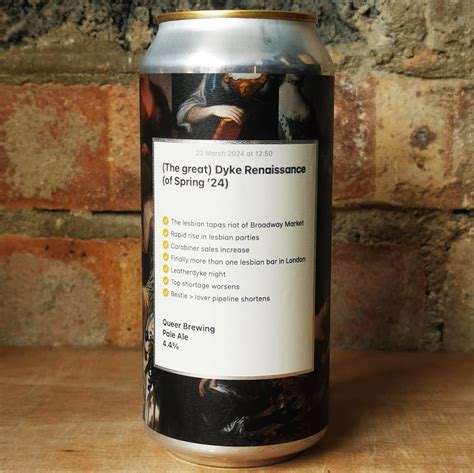
But what about the lived reality of queer womanhood? Well, there’s great news here too: we are living in a truly historic time for sapphic culture in the UK. Proudly out lesbian and bisexual women can be found across the pop charts, on TV, and across social media. Queer bookshops are on the rise. Pop-up butch bars and new queer cafes can be found in major cities and small towns.  And, excitingly, even the much-maligned lesbian bar is making a comeback, with three permanent venues and numerous occasional nights now running in London alone. It’s all got so out of hand that in 2024 the Queer Brewing company sold a juicy pale ale named Dyke Renaissance, which conveniently listed an educational series of cultural milestones on the can.

If trans people are trying to disappear lesbians, we’re doing a really bad job of it.

Photo of a beer can. Text on the can reads as follows. The great Dyke Renaissance of Spring 24. The lesbian tapas riot of Broadway Market. Rapid increase in lesbian parties. Carabiner sales increase. Finally more than one lesbian bar in London. Leatherdyke night. Top shortage worsens. Bestie to lover pipeline shortens. Queer Brewing, pale ale, 4.4%.


Meanwhile, queer cis women tend to be pretty supportive of trans people. In fact they’re one of the single most supportive demographics in the UK – which is presumably why the Equality and Human Rights Commission is, right now, attempting to ban trans dykes such as myself from associating with any more than 25 biological lesbians at any one time.

On evidence

As lesbian conspiracy theories show, the very concept of evidence has had a bit of a hard time over the past decade.

In the UK, this was perhaps best encapsulated in 2016 by the Conservative politician Michael Gove. While campaigning for Brexit, he declared that the British people “have had enough of experts”. Gove’s claim is echoed in a growing anti-intellectualism across the globe. From the mass purge of universities in Türkiye, to the post-truth bizarro world of Donald Trump, to Israel’s scholasticide in Gaza, this trend manifests in blunt and brutal ways. Anti-expert authoritarianism doesn’t care about your facts or your feelings.

However, attacks on evidence can also be more subtle. Gove’s comments are widely quoted, but it’s less well-known that he singled out a particular kind of expert for criticism: “people from organisations with acronyms saying that they know what is best and getting it consistently wrong”. While this was gloriously vague in a way that allowed the listener to project all kinds of things onto Gove’s words, in context it was nevertheless evocative of the kind of group that tends to advocate for social justice. LGBTQQIAAP groups, perhaps.

From academic thinktanks, to charities, to campaigning organisations, the implicit problem was any kind of challenge to conservative common sense. The UK’s political mainstream has since doubled-down on this approach. In the run up to the 2024 general election, Tory home secretary Suella Braverman criticised “experts and elites”, while the secretary of state for science, innovation and technology, Michelle Donelan, promised to “kick woke ideology out of science”.

One of Donelan’s targets was the “denial of biology” in research by feminists, social scientists… and biologists. The problem here is that supposedly common sense notions of sex and gender, which assume clean and tidy biological divisions between male and female, collide violently with the beautiful messy reality of the material world. At this point in history, it is well-established that sexual diversity exists throughout nature, that men are not biologically superior to women, that social advantage is not conferred or denied by chromosomes, and that queer, trans, and intersex people exist in the world. The evidence for this is gloriously multifaceted. We find it in laboratories, in systematic reviews, in surveys and questionnaires, in the way that men shout abuse at us in the streets, in how our sexed bodies shift and change under hormonal influence, in the way we feel when we finally have a language that describes our experiences.

Michelle Donelan decided to tackle the thorny problems of feminist science, intersex bodies, and trans existence by commissioning a research project by Alice Sullivan, a supposed sociologist who doesn’t care one jot for any of the evidence outlined above. Published in March 2025, the Sullivan Review insisted that data collection relating to sex and gender should rely on a very narrow definition of biological sex: one that ignores trans and intersex women’s real lives, bodies, and experiences of misogyny, while promoting a sexist model of essentialised womanhood. Her findings were echoed in those of the Supreme Court judges a month later, whose pronouncements on biological sex were made without any reference to relevant social, scientific, or philosophical research on how this might actually be understood or defined in practice. 

To position this as a wholly new trend would, of course, would be inaccurate. Western jurisdictions have long used and abused pseudoscience to oppress minoritised groups, especially in colonial contexts. This can be seen for example in the British state’s shameful embrace of “race science” and eugenics in the 19th and 20th centuries. What we are now witnessing is an example of the imperial boomerang, in which the logics of colonialism are turned inwards, resulting in increasingly fascist domestic politics.


But did you have a nice time in Switzerland, Ruth?

On that fateful week in April, I joined a group of feminist, trans, and lesbian researchers and activists for the workshop at the University of Lausanne. In the face of increasingly ill-informed policymaking across multiple contexts, it provided us a space to think together about the lessons we might learn collectively from our very different work on healthcare, sports, and prisons.

One overarching theme was the importance of evidence in understanding human experience, in terms of rigorous data collection, careful analysis – and accounting for the lived reality of actual people’s actual lives. A powerful account of the latter point was provided by Dinah Bons, a veteran campaigner for HIV prevention. She pointed out that if a sex worker repeatedly attends a community clinic for her STI tests, this provides evidence that the clinic feels safe enough for her to return regularly, which is far from a given. Such matters are often highly evident to service users and providers on the ground, without any need for a survey or interview.

Another key theme at the workshop was the extent to which various principles of evidence are increasingly abused by politicians, journalists, and institutions.

The concept of evidence has not been rejected wholescale by sexist, transphobic, and lesbophobic policymakers. Rather, “evidence” is increasingly a buzzword to justify particular approaches or points of view, rather than something grounded in a commitment to scholarly standards or an acknowledgement of lived experience. At the workshop, we explored how flawed notions of evidence have been used to support misleading statements or outright lies about human bodies or human experiences. We heard about the use and abuse of evidence in justifying invasive sex-testing for woman athletes, misrepresenting research on young people’s ability to engage in informed decision-making, and defending conversion practices. Notably, while most of these abuses arose from a specifically transphobic politics, they have far wider consequences: especially for women, intersex, and queer people, but also for scientific processes, community consultations, and informed advocacy more broadly.

You can see an example of this in the Cass Review. Through successfully performing the aesthetics of acceptable expertise and science to the satisfaction of the British public, the Review has become what one workshop participant described as a black box. By this they meant that it has become an abstracted justification for policy and practice, handily replacing any ongoing discussion of evidence regarding young trans people’s health and wellbeing. You don’t need to know what the Cass Review actually says or how rigorous it actually is, only that it exists. Well-documented criticisms of the review from healthcare practitioners, academic experts, trans community groups, and (most importantly) young trans people themselves are been rendered irrelevant. The Cass Review is the evidence, and no other systematic review, original research, or personal testimony can henceforth count against it. Not, at least, until 2031 at the earliest: the official end-date of a single £10 million study, based on the Cass recommendations and featuring precisely zero trans researchers.

The British establishment is now attempting to repeat this trick with the Sullivan Review – never mind that projects such as MESSAGE have conducted more extensive and nuanced work on the same topic with a far wider group of experts – and, of course, with the Supreme Court judgement.

Beyond doom

As with Cass, as with Sullivan, it is difficult to capture the sheer enormity of harm caused by the Supreme Court’s pronouncement on biological sex. The consequences are still playing out, and will no doubt continue to do so for many awful months and years.

At the time of writing, the Equality and Human Rights Commission have proposed a programme of mass segregation, designed to discriminate against trans people in the workplace, in public services, and in social groups. The guidance they have written is just that: guidance, not law. Nevertheless, major organisations such as the Football Association, the British Transport Police, and Barclays Bank, all of whom shamelessly paraded rainbows through their social media profiles last Pride season, are falling over themselves to comply. We are witnessing the attempted complete exclusion of trans people from public life, in the latest culmination of a transparent attempt to eliminate us altogether.

In such moments, it can be easy to despair. This is in part because it is easy to forget the strength, resources, power held within trans communities and by our allies. That includes the knowledge and evidence we have access to.

Don’t get me wrong. The people who want to eliminate us are better-funded, better-connected, and now have the Labour government on-side as well as the UK’s traditional right-wing parties. We are not going to win trans liberation overnight.

But then, again, we never were.

Everything I said about lesbian culture earlier is true of trans people too. There are more of us publicly creating art and culture, more of us creating events and running nightclubs and playing in bands and writing essays (hi). There are more community groups providing mutual aid and support when charities and state bodies fail us. And, importantly, we are not alone.

Trans women and non-binary people are a part of the dyke renaissance. We are at the butch bars, and bemoaning the top shortage. We are dancing to Le Tigre and to Chappelle Roan. We are reading Gideon the Ninth and watching We Are Lady Parts and having all the feelings. My partner of the last decade was probably the most surprised of all to learn from the Supreme Court that I am not, in fact, a lesbian, as every bit of evidence from our shared personal lives points to quite the contrary.

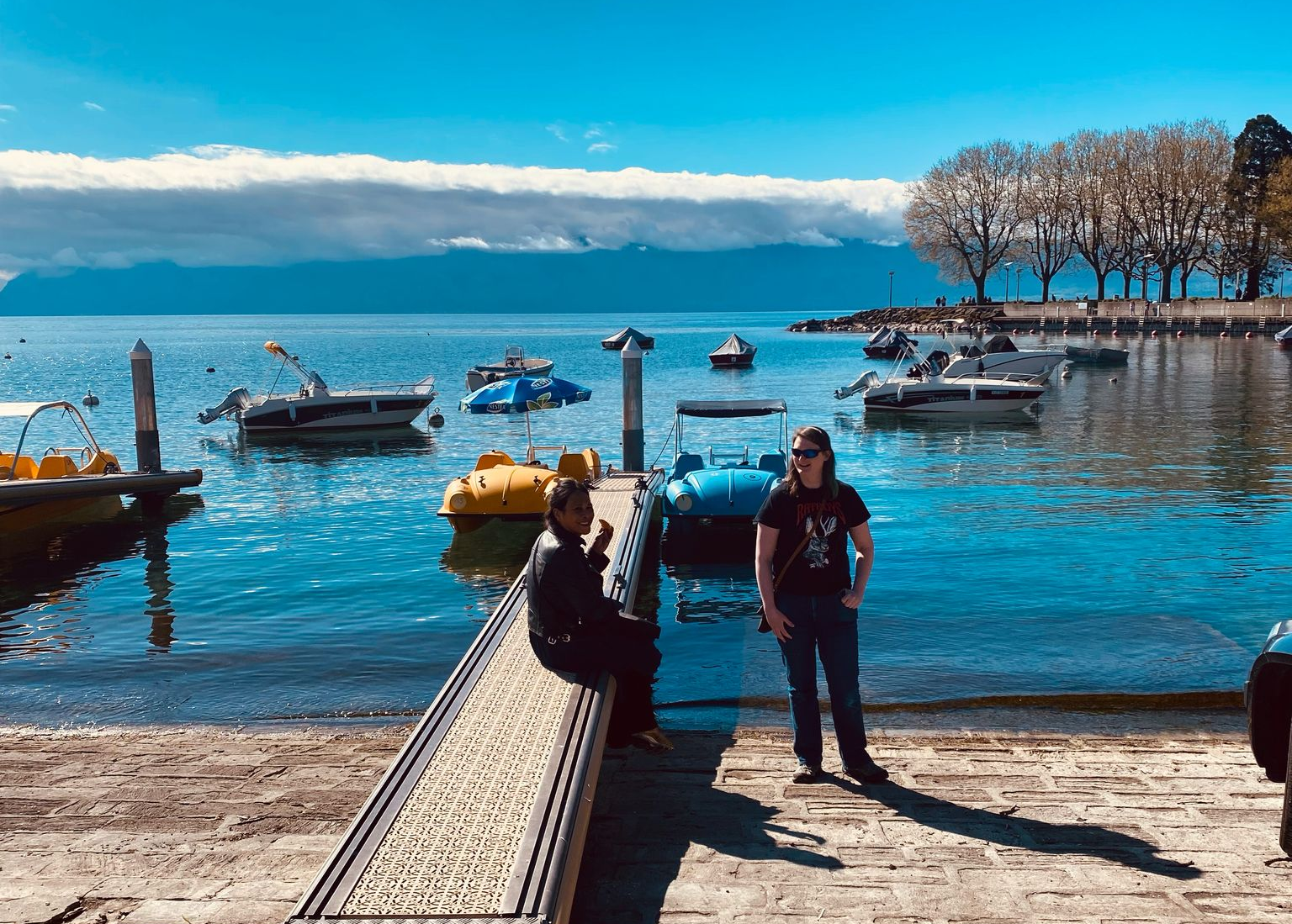
I will concede that some trans people are not in fact lesbians, or even queer. Nevertheless, there are so many other places to find us in community with others. Trans people are in trade unions. Trans people are in workplaces. Trans people are in schools and colleges and universities. Trans people are in the streets. Trans people are on the bus. Trans people are in families. Trans people are making families. Trans people are playing football (suck it, Football Association). Trans people are eating pizza. Trans people are restoring the countryside. Trans people are hanging out beside Lake Geneva in the glorious sunshine, enjoying a much-needed break.


There are more of us than ever, and it is too damn late to put us back in a box.

Resistance is fertile

I was honoured to present the keynote presentation at the Swiss workshop. I spoke about the findings of the Trans Pregnancy Project, a study that produced enormous amounts of evidence on the experiences, needs, and perspectives of men and non-binary people who conceive, carry, and give birth.

No matter how much our findings are slammed by the media and billionaire children’s authors and washed-up comedy writers, our peer-reviewed work has demonstrated the lived reality of male and non-binary pregnancy over and over again. Most importantly, it has helped people. We are part of a far wider movement of parent groups, midwives, and researchers who are collectively building knowledge. I am constantly hearing from people who describe how much this knowledge has resulted in better care for them and their child. This kind of story drives everything I do.

Towards the end of my talk, I discussed the anti-trans moral panic, and the Supreme Court judgement. I then showed the below table of findings from the National Maternity Survey. This annual survey involves those who have recently given birth every year in many (but not all!) English hospitals, over the course of a few weeks. Since 2021, they have started asking whether the person giving birth has a different gender to the sex they were assigned at birth – i.e. are they trans?

Table showing data in response to the question, is your gender different from the sex you were assigned at birth. It shows a statistically significant increase in the proportion of people answering "yes", which rises from 0.56% in 2021, to 0.65% in 2022, to 0.77% in 2023, to 1.58% in 2024.


Two things leap out from this table for me. Firstly, the 2021 data shows a very similar proportion of people indicating they are trans when compared to the 2021 censuses in Scotland, England, and Wales. This suggests that, contrary to assumptions around trans infertility or undesirability, trans men and non-binary people may well be just as likely to give birth as cis women are to become birth mothers.

Secondly, the number of trans people giving birth has risen dramatically over four years. Even as the anti-trans moral panic has deepened. Even as attacks on even recognising the existence of trans people in perinatal services have increased. As Del La Grace Volcano once it put it: “resistance is fertile!”

In the face of growing oppression, trans people are simply refusing to disappear. In fact, we are doing the opposite.

This, then, is the power that the anti-trans movement, the Labour party, and the Supreme Court cannot possibly take away from us. The more trans people are out and visible to one another, the more trans people come out and become visible to one another. Sure, we will unfortunately need to think more carefully about where and when we are out, and where and when we are visible, if this is something we even have any power over in our specific lives. I am sure that more trans people will be going stealth in future years, if they can. But regardless – there are more of us in community, more of us organising protests, and more of us than ever in the lives of our friends, families, colleagues, and allies, showing that it possible to have a good life while being trans.

In this context, it is important to know that people from many parts of the world gathered in Lausanne this April to pool our knowledge and skills and experiences. It is important to know that we have each returned to our home countries to share what we gained. It is important for people to know that similar meetings are happening across the world, in community centres and on university campuses, in board rooms and in bedrooms, involving trans people, and feminists, and yes, lesbians. We are constantly building a movement for positive change, and you do not have to be an academic or veteran activist to be a part of it. Trans power is for everyone.

There is much to say what needs doing in the current moment. We need allies to continue fighting alongside trans people for our collective liberation. We need to be demonstrating in the streets, funding mutual aid and legal action, actively resisting complicity in Labour’s eliminationist agenda, and encouraging every public body under the sun to do the same.

Evidence will be helpful for this. Evidence from academic research, sure, but also – as Dinah Bons pointed out – testimony from the everyday reality of trans people’s lives. And oh boy, do we have that evidence.

More of us than ever are producing evidence of trans existence, and trans persistence.

And this is how we win.

Supreme Court auto-reply

Last week I attended a workshop in Switzerland on standards of evidence in sex and gender research (more on that soon!) During my trip, I had my standard out-of-office auto-reply set up for my email account, informing people of my absence so they wouldn’t expect any immediate engagement from me.

I would typically switch off that auto-reply on my return to work as normal. However, in the wake of last week’s Supreme Court judgement, there is simply no more “work as normal” for me or any other trans person living in the UK.

As such, I have written a new auto-reply, which will be sent to everyone internal to my workplace who emails me. It is impossible for me to forget what is happening to trans people and especially trans people in the UK, so I will ensure it is impossible for my colleagues to forget this also. Equally, my intention is to transform bad feelings into understanding, and practical action. We have always been powerful when we work together and build movements.

I am sharing the text of the auto-reply here in case it is of use to anyone wishing to do similar.


You may be aware that the UK’s Supreme Court has initiated a mass rollback of trans people’s civil rights. In light of this, I am uncertain if it will continue to be safe for women and people like me to continue working at the University of Glasgow.

You can read more about the judgment and its implications here:

UK Supreme Court Rules That Trans Women Aren’t Women under the Equality Act 2010
https://www.wearequeeraf.com/uk-supreme-court-rules-that-trans-women-arent-women-under-the-equality-act-2010/

Illegally Female
https://www.autostraddle.com/uk-supreme-court-ruling-anti-trans-women

While the judgment itself does not require organisations to act in a prejudiced manner, numerous politicians and policymakers have indicated that they intend to make discrimination mandatory. My friends have reported increased street harassment, as the ruling is seen to position trans women as legitimate targets for misogyny and violence. Trans people of all genders are already even more likely to experience public harassment, sexual assault and rape than cis women (see e.g. https://bulletin.appliedtransstudies.org/article/3/1-2/3/), and this is likely to get worse.

The Chair of the Equality and Human Rights Commission (EHRC), Baroness Falkner, has promised to revise guidance to encourage employers to discriminate against trans people in the workplace. For example, she told Radio 4: “if a service provider says we’re offering a women’s toilet, that trans people should not be using that single-sex facility.”

If you are concerned about the safety, wellbeing, and continued access to employment and education for women and trans people such as myself, you can take one or more of the following actions:

  • Write to members of the Senior Management Team at the University of Glasgow, especially the Equality Champions, and ask what they will do to protect trans staff and students, including through ensuring continued access to women’s and men’s facilities as relevant. Find their contact details there <link removed for blog post>.

  • Write to your Head of School and ask what pressure they will be putting on the Senior Management Team to do the same.

  • Write to your MP and MSPs. Explain exactly why you are concerned, and demand action to protect trans people’s civil rights. For example, you could ask for new primary legislation to protect trans people, ask why the UK is no longer complying with the European Convention on Human Rights, or demand the dismissal of biased commissioners from the EHRC. You do not have to write a perfect letter and it is okay to be emotional and express sorrow or anger, so long as you are not aggressive or mean. Advice on writing letters is linked here: https://bsky.app/profile/whatthetrans.com/post/3lnf4sadrjs2p. You can find contact details for your representatives here: https://www.theyworkforyou.com/.

  • Support trans people materially, through providing time, resources, and/or money to community initiatives. Examples include: Glasgow Trans Collective (fundraising for emergency support to people facing an immediate danger of threat to life, https://linktr.ee/glasgowtranscollective); Trans Harm Reduction (supporting harm reduction for people self-medicating in the absence of NHS treatment, https://transharmreduction.org); and Five for Five (donating money every month to a range of trans women’s causes, https://www.fiveforfive.co.uk).

  • Check in on your trans friends and colleagues. Make sure they are okay, and do what you can to be there for them. But do your own research on what you can do to help: don’t put this burden on us. Some good places for information include the websites and social media channels for TransActual, What The Trans, QueerAF, Trans Safety Network, and Trans Writes.

This auto-response is inspired by bell hooks’ comments in her book Teaching to Transgress:

When education is the practice of freedom, students are not the only ones who are asked to share, to confess […] empowerment cannot happen if we refuse to be vulnerable while encouraging students to take risks. [Lecturers] who expect students to share confessional narratives but are themselves unwilling to share are exercising power in a way that could be coercive. In my classrooms, I do not expect students to take any risks I would not take, to share in any way that I would not share. […] It is often productive if [lecturers] take the first risk, linking confessional narratives to academic discussions so as to show how experience can illuminate and enhance our understanding[.]

I will not necessarily respond to any replies you send to this automated message, as I am trying to stay focused on teaching, admin, and research. But regardless, thank you.

Photo of a lake and mountains.

Politicians and journalists want to remove trans people from public life. Fuck that.

Politicians and journalists want to remove trans people from public life. Fuck that.

On 4th April 2023 the Equality and Human Rights Commission (EHRC) provided advice to the UK Government on “clarifying” the definition of sex in law. Specifically, they recommended the protected characteristic of sex in the Equality Act 2010 be re-defined as “biological sex”. The proposals have been welcomed by the Labour party as well as the Conservatives.

If adopted, the EHRC’s proposals would strip trans people of numerous legal protections currently afforded by the Equality Act as well as the Gender Recognition Act.

This is made extremely clear by the EHRC. Their own examples include the argument that it is a problem that trans women may be protected from sexism under current law, and (as “legal lesbians”) from homophobia if we have female partners. Most worryingly of all, they have doubled down on previous attacks on our right to access gendered spaces. If implemented, the proposals may result in the trans women being barred by law from women’s toilets, changing rooms, hospital wards, domestic violence shelters, rape crisis centres, and book clubs (the latter is a genuine example provided by the EHRC).

I am not going to get into the weeds with these proposals. Others will no doubt provide deep legal analyses. I have already seen “gender critical” commentators claiming that this will have no real effect on our lives in practice. To which I say: fuck you.

I am done with being polite, and reasonable, and rational. These proposals represent a blatant attack not just on our civil rights but also on our rights to exist as human beings in public. In practice, banning trans women from women’s toilets means that many if not most of us simply cannot use public toilets.

Trans women use women’s facilities because we are women. And when I say “trans women are women” I am not merely making some kind of abstract metaphysical claim. I am saying that we are structurally disadvantaged under patriarchy, and experience sexist violence every day from men. That is the material reality. Insisting that trans men use women’s toilets is equally stupid, especially if your supposed aim as a “gender critical” campaigner is to produce a space free of beards and penises.

But here I am disappearing once again into details. None of this is about details. It’s about terrorising trans people, and we are terrified.

It’s about making our lives impossible. Ideally, we will disappear; our oppressors don’t really care if we suffer or we die. And we know, trans people know, that people around us are suffering and dying because we are actually a part of that community. I’ve spent the past 13 years producing research that formally documents the oppression we face, because when we simply say what we know is true because we are living that truth every day, nobody in power gives a shit.

In the meantime, people in suits believe there are votes and clicks and money to be won through fighting culture wars, through distracting people from rising poverty and slow-burning climate collapse.

If you are cis, it is up to you, the reader, to do something about this. Over the past five years trans people have been systematically harassed and silenced by a hostile media. We have been pushed out of political parties and campaign groups. Supposed human rights protectors such as the EHRC have been institutionally captured by the far right. Academics happily write abstract theory about what a terrible danger we pose. Fascist groups are rallying against us in the streets, trans healthcare is under attack, and trans children are being told they must be outed to their parents, all with the support of Labour and Tory politicians as well as popular children’s authors.

Obviously we will fight for our own liberation. We have always fought. We are so beautiful and so powerful, especially here and especially now.

But we need you to fight with us.

Here are some things you can do. Write to your MP, and then do it again. Make sure they are sick of hearing from you and then keep going. Go to a protest. Engage in direct action. Maybe sign a petition if you’re into that kind of thing. If you are in a political party, fight like hell to ensure that party is actually on our side. Join a union and fight for us there. Join a human rights group. Join a small trans organisation and offer whatever you can, whether that’s volunteer time, small donations, or signal-boosting.

Think about how you or your organisation might productively break the law to help people. If the EHRC’s proposals actually make it through Parliament, we must make them unworkable. Section 28 was only successful because teachers, administrators, and local authorities collaborated with an openly homophobic government. That doesn’t have to be the case again.

If you need evidence to back you up, it is all over this website. Don’t ask me for advice – I am tired and burned out and have already done the work. Read TERF Wars, read my evidence to Parliament, read the report I wrote with Katharine Jenkins with a feminist perspective on sex, gender, and the Gender Recognition Act.

Finally, it’s important to note this is just the tip of the iceberg. Attacking trans people and defining women by “biological sex” are a part of a wider attempt to remove women’s reproductive rights. Our government is shredding the refugee convention and putting asylum seekers in camps. Our legal rights to protest and strike have been massively curtailed.

If you’ve ever wondered “what would I have done in the face of rising fascism?” then wonder no longer.

Your moment is here. The question is how you act.

edit 9/4/23 – read more here:

A pocket guide to escalation (Beth Gale)

Gender: the EHRC explain (jane fae)

The EHRC wants to redefine sex. Here’s what it means for trans people (Open Democracy)

There is never enough research

This morning I’ve found myself reading a new Equalities and Human Rights Commission (EHRC) research review about “identity-based” bullying in schools (as you do!) The report summarises statistics and qualitative data from research into racist, sexist, disabilist, homophobic and transphobic bullying in British schools. Yep, you read that right: the “T” word is very much in there. I suppose all that hot air from government departments and quangos about “equality strands” has to be good for something.

To my dismay, the section on transphobic bullying was tiny. Not because the EHRC didn’t put any effort into it – I’m pretty certain they were giving it their best shot – but because there was so little for them to write about. My heart sank when I came across that that classic phrase…

“there is little existing literature”

As in:

“Transphobia is an understudied area and there are very few UK-based studies which have explored this, especially in relation to transgender young people”

…and:

“In terms of preventing and responding to transphobic bullying, there is little existing literature highlighting particular issues for transphobic individuals”

…meaning that:

further research is needed to help identify young people who may be most at risk of experiencing transphobic bullying and the specific support needs they may have.

This is how it always goes. It doesn’t matter if the research is about bullying in school, access to health care, access to employment and/or benefits, experiences in the street or in the home: it almost always boils down to “further research is needed”. This is the case in pretty much any field (how else would academics gain gainful employment, after all?) but so much more the case with particularly marginalised groups, including travellers and asylum seekers as well as trans people.

There are a few utterly fantastic pieces of research out there dealing with trans experiences of discrimination and harassment, but in the broad scheme of things there’s very little for activists and public sector bodies to draw upon when trying to get a realist picture of what’s going on.

The thing is, there’s very few people doing trans research, and even less people prepared to fund it. With government-backed research councils being massively scaled down because of the cuts, this is only going to get worse. This is pretty disastrous if you’re trying to get public bodies to tackle transphobia, and even more disastrous if you’re trying to get the government to pass trans-friendly legislation. For instance, the Labour government refused to budge on the exclusion of non-binary gender identities from the Equality Act because there was “no evidence” of such people even existing.

Research reviews are all very well and good, but we’re being told over and over again that there isn’t much to say about transphobia: not because it doesn’t happen, but because not enough people have looked at it. It’s time for organisations such as the EHRC and NHS to put their money where their mouth is and actually back some thoughtful, in-depth trans research projects.

Brief update on the Equality Bill (and PFC)

I’m not in the mood for a full update on this, but since a previous entry contains heavy criticism of Press For Change, I feel it’s worth a brief summary of what happened next.

Following heavy criticism of the draft briefing by PFC, a new briefing was issued that better addressed the problems faced by trans people with non-binary identities. At a meeting with the Equality and Human Rights Commission, every trans group present (bar a:gender) argued strongly for a fully inclusive equality bill.

In June, an amendment was proposed by Lynne Featherstone MP (Lib Dem), Dr Evan Harris MP (Lib Dem) and Tim Boswell MP (Cons) that would extend protections in the Equality Bill to non-binary trans people. Unfortunately this was then struck down byVera Baird (Lab), the Solicitor-General. A report of the debate can be found here, under “Clause 4”.

Since then, I believe various trans organisations – as well as independent activists – have continued quietly lobbying for full inclusion. Press For Change have indicated that they are now fully behind this.

Update: a:gender have since supported a fully trans-inclusive Equality Bill.

Important Equality Bill survey

The Scottish Transgender Alliance and Gender Spectrum – who are attending a meeting with representatives of the Equality and Human Rights Commission in a few days time – have launched a survey to gather ordinary trans people’s views on the Equality Bill in order to properly represent our interests. Their stated intent is to gain the imput of as wide a range of individuals as possible, from different backgrounds and with different identities.

If you’re a UK-based trans person, please take the time to fill this in, and pass it on to others if you’re able to.

The deadline is Saturday 23rd. The survey has only been live a week or so, but there isn’t much time left for Parliament to make significant amendments.

*****
Press Release from the Scottish Transgender Alliance & Gender Spectrum UK
Tuesday 12th May 2009
*****

The Scottish Transgender Alliance (www.scottishtrans.org) & Gender Spectrum UK (www.gsuk.org ) wish to announce the launch of an on-line survey for the Gender Variant community with regards to issues that have come to light through the publication of the Equality Bill.

https://www.surveymonkey.com/s.aspx?…oYOUAxsg_3d_3d

or

http://tinyurl.com/plz9bc

This is an important Bill and introduces some positive lines of protection for everyone.

Whilst the Bill itself covers several different strands, we wish to specifically concern ourselves with the issues that affect the Gender Variant community.

The survey will be anonymous and should take around 10 minutes to complete. The results will be published on the websites of both the Scottish Transgender Alliance and Gender Spectrum UK.

The closing date for this survey is Saturday 23rd May.

We would truly appreciate YOUR views on the priority issues within the Equality Bill.