When I received an invitation to speak about my research at the University of California in Davis, my initial, instinctive response was “heck no”.
It was December 2025, and the United States was looking an increasingly dangerous place to be both trans, and to be a critical scholar. The last year has seen anti-trans legislation introduced at every level across the country, while the influential Oversight Project at the Heritage Foundation and some in the FBI sought to brand trans activism as “violent extremism“. Meanwhile, attacks on academic freedom have resulted in massive funding cuts, the mass censorship of race and gender studies, and the kidnapping and detainment of students who protest the genocide in Gaza. One scholar seeking to flee the country with his family following death threats arrived at the airport gate to find their flights had been mysteriously cancelled.
Then there’s the international situation. Back in December, the US administration was beginning to escalate its rhetoric around Greenland. By January, I was genuinely concerned that a visit to California might coincide with a previously inconceivable outbreak of war between the US and its former European allies. It seemed that no possibility was off the table.
Don’t get me wrong, for all that Brits like to dump on Trump, I fear the UK is rapidly heading in a similar direction. While the dangers posted by the US administration are more blatant, thanks to its volatile and emotional rhetoric, the UK’s Labour government is pursuing a similarly authoritarian agenda. We can see this for example in deeply racist policies on migration and asylum, a crackdown on protest groups, attacks on equality and diversity policies, and the embrace of disinformation and pseudoscience in pursuit of an anti-trans agenda. And of course, our country too is entirely complicit in various conflicts and forms of state violence, including the ongoing genocide in Gaza.
Nevertheless, I have the considerable privilege of being a white UK citizen. I own a passport that enables me to freely leave and enter the country. I do not fear being detained on the UK border. I live in a diverse community where I feel safe and held by my neighbours. I am still – for now – able to maintain a university profile that openly states my commitment to feminism and equality work. And while I am increasingly afraid of facing violence at work, at least there aren’t many guns in this country.
So while I felt morally torn about potentially travelling to the USA, I was also aware that my home country is not exactly a great place. Thinking through the idea of complicity, Mijke van der Drift and Nat Raha encourage us to find “the right relation to what your position is in the world”. This “entails attending to where one is, and what one can do from that place”.
The question, then, was one of getting to California safely, and then ensuring that the trip would be worth it. What could my in-person presence offer that was not possible in my writing, or over the internet? What could I offer, and what would be worth the risk?
The Trans Freedom School
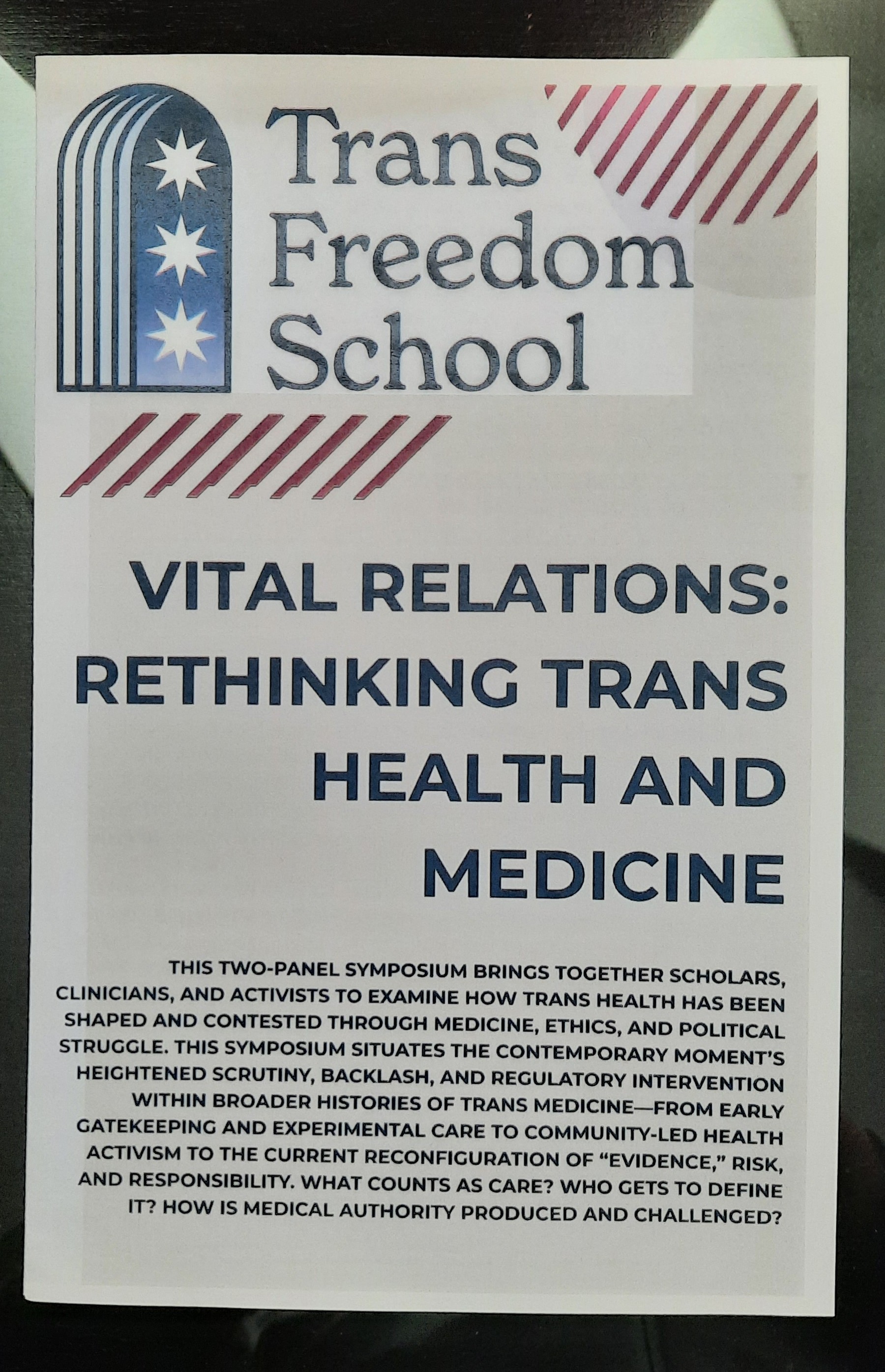
It turned out that my colleagues at UC Davis really knew what they were doing. The event I spoke at, Vital Relations, was part of the Trans Freedom School. This is a series led by Ava Kim and Christoph Hanssmann, which brings together scholars to share knowledge and ideas on a range of extremely pressing topics.
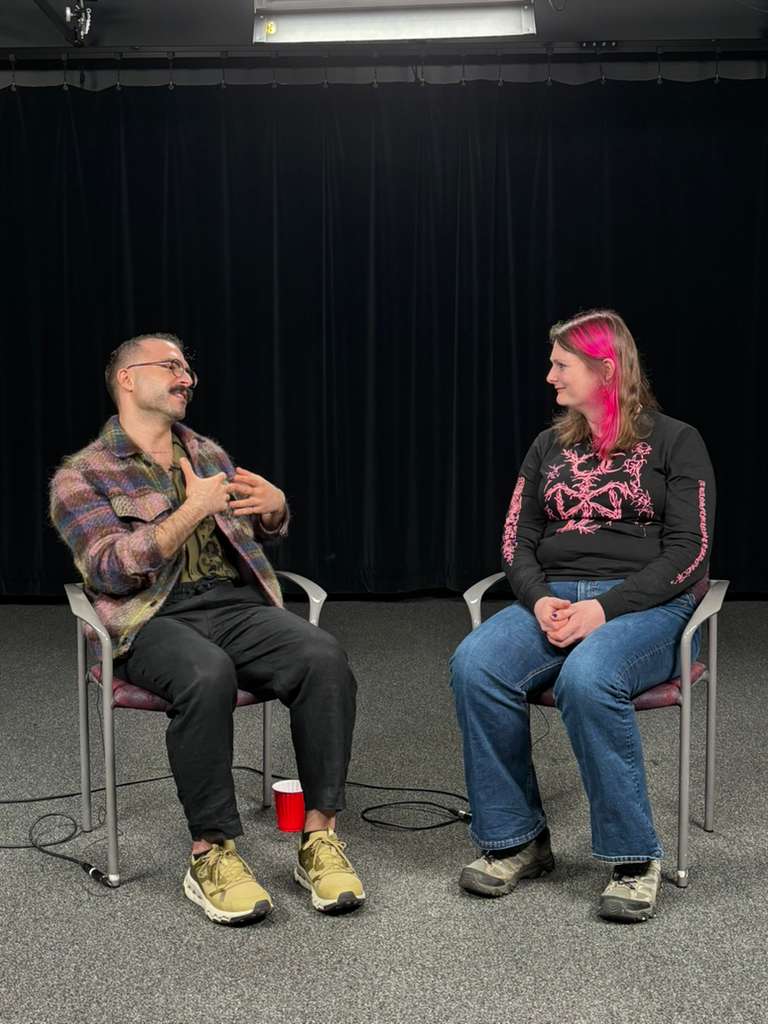
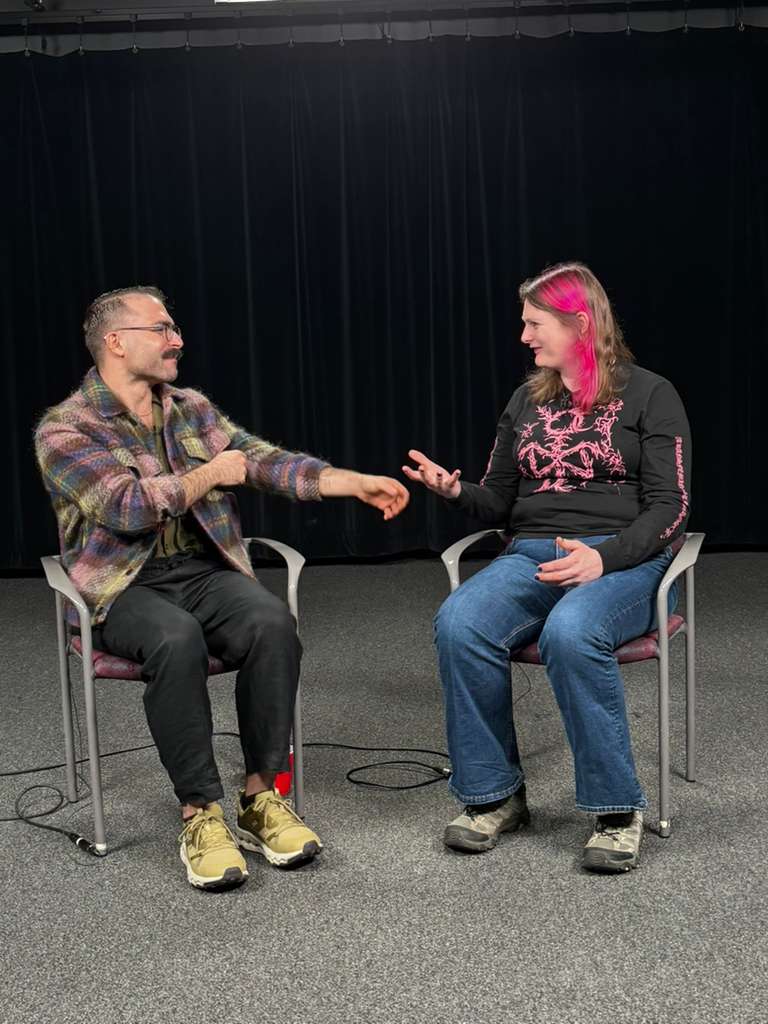
Our event specifically addressed the past, present, and future of trans health and medicine. This included how trans healthcare might be defined, whose interests have shaped the development of the field, how to address threats to trans people’s health and wellbeing, and how all of this connects to wider struggles around the pursuit of truth and defense of free inquiry. The event format was a facilitated conversation, meaning that the speakers were in conversation with one another as well as the audience. This felt extremely generative given the range of knowledge and experience in the room.
I sat on a panel with Tankut Atuk, who is doing amazing work on pathogenicity: specifically, the social contexts and power relations which make minoritised people more vulnerable to illness and disease. Understanding these things can help us learn not only how and why people are disadvantaged, but also how we can organise against such disadvantage. We explored examples from Tankut’s research with trans sex workers in Turkey, my work on trans people’s experiences of perinatal care, and Glasgow’s strong community networks. A second panel saw Kadji Amin and Jacob Moses explore histories of trans healthcare, plus debates around identity and regret.
Importantly, these conversations are not limited to academic events. The panel discussions are bring professionally filmed, as are separate studio conversations with the speakers. The idea is to produce information and teaching resources for the long term. Other events associated with the Trans Freedom School take a wider look at current debates around gender and race, at a time when discussion on these topics is increasingly censored within media and scholarship, in the US and beyond.
In short, this was indeed vital.
Continuing to foster international dialogue and the free exchange of ideas is incredibly important, especially when these things are under threat. Teaching materials that challenge norms while tackling disinformation are desperately needed. I am grateful and honoured that I was invited to be part of this work.
I will of course be sharing materials produced by the Trans Freedom School when these are ready to go online. In the meantime, I was left with a great deal to think about, which will no doubt shape my own ideas and work going forward.
The right relation
As it turned out, the US did not invade Greenland while I was in California. Instead, as I flew home, the US and Israel launched a series of airstrikes on Iran. They killed the Supreme Leader Ali Hosseini Khamenei, along with members of his family, plus hundreds of civilians. This including over 170 people at a girls’ primary school, most of whom were children. This was an immediate reminder of how the world’s greatest superpower is also a rogue state, prepared to inflict death and suffering for seemingly little reason other than flattering the macho egos of its unchecked leadership.
Seeing sickening scenes of violence unfold across the Middle East in the following days made me feel extremely powerless. It is hard to know what to do, how to respond, in the face of such evil. I’ve had enough Iranian friends that I have no sympathy with the awful regime there. But the Iranian people will not be freed from tyranny by a racist foreign power murdering schoolgirls. I remember the slow, pointless horrors of the Afghanistan and Iraq wars, with hundreds of thousands of people killed across the long years. I remember joining a million people on the streets of London to oppose this violence in 2003, only to be entirely ignored by the Labour government of the day.
In countries such as the UK and the US, what we do with our complicity in state violence depends on what tools we have, and options are in front of us. Here in Glasgow I will be supporting protests against war and arms dealers. I will be sharing information with my friends and neighbours. I will be teaching about power and its abuses in my day job. I will be voting to keep Labour as well as Reform out of Scotland in the forthcoming Holyrood election. It probably won’t feel like enough, but it does matter to do what we can.
The same goes for confronting other forms of state and corporate violence. I focus much of my research, activism, and writing on addressing discrimination and violence against trans people, because this happens to be where I have developed my skills and knowledge. The Trans Freedom School reminded me that the benefits of such skills and knowledge can cross entire oceans. It mattered for people in California to learn not only about my research, but also about the work of UK and Irish groups I spoke about, such as Trans Kids Deserve Better and Trans Harm Reduction. These groups are not working in universities or speaking to government. They are meeting with others in their community and building connections and resources, step by step, conversation by conversation.
“There are more of us publicly creating art and culture, more of us creating events and running nightclubs and playing in bands and writing essays (hi). There are more community groups providing mutual aid and support when charities and state bodies fail us. And, importantly, we are not alone.”
There are always things we can do. It is simply a matter of attending to where we are, and doing what we can from that place.
Like this post? Want to read more?
Don’t rely on corporate social media – subscribe now to receive new posts whenever I write them.
I’m currently in the middle of a busy fortnight for work-related travel (more on that soon!) But last night, I managed to make the most of a brief return to Glasgow.
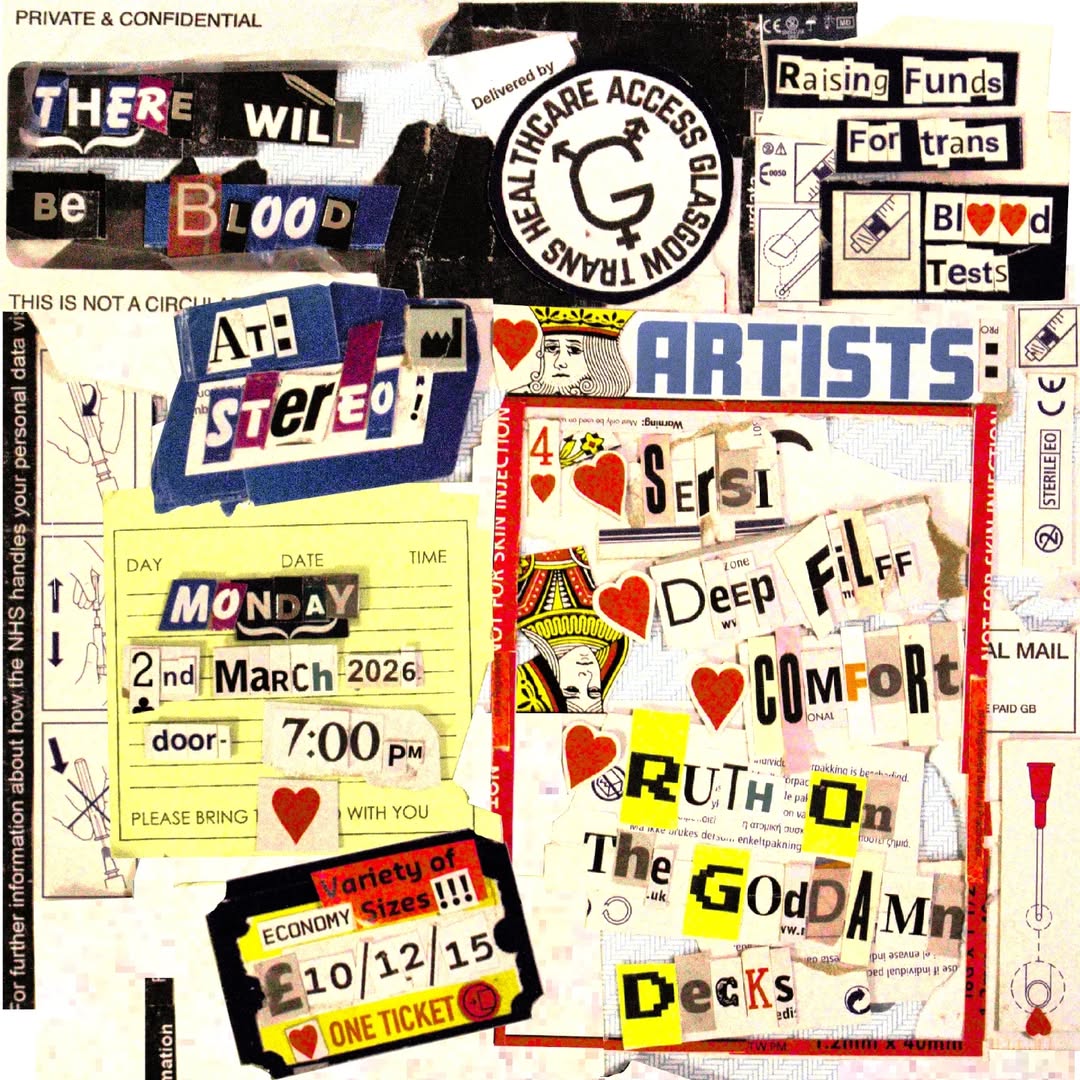
The occasion was There Will Be Blood! a fundraiser at Stereo for the brilliant group Trans Healthcare Access Glasgow. They are helping to provide free laboratory testing for bloods. This is really important for trans people on HRT who are increasingly denied monitoring by GPs. If you couldn’t make it but would still like to donate, you can do so here.
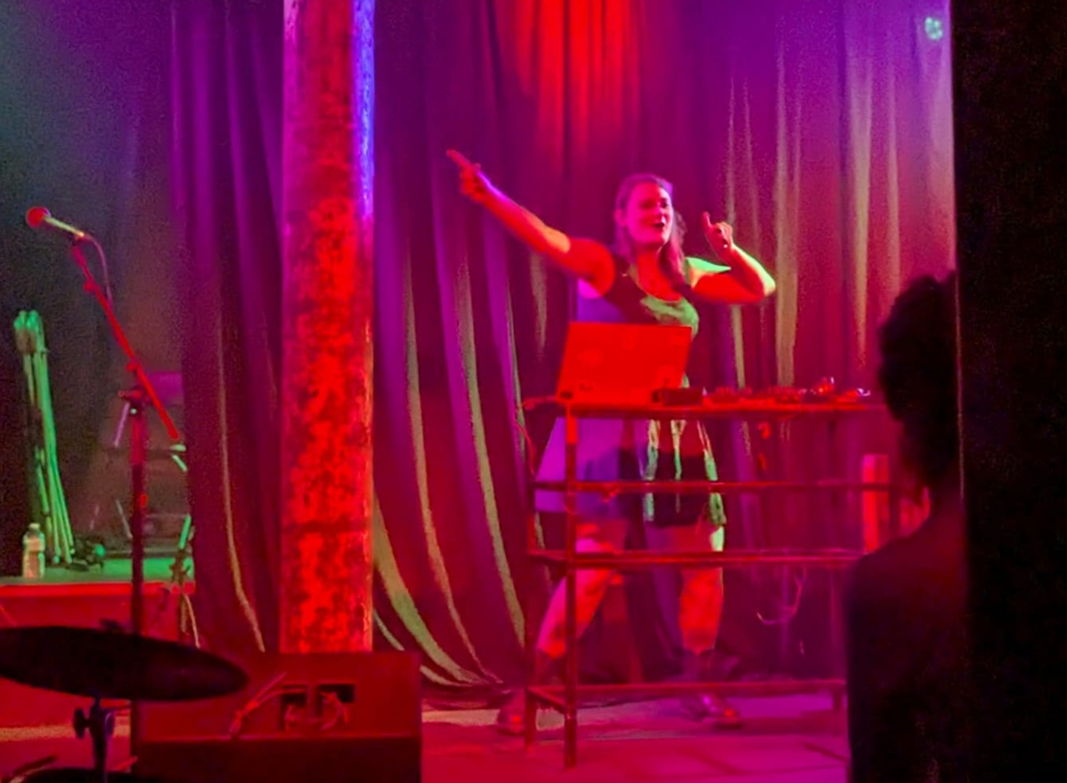
The organisers put together a fantastic lineup and there was a great turnout – especially for a Monday night. It was exciting to see so much talent from within our community, and loads of people come out to support both the cause and a pretty eclectic collection of artists. And exciting for me to be a part of it, performing a DJ set as ROGD.
In which I am going for it. Photo by Onni Gust.
The night kicked off with a luscious set from singer-songwriter and drag artist Sersi. He’s probably the first person I’ve ever seen sport a Britney mic at a DIY gig, which was very cool but sadly couldn’t quite capture the sheer dynamic range of his vocals on the night. At the same time, it enabled him to completely own the stage for a series of ballads that were by turns beautiful and strange. Sersi was ably supported by a pal with a laptop, and Johanna Kirkpatrick (of trad folk bands Chanterelle and Madderam) looking dead dykey on acoustic guitar.
Next to take the stage were Deep Filff. I hadn’t had a chance to look them up before the gig so had zero idea what to expect, although they did arrive with an absolutely enormous inflatable swan. Deep Filff turned out to be a two piece, with Nadia Fiffsky playing bass and belting out epic sun-baked vocals, while Jenny Tingle methodically destroyed the drumkit. As purveyors of some of the dirtiest psychedelic grunge-punk riffs I think I’ve ever heard, they were extremely well-named. It was engrossing, hypnotic stuff. Eventually the swan came out and bounced around the audience, most likely representing a serious hazard to some of the important-looking wires and glitterball hanging from the ceiling.
Local heroes comfortnever fail to disappoint, and this evening they truly tore up the stage as the final live act of the evening. The sibling duo have a truly unique sound, with Natalie’s staccato vocals punctuating a skitterish soundscape of totally artificial electronic sounds, underpinned by Sean’s assertive drumming. It was impossible not to dance. My favourite moments came whenever the band’s weird, abrasive noise would suddenly gave way to a transcendentally beautiful synth melody for a minute or two, before we all dived collectively back into the tumult.
Finally, following a quick raffle, I was up! The gig was due to end at a remarkably civilised 10pm, so I had a tight half hour DJ set.
I’ve thought a lot since returning to DJing that the landscape of queer and feminist music and activism has completely changed. Back in the day, I used to do quite a few “Women’s Voices” DJ sets, especially for feminist events such as Reclaim The Night afterparties, and the woman-only Women’s Aid and NUS Women’s Conference discos. The idea was that every song played (sometimes for sets of up to four or five hours) had a woman on lead vocals, and ideally women also playing instruments. Finn Mackayalways used to refer to me as “feministDJRuthPearce” (all in one breath!) which was never failed to be delightful.
Unfortunately, many of the people who were only too happy to join the dancefloor for those events are now either actively backing trans-exclusionary politics and the grossest forms of transmisogyny, or otherwise failing to speak out again them. (Junior equalities minister Liv Bailey, I’m looking at you – remember when you hoped I’d DJ your wedding one day?!) It’s odd to reflect on just how normal it was for trans women to be involved in woman-only politics spaces in the UK, given the extremity of the post-2017 moral panic.
Anyway, I digress.
Another thing that has happened over the last decade is the enormous influx of excellent trans artists to both underground and mainstream music scenes. We live in an age where I listened to jasmine.4.tfor the first time because my mum told me she’d done a good interview with Craig Charles on BBC 6 Music(!) So, while I’d like to do more Women’s Voices DJ sets in the future, for the first time it felt realistic to put together a Trans Voices set, with a mixture of tunes fronted by trans women and men, and/or non-binary, genderqueer, or genderfluid people, that I could reasonably expect a large number of people in the audience to be familiar with.
So, here’s what I played:
Shopping – The Hype My Chemical Romance – Teenagers 100 gecs – mememe SOPHIE – Immaterial underscores – Locals (Girls Like Us) [with gabby start] Kae Tempest – Move Ada Rook – BURY YOURSELF Janelle Monáe – Make Me Feel jasmine.4.t – Guy Fawkes Tesco Dissociation G.L.O.S.S. – Outlaw Stomp Against Me! – True Trans Soul Rebel
Obviously I could have kept going a lot longer, but I’ve got to say, it was one heck of a half hour. I have such enormous love for everyone who joined me to dance their arse off on a Monday night. And if you’d like me to DJ your event – I’m officially back behind the decks, so do get in touch!
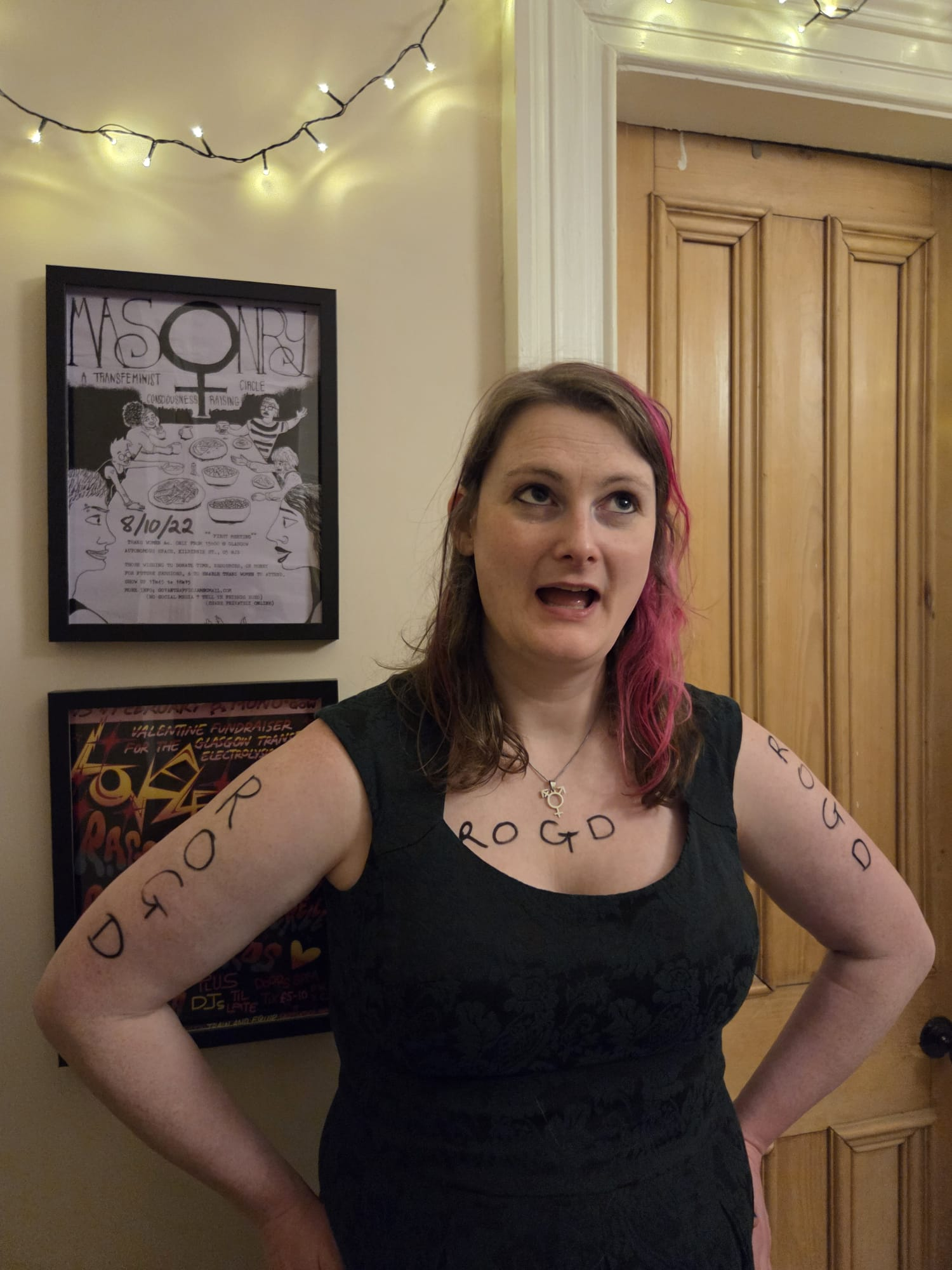
I’m super hyped to announce I will be doing a DJ set at Stereo on 2nd March 2026 – performing for the first time as ROGD.
This will be at a gig for Trans Healthcare Access Glasgow. They are raising money to provide free blood tests for trans people who have otherwise been denied healthcare by the NHS.
Much like the Glasgow Electrolysis Project (who are now running a successful clinicin the city) the very existence of Trans Healthcare Access Glasgow is both an indictment of the NHS and a credit to our community organisers. It’s depressing that the UK’s state healthcare system has so profoundly failed trans people that many GPs are now refusing to even monitor the safety and efficacy of NHS-prescribed medication. But it is also truly excellent that we are building our own new networks of medical support, which offer an alternative to the cis-led medical systems that have abused and exploited us for decades. Through the work of harm reduction groups such as Trans Healthcare Access Glasgow, we are collectively less reliant on these systems than we have ever been.
Meanwhile, I have a long history as a rock DJ but don’t get behind the decks too often these days. While I’m hoping to perform a bit more often again going forward, there’s no guarantee – so snap up those tickets while you can!
In summer 2026 the World Community Development Conferencewill be coming to Scotland! I am part of a group of lecturers from the Community Development programmes at the University of Glasgow who are helping to organise this event.
Running from 29 June to 2 July 2026, the conference will be a space for connection, critical reflection, creative exchange, and global solidarity. It will be rooted in the values of justice, participation, community empowerment and human rights and underpinned by Community Development’s emphasis on collective initiatives for collective outcomes.
Conference Themes and Guiding Questions
We invite submissions aligned with one or more of the following core themes. To support your thinking, we offer the following open questions:
1. Challenge
This theme centres on critiquing and confronting systems of injustice and advocating for policy and funding to support rights-based Community Development.
What are the most urgent challenges facing communities and how is Community Development responding?
How are issues of power, inequality, technology, marginalisation or oppression being confronted and addressed?
2. Change
This theme is about co-creating new approaches through collaboration and future-focused dialogue, while strengthening the resilience of practitioners and communities in complex environments.
What new ideas, or practices are driving meaningful change in your work?
How is resilience being built in communities facing political oppression, social or economic inequality, or the ill effects of climate change?
How are human rights and Community Development being used as tools for accountability?
3. Collective Action
This theme explores community organising through inclusive, participatory, and justice-driven practices and connecting across borders to build solidarity.
How are people coming together to organise, mobilise, and demand justice?
What examples of effective collective action can you share, and what impact is it having?
How can we ensure that Community Development is oriented towards collective justice rather than exclusion?
Presentation Formats
We welcome a wide range of formats, including:
Conference Paper: Research or practice-based presentations (20 minutes)
Facilitated or creative workshop: Participatory, performative or creative workshops by individuals or groups (1 hour)
Lightning talk: A concise presentation highlighting a key issue or insight (5 minutes)
Poster presentation: Digital or multimedia posters showcasing projects or research
Creative and participatory formats: Including book launches, exhibitions, and cultural events
Submission Requirements
Please submit a 300-word abstract or a 3-minute video of your proposed contribution, including:
The topic and framing of your contribution
The format of your presentation
The relevance to one or more of the conference themes
Author/s name(s), organisation/institution, contact information (e.g. email address, mobile/telephone number).
This week I took the long train down to the south of England for my friend Robyn’s funeral. She died very suddenly three weeks ago, aged just 32.
Robyn gave so much love to the world, and was so loved in turn. Around a hundred and fifty people crammed into a small building for the service. There weren’t enough seats for everyone, so many stood at the back and sides of the room. I sat on the floor. More attended online.
We shared stories from Robyn’s life, learned from each other, cried together. Like many funerals, especially for young trans people, it was absolutely gutwrenching. It also helped move us towards closure. It was good to be in community together, to think and speak not just of Robyn’s past, but of our collective futures. Robyn lived life to the absolute maximum. Surely we could take inspiration from her example.
Robyn at Manchester Punk Festival 2024. Photo by Chris Bethell for The Guardian(!)
After the funeral, I stayed the night with queer friends in rural Surrey. We went for a curry, toasted Robyn, caught up about our lives. We talked about work and about books and about art and about holidays we wanted to take. That evening I felt tentatively more at peace with the world.
And then I looked at my phone. And I learned that another young friend, Jessica, had also just died.
***
It’s a shit time to be trans. Many people are saying this.
But then again, when has it not been a shit time?
Eight years of moral panic have taken an enormous toll. In the UK, as in many other countries, our civil rights and our access to public services, public spaces, and public life are all being rapidly rolled back. Politicians and influencers fall over themselves to promote anti-trans violence and praise one another’s incendiarytakes. We are less safe at work, at home, in hospitals, in schools, and in the streets.
Trans people often die young, including too many of my friends. Sometimes (all too often) we die by suicide, driven to despair in a world full of hate and malice. Sometimes (mercifully less often in the UK) we are murdered, usually in incredibly violent ways. Other times, it’s more complicated. I think of Denise, who died a sudden death from melanoma. I think about Elli, who died of Covid-19. And now I also think about Robyn and Jessica, who each died suddenly of apparently natural or accidental causes.
These days, the high rate of untimely trans death can feel like a consequence of the trans panic. Certainly I believe it’s making things worse. However, this phenomenon pre-dates the current political situation. Trans people disproportionately died young in the 2010s, at the time of the so-called “tipping point“. Trans people disproportionately died young before this too. Sociological theory can tell us why.
A decade or so ago, I worked for a couple of years in Warwick Medical School. I was there to teach medical students about social determinants of health. The basic concept is that our general health is affected enormously by the context in which we live. This includes factors such as the resources and services we do and do not have access to, and barriers we might face in attempting to access healthcare services or otherwise look after ourselves
So, it’s not a coincidence that – for example – life expectancies are shorter in poorer neighbourhoods, or that Black women are more likely to die in childbirth. There is nothing inevitable or biological about any of this, something intrinsically different about poor people or Black people. The issue is that entire groups of people are more likely to experience particular kinds of illness, and more likely to die of things others might survive. This is because of the social disadvantages they face, and because of the discrimination they experience at the hands of bigoted doctors and nurses.
There is a massive scientific literature on social determinants of health. I’ve contributed to it myself, co-authoring a recent study showing an association between transphobic microaggressions and poor mental health among trans people. For this reason, I know it’s no coincidence that so many of my trans friends have died untimely deaths. Trans people are more likely to have worse health because of transphobia. They are less likely to receive timely and effective treatment because of transphobia. This means when trans people are seriously ill, we are on average less likely to survive. I see this when I look at the academic literature, and I see this every day in the lives trans people I know.
I see the impact of transphobia when I look at Robyn’s life and death. Her health deteriorated significantly in her final years. She was afraid to seek help from doctors though: and for good reason, given the discrimination she and many of her friends experienced in NHS services. I wrote my entire goddamn PhD thesis on this problem.
Things were even worse for Jessica. I witnessed so many organisations and institutions in her home city of Coventry failing her time and time again. I could fill whole books with accounts of the violence done against her. She was failed by her school, her church, a political party she gave so much energy to, the council, the local hospital, the psychiatric ward, the housing association. Just last year I sat helplessly on the other end of the phone while she attempted suicide, doing the best I could in this moment to ensure that she was not alone.
The institutional failings experienced by Robyn and Jessica and so many others are the result not just of ignorance, but of actively malicious transphobia and transmisogyny. I believe these factors contributed significantly to their untimely deaths.
How can any of us expect to find hope and purpose in the face of such violence?
***
In recent months I have noticed an uptick in trans doom-posting. By this I mean trans social media posts, blog posts, and videos which dwell entirely on negative feelings and convey a sense of hopelessness.
A prominent example is Shon Faye’s recent essay, well, it’s over, which she describes as “a brief eulogy for the ‘trans rights’ movement”. Shon observes that powerful transphobic movements in the USA and UK are succeeding in many of their aims. They have spread fear and disinformation far and wide, made allies of mainstream politicians and media platforms, and enacted bans on trans healthcare. Now they are attempting to criminaliseour very existence, as part of a campaign to eliminate us altogether.
Shon’s conclusion appears to be: well, that’s it. We’re all fucked.
“Today I doubt I will see another progressive measure (either in legislation or healthcare policy) put in place for trans people in my lifetime. Who knows what may yet be taken away.”
I very much empathise with her account of trying to talk about this in any way with cis friends and family:
“their instinct is to try and generate hope or minimise despair [which] typically minimises the gravity of the situation and the depth of my grief and exhaustion and fear – increasing my resentment.”
Shon concludes that she doesn’t want to hear “fucking platitudes” – “there’s time for hope later”. For now, she wants time to grieve. I’ve seen similar sentiments shared by other authors on various social media platforms, including posts from extremely popular trans meme accounts.
I understand intimately where all of this is coming from. Just look at everything I said earlier about social determinants of health. I recognise the violence we are subject to, and its costs. This post too is written from a place of deep grief.
But there is also the question of where and how we grieve. We do need space to vent and to despair. But we also need space to process, and figure out what happens next. Ideally, we need places and times we can do this collectively, rather than just being isolated as individuals. Robyn’s funeral offered this.
I’m not saying we shouldn’t talk about what is happening to us. What I am concerned about is the individualising effect of public platforms, and the parasocial relations we hold with high-profile accounts. We tend to consume doom-posting on our own, on a phone. We often have no-one to process it with, and little context beyond the content in front of us. In this way, doom-posting offers only a partial account of reality, and no way out from despair.
And there is a way out. We find it in community.
***
Look, I have a great deal of respect for Shon Faye. I have a hard enough time navigating the consequences of my own very minor microcelebrity. Shon has to tackle a great deal more attention: from trans people looking for someone to idolise and/or tear down, from cis readers who project heroic expectations onto her, and from haters who see her as the antichrist or something. She’s great on camera, and a brilliant writer. I would recommend her book The Transgender Issue to literally any cis reader. I also recognise that her blog post comes from a place of incredible pain.
At the same time, I am concerned that many trans people and allies are putting way too much energy into engaging mainstream institutions and liberal systems on their own, individualistic terms, rather than looking to the alternative power and support we can build in our communities. Notably, a lot of Shon’s post talks about civil society, legislation, lobbying, and the role of organisations such as Stonewall. This is definitely a realm in which “trans rights” face a seemingly terminal decline. But it is also not the first place I would look for real, grounded hope.
You can find a similar energy in Jules Gill-Peterson’s dire essay Reject Trans Liberalism, which is referenced by Shon. Jules’ piece simultaneously criticises the trans liberation movement for being about more than transition, while also insisting that preparing ideologically sound documents for the US supreme court is a radical act. It posits a false and ahistorical dichotomy between transsexuals (good, pure, radical) and transgenders (bad, elitist, liberal). The essay does not consider how gender diverse people might work together or support one another across our differences. This contrasts with existing critiques of trans liberalism already advanced by activist-scholars such as Nat Rahaand Mijke van der Drift. Again, don’t get me wrong, I’m a huge fan of Jules’ previous work. But as trans people, and especially as trans women, we owe each other so much more than this.
Now, I’m hardly without fault. This very blog is replete with examples of myself and others putting untold hours into lobbying politicians, participating in public consultations, advising the National Health Service and so on and so forth. In her post Stepping Over The Line, Josie Giles, who once again I admire greatly (look, I just fucking love trans women) argues that:
“Theoretically, an army of well-resourced energetic activists could simultaneously engage in state-centred advocacy and also do grassroots politics. In practice, it doesn’t happen. In practice, state-centred pseudo-organising dominates the social media feeds and the limited energy reserves of an already depleted community, and absorbs what little money is available to pay for the salaried self-licking ice-cream cone of the lobbying profession.”
Sick burn!
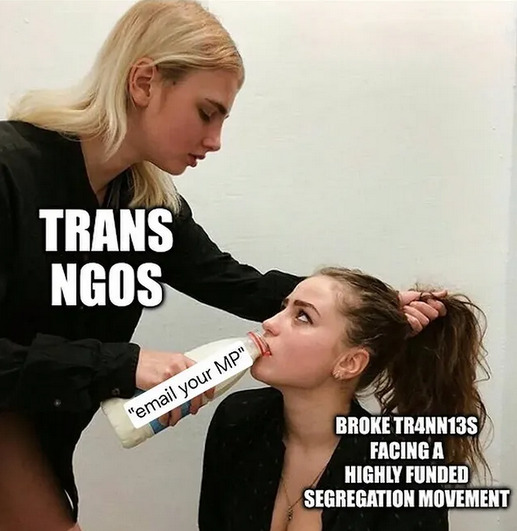
Meme acquired via one of them social media platforms we’ve all heard so much about.
I do disagree with Josie a little. Unlike Shon and Jules and also Josie, I transitioned in the early 2000s. This was well before the tipping point, and before most trans civil rights even existed in law. I remember how we fought successfully for changes that genuinely improved many people’s lives. I feel it will always be worthwhile to use what levers we can to minimise the harm caused by those who have power over us. Lobbying is the most accessible form of activism for some people. I still have an auto-reply on which encourages every damn cis person who emails me at work to contact their MP.
But Josie is completely right that many if not most trans people can and should be putting a lot more of our energy into grassroots politics. This must necessarily involve re-imagining what our worlds could look like, using what we already have as a basis from which to build. I know from lived experience that we can not only survive in the absence of certain civil rights and recognition, but also see material improvements in our lives when we come together. I met Jessica because we built trans-led community services in Coventry from the ground up.
Similar points are made by Roz Kaveney, who first came out over 50 years ago. In her criminally underrated 2022 poetry collection, The Great Good Time, Roz does reflect on the violence faced by young trans women in her youth. However, she also details the vibrant lives they lived together, the joys they experienced, how they shared housing and clothes and had each others’ backs. In a short forward to the book, she notes:
“I observed a lot of bleakness creeping into trans social media and thought it my job as a community elder to remind young people that things have been, if not worse, then at least as bad in different ways”.
As Josie states in Stepping Over The Line, white, middle-class trans people in particular need to understand in this current moment that we are as disposable to the ruling classes as any other minoritised individual. Our strength lies in practical solidarity with others subject to the violence of corporations, fascist movements, and the state. To once again reiterate the point, we need to be in community with one another.
Both Robyn and Jessica’s lives offered perfect models for this.
***
Every single speaker at Robyn’s funeral talked about how much time and energy she put into punk and folk music, building and fixing things, and caring for others. She was a loud, proud butch who was incredibly committed to sustaining community wherever she went. When she saw a need, she sought to meet it. Many of us only wished that she was better at asking for or accepting help herself.
If a trans person needed somewhere to stay, Robyn would put them up. If a trans person needed to move house, or was being evicted or was fleeing a violent relationship, Robyn would turn up with a van. If a trans person was having trouble at work, Robyn would show up online or in person with sensible advice. This attitude inspired Robyn to volunteer with groups such as Reading Red Kitchen, a grassroots project which provides a social foodbank and free community meals for asylum seekers experiencing food poverty. For Robyn, radical politics could never simply be about slogans and demonstrations: it was about cooking, connecting with others, and washing the dishes.
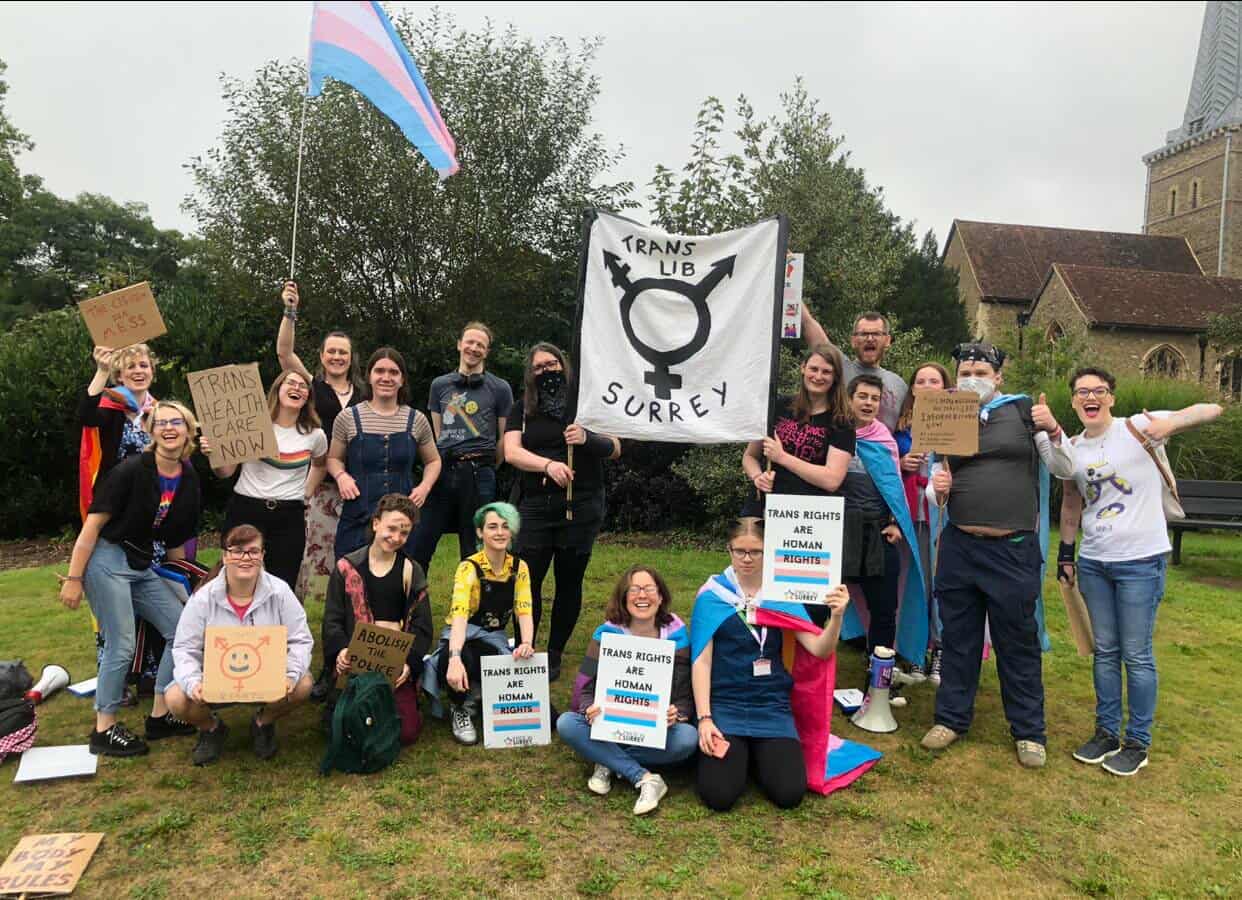
None of this is to say that Robyn was never found at a protest: quite the opposite. When I lived in the south we co-founded Trans Liberation Surrey, a collective which worked to oppose transphobia in a county hardly known for its activist movements. My most treasured memory of Robyn is from this time, when we attended a small anti-fascist demonstration in Wokingham. A coalition of neo-nazis, anti-vaxxers, and climate conspiracists descended on the town to protest a drag queen storytime event for young children. Robyn and I joined other locals outside the library to wave rainbow flags and play upbeat music, enabling families to attend the event without disruption.
Trans Liberation Surrey, at Surrey Pride 2021.
Jessica was also extremely motivated to help others, in spite of her own difficult circumstances. Like Robyn, she was a committed trade unionist. For many years she was also involved in a small political party, before eventually being ejected for challenging the leadership. Her motivation for this was a genuine belief in the possibility of positive political change, and in the potential for people to come together and make that change happen. Later in life she would rediscover her Christian faith as alternative vehicle for community action.
After hearing of Jessica’s death, our mutual friend Charlotte reached out, and we asked one another how we knew her. It turned out Charlotte had also been a member of that political party, and reconnected with Jessica several years later as they both sought new ways to make a difference in the world. In turn, I explained how Jessica and I met while lived in Coventry, and was myself involved in organising trans community social events, meals, and punk nights. Charlotte and I also both knew Robyn. “Christ Ruth,” said Charlotte, “trans lives are so entangled and we often don’t even realise”.
So it is. Right now, Jessica’s Facebook wall is replete with people thanking her for being there as a friend, for providing them with advice, for helping them come out.
In a hostile world, we are everything to one another. In the face of the most horrific hate, our love is so powerful. Such love survives death.
Selfie taken by Jessica.
***
This is where I find hope. At protests and demonstrations, sure, but more importantly in the contexts where we give each other’s lives meaning.
I find hope in community meals, mutual aid, queer bars and queer bookshops and queer gigs. I find hope in small parties, in big Pride events, in quiet meetings at work, in food pantries. I find hope in housing projects and healthcare projects, and in the Glasgow Electrolysis Project, which has created actual jobs for trans women and a vital new service for hundreds of us across the city. We know we are failed constantly by mainstream institutions: rather than seek incremental change, is it not time to re-imagine the clinic, re-think the workplace? Our problems will not be solved by refusing to engage with existing services, nor by creating trans charities that replicate existing hierarchies. We need to find ways to build something new entirely.
I find hope in the fact there are more of us out than ever, more connected than ever. These collective endeavors are all so much more important than anything I personally might write, any research I might do, and certainly any “progressive” policy I might influence.
Doom-posting and finger-pointing cannot deliver any of these things. We need to take the time to connect with one another, especially outside the internet. Yes we need to grieve, but we need so much more than this. We need to actively look after one another, and provide space for rest and recuperation. We need to have each others’ backs. We need to connect across difference, and not (re)create hierarchies of oppression or need.
These are no fucking platitudes. This is my life. This is the lifeblood of our shared communities. This is how we create better social determinants for our goddamn health.
This post shares a video and transcript of my speech at the emergency demonstration in George Square, Glasgow, on 18 April 2024, against the decision from NHS Greater Glasgow and Clyde to ban endocrine treatments for trans people aged under 18. The speech was unplanned and made without notes, so I have made some small corrections in the transcript, plus minor amendments for clarity. I have also added references for some key points. Thank you to @transprotestglasgowfor the video.
Readers seeking more detailed evidence and academic critiques may find my previous blog post helpful: What’s wrong with the Cass Review?
I’m a Lecturer in Community Development at the University of Glasgow, and I’m a researcher on trans healthcare.
And I was a trans child.
I want to talk about that for a moment. Because I came out to myself circa 2001, when I was 15, when not many people did that. And it was hard for us. And there was trans community, and there was information, but it was very difficult because we felt very, very alone. I was mostly only able to connect with other trans people my age through the internet, through blogs, and they were mostly Americans. The Brits were there; a lot of us connected later as we grew older. But we were so isolated.
A really important thing to remember, in a moment like this where we are seeing a return to the kind of medical policies that were in place when I was a kid: there are so many more of us, and we are so much more powerful than we have ever been.1 Never forget that strength we have together.
One of the things Hilary Cass says in her report is that the meaning of the word “trans” has changed since 2020.2 She says, and there is no evidence for this, that “trans” in 2020 meant something quite rigid and specific, and only now in 2024 it’s become an umbrella term for lots of identities. Tell that to me coming out as a trans teenager in 2001!
So here’s the thing. We’ve always been here, and we are more powerful now, but we are seeing this backlash. That’s been a long time coming and transphobia changes its face over time. One of the things I wanted to do to deal with my loneliness and the experiences I had was that I wanted to become an activist. And when I started doing activism, when I got into meetings with people in government, and with the Equality and Human Rights Commission, they said “there’s no evidence” for the discrimination we faced. So I was like, “fine: let’s see what evidence I can find”.
So I did a PhD in trans healthcare.3 And I found what you often find when you do research; you often find things you don’t expect. So I did find some things I expected to find. About waiting lists and how hard they are. About how hard appointments can be when you’re meeting with sexist and transphobic clinicians who are asking you, as a young person, how you masturbate and who you’re attracted to. But what I didn’t expect was the sheer level of pain from the waiting. And I talk about that in my work. And the anticipation, where we are anticipating all the time. When is it going to happen? When are we going to get to live our lives? And that happens on every level of our lives.
I was also shocked by the level, and detail, and complexity of the ignorance of healthcare practitioners. It ranges: it’s not just that they all hate us, right? It’s that some people are trying to control us, some people want to help but don’t understand how, and some people don’t want to know. There’s different kinds of ignorance.4
So I published my work, and other people have followed. Other people were there before me of course, because “trans” was not new, and trans research wasn’t new either. There is now a lot of published research on what it is like to go through a gender clinic, and what it is like for a young person to go through a gender clinic. There’s people like Cal Horton5 and Natacha Kennedy6 who are writing on this, and Harvey Humphrey7 who works here in Glasgow. There’s a lot of people doing work on this.
We are saying, time and time again, “we need services that meet our needs”. For some people, that is access to puberty blockers, and that is access to hormones. For other people, that is access to counselling, and therapy, and community support. What we call “trans-affirmative” or “gender-affirmative” care is flexibility, meeting a person where they are at, and based on what they want to do with their lives.8 You don’t have to change your body – but you can.
It’s our body, it’s our right: we can do what we want with our own bodies.
This is what is disgusting about the decision by NHS Greater Glasgow and Clyde. They have not addressed the years and years of mistreatment and abuse in their child and adolescent clinic at Sandyford. It is not a great place that we are trying to save. It is a clinic that has repeatedly refused to treat young people, and made people hold on for care. It has helped a handful of people. Dozens of people – only dozens – have accessed treatment in the last few years.9 Now they are proposing to stop doing the very little they are doing to support young trans people.
People who get a referral to a child and adolescent gender clinic are not necessarily seeking access to counselling and therapy, because you can get that elsewhere.10 They are not seeking access to community, because you will find no community at Sandyford. They are most likely seeking access to endocrine treatments: puberty blockers and hormone therapy. And that’s what they are going to stop doing.
Sandyford say they are still accepting new referrals. But what is the point of a gender clinic that does not offer people medical treatment?
NHS Greater Glasgow and Clyde have based their decision on the final report of the Cass Review. Let’s talk a bit about the Cass Review.
I’m an academic researcher. If the Cass Review was submitted by an undergraduate student, the first thing I would say is: “That’s nearly 400 pages long! No-one’s going to have time to mark that”.11 And you’ll notice that all the people in the media, all the Labour politicians, all the Tory politicians, all the people saying we should immediately implement the findings of the report: none of them read nearly 400 pages in one day. Neither did the journalists at the BBC, the Telegraph, the Times, the Daily Mail, the Observer, the Independent. We expect better! And now the Scottish media: it’s all over the Scotsman, the National, the Herald. None of them have bothered to read the report, or think about it critically.
So here’s a bit of information about the Cass Review. The Cass Review was undertaken by a group of people who, from the very start, excluded trans people from oversight of the project. That was in their terms of reference.12 They didn’t want people who had experienced services having a formal part in the report. They excluded healthcare experts. If you were someone who had worked in a gender clinic you were excluded from being part of that.13 You know, I have lots of disagreements with many people who work in gender clinics, but you would have thought they might get a say.
You can see that ignorance, that intentional ignorance, playing out in the final report of the Cass Review. You can see, if you read the Cass report, that they looked at over 100 studies, most of which show that puberty blockers and hormone therapy can help young trans people. And they just ignored them.14 Intentionally. They say that the majority were not “high quality evidence”.15
What else is not high-quality evidence in healthcare? Paracetamol for back pain.16 There is no high quality evidence for that, in the terms of the Cass Review. Anti-psychotics.17 ADHD medication.18 All these medications that are in regular use. You know what else? Puberty blockers for young people with precocious puberty – if they’re cis.19 That is direct discrimination. 20
The thing is, that’s the Cass Review being serious. Let’s think about when it gets weird.
There’s a graph in there, where they show referrals to a gender clinic (the Gender Identity and Development Service in England) rising year on year, with “an exponential rise in 2014”. But they cut the graph off at 2017. But if you look at 2017-2020 the referral rate flattens off. It’s deliberate removal of evidence.21
We know why this is happening. Experts – medical experts, and experts by experience have been cut out of the Cass Review process. If you are trans, that’s you. You are an expert by experience. You know what it’s like. We have been cut out the process!
And the NHS have done that here in Scotland. There was no consultation on the ban that’s come in.
Who did they consult? We know there are people who are proponents of conversion therapy who were on the Cass Review team.22 That is what they are proposing.
They are proposing conversion therapy. Not just for trans kids, because they want to deal with all gender-questioning and non-conforming kids. This is going to be conversion therapy for queer kids. Little boys who want to wear a dress, they might not be trans, but they deserve to have the space to explore. That is not going to be what happens in clinics where people are referred which are being informed by conversion therapists.23
So consequently you have other weird stuff in the Cass Review. They’re dismissing all the evidence about why puberty blockers and hormones can benefit people within particular contexts, but they’re relying on other evidence for their recommendations. Let me give you one citation. “Thoughts on Things and Stuff, 2023”. That is a citation from the Cass Review: Thoughts on Things and Stuff.24
What is “Thoughts on Things and Stuff”? It’s a right-wing Youtube channel run by anti-trans bigots,25 featuring contributors such as “Gays Against Groomers”.26 This is the level of evidence that is informing NHS Greater Glasgow and Clyde.
And I’ll tell you what else is in the Cass report. They say that little girls are likely biologically inclined to play with dolls. It’s right in there, in the Cass report.27 And little boys are probably biologically inclined to play with trucks. Why is this? It’s not just an anti-trans agenda. It’s an anti-feminist agenda. Its an anti-woman agenda.
Why is this happening? It’s happening because trans people are an easy target.
If you want to stop young people accessing contraception as teenagers, you remove trans people’s right to consent to care as young people. If you want to prevent young people – teenage girls – from having abortions, and you’re failing time and time again in the courts, you instead target puberty blockers, because that way you can set a precedent for preventing people from being able to make decisions as young people. You are undermining the idea that young people might have the capacity to consent to care and make an informed decision about their own bodies.28
So I will end on this. I’m a woman, I’m a trans person, and I think it’s really important we think about allies. I had the parent of a trans child contact me and say, “thank you for being an ally”. I want to think her for being an ally. The thing about allies is, we talk a lot about an “ally” being someone who supports somebody else. But no: allies are people who stand by each other and work together.
That’s why we need a trans feminist movement. A trans feminist movements gives people autonomy over their own bodies, space to make their own decisions, and enables people to stand together when we are all at risk.
So I’ll leave you with a chant I want to hear more of at protests:
“Trans rights, women’s rights: one struggle, one fight”.
FOOTNOTES
My statement here is intended to highlight that more people are out as trans than ever before. Contrary to narratives of “social contagion”, there have always been people with gender diverse or sex nonconforming experiences. What has changed is that there is greater access to information and community, which makes it easier for people to come out. ↩︎
“During the lifetime of the Review, the term trans has moved from being a quite narrow definition to being applied as an umbrella term to a broader spectrum of gender diversity. This clearly has implications for conceptualisations of detransition” (Cass et al., 2024, p.187). This claim is demonstrably false, as “trans” (and before that, “transgender”) has been used as an umbrella term for decades. This is shown in my own previous work as well as writing dating back to at least the 1980s by individuals such as Leslie Feinberg. ↩︎
“Our stance, as gender-affirming practitioners, is that children should be helped to live as they are most comfortable. For a gender-nonconforming child, determining what is most comfortable is often a fluid process, and can modify over time. Therefore, in a gender affirmative model, gender identity and expression are enabled to unfold over time, as a child matures, acknowledging and allowing for fluidity and change” (Hidalgo et al., 2013). ↩︎
Although in practice, trans people are often also turned away from mental health services due to “trans broken arm syndrome“. ↩︎
In my original speech, I inaccurately stated that the report was “500 pages long”. However, my point about requiring time to carefully consider its contents remains. ↩︎
“The original published Terms of Reference (ToR) for the Cass Review’s assurance group explicitly excluded trans expertise, stating that it “deliberately does not contain subject matter experts or people with lived experience of gender services” [Report 1, version 1]. The current (updated) assurance group ToR is worded less clearly, yet still conveys exclusion of those with expertise or lived experience, as such individuals would naturally be expected to have an interest in the outcome of the review” (Horton, 2024: p.7) ↩︎
Hilary Cass has contested this claim in reporting for the BBC. Her argument is that of the 103 studies analysed for the review, 60% were included in the synthesis of evidence. However, my argument here is specifically that the findings of these papers were broadly ignored in the writing of the report’s recommendations, while less robust material was instead prioritised. As Simon Whitten argues, “The majority of moderate certainty studies were included in the results section but then arbitrarily ignored in the conclusion entirely”. ↩︎
I have removed a statement I made about randomised control trials from the transcript here as my point was unclear and therefore potentially misleading (as can happen when you do an unplanned speech on a complex topic!) Unlike the Cass Review team, I am keen to correct my errors. See the links in the above footnotes above for more detailed information on inclusion/exclusion criteria for the Cass Review. ↩︎
The landscape of evidence anti-psychotics is a complex one. There is “high-quality” evidence that anti-psychotic drugs work better than placebos in addressing various conditions, but the evidence for use of multiple drugs, reducing or increasing doses at particular junctures in treatment, or taking one drug rather than another in treating specific conditions is often of a similar (or lower) quality than the evidence for benefits of endocrine interventions assessed by the Cass Review (see e.g. https://www.sciencedirect.com/science/article/pii/S0890856716319992). ↩︎
At this point, somebody stuck their hand up in the audience. I responded: “Someone stuck their hand up and might give me a footnote on that! I totally approve of that. I might invite you up later because I like evidence and I’m obsessed with it. [person indicates they were just waving to their friend, crowd laughs] Oh that’s grand! There we go, we haven’t even had a footnote.” Well, here is the footnote. ↩︎
p.24 of the Cass Review final report. The rationale for this within the report is that the figure is adapted from a 2018 paper published in Archives of Sexual Behaviour. However, as Trans Actual observe: “The number of referrals to GIDS is known until 2020/21 […] the last 3 years for which data is available, shows that the number of referrals has recently plateaued. Such data is inconvenient for a narrative that relies on an inexplicable explosion in need[.]” ↩︎
p.70, used to evidence the activities of GIDS’ research team at a WPATH conference. They could have instead cited the conference website. ↩︎
A good summary of the channel can be found in this piece by What The Trans: “When citing a recording from the WPATH 2016 conference, Cass uses a YouTube channel called Thoughts on Things and Stuff. This appears to be the associated channel of a now-defunct blog largely focussed on criticising the Mormon Church. Why this was relevant to Cass is unclear, although titles of recent uploads at the time of the WPATH video include “Dr. Stephen Levine: 13 Untruths Behind Gender Affirmative Therapies for Kids” (Levine is an advisor to Genspect) and “Gays Against Groomers: stop the indoctrination and medicalization of children. 2023 Florida testimony.”, which perhaps provides a clue to how Hilary Cass ended up citing a channel with only 22.4K subscribers. It thus seems that, in addition to being advised by and networked with a variety of prominent anti-trans figures and organisations, Hilary Cass appears to be getting her professional news from homophobic and transphobic YouTube channels.” ↩︎
Anti-gay campaigners have long attempted to position LGBTIQ+ people as a danger to children. In recent years this tactic has seen a resurgence, through positioning trans and queer campaigners as “groomers”. GLAAD have described Gays Against Groomers as a group who intentionally use “ambiguous messaging about characterizing LGBTQ+ people as pedophiles falsely and maliciously with the absolutely clear intent of driving fear.” ↩︎



 Dr Ruth Pearce