I have a new article out, co-authored with Dr Cal Horton. It’s about the incorporation of UN convention rights into Scottish law, and what this should (in theory) mean for trans children in Scotland and beyond. The article is totally open access so anyone can read, download, and share it anywhere. You can peruse a copy right here:
In recent years I’ve felt increasingly critical of human rights as an artificial framework for behaviour, which is frequently ignored or manipulated by those in power. As Nat Raha and Mijke van der Drift put it, these are “human rights for human resources”. Nevertheless, the UN Convention on the Rights of the Child (UNCRC) is now part of Scottish law, and Scottish children and policymakers alike are being informed that this conveys certain expectations for how young people are to be treated.
Cal and I believe it is important to reflect on what this all means for people seeking to work in a humane way with trans children, in Scotland and beyond. In particular, we emphasise the importance of directly involving young people in conversations and decision-making about their own lives. We draw on the demands of young people themselves in doing so, including groups such as Trans Kids Deserve Better Scotland, who note that policymakers have actively ignored young trans people by “by shutting trans bodies and voices out of every room that matters [and] pretending we don’t exist.”
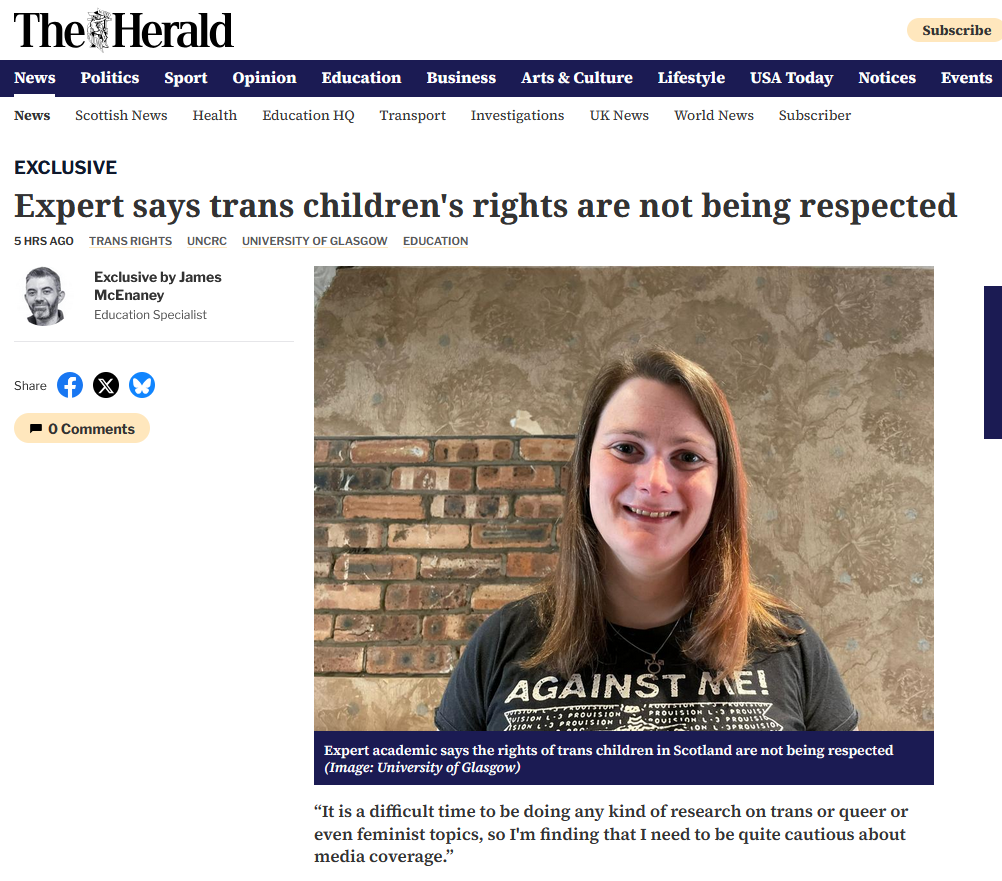
This weekend also sees the publication of an interview I did for the Herald about the UNCRC article. In this, I discuss the findings of my research with Cal. I also reflect more generally on the situation faced by trans studies researchers, in which it is increasingly hard to conduct trans-positive research even as the UK government and funding bodies throw millionsofpounds at anti-trans researchers.
We end the interview with key three takeaways regarding what can be done to protect the rights of trans children, in Scotland and beyond:
“Number one would be to genuinely consult with young trans people and ask what they want and need. They deserve real and meaningful consultation.
“Number two is that there is a huge amount of knowledge that already exists, both on young trans people’s experiences and on how to consult with young people. Draw on the knowledge that already exists.
“And number three is to acknowledge that there is a trans-eliminationist movement. Acknowledge that there is an active attempt to stop anyone from doing the first two things.
“There’s an active attempt to stop any anyone taking seriously what young trans people have to say about their own lives, and an active attempt to stop any accessing of existing knowledge, and that comes from a place of prejudice.
“One of your starting points has to be acknowledging that that exists.”
This morning I logged into instagram and watched, transfixed in amazement and worry, as a young person scaled the walls of the Department for Education.
The aspiring spiderman is part of the activist group Trans Kids Deserve Better. At the time of writing they are staging a multi-day protest at the Department for Education building in London, for the right to a safe and inclusive education.
Watching the video, I fear for Squirrel, the anonymous activist who is genuinely risking their life to stop government employees from taking the group’s banner. It’s very apparent that Squirrel is a skilled climber who knows what they are doing – equally, one wrong move could result in a deadly drop to the concrete pavement. This is not safe.
But of course, the entire reason this protest is happening is because young trans people are not safe.
Trans Kids Deserve Better launched their campaign for youth autonomy, safety, respect, and inclusion in July, from a dramatically high ledge of an NHS England building. In an interviewwith Jess O’Thompson for Trans Writes, the emergency doctor and children’s TV presenter Dr Ronx Ikharia argued that “our young people deserve better than suffering, and shouldn’t be scaling walls”. But they added that for this to happen, trans kids must be “believed, supported, affirmed, and loved”.
And this is the crux of the issue. Under the Conservative and Labour governments, we have seen a policy environment in which teachers, doctors, therapists and parents are actively discouraged or prevented from believing, supporting, affirming, or loving young trans people. Instead, families face prison sentencesfor supporting young people’s continued access to medication, NHS England is expanding the provision of state-funded conversion clinics, and a growing number of schools are refusing to allow even the discussion of trans experiences.
Trans kids are not safe because they have been entirely failed by the adult world. They have been failed by politicians, failed by civil servants, failed by the NHS, failed by the voluntary sector, failed by researchers, and in many cases also failed by their doctors, teachers, and parents or carers. This is why the activists from Trans Kids Deserve Better are literally scaling walls in their fight for an actual future.
Looking at the challenges facing young trans people, it can be easy to lose hope. But the actions of Trans Kids Deserve Better show that there is a better way. Doomerism helps nobody. The successes of successive liberation struggles have come about because people have continually dared to believe that a better world is possible, and fight for it. The young people currently sat outside the Department of Education are not bemoaning what they have lost: they are insistently demanding change.
Image from Trans Kids Deserve Better
What can we do? In their conversation with O’Thompson, activists from Trans Kids Deserve Better explained that while trans adults often want to “protect” trans youth, they would rather we “amplify” them: “we don’t need sympathy, we need support”. This is a call to action, with a focus on solidarity, rather than trying to speak for young people or bemoan their situation.
Many adult trans people and allies have complained about the lack of mainstream media coverage for the actions of Trans Kids Deserve Better. But we should not simply wait for the papers or news programmes to start caring. It’s up to us to talk about what’s happening. Today’s queer and trans communities only exist at scale because we made our own media, told our own stories, and forced the mainstream to catch up.
So I encourage everyone who reads this to share the story of what is happening. Share it on social media, share it with friends and family, share it in conversations at work and in bars and in cafes and in parks and at gigs and festivals. A few days ago I was at a pub in Bath, fresh from Pride, still holding a placard that read “Ban Wes Streeting” (copied shamelessly from someone else in Glasgow a couple of weeks prior). Someone asked what Wes Streeting had done, so I told her. She was appalled, but grateful to have learned what is happening, and better informed to act. Information spreads when we spread information.
If you, like me, would rather not see young people risking life and limb by climbing public buildings, it is time to fight with them, not “for” them. Together we can build a safer world.
This post shares a video and transcript of my speech at the emergency demonstration in George Square, Glasgow, on 18 April 2024, against the decision from NHS Greater Glasgow and Clyde to ban endocrine treatments for trans people aged under 18. The speech was unplanned and made without notes, so I have made some small corrections in the transcript, plus minor amendments for clarity. I have also added references for some key points. Thank you to @transprotestglasgowfor the video.
Readers seeking more detailed evidence and academic critiques may find my previous blog post helpful: What’s wrong with the Cass Review?
I’m a Lecturer in Community Development at the University of Glasgow, and I’m a researcher on trans healthcare.
And I was a trans child.
I want to talk about that for a moment. Because I came out to myself circa 2001, when I was 15, when not many people did that. And it was hard for us. And there was trans community, and there was information, but it was very difficult because we felt very, very alone. I was mostly only able to connect with other trans people my age through the internet, through blogs, and they were mostly Americans. The Brits were there; a lot of us connected later as we grew older. But we were so isolated.
A really important thing to remember, in a moment like this where we are seeing a return to the kind of medical policies that were in place when I was a kid: there are so many more of us, and we are so much more powerful than we have ever been.1 Never forget that strength we have together.
One of the things Hilary Cass says in her report is that the meaning of the word “trans” has changed since 2020.2 She says, and there is no evidence for this, that “trans” in 2020 meant something quite rigid and specific, and only now in 2024 it’s become an umbrella term for lots of identities. Tell that to me coming out as a trans teenager in 2001!
So here’s the thing. We’ve always been here, and we are more powerful now, but we are seeing this backlash. That’s been a long time coming and transphobia changes its face over time. One of the things I wanted to do to deal with my loneliness and the experiences I had was that I wanted to become an activist. And when I started doing activism, when I got into meetings with people in government, and with the Equality and Human Rights Commission, they said “there’s no evidence” for the discrimination we faced. So I was like, “fine: let’s see what evidence I can find”.
So I did a PhD in trans healthcare.3 And I found what you often find when you do research; you often find things you don’t expect. So I did find some things I expected to find. About waiting lists and how hard they are. About how hard appointments can be when you’re meeting with sexist and transphobic clinicians who are asking you, as a young person, how you masturbate and who you’re attracted to. But what I didn’t expect was the sheer level of pain from the waiting. And I talk about that in my work. And the anticipation, where we are anticipating all the time. When is it going to happen? When are we going to get to live our lives? And that happens on every level of our lives.
I was also shocked by the level, and detail, and complexity of the ignorance of healthcare practitioners. It ranges: it’s not just that they all hate us, right? It’s that some people are trying to control us, some people want to help but don’t understand how, and some people don’t want to know. There’s different kinds of ignorance.4
So I published my work, and other people have followed. Other people were there before me of course, because “trans” was not new, and trans research wasn’t new either. There is now a lot of published research on what it is like to go through a gender clinic, and what it is like for a young person to go through a gender clinic. There’s people like Cal Horton5 and Natacha Kennedy6 who are writing on this, and Harvey Humphrey7 who works here in Glasgow. There’s a lot of people doing work on this.
We are saying, time and time again, “we need services that meet our needs”. For some people, that is access to puberty blockers, and that is access to hormones. For other people, that is access to counselling, and therapy, and community support. What we call “trans-affirmative” or “gender-affirmative” care is flexibility, meeting a person where they are at, and based on what they want to do with their lives.8 You don’t have to change your body – but you can.
It’s our body, it’s our right: we can do what we want with our own bodies.
This is what is disgusting about the decision by NHS Greater Glasgow and Clyde. They have not addressed the years and years of mistreatment and abuse in their child and adolescent clinic at Sandyford. It is not a great place that we are trying to save. It is a clinic that has repeatedly refused to treat young people, and made people hold on for care. It has helped a handful of people. Dozens of people – only dozens – have accessed treatment in the last few years.9 Now they are proposing to stop doing the very little they are doing to support young trans people.
People who get a referral to a child and adolescent gender clinic are not necessarily seeking access to counselling and therapy, because you can get that elsewhere.10 They are not seeking access to community, because you will find no community at Sandyford. They are most likely seeking access to endocrine treatments: puberty blockers and hormone therapy. And that’s what they are going to stop doing.
Sandyford say they are still accepting new referrals. But what is the point of a gender clinic that does not offer people medical treatment?
NHS Greater Glasgow and Clyde have based their decision on the final report of the Cass Review. Let’s talk a bit about the Cass Review.
I’m an academic researcher. If the Cass Review was submitted by an undergraduate student, the first thing I would say is: “That’s nearly 400 pages long! No-one’s going to have time to mark that”.11 And you’ll notice that all the people in the media, all the Labour politicians, all the Tory politicians, all the people saying we should immediately implement the findings of the report: none of them read nearly 400 pages in one day. Neither did the journalists at the BBC, the Telegraph, the Times, the Daily Mail, the Observer, the Independent. We expect better! And now the Scottish media: it’s all over the Scotsman, the National, the Herald. None of them have bothered to read the report, or think about it critically.
So here’s a bit of information about the Cass Review. The Cass Review was undertaken by a group of people who, from the very start, excluded trans people from oversight of the project. That was in their terms of reference.12 They didn’t want people who had experienced services having a formal part in the report. They excluded healthcare experts. If you were someone who had worked in a gender clinic you were excluded from being part of that.13 You know, I have lots of disagreements with many people who work in gender clinics, but you would have thought they might get a say.
You can see that ignorance, that intentional ignorance, playing out in the final report of the Cass Review. You can see, if you read the Cass report, that they looked at over 100 studies, most of which show that puberty blockers and hormone therapy can help young trans people. And they just ignored them.14 Intentionally. They say that the majority were not “high quality evidence”.15
What else is not high-quality evidence in healthcare? Paracetamol for back pain.16 There is no high quality evidence for that, in the terms of the Cass Review. Anti-psychotics.17 ADHD medication.18 All these medications that are in regular use. You know what else? Puberty blockers for young people with precocious puberty – if they’re cis.19 That is direct discrimination. 20
The thing is, that’s the Cass Review being serious. Let’s think about when it gets weird.
There’s a graph in there, where they show referrals to a gender clinic (the Gender Identity and Development Service in England) rising year on year, with “an exponential rise in 2014”. But they cut the graph off at 2017. But if you look at 2017-2020 the referral rate flattens off. It’s deliberate removal of evidence.21
We know why this is happening. Experts – medical experts, and experts by experience have been cut out of the Cass Review process. If you are trans, that’s you. You are an expert by experience. You know what it’s like. We have been cut out the process!
And the NHS have done that here in Scotland. There was no consultation on the ban that’s come in.
Who did they consult? We know there are people who are proponents of conversion therapy who were on the Cass Review team.22 That is what they are proposing.
They are proposing conversion therapy. Not just for trans kids, because they want to deal with all gender-questioning and non-conforming kids. This is going to be conversion therapy for queer kids. Little boys who want to wear a dress, they might not be trans, but they deserve to have the space to explore. That is not going to be what happens in clinics where people are referred which are being informed by conversion therapists.23
So consequently you have other weird stuff in the Cass Review. They’re dismissing all the evidence about why puberty blockers and hormones can benefit people within particular contexts, but they’re relying on other evidence for their recommendations. Let me give you one citation. “Thoughts on Things and Stuff, 2023”. That is a citation from the Cass Review: Thoughts on Things and Stuff.24
What is “Thoughts on Things and Stuff”? It’s a right-wing Youtube channel run by anti-trans bigots,25 featuring contributors such as “Gays Against Groomers”.26 This is the level of evidence that is informing NHS Greater Glasgow and Clyde.
And I’ll tell you what else is in the Cass report. They say that little girls are likely biologically inclined to play with dolls. It’s right in there, in the Cass report.27 And little boys are probably biologically inclined to play with trucks. Why is this? It’s not just an anti-trans agenda. It’s an anti-feminist agenda. Its an anti-woman agenda.
Why is this happening? It’s happening because trans people are an easy target.
If you want to stop young people accessing contraception as teenagers, you remove trans people’s right to consent to care as young people. If you want to prevent young people – teenage girls – from having abortions, and you’re failing time and time again in the courts, you instead target puberty blockers, because that way you can set a precedent for preventing people from being able to make decisions as young people. You are undermining the idea that young people might have the capacity to consent to care and make an informed decision about their own bodies.28
So I will end on this. I’m a woman, I’m a trans person, and I think it’s really important we think about allies. I had the parent of a trans child contact me and say, “thank you for being an ally”. I want to think her for being an ally. The thing about allies is, we talk a lot about an “ally” being someone who supports somebody else. But no: allies are people who stand by each other and work together.
That’s why we need a trans feminist movement. A trans feminist movements gives people autonomy over their own bodies, space to make their own decisions, and enables people to stand together when we are all at risk.
So I’ll leave you with a chant I want to hear more of at protests:
“Trans rights, women’s rights: one struggle, one fight”.
FOOTNOTES
My statement here is intended to highlight that more people are out as trans than ever before. Contrary to narratives of “social contagion”, there have always been people with gender diverse or sex nonconforming experiences. What has changed is that there is greater access to information and community, which makes it easier for people to come out. ↩︎
“During the lifetime of the Review, the term trans has moved from being a quite narrow definition to being applied as an umbrella term to a broader spectrum of gender diversity. This clearly has implications for conceptualisations of detransition” (Cass et al., 2024, p.187). This claim is demonstrably false, as “trans” (and before that, “transgender”) has been used as an umbrella term for decades. This is shown in my own previous work as well as writing dating back to at least the 1980s by individuals such as Leslie Feinberg. ↩︎
“Our stance, as gender-affirming practitioners, is that children should be helped to live as they are most comfortable. For a gender-nonconforming child, determining what is most comfortable is often a fluid process, and can modify over time. Therefore, in a gender affirmative model, gender identity and expression are enabled to unfold over time, as a child matures, acknowledging and allowing for fluidity and change” (Hidalgo et al., 2013). ↩︎
Although in practice, trans people are often also turned away from mental health services due to “trans broken arm syndrome“. ↩︎
In my original speech, I inaccurately stated that the report was “500 pages long”. However, my point about requiring time to carefully consider its contents remains. ↩︎
“The original published Terms of Reference (ToR) for the Cass Review’s assurance group explicitly excluded trans expertise, stating that it “deliberately does not contain subject matter experts or people with lived experience of gender services” [Report 1, version 1]. The current (updated) assurance group ToR is worded less clearly, yet still conveys exclusion of those with expertise or lived experience, as such individuals would naturally be expected to have an interest in the outcome of the review” (Horton, 2024: p.7) ↩︎
Hilary Cass has contested this claim in reporting for the BBC. Her argument is that of the 103 studies analysed for the review, 60% were included in the synthesis of evidence. However, my argument here is specifically that the findings of these papers were broadly ignored in the writing of the report’s recommendations, while less robust material was instead prioritised. As Simon Whitten argues, “The majority of moderate certainty studies were included in the results section but then arbitrarily ignored in the conclusion entirely”. ↩︎
I have removed a statement I made about randomised control trials from the transcript here as my point was unclear and therefore potentially misleading (as can happen when you do an unplanned speech on a complex topic!) Unlike the Cass Review team, I am keen to correct my errors. See the links in the above footnotes above for more detailed information on inclusion/exclusion criteria for the Cass Review. ↩︎
The landscape of evidence anti-psychotics is a complex one. There is “high-quality” evidence that anti-psychotic drugs work better than placebos in addressing various conditions, but the evidence for use of multiple drugs, reducing or increasing doses at particular junctures in treatment, or taking one drug rather than another in treating specific conditions is often of a similar (or lower) quality than the evidence for benefits of endocrine interventions assessed by the Cass Review (see e.g. https://www.sciencedirect.com/science/article/pii/S0890856716319992). ↩︎
At this point, somebody stuck their hand up in the audience. I responded: “Someone stuck their hand up and might give me a footnote on that! I totally approve of that. I might invite you up later because I like evidence and I’m obsessed with it. [person indicates they were just waving to their friend, crowd laughs] Oh that’s grand! There we go, we haven’t even had a footnote.” Well, here is the footnote. ↩︎
p.24 of the Cass Review final report. The rationale for this within the report is that the figure is adapted from a 2018 paper published in Archives of Sexual Behaviour. However, as Trans Actual observe: “The number of referrals to GIDS is known until 2020/21 […] the last 3 years for which data is available, shows that the number of referrals has recently plateaued. Such data is inconvenient for a narrative that relies on an inexplicable explosion in need[.]” ↩︎
p.70, used to evidence the activities of GIDS’ research team at a WPATH conference. They could have instead cited the conference website. ↩︎
A good summary of the channel can be found in this piece by What The Trans: “When citing a recording from the WPATH 2016 conference, Cass uses a YouTube channel called Thoughts on Things and Stuff. This appears to be the associated channel of a now-defunct blog largely focussed on criticising the Mormon Church. Why this was relevant to Cass is unclear, although titles of recent uploads at the time of the WPATH video include “Dr. Stephen Levine: 13 Untruths Behind Gender Affirmative Therapies for Kids” (Levine is an advisor to Genspect) and “Gays Against Groomers: stop the indoctrination and medicalization of children. 2023 Florida testimony.”, which perhaps provides a clue to how Hilary Cass ended up citing a channel with only 22.4K subscribers. It thus seems that, in addition to being advised by and networked with a variety of prominent anti-trans figures and organisations, Hilary Cass appears to be getting her professional news from homophobic and transphobic YouTube channels.” ↩︎
Anti-gay campaigners have long attempted to position LGBTIQ+ people as a danger to children. In recent years this tactic has seen a resurgence, through positioning trans and queer campaigners as “groomers”. GLAAD have described Gays Against Groomers as a group who intentionally use “ambiguous messaging about characterizing LGBTQ+ people as pedophiles falsely and maliciously with the absolutely clear intent of driving fear.” ↩︎
[Edit 14/02/19 – the special issue has now formally been published, and is available here.]
I’m delighted to announce that the articles written for the Sexualitiesspecial issue ‘Trans Genealogies’ – edited by myself, Deborah Lynn Steinberg and Igi Moon – have now been pre-published on OnlineFirst.
While the creation of this special issue has been a particularly long and difficult affair, it was really fantastic to work with such interesting and thought-provoking articles. I’m really excited that we can now finally share them with the world.
—
The articles will be formally collated and published in a single issue of Sexualities in a few months’ time. This will be available both online and in print format, and I’ll no doubt be using that as an opportunity to once again encourage people to read them.
However, for now you can read the special issue articles here:
Introduction: The Emergence of ‘Trans’ Ruth Pearce, Deborah Lynn Steinberg and Igi Moon [OnlineFirst] [open access]
Axiomatic: Constituting ‘transexuality’ and trans sexualities in medicine JR Latham [OnlineFirst]
Response and responsibility: Mainstream media and Lucy Meadows in a post-Leveson context Kat Gupta [OnlineFirst]
Rethinking queer failure: Trans youth embodiments of distress Katrina Roen [OnlineFirst]
‘Boying’ the boy and ‘girling’ the girl: From affective interpellation to trans-emotionality Igi Moon [OnlineFirst]
Genderqueer(ing): ‘On this side of the world against which it protests’ Zowie Davy [OnlineFirst]
De/constructing DIY identities in a trans music scene Ruth Pearce and Kirsty Lohman [OnlineFirst] [open access]
Mak nyahs and the dismantling of dehumanisation: Framing empowerment strategies of Malaysian male-to-female transsexuals in the 2000s Joseph N Goh and Thaatchaayini Kananatu
[OnlineFirst]
—
Here’s what we have to say about the special issue content in the editorial introduction:
We open with JR Latham’s ‘Axiomatic: Constituting ‘‘transexuality’’ and trans
sexualities in medicine’. Latham provides a genealogy of medical becoming, draw-
ing the reader’s attention to the manner by which trans identities may be consti-
tuted in and through a pathologising discourse that retains the influence of
pioneering mid-20th century clinician Harry Benjamin. Through his elucidation
of four axioms of transsexualism, Latham also unpacks the role of sexuality in
the becoming/emergence of trans in medical settings, and explores the manner by
which we might arrive into entirely contingent spaces of gender subjectivity and
enactment that we nevertheless take for granted.
A second example of the disciplinary impact of categorical thinking is explored
in Kat Gupta’s article, ‘Response and responsibility: Mainstream media and Lucy
Meadows in a post-Leveson context’. Like Latham, Gupta describes how trans
might ‘emerge’ and ‘become’ through the interventions of non-trans actors: in this context, journalists writing about trans teacher Lucy Meadows after she came out
in the workplace. Meadows’ dreadfully sad fate is only compounded by the con-
tinued construction of an unwanted male identity for her in British newspaper
reporting. However, as Gupta carefully demonstrates, this was not entirely the
outcome of intentional prejudice: rather, the misgendering of Meadows emerges
through the subtle contingencies of repetitious reproduction and metacommentary.
The four articles that follow critique binary thinking from a range of perspec-
tives, and question both cis-normative and trans-normative approaches to categor-
isation. These articles ask how we might think about bodies and psyches in a more
open and ethical manner, informed by ‘trans’ discourse but with wider conse-
quences for understandings of gender and sexuality. They look at how we might
move beyond the axioms described by Latham and the cultural forces analysed by
Gupta, inviting us to consider how we might re-think our approaches to bodies and
identities, avoiding binaries in inhabiting these ideas while building new solidarities
and allowing new possibilities to emerge.
In ‘Rethinking queer failure: Trans youth embodiments of distress’, Katrina
Roen explores how we could seek to break from normative thinking, including
the transnormativities that have emerged with ‘trans’. Noting that trans youth
are frequently associated with narratives of distress and self-harm, Roen draws
upon Jack Halberstam’s concept of queer failure and Sara Ahmed’s feminist cri-
tique of happiness in order to ‘unsettle’ these narratives and imagine new trans
possibilities ‘that do not involve straightening or alignment’.
Igi Moon also looks predominantly at the experiences and narratives of trans youth in ‘‘‘Boying’’ the boy and ‘‘girling’’ the girl: From affective interpellation to trans-emotionality’. In their article, Moon argues that emergent trans discourses offer an important alternative to binary notions of emotionality. Moon describes ‘trans-emotionality’ as a pluralistic approach to understanding gendered feeling that has been made possible through non-binary and genderqueer peoples’ responses to experiences of sexual liminality and dis-orientation.
In ‘Genderqueer(ing): ‘‘On this side of the world against which it protests’’’,
Zowie Davy questions the categorical lines that are frequently drawn between
‘transsexual’ and ‘genderqueer’ trans identities, desires and bodies. Revisiting a
series of interviews from the early 2000s, Davy employs the Deleuzian notion of
‘assemblage’ to question frequently taken-for-granted assumptions around trans
difference. She asks us to be reflexive in our understanding of the terminologies of
trans, transsexualism, transgenderism, genderqueer and non-binary; terminologies
that can be used to help us understand specificity but which can also be used to
close down analyses of connection and similarity. In this way we are effectively
encouraged to be attentive to the limitations of a ‘non-binary’/‘binary’ binary in
our accounts of trans possibility.
An optimistic account of such possibilities is provided by Ruth Pearce and Kirsty Lohman. In ‘De/constructing DIY identities in a trans music scene’, the authors draw upon a case study of an ‘underground’ scene in the UK to explore how trans discourses and everyday political approaches can feed into processes of cultural production. This offers an insight into what possibilities might emerge and flow from ‘trans’ as a pluralistic approach to gender and identification.
The issue closes with an account of Malaysian legal and media advocacy, ‘Mak nyahs and the dismantling of dehumanisation: Framing empowerment strategies of
Malaysian male-to-female transsexuals in the 2000s’. In this article, Joseph N Goh
and Thaatchaayini Kananatu effectively revisit a range of themes from across the
special issue: processes of becoming and definition (including self-definition
as well as being defined by others) and the manner in which activism intersects with the media and law as well as the medical and political establishments. Like the UK case studies, this account is one of both specific importance and broader relevance. It is vital to acknowledge the particular context of the struggles for gender liberation by mak nyahs in Malaysia: a context shaped both by local law and religion, and the
complex post-colonial impact of Western discourses and political interventions.
The emergent language of mak nyah identity effectively stands in opposition not
only to the cis and binary gender norms of conservative politics and religious
fundamentalism, but also to a homogenised white, Western, Anglophone discourse
of ‘trans’. At the same time, Goh and Kananatu highlight how high the stakes are
and how difficult the battles for liberation can be for gender diverse peoples around
the world, in an important account of the dangers and possibilities that come with
‘trans’ visibility.
I hope readers find the special issue articles as fascinating, challenging, and useful as we did. Enjoy!



 Dr Ruth Pearce