Regarding the Charity Commission and Cass Review

I was relieved to see today that the Charity Commission’s investigation into Mermaids has finally concluded. The Commission’s published decision found that Mermaids was mismanaged in several respects, but did not find evidence of misconduct, especially in terms of safeguarding young people or providing medical advice.

This is great news in that Mermaids can now continue to operate as a charity and seek funding from relevant agencies to do so. The organisation clearly faced an enormous squeeze during this time, that significantly affected service provision.

However, I am concerned by the language used around the Cass Review in the Commission’s report and accompanying press release. I feel much of this language is deeply misleading and demonstrates considerable ignorance regarding the Review. At the same time, I feel there are some good, practical recommendations in there for charities which face potential harassment from media reporting and on social media.

Logo for the Charity Commission for England and Wales


Binders

The most concerning statement can be found in the Charity Commission’s press release, concerning Mermaids’ former provision of binders to young people as a harm reduction measure:

The Commission has issued statutory advice to the charity requiring that, should it ever resume this service, its future policy and controls should reflect the recent Cass Review, or any future NHS guidelines on parental involvement.

The Cass Review does not, of course, actually make any formal recommendations for non-medical service providers – moreover, its commentary on social transition is not well-evidenced.

However, the Charity Commission decision quotes the final report of the Cass Review, which states that “parents should be actively involved in decision making unless there are strong grounds to believe that this may put the child or young person at risk“. This would appear to align with Mermaids’ actual policy, which was to work with parents, families, or carers unless a young person was not directly supported. The issue, of course, is that the Charity Commission (and, indeed, the Cass Review team) do not fully interrogate or understand the considerable risks posed to young trans people by unsupportive parents.

I am increasingly of the impression that policymakers are taking all kinds of decisions without having read the Cass Report in any detail, let alone with a critical eye. This would appear to be another example of this.


Having “regard” to the Cass Review

Similarly, in a sub-section of the decision report titled “Implementing the findings of the Cass Review”, the Charity Commission recommends that trustees working with “children and young people who are questioning their gender identity or experiencing gender dysphoria” need to “ensure that they have regard to the findings, conclusions and recommendations of the Cass Review and ensure that they have reviewed their charity’s literature, website and guidance in light of them“.

This statement is, I believe, being wilfully misinterpreted on social media and in media commentary. For example, the Standard’s report on the decision leads with the headline “Charities should follow Cass Review recommendations, say watchdog”. However, that is not what the decision actually says.

In the UK, “have regard” means that organisations should take account of guidance and carefully consider it. An example of this can be found in the Charity Commission’s rules for charities on public benefit:

As a charity trustee, ‘having regard’ to the commission’s public benefit guidance means being able to show that:

  • you are aware of the guidance
  • you have taken it into account when making a decision to which the guidance is relevant
  • if you have decided to depart from the guidance, you have a good reason for doing so

In the current political climate, this strikes me as an eminently sensible approach to the Cass Review. I would expect all service providers and researchers to be aware of the Review’s final report, to take it into account, and (for the purpose of defending against bad faith actors) be able to provide good evidence for acting otherwise.

Going by a statement from Mermaids Chair Kathryn Downs for Third Sector, this appears to the charity’s planned approach to having regard:

The Cass Review final report is the highest-profile review of youth healthcare in the world and has influenced NHS England’s policies. However, it is not legislation or guidance.

She then goes on to emphasise that Mermaids’ advocacy and policy work will continue to be “driven by and give a platform to the voices of young trans people“.


We deserve better from the Charity Commission

Overall, I feel this is good news for Mermaids, and for trans organisations more generally. However, the language used by the Charity Commission, especially in their press release, really muddies the water by providing considerable grounds for bad faith interpretation.

It’s also deeply frustrating to see the Cass Review continually upheld as a paragon of policy advice. Trans people know that the Review was conducted by non-experts and involved individuals hugely hostile to our very existence. As a researcher, when I open the final report I see a methodological and ethical nightmare. The Cass Review is an example of runaway bad science, treated as an article of faith by mainstream decision-makers, many of whom haven’t actually read it.

I don’t think it’s unreasonable to speculate that the Charity Commission’s final decision reflects the influence of transphobic actors. Two years is an extraordinarily long time for an investigation to take place, and surely does not serve the interests of the young people Mermaids work with. Earlier this year the Commission’s Twitter account “accidentally” shared a transphobic post claiming (without evidence) that the charity had caused “so much harm”, calling into question the independence of the investigation.

I’ve been critical of Mermaids myself in the past, especially given I did not feel appropriately supported by them when I came out as a teenager. I am sure I will continue to be critical in the future. However, I hope this criticism can always be both constructive and grounded in reality, recognising our shared interest and care in building a better future for young people.

I’ll end this post, then, by amplifying Mermaids’ demand for better:

…the time taken to publish this report has been frustrating, significantly affecting Mermaids’ fundraising and ability to deliver on our charitable objectives. We call on the Charity Commission to ensure that organisations serving groups facing rising hostility are supported and protected, whilst being held to account where this is necessary.

Out now in Scientific American: “The U.K.’s Cass Review Badly Fails Trans Children”

I have co-authored an article with Cal Horton for the science magazine Scientific American. We take a concise look at what the Cass Review is, what it found, why the methods used were troubling, and how it is being used to harm young people.

You can read the article here. I hope it will be helpful as a basic explainer for why trans community groups, academic experts, and clinical specialists are so concerned about the Cass Review.

Screenshot of Scientific American website.

Writing for Scientific American was a really interesting experience. It was of course radically different to publishing in a peer-reviewed journal: we put the piece together in a matter of weeks, and it was not scrutinised by academic experts from our specific field of study. At the same time, there was an extremely rigorous editorial, fact-checking, and copyediting process that also made it very different to publishing in most magazines or newspapers.

I was deeply impressed with the sheer amount of time and care the Sci Am editors put into this piece. On one hand, their contributions ensured the piece is written in accessible language, with an international (and especially US-based) readership in mind. On the other hand, we had extensive discussions to ensure that all points made in the article could be rigorously evidenced, including some very detailed exchanges about the specifics of UK law, and what exactly the Cass Review document does and does not have to say about exponential growth over different periods of time. We had to be able to strongly back up any even slightly contentious point.

It was a challenging experience, but one I felt very held by as an author committed to consciencious research practice. Publishing this piece in Sci Am definitely ensured that it was as good as it could possibly be.

My speech on the Cass Review and Scotland’s trans healthcare ban (with footnotes!)

This post shares a video and transcript of my speech at the emergency demonstration in George Square, Glasgow, on 18 April 2024, against the decision from NHS Greater Glasgow and Clyde to ban endocrine treatments for trans people aged under 18. The speech was unplanned and made without notes, so I have made some small corrections in the transcript, plus minor amendments for clarity. I have also added references for some key points. Thank you to @transprotestglasgow for the video.

Readers seeking more detailed evidence and academic critiques may find my previous blog post helpful: What’s wrong with the Cass Review?

TRANSCRIPT

Hi, I’m Ruth Pearce.

I’m a Lecturer in Community Development at the University of Glasgow, and I’m a researcher on trans healthcare.

And I was a trans child.

I want to talk about that for a moment. Because I came out to myself circa 2001, when I was 15, when not many people did that. And it was hard for us. And there was trans community, and there was information, but it was very difficult because we felt very, very alone. I was mostly only able to connect with other trans people my age through the internet, through blogs, and they were mostly Americans. The Brits were there; a lot of us connected later as we grew older. But we were so isolated.

A really important thing to remember, in a moment like this where we are seeing a return to the kind of medical policies that were in place when I was a kid: there are so many more of us, and we are so much more powerful than we have ever been.1 Never forget that strength we have together.

One of the things Hilary Cass says in her report is that the meaning of the word “trans” has changed since 2020.2 She says, and there is no evidence for this, that “trans” in 2020 meant something quite rigid and specific, and only now in 2024 it’s become an umbrella term for lots of identities. Tell that to me coming out as a trans teenager in 2001!

So here’s the thing. We’ve always been here, and we are more powerful now, but we are seeing this backlash. That’s been a long time coming and transphobia changes its face over time. One of the things I wanted to do to deal with my loneliness and the experiences I had was that I wanted to become an activist. And when I started doing activism, when I got into meetings with people in government, and with the Equality and Human Rights Commission, they said “there’s no evidence” for the discrimination we faced. So I was like, “fine: let’s see what evidence I can find”.

So I did a PhD in trans healthcare.3 And I found what you often find when you do research; you often find things you don’t expect. So I did find some things I expected to find. About waiting lists and how hard they are. About how hard appointments can be when you’re meeting with sexist and transphobic clinicians who are asking you, as a young person, how you masturbate and who you’re attracted to. But what I didn’t expect was the sheer level of pain from the waiting. And I talk about that in my work. And the anticipation, where we are anticipating all the time. When is it going to happen? When are we going to get to live our lives? And that happens on every level of our lives.

I was also shocked by the level, and detail, and complexity of the ignorance of healthcare practitioners. It ranges: it’s not just that they all hate us, right? It’s that some people are trying to control us, some people want to help but don’t understand how, and some people don’t want to know. There’s different kinds of ignorance.4

So I published my work, and other people have followed. Other people were there before me of course, because “trans” was not new, and trans research wasn’t new either. There is now a lot of published research on what it is like to go through a gender clinic, and what it is like for a young person to go through a gender clinic. There’s people like Cal Horton5 and Natacha Kennedy6 who are writing on this, and Harvey Humphrey7 who works here in Glasgow. There’s a lot of people doing work on this.

We are saying, time and time again, “we need services that meet our needs”. For some people, that is access to puberty blockers, and that is access to hormones. For other people, that is access to counselling, and therapy, and community support. What we call “trans-affirmative” or “gender-affirmative” care is flexibility, meeting a person where they are at, and based on what they want to do with their lives.8 You don’t have to change your body – but you can.

It’s our body, it’s our right: we can do what we want with our own bodies.

This is what is disgusting about the decision by NHS Greater Glasgow and Clyde. They have not addressed the years and years of mistreatment and abuse in their child and adolescent clinic at Sandyford. It is not a great place that we are trying to save. It is a clinic that has repeatedly refused to treat young people, and made people hold on for care. It has helped a handful of people. Dozens of people – only dozens – have accessed treatment in the last few years.9 Now they are proposing to stop doing the very little they are doing to support young trans people.

People who get a referral to a child and adolescent gender clinic are not necessarily seeking access to counselling and therapy, because you can get that elsewhere.10 They are not seeking access to community, because you will find no community at Sandyford. They are most likely seeking access to endocrine treatments: puberty blockers and hormone therapy. And that’s what they are going to stop doing.

Sandyford say they are still accepting new referrals. But what is the point of a gender clinic that does not offer people medical treatment?

NHS Greater Glasgow and Clyde have based their decision on the final report of the Cass Review. Let’s talk a bit about the Cass Review.

I’m an academic researcher. If the Cass Review was submitted by an undergraduate student, the first thing I would say is: “That’s nearly 400 pages long! No-one’s going to have time to mark that”.11 And you’ll notice that all the people in the media, all the Labour politicians, all the Tory politicians, all the people saying we should immediately implement the findings of the report: none of them read nearly 400 pages in one day. Neither did the journalists at the BBC, the Telegraph, the Times, the Daily Mail, the Observer, the Independent. We expect better! And now the Scottish media: it’s all over the Scotsman, the National, the Herald. None of them have bothered to read the report, or think about it critically.

So here’s a bit of information about the Cass Review. The Cass Review was undertaken by a group of people who, from the very start, excluded trans people from oversight of the project. That was in their terms of reference.12 They didn’t want people who had experienced services having a formal part in the report. They excluded healthcare experts. If you were someone who had worked in a gender clinic you were excluded from being part of that.13 You know, I have lots of disagreements with many people who work in gender clinics, but you would have thought they might get a say.

You can see that ignorance, that intentional ignorance, playing out in the final report of the Cass Review. You can see, if you read the Cass report, that they looked at over 100 studies, most of which show that puberty blockers and hormone therapy can help young trans people. And they just ignored them.14 Intentionally. They say that the majority were not “high quality evidence”.15

What else is not high-quality evidence in healthcare? Paracetamol for back pain.16 There is no high quality evidence for that, in the terms of the Cass Review. Anti-psychotics.17 ADHD medication.18 All these medications that are in regular use. You know what else? Puberty blockers for young people with precocious puberty – if they’re cis.19 That is direct discrimination. 20

The thing is, that’s the Cass Review being serious. Let’s think about when it gets weird.

There’s a graph in there, where they show referrals to a gender clinic (the Gender Identity and Development Service in England) rising year on year, with “an exponential rise in 2014”. But they cut the graph off at 2017. But if you look at 2017-2020 the referral rate flattens off. It’s deliberate removal of evidence.21

We know why this is happening. Experts – medical experts, and experts by experience have been cut out of the Cass Review process. If you are trans, that’s you. You are an expert by experience. You know what it’s like. We have been cut out the process!

And the NHS have done that here in Scotland. There was no consultation on the ban that’s come in.

Who did they consult? We know there are people who are proponents of conversion therapy who were on the Cass Review team.22 That is what they are proposing.

They are proposing conversion therapy. Not just for trans kids, because they want to deal with all gender-questioning and non-conforming kids. This is going to be conversion therapy for queer kids. Little boys who want to wear a dress, they might not be trans, but they deserve to have the space to explore. That is not going to be what happens in clinics where people are referred which are being informed by conversion therapists.23

So consequently you have other weird stuff in the Cass Review. They’re dismissing all the evidence about why puberty blockers and hormones can benefit people within particular contexts, but they’re relying on other evidence for their recommendations. Let me give you one citation. “Thoughts on Things and Stuff, 2023”. That is a citation from the Cass Review: Thoughts on Things and Stuff.24

What is “Thoughts on Things and Stuff”? It’s a right-wing Youtube channel run by anti-trans bigots,25 featuring contributors such as “Gays Against Groomers”.26 This is the level of evidence that is informing NHS Greater Glasgow and Clyde.

And I’ll tell you what else is in the Cass report. They say that little girls are likely biologically inclined to play with dolls. It’s right in there, in the Cass report.27 And little boys are probably biologically inclined to play with trucks. Why is this? It’s not just an anti-trans agenda. It’s an anti-feminist agenda. Its an anti-woman agenda.

Why is this happening? It’s happening because trans people are an easy target.

If you want to stop young people accessing contraception as teenagers, you remove trans people’s right to consent to care as young people. If you want to prevent young people – teenage girls – from having abortions, and you’re failing time and time again in the courts, you instead target puberty blockers, because that way you can set a precedent for preventing people from being able to make decisions as young people. You are undermining the idea that young people might have the capacity to consent to care and make an informed decision about their own bodies.28

So I will end on this. I’m a woman, I’m a trans person, and I think it’s really important we think about allies. I had the parent of a trans child contact me and say, “thank you for being an ally”. I want to think her for being an ally. The thing about allies is, we talk a lot about an “ally” being someone who supports somebody else. But no: allies are people who stand by each other and work together.

That’s why we need a trans feminist movement. A trans feminist movements gives people autonomy over their own bodies, space to make their own decisions, and enables people to stand together when we are all at risk.

So I’ll leave you with a chant I want to hear more of at protests:

“Trans rights, women’s rights: one struggle, one fight”.

FOOTNOTES

  1. My statement here is intended to highlight that more people are out as trans than ever before. Contrary to narratives of “social contagion”, there have always been people with gender diverse or sex nonconforming experiences. What has changed is that there is greater access to information and community, which makes it easier for people to come out. ↩︎
  2. “During the lifetime of the Review, the term trans has moved from being a quite narrow definition to being applied as an umbrella term to a broader spectrum of gender diversity. This clearly has implications for conceptualisations of detransition” (Cass et al., 2024, p.187). This claim is demonstrably false, as “trans” (and before that, “transgender”) has been used as an umbrella term for decades. This is shown in my own previous work as well as writing dating back to at least the 1980s by individuals such as Leslie Feinberg. ↩︎
  3. https://wrap.warwick.ac.uk/88285/ ↩︎
  4. For an excellent, more recent and more detailed analysis on this topic in the context of trans youth healthcare, see Magdalena Mikulak’s (2021) article “For whom is ignorance bliss? Ignorance, its functions and transformative potential in trans health“. ↩︎
  5. https://growinguptransgender.com/evidence/ ↩︎
  6. https://www.gold.ac.uk/educational-studies/staff/kennedy-natasha/ ↩︎
  7. https://www.gla.ac.uk/schools/socialpolitical/staff/harveyhumphrey/ ↩︎
  8. “Our stance, as gender-affirming practitioners, is that children should be helped to live as they are most comfortable. For a gender-nonconforming child, determining what is most comfortable is often a fluid process, and can modify over time. Therefore, in a gender affirmative model, gender identity and expression are enabled to unfold over time, as a child matures, acknowledging and allowing for fluidity and change” (Hidalgo et al., 2013). ↩︎
  9. “Since 2018, around 1.77% of young people who are referred to the gender care services at Sandyford have gone on to be prescribed puberty blockers”: https://www.thenational.scot/news/24262271.many-young-people-scotland-given-puberty-blockers/. ↩︎
  10. Although in practice, trans people are often also turned away from mental health services due to “trans broken arm syndrome“. ↩︎
  11. In my original speech, I inaccurately stated that the report was “500 pages long”. However, my point about requiring time to carefully consider its contents remains. ↩︎
  12. “The original published Terms of Reference (ToR) for the Cass Review’s assurance group explicitly excluded trans expertise, stating that it “deliberately does not contain subject matter experts or people with lived experience of gender services” [Report 1, version 1]. The current (updated) assurance group ToR is worded less clearly, yet still conveys exclusion of those with expertise or lived experience, as such individuals would naturally be expected to have an interest in the outcome of the review” (Horton, 2024: p.7) ↩︎
  13. One former gender clinician was involved in the research process: Tilly Langton, formely of England’s Gender Identity Development Service (GIDS). Langton’s recent activities include promoting conversion therapy materials in training for NHS psychiatrists and lobbying Kemi Badenoch about the UK government’s conversion therapy ban, alongside proponents of conversion practices. ↩︎
  14. Hilary Cass has contested this claim in reporting for the BBC. Her argument is that of the 103 studies analysed for the review, 60% were included in the synthesis of evidence. However, my argument here is specifically that the findings of these papers were broadly ignored in the writing of the report’s recommendations, while less robust material was instead prioritised. As Simon Whitten argues, “The majority of moderate certainty studies were included in the results section but then arbitrarily ignored in the conclusion entirely”. ↩︎
  15. I have removed a statement I made about randomised control trials from the transcript here as my point was unclear and therefore potentially misleading (as can happen when you do an unplanned speech on a complex topic!) Unlike the Cass Review team, I am keen to correct my errors. See the links in the above footnotes above for more detailed information on inclusion/exclusion criteria for the Cass Review. ↩︎
  16. See e.g. https://www.nps.org.au/news/is-paracetamol-effective-for-low-back-pain. ↩︎
  17. The landscape of evidence anti-psychotics is a complex one. There is “high-quality” evidence that anti-psychotic drugs work better than placebos in addressing various conditions, but the evidence for use of multiple drugs, reducing or increasing doses at particular junctures in treatment, or taking one drug rather than another in treating specific conditions is often of a similar (or lower) quality than the evidence for benefits of endocrine interventions assessed by the Cass Review (see e.g. https://www.sciencedirect.com/science/article/pii/S0890856716319992). ↩︎
  18. Specifically in the long-term, see e.g.: https://www.nationalelfservice.net/mental-health/adhd/adhd-medications-effective-safe/. ↩︎
  19. https://onlinelibrary.wiley.com/doi/10.1111/cen.14410 ↩︎
  20. At this point, somebody stuck their hand up in the audience. I responded: “Someone stuck their hand up and might give me a footnote on that! I totally approve of that. I might invite you up later because I like evidence and I’m obsessed with it. [person indicates they were just waving to their friend, crowd laughs] Oh that’s grand! There we go, we haven’t even had a footnote.” Well, here is the footnote. ↩︎
  21. p.24 of the Cass Review final report. The rationale for this within the report is that the figure is adapted from a 2018 paper published in Archives of Sexual Behaviour. However, as Trans Actual observe: “The number of referrals to GIDS is known until 2020/21 […] the last 3 years for which data is available, shows that the number of referrals has recently plateaued. Such data is inconvenient for a narrative that relies on an inexplicable explosion in need[.]” ↩︎
  22. https://transsafety.network/posts/gender-exploratory-nhs-training/ ↩︎
  23. A historical example of treatment that “tries to make the child comfortable with the sex he or she was born with” within a gender clinic context can be found here: https://www.npr.org/2008/05/07/90247842/two-families-grapple-with-sons-gender-preferences. ↩︎
  24. p.70, used to evidence the activities of GIDS’ research team at a WPATH conference. They could have instead cited the conference website. ↩︎
  25. A good summary of the channel can be found in this piece by What The Trans: “When citing a recording from the WPATH 2016 conference, Cass uses a YouTube channel called Thoughts on Things and Stuff. This appears to be the associated channel of a now-defunct blog largely focussed on criticising the Mormon Church. Why this was relevant to Cass is unclear, although titles of recent uploads at the time of the WPATH video include “Dr. Stephen Levine: 13 Untruths Behind Gender Affirmative Therapies for Kids” (Levine is an advisor to Genspect) and “Gays Against Groomers: stop the indoctrination and medicalization of children. 2023 Florida testimony.”, which perhaps provides a clue to how Hilary Cass ended up citing a channel with only 22.4K subscribers. It thus seems that, in addition to being advised by and networked with a variety of prominent anti-trans figures and organisations, Hilary Cass appears to be getting her professional news from homophobic and transphobic YouTube channels.”  ↩︎
  26. Anti-gay campaigners have long attempted to position LGBTIQ+ people as a danger to children. In recent years this tactic has seen a resurgence, through positioning trans and queer campaigners as “groomers”. GLAAD have described Gays Against Groomers as a group who intentionally use “ambiguous messaging about characterizing LGBTQ+ people as pedophiles falsely and maliciously with the absolutely clear intent of driving fear.” ↩︎
  27. pp.100-101 ↩︎
  28. https://transsafety.network/posts/bell-v-tavistock/ ↩︎

Trans joy in hateful times

“We’re living in the future!”

I bounced up to an old friend to share this important insight. All around, queer bodies danced and swayed to furiously enthusiastic music. We have always sought refuge in one another, in our in our art, in utopic dancefloors and community care. But something felt different.

The collective energy of the crowd was wild, strong, cohesive. The entire room was dancing – and among us, so so many out, happy trans women and transfeminine people. On stage, a non-binary person sang explicitly about their experiences of gender to an assertive ska beat. It was a joyful moment – but the true wonder of it for me was that it was far from unique.

This was the last in a string of winter tour dates for my band wormboys, at the brilliant Queer As Punk event in Edinburgh. But I’d experienced similar in Dundee, in Glasgow, in Newcastle, in Hull, in Leeds. At every gig, trans women and non-binary people were scattered throughout the audience; at most, there were also several of us on stage through the night. It’s a world of difference from when I encountered just the occasional trans man playing gigs in the mid-2010s; let alone from when wrote a blog post titled Trans/queer rock music back in 2010, in which I desperately sought validation in questionable gender-bending tunes written by (largely) cis musicians.

While trans women (and trans people more broadly) have always been involved in DIY music, there’s a clear change taking place. We have taken our inheritance and run with it. There are more of us making our own art, telling our own stories, and celebrating one another more than ever before. We are more visible, we are more assertive, we are more respected within our scenes, and – collectively – we are having more fun.

Photo of three people from a band, rocking out in front of an audience in a darkened room
wormboys play Queer As Punk. Photo by Blanka Bandi.

The very night we enacted a better future on that dancefloor in Edinburgh, 16 year-old trans girl Brianna Ghey was stabbed to death in Warrington. Two other teenagers, a girl and a boy, have been charged with her murder.

For trans people across the UK – especially trans women and girls – this lethal attack was not unexpected. It feels like the culmination of a vicious hate campaign that permeates our media and politics. It’s also the tip of a vast iceberg of intentional violence and untimely death.

Suicide is endemic among trans youth driven to despair by the socially-sanctioned antagonism directed at them every hour of every day. I am tired of citing statistics. I have lost so many of my friends and peers. Words and numbers are insufficient for the raw anguish of my grief.

This is only compounded by the failures of bystanders who refuse to intervene, schools and employers who try to make us disappear, a National Health Service that inflicts harm upon us. England’s only child and adolescent gender clinic is due to close in a matter of weeks, with nothing ready to replace it. In an extraordinary open letter, the majority of clinical, research, and administrative staff at the clinic note an “increase in deaths related to the service” since the suspension of endocrine treatments in 2020.

Many of my friends have been threated or assaulted in broad daylight. One, for instance, had rocks thrown at her. Another was assaulted in front of the school gates. Another was raped by boys in the school playground. I frequently struggle with feelings of survivor’s guilt, having merely been publicly assaulted, stalked, harassed, and subject to threats of legal action and murder. Relatively minor matters, in the scheme of things.

Photograph of a large crowd in a narrow street in London, with occasional placards and a trans flag.
Vigil for Brianna Ghey outside the Department of Education, London. Photo by David Griffiths.

How to understand joy in the face of so much hate and despair?

This is a question I struggled with throughout our tour. The night before Brianna’s murder, 400 people rioted in Knowsley outside a hotel that houses asylum seekers, spurred on by the fascist group Patriotic Alternative. This horrific event, too, did not occur in a vacuum. Racist and anti-migrant sentiment has similarly been stirred up by cynical politicians and journalists, as asylum seekers, economic migrants, British Black and Asian people, Gypsies and Travellers are repeatedly failed or directly targeted by our authorities and institutions. Patriotic Alternative have also repeatedly targeted LGBTIQ+ communities, through their campaign against Drag Queen Story Hour.

The Sunday prior, a large rally was held in Glasgow by anti-trans group “Let Women Speak”, who have a long history of collaboration with white supremacists and antisemites. This event, supposedly organised in support of “women’s rights”, featured numerous flags in the suffragette colours of green, white, and purple, alongside massive black banners emblazoned with the slogan: “Woman (noun): Adult Human Female”. It was attended by Holocaust deniers, anti-migrant, and anti-abortion campaigners, and was described by supporters as an “undisputed Aryan victory”.

I could say so much more: about assaults on disabled people’s rights and livelihoods, about the demonisation of the poor, about attacks on pay, pensions, and the unions that attempt to defend them (I am writing this post while on strike). About how fascist violence is excused by sexist men in the name of “defending women and girls”. About how oppressed groups are played off against one another, while the effects of all this hateful discourse and action are felt most keenly at the intersection of multiple forms of persecution, such as by migrant trans women of colour.

Ultimately though, my point is this: what we are seeing is both a consequence of historic prejudices in our society, and of rising fascism.

Minority groups, women, migrants, and working class people in the UK have always faced a shared struggle against systemic discrimination and violence. Following a period of mild reform in the 1990s and 2000s, we are now experiencing a significant upswing in bold, blatant hate speech and violence,  effectively condoned by every major political party and the majority of mainstream media publications.

This is the context of trans joy in the 2020s – and the reason why that joy is so necessary and vital.

Our tour reminded me that art is resistance, and resistance is collective. In recent days I have felt myself marinading in my own fear, a recipe for passive inaction. If we cannot experience joy, we cannot dream; if we cannot dream, we cannot hope; if we cannot hope, we cannot fight back. In the face of a world that wants so many of us dead, it is vital that we create reasons to live, and to thrive.

In Leeds, wormboys played to a rammed room in Wharf Chambers, a triumphant hometown crowd. We invited the brilliant Punjabi-Celtic-indie fusion trio Kinaara and gorgeous queer folk duo Serin to support us, building new friendships and cementing old ones. In Hull we debuted at the New Adelphi, where now-legendary acts such as Lizzo, Manic Street Preachers, Pulp, Skunk Anansie, and PJ Harvey played before they were famous. We shared the stage with Sandbox Mode – a solo hip-hop artist making deeply honest and funny songs about mundanity and despair – and Baby Flowers, an exciting young grunge group playing their second ever gig. This was the least well-attended, most male-dominated, and least obviously queer gig on our tour. And yet: the mood was vibrant, I noted at least one other trans woman in the audience, and Baby Flowers’ bassist was showing off a well-placed trans rights sticker.

In Newcastle, we found ourselves in the Little Buildings, a venue which has miraculously survived Covid-19 despite being founded just the pandemic began. The event was hosted by new dance party Queer Love. We played alongside the incredible hardcore group Disciplinary with their two bass guitars, and also the feminist dance-punk phenomenon of Fashion Tips. The whole night was amazing, but Fashion Tips were particularly exciting for me. Frontwoman (and Queer Love organiser) Esmé Louise Newman has a long history of involvement in groundbreaking queer feminist punk, metal and no-wave groups, including Penance Stare and Etai Keshiki. The new band were just as brilliant, with aggressive guitars and vocals underpinned by a powerful rhythm section, heralding a new era of revolutionary dancefloor divination.

Next to Glasgow, where I organised a well-attended gig at The 13th Note in less than a week, after our original promoter pulled out at the last minute. We booked the astoundingly powerful riot grrrl group Brat Coven to play with us, along with HAVR, purveyors of gorgeous post-punk soundscapes. The latter band are fronted by Carrie Marshall, author of Carrie Kills A Man, who noted to cheers that she was a different gender the last time she played the venue. This was an event with plenty of trans women present, beaten only by brilliant gig in the same venue the very next night, which I went to see my soulful dyke folk pal Pictureskew play inbetween our own shows. That event might well be the first of its kind I’ve been to where there were at least as many trans women in attendance as anyone else. It was beautiful.

Then to Dundee, where Rad Apples and Make That A Take put anarchist theory into practice by actively working to provide a safer punk venue and events for women, queer people, and migrants, through simultaneously building a welcoming space and promoting a zero-tolerance attitude towards discrimination and abuse. There I had two totally new life experiences. First, I witnessed somebody crowdsurfing in a shopping trolley during a storming set from banjo punks Alldeepends. Then, we were subject to the well-organised chaos of the “crowd surfing machine” by jubilant anarcho-folk headliners Boom Boom Racoon (a variant on the sat-on-the-floor rowing boat dance associated with songs such as “Oops Upside Your Head” and “Rock The Boat”, but with audience members encouraged to take turns in crowdsurfing along the boat).

Through the tour, I’d been carrying a trans flag to drape over my bass amp, and have often said something about trans liberation from stage inbetween songs. wormboys are a political band, but not in the same way as more in-your-face punk groups I’ve previously fronted. I’ve reveled in the ability to just be a musician and make that – rather than my status as a trans woman – the focal point of my involvement, leaving most of the talking to dual vocalists duo Sop and Harry. In the current political environment, that has increasingly felt untenable. It seems important to speak out, make myself visible, be obviously a trans woman making music.

But at Rad Apples I didn’t need to. There was already a trans flag up. There were plenty of other trans people there. There were placards in the bar opposing Section 35. I could just be.

And so to Edinburgh, where I found myself living in the future during a joyous set from opening act Bufandas. A future in which we experience the true paradox of trans visibility, in that we are both uniquely vulnerable, and uniquely strong. No longer hiding in the shadows, we are easier targets for those who hate us, but also have so much more potential to build power together.

Brianna Ghey’s killers may be convicted and jailed, but that will do nothing to stop the violence we face across these islands, and across the wider world. We have learned that we cannot trust the police to save us, or the courts, or politicians, or journalists, or managers, or human resources departments. But we don’t need any of these people or organisations. We owe it to Brianna to continue the grassroots work she did to improve other people’s lives, because another world is possible.

The headliners at Queer as Punk in Edinburgh were the fiercely feminist disco punk group The Red Stains. Their set included several explicit statements of support for trans people and especially trans women and girls, reflecting the attitude of most women active within actual feminist movements. This was an important reminder that anti-trans movements do not speak for all women, and never will.

My experience of sharing a stage with so many amazing musicians, from so many backgrounds, featured many such reminders. I was reminded of the sheer depth and range of human creativity. I was reminded of how much we can be inspired by our differences as well as shared experience. I was reminded of how far we have come, as well as how far we have to go. 

There are so many of us. Today, we mourn. Tomorrow, we fight. Soon, we will win.

Understanding Trans Health on Philosophy Tube

My book Understanding Trans Health is cited prominently in the new Philosophy Tube video on complaint, systematic inflexibility, and England’s NHS trans health crisis.

It’s a great video, which manages to capture the sheer horror of NHS failings while still delivering silly jokes, ridiculous costumes, and a strong analysis. In addition to drawing on my work, Philosophy Tube’s Abigail Thorne consulted me on the script for this episode, and I appreciated the opportunity to use my research in this way.

I am personally more optimistic than Abigail about the opportunities offered by the four NHS England ‘pilot’ clinics. These are beginning to slash waiting times, and several are now effectively run by trans people, for trans people. However, I do think it’s important to still critique the very logic that underpins many trans healthcare systems, especially the highly questionable ways in which the medical diagnosis of ‘gender dysphoria’ is constructed, and used to try and control us.

You can buy Understanding Trans Health directly from Policy Press here. It’s also available from all major booksellers, plus many independent queer book stores (e.g. Leeds’ brilliant The Bookish Type). I have also written to my publisher for permission to put a chapter of the book online for free – watch this space! In the meantime, free links to much of my other academic writing can be found here.

No, I will not help Sundog make a documentary on trans “regret”

This afternoon I received an unsolicited email in my work account from an employee of Sundog Pictures. An excerpt follows:

I’m currently working on an idea alongside Channel 4 following transgender individuals who have come to regret their sex changes and are keen to undergo further treatment / operations to reverse the change. The doc will be insightful and sensitive and will look at the way in which transgender individuals are treated in society and whether the process before someone is permitted an operation is robust enough.

I’m currently looking for real life cases to include in my pitch document and was wondering whether you might be able to recommend people I could speak to, or places I could contact to find individuals who are currently thinking about a reverse sex change. Any help would be really appreciated.

Given the email account used, I feel that I can safely assume that I was contacted because of my academic work, which looks at discourses of trans healthcare provision. Sundog seem to hope that I will (without compensation) draw upon my community contacts and research findings to recommend participants for their television programme.

I couldn’t think of anything more inappropriate.

There’s a lot to be said about research ethics and a duty of care towards participants, but plenty has been written about that elsewhere (the BSA Statement of Ethical Practice offers a decent broad overview). So in this post I focus on the huge problems that come with the proposed topic of the documentary: that of trans “regret”.


The numbers

The mainstream media take an undue interest in trans “regret”. It’s very easy to come across such stories on daytime television and in both tabloid and broadsheet newspapers. The popularity and frequency of such stories suggests that it’s not too unusual for people who have undertaken a physical transition from male to female, or from female to male, to consider or undertake a “reverse sex change”.

In reality, research has shown time and time again that the actual rate of regret is extremely low. For instance, only 2% of respondents in the Trans Mental Health Study (the second-largest trans study undertaken in the UK) reported “major regrets” about the physical changes experienced during transition. Reported regrets from participants included:

“…not having the body that they wanted from birth, not transitioning sooner/earlier, surgery complications (especially loss of sensitivity), choice of surgeon (if surgery required revisions and repairs), losing friends and family, and the impact of transition on others.”

It’s clear therefore that “regret”, when it occurs, is likely to stem from societal and surgical issues rather than the process of physical transition in and of itself. The Trans Mental Health Study also demonstrates a clear link between physical transition and wellbeing in terms of mental health, body confidence and general life satisfaction.

With so few trans people regretting physical transition – and even less considering some kind of “de-transition” – it’s no surprise that sometimes the same individuals are trotted out time and time again to re-affirm a discourse of regret.


What’s missing from this story?

It’s pretty clear from the email I received that that the author has not done their research. Given the existence of organisations such as Trans Media Watch and All About Trans who are entirely keen to offer advice, this does not exactly inspire confidence.

For a start, transition is conflated with “sex change”, a term that is not only most frequently associated with transphobic tabloid headlines, but is also broadly meaningless. At what point can we talk about a “sex change”? When an individual undertakes hormone therapy? Chest surgery? Genital surgery? What about individuals who transition socially, but only undergo some (or even none!) of these processes? It’s not the kind of language that suggest an “insightful and sensitive” documentary can be made.

There’s a couple of more fundamental mistakes in the proposal, however. The first is the question of “whether the process before someone is permitted an operation is robust enough”. My own initial research findings suggest that if anything, the process in question is too robust – in that patients requiring surgery are typically required to wait many years before treatment is available.

The World Professional Association for Transgender Health Standards of Care require patients to undergo at least 12 months of hormone therapy prior to genital surgery. In reality, patients in England and Wales face a substantial waiting list (sometimes lasting years) before they are able to attend an NHS Gender Clinic, where two separate clinicians are required to approve a regime of hormone therapy before it can be undertaken. An additional two opinions are needed at a later date before a referral for genital surgery can take place. There are many, many opportunities and a great deal of time for patients to consider and re-consider their option – and that’s even before we take into account the horrific scale of the current crisis in surgery provision for trans women.

The current system is not constructed to facilitate transition so much as prevent the very possibility of regret. The result is increased suffering – in terms of the mental and physical health impact upon individuals who are forced to wait many years for hormones and surgery, whilst fearing (sometimes with good reason) that they will be denied treatment on spurious grounds. It’s no surprise that the Trans Mental Health Study found that “not transitioning sooner/earlier” is a major cause of “regret”, as individuals who have waited until breaking point to transition soon discover that there is still a long, long road ahead of them.

The second fundamental problem with Sundog’s proposal is their idea that trans people who aren’t too happy with their transition might be “keen to undergo further treatment / operations to reverse the change”. This is a very binaristic notion that both stems from and reinforces the notion that transition is a one-way process, from one (binary) gender to the other. In reality, there are many people for whom transition is a complex, ongoing process. For instance,  an individual who initially transitions from male to female might later feel that their identity is better understood as genderqueer, and may allow or pursue further physical changes to reflect this.


The wider political context

Given the tiny proportion of trans people who “regret” transition and the realities of service provision, the choice of a documentary about the subject appears at best to be somewhat misguided. However, the impact of insensitive coverage on this topic is such that I believe that I believe this documentary could be actively harmful, particularly as Sundog’s email asks “whether the process before someone is permitted an operation is robust enough”.

This is in part because the way in which discourses of regret are handled makes it harder for trans people to get treatment. Gender clinics in the UK require urgent intervention to make life easier for individuals who transition, not harder. Media hysteria over the possibility of regret reinforces the current system’s approach, which is to require people to demonstrate over and over again that they are trans before there is any hope of treatment.

But it’s also because discourses of regret are employed by those who campaign against trans liberation, including conservative commentators and anti-trans radical feminists who would deny funding for transition on the NHS altogether. Writers such as Julie Bindel are all too keen to use any example of individual regret to argue that transition is unnecessary mutilation, undertaken by sad, sick individuals who might have done otherwise if only they’d been given the option of, say, some form of reparative therapy.

The focus on the medical process is therefore politically loaded. Yes, some people do de-transition, and their stories are important and of worth. But these stories have yet to be told by the mainstream media in a non-sensationalised manner, in a way that doesn’t reinforce (intentionally or otherwise) a pernicious anti-trans agenda. Sundog’s proposal appears to feed right into this agenda.

This proposed documentary should not be regarded as a curiosity piece taking place in a cultural vacuum. It draws upon and will contribute to damaging and inaccurate tropes about transition. Ill-informed media accounts ultimately play a part in creating and maintaining a situation where “regret” frequently stems from the responses of friends and family, delays to transition and other negative experiences that come with transitioning in a transphobic society.

I hope therefore that any future attempts to examine trans health issues in this way will involve better research into the topic at the initial stages, and a greater sensitivity to both the personal and political consequences of exposing trans lives to media scrutiny.

In a gender liberated world…there would be no moral panic over trans parents or trans children

And so the Bizarrely Busy Month of Trans News rolls on.

On the subject of trans parents, the Daily Mail has effectively outed a trans father; on a slightly brighter note, Green MP Caroline Lucas has tabled an Early Day Motion condemning the ongoing media witch-hunt that’s currently targeting pregnant trans guys. Kudos once again to Trans Media Watch and Jane Fae for their ongoing work on this. Meanwhile, bookmakers Paddy Power are under fire for a transphobic advert, and today saw a five-year-old trans girl splashed all over the tabloids (including front page stories in the Metro and the Sun).

Paddy Power will no doubt defend their advert (basically a “spot the tranny” competition themed around Ladies’ Day at Cheltenham) on the grounds of humour: it’s just a laugh, right? Meanwhile the tabloids will continue to defend their almost fetishistic obsession with the private lives of trans people on the grounds of “public interest”. Both actions serve to dehumanise and objectify trans people even as they build public interest in the queer freak show we supposedly offer.

This is all, of course, of massive concern to the so-called trans community. But we’re not the only ones who are affected.

In today’s front-page article, the Metro quotes “social commentator” Anne Atkins (who?) Atkins – clearly a great expert on gender diversity – says:

“Between the ages of about five and eight, I wanted to be a boy more than anything in the world. Acute though my longing was, it was relatively shortlived. I am grateful to say that there was no one around at the time to diagnose me with GID [Gender Identity Disorder]”

If I had a pound for every well-meaning cis friend who’d told me this at the beginning of my transition…well, I wouldn’t have a huge amount of money, but I’d definitely be able to afford a better toaster. But my problem with this isn’t one of cis privilege. It basically runs as follows:

What’s intrinsically wrong with a kid spending part of their childhood as a “boy” and part of their childhood as a “girl”?

What’s intrinsically wrong with the idea of a man having a baby?

What’s intrinsically wrong with (or, for that matter, funny about)  gender being complex or fluid or aligned with their body in a non-normative fashion?

I’ve not come across a single answer to any of those questions that isn’t inherently sexist in one way or another. We shouldn’t have to subscribe to an ideology of gender difference that necessitates people being placed in boxes that restrict their self-expression. We shouldn’t have to rely on old-fashioned gender roles. At the same time, we shouldn’t have to demand that “gender” be obliterated altogether. Why can’t five-year-old Zach live as a girl? Why couldn’t Anne Atkins live as a boy for a few years before settling into womanhood?

In a gender liberated world, gender expression would be free and fluid. Adults could be men, women, genderqueer, polygendered or non-gendered as they desire. Children could be children, and explore gender as one set of social possibilities amongst many. And everyone benefits, not just trans people. We’d all have more space to be ourselves.

If you think this is hopelessly utopic and ultimately impossible, try dropping by spaces such as Genderfork and Wotever, where users/attendees are pioneering gender liberated approaches to language and social interaction.

We don’t need to do away with gender, but at the same time we don’t need to subscribe to fixed, binary ideals of gender in order to live in a decent world where people value one another’s work and care for one another.

In a gender liberated world, neither the media nor the medical world would care about five-year-old trans girl, a pregnant man or a trans person at Cheltenham because it simply wouldn’t be a big deal.

The trans girl could live out her childhood as she desired and privately transition physically – or not! – at an appropriate point in her teens. The man could access appropriate care during his pregnancy without fearing the consequences of doing so. And at Cheltenham…well, isn’t the very concept of “Ladies’ Day” totally regressive?

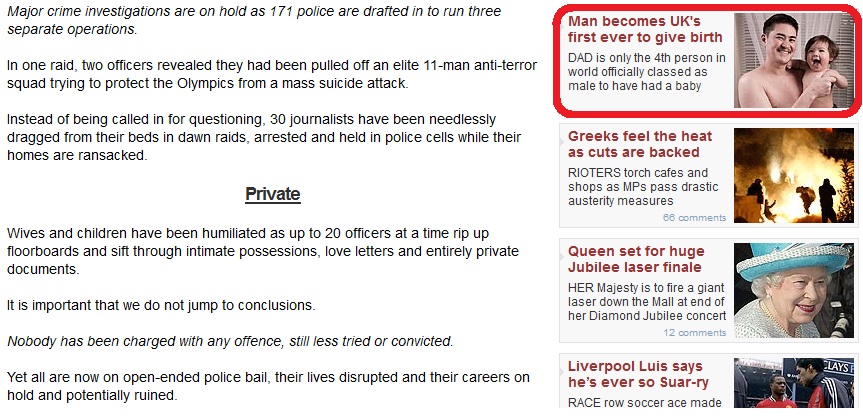
The Sun’s hypocrisy laid bare

The Sun is in trouble. Years of journalistic malpractice are finally catching up with the venerable tabloid, with employees arrested en-masse on “suspicion” of corruption and bribery.

Associate editor Trevor Kavanagh is upset about this.  “Witch-hunt has put us behind ex-Soviet states on Press Freedom”, his editorial thunders. It goes on to detail the humiliation experienced by Sun journalists and their families:

Instead of being called in for questioning, 30 journalists have been needlessly dragged from their beds in dawn raids, arrested and held in police cells while their homes are ransacked. […]

Wives and children have been humiliated as up to 20 officers at a time rip up floorboards and sift through intimate possessions, love letters and entirely private documents. […]

Nobody has been charged with any offence, still less tried or convicted.

Yet all are now on open-ended police bail, their lives disrupted and their careers on hold and potentially ruined.

How awful! And it’s not like Sun journalists would ever do such a thing to others, is it?

But wait! what’s this we see next to Kavanagh’s article in the online edition?

(click image for full size)

That’s right, it’s the Pregnant Man! Let’s take a look at his story.

Don’t forget kids, private lives are for News International employees, not for proles! Particularly queer proles.

Of course, it could be that the Sun is simply asking for contributions because all their journalists have been arrested…

(For more constructive commentary, see this powerful post by Ralph Francis Fox, as well as analyses from Jane Fae and Christine Burns.)

“Pregnant Man” story isn’t racy enough for The Telegraph

Yesterday, I noted a number of issues with the reporting of a British man’s pregnancy and the subsequent birth of his child. It seems, however, that the story simply wasn’t exciting enough for The Telegraph, who have revised their article somewhat overnight.

(click above for full-sized image)

The story itself remains largely unchanged: there is no new information. The only difference I could pick out was the introductory paragraph, which has changed one phrase in order to turn this somewhat inaccurate but broadly inoffensive sentence:

The man, who is believed to be in his 30s, was able to carry a child after taking female hormones to reverse the effects of his female-to-male sex change treatment.

…into something which takes that extra step to question the subject’s gender.

The ‘male mother’, who is believed to be in his 30s, was able to carry a child after taking female hormones to reverse the effects of his female-to-male sex change treatment.

Somewhat bizarrely, the original story remains online, possibly because The Telegraph wouldn’t dare offend the hundreds of readers who took time to comment on how disgusting it is that trans people want to mutilate their bodies.

Yesterday I was prepared to concede that Telegraph journalists were content to merely be stupid and lazy on trans issues. It turns out, however, that they’re actually prepared to put effort into their transphobic bigotry. Well done all.

British media in a tizzy over pregnant man

It’s finally happened: someone has noticed that a trans man in this country has had a baby. Of course the mainstream media, who between them seem utterly incapable of the slightest act of research, are responding in a predictable storm of inaccuracy and mild hysteria.

The facts appear to be as follows: some fellow – who quite understandably appears to desire anonymity – decided to have a child, and contacted the Beaumont Society for advice. The Beaumont Society don’t have a lot of knowledge in this area as they predominantly help out MtF spectrum individuals and their families, so they quite sensibly referred the individual in question on to GIRES. The grateful father later got back in contact with the Beaumont Society to thank them for their help, and everyone lived happily ever after.

Of course, that really isn’t a very exciting story. So the British media have taken a few steps to spice it up a little:

1) Exoticise trans pregnancy. Apparently this is the first British man to ever give birth. Except, of course, he isn’t. He’s just the first one they’ve noticed. There are a great many trans men in this country with children, but I suppose if you give birth before having a “sex change” (by which I believe the media mean taking hormones and/or having chest surgery) it doesn’t really count. I mean, you’ve got to be covered in hair to be a “real man”, right? There are probably also several trans guys who have had children prior to transition (at least one guy I know is planning this) but if the media doesn’t know about it, it ain’t happened. Even Pink News fall foul of this one.

2) On a related note: emphasise the international significance. Only around two or three men in the world have ever given birth before! I say “around” because there’s some confusion over this. The Telegraph uncritically quotes the Beaumont Society’s Joanna Darrell, who (purportedly) stated that one trans man gave birth in the United States (Thomas Beatie) and another in Spain. Meanwhile, the Metro states that an additional American and a guy in Israel gave birth after Beatie.

3) Highlight the risks. There is no evidence that trans children are in any particular danger from being born to trans parents, but gosh-darn it there might be! Right? According to the Telegraph: “Last night medical ethics experts called for a full inquiry into the issues surrounding transgender births, saying the interests of the child should not be risked to ‘fulfil the rights of an adult’.” At the heart of this is a very topical concern with trans fertility.

4) Finally, think of the children.  A number of sources are citing Trevor Stammers, Director of Medical Ethics at St. Mary’s University College. Stammers clearly isn’t a fan of queer families:  “The fact that the medical profession is facilitating and encouraging this is a serious problem. You are hardly going to end up with a baby that’s going to have a happy, productive and optimal childhood.

Of course, Stammers himself doesn’t appear to be a medical doctor. Now there’s a surprise.