Activist pasts and imagined futures

Back in October I caught the train down to Coventry to visit my old stomping grounds at the University of Warwick. The occasion was the 20th Anniversary of Warwick Anti-Sexism Society (WASS), a student campaigning group at the university. Technically WASS was 21 this year, but whoever let technicalities get in the way of a good celebration?

Co-hosted by the Centre for the Study of Women and Gender, the event brought current WASS members, including WASS president Izie Lopez-Scott and Students’ Union sabbatical officer Ananya Sreekumar, together with former students and feminist academics, including founders Sam Lyle and Cath Lambert, and early member Maria do Mar Pereira.

As I arrived on campus, it occurred to me that I must have been one of longest-running members of WASS. In contrast to the likes of Sam and Cath, I never played an organising role, instead on volunteering my time with Warwick Pride (the LGBTUA+ society), Rocksoc (for the metalheads), and later also Bandsoc (for whom I still occasionally judge the university’s annual Warwick Battle of the Bands). Nevertheless, after originally joining WASS way back in the academic year of 2005-2006, I maintained an on-and-off membership through my undergraduate, masters, and PhD degrees, finally leaving in 2016. During that time I attended numerous talks, workshops, protests, and occupations as a member of WASS, and joined fellow members as a delegate to Women’s Conferences hosted by the National Union of Students.

I wasn’t quite sure how it would feel to participate in the anniversary event. I anticipated it would be somewhat nostalgic.

Certainly the event served me nostalgia in spades. A WASS exhibition featured numerous t-shirts, hoodies, zines, posters, and pamphlets produced by the society from 2004 to the present day. I brought along a couple of zines from the 2010s – Sam brought along a huge amount of old material, much of which dated back to my undergraduate days. In a panel discussion, we reflected together on the context in which WASS was formed, why it felt so difficult and important to name yourself as a feminist in the early 2000s, and how the society’s early campaigns reflected the priorities and debates of the day (lads’ mags! feminism for men! Page 3!)


But my main takeaway was the way in which our actions can echo through time, informing and influencing others in ways we might never be aware of.

When Sam and Cath founded WASS, they were focused on the present. They didn’t think much about how it might provide a way into activism and feminist thought for hundreds of people over two decades. Looking at the exhibition, speaking in a session about what had changed and what happened, it felt clear to me that we are living in a world shaped hugely be the world of 00s feminism, even amidst an enormous misogynist backlash.

There is something here about the complexity of wins, and the importance of work over time. It is not simply the case that the world gets better or worse. At the event, we discussed the growing cultural impact of violent misogynists from the manosphere. Sam highlighted how rates of femicide remain extremely high, half a century after the second-wave feminist movement kicked into gear. Equally, we reflected on how there is far more mainstream acknowledgement, understanding, and support for survivors domestic violence than there used to be even 20 years ago. This matters: it provides more people with a way out, a route into rebuilding their lives with the support of their families and communities.

Similarly, even as racist rhetoric dominates mainstream political discourse, feminist movements have increasingly learned from the difficult discussions around intersectionality that have taken place across years, decades. Meanwhile, other social movements have got better at acknowledging sexism, and embracing feminist ideals. WASS was originally an all-white, all-cis, non-disabled collective, which struggled to build alliances with other student liberation groups. This has not been the case for years. Key issues for student feminists at Warwick in 2025 include the genocide in Gaza, and fighting back against the university’s attempts to implement anti-trans policies. Warwick’s liberation movements frequently collaborate and cross-advertise events, and current students described how activists were often involved simultaneously in anti-sexist, anti-racist, and pro-queer groups.

A young man at the event asked me how campaigners stay motivated when there is so much rollback. I said I was inspired by the fact that we can still help people, that we can still create ideas and resources that it turns out are useful to others years, decades later. This was illustrated perfectly by the most unexpected story I heard that day, from an early career academic who thanked me for my old writing on TeachHigher.

A decade ago, TeachHigher was the University of Warwick’s attempt to advance insecure employment on campus, and undermine trade unionism. Branded as “a more consistent approach to the employment of hourly paid staff who work in different departments”, TeachHigher would provide a framework specifically for casual teaching contracts, offering an alternative to full-time, salaried lectureships. As a “wholly-owned subsidiary” of Warwick, it would technically be a separate company, while still funneling profits directly back into the university. This meant workers contracted through TeachHigher would be unable to benefit from collective bargaining with the University and College Union (UCU). The intention was to expand the model already used by Unitemps, another Warwick-owned subsidiary which “offers flexible staffing solutions” (often zero-hour contracts) across the higher education sector.

An enormous struggle over TeachHigher happened in 2015. The scheme was pushed aggressively by management, and opposed vociferously by hourly-paid teaching staff: the very people TeachHigher intended to contract. In subsequent years, I spoke and wrote about how this model for internal outsourcing was defeated through collective action on the part of students and staff. Workers such as myself carefully scrutinised the university’s proposals, identified pressure points within our own departments, found allies amongst more securely employed faculty, and organised accordingly. We effectively took over our local UCU branch, while also planning outside of its structures. Loopholes in existing casualised contracts enabled us to circumvent the UK’s anti-union laws, through moves such as departmental teaching boycotts. Multiple departments declared that they would refuse to participate in the TeachHigher pilot. The final straw came when UCU announced a national demonstration on a University of Warwick open day, which would have been an enormous embarrassment to the institution.

The successful campaign against TeachHigher brought student groups such as WASS and Warwick Anti-Racism Society together with staff bodies such as UCU. Due to the unequal impacts of casualisation, we recognised – as my late, great colleague Christian Smith put it – that “TeachHigher is sexist, and TeachHigher is racist”. We built on tactics developed in previous years. For example, the idea of protesting on an open day was developed by the 2013 Protect the Public University campaign, which grew out of the 2011 Occupy Warwick encampment. WASS members, naturally, were involved in both.

The defeat of TeachHigher was an enormous win for campaigners. Not only was the scheme withdrawn: we also negotiated pay rises, better terms and conditions for all casualised staff, and pathways towards more secure contracts for some.

Photograph of trees with yellowed leaves lining a road on an autumnal day

Yet by 2025, there was very little institutional memory of TeachHigher. For all that we won, many teaching staff remained on casualised contracts, and Unitemps continued to prosper. Meanwhile, the vast majority of those involved in the struggle have moved on, to live and work elsewhere. The university was largely under new management, and there had been an enormous turnover within human resources as well as student bodies. For those who even know the dispute happened, it can be hard to find concrete information. News platforms delete old stories, and enshittification makes it harder to use search engines to find those that remain.

At the WASS Anniversary, I learned that a key source of information on TeachHigher today can be found in my past blog posts.

Old wins echo down the years. Temporary gains are gains nonetheless. I would guess that every one of us who benefited from the TeachHigher defeat is better off now as a result. Personally, I found myself in a better place financially to finish my PhD and continue an academic career. I also learned an enormous amount about the practicalities of collective organising. I know I have draw on those gains repeatedly over the last decade to continue supporting others in turn.

Even if pay rises for casualised staff were eroded over time, the fact that we fought and that we won can continue to inspire workers facing similar struggles. Just as TeachHigher was inspired by Protect the Public University, which was inspired by Occupy Warwick, which was inspired by the Red Warwick occupations of the 1970s as well as the US-led Occupy Movement, the Spanish Indignados Movement, and the Arab Spring. These long influences don’t just happen: they rely on people writing things down, saving artifacts, and remembering together.

The funny thing is, I had no idea anyone might find my old blog posts on TeachHigher useful after so many years. I was one small part of a far larger movement, and have been involved in so many other campaigns since. Nevertheless, through chronicling events it turns out that I created a resource that remains useful to this day.

At the WASS Anniversary, I was reminded how important it is to commemorate our local histories of activism, and to share what we have learned along the way. Social progress is neither linear, nor guaranteed. But if we imagine there might be a better future around the corner, and act accordingly, then we might change the world in ways we cannot possibly anticipate.

Photo of a poster with bold text and a small picture of a sapling plant. Text reads as follows "By choosing a feminist politics, you are making a commitment to a world that has not yet been built" - Lola Olufemi. Warwick Anti Sexism Society. Campaigning for gender liberation. @warwickantisexismsociety


Reject Trans Doom-Posting

This week I took the long train down to the south of England for my friend Robyn’s funeral. She died very suddenly three weeks ago, aged just 32.

Robyn gave so much love to the world, and was so loved in turn. Around a hundred and fifty people crammed into a small building for the service. There weren’t enough seats for everyone, so many stood at the back and sides of the room. I sat on the floor. More attended online.

We shared stories from Robyn’s life, learned from each other, cried together. Like many funerals, especially for young trans people, it was absolutely gutwrenching. It also helped move us towards closure. It was good to be in community together, to think and speak not just of Robyn’s past, but of our collective futures. Robyn lived life to the absolute maximum. Surely we could take inspiration from her example.

Photo of a punk crowd having a good time. In the centre of the image, a white butch woman exclaims and points with delight.
Robyn at Manchester Punk Festival 2024. Photo by Chris Bethell for The Guardian(!)


After the funeral, I stayed the night with queer friends in rural Surrey. We went for a curry, toasted Robyn, caught up about our lives. We talked about work and about books and about art and about holidays we wanted to take. That evening I felt tentatively more at peace with the world.

And then I looked at my phone. And I learned that another young friend, Jessica, had also just died.

***

It’s a shit time to be trans. Many people are saying this.

But then again, when has it not been a shit time?

Eight years of moral panic have taken an enormous toll. In the UK, as in many other countries, our civil rights and our access to public services, public spaces, and public life are all being rapidly rolled back. Politicians and influencers fall over themselves to promote anti-trans violence and praise one another’s incendiary takes. We are less safe at work, at home, in hospitals, in schools, and in the streets.

Trans people often die young, including too many of my friends. Sometimes (all too often) we die by suicide, driven to despair in a world full of hate and malice. Sometimes (mercifully less often in the UK) we are murdered, usually in incredibly violent ways. Other times, it’s more complicated. I think of Denise, who died a sudden death from melanoma. I think about Elli, who died of Covid-19. And now I also think about Robyn and Jessica, who each died suddenly of apparently natural or accidental causes.

These days, the high rate of untimely trans death can feel like a consequence of the trans panic. Certainly I believe it’s making things worse. However, this phenomenon pre-dates the current political situation. Trans people disproportionately died young in the 2010s, at the time of the so-called “tipping point“. Trans people disproportionately died young before this too. Sociological theory can tell us why.

A decade or so ago, I worked for a couple of years in Warwick Medical School. I was there to teach medical students about social determinants of health. The basic concept is that our general health is affected enormously by the context in which we live. This includes factors such as the resources and services we do and do not have access to, and barriers we might face in attempting to access healthcare services or otherwise look after ourselves

So, it’s not a coincidence that – for example – life expectancies are shorter in poorer neighbourhoods, or that Black women are more likely to die in childbirth. There is nothing inevitable or biological about any of this, something intrinsically different about poor people or Black people. The issue is that entire groups of people are more likely to experience particular kinds of illness, and more likely to die of things others might survive. This is because of the social disadvantages they face, and because of the discrimination they experience at the hands of bigoted doctors and nurses.

There is a massive scientific literature on social determinants of health. I’ve contributed to it myself, co-authoring a recent study showing an association between transphobic microaggressions and poor mental health among trans people. For this reason, I know it’s no coincidence that so many of my trans friends have died untimely deaths. Trans people are more likely to have worse health because of transphobia. They are less likely to receive timely and effective treatment because of transphobia. This means when trans people are seriously ill, we are on average less likely to survive. I see this when I look at the academic literature, and I see this every day in the lives trans people I know.

I see the impact of transphobia when I look at Robyn’s life and death. Her health deteriorated significantly in her final years. She was afraid to seek help from doctors though: and for good reason, given the discrimination she and many of her friends experienced in NHS services. I wrote my entire goddamn PhD thesis on this problem.

Things were even worse for Jessica. I witnessed so many organisations and institutions in her home city of Coventry failing her time and time again. I could fill whole books with accounts of the violence done against her. She was failed by her school, her church, a political party she gave so much energy to, the council, the local hospital, the psychiatric ward, the housing association. Just last year I sat helplessly on the other end of the phone while she attempted suicide, doing the best I could in this moment to ensure that she was not alone.

The institutional failings experienced by Robyn and Jessica and so many others are the result not just of ignorance, but of actively malicious transphobia and transmisogyny. I believe these factors contributed significantly to their untimely deaths.

How can any of us expect to find hope and purpose in the face of such violence?

***

In recent months I have noticed an uptick in trans doom-posting. By this I mean trans social media posts, blog posts, and videos which dwell entirely on negative feelings and convey a sense of hopelessness.

A prominent example is Shon Faye’s recent essay, well, it’s over, which she describes as “a brief eulogy for the ‘trans rights’ movement”. Shon observes that powerful transphobic movements in the USA and UK are succeeding in many of their aims. They have spread fear and disinformation far and wide, made allies of mainstream politicians and media platforms, and enacted bans on trans healthcare. Now they are attempting to criminalise our very existence, as part of a campaign to eliminate us altogether.

Shon’s conclusion appears to be: well, that’s it. We’re all fucked.

Today I doubt I will see another progressive measure (either in legislation or healthcare policy) put in place for trans people in my lifetime. Who knows what may yet be taken away.

I very much empathise with her account of trying to talk about this in any way with cis friends and family:

“their instinct is to try and generate hope or minimise despair [which] typically minimises the gravity of the situation and the depth of my grief and exhaustion and fear – increasing my resentment.”

Shon concludes that she doesn’t want to hear “fucking platitudes” – “there’s time for hope later”. For now, she wants time to grieve. I’ve seen similar sentiments shared by other authors on various social media platforms, including posts from extremely popular trans meme accounts.

I understand intimately where all of this is coming from. Just look at everything I said earlier about social determinants of health. I recognise the violence we are subject to, and its costs. This post too is written from a place of deep grief.

But there is also the question of where and how we grieve. We do need space to vent and to despair. But we also need space to process, and figure out what happens next. Ideally, we need places and times we can do this collectively, rather than just being isolated as individuals. Robyn’s funeral offered this.

I’m not saying we shouldn’t talk about what is happening to us. What I am concerned about is the individualising effect of public platforms, and the parasocial relations we hold with high-profile accounts. We tend to consume doom-posting on our own, on a phone. We often have no-one to process it with, and little context beyond the content in front of us. In this way, doom-posting offers only a partial account of reality, and no way out from despair.

And there is a way out. We find it in community.

***

Look, I have a great deal of respect for Shon Faye. I have a hard enough time navigating the consequences of my own very minor microcelebrity. Shon has to tackle a great deal more attention: from trans people looking for someone to idolise and/or tear down, from cis readers who project heroic expectations onto her, and from haters who see her as the antichrist or something. She’s great on camera, and a brilliant writer. I would recommend her book The Transgender Issue to literally any cis reader. I also recognise that her blog post comes from a place of incredible pain.

At the same time, I am concerned that many trans people and allies are putting way too much energy into engaging mainstream institutions and liberal systems on their own, individualistic terms, rather than looking to the alternative power and support we can build in our communities. Notably, a lot of Shon’s post talks about civil society, legislation, lobbying, and the role of organisations such as Stonewall. This is definitely a realm in which “trans rights” face a seemingly terminal decline. But it is also not the first place I would look for real, grounded hope.

You can find a similar energy in Jules Gill-Peterson’s dire essay Reject Trans Liberalism, which is referenced by Shon. Jules’ piece simultaneously criticises the trans liberation movement for being about more than transition, while also insisting that preparing ideologically sound documents for the US supreme court is a radical act. It posits a false and ahistorical dichotomy between transsexuals (good, pure, radical) and transgenders (bad, elitist, liberal). The essay does not consider how gender diverse people might work together or support one another across our differences. This contrasts with existing critiques of trans liberalism already advanced by activist-scholars such as Nat Raha and Mijke van der Drift. Again, don’t get me wrong, I’m a huge fan of Jules’ previous work. But as trans people, and especially as trans women, we owe each other so much more than this.

Now, I’m hardly without fault. This very blog is replete with examples of myself and others putting untold hours into lobbying politicians, participating in public consultations, advising the National Health Service and so on and so forth. In her post Stepping Over The Line, Josie Giles, who once again I admire greatly (look, I just fucking love trans women) argues that:

Theoretically, an army of well-resourced energetic activists could simultaneously engage in state-centred advocacy and also do grassroots politics. In practice, it doesn’t happen. In practice, state-centred pseudo-organising dominates the social media feeds and the limited energy reserves of an already depleted community, and absorbs what little money is available to pay for the salaried self-licking ice-cream cone of the lobbying profession.

Sick burn!

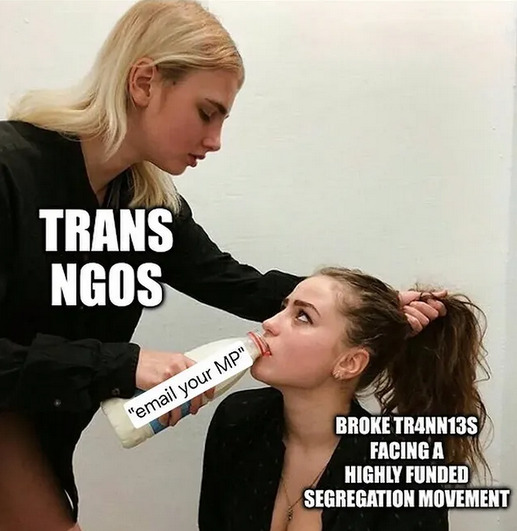
Meme depicting two femme white women. One is labelled "trans NGOs", and is holding the other woman firmly by her hair. The second woman is labelled "broke trannies facing a highly funded segregation movement". The first woman is force-feeding the second woman a bottle of milk, labelled "email your MP".
Meme acquired via one of them social media platforms we’ve all heard so much about.


I do disagree with Josie a little. Unlike Shon and Jules and also Josie, I transitioned in the early 2000s. This was well before the tipping point, and before most trans civil rights even existed in law. I remember how we fought successfully for changes that genuinely improved many people’s lives. I feel it will always be worthwhile to use what levers we can to minimise the harm caused by those who have power over us. Lobbying is the most accessible form of activism for some people. I still have an auto-reply on which encourages every damn cis person who emails me at work to contact their MP.

But Josie is completely right that many if not most trans people can and should be putting a lot more of our energy into grassroots politics. This must necessarily involve re-imagining what our worlds could look like, using what we already have as a basis from which to build. I know from lived experience that we can not only survive in the absence of certain civil rights and recognition, but also see material improvements in our lives when we come together. I met Jessica because we built trans-led community services in Coventry from the ground up.

Similar points are made by Roz Kaveney, who first came out over 50 years ago. In her criminally underrated 2022 poetry collection, The Great Good Time, Roz does reflect on the violence faced by young trans women in her youth. However, she also details the vibrant lives they lived together, the joys they experienced, how they shared housing and clothes and had each others’ backs. In a short forward to the book, she notes:

“I observed a lot of bleakness creeping into trans social media and thought it my job as a community elder to remind young people that things have been, if not worse, then at least as bad in different ways”.

As Josie states in Stepping Over The Line, white, middle-class trans people in particular need to understand in this current moment that we are as disposable to the ruling classes as any other minoritised individual. Our strength lies in practical solidarity with others subject to the violence of corporations, fascist movements, and the state. To once again reiterate the point, we need to be in community with one another.

Both Robyn and Jessica’s lives offered perfect models for this.

***

Every single speaker at Robyn’s funeral talked about how much time and energy she put into punk and folk music, building and fixing things, and caring for others. She was a loud, proud butch who was incredibly committed to sustaining community wherever she went. When she saw a need, she sought to meet it. Many of us only wished that she was better at asking for or accepting help herself.

If a trans person needed somewhere to stay, Robyn would put them up. If a trans person needed to move house, or was being evicted or was fleeing a violent relationship, Robyn would turn up with a van. If a trans person was having trouble at work, Robyn would show up online or in person with sensible advice. This attitude inspired Robyn to volunteer with groups such as Reading Red Kitchen, a grassroots project which provides a social foodbank and free community meals for asylum seekers experiencing food poverty. For Robyn, radical politics could never simply be about slogans and demonstrations: it was about cooking, connecting with others, and washing the dishes.

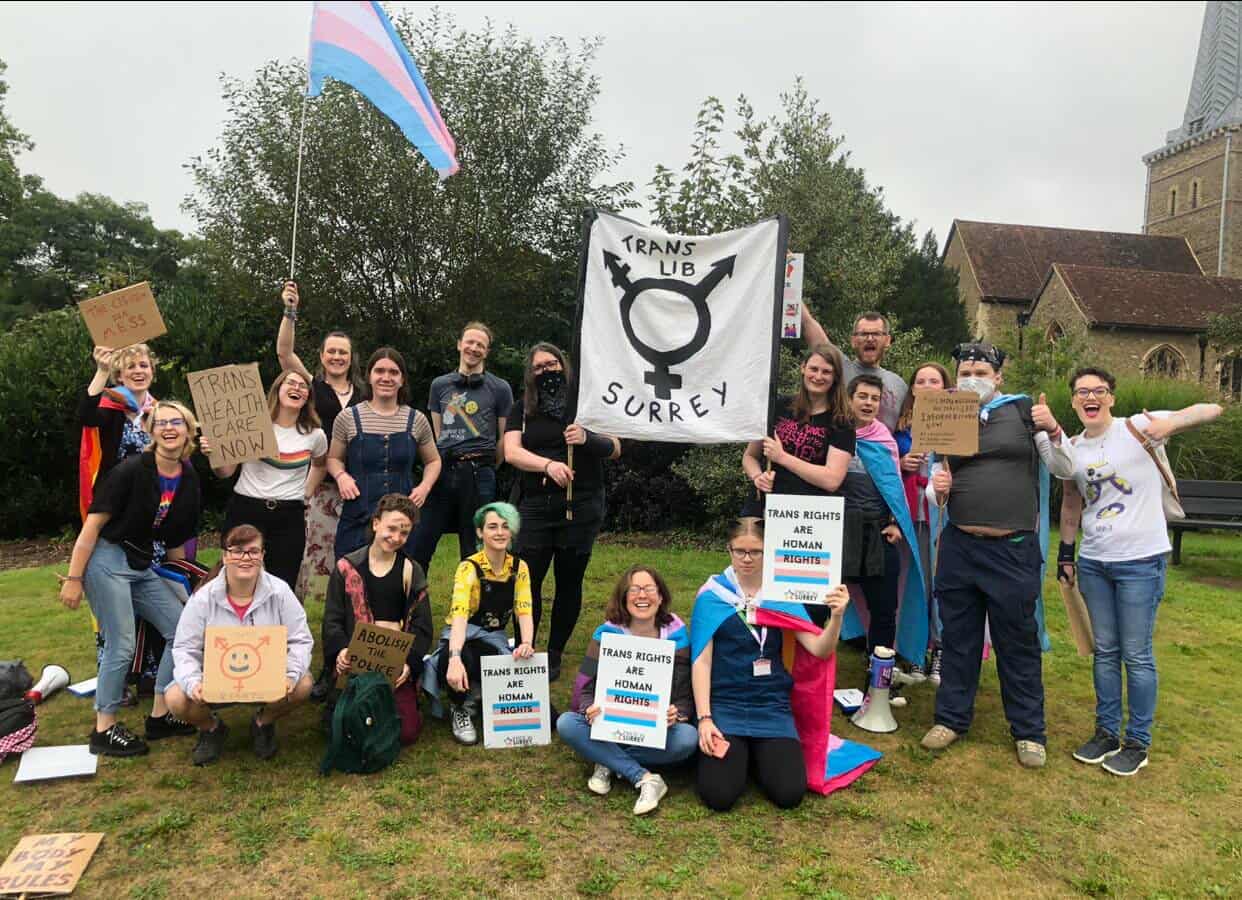
None of this is to say that Robyn was never found at a protest: quite the opposite. When I lived in the south we co-founded Trans Liberation Surrey, a collective which worked to oppose transphobia in a county hardly known for its activist movements. My most treasured memory of Robyn is from this time, when we attended a small anti-fascist demonstration in Wokingham. A coalition of neo-nazis, anti-vaxxers, and climate conspiracists descended on the town to protest a drag queen storytime event for young children. Robyn and I joined other locals outside the library to wave rainbow flags and play upbeat music, enabling families to attend the event without disruption.

Photo of people with placards around a banner labelled Trans Lib Surrey.
Trans Liberation Surrey, at Surrey Pride 2021.


Jessica was also extremely motivated to help others, in spite of her own difficult circumstances. Like Robyn, she was a committed trade unionist. For many years she was also involved in a small political party, before eventually being ejected for challenging the leadership. Her motivation for this was a genuine belief in the possibility of positive political change, and in the potential for people to come together and make that change happen. Later in life she would rediscover her Christian faith as alternative vehicle for community action.  

After hearing of Jessica’s death, our mutual friend Charlotte reached out, and we asked one another how we knew her. It turned out Charlotte had also been a member of that political party, and reconnected with Jessica several years later as they both sought new ways to make a difference in the world. In turn, I explained how Jessica and I met while lived in Coventry, and was myself involved in organising trans community social events, meals, and punk nights. Charlotte and I also both knew Robyn. “Christ Ruth,” said Charlotte, “trans lives are so entangled and we often don’t even realise”.

So it is. Right now, Jessica’s Facebook wall is replete with people thanking her for being there as a friend, for providing them with advice, for helping them come out.

In a hostile world, we are everything to one another. In the face of the most horrific hate, our love is so powerful. Such love survives death.

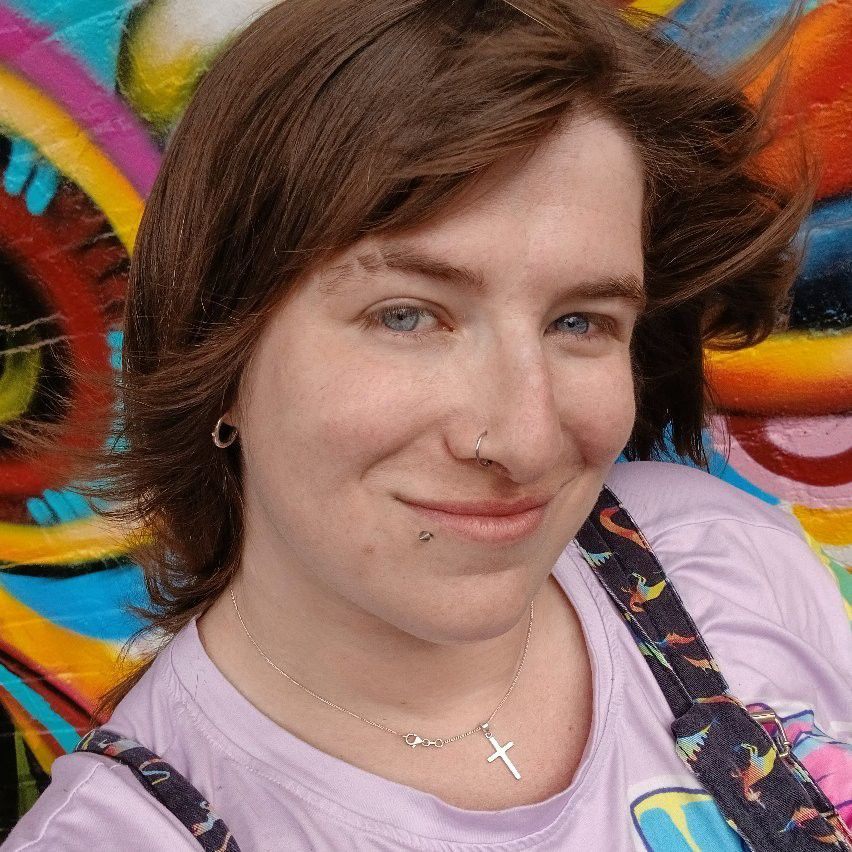
Selfie photo taken by a white woman with shoulder-length brown hair. She is wearing colourful clothes and a cross around her neck, and smiling at the camera.
Selfie taken by Jessica.

***

This is where I find hope. At protests and demonstrations, sure, but more importantly in the contexts where we give each other’s lives meaning.

I find hope in community meals, mutual aid, queer bars and queer bookshops and queer gigs. I find hope in small parties, in big Pride events, in quiet meetings at work, in food pantries. I find hope in housing projects and healthcare projects, and in the Glasgow Electrolysis Project, which has created actual jobs for trans women and a vital new service for hundreds of us across the city. We know we are failed constantly by mainstream institutions: rather than seek incremental change, is it not time to re-imagine the clinic, re-think the workplace? Our problems will not be solved by refusing to engage with existing services, nor by creating trans charities that replicate existing hierarchies. We need to find ways to build something new entirely.

I find hope in the fact there are more of us out than ever, more connected than ever. These collective endeavors are all so much more important than anything I personally might write, any research I might do, and certainly any “progressive” policy I might influence.

Doom-posting and finger-pointing cannot deliver any of these things. We need to take the time to connect with one another, especially outside the internet. Yes we need to grieve, but we need so much more than this. We need to actively look after one another, and provide space for rest and recuperation. We need to have each others’ backs. We need to connect across difference, and not (re)create hierarchies of oppression or need.

These are no fucking platitudes. This is my life. This is the lifeblood of our shared communities. This is how we create better social determinants for our goddamn health.

Long may we live together.  

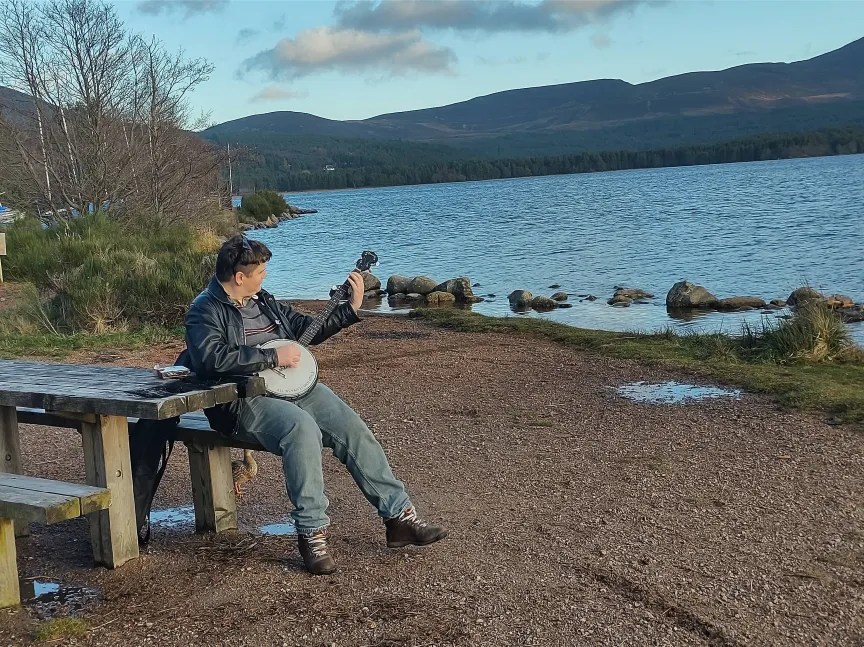
Photo of a butch white woman playing a banjo next to a Scottish loch.
Robyn in the Highlands. Photo by Elaine O’Neill.

Endorsement: Writing Badly (2025)

In recent years I’ve provided a few written endorsements for cool books and other publications. I’ve decided to start sharing them to this site so more people are aware of these works!

I’m starting off with the first issue of Writing Badly. This is a new journal of letters, written by and for trans women on the subjects of misogyny and feminism. It is – intentionally – only available in print.

Here’s what I had to say about issue 1 of Writing Badly:

Throw away your phone and read this instead. From cookery to consciousness-raising, from deep theory to casual misandry, from practical advice to impractical advice, the essays and letters of Writing Badly will help you build new worlds.

Imagine deep conversation with the cleverest women you know. Imagine organising with the coolest women you know. Imagine arguing with the most annoying women you know. Imagine being in community with women who will always have your back.

By turns profound and infuriating, beautiful and devastating, this collection has it all.

Photo of Writing Badly Issue 1. The cover image is greyscale and features an abstract image of several fish.


On publication, I supported Writing Badly through buying myself a copy from my local independent bookshop, for the grand price of a tenner. They didn’t have a copy when I first went in, so I asked them if they could order one in for me. They instead ordered in a load, and now have them on the shelf for other women (and other people). Maybe you can do the same! Alternatively, it’s available to order online through ebay.

Supreme Court auto-reply

Last week I attended a workshop in Switzerland on standards of evidence in sex and gender research (more on that soon!) During my trip, I had my standard out-of-office auto-reply set up for my email account, informing people of my absence so they wouldn’t expect any immediate engagement from me.

I would typically switch off that auto-reply on my return to work as normal. However, in the wake of last week’s Supreme Court judgement, there is simply no more “work as normal” for me or any other trans person living in the UK.

As such, I have written a new auto-reply, which will be sent to everyone internal to my workplace who emails me. It is impossible for me to forget what is happening to trans people and especially trans people in the UK, so I will ensure it is impossible for my colleagues to forget this also. Equally, my intention is to transform bad feelings into understanding, and practical action. We have always been powerful when we work together and build movements.

I am sharing the text of the auto-reply here in case it is of use to anyone wishing to do similar.


You may be aware that the UK’s Supreme Court has initiated a mass rollback of trans people’s civil rights. In light of this, I am uncertain if it will continue to be safe for women and people like me to continue working at the University of Glasgow.

You can read more about the judgment and its implications here:

UK Supreme Court Rules That Trans Women Aren’t Women under the Equality Act 2010
https://www.wearequeeraf.com/uk-supreme-court-rules-that-trans-women-arent-women-under-the-equality-act-2010/

Illegally Female
https://www.autostraddle.com/uk-supreme-court-ruling-anti-trans-women

While the judgment itself does not require organisations to act in a prejudiced manner, numerous politicians and policymakers have indicated that they intend to make discrimination mandatory. My friends have reported increased street harassment, as the ruling is seen to position trans women as legitimate targets for misogyny and violence. Trans people of all genders are already even more likely to experience public harassment, sexual assault and rape than cis women (see e.g. https://bulletin.appliedtransstudies.org/article/3/1-2/3/), and this is likely to get worse.

The Chair of the Equality and Human Rights Commission (EHRC), Baroness Falkner, has promised to revise guidance to encourage employers to discriminate against trans people in the workplace. For example, she told Radio 4: “if a service provider says we’re offering a women’s toilet, that trans people should not be using that single-sex facility.”

If you are concerned about the safety, wellbeing, and continued access to employment and education for women and trans people such as myself, you can take one or more of the following actions:

  • Write to members of the Senior Management Team at the University of Glasgow, especially the Equality Champions, and ask what they will do to protect trans staff and students, including through ensuring continued access to women’s and men’s facilities as relevant. Find their contact details there <link removed for blog post>.

  • Write to your Head of School and ask what pressure they will be putting on the Senior Management Team to do the same.

  • Write to your MP and MSPs. Explain exactly why you are concerned, and demand action to protect trans people’s civil rights. For example, you could ask for new primary legislation to protect trans people, ask why the UK is no longer complying with the European Convention on Human Rights, or demand the dismissal of biased commissioners from the EHRC. You do not have to write a perfect letter and it is okay to be emotional and express sorrow or anger, so long as you are not aggressive or mean. Advice on writing letters is linked here: https://bsky.app/profile/whatthetrans.com/post/3lnf4sadrjs2p. You can find contact details for your representatives here: https://www.theyworkforyou.com/.

  • Support trans people materially, through providing time, resources, and/or money to community initiatives. Examples include: Glasgow Trans Collective (fundraising for emergency support to people facing an immediate danger of threat to life, https://linktr.ee/glasgowtranscollective); Trans Harm Reduction (supporting harm reduction for people self-medicating in the absence of NHS treatment, https://transharmreduction.org); and Five for Five (donating money every month to a range of trans women’s causes, https://www.fiveforfive.co.uk).

  • Check in on your trans friends and colleagues. Make sure they are okay, and do what you can to be there for them. But do your own research on what you can do to help: don’t put this burden on us. Some good places for information include the websites and social media channels for TransActual, What The Trans, QueerAF, Trans Safety Network, and Trans Writes.

This auto-response is inspired by bell hooks’ comments in her book Teaching to Transgress:

When education is the practice of freedom, students are not the only ones who are asked to share, to confess […] empowerment cannot happen if we refuse to be vulnerable while encouraging students to take risks. [Lecturers] who expect students to share confessional narratives but are themselves unwilling to share are exercising power in a way that could be coercive. In my classrooms, I do not expect students to take any risks I would not take, to share in any way that I would not share. […] It is often productive if [lecturers] take the first risk, linking confessional narratives to academic discussions so as to show how experience can illuminate and enhance our understanding[.]

I will not necessarily respond to any replies you send to this automated message, as I am trying to stay focused on teaching, admin, and research. But regardless, thank you.

Photo of a lake and mountains.

My speech on the Cass Review and Scotland’s trans healthcare ban (with footnotes!)

This post shares a video and transcript of my speech at the emergency demonstration in George Square, Glasgow, on 18 April 2024, against the decision from NHS Greater Glasgow and Clyde to ban endocrine treatments for trans people aged under 18. The speech was unplanned and made without notes, so I have made some small corrections in the transcript, plus minor amendments for clarity. I have also added references for some key points. Thank you to @transprotestglasgow for the video.

Readers seeking more detailed evidence and academic critiques may find my previous blog post helpful: What’s wrong with the Cass Review?

TRANSCRIPT

Hi, I’m Ruth Pearce.

I’m a Lecturer in Community Development at the University of Glasgow, and I’m a researcher on trans healthcare.

And I was a trans child.

I want to talk about that for a moment. Because I came out to myself circa 2001, when I was 15, when not many people did that. And it was hard for us. And there was trans community, and there was information, but it was very difficult because we felt very, very alone. I was mostly only able to connect with other trans people my age through the internet, through blogs, and they were mostly Americans. The Brits were there; a lot of us connected later as we grew older. But we were so isolated.

A really important thing to remember, in a moment like this where we are seeing a return to the kind of medical policies that were in place when I was a kid: there are so many more of us, and we are so much more powerful than we have ever been.1 Never forget that strength we have together.

One of the things Hilary Cass says in her report is that the meaning of the word “trans” has changed since 2020.2 She says, and there is no evidence for this, that “trans” in 2020 meant something quite rigid and specific, and only now in 2024 it’s become an umbrella term for lots of identities. Tell that to me coming out as a trans teenager in 2001!

So here’s the thing. We’ve always been here, and we are more powerful now, but we are seeing this backlash. That’s been a long time coming and transphobia changes its face over time. One of the things I wanted to do to deal with my loneliness and the experiences I had was that I wanted to become an activist. And when I started doing activism, when I got into meetings with people in government, and with the Equality and Human Rights Commission, they said “there’s no evidence” for the discrimination we faced. So I was like, “fine: let’s see what evidence I can find”.

So I did a PhD in trans healthcare.3 And I found what you often find when you do research; you often find things you don’t expect. So I did find some things I expected to find. About waiting lists and how hard they are. About how hard appointments can be when you’re meeting with sexist and transphobic clinicians who are asking you, as a young person, how you masturbate and who you’re attracted to. But what I didn’t expect was the sheer level of pain from the waiting. And I talk about that in my work. And the anticipation, where we are anticipating all the time. When is it going to happen? When are we going to get to live our lives? And that happens on every level of our lives.

I was also shocked by the level, and detail, and complexity of the ignorance of healthcare practitioners. It ranges: it’s not just that they all hate us, right? It’s that some people are trying to control us, some people want to help but don’t understand how, and some people don’t want to know. There’s different kinds of ignorance.4

So I published my work, and other people have followed. Other people were there before me of course, because “trans” was not new, and trans research wasn’t new either. There is now a lot of published research on what it is like to go through a gender clinic, and what it is like for a young person to go through a gender clinic. There’s people like Cal Horton5 and Natacha Kennedy6 who are writing on this, and Harvey Humphrey7 who works here in Glasgow. There’s a lot of people doing work on this.

We are saying, time and time again, “we need services that meet our needs”. For some people, that is access to puberty blockers, and that is access to hormones. For other people, that is access to counselling, and therapy, and community support. What we call “trans-affirmative” or “gender-affirmative” care is flexibility, meeting a person where they are at, and based on what they want to do with their lives.8 You don’t have to change your body – but you can.

It’s our body, it’s our right: we can do what we want with our own bodies.

This is what is disgusting about the decision by NHS Greater Glasgow and Clyde. They have not addressed the years and years of mistreatment and abuse in their child and adolescent clinic at Sandyford. It is not a great place that we are trying to save. It is a clinic that has repeatedly refused to treat young people, and made people hold on for care. It has helped a handful of people. Dozens of people – only dozens – have accessed treatment in the last few years.9 Now they are proposing to stop doing the very little they are doing to support young trans people.

People who get a referral to a child and adolescent gender clinic are not necessarily seeking access to counselling and therapy, because you can get that elsewhere.10 They are not seeking access to community, because you will find no community at Sandyford. They are most likely seeking access to endocrine treatments: puberty blockers and hormone therapy. And that’s what they are going to stop doing.

Sandyford say they are still accepting new referrals. But what is the point of a gender clinic that does not offer people medical treatment?

NHS Greater Glasgow and Clyde have based their decision on the final report of the Cass Review. Let’s talk a bit about the Cass Review.

I’m an academic researcher. If the Cass Review was submitted by an undergraduate student, the first thing I would say is: “That’s nearly 400 pages long! No-one’s going to have time to mark that”.11 And you’ll notice that all the people in the media, all the Labour politicians, all the Tory politicians, all the people saying we should immediately implement the findings of the report: none of them read nearly 400 pages in one day. Neither did the journalists at the BBC, the Telegraph, the Times, the Daily Mail, the Observer, the Independent. We expect better! And now the Scottish media: it’s all over the Scotsman, the National, the Herald. None of them have bothered to read the report, or think about it critically.

So here’s a bit of information about the Cass Review. The Cass Review was undertaken by a group of people who, from the very start, excluded trans people from oversight of the project. That was in their terms of reference.12 They didn’t want people who had experienced services having a formal part in the report. They excluded healthcare experts. If you were someone who had worked in a gender clinic you were excluded from being part of that.13 You know, I have lots of disagreements with many people who work in gender clinics, but you would have thought they might get a say.

You can see that ignorance, that intentional ignorance, playing out in the final report of the Cass Review. You can see, if you read the Cass report, that they looked at over 100 studies, most of which show that puberty blockers and hormone therapy can help young trans people. And they just ignored them.14 Intentionally. They say that the majority were not “high quality evidence”.15

What else is not high-quality evidence in healthcare? Paracetamol for back pain.16 There is no high quality evidence for that, in the terms of the Cass Review. Anti-psychotics.17 ADHD medication.18 All these medications that are in regular use. You know what else? Puberty blockers for young people with precocious puberty – if they’re cis.19 That is direct discrimination. 20

The thing is, that’s the Cass Review being serious. Let’s think about when it gets weird.

There’s a graph in there, where they show referrals to a gender clinic (the Gender Identity and Development Service in England) rising year on year, with “an exponential rise in 2014”. But they cut the graph off at 2017. But if you look at 2017-2020 the referral rate flattens off. It’s deliberate removal of evidence.21

We know why this is happening. Experts – medical experts, and experts by experience have been cut out of the Cass Review process. If you are trans, that’s you. You are an expert by experience. You know what it’s like. We have been cut out the process!

And the NHS have done that here in Scotland. There was no consultation on the ban that’s come in.

Who did they consult? We know there are people who are proponents of conversion therapy who were on the Cass Review team.22 That is what they are proposing.

They are proposing conversion therapy. Not just for trans kids, because they want to deal with all gender-questioning and non-conforming kids. This is going to be conversion therapy for queer kids. Little boys who want to wear a dress, they might not be trans, but they deserve to have the space to explore. That is not going to be what happens in clinics where people are referred which are being informed by conversion therapists.23

So consequently you have other weird stuff in the Cass Review. They’re dismissing all the evidence about why puberty blockers and hormones can benefit people within particular contexts, but they’re relying on other evidence for their recommendations. Let me give you one citation. “Thoughts on Things and Stuff, 2023”. That is a citation from the Cass Review: Thoughts on Things and Stuff.24

What is “Thoughts on Things and Stuff”? It’s a right-wing Youtube channel run by anti-trans bigots,25 featuring contributors such as “Gays Against Groomers”.26 This is the level of evidence that is informing NHS Greater Glasgow and Clyde.

And I’ll tell you what else is in the Cass report. They say that little girls are likely biologically inclined to play with dolls. It’s right in there, in the Cass report.27 And little boys are probably biologically inclined to play with trucks. Why is this? It’s not just an anti-trans agenda. It’s an anti-feminist agenda. Its an anti-woman agenda.

Why is this happening? It’s happening because trans people are an easy target.

If you want to stop young people accessing contraception as teenagers, you remove trans people’s right to consent to care as young people. If you want to prevent young people – teenage girls – from having abortions, and you’re failing time and time again in the courts, you instead target puberty blockers, because that way you can set a precedent for preventing people from being able to make decisions as young people. You are undermining the idea that young people might have the capacity to consent to care and make an informed decision about their own bodies.28

So I will end on this. I’m a woman, I’m a trans person, and I think it’s really important we think about allies. I had the parent of a trans child contact me and say, “thank you for being an ally”. I want to think her for being an ally. The thing about allies is, we talk a lot about an “ally” being someone who supports somebody else. But no: allies are people who stand by each other and work together.

That’s why we need a trans feminist movement. A trans feminist movements gives people autonomy over their own bodies, space to make their own decisions, and enables people to stand together when we are all at risk.

So I’ll leave you with a chant I want to hear more of at protests:

“Trans rights, women’s rights: one struggle, one fight”.

FOOTNOTES

  1. My statement here is intended to highlight that more people are out as trans than ever before. Contrary to narratives of “social contagion”, there have always been people with gender diverse or sex nonconforming experiences. What has changed is that there is greater access to information and community, which makes it easier for people to come out. ↩︎
  2. “During the lifetime of the Review, the term trans has moved from being a quite narrow definition to being applied as an umbrella term to a broader spectrum of gender diversity. This clearly has implications for conceptualisations of detransition” (Cass et al., 2024, p.187). This claim is demonstrably false, as “trans” (and before that, “transgender”) has been used as an umbrella term for decades. This is shown in my own previous work as well as writing dating back to at least the 1980s by individuals such as Leslie Feinberg. ↩︎
  3. https://wrap.warwick.ac.uk/88285/ ↩︎
  4. For an excellent, more recent and more detailed analysis on this topic in the context of trans youth healthcare, see Magdalena Mikulak’s (2021) article “For whom is ignorance bliss? Ignorance, its functions and transformative potential in trans health“. ↩︎
  5. https://growinguptransgender.com/evidence/ ↩︎
  6. https://www.gold.ac.uk/educational-studies/staff/kennedy-natasha/ ↩︎
  7. https://www.gla.ac.uk/schools/socialpolitical/staff/harveyhumphrey/ ↩︎
  8. “Our stance, as gender-affirming practitioners, is that children should be helped to live as they are most comfortable. For a gender-nonconforming child, determining what is most comfortable is often a fluid process, and can modify over time. Therefore, in a gender affirmative model, gender identity and expression are enabled to unfold over time, as a child matures, acknowledging and allowing for fluidity and change” (Hidalgo et al., 2013). ↩︎
  9. “Since 2018, around 1.77% of young people who are referred to the gender care services at Sandyford have gone on to be prescribed puberty blockers”: https://www.thenational.scot/news/24262271.many-young-people-scotland-given-puberty-blockers/. ↩︎
  10. Although in practice, trans people are often also turned away from mental health services due to “trans broken arm syndrome“. ↩︎
  11. In my original speech, I inaccurately stated that the report was “500 pages long”. However, my point about requiring time to carefully consider its contents remains. ↩︎
  12. “The original published Terms of Reference (ToR) for the Cass Review’s assurance group explicitly excluded trans expertise, stating that it “deliberately does not contain subject matter experts or people with lived experience of gender services” [Report 1, version 1]. The current (updated) assurance group ToR is worded less clearly, yet still conveys exclusion of those with expertise or lived experience, as such individuals would naturally be expected to have an interest in the outcome of the review” (Horton, 2024: p.7) ↩︎
  13. One former gender clinician was involved in the research process: Tilly Langton, formely of England’s Gender Identity Development Service (GIDS). Langton’s recent activities include promoting conversion therapy materials in training for NHS psychiatrists and lobbying Kemi Badenoch about the UK government’s conversion therapy ban, alongside proponents of conversion practices. ↩︎
  14. Hilary Cass has contested this claim in reporting for the BBC. Her argument is that of the 103 studies analysed for the review, 60% were included in the synthesis of evidence. However, my argument here is specifically that the findings of these papers were broadly ignored in the writing of the report’s recommendations, while less robust material was instead prioritised. As Simon Whitten argues, “The majority of moderate certainty studies were included in the results section but then arbitrarily ignored in the conclusion entirely”. ↩︎
  15. I have removed a statement I made about randomised control trials from the transcript here as my point was unclear and therefore potentially misleading (as can happen when you do an unplanned speech on a complex topic!) Unlike the Cass Review team, I am keen to correct my errors. See the links in the above footnotes above for more detailed information on inclusion/exclusion criteria for the Cass Review. ↩︎
  16. See e.g. https://www.nps.org.au/news/is-paracetamol-effective-for-low-back-pain. ↩︎
  17. The landscape of evidence anti-psychotics is a complex one. There is “high-quality” evidence that anti-psychotic drugs work better than placebos in addressing various conditions, but the evidence for use of multiple drugs, reducing or increasing doses at particular junctures in treatment, or taking one drug rather than another in treating specific conditions is often of a similar (or lower) quality than the evidence for benefits of endocrine interventions assessed by the Cass Review (see e.g. https://www.sciencedirect.com/science/article/pii/S0890856716319992). ↩︎
  18. Specifically in the long-term, see e.g.: https://www.nationalelfservice.net/mental-health/adhd/adhd-medications-effective-safe/. ↩︎
  19. https://onlinelibrary.wiley.com/doi/10.1111/cen.14410 ↩︎
  20. At this point, somebody stuck their hand up in the audience. I responded: “Someone stuck their hand up and might give me a footnote on that! I totally approve of that. I might invite you up later because I like evidence and I’m obsessed with it. [person indicates they were just waving to their friend, crowd laughs] Oh that’s grand! There we go, we haven’t even had a footnote.” Well, here is the footnote. ↩︎
  21. p.24 of the Cass Review final report. The rationale for this within the report is that the figure is adapted from a 2018 paper published in Archives of Sexual Behaviour. However, as Trans Actual observe: “The number of referrals to GIDS is known until 2020/21 […] the last 3 years for which data is available, shows that the number of referrals has recently plateaued. Such data is inconvenient for a narrative that relies on an inexplicable explosion in need[.]” ↩︎
  22. https://transsafety.network/posts/gender-exploratory-nhs-training/ ↩︎
  23. A historical example of treatment that “tries to make the child comfortable with the sex he or she was born with” within a gender clinic context can be found here: https://www.npr.org/2008/05/07/90247842/two-families-grapple-with-sons-gender-preferences. ↩︎
  24. p.70, used to evidence the activities of GIDS’ research team at a WPATH conference. They could have instead cited the conference website. ↩︎
  25. A good summary of the channel can be found in this piece by What The Trans: “When citing a recording from the WPATH 2016 conference, Cass uses a YouTube channel called Thoughts on Things and Stuff. This appears to be the associated channel of a now-defunct blog largely focussed on criticising the Mormon Church. Why this was relevant to Cass is unclear, although titles of recent uploads at the time of the WPATH video include “Dr. Stephen Levine: 13 Untruths Behind Gender Affirmative Therapies for Kids” (Levine is an advisor to Genspect) and “Gays Against Groomers: stop the indoctrination and medicalization of children. 2023 Florida testimony.”, which perhaps provides a clue to how Hilary Cass ended up citing a channel with only 22.4K subscribers. It thus seems that, in addition to being advised by and networked with a variety of prominent anti-trans figures and organisations, Hilary Cass appears to be getting her professional news from homophobic and transphobic YouTube channels.”  ↩︎
  26. Anti-gay campaigners have long attempted to position LGBTIQ+ people as a danger to children. In recent years this tactic has seen a resurgence, through positioning trans and queer campaigners as “groomers”. GLAAD have described Gays Against Groomers as a group who intentionally use “ambiguous messaging about characterizing LGBTQ+ people as pedophiles falsely and maliciously with the absolutely clear intent of driving fear.” ↩︎
  27. pp.100-101 ↩︎
  28. https://transsafety.network/posts/bell-v-tavistock/ ↩︎

Open letter to Routledge on sexual misconduct

Cover image of the book Sexual Misconduct in Academia

I recently received an email from a colleague informing me of a very concerning case regarding censorship of feminist research by the academic publisher Routledge. I have signed an open letter to Routledge and encourage other academics to do so too.

My colleague kindly granted me permission to reproduce the contents of her email on my blog, which are as follows:

Some of you will be aware of an ongoing case involving the book Sexual Misconduct in Academia: Informing an Ethics of Care in the University (2023).

The book was published by Routledge in March 2023 and contained several chapters by different authors, analysing the topic from a range of perspectives. One chapter, written by Lieselotte Viaene, Catarina Laranjeiro, and Miye Nadya Tom, analyses misconduct within an unnamed research centre, describing the culture and social norms that enabled the harassment to occur. Although no institutions or individuals were identified in the chapter, speculation about their identity led one professor to confirm that he was the “star professor” discussed in the book; he then threatened the authors in the press with legal action. Shortly after that, the book was temporarily withdrawn from circulation while Routledge – Taylor & Francis Group looked into “complaints” and a cease-and-desist letter it had received about the chapter. On 31 August 2023 the authors of Chapter 12 were informed that Routledge would no longer be making that chapter available. It is not yet clear what will happen to the rest of the book, but its page on the Routledge website has disappeared.

Colleagues across the world are deeply concerned with Routledge’s decision to remove from circulation a peer-reviewed feminist study of workplace harassment and sexual misconduct and have written, and signed, an open letter on the issue. The letter asks Routledge to:

  • publicly state why they have removed the chapter and the book itself from their website
  • reinstate chapter 12 and the book as a whole

The open letter can be found here:

We are inviting colleagues to sign the open letter. If you’d like to do so, click here.

The Soul of Sexism

What The Commitments taught me about playing music

Like most women musicians, I’ve experienced a fair amount of sexism while playing in a band.

It can be insidious. Bands with women in often find they are more likely to put on stage earlier in the night, and paid less than other bands, regardless of skill, experience or size of following.

Other times, it’s entirely explicit. Like when men have shouted GET YOUR TITS OUT while I’m setting up on stage, or RAPE while we’re playing.

Sometimes, I downplay the impact of sexism in music, to focus on the positives. But it always gets to me – that sense that live music is for men and boys, that sense that it’s not for women and girls, that sense that we’re not really welcome – unless we are willing to be objectified and treated less seriously as performers.

I saw The Commitments musical with colleagues during its December 2022 run in Glasgow. After a difficult semester, I looked forward to being at the theatre with new friends from work, and enjoying a night of brilliant soul classics.

The Commitments is about a group of young (white) Irish people who form a soul covers band in the late 1980s. The musical depicts disparate personalities coming together, arguing a lot, playing a handful of gigs, and then going their separate ways. Most of the songs are performed by the cast on stage, although the production also used either off-stage musicians or a backing track.

The Commitments lived up to its billing as a jukebox musical. The band (on stage and off) were great. It was exciting to hear a series of well-known tunes re-arranged for the show, and performed with gusto. The architecture of the stage set was gorgeous, variously depicting a Dublin neighbourhood, small family houses, pubs, and bingo halls. The plot and characters were paper thin at best, but this didn’t detract from the overall experience – or wouldn’t have done, if it weren’t for the treatment of the handful of women on stage.

There were three women in the band. They were portrayed as backing singers, although often they actually performed lead vocals. They were collectively referred to as the “Commit-tits”.

Most of the male characters benefited from some basic level of characterisation: e.g. the drunk “prick” of a lead singer with a great voice, the older guy who claimed to have played in various famous bands, the manager with a grand vision. By contrast, only one woman had a character trait; she was the “hot one”. Literally every male character in the band made various objectifying comments about her. The other two women were implicitly pitted against her, and one another; the randy older guy had sex with all three, eventually resulting in a brief fight where they jealously pulled each another’s hair.

During the first half of the musical, the band members changed into stage wear, which they remained in for most of the rest of the play. The eight male performers wore smart white shirts, black suits and ties. The three women wore sexy black mini dresses.

Their characters were objectified in every sense, existing seemingly only as objects of desire and the butt of every misogynist joke. Meanwhile, I was surrounded in the theatre by the joy and laughter of an audience who enthusiastically clapped and sang along with the (genuinely excellent) music. The cognitive dissonance was wild.

Through the second half of the play, I felt increasingly physically sick.

Once the night was over, I reflect on why I experienced such a visceral reaction to the sexism of The Commitments. None of the musical’s misogyny was extraordinary or spectacular. On the contrary, it was low-key, continual, and passed off as normal: just like the everyday sexism women experience in our everyday lives. This makes it hard to identify as a problem, and hard to address in practice.

When I spoke about my feelings on social media, several people who had seen the 1991 movie told me that I misunderstood The Commitments. They told me this was a story of white working class experience in 1980s Dublin, that the characters’ behaviour was reflective of attitudes at the time, that the characters were represented honestly within a social realist narrative.

My issue is, however, is not with a film I haven’t watched. What I saw in the theatre was not social realism, but a jukebox musical where the story worked to loosely link one song to another. The setting was broad; the characters were one note at best.

The narrative of the play had nothing to say about the constant sexism to which women were subject. It was simply present in the actions and words of every male character. In this way, it was normalised, and legitimised.

The very structure of the play itself perpetuated sexist stereotypes about the roles of men and women within storytelling, within society, and within music. The male characters expressed desires and interests, organised events, played musical instruments, and provided commentary on one another’s decisions. The women sang nicely, looked pretty, and were a device for the characters development among the men who leered at them. That is what women are for. That is what women do.

The everyday sexism of The Commitments also reflected a wider failure of the musical to grapple with the political issues it hinted at. An apparently all-white cast performed music historically written and performed by Black women and men, for an overwhelmingly white audience. The musical’s only nod to this were some vague references to worker’s rights and the assertion by one character that “the Irish are the Blacks of Europe, and Dubliners are the Blacks of Ireland”. While I imagine the play was attempting to comment on class solidarity and the historical contingency of whiteness, the clumsy claim of comparative oppression treated the existence of actual Black Irish people as an impossibility (an assumption made all the more bizarre by a later brief reference to the Thin Lizzy version of “Whisky in the Jar”).

I felt sick watching The Commitments because I saw myself – the expectations placed on me as a woman, the possibilities available to me as a woman, the everyday impact of everyday sexism on me as a woman – in the experiences of those women on stage.

I felt sick watching The Commitments because I saw how my non-white friends are so often treated, especially women of colour – their creative endeavours diminished or appropriated, their experiences of racism ignored and erased.

As a bassist and singer, I saw the norms that have led to male musicians shouting stuff at me and my bandmates when we are playing, demanding to examine my fingers for calluses, and assuming that I am at a gig accompanying a man. I saw the hidden structures that made it hard for me and many of my friends to pick up an instrument in the first place. I saw how and why it is constantly so difficult for women and people of colour to simply turn up and play music in so many settings.

I felt sick watching The Commitments because I was witnessing the operation of power.

The stage musical version of The Commitments debuted in 2013: the same year myself and a couple of friends were organising Revolt, a feminist club night in Coventry which prioritised women and trans performers. We did this in reaction to male dominated line-ups, which perhaps had a token woman singing or (at a certain kind of indie rock show) playing bass guitar. We knew that having numerous women from a range of backgrounds on stage does something important. It undermines the assumption that women musicians can or should only play second fiddle to men, and builds a sense of possibility for women in the audience: that music is for us.

We can be more; we will be more; we are more. Creating space for many types of people on stage changes people’s worlds.

In doing so it threatens white male power, which can sometimes feel threatening for white men.

That is why certain promoters and musicians and audience members make life difficult for others in music, through intentional bigotry or unthinking bias. For women, it doesn’t matter how good we are, how we dress, or how we behave on stage. We are so often an alien presence in a space supposedly for men, not obeying the unspoken rules: shut up, don’t speak out, and don’t take up a male musician’s space on stage unless you’re prepared to be compliant and sexually available.

What does matter is context. I reflected on this, wondering why the clothing the women wore in The Commitments bothered me so much. I’ve worn very similar outfits on stage myself. Men have shouted RAPE at me when I’ve done so. But they’ve also shouted GET YOUR TITS OUT at me when I was wearing jeans, trainers, and a loose black band t-shirt. It’s not about what we’re wearing – it’s never about what we’re wearing. It’s about how male desire, male prejudice, and male power is projected onto us.

I realised my problem with The Commitments was that the women characters’ sexuality doesn’t belong to them. Within the context of the plot, they were only ever given the opportunity to be attractive for the men around them, not for themselves. Sex without power.

The Commitments musical wants women in the audience to enjoy the music while sucking up the sexism and ignoring the depth of anti-racist histories. By contrast, at Revolt we sought to build power for women – all women – on and off stage. We sought to bring into being a world in which we can dress how we want, and dance, and sing, and listen, and play, and there’s not a damn thing anyone can do to diminish us for having and creating a great time. It wasn’t perfect, but it was ours.

I love a good feminist space, but separatism won’t save us. If we want women musicians to prosper, we need an actual commitment to promoting respect in every context.

The biggest onus is on event organisers, writers, and musicians – especially those in a position of relative power. There is no excuse for endless all-male and all-white line-ups at events, for casual sexism or racism in lyrics, in event promotion, or in the lines of a jukebox musical. How many people involved in putting on The Commitments looked at the script or the choreography and thought, “hang on a moment”, but didn’t speak out? How many white men (or women) who put on gigs or tour in bands even bother to think about whether or not there are women or people of colour on stage?

Simply having women or people of colour in the room is also not enough. We deserve to be present without having to worry about discrimination or abuse. Campaigns such as Good Night Out and the Healthy Music Audiences project have loads of resources available oncreating safer spaces for musicians and audience members alike.

Ultimately, everyone can play a part in changing the world – that’s how cultural change happens. You can support minoritized musicians by taking us seriously and helping us to build power. Attend our shows, listen to our music, share it with other people, and have a great time. That, really, is what it’s all about. 

Reflecting on “​My message to those who would attend Radfem 2012”

Note: this is the second part of my response to transphobia during Feminist Times’ “Gender Week”. You can read the first part here.

It’s been almost two years now since I published the most widely-read piece I’ve yet written: “My message to those who would attend Radfem 2012“.

I actually wrote this piece quite quickly. I remember turning it over in my mind for a few hours, and then writing it up and posting it to my blog without any inkling of how it would be read by thousands of people. I was angry, but also upset, with part of my upset arising from a sense of empathy for those I disagreed with. You, like me, are damaged. You, like me, are hurt. Why is it that we must hurt one another so?

Ironically, it was also this piece that helped me come to the conclusion that I was right to engage in ideological struggles against transphobic forms of radical feminism. Engaging in this struggle is – in a sense – an attempt at self-preservation, as well as an act of solidarity with other trans people.

I don’t personally participate much in the never-ending arguments between trans people and trans-exclusive radical feminists (“TERFs”) across Twitter, Facebook and Tumblr. I don’t have the energy, and I’m not sure that it’s always productive to argue with individuals who are never going to be persuaded to change their views.

But I do think it is important to intervene on many occasions – for instance, when transphobic views are aired by TERFs in the mainstream media, or when TERFs are afforded platforms at feminist or LGBT events. The point is not to deny people the freedom to express their awful views: instead, the idea is to always contest these views. To ensure that anti-trans perspectives don’t start gaining additional traction.

In light of this, I’ve strived to keep “My message…” alive, in one form or another. I’ve performed bits of it on a number of occasions with Not Right (ironically, this frequently does not go well as references to feminism have riled cis men in the audience on a number of occasions). I’m hoping to read the whole thing out during an upcoming feminist event at the University of Warwick. And I’ve recently been working on a number of revisions, as I hope to create a new version with the same sense of flow but a somewhat wider outlook.

It was in this spirit that I granted Feminist Times permission to republish the piece as part of their “Gender Week”.

I wondered initially if I perhaps should have thought this through better. There was some confusion as I was originally asked to write a companion piece to accompany an article by Finn Mackay, but (due to external circumstances) wasn’t able to meet the deadline.

In retrospect, I feel I should have ensured that my article was published as a stand-alone piece. I feel like both my article and Finn’s attempt to “talk to” the other “side” in the supposed trans/radical feminist debate, but the way in which both pieces were written independently means we’re kind of talking past one another. This is a pity. Finn and I have a lot of common ground, and I feel we could have a productive and interesting dialogue about our differences.

Whilst the comment sections on many of the Gender Week articles have seen some extremely unpleasant views aired, and the Twitter hashtag (#GenderWeek) has spun horribly out of control, I’m glad to see Feminist Times offer a platform for trans voices in an attempt to thoughtfully address transphobia in the feminist movement.

It’s important that we create safe spaces for trans people to discuss gender, identity and politics. It’s also important that we reach beyond these spaces, lest trans discourse becomes an echo chamber. I’ve experienced quite serious burnout recently, but fully intend to keep talking about the place of trans people in feminism. Keeping “My message…” alive is an important part of this.

Of course, the resulting attentions of both male misogynists and the TERFs are horrific. One lesson we can learn from this is that trans people who gain a platform benefit from content warnings, strong moderation and (during offline events) “no tolerance” door policies, lest we buckle under the pressure of hatred received.

In solidarity with Julie Bindel against rape threats.

Some things are more important than existing disputes, regardless of how deeply-felt and powerful those disputes are. I fully back the press release from Protest Transphobia (see below). No-one should ever, ever be threatened with rape or violence and we should stand by those who receive such threats.

Press Release from Protest Transphobia:

In solidarity with Julie Bindel against threats

Members of Protest Transphobia were shocked and dismayed recently to read that the commentator Julie Bindel had been threatened with violence including rape, allegedly by a transgender person, in relation to the University of Manchester debate on the pornography industry next week in which she had planned to take part as a panelist.

A protest at the event had been organised by a group of transgender students in Manchester, due to legitimate concerns about her writings on matters related to transgender identity and transition-related healthcare, and the impact of providing a platform to a speaker with a known history of making transphobic statements.

We understand rape and threats of rape as a vicious form of torture and a patriarchal weapon for the preservation of male dominance in society, and with some exceptions, an overwhelmingly male crime against women, both cisgender and transgender.

Regardless of the source of this threat, we fully support Ms Bindel’s action in reporting the incident to the authorities. Whilst transgender people may be directly endangered by certain points of Ms Bindel’s ideology, we unequivocally condemn the threats she has received and regard threats of rape to be categorically reprehensible.

We wish to take this opportunity to offer solidarity to Ms Bindel against any and all threats of violence.

​My message to those who would attend Radfem 2012

In you, I see the girls who spat in my face as I walked home from school.

In me, you see every man who has ever treated you like a lesser being.

In you, I see the boys who always wanted to pick a fight.

In me, you see someone who just won’t listen.

In you, I see my father, a man I’ve always considered to be wise and thoughtful, telling me that I’ll be outed by the press and kicked out of university for using the women’s toilets if I transition after my A-levels.

In me, you see a forceful male penetration into women’s spaces.

In you, I see a hundred tabloid headlines screaming “tranny”.

In me, you see a blind adherence to the oppressive system of binary gender.

In you, I see the doctor who tells me what I can and can’t do with my body.

In me, you see the stooge of a patriarchal medical system.

In you, I see friends who have been beaten or raped before being told by authority figures that they brought it on themselves.

In me, you see a systematic desire to control and define womanhood.

In you, I see a systematic desire to control and define womanhood.

How do we bridge this impossible divide?

My truth and your truth are both derived from a fierce feminism, but somehow remain diametrically opposed.  How is it that we can disagree so much over the existence of a feminist conference for “women born women living as women”?

I would tell you that my subconscious sex, the mental matrix that somehow marks the flesh I expect to see and feel when I behold myself, maps snugly onto the body I have inhabited since undergoing hormone therapy and genital reconstruction. I would tell you that for the last three years I have been happy and at ease with myself in a way I could never have been before.

I would tell you that I am a woman because I identify as a woman, I move through the world as a woman, and in this sense I have been a woman my entire adult life. I would tell you that I don’t even know what it’s like to be a man because that’s something I’ve simply never experienced. I do know what it’s like to be a teenage trans girl faking it as a boy though, and I can tell you that isn’t a whole lot of fun. I would tell you that trans women who transition later in life tend to encounter more significant challenges than I did, and that they are no less a woman for this.

I would tell you that yes, I agree that gender is a social construct that ascribes hegemonic power to the masculine. I would tell you that I, like you, am forced to negotiate a society where we cannot simply reject gender because we are gendered constantly by others. The body I inhabit, the things I enjoy, the manner in which I communicate, the clothes I prefer to wear fit better into the artificial category of “woman” than the artificial category of “man”.

I would tell you that “trans” is an aspect of my womanhood: womanhood is not an aspect of my transness. I am a woman who happens to be trans.

I would tell you that when I was with a woman, she loved me as a woman. Now I am with a man, he loves me as a man. I am entirely at ease with my bisexuality.

I would tell you that I reject outdated ideals of “appropriate” female behaviour. I don’t see why I should take on a submissive role within society, although I do feel it is important to recognise the voices of others and listen in a sisterly fashion. I  do not see why I should dress in a particular feminine fashion, wear make-up or force myself into uncomfortable shoes, but reserve the right to occasionally dress “femme” when the mood takes me.

I would tell you that I rage against sexism and misogyny at every possible opportunity. I have dedicated a great deal of time fighting in solidarity alongside my feminist sisters for equality, for liberation, for choice.

I would tell you that I, too am subject to sexism and misogyny in many of their vile forms. My transness does not spare me. I would also tell you that I have experienced worse for being trans than I have for being a woman, although these unpleasant experiences have been limited by the privileges that come with my class status and the colour of my skin.

I would tell you that I believe in the importance of women’s spaces. I would argue that no group of women should be rejected from such a space.

I would tell you that this is my truth, and that there is no universal trans truth. That some trans people feel their gender is essential and innate, whilst others reject gender entirely, and so many occupy a myriad of positions between these poles. I would ask you to acknowledge the diversity and complexity of trans truths.

And you would tell me your truth. You would tell me of the pain that comes from growing up as a girl and then a woman in a patriarchal world. You would tell me that I can never know what this is like, that I will always be a man, that my chromosomes and life experience alike cannot be erased. You would tell me that you have a right to organise without me. That I should just leave you alone.

And the argument could roll on for a long time. For instance, I might draw upon the wisdom of black feminist thinkers to argue that there is no universal experience of womanhood. And you might argue that I, nevertheless, will always have with me the male privilege that comes with being raised as a boy. And I would say yes, I accept that, but I seek to acknowledge and check this in the same way I seek to acknowledge and check my other privileges, and moreover this intersects complexly with the oppression I experienced growing up as a young trans person, unable to access hegemonic forms of masculinity.

Where does this leave us?

At the end of the day, we have to draw a line in the sand. So you have your conference, and I am explicitly excluded. But I necessarily object to your conference, because you not only reject me on grounds that trouble me, but you invite a speaker who actively opposes my liberation.

So I am left with no choice but to actively oppose the public manifestation of opinions that will do harm to myself and my friends and my trans sisters and my trans brothers and my queer and/or non-gender-specific trans siblings.

I oppose you not because I hate you, and certainly not because I oppose feminism. I oppose you because you would cause me harm.

And in doing so, you believe that I cause you harm.

And so the dance goes on.

TRIGGER WARNING:comments contain upsetting language, erasure etc.