I’m currently helping to raise money for Isaac, a young trans man I know, and his family.* In the face of enormous NHS failings, they need your help to afford trans healthcare.
There is of course already a lot of fundraising for healthcare within trans communities. This is inherently unfair for several reasons. Firstly and most importantly, it’s wrong that people struggle to receive the care they need from state-funded providers, and pretty much all trans people across the world are discriminated against in this regard (whether or not we are talking about medical transition).
Secondly, research showsthat crowfunding tends to favour individuals with more existing social capital. People trying to raise money for their care benefit from factors such as being older, transmasculine, white, and/or well-connected on social media.
However, there are cases where we simply don’t have the infrastructure or resources in place (yet?!) to support collective fundraising. A good example of this is all minors: young trans people who are more likely to face heightened discrimination and legal barriers both to accessing care in the first place, and in attempting to circumnavigate these barriers.
I do not have the capacity to make a habit of running fundraisers. In this instance, I have known both Isaac and his family for a long time. I know that they are systemically disadvantaged due to economic factors, an inability to go public and put a face to their crowdfunder, and the intersection of transphobia, racism, and various other forms of structural oppression.
Here’s some of the blurb from the crowdfunder page about why you should support Isaac:
Isaac’s story
Isaac is a Black trans kid living in England. He is an expert baker of chocolate chip cookies, loves painting and drawing sharks, and has a budding rock collection. He’s obsessed with highland cows, and knows all the words to Hamilton.
Isaac has a very supportive family who want to help him access healthcare. However, they are in low income work, and are on universal credit.
They therefore need your help to afford care for Isaac.
NHS failings
Isaac received a diagnosis of gender dysphoria from the NHS England Gender Identity and Development Service (GIDS). However, the clinical timelines were so slow at GIDs that this diagnosis came too late for him to access any medical treatment before the clinic closed in 2024.
Like many of young people, Isaac has found the new NHS trans healthcare clinic for under-18s – the Children and Young People’s Gender Service – to be traumatic and abusive. He also has no hope of being prescribed medication there.
For more information on young trans people’s terrible experiences at NHS clinics, see Dr Cal Horton’s article, “The worst thing I ever experienced”
How much money does Isaac’s family need?
We are aiming to raise up to £8000. This is to cover the cost of the following for up to three years:
Diagnostic appointments
Subscription to a private clinic
Medication costs
Blood tests
Isaac’s family may save on some of these costs if they can find a GP who will provide shared care and blood tests. However, this is not guaranteed.
If Isaac’s treatment costs less than the money raised, any remaining donations will go towards a top surgery fund for when he is an adult.
If there is still remaining money not spent on Isaac’s healthcare, the family will donate this to fundraisers for other trans kids and/or other trans people of colour.
*Isaac, of course, is not his real name.However, the image for this campaign is a self-portrait of his future self that he drew when much younger. Isn’t it amazing?
In May 1988, the Conservative government introduced Section 28. This legal measure outlawed support for “homosexuality as a pretended family relationship” across Britain, especially in schools. While Section 28 was eventually repealed between 2000 and 2003, it has had a long legacy of harm. Most LGBTIQ+ people who lived through it have never forgiven the politicians responsible.
In February 2026, following a similar pattern of escalating moral panic and extremist rhetoric against trans people (including non- binary people), the Labour government looks set to introduce its own version of Section 28, in the form of proposed revisions to the guidance on “keeping children safe in education” in England. These proposals seek to erase trans children: through extreme restrictions on social transition, toilet and sports bans, and censorship of the word “trans” itself. Like Section 28, they will most likely also create a wider chilling effect, reducing support for lesbian, gay, bi, and gender-nonconforming young people as well.
There are some important differences between the situation in the 1980s and today. Section 28 provided a strong rallying point for action in part because it was a single, explicitly homophobic, and powerfully impactful legal clause. Labour’s transphobiahas been a lot more piecemeal, and complicated by an endless series of messy court cases, including this week’s extremely unclear High Court ruling on proposed segregation measures in the workplace and public services. Meanwhile, many Labour politicians continue to claim that they oppose transphobia, even as they support the most actively transphobic government in British history.
It is for this reason that we need to be loud, clear, and explicit about the active danger posed by Labour government policy. And this danger is explicit in the new proposals for “keeping children safe in education”.
“Keeping children safe in education” is statutory guidance for schools in colleges in England. As “statutory” guidance, the document effectively operates as part of English law. It is regularly updated by UK governments, and the Labour government is now consulting on proposed revisions for 2026.
It is these proposed revisions that pose a threat to the safety of young trans people.
Importantly, this is not the same as the draft non-statutory guidance on “Gender Questioning Children” introduced by the Conservative government in late 2023. That guidance was not law, and was never formally adopted by the government – although in practice, many schools changed their policies and practice because of it.
However, Labour’s new proposed revisions to the guidance on “keeping children safe” are clearly influenced by that Conservative document, as well as the Cass Review, and the 2025 anti-trans Supreme Court judgementin For Women Scotland vs The Scottish Ministers.
In 2023 I outlined some key issues with the Conservative guidance. Here are those points, with notes on what has changed or been kept the same, as Labour seek to bring the Tory proposals into law.
Trans students are presented as an implicit danger to themselves and others. This is still effectively the case in the 2026 proposals, which position a young person coming out as a major safeguarding issue.
Schools are told to out trans students. This is still effectively the case in the 2026 proposals, which ban measures to protect trans students’ privacy (see toilets and changing rooms) and encourage schools to tell parents if their child is is “questioning their gender”.
Schools are encouraged to intentionally misgender students. This is still effectively the case in the 2026 proposals, which draw on the Cass Review to discourage support for social transition.
Schools are told to ban trans girls from girls’ toilets and changing rooms, and ban trans boys from boys’ toilets and changing rooms. This point is made even more strongly in the 2026 proposals, which draw on the 2025 Supreme Court decision to call for a complete trans toilet ban.
School uniforms should be worn according to “biological sex”. This is one of the few Tory proposals which has been dropped from the 2026 proposals. The new proposals instead state that schools and colleges “should consider adopting policies across school and college life that maintain flexibility and avoid rigid rules based on gender stereotypes”.
For sports, schools are told to “adopt clear rules which mandate separate-sex participation”. This is still the case in the 2026 proposals, which explicitly ban participation “in sports designated for the opposite sex”.
The guidance entirely ignores legal protections for young trans people. This is almost entirely the case for the 2026 proposals, which acknowledge possible Equality Act protections on the grounds of “gender reassignment” in one short footnote.
The guidance does not actually use the word “trans” once. This is still the case in the 2026 proposals. Young trans people are instead referred to as “gender questioning“. The document also uses the term “LGB” instead of “LGBT”. The language of trans or non-binary identity and experience is entirely erased.
Safeguarding and risk
“Keeping children safe in education” is a safeguarding document. The idea of the guidance is to manage risk, and help prevent harm to young people. Yet the Labour government’s proposed changes will have the opposite effect.
Discrimination and exclusion hurts people, especially young people. If implemented, the new guidelines will ensure that schools cannot possibly be an affirming or safe space for young trans people. This will be especially dangerous for the many young trans people who do not have a safe home environment, due to the transphobia of their parents, carers, or guardians. My own research has shown how an absence of affirmation can put young trans people at risk of sexual exploitation and statutory rape. These risks can be mitigated where people are able to socially transition in a safe, supportive environment.
This leads me on to the biggest issue with the proposed guidelines: their fearmongering and misinformation around social transition.
Social transition
Social transition describes a range of things a person might do to affirm their own gender. These things might include: a change of clothes or haircut, a change of name, and/or a change in pronouns. Social transition describes a series of choices that are linked to coming out as trans or otherwise gender diverse (e.g. non-binary, genderqueer, genderfluid). Social transition can also be a stage of experimentation or questioning, where young people figure out what is right for themselves. The changes we make may be temporary, or permanent: but regardless, these are deeply personal decisions.
In the Labour government’s proposed changes to the “Keeping children safe in education”, social transition is represented as a problem. The document recommends that “Schools and colleges should take a very careful approach”, and that “Primary schools should exercise particular caution, and we would expect support for full social transition to be agreed very rarely”. It further states that “a [school’s] decision relating to social transition may not be the same as a child’s wishes”.
This guidance is justified through reference to the final report of the Cass Review, a document which pathologises social transition by insisting that it should only be undertaken with medical guidance. This recommendation is as dangerous as it is offensive. Social transition is a personal decision linked to coming out. Doctors should have no role in deciding how someone dresses, or what name or pronoun they use.
The Cass Review has beenwidely discredited and condemned globally by researchers, medical practitioners, and community groups with relevant experience and expertise. This is in part because its most controversial recommendations are informed by pseudoscience and misrepresentation of evidence. For example, the Cass Review found no actual evidence of harm caused by social transition. Instead, it positions transition as a problem in and of itself. Its recommendations have been adopted as part of an eliminationist drive to erase trans existence entirely.
Speaking to the Metro this week, Dr Cal Horton, an expert in trans childhood, explained:
“Trans children need to be supported and respected in order to be safe at school, in order to access their right to education, in order to enjoy their childhood. Instead, we are seeing a complete ban on access to appropriate toilets, PE, accommodation on school trips, a complete erosion of their rights. It will lead to children avoiding the bathroom, avoiding exercise, missing out on school trips, dropping out of school, losing any hope of education, equality, friendship, happiness.”
I agree with Dr Horton. Furthermore, I believe these are the intended outcomes of the new Labour government proposals. As with Section 28, young people are presented with a choice between state-mandated abuse, or staying in the closet. The overall aim is to stop trans children from existing altogether.
As with Section 28, these hateful guidelines will never fully succeed in their aims. If implemented, they will certainly cause enormous harm. Yet trans kids are powerful and know their own minds, and many will continue to come out.
It is incumbent on us to fight with them for liberation.
Act by 22 April
We have two months to fight back against the Labour government’s new Section 28, as a consultation on the proposed guidelines is open until Wednesday 22 April.
One of the most obvious things you can do is respond to the consultation. This will likely be a long and discouraging process, so if you choose to respond, I encourage you to give yourself as much time as possible to work on it.
A really good consultation response guide has been jointly prepared by The Proud Trust, Allsorts, and The Kite Trust.
You can find the UK Government’s consultation page here. Note that they are consulting on a series of wider changes to the “Keeping children safe in education” guidance, not just the section on “gender questioning children”. Scroll to the bottom of the page for consultation document, full draft guidance, and a summary document.
At the same time, you may quite reasonably distrust government consultation processes at this point. I know I do. The consultation on the EHRC’s trans segregation plans last summer received approximately 50,000 responses, which were fed into AI instead of being read by human beings. If media reports from the likes of The Times are to be believed, the EHRC then simply produced the same hostile guidelines they were planning to all along.
Fortunately, there are a lot of other things you can do to oppose Labour’s new Section 28, including:
Writing to your MP
Organising against the proposals within your union
Organising against the proposals with other parents or students
Asking your local school’s headteacher or board of governors to speak out against it
Banning the Labour Party from your local Pride (if they’re not already banned!)
Planning or supporting protests against the Government, Department for Education, and Labour Party
I’ve written about these ideas and more in two previous blogs posts. Both are also available as downloadable zines, so feel free to share these freely, either as PDFs or through printing them out and sharing them around.
I am hoping to update the first one at some point to more explicitly address the latest proposals. However, I am not realistically sure when I will have the time or capacity. You are therefore welcome to create your own updated version too if you want, as long as you don’t sell it for profit, or misrepresent any of my original words or messages.
If you seek to understand criticisms of the Cass Review, or collate evidence for sharing others, I am maintaining an ever-growing roundup of academic research, commentary from medical experts, and statements from community groups here:
Alternatively, Abigail Thorn of Philosophy Tube has produced a fantastic, accessible video on conversion practices, which includes strong sections on the Cass Review and current UK government policy:
None of this succeeded in stopping Section 28. But it did provide the initial momentum for a long, gruelling, yet eventually entirely successful campaign for its repeal. In the process, an entirely new wave of campaigning groups and activists emerged – including Queer Youth Network, where I cut my own teeth as a young campaigner.
The Conservative Party, meanwhile, never fully shook off the legacy of Section 28. They are still distrusted by many queer and trans voters for the harm they caused to entire generations.
If the Labour Party similarly proceeds with its plans for trans segregation and erasure in schools and beyond, we must never forget. Their legacy will be one of bigotry and hatred – and it is up to us to ensure their policies fail.
[post updated 21/03/26, adding the consultation guide from The Proud Trust, Allsorts, and The Kite Trust, and a link to the new Philosophy Tube video on conversion practices]
Did you find this post helpful? Want to read more?
Don’t rely on corporate social media – subscribe now to receive new posts whenever I write them.
I have a new article out, co-authored with Dr Cal Horton. It’s about the incorporation of UN convention rights into Scottish law, and what this should (in theory) mean for trans children in Scotland and beyond. The article is totally open access so anyone can read, download, and share it anywhere. You can peruse a copy right here:
In recent years I’ve felt increasingly critical of human rights as an artificial framework for behaviour, which is frequently ignored or manipulated by those in power. As Nat Raha and Mijke van der Drift put it, these are “human rights for human resources”. Nevertheless, the UN Convention on the Rights of the Child (UNCRC) is now part of Scottish law, and Scottish children and policymakers alike are being informed that this conveys certain expectations for how young people are to be treated.
Cal and I believe it is important to reflect on what this all means for people seeking to work in a humane way with trans children, in Scotland and beyond. In particular, we emphasise the importance of directly involving young people in conversations and decision-making about their own lives. We draw on the demands of young people themselves in doing so, including groups such as Trans Kids Deserve Better Scotland, who note that policymakers have actively ignored young trans people by “by shutting trans bodies and voices out of every room that matters [and] pretending we don’t exist.”
This weekend also sees the publication of an interview I did for the Herald about the UNCRC article. In this, I discuss the findings of my research with Cal. I also reflect more generally on the situation faced by trans studies researchers, in which it is increasingly hard to conduct trans-positive research even as the UK government and funding bodies throw millionsofpounds at anti-trans researchers.
We end the interview with key three takeaways regarding what can be done to protect the rights of trans children, in Scotland and beyond:
“Number one would be to genuinely consult with young trans people and ask what they want and need. They deserve real and meaningful consultation.
“Number two is that there is a huge amount of knowledge that already exists, both on young trans people’s experiences and on how to consult with young people. Draw on the knowledge that already exists.
“And number three is to acknowledge that there is a trans-eliminationist movement. Acknowledge that there is an active attempt to stop anyone from doing the first two things.
“There’s an active attempt to stop any anyone taking seriously what young trans people have to say about their own lives, and an active attempt to stop any accessing of existing knowledge, and that comes from a place of prejudice.
“One of your starting points has to be acknowledging that that exists.”
In early September I recieved an email from the Department for Health and Social Care, inviting me to participate in a closed consultation on the Labour government’s proposed extension of the Tory ban on puberty blockers. The deadline was 1st October 2024.
September was already extremely busy. I started the month at the International Trans Studies Conferencein Chicago, and ended it at the WPATH Symposium in Lisbon. In the meantime I was faced with various writing deadlines, administrative tasks, and the start of a new teaching semester. The small number of other academic experts and voluntary organisations who were also invited to respond no doubt faced very similar challenges with the short notice and unforgiving deadline.
Nevertheless, I scrambled to respond. Like Cal Horton, I regard government consultations on trans healthcare to be inherently abusive at this stage; as I wrote to the Nuffield Council on Bioethics in 2018, “we respond not with hope or optimism, but in fear. This is the power you wield over us”. Given the turgid vibes found in recent political discourse, I also held little hope of a long-term ban being prevented. However, it seemed worth using what little prestige I have as an academic to at least try to encourage the government to listen to actual evidence.
Trans Writes are now reporting that an extension of the ban until 2027 is on the cards for Britain, following a unanimous vote on the same by the Northern Ireland Assembly. With this in mind, I am now publicly sharing the evidence I provided in the closed consultation, plus slides from an oral presentation to the Commission on Human Medicines, who advised the Government.
I don’t think for a moment that sharing these materials will change anything in the short term. However, I feel it is important to put them in the public realm now for the sake of transparency.
Going forward, I hope the work that many of us have done in building and sharing an ethical base for the ethical provision of trans healthcare will make a difference. In the meantime, there is an important lesson here about relying on existing, unequal systems of power and control. As Nat Raha and Mijke van der Drift argue in their new book Trans Femme Futures, making demands of institutions leaves the power in their hands. It is more important than ever for trans people to build power and knowledge within our own communities, in collaboration with others.
We have survived worse in the past by sharing information, ideas, and life-changing medication between us, and we will do so again.
I was relieved to see today that the Charity Commission’s investigation into Mermaids has finally concluded. The Commission’s published decisionfound that Mermaids was mismanaged in several respects, but did not find evidence of misconduct, especially in terms of safeguarding young people or providing medical advice.
This is great news in that Mermaids can now continue to operate as a charity and seek funding from relevant agencies to do so. The organisation clearly faced an enormous squeeze during this time, that significantly affected service provision.
However, I am concerned by the language used around the Cass Review in the Commission’s report and accompanying press release. I feel much of this language is deeply misleading and demonstrates considerable ignorance regarding the Review. At the same time, I feel there are some good, practical recommendations in there for charities which face potential harassment from media reporting and on social media.
Binders
The most concerning statement can be found in the Charity Commission’s press release, concerning Mermaids’ former provision of binders to young people as a harm reduction measure:
The Commission has issued statutory advice to the charity requiring that, should it ever resume this service, its future policy and controls should reflect the recent Cass Review, or any future NHS guidelines on parental involvement.
The Cass Review does not, of course, actually make any formal recommendations for non-medical service providers – moreover, its commentary on social transition is not well-evidenced.
However, the Charity Commission decision quotes the final report of the Cass Review, which states that “parents should be actively involved in decision making unless there are strong grounds to believe that this may put the child or young person at risk“. This would appear to align with Mermaids’ actual policy, which was to work with parents, families, or carers unless a young person was not directly supported. The issue, of course, is that the Charity Commission (and, indeed, the Cass Review team) do not fully interrogate or understand the considerable risks posed to young trans people by unsupportive parents.
I am increasingly of the impression that policymakers are taking all kinds of decisions without having read the Cass Report in any detail, let alone with a critical eye. This would appear to be another example of this.
Having “regard” to the Cass Review
Similarly, in a sub-section of the decision report titled “Implementing the findings of the Cass Review”, the Charity Commission recommends that trustees working with “children and young people who are questioning their gender identity or experiencing gender dysphoria” need to “ensure that they have regard to the findings, conclusions and recommendations of the Cass Review and ensure that they have reviewed their charity’s literature, website and guidance in light of them“.
This statement is, I believe, being wilfully misinterpreted on social media and in media commentary. For example, the Standard’s report on the decision leads with the headline “Charities should follow Cass Review recommendations, say watchdog”. However, that is not what the decision actually says.
In the UK, “have regard” means that organisations should take account of guidance and carefully consider it. An example of this can be found in the Charity Commission’s rules for charities on public benefit:
As a charity trustee, ‘having regard’ to the commission’s public benefit guidance means being able to show that:
you are aware of the guidance
you have taken it into account when making a decision to which the guidance is relevant
if you have decided to depart from the guidance, you have a good reason for doing so
In the current political climate, this strikes me as an eminently sensible approach to the Cass Review. I would expect all service providers and researchers to be aware of the Review’s final report, to take it into account, and (for the purpose of defending against bad faith actors) be able to provide good evidence for acting otherwise.
Going by a statement from Mermaids Chair Kathryn Downs for Third Sector, this appears to the charity’s planned approach to having regard:
“The Cass Review final report is the highest-profile review of youth healthcare in the world and has influenced NHS England’s policies. However, it is not legislation or guidance.“
She then goes on to emphasise that Mermaids’ advocacy and policy work will continue to be “driven by and give a platform to the voices of young trans people“.
We deserve better from the Charity Commission
Overall, I feel this is good news for Mermaids, and for trans organisations more generally. However, the language used by the Charity Commission, especially in their press release, really muddies the water by providing considerable grounds for bad faith interpretation.
It’s also deeply frustrating to see the Cass Review continually upheld as a paragon of policy advice. Trans people know that the Review was conducted by non-experts and involved individuals hugely hostile to our very existence. As a researcher, when I open the final report I see a methodological and ethical nightmare. The Cass Review is an example of runaway bad science, treated as an article of faith by mainstream decision-makers, many of whom haven’t actually read it.
I don’t think it’s unreasonable to speculate that the Charity Commission’s final decision reflects the influence of transphobic actors. Two years is an extraordinarily long time for an investigation to take place, and surely does not serve the interests of the young people Mermaids work with. Earlier this year the Commission’s Twitter account “accidentally” shared a transphobic post claiming (without evidence) that the charity had caused “so much harm”, calling into question the independence of the investigation.
I’ve been critical of Mermaids myself in the past, especially given I did not feel appropriately supported by them when I came out as a teenager. I am sure I will continue to be critical in the future. However, I hope this criticism can always be both constructive and grounded in reality, recognising our shared interest and care in building a better future for young people.
…the time taken to publish this report has been frustrating, significantly affecting Mermaids’ fundraising and ability to deliver on our charitable objectives. We call on the Charity Commission to ensure that organisations serving groups facing rising hostility are supported and protected, whilst being held to account where this is necessary.
I have co-authored an article with Cal Horton for the science magazine Scientific American. We take a concise look at what the Cass Review is, what it found, why the methods used were troubling, and how it is being used to harm young people.
You can read the article here. I hope it will be helpful as a basic explainer for why trans community groups, academic experts, and clinical specialists are so concerned about the Cass Review.
Writing for Scientific American was a really interesting experience. It was of course radically different to publishing in a peer-reviewed journal: we put the piece together in a matter of weeks, and it was not scrutinised by academic experts from our specific field of study. At the same time, there was an extremely rigorous editorial, fact-checking, and copyediting process that also made it very different to publishing in most magazines or newspapers.
I was deeply impressed with the sheer amount of time and care the Sci Am editors put into this piece. On one hand, their contributions ensured the piece is written in accessible language, with an international (and especially US-based) readership in mind. On the other hand, we had extensive discussions to ensure that all points made in the article could be rigorously evidenced, including some very detailed exchanges about the specifics of UK law, and what exactly the Cass Review document does and does not have to say about exponential growth over different periods of time. We had to be able to strongly back up any even slightly contentious point.
It was a challenging experience, but one I felt very held by as an author committed to consciencious research practice. Publishing this piece in Sci Am definitely ensured that it was as good as it could possibly be.
Young trans people have been leading an incredible protest at Wellington House, the London headquarters of NHS England. They have been holding space on a ledge of the front facade since London Pride on Saturday 29 June.
The protesters will be coming down today (Tuesday 2 July) and have called for supporters in London to join them at a rally from 4pm.
The action powerfully highlights the repeated failure of UK politicians, the mainstream media, and NHS bodies to truly listen to young trans people about their experiences and needs. This is perhaps most powerfully seen in the Cass Review, which has systematically excluded expertise and evidence from trans people in formulating its recommendations, and in trans healthcare bans implemented for under-18s in England in Scotland. Meanwhile, the Labour party are promising to uphold these bans and implement a range of deeplytransphobicpoliciesshould they win the election on 4 July.
These concerns are powerfully highlights by the protesters themselves. InDiva, a 17 year old activist explains:
“Decisions are being taken that affect our lives without any trans people in the room, let alone trans young people. Too often trans kids are portrayed as a monolith of confused, depressed teenagers. We are denied choice and robbed of our autonomy. But we should be trusted to make the same decisions about our healthcare that all people are.
In every other way I am trusted when I tell people what I want to do with my life. But not now. There is so much real anger out there and we hope our actions will encourage others to fight for a voice, and the healthcare and dignity that we are currently denied.”
“We are staging this protest to remind politicians and voters that we’re real kids, not just political talking points. We may not have a vote, but it is our lives that are at stake. Gender-affirming healthcare is a matter of life and death for us and we hope our actions will bring awareness to this fact and encourage others to fight for the healthcare and dignity we are so shamefully denied.”
As a former youth activist working in this field for almost two years now, I am hugely heartened and inspired by this powerful protest. In the face of institutionalised violence and silencing, young trans people are seizing the narrative. It is up to us adults to listen, learn, and fight alongside them.
I’m pleased to announce that Child rights in trans healthcare – a call to action has just been published as an advance article in the International Journal of Transgender Health. I helped to co-author it alongside an international team of expert researchers and clinicians, including Cal Horton, Jaimie Veale, TC Oakes-Monger, Ken Pang, Annie Pullen Sansfaçon, and Sophie Quinney.
This article is an editorial, reflecting on the current landscape of policy and practice regarding children’s rights within trans healthcare:
In this editorial we first call attention to the importance of child-rights informed policy and practice in trans healthcare. We outline critical pillars of rights-respecting healthcare for trans, gender-diverse, and gender non-conforming children. We highlight the importance of embedding rights within service delivery, discussing the need for child participation in healthcare design, evaluation and accountability. In the second section of this editorial we articulate and call attention to a sector-wide ethical duty of care to children, building a sector where child rights violations are no longer tolerated. We highlight the responsibilities of all trans healthcare stakeholders and professionals, including those in adult trans healthcare, in ensuring a sector-wide shift to ethical and rights-respecting practice.
Wednesday 10 April 2024 saw the long-awaited publication of the final report of the Cass Review. This report was commissioned by NHS England, and provides a review of evidence plus recommendations regarding gender identity services for children and young people. It costed £3 millionto produce.
On publication, the Cass Review’s findings and recommendations were welcomed by the majority of UK media outlets, NHS England, the Editor-in-Chief of medical journal the BMJ, conversion therapy proponents such as SEGM, Sex Matters and Transgender Trend, plus spokespeople for the Conservative and Labour parties, who promised to ensure it will be “fully implemented”.
Conversely, the Review has been extensively criticised by trans community organisations, medical practitioners, and scholars working in fields including transgender medicine, epidemiology, neuroscience, psychology, women’s studies, feminist theory, and gender studies. They have highlighted problems with the Cass Review that include substandard and inconsistent use of evidence, non-evidenced claims, unethical recommendations, overt prejudice, pathologisation, and the intentional exclusion of service users and trans healthcare experts from the Review process.
This post provides a round-up of links to primarily written commentary and evidence regarding problems with the Cass Review, plus quotes pulled from each. In light of these, I believe that current attempts to implement many of the Review’s recommendations are both misguided and harmful.
Readers who agree with me may wish to take actions including:
writing letters to MPs and other political representatives, NHS and professional bodies;
raising awareness within voluntary sector organisations and trade unions;
protests and demonstrations.
I am keeping this post updated with new material. However, whilst there is a lot here, this is not an exhaustive collection. There are now so many published critiques of the Cass Review that I do not have the capacity to track everything. I stick here to material I have (a) actually found and (b) actually read. Additionally, I have focused on written commentary, but there is also a growing number of good videos and podcasts on the topic.
“The Cass Review has been extensively critiqued by healthcare professionals, scholars, service users and trans communities, and is considered an exemplar in policy-based evidence-making […] Parent/carers felt the model of care being offered by the new CYPGS was conversive, with a parent describing the gender clinic approach post Cass Review as ‘conversion therapy under a different name‘”.
“The first sentence of the introduction to the final report (Cass Review, 2024) states ‘this Review is not about defining what it means to be trans, nor is it about undermining the validity of trans identities, challenging the right of people to express themselves, or rolling back on people’s rights to healthcare’ (p. 12). In reality, the Review achieved all of these things and more.”
“The Cass Review and its impact is significant for two reasons. First, it demonstrates that transphobic pop-cultural discourses have real material effects. Transphobic discourses became increasingly publicly popular, which led to increased criticism of current care models for trans youth. Heightened public scrutiny led to the Review’s commissioning and the subsequent banning of puberty blockers. There is a direct line between public discourse and restrictions on trans rights. Second, the Review’s impacts are not limited to the United Kingdom.”
“The consequences of this ban [on puberty blockers, post-Cass] on trans and non-binary children and young people are analysed revealing very serious adverse effects, less than a year after its imposition, including sharply declining mental health, increased depression, social isolation, anxiety, stress, self-harm, school avoidance and suicide ideation.” […]
“It needs to be emphasized here that even The Cass Review found no empirical evidence of harm being caused to young trans people by puberty-blockers. This study, however, demonstrates that banning them causes very significant harm indeed. […] By far the most consistent prevailing theme to come out of the data was that of the overwhelming levels of distress these young people are experiencing[.]”
“The Cass Review’s internal contradictions are striking. It acknowledged that some trans young people benefit from puberty suppression, but its recommendations have made this currently inaccessible to all. It found no evidence that psychological treatments improve gender dysphoria, yet recommended expanding their provision. It found that NHS provision of GAMT [gender-affirming medical treatment] [..] was already very restricted, and that young people were distressed by lack of access to treatment, yet it recommended increased barriers to oestrogen and testosterone for any trans adolescents aged under 18 years. It dismissed the evidence of benefit from GAMT as ‘weak’, but emphasised speculative harms based on weaker evidence. The harms of withholding GAMT were not evaluated.”
“The administered ‘therapy’ included psychologically coercive and aversive practices with the goal of gender-typical, heterosexual outcomes. […] Although the 1987 article concluded that J’s case, among others, provided evidence that such therapy can ‘help’ similar children, J’s account indicates that all this treatment ultimately did was cause trauma and suppress her self-acceptance for 22 years. […] The 1987 publication should not be considered reputable evidence in any debate over transgender policies — either by direct or indirect citation. And yet, this article and publications of a similar age and theoretical background continue being referenced as if they were factual and reliable, by actors ranging from the Endocrine Society and the Cass Review to a parent support group[.]”
“The lead author had no expertise in the treatment of or research into gender dysphoria in children and adolescents, and individuals with lived experience of being transgender had limited input into the process. This contravenes best practices for evidence synthesis and guideline development, which call for appropriate subject-matter expertise and meaningful accountability to stakeholders to mitigate bias and strengthen validity. By analogy, a review of cisgender women’s health that overtly excluded clinicians or researchers specialising in the field and rebuffed input from cisgender women themselves would rightly be regarded as biased, uninformed and fundamentally flawed.”
“Unfortunately, the Review repeatedly misuses data and violates its own evidentiary standards by resting many conclusions on speculation. Many of its statements and the conduct of the York SRs [systematic reviews] reveal profound misunderstandings of the evidence base and the clinical issues at hand. The Review also subverts widely accepted processes for development of clinical recommendations and repeats spurious, debunked claims about transgender identity and gender dysphoria. These errors conflict with well-established norms of clinical research and evidence-based healthcare. Further, these errors raise serious concern about the scientific integrity of critical elements of the report’s process and recommendations.”
~
Professor Gordon Guyatt and colleagues [added 15/10/25] Systematic reviews related to gender-affirming care (statement led by the original pioneer of evidence-based medicine – while it does not explicitly name the Cass Review, it is highly relevant given the Cass team’s approach to conducting and interpreting systematic reviews, as noted in this analysis by Gideon Meyerowitz-Katz)
“Following fundamental principles of humane medical practice, clinicians have an obligation to care for those in need, often in the context of shared decision making. It is unconscionable to forbid clinicians from delivering gender-affirming care.”
“One of the overt criteria that the NHS followed in choosing Hilary Cass was her complete lack of experience in working with people with gender incongruence and dysphoria […] The common thread of many objections to the Cass report is the multifaceted downplaying of the importance of the voices of adolescents and their families, clinical practice, the scientific knowledge base, and national and global recommendations, while misleading the public that a complete lack of clinical experience in a given field is a guarantee of reliability. As a multidisciplinary team of experts and patients, we consider such a trend to be harmful and completely contrary to the interests of adolescents in need of help.”
“[I]t is very unusual in the history of medicine that a time-honoured treatment, with a good safety record, even if based on non-randomised trials and experts’ opinion, is simply banned, while waiting for better evidence.”
“Ultimately our responsibility is to offer compassionate, evidence-informed treatment to patients so that they get to decide what is best for them, given what is known and unknown about the risks and benefits of an intervention. To do otherwise would be failing in our scientific mission to ensure that gender affirming care is safe, effective, patient-centered, timely, efficient, and equitable[.]”
“Regardless of what Dr. Cass’ intentions may or may not have been, the Cass Review process itself intentionally and explicitly excluded any oversight from patients and their families and trans healthcare experts, and its content is not supported by a robust methodology. The Cass Review relies on selective and inconsistent use of evidence, and its recommendations often do not follow from the data presented in the systematic reviews. The Cass Review deprives young trans and gender diverse people of the high-quality care they deserve and causes immense distress and harm to both young patients and their families.”
“[…] while waiting for research results, not providing transgender adolescent care that may include puberty blockers and hormones to adolescents who experience gender incongruence is not a neutral act given that it may have immediate as well as lifelong harmful effects for the young transgender person. Also, asking transgender adolescents to participate in research as the only way to receive puberty blockers, as Cass recommends, is unethical.”
“Members of the BMA’s Council recently voted in favour of a motion which asked the Association to ‘publicly critique the Cass Review’, after doctors and academics in several countries, including the UK, voiced concern about weaknesses in the methodologies used in the Review and problems arising from the implementation of some of the recommendations. […] The BMA has been critical of proposals to ban the prescribing of puberty blockers to children and young people with gender dysphoria, calling instead for more research to help form a solid evidence base for children’s care – not just in gender dysphoria but more widely in paediatric treatments.”
“We are aware that this week’s release of the Cass review raises many questions and uncertainties for people accessing or wanting to access gender identity services, as well as for the staff working in those services. We also know that this is likely to be a source of significant distress and worry. On first glance, BAGIS Council are deeply troubled by some of the content of the Cass Review and the potential impact thereof. We will be considering this lengthy document carefully, and in detail, before offering a comprehensive response to its recommendations and before making any relevant observations regarding the process that has underpinned them.”
“The final Cass Review did not include trans or non-binary experts […] in its decision-making, conclusions, or findings. Instead, a number of people involved in the review and the advisory group previously advocated for bans on gender affirming care in the United States, and have promoted non-affirming ‘gender exploratory therapy’, which is considered a conversion practice.”
“The Cass review recommendations are at odds with the current evidence base, expert consensus and the majority of clinical guidelines around the world.”
“[…] multiple relevant international organizations, including the Endocrine Society in the United States, have made statements to the effect that the issues pointed out by the Cass Review were already known, that puberty suppression treatment has been developed over many years, and that determinations on things such as the efficacy and safety of puberty suppression treatment should be made based on scientific findings […] WPATH 8th edition SOC in regards to the effectiveness, limits, and side-effects [of puberty suppression treatment] is written based on a greater number of systematic reviews than the Cass Review.” [p.17, translation by What The Trans, checked by myself with Google translate]
“Welche weiteren Personen außer der Autorin auf welche Art in der Erarbeitung des Reviews beteiligt wurden, ist nicht dokumentiert. […] Medizinische Fachgesellschaften wurden an der Erstellung des Berichts nicht erkennbar beteiligt. Es wurde eine sogenannte „Assurance Group“ berufen, welche jedoch ausdrücklich nicht an der Erarbeitung von Empfehlungen des Cass Reviews beteiligt war. Es liegen Berichte vor, dass außerdem ein „Advisory Board“ eingerichtet wurde. Die Zusammensetzung sowie der konkrete Beitrag dieses „Advisory Boards“ sind nicht dokumentiert[.] Es lässt sich insofern keine Einschätzung über die Expertise der Mitglieder abgeben.”
“It is not documented which other people, apart from the author, were involved in the preparation of the review and in what way. […] Medical societies were not identifiably involved in the preparation of the report. A so-called “Assurance Group” was appointed, but it was expressly not involved in the development of recommendations for the Cass Review. There are reports that an “Advisory Board” was also set up. The composition and specific contribution of this “Advisory Board” are not documented[.] It is therefore not possible to make any assessment of the expertise of the members.“
“TACTT is deeply concerned by the final report of the Cass Review, whose core underlying premise is effectively an eliminationist agenda, dressed up in the language of ‘reasonableness’ […] We urge clinicians to treat the Cass findings with extreme caution and not to assume that they represent best practice or that they have been arrived at after a full and impartial review of clinical data.”
~
Endocrine Society (USA and international) Statement from Endocrine Society[added 15/05/24] Note: statement prepared in response to an interview with Hilary Cass for the ‘On Point’ podcast.
“NHS England’s recent report, the Cass Review, does not contain any new research that would contradict the recommendations made in our Clinical Practice Guideline on gender-affirming care. […] Although the scientific landscape has not changed significantly, misinformation about gender-affirming care is being politicized.”
~
American Academy of Pediatrics (USA) Statement from American Academy of Pediatrics[added 15/05/24] Note: statement prepared in response to an interview with Hilary Cass for the ‘On Point’ podcast.
“The AAP’s gender-affirming care policy, like all our standing guidance, is grounded in evidence and science. […] What we’re seeing more and more is that the politically infused public discourse is getting this wrong and it’s impacting the way that doctors care for their patients. […] Politicians have inserted themselves into the exam room, and this is dangerous for both physicians and for families.”
~
Dr Max Davie and Dr Lorna Hobbs [added 08/08/24] (Consultant paediatrician and clinical psychologists – former education leads for London’s new child and adolescent gender services) Cass: the good, the bad, the critical
“The fact that any new prescriptions of puberty-pausing medication for someone under 18 is now a criminal offence in the UK may be shocking, but to those of us who were observing the Cass review it is not surprising. Dr Cass was known by colleagues to oppose medical transition when she was appointed to the review, after all.”
“[…] one experienced psychiatrist at a gender identity clinic in England – who did not wish to be identified – told the Sunday National that failure [to include those with lived or professional experience] had concerned many within the field. They said: “The terms of reference stated that the Cass Review ‘deliberately does not contain subject matter, experts or people with lived experience of gender services’ and Dr Cass herself was explicitly selected as a senior clinician ‘with no prior involvement … in this area’. ‘Essentially, ignorance of gender dysphoria medicine was framed as a virtue. I can think of no comparable medical review of a process where those with experience or expertise of that process were summarily dismissed’.”
“’There have been multiple expert academic treatises written on what was wrong with the Cass Review … they intentionally sidelined people who worked in the field,’ [Brisbane GP Dr Fiona Bisshop] told The Medical Republic. ‘Practitioners who worked with trans patients and trans people themselves were excluded from that whole review, and that didn’t happen [in Queensland]. They talked to the right people who were using the service and they also included some people in the review panel who were experts.’”
“The Mermaids UK submitted their recommendations for consideration of what the queer/trans youth would prefer and/or want and this article explains further what those may look like one year on. The main issue was that the Cass review had ignored their voices by not considering the Mermaids’ recommendations […] Recommendations not fully addressed were the following […] Comprehensive Support Services […] Inclusion of Trans Voices and Expertise […] Affirmative and Respectful Care”.
Ruth’s note: this article is written by a therapist who facilitated structured consultations with young trans people in Mermaids on behalf of the Cass Review. Reflecting wider issues with the Review, the article contains some significant ethical problems – includingthat claim that the article does not “count” as research, and therefore did not require any formal ethics review. However, it also provides an important account of how the voices of young people theoretically consulted for the Cass Review were actively ignored.
Responses and publications from expert researchers and educators
“Using the ROBIS tool, we identified a high risk of bias in each of the systematic reviews driven by unexplained protocol deviations, ambiguous eligibility criteria, inadequate study identification, and the failure to integrate consideration of these limitations into the conclusions derived from the evidence syntheses. We also identified methodological flaws and unsubstantiated claims in the primary research that suggest a double standard in the quality of evidence produced for the Cass report compared to quality appraisal in the systematic reviews.”
“The Cass Review relies on six systematic reviews of different aspects of healthcare for young people accessing gender identity services. Systematic reviews are a way of compiling information from multiple studies that have looked at the same topic and come to an overall understanding of the results. There are very specific guidelines for how systematic reviews should be done but the Cass Review’s systematic reviews deviated from best practice in systematic review methodology in several ways […]”
“While the Cass Review has been presented by the U.K. media, politicians and some prominent doctors as a triumph of objective inquiry, its most controversial recommendations are based on prejudice rather than evidence. Instead of helping young people, the review has caused enormous harm to children and their families, to democratic discourse and to wider principles of scientific endeavour.”
“Inductive and deductive reflexive thematic analysis was applied to a collection of Cass Review publications related to trans children’s healthcare published between January 2020 and May 2023 […] Four concerns are presented and explored: (1) prejudice; (2) cisnormative bias; (3) pathologization; and (4) inconsistent standards of evidence. Each of these concerns impacts the Cass Review’s approach to trans children’s healthcare, with negative repercussions for trans children’s healthcare rights and well-being.”
“Each of the recommendations summarised below is built on a foundation of prejudice, ignorance, cisnormativity and pathologisation of trans lives, running in direct opposition to the evidence base, and running in direct contravention of an NHS duty of care to children’s rights, children’s welfare, healthcare equality and healthcare ethics.”
“The Cass Review has shown zero evidence of harms of social transition or puberty blockers. The only harm is this hypothesis that they change the trajectory and outcome, locking children into a trans lifetime. This hypothesis is based on the worst quality evidence I’ve ever seen. This is why trans healthcare researchers are feeling stress and dismay at UK media and politicians cheering on Cass’ evidence-based policy.”
“In this commentary, this scientific evidence is reviewed, particularly focusing on the biological and psychosocial claims reported in the [Cass] Review. The scientific substantiation of assertions in the sections on understanding the patient cohort and clinical approaches is examined critically, resulting in the finding that the Review shows a number of issues that together point to a substandard level of scientific rigor in the Review. As such, it called in question whether the Review provides sufficient evidence to substantiate its recommendations to deviate from the international standard of care for trans children.”
“Zoals vele artikelen, waaronder mijn eigen recentelijke publicatie, hebben aangetoond, is het onderzoek van Cass echter zélf wetenschappelijk zwaar onder de maat. Het geeft bijvoorbeeld geen statistische onderbouwing van kwantitatieve claims. Ook gebruikt Cass eenzijdige bronnen voor haar aanbevelingen. Het rapport versimpelt verder veel lastige biologie, zoals het idee dat het brein pas volwassen is als je 25 bent.”
“However as many articles, including my own recent publication, have shown, Cass’s research itself is scientifically seriously substandard. For example, it provides no statistical substantiation of quantitative claims. Cass also uses one-sided sources for its recommendations. The report also simplifies a lot of difficult biology, such as the idea that the brain is not fully mature until you are 25.“
“Despite the concern-laden language about “helping” and “supporting” trans children, it is my opinion that what Cass is attempting to establish is an all-enveloping ambient conversion therapy approach to trans children, removing their autonomy, freedom of expression, mental health, helpful support and healthcare. […] If imposed it will, in my view, result in the deaths and deterioration in mental health of many trans children.”
“The Cass Review […] demonstrates that transphobic pop-cultural discourses have real material effects. Transphobic discourses became increasingly publicly popular, which led to increased criticism of current care models for trans youth. Heightened public scrutiny led to the Review’s commissioning and the subsequent banning of puberty blockers. There is a direct line between public discourse and restrictions on trans rights.”
“The Review does not make it clear that such a significant proportion of the experts it relies on do not believe in [the existence of] transgender children or that the root cause of distress in this population is gender. It may be unclear to policymakers and the public that people holding such views are shaping practice norms.”
“[…] above all else, the Cass teams disregarded evidence supporting trans care. They did so by starting their research from the position that trans care is a problem which must be solved in the first place. […] They started from the logic of a pandemic, expressed in the fear of a “social contagion” capable of upending cisgender supremacy, and in so doing, they created the conditions to make evidence that would assert a position of cis-supremacy.”
“I will argue that some of the recommendations contained in the Cass Review are not congruent with ethical norms concerning clinical research involving minors. There are sound reasons to perform clinical research in this area, and the investment in research is to be welcomed. However, a clinical trial is unlikely to enhance the evidence base.”
“Our concern here is that the Review transgresses medical law, policy, and practice, which puts it at odds with all mainstream U.S. expert guidelines. The report deviates from pharmaceutical regulatory standards in the United Kingdom. And if it had been published in the United States, where it has been invoked frequently, it would have violated federal law because the authors failed to adhere to legal requirements protecting the integrity of the scientific process. […] More generally, the Review’s circumscribed approach to drug approvals is out of step with pharmaceutical law and policy in both the United Kingdom and the United States. […] The [final] report’s application of a heightened evidentiary standard probably stems in part from its deviation from standard medical scientific process. Specifically, it lacked peer review, transparency of authorship, and equitable selection of nonauthor contributors.”
“Trust in research is not only fragile, but it is built on, over time. When this gets eroded or broken (as in the Cass Review), it creates a highly volatile environment for the medical and scientific community to try and shift.”
“In the USA, the 2025 HHS Gender Dysphoria Report […] it dismisses decades of clinical practice and undermines the legitimacy of care models that affirm youth gender identities. Like the Cass Review, it frames gender-affirming care as inherently suspect, requiring extraordinary proof to be considered safe. The resulting policies render timely care inaccessible, especially in politically hostile states. Neither report applies comparable scrutiny to irreversible paediatric interventions in other contexts, such as intersex care, nor do they address the harms of care denial or of imposition of questionable care.”
“Cass’ conclusions generally focus on limiting or minimizing medical GAC for youth and she also minimizes the robust data and the potential negative impact of increasing barriers for an already disenfranchised group.”
“The [Cass Report] is not a clinical guideline or a working manual. Unlike the systematic reviews from which it draws its conclusions, the report is not a scientific publication and was not submitted to a peer-reviewed journal. Furthermore, it does not produce new evidence or find any evidence of harm caused by social transition and the use of medical treatments such as puberty blockers and cross-sex hormones. […] [Critical reports] have compellingly exposed some of the report’s methodological flaws and the undue interpretation of the report by those who have used the document to advance their own anti-rights agendas.”
“Whilst the report cites adjacent NHS services using 0-25 models to justify a ‘continuity of care’ (224), designating trans persons as ‘vulnerable’ and confining them to child-oriented services indicates that more is at stake. These rhetorics contribute to the shoring up of state surveillance and intervention into the lives of legal adults who want to make choices the state disagrees with.”
“One of the main arguments that the Cass review has made is that there has been a dramatic and hard-to-explain increase in the number of children who identify as transgender and attend UK clinics with gender dysphoria seeking help. In a number of places, the review describes this increase as “exponential”, and notes that it appears to have been accelerating in recent years. […] The authors say that this increase is far too big to be caused by social acceptance of trans people, and therefore there must be some form of pernicious influence such as social media, mental health problems, or some other issue causing kids to become trans at increasing rates. […] But if you look at the actual data in the reports that the review is discussing, not only is the increase not exponential, it’s not actually that surprising.”
“I think it’s important to stick to the facts when critiquing a review such as the Cass report. […] I think the review made some serious mistakes in both science and interpretation, but they didn’t simply discard most of the evidence, or sneakily change their methodology to get rid of important research. The real story of the Cass review is much more complex than a single weakness that entirely discredits the work.”
“Some of the main arguments AGAINST using hormones and medications for transgender children are contradicted by the Cass review. Barely anyone has noticed, because the review mentions this fact once in a single paragraph, and most of the data is relegated to Appendix 8. […] This should be a key point. A chapter of the review. “Common arguments against giving transgender children medications are wrong”. Instead, it’s a footnote. That raises all sorts of red flags. Why were these key findings shunted to an appendix and largely ignored?”
“The [Cass Review] authors cite conversion clinics as evidence that transgender children rarely experience dysphoria as adults, use incredibly low-quality research to support the idea that detransition is more common than we might imagine, and almost entirely avoid the data which shows that most transgender people – including children – persist in their identities and do not regret their transition.”
“One of the strangest parts of the Cass review is the speculation on the potential negatives that medications may have […] For a review that spends a great deal of time bemoaning the state of the evidence supporting transgender care, this is an astonishing thing to do. The cited reference [on brain maturation being disrupted by puberty blockers] is a speculative theory about the importance of pubertal hormones on mice, with no follow-up data in humans.”
“There seems to be a very strong pattern in the Cass review which we are seeing repeated in almost every part of the publication. First, we have a review of the evidence for gender-affirming care in kids. Mostly, the evidence isn’t great. This is an unfortunate fact, and one that I’ve discussed at length. Then, the review will cite various unsubstantiated theories that vary from possible to unlikely to complete pseudoscience. These theories are given equal – or in some cases, greater – weight than the existing evidence in actual trans children.”
“For a document that spends literally thousands of words lamenting the quality of evidence for trans healthcare, it is startling to see that the only therapies that Cass recommends are the ones with by far the worst evidence around.”
“What we can say with some certainty is that the most impactful review of gender services for children was seriously, perhaps irredeemably, flawed. The document made numerous basic errors, cited conversion therapy in a positive way, and somehow concluded that the only intervention with no evidence whatsoever behind it was the best option for transgender children. […] The fact that so many have taken such an error-filled document at face value, using it to drive policy for vulnerable children, is very unfortunate.”
“[The Cass Review] is just a review. In my previous essay, I cited numerous scientific reviews carried out by experts in the field which all came to a different conclusion than the Cass review: that gender-affirming care is beneficial and gender-disaffirming approaches harmful for trans and gender-diverse youth. If those reviews aren’t “authoritative” enough for you, then how about the American Academy of Pediatrics review, or the Endocrine Society review, or the WPATH Standards of Care, or any of the other health professional organizations who have come to similar conclusions.”
“We suggest that the Cass Review contains unsound methodology, unacceptable bias, and unsupported conclusions. As academics and experts in the field, we regard The Cass Review as potentially harmful to trans children.”
“Some of [the] recommendations follow entirely spurious narratives and draw unfounded conclusions. The whole report is positioned in a way which considers continuation of current medication access as harmful, but removal of the current medication access as a neutral or beneficial act, despite no evidence to support this. We are particularly concerned about the content discussing neurodiversity; social transition; and access to medications for children and young people. The report positions the fact that clinicians are unable to predict the future of children and young people’s gender expression as a critical failing of current practice. No service can or should aim to predict the future of children or young people’s lives and the idea that a clinician will know a young person better than they know themselves is in direct contradiction to the United Nations Convention on the Rights of the Child. The aim for clinicians should be to provide a safe, accessible and supportive service which provides individualised care to all children and young people it encounters.”
“The signatories urged [UK education secretary] Phillipson to undertake three actions: – Restate commitment to, and pursue with haste, a legislative ban [on] all conversion practices. – Welcome the fair criticism of the Cass Review, reflecting the nuance of a complex field and recognising the substantial, widespread international critique. – Meet with us, with a shared commitment to keep inclusion at the heart of our practice, so that we can help build an education system and society where everyone can find a place to belong.”
“I am persuaded that the Cass Review, whilst by no means irrelevant, is deserving of little weight in determining where Ash’s best interests lie. (186) […] The wholly untested Cass Review does not help much, or even at all, since it could only (in this case) recommend that there is nothing that can be done to help Ash. Indeed I must confess the “do nothing” approach […] (albeit practically cloaked as “psychotherapy” – which Ash will not likely accept, even if it could be funded, which on the evidence it could not), troubles me because it seems to work on the assumption that doing nothing is better, which seems to be just kicking the can down the road until Ash is 18, in the hope that, given time, he will change his mind. (248)”
Important note: the conclusion to the judgement adds: “observers may also read this judgment as some kind of refutation of the Cass Review and the views of health professionals who adhere to similar views as expressed in that review, but again it is no such thing. Whilst the Cass Review appears to have some deficiencies, blind spots and limitations, ultimately that is a matter for the UK Government, not an Australian court, to determine” (276). I am sharing the judgement here as I feel it highlights important limitations in the Review even if it does not amount to a formal refutation.
Responses from trans community organisations
Coalition of 100+ LGBTQ+ community organisations and experts Letter to Wes Streeting[added 11/11/24]
“Trustworthy government reviews of the evidence base for a particularly controversial policy, especially in the medical field, do not look like the Cass Review. They have a clear mandate and problem to solve which are raised by those directly affected, not by newspaper columnists or ideologues. They do not exclude members of the patient cohort and those with long-term experience in the field from being part of their team or consider professional or lived experience “bias”. They ensure there is transparency and meritocracy in the appointment of key personnel. They consult openly and in an ongoing fashion with patients and organisations representing them. They do not assume that the treatments in question and anyone involved with them are part of an ideological conspiracy. They are clear and consistent about the evidentiary standards being used to judge any given concerns. They are careful not to give credence to unevidenced theories. They accurately represent the views of those they have engaged with. When problems arise or mistakes are made, they engage with the impacted communities. When strong critiques are made by other experts internationally, these are discussed and engaged with rather than ducked and declared unacceptable to mention.”
Disclosure: I contributed to and signed this letter.
“Decisions are being taken that affect our lives without any trans people in the room, let alone trans young people. Too often trans kids are portrayed as a monolith of confused, depressed teenagers. We are denied choice and robbed of our autonomy. But we should be trusted to make the same decisions about our healthcare that all people are.”
“[…] we believe there to be systemic biases in the ways that the review prioritises speculative and hearsay evidence to advance its own recommendations while using highly stringent evidence standards to exclude empirical and observational data on actual patients. This adds to the concerns we have previously had about Cass excluding trans people from the research oversight board – that Cass was set up from the start to impose a particular perspective without input from the patient cohort affected by the outcome.”
“In the absence of effective treatments for dysphoria outside of transition, ‘alternatives’ rely primarily on impossibilising transition […] any therapeutic paradigm for trans and gender-variant young people must explicitly centre the reality and accessibility of transition and affirm all potential genders/embodiments, and should provide information on what pseudo-therapeutic manifestations of anti-trans rhetoric look like, both in clinical and community settings. Models that do not include this risk endorsing the influence of transphobic hostility on identity formation, for instance, or affirming rhetoric that assigned sex is ‘reality’ when this coheres with a given young person’s identity.”
“Whether Hilary Cass wants conversion therapy to be institutionalised on the NHS again is immaterial: her recommendations have made space for it. Therapy is a caring profession, and despite the crueller parts of its history, good work happens under its banner – but so does violence. The NHS must set out a clear and actionable plan to keep conversion therapy out of its services, and investigate instances where it may have been allowed to take place. Anything else is complicity.”
“In June of 2023 it was disclosed to us by members of the Cass Review team that anti-trans author and commentator Dr Az Hakeem was part of “NHS England’s policy working group which commissioned the NICE evidence reviews undertaken in 2020”. Dr Az Hakeem has long been a partisan opponent of gender affirming medical treatments. While Hakeem disavows conversion therapy or trying to dissuade trans people from medical interventions, on his personal website he directs readers looking for specialist support for gender dysphoria to conversion therapy activist groups, such as Bayswater Support Group, and the anti-trans pseudoscientific lobby group SEGM. Hakeem is also a member of CAN-SG who have from their earliest webinars (link) promoted the idea that trans people should be dissuaded from transition and instead either change their minds, or undergo therapy to live with the discomfort of gender dysphoria without accepting their trans identity — in other words, that trans people should undergo conversion therapy.”
“The report […] strays far beyond its scope and competence in recommending a review of adult services and in suggesting that young people ought to stay under the care of children and young people’s services until the age of 25. The latter is based on highly questionable understandings of brain development which have been repeatedly debunked as an oversimplification of the constant changes in human neurology over the course of our lives. […] Underpinning this report is the idea that being trans is an undesirable outcome rather than a natural facet of human diversity. This is clear not only from the recommendations but also from the exclusion of trans researchers from the design of the review process and the links individual members of the research team have to anti-trans groups, which the Cass team were warned about.”
“The Report dismisses almost all evidence around existing protocols for treating trans young people, including lived experience, on the spurious grounds it does not meet unobtainable levels of proof. The team do not apply the same rigorous evidential tests to their own proposals. Indeed, if such evidential requirements were imposed consistently and equally across the NHS, it would mean that many routine treatments, including treatments for menopause, palliative care and mental health, would also have to cease.”
“Of note, many other paediatric medications that are routinely used in paediatric care, do not and cannot have the level of evidence that Cass and NHS England demand: medicines for ADHD, for example, anti-psychotic medications, and many others have comparable if not lower levels of evidence.”
“I was invited to consult with the Cass review. After three discussions it was obvious that the review had been written before we started. She totally discounted evidence from trans people from the basis of knowledge or lived experience.”
“Young people we have spoken to are concerned about what they have read, including the desire to understand “why” young people are trans, and to place what feel like “limits” on gender expression, further pathologising and medicalising their identities. We share these concerns. We are deeply frustrated with the lack of clarity throughout the report, which has enabled wilful misinterpretation and the spread of harmful misinformation. Clear and accessible language is vital, especially when services are operating in a context where there is significant hostility to and misconceptions about trans people, particularly in the media. “
“In the world the Cass Review imagines a trans child will be seen quickly but not given the care they need. They will still wait for years if they want to access gender affirming healthcare. While they wait they will be expected to engage with therapy that risks becoming conversion practice. While they wait, they will go through a puberty they may find profoundly distressing. They will be treated for every other condition they have. They will be treated for conditions they develop as a consequence of denial of trans healthcare and living in a transphobic world. But they won’t get the care they need to feel comfortable in their own skin. This is a model of care that works for cis people who are upset by the idea of a trans child existing.”
“The NHS has always been a violent, white supremacist, saneist, transphobic system; the Cass Report was never going to change that system, indeed it was designed to expand it. The NHS does not provide trans healthcare: it disciplines and punishes trans people, so we will transition in any way we can – with community-led care, private care, and overseas care. We will smuggle, borrow, share, and steal the medicine we need. We will take direct action to protect each other. We survive. We rebel. Fuck the NHS.”
“Politicians will continue to create moral panics to distract and divide us from their own failings. The Cass Review, instead of focusing on a lack of funding, long waiting lists and overstretched staff is ultimately calling to restrict trans healthcare. Enough is enough. Trans youth don’t need to be studied, managed or saved. They need the same opportunities and quality of care that their cis friends and family receive.”
Responses from trade unionists and human rights groups
“[T]rade unions’ rejection of what has been framed by the media and political establishment as a ‘moderate’ and ‘reasonable’ line on trans rights should be seen as a cause for hope. […] Regardless of what comes next, though, we must be guided in everything we do by what trans communities and trans-led organisations are asking for. As members of organisations founded on worker self-representation, “nothing about us, without us” must be at the front of our minds and hearts.”
“This review is being weaponised by people who revel in spreading disinformation and myths about healthcare for trans young people. It’s concerning that sections of the media and many politicians continue to spread moral panic with no regard for the possible consequences for trans people and their families. The negative rhetoric by the Government about the dangers of so-called gender ideology, healthcare for young trans people, as well as the push against LGBT-inclusive sex and relationship education is harmful and extremely damaging.”
“As much as Cass’s report insists that all lives — trans lives, cis lives, nonbinary lives — have equal value, taken in full it seems to have a clear, paramount goal: making living life in the sex you are assigned at birth as attractive and likely as possible. Whether Cass wants to acknowledge it or not, that is a value judgment: It is better to learn to live with your assigned sex than try to change it. If this is what Cass personally believes is right, fair enough. It can charitably be called a cultural, political or religious belief. But it is not a medical or scientific judgment.”
“Though there is much more evidence now to support gender-affirming care than in 2008, there is also a much stronger anti-trans movement seeking to discredit and ban such care. British media coverage has given that movement a big boost in recent years, turning the spotlight away from the realities that trans kids and their families are facing, and pumping out stories nitpicking at the strength of the expanding evidence base for gender-affirming care. Its coverage of the Cass Review followed suit.”
“International medical organizations and transgender activists are roundly condemning a new U.K. report on gender-affirming care for minors, saying the report ignores years of research to propagate “harmful” misinformation.”
“The Report included many recommendations for treatment of youth presenting at gender clinics in England. Some of these were fairly technical, describing proposed relationships between NHS entities such as regional centers, centralized authorities, and local/tertiary providers. Other recommendations were broader […] The recommendations synthesize a view of medical transition as a bad outcome to be avoided, and a belief that gender dysphoria can be successfully treated non-medically, despite no non-medical interventions being evaluated in any of the series of systematic reviews[.]”
“The French Society of Pediatric Endocrinology and Diabetology (SFEDP) recently commissioned its own version of the Cass Review, and this study reached almost the exact opposite conclusions of Cass […] Upon reading both the Cass Review and the SFEDP Review, what immediately jumps out is the very different tone of each—Cass takes a tone that feels skeptical to the point of excess, offering mysteriously curt phrasing, statements rife with implications of harm or conspiracy by mainstream providers, and an overall sense of invalidation. By contrast, the SFEDP Review reads like a scientific paper—its language is straightforward and sterile, and there is none of the innuendo of Cass.”
“This week, when the Cass Review was released, news outlets rushed to cover the story, highlighting the report’s conclusions without taking time to consider whether the report could be flawed. In doing so, it amplified and solidified to the wider public the report’s key conclusions without balancing it against the evidence it excluded to reach them. […] Crucially, despite a four-year process, it still failed to find any smoking gun of widespread regret among trans folks who transition. It instead had to rely on a methodology that allowed it to exclude any data about how gender-affirming care helps trans people.”
“We contend that the Cass Review is not fit for purpose. We suggest that it was not merely knocked off course by a flawed methodology. We believe the Cass Report is a deliberate part of a political project aiming to reduce the availability of trans healthcare, possibly eventually in its entirety. It is imperative that we understand this and act on it.”
“The trans and questioning children who are at the centre of this conversation are in community with one another, and they understand exactly what is happening to them. While we are focussed on the bigger picture, I was taken by their confidence and eloquence when speaking of their experiences. [A speaker shared] a story about speaking to a trans kid they knew through their work, who, speaking of their many friends who had died of suicide: “Yeah, you know how it is.” And we do. We are used to just how extreme what is currently happening to us in the UK is, and the real effects it has on us. We have been sounding the alarm for years, but we are now feeling the UK’s uniquely slow and bureaucratic oppression start to bite[.]”
“Children’s wellbeing is indeed at stake here, but that includes the wellbeing of children who are actually trans. Far from taking the matter out of politics, the review – and Rishi Sunak’s subsequent praise of it – has put it centre-stage. Some readers will remember the climate of homophobia that suffused the run-up to the 1997 general election, when the Conservative Party, desperate as it is now, brought out the “They’re coming for your children” rhetoric in a last-ditch effort to panic people into voting for it. This review – whose final report has been awaited for some time – feels like an attempt at the same thing.”
“It is important to note that the Cass Review contains very little new data and evidence. Any statements it makes are based on the same level of evidence that every major medical organization in the United States, along with some of the largest mental health societies in the world and professional associations of transgender health, have determined to support transgender care. If its claims differ from those institutions, it’s because reviewers made choices to view the evidence around transgender care negatively.”
“The Cass Review seems to have emulated the Florida Review, which employed a similar method to justify bans on trans care in the state—a process criticized as politically motivated by the Human Rights Campaign. Notably, Hilary Cass met with Patrick Hunter, a member of the anti-trans Catholic Medical Association who played a significant role in the development of the Florida Review and Standards of Care under Republican Governor Ron DeSantis. Patrick Hunter was chosen specifically by the governor, who has exhibited fierce opposition towards LGBTQ+ and especially transgender people, and then immediately got to work on targeting transgender care. The Florida review was purportedly designed and manipulated with the intention of having “care effectively banned” from the outset, as revealed by court documents. The Florida Review was slammed by Yale Researchers as “not a serious scientific analysis, but rather, a document crafted to serve a political agenda,” and much of their full critique is applicable to the Cass Review as well.”
“[A] focus on “distress” was used to obfuscate the core purposes of treatments in transgender care. By keeping the reader’s attention on a subset of a treatment’s (often hypothesized) effects, Cass elides ancillary outcomes with the reasons why those treatments are used […] It is urgent to understand that implementing Cass will entrench deeply transphobic ideas and practices within the NHS. The result will be a systematic and dangerous failure to serve the needs of a patient group that is marginalized, maligned, and misunderstood at every turn.”
“The 32 recommendations, informed by the highly conservative evidence base, look to impose further restrictions and control on trans lives — and not just the lives of trans youth with the scope of these recommendations including 25 year olds. Given that we know The Cass Review has been majorly influenced by anti-trans activists with ties to conversion therapy efforts, it’s probably worth looking at some of the recommendations and how they relate back to what transphobes are doing to organise against trans liberation.”
“The overall recommendation is to force patients to wait through psychological busywork and relevant-sounding delays, implementing a largely-arbitrary set of hoops to jump through with the hopes the patient just gives up. Focus on the patient’s anxiety, focus on their autism, focus on any other issue except their gender and their desire for a sex change[.]”
“Earlier this month, WIRED noted that generative AI has a track record of representing queer and trans people as a collage of stereotypes. It is not clear why the Cass team used AI-generated images in this report, which, again, has been used as evidence by the NHS to stop providing gender-affirming care to trans kids.”
“Questions have been raised about the neutrality & evidence basis for the controversial #CassReview. The report’s author Hilary Cass has been asked to provide answers why she is meeting with Women’s Declaration in the House of Lords this week.”
“§6.18 presents us with the idea that toy choice is influenced by hormones. To accept this report is to accept that estrogen, for example, has a biological effect that causes a preference for play with toy cooking pans over toy trucks. In §6.23 we are directed to the work of Melissa Hines in support of this hypothesis. Hines was one of the two authors of the “vervet monkey” study that claimed to show such toy preferences in monkeys. A study that implies something about estrogen makes monkeys want to play with cooking pans.”
“Here is Cass citing “Thoughts On Things And Stuff”. This is a YouTuber whose channel includes a host of anti-trans video material, including material from notorious anti-trans figures, including ‘”‘Gays Against Groomers’.”
“It has been drawn to my attention that [a booklet produced based on research cited by the Cass Review] was funded by SEGM’s William Malone & anti Trans lobby group Transgender Trend.”
“In 2021, Trilby “Tilly” Langton, the sole gender affirming care “expert” involved in the Cass systematic reviews, went to lobby Kemi Badenoch about the conversion therapy ban. With a featured speaker at the 2024 CAN-SG conversion therapy conference.”
“The review found 5 studies of moderate certainty relevant to psychological health. All 5 supported the conclusion that treatment of trans teens with CSH [cross-sex hormones] improved psychological health. There were no findings of worsening psychological health. What conclusions would you draw from this? Our intrepid authors draw no conclusions from this whatsoever, instead declaring the evidence for every outcome for which there was no high certainty study “inconclusive.” Similar is true for other outcomes and for puberty blockers. This is the sense in which the Cass Review absolutely did ignore almost all evidence on the efficacy & safety of PBs [puberty blockers] and CSH. The majority of moderate certainty studies were included in the results section but then arbitrarily ignored in the conclusion entirely.”
“The Cass Review Report does not conclude that puberty suppressing hormones are an unsafe treatment. The report supports a research study being implemented to allow pre-pubertal children to have a pathway to accessing this treatment in a timely way and with suitable follow up and data collection, to provide the highest quality of evidence for the ongoing use of puberty suppressing hormones as a treatment for gender dysphoria. In the data the Cass Review examined, the most common age that trans young people were being initially prescribed puberty suppressing hormones was 15. Dr. Cass’s view is that this is too late to have the intended benefits of supressing [sic] the effects of puberty and was caused by the previous NHS policy of requiring a trans young person to be on puberty suppressing hormones for a year before accessing gender affirming hormones. The Cass Review Report recommends that a different approach is needed, with puberty suppressing hormones and gender affirming hormones being available to young people at different ages and developmental stages alongside a wider range of gender affirming healthcare based on individual need.”
Some final thoughts: recommendations such as this from the Q&A are not clearly reflected in the content of the reportor thelater Q&A published on the Cass Review website. In a blog post accompanying that Q&A, Dr Cass complains about “some of the assertions being made on social media, and occasionally on mainstream broadcast media, which misrepresent the report and its findings, whether wilfully or otherwise“.
In my expert opinion, the critiques linked to in this blog post have yet to be properly addressed by the Cass Review team, let alone any of the politicians or healthcare service directors promising the implementation of the Review’s findings.
Regardless of whatever Dr Cass’ intention may or may not have been, the Review process itself intentionally and explicitly excluded any oversight from service users and trans healthcare experts, and involved collaboration with proponents of conversion practices. The final report relies on poor and inconsistent use of evidence, and makes recommendations that put young trans people in danger.
Over the last couple of years, members of the Trans Pregnancy projectteam have been quietly plugging away writing up more of our findings from our 2017-2020 research.
Recently, three new books have come out which include chapters based on our work, plus we have just had a new academic article published. I hope all of these will be useful for expanding knowledge about trans people’s experiences of pregnancy and childbirth, in ways that will be useful to community members, healthcare providers, and researchers.
The Conversation on Gender Diversity (edited by Jules Gill-Peterson, published by Johns Hopkins University Press) is a collection of short trans studies essays originally published on The Conversation. It’s written in an accessible way and priced affordably. It includes our essay “Giving Birth as a Father – Experiences of Trans Birth Parents“, which provides a concise introduction to the topic and to our research.
The Routledge International Handbook of New Critical Race and Whiteness Studies (edited by Rikke Andreassen, Catrin Lundström, Suvi Keskinen, and Shirley Anne Tate, published by Routledge) is a hefty academic volume with a series of articles which critically interrogate whiteness. The book includes our essay “Whiteness in research on men, trans/masculine and non-binary people and reproduction: Two parallel stories“, in which we reflect on both the racialisation of both trans pregnancy and childbirth, and on the whiteness of our research team. It’s currently only available in hardback at “academic” prices, so I encourage people to order it into your local library if it is of interest to you. I’m also very happy to email people a copy of the essay if you’d like to read it, and will be making a version freely available on this site as soon as the copyright agreement allows.
Trans Reproductive and Sexual Health (edited by Damien W. Riggs, Jane Ussher, Kerry H. Robinson, and Shoshana Rosenberg, also published by Routledge) is another academic book, this time focusing on topics including intimacy, sexual violence, sex education, and reproduction. It includes our essay on “Young men, trans/masculine and non-binary people’s views about pregnancy“, drawing on focus groups undertaken with young people to ask about how they see their reproductive futures. Again, this book has academic pricing, so we would greatly appreciate people asking their local library for a copy, and you’re welcome to contact me if you’d like to read the essay.


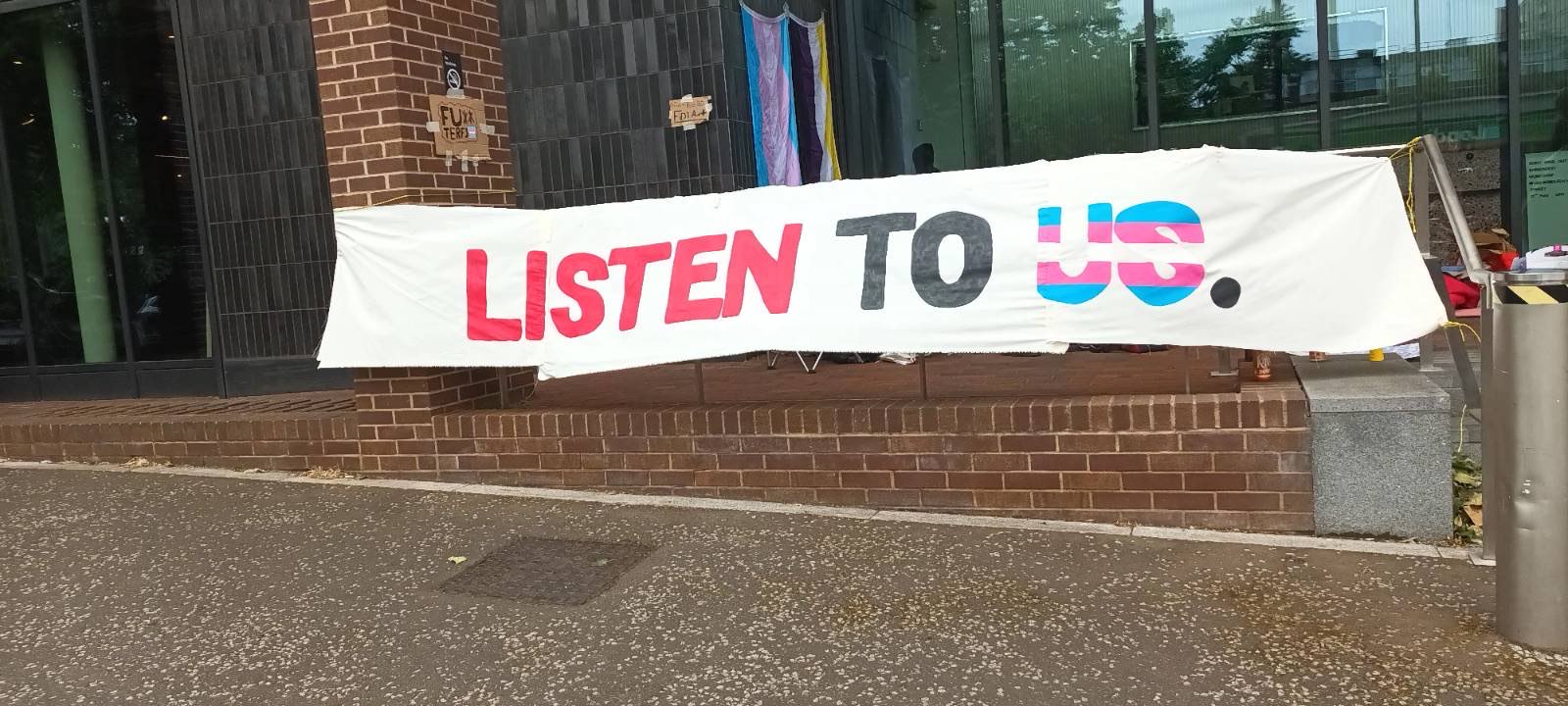

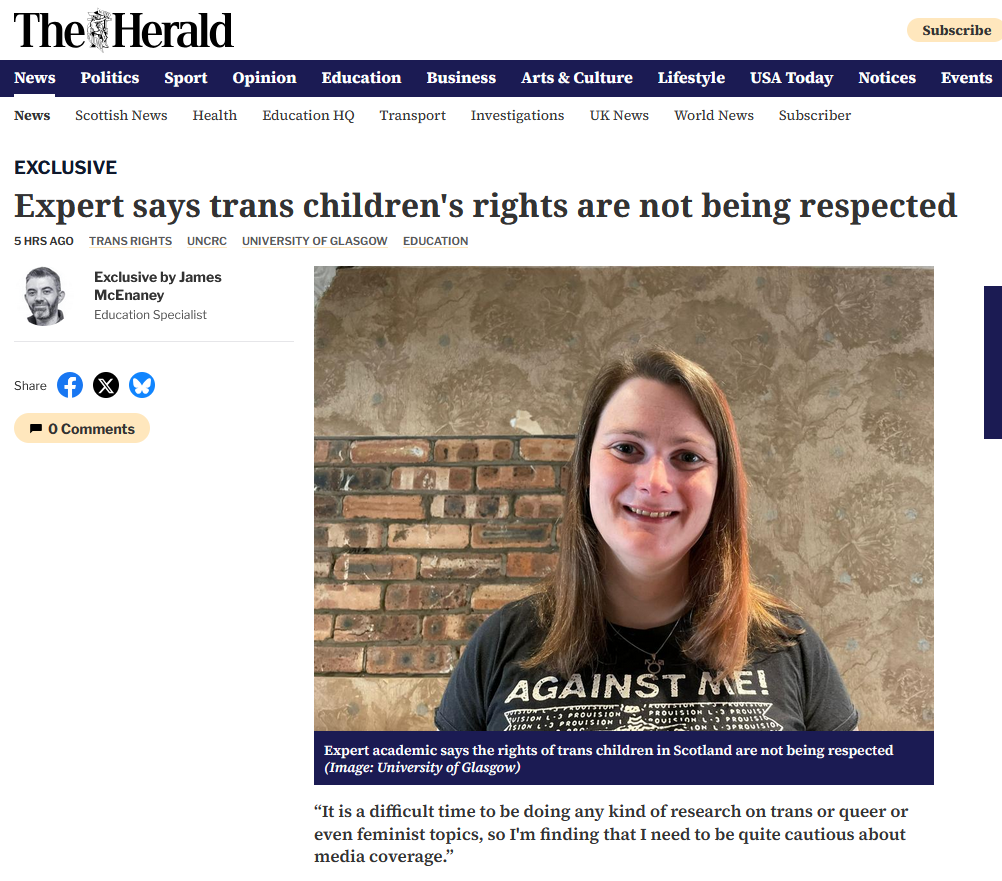



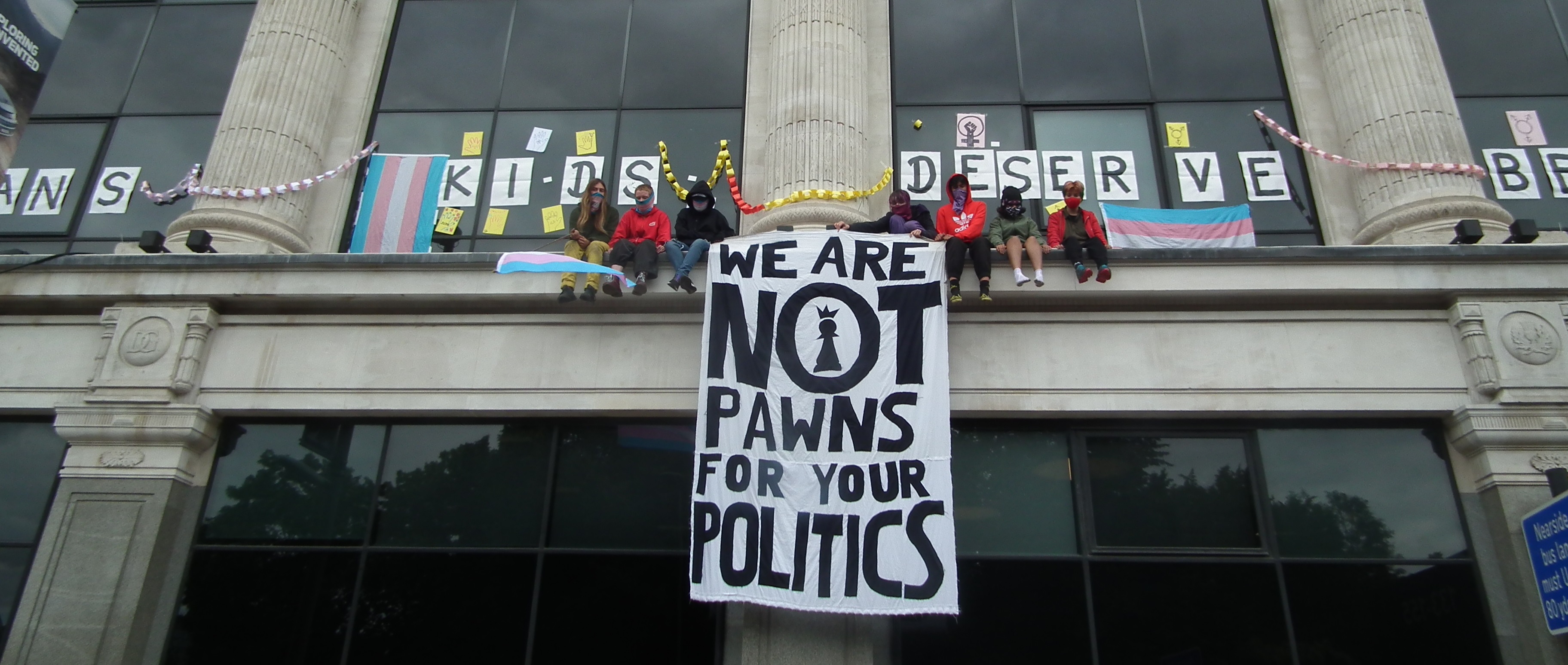



 Dr Ruth Pearce