Podcast: Who Who Is Wes Streeting and Why Is He Like That?

Last month I returned to the fabulous Red Medicine podcast to talk all things Wes Streeting. I joined the socialist writer Jonas Marvin and host Sam Kelly to discuss the UK Secretary of State for Health and Social Care’s political background, possible motivations, and current challenges.

Red Medicine always offers a great deep dive into health-related topics of the day. Streeting’s alignment with transphobic pseudoscience and conversion proponents means that obviously I had a lot to say about his impact on trans healthcare. However, our conversation was offered a great opportunity to grapple with the wider context of Streeting’s ideology and actions, discussing wider matters such as class, party politics, and trade unionism: highly relevant given current discourse around the proposed strike by resident doctors! I also talk a little about my encounters with Streeting in the 2000s, back when I was a campaigner with the National Union of Students’ LGBT and Women’s Campaigns.

You can listen to Red Medicine through all the major podcast platforms – or through the link below.


You can also hear me talking about the Cass Review on a previous episode of the podcast in June 2024.

Interview with Xtra: lesbians resisting transphobia

Even if the worst-case scenario occurs and the interim guidance becomes law, Pearce emphasizes that laws “only make sense if people uphold them.” People and organizations must be willing to fight for trans rights, and make the laws essentially impossible to enforce. 

As Pearce puts it, “We need intentional, aggressive, extremely homosexual non-compliance.”


Earlier this month I spoke with journalist Emma Bainbridge about lesbian community responses to the UK’s transphobic Supreme Court judgement. That piece is out now in the Canadian magazine Xtra. You can read it here:

PDF zine: But what can I do? How to fight the trans panic

This is the latest version of a zine I have distributed at wormboys gigs over the last couple of years. I’ve recently updated it to address recent events, including the April 2025 Supreme Court ruling.

The zine is written particularly with allies in mind. It provides some background information on the UK’s anti-trans moral panic, and offers some suggestions for easy things people can do. These include: changing the conversation in everyday settings; making complaints or compliments; writing to politicians; introducing pro-trans policies; refusing to comply with anti-trans policies; supporting small trans organisations; and supporting trans creators.

This zine is intended to be freely copied and distributed. Please feel free to download and share the PDF. If you want to print it as an A5 booklet, simply select “print as booklet” and print onto A4 paper, then fold it in half.

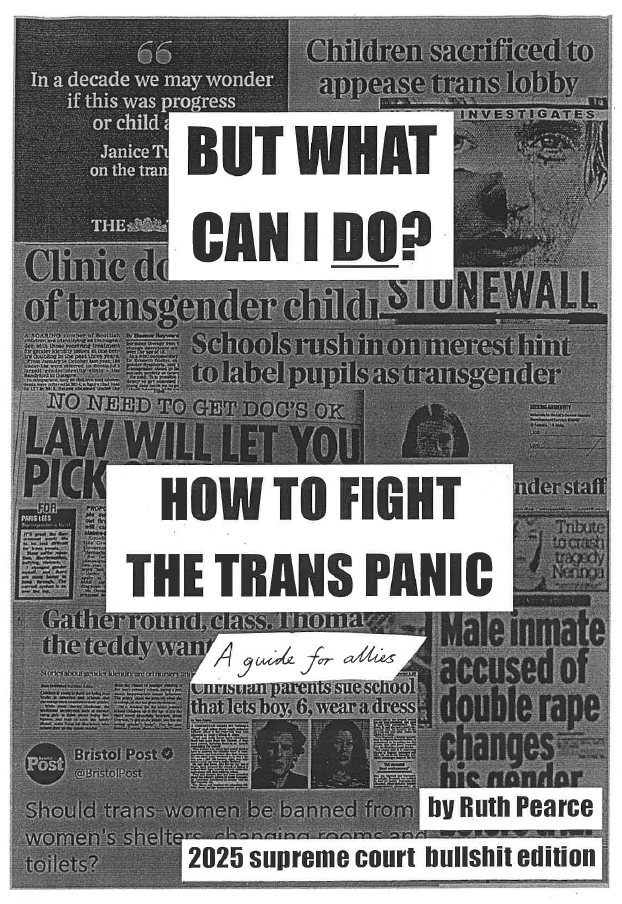
Cover image for the zine, but what can I do? How to fight the trans panic. It contains various images of transphobic newspaper headlines behind the title text.


But What Can I Do? PDF download

You can also download a more accessible simplified version here, which is text-only and will hopefully work with screen readers:

But What Can I do – May 2025 accessible

I am once again distributing the zine at wormboys shows in coming months, as well as queer bookshops such as Category Is Books in Glasgow. However, if you want copies in your area, the best thing to do is to download the PDF and print some off.

Tell your friends!

Regarding the Charity Commission and Cass Review

I was relieved to see today that the Charity Commission’s investigation into Mermaids has finally concluded. The Commission’s published decision found that Mermaids was mismanaged in several respects, but did not find evidence of misconduct, especially in terms of safeguarding young people or providing medical advice.

This is great news in that Mermaids can now continue to operate as a charity and seek funding from relevant agencies to do so. The organisation clearly faced an enormous squeeze during this time, that significantly affected service provision.

However, I am concerned by the language used around the Cass Review in the Commission’s report and accompanying press release. I feel much of this language is deeply misleading and demonstrates considerable ignorance regarding the Review. At the same time, I feel there are some good, practical recommendations in there for charities which face potential harassment from media reporting and on social media.

Logo for the Charity Commission for England and Wales


Binders

The most concerning statement can be found in the Charity Commission’s press release, concerning Mermaids’ former provision of binders to young people as a harm reduction measure:

The Commission has issued statutory advice to the charity requiring that, should it ever resume this service, its future policy and controls should reflect the recent Cass Review, or any future NHS guidelines on parental involvement.

The Cass Review does not, of course, actually make any formal recommendations for non-medical service providers – moreover, its commentary on social transition is not well-evidenced.

However, the Charity Commission decision quotes the final report of the Cass Review, which states that “parents should be actively involved in decision making unless there are strong grounds to believe that this may put the child or young person at risk“. This would appear to align with Mermaids’ actual policy, which was to work with parents, families, or carers unless a young person was not directly supported. The issue, of course, is that the Charity Commission (and, indeed, the Cass Review team) do not fully interrogate or understand the considerable risks posed to young trans people by unsupportive parents.

I am increasingly of the impression that policymakers are taking all kinds of decisions without having read the Cass Report in any detail, let alone with a critical eye. This would appear to be another example of this.


Having “regard” to the Cass Review

Similarly, in a sub-section of the decision report titled “Implementing the findings of the Cass Review”, the Charity Commission recommends that trustees working with “children and young people who are questioning their gender identity or experiencing gender dysphoria” need to “ensure that they have regard to the findings, conclusions and recommendations of the Cass Review and ensure that they have reviewed their charity’s literature, website and guidance in light of them“.

This statement is, I believe, being wilfully misinterpreted on social media and in media commentary. For example, the Standard’s report on the decision leads with the headline “Charities should follow Cass Review recommendations, say watchdog”. However, that is not what the decision actually says.

In the UK, “have regard” means that organisations should take account of guidance and carefully consider it. An example of this can be found in the Charity Commission’s rules for charities on public benefit:

As a charity trustee, ‘having regard’ to the commission’s public benefit guidance means being able to show that:

  • you are aware of the guidance
  • you have taken it into account when making a decision to which the guidance is relevant
  • if you have decided to depart from the guidance, you have a good reason for doing so

In the current political climate, this strikes me as an eminently sensible approach to the Cass Review. I would expect all service providers and researchers to be aware of the Review’s final report, to take it into account, and (for the purpose of defending against bad faith actors) be able to provide good evidence for acting otherwise.

Going by a statement from Mermaids Chair Kathryn Downs for Third Sector, this appears to the charity’s planned approach to having regard:

The Cass Review final report is the highest-profile review of youth healthcare in the world and has influenced NHS England’s policies. However, it is not legislation or guidance.

She then goes on to emphasise that Mermaids’ advocacy and policy work will continue to be “driven by and give a platform to the voices of young trans people“.


We deserve better from the Charity Commission

Overall, I feel this is good news for Mermaids, and for trans organisations more generally. However, the language used by the Charity Commission, especially in their press release, really muddies the water by providing considerable grounds for bad faith interpretation.

It’s also deeply frustrating to see the Cass Review continually upheld as a paragon of policy advice. Trans people know that the Review was conducted by non-experts and involved individuals hugely hostile to our very existence. As a researcher, when I open the final report I see a methodological and ethical nightmare. The Cass Review is an example of runaway bad science, treated as an article of faith by mainstream decision-makers, many of whom haven’t actually read it.

I don’t think it’s unreasonable to speculate that the Charity Commission’s final decision reflects the influence of transphobic actors. Two years is an extraordinarily long time for an investigation to take place, and surely does not serve the interests of the young people Mermaids work with. Earlier this year the Commission’s Twitter account “accidentally” shared a transphobic post claiming (without evidence) that the charity had caused “so much harm”, calling into question the independence of the investigation.

I’ve been critical of Mermaids myself in the past, especially given I did not feel appropriately supported by them when I came out as a teenager. I am sure I will continue to be critical in the future. However, I hope this criticism can always be both constructive and grounded in reality, recognising our shared interest and care in building a better future for young people.

I’ll end this post, then, by amplifying Mermaids’ demand for better:

…the time taken to publish this report has been frustrating, significantly affecting Mermaids’ fundraising and ability to deliver on our charitable objectives. We call on the Charity Commission to ensure that organisations serving groups facing rising hostility are supported and protected, whilst being held to account where this is necessary.

Out now in Scientific American: “The U.K.’s Cass Review Badly Fails Trans Children”

I have co-authored an article with Cal Horton for the science magazine Scientific American. We take a concise look at what the Cass Review is, what it found, why the methods used were troubling, and how it is being used to harm young people.

You can read the article here. I hope it will be helpful as a basic explainer for why trans community groups, academic experts, and clinical specialists are so concerned about the Cass Review.

Screenshot of Scientific American website.

Writing for Scientific American was a really interesting experience. It was of course radically different to publishing in a peer-reviewed journal: we put the piece together in a matter of weeks, and it was not scrutinised by academic experts from our specific field of study. At the same time, there was an extremely rigorous editorial, fact-checking, and copyediting process that also made it very different to publishing in most magazines or newspapers.

I was deeply impressed with the sheer amount of time and care the Sci Am editors put into this piece. On one hand, their contributions ensured the piece is written in accessible language, with an international (and especially US-based) readership in mind. On the other hand, we had extensive discussions to ensure that all points made in the article could be rigorously evidenced, including some very detailed exchanges about the specifics of UK law, and what exactly the Cass Review document does and does not have to say about exponential growth over different periods of time. We had to be able to strongly back up any even slightly contentious point.

It was a challenging experience, but one I felt very held by as an author committed to consciencious research practice. Publishing this piece in Sci Am definitely ensured that it was as good as it could possibly be.

Understanding Trans Health on Philosophy Tube

My book Understanding Trans Health is cited prominently in the new Philosophy Tube video on complaint, systematic inflexibility, and England’s NHS trans health crisis.

It’s a great video, which manages to capture the sheer horror of NHS failings while still delivering silly jokes, ridiculous costumes, and a strong analysis. In addition to drawing on my work, Philosophy Tube’s Abigail Thorne consulted me on the script for this episode, and I appreciated the opportunity to use my research in this way.

I am personally more optimistic than Abigail about the opportunities offered by the four NHS England ‘pilot’ clinics. These are beginning to slash waiting times, and several are now effectively run by trans people, for trans people. However, I do think it’s important to still critique the very logic that underpins many trans healthcare systems, especially the highly questionable ways in which the medical diagnosis of ‘gender dysphoria’ is constructed, and used to try and control us.

You can buy Understanding Trans Health directly from Policy Press here. It’s also available from all major booksellers, plus many independent queer book stores (e.g. Leeds’ brilliant The Bookish Type). I have also written to my publisher for permission to put a chapter of the book online for free – watch this space! In the meantime, free links to much of my other academic writing can be found here.

Forthcoming talk: The Transgender Moral Panic

I’ve been invited to give a guest lecture at the University of Warwick next week, on Thursday 8th February.

This will be part of the “Hidden Histories” alternative lecture series, organised by Warwick Students’ Union with support from a number of academic departments.

The talk will take place from 7pm in S0.21 (Social Science Building), and is open to all. I will speak for around an hour and there will be time for questions and discussions.

Here’s the blurb from the Facebook event page:

The Transgender Moral Panic: A Brief Social History

Over the last few months, there has been an enormous upsurge in media commentary that expresses concern about the role of trans people in public life. Gendered changing rooms, non-binary people, trans children and notions of self-definition have all come under intense scrutiny, with psychologist Meg-John Barker describing 2017 as “the year of the transgender moral panic”.

For the 2nd lecture in our Hidden Histories series, Ruth Pearce will explore the background to the recent wave of media interest, taking in radical feminist theories, scientific racism and proposed changes to UK law. She will show how the transgender moral panic has been shaped by deep-seated cultural anxieties around sex and gender, brought to the fore by the precarious successes of the trans liberation movement.

Ruth Pearce is a trans feminist scholar. Her research primarily examines discourses, practices and experiences of trans health. Her PhD was awarded by the University of Warwick in 2016. Her thesis looked at how trans health is differently understood within trans communities, activist groups and professional literatures, with a range of meanings and practices contested within and between these spaces.

Come along for what is set to be a fascinating event exploring a topic which is generally erased from mainstream curricula. Refreshments will be provided!

Hidden Histories banner

No, I will not help Sundog make a documentary on trans “regret”

This afternoon I received an unsolicited email in my work account from an employee of Sundog Pictures. An excerpt follows:

I’m currently working on an idea alongside Channel 4 following transgender individuals who have come to regret their sex changes and are keen to undergo further treatment / operations to reverse the change. The doc will be insightful and sensitive and will look at the way in which transgender individuals are treated in society and whether the process before someone is permitted an operation is robust enough.

I’m currently looking for real life cases to include in my pitch document and was wondering whether you might be able to recommend people I could speak to, or places I could contact to find individuals who are currently thinking about a reverse sex change. Any help would be really appreciated.

Given the email account used, I feel that I can safely assume that I was contacted because of my academic work, which looks at discourses of trans healthcare provision. Sundog seem to hope that I will (without compensation) draw upon my community contacts and research findings to recommend participants for their television programme.

I couldn’t think of anything more inappropriate.

There’s a lot to be said about research ethics and a duty of care towards participants, but plenty has been written about that elsewhere (the BSA Statement of Ethical Practice offers a decent broad overview). So in this post I focus on the huge problems that come with the proposed topic of the documentary: that of trans “regret”.


The numbers

The mainstream media take an undue interest in trans “regret”. It’s very easy to come across such stories on daytime television and in both tabloid and broadsheet newspapers. The popularity and frequency of such stories suggests that it’s not too unusual for people who have undertaken a physical transition from male to female, or from female to male, to consider or undertake a “reverse sex change”.

In reality, research has shown time and time again that the actual rate of regret is extremely low. For instance, only 2% of respondents in the Trans Mental Health Study (the second-largest trans study undertaken in the UK) reported “major regrets” about the physical changes experienced during transition. Reported regrets from participants included:

“…not having the body that they wanted from birth, not transitioning sooner/earlier, surgery complications (especially loss of sensitivity), choice of surgeon (if surgery required revisions and repairs), losing friends and family, and the impact of transition on others.”

It’s clear therefore that “regret”, when it occurs, is likely to stem from societal and surgical issues rather than the process of physical transition in and of itself. The Trans Mental Health Study also demonstrates a clear link between physical transition and wellbeing in terms of mental health, body confidence and general life satisfaction.

With so few trans people regretting physical transition – and even less considering some kind of “de-transition” – it’s no surprise that sometimes the same individuals are trotted out time and time again to re-affirm a discourse of regret.


What’s missing from this story?

It’s pretty clear from the email I received that that the author has not done their research. Given the existence of organisations such as Trans Media Watch and All About Trans who are entirely keen to offer advice, this does not exactly inspire confidence.

For a start, transition is conflated with “sex change”, a term that is not only most frequently associated with transphobic tabloid headlines, but is also broadly meaningless. At what point can we talk about a “sex change”? When an individual undertakes hormone therapy? Chest surgery? Genital surgery? What about individuals who transition socially, but only undergo some (or even none!) of these processes? It’s not the kind of language that suggest an “insightful and sensitive” documentary can be made.

There’s a couple of more fundamental mistakes in the proposal, however. The first is the question of “whether the process before someone is permitted an operation is robust enough”. My own initial research findings suggest that if anything, the process in question is too robust – in that patients requiring surgery are typically required to wait many years before treatment is available.

The World Professional Association for Transgender Health Standards of Care require patients to undergo at least 12 months of hormone therapy prior to genital surgery. In reality, patients in England and Wales face a substantial waiting list (sometimes lasting years) before they are able to attend an NHS Gender Clinic, where two separate clinicians are required to approve a regime of hormone therapy before it can be undertaken. An additional two opinions are needed at a later date before a referral for genital surgery can take place. There are many, many opportunities and a great deal of time for patients to consider and re-consider their option – and that’s even before we take into account the horrific scale of the current crisis in surgery provision for trans women.

The current system is not constructed to facilitate transition so much as prevent the very possibility of regret. The result is increased suffering – in terms of the mental and physical health impact upon individuals who are forced to wait many years for hormones and surgery, whilst fearing (sometimes with good reason) that they will be denied treatment on spurious grounds. It’s no surprise that the Trans Mental Health Study found that “not transitioning sooner/earlier” is a major cause of “regret”, as individuals who have waited until breaking point to transition soon discover that there is still a long, long road ahead of them.

The second fundamental problem with Sundog’s proposal is their idea that trans people who aren’t too happy with their transition might be “keen to undergo further treatment / operations to reverse the change”. This is a very binaristic notion that both stems from and reinforces the notion that transition is a one-way process, from one (binary) gender to the other. In reality, there are many people for whom transition is a complex, ongoing process. For instance,  an individual who initially transitions from male to female might later feel that their identity is better understood as genderqueer, and may allow or pursue further physical changes to reflect this.


The wider political context

Given the tiny proportion of trans people who “regret” transition and the realities of service provision, the choice of a documentary about the subject appears at best to be somewhat misguided. However, the impact of insensitive coverage on this topic is such that I believe that I believe this documentary could be actively harmful, particularly as Sundog’s email asks “whether the process before someone is permitted an operation is robust enough”.

This is in part because the way in which discourses of regret are handled makes it harder for trans people to get treatment. Gender clinics in the UK require urgent intervention to make life easier for individuals who transition, not harder. Media hysteria over the possibility of regret reinforces the current system’s approach, which is to require people to demonstrate over and over again that they are trans before there is any hope of treatment.

But it’s also because discourses of regret are employed by those who campaign against trans liberation, including conservative commentators and anti-trans radical feminists who would deny funding for transition on the NHS altogether. Writers such as Julie Bindel are all too keen to use any example of individual regret to argue that transition is unnecessary mutilation, undertaken by sad, sick individuals who might have done otherwise if only they’d been given the option of, say, some form of reparative therapy.

The focus on the medical process is therefore politically loaded. Yes, some people do de-transition, and their stories are important and of worth. But these stories have yet to be told by the mainstream media in a non-sensationalised manner, in a way that doesn’t reinforce (intentionally or otherwise) a pernicious anti-trans agenda. Sundog’s proposal appears to feed right into this agenda.

This proposed documentary should not be regarded as a curiosity piece taking place in a cultural vacuum. It draws upon and will contribute to damaging and inaccurate tropes about transition. Ill-informed media accounts ultimately play a part in creating and maintaining a situation where “regret” frequently stems from the responses of friends and family, delays to transition and other negative experiences that come with transitioning in a transphobic society.

I hope therefore that any future attempts to examine trans health issues in this way will involve better research into the topic at the initial stages, and a greater sensitivity to both the personal and political consequences of exposing trans lives to media scrutiny.

Laura Jane Grace subverts MTV with style

Having previously written a little bit about Against Me! frontwoman Laura Jane Grace’s recent appearance on MTV’s House of Style, I finally got around to watching it.

And, you know what, I really am impressed.

Grace makes the most of every moment of air time: she seems determined to convey a whole series of positive messages. It seems like the editing team who put together the short were pretty respectful of this. The whole programme is also largely free of the usual transphobic tropes, which is an achievement in and of itself.

I’m not normally a fan of this kind of thing. I don’t care how celebrities dress. I don’t care how they “choose” their “style”. I associate such programmes with shallow consumerism and damagingly limited ideas about how people should and shouldn’t express themselves.

But the messages that come from Grace are powerful, important and – to my mind – broadly feminist. Be true to your tastes and interests (“You can see like the texture of it? That’s real dirt”). Dress in a way that makes you feel good. Passing doesn’t need to be an end in and of itself. If you’re a young trans people, it’s okay – other trans people exist, in public!

Grace is self-consciously making herself into a role model. That’s not always a good thing, but the message here isn’t “be like me”, it’s “be yourself”. Sod the naysayers: this is punk as fuck.

Video embedded for readers who (like me) aren’t based in the US, and hence can’t watch this on the MTV website.

There’s more to (public) life than being trans

A news feed informed me the other day that Against Me! frontwoman Laura Jane Grace had appeared on MTV’s House of Style to talk about her, uh, style. On one level, I suppose this is pretty typical of the vapid programming you’d expect from MTV – celebrity turns up, talks about her wardrobe, nobody learns anything of value but some mild entertainment supposedly takes place.

Except this is a big deal in one sense, because Grace is trans, and transitioning. By appearing on this kind of programme talking about her favourite clothes and showing off her collection of obscure punk records, she normalises transness.

There’s part of me that feels a bit uncomfortable about this – social inclusion is a worthy goal, but should it really come at the expense of a dull assimilation into corporate cultural mediocrity?

Still, I went looking for the video. I didn’t manage to find it because MTV really aren’t keen on British people watching American video content (and I can’t be bothered with proxies, at least not over this). However, I did come across a bunch of punks arguing about Grace’s participation in the programme. Some of them were unimpressed, arguing that the singer was engaging in shameless self-publicity. Others pointed out that Grace has stated before that she’s being public about her transition entirely so she can help young trans people who are struggling with their feelings. I sympathise with that latter position pretty strongly.

And so Laura Jane Grace is all over the media, talking to MTV (in a variety of contexts), Rolling Stone, newspapers, webcasts and suchlike about being trans. Like other prominent LGBT people who have come out in a high-profile way, she’s taking advantage of celebrity culture to talk about something real and important for a change.

So I feel okay with Grace being on MTV, and I feel okay with these appearances currently centring on her transness. But there’s still a danger of her becoming a one-dimensional public figure, and the rest of us have to take responsibility for this.

If you look at pretty much any Against Me! video on Youtube or read any piece about the band’s current musical plans you’ll find comment threads filled with people talking about Grace’s transition and/or arguing about her pronouns. No-one, even Grace’s supporters in this context, seem bothered with the idea that there might be anything to talk about other than her gender identity (obviously the rest of the band don’t get a look-in!)

You could blame Grace’s current media presence for this. But it’s not like she doesn’t have plenty else to say. She’s written songs about economic inequality, war, love, solidarity, terminal illness, drug abuse and the death of good friends. None of them have magically disappeared just because she’s since come out.

I realise that arguments over gender in comment threads are a somewhat inevitable consequence of the ongoing cultural contestation of transness. I’m also probably contributing somewhat to the issue by writing about it on a trans-oriented blog. Still, when I’m singing along to I Was A Teenage Anarchist I tend to think about what that might mean about youth, personal growth and political affiliation – stuff that’s important regardless of how the songwriter might define her gender. I hope others are able to keep sight of this.