International Trans Studies Conference, Day 3: getting emotional with political economy

This is the third in a series of blog posts about the 2nd International Trans Studies Conference in Evanston (4-7 September 2024).


Read Part 1 here.
Read Part 2 here.

There is something about seeing your experiences accurately represented in research. This can be very emotional if you are used to seeing people like you ignored, erased, or otherwise grossly mispresented. Much like media representation, research representation can be powerful in putting a mirror to our experiences and suddenly making them a lot more real.

I dislike the vast overuse of the term “valid” in trans discourse, but there is something very important about being actively validated, about being seen, when the entirely of society feels like it’s set up to deny or gaslight you. It’s a consciousness-raising moment, in which you become capable of truly acknowledging or naming what is happening to you. It is meaningful and authentic and it enables action. But it is also very painful.

As a trans health researcher, I think I’ve developed a pretty thick skin. I see a huge amount of bad trans health research, built on cis ignorance and a fundamental inability to engage with the reality of our lives. I also see growing amounts of painfully real research from researchers who are engaging with care. For better and for worse, I feel I’ve learned to carefully manage my emotions and let all of this wash over me, in order to engage consistently and “professionally”.

But on Thursday morning, a series of presentations made me cry.


Global Struggles, Local Solutions: Transgender Perspectives on Economics and Welfare

The morning began with doughnuts, piled high in the reception area of the conference, a very extravagant seeming American breakfast. From there I headed to the first session of the day, which explored trans political economy. This might seem like the dryest topic imaginable, but for me it gets right to the core of how systemic transphobia and cisgenderism operate, how we feel about that, and what we might do about it.

The study of political economy is concerned with how economic systems interface with social and political systems, and vice-versa. The first paper in this session, by Yukari Ishii of Sophia University (Japan), looked at homeless trans people’s access to welfare systems. In Reasons Underlying Gender-diverse Individuals’ Need for Public Social Welfare Support in Japan, Ishii reported on findings from the 2009-2020 consultation records of Moyai, a non-profit voluntary sector welfare provider, plus interviews with service users.

Ishii’s paper mapped in detail how trans people find themselves accessing welfare systems after being failed by heteronormative and cisnormative systems throughout their lives. She described trans people being rejected by their parents, dropping out from school due to the hostility of the heavily gendered environment, which limited their formal educational attainment. Participants in her research struggled to find work, or were otherwise fired for being trans. More tolerant work environments either required skills or an education background that trans people were less likely to have, or were deeply insecure, as in the case of sex work. Trans people who struggled to hold down a job also struggled to find places to live, with many sleeping at friend’s houses, in Internet cafes, or in the streets.

Ishii’s research showed up vulnerability is created through structurally embedded cisgenderism, impacting people from families to schools to workplaces and even to apparent sites of last resort; for example, she described how Internet cafes did not allow trans women to stay overnight if they were sex workers. She further noted that the consultation records at Moyai were limited where consultants didn’t have a lot of knowledge about queer people, or didn’t know what questions to ask about (for example) family violence. She concluded by recommending that welfare professionals gain knowledge of gender and queer issues, to ensure they are best placed to provide advice and support to service users, and keep better records for improving long-term understanding of the problems faced.

The next paper similarly traced the deep context of economic disadvantage, this time looking to history for a deeper context. In Trans-cending Barriers to QTPOC Labor in the South, Anthony Belotti of Virginia Commonwealth University (USA) focused on the US South’s historical legal landscape, linking this to the region’s racism, homophobia, and transphobia.

Belotti argued that “the history of the South has created an environment where QTPOC (queer and trans people of colour) do not have equal access to labour opportunities and class mobility”. Various legislation effectively criminalised queer, trans, and Black existence, including the Jim Crow laws, “decency” laws which banned wearing clothes not associated with sex assigned at birth, and anti-union “right to work” laws. Belotti argued that while there is relatively little archival material on QTPOC experiences in the South, these laws provide an important insight into people’s experiences, especially given the existence of legislation such as the decency laws implies a perceived need for them from authorities. The concrete impact of all this was that QTPOC had difficulties finding and keeping legal employment.

By the time Dan Irving presented, I will admit I was already feeling pretty vulnerable. In Ishii and Belotti’s excellent papers, I heard about contexts both very different to the UK, and remarkably similar. Beyond the broad importance of their findings, I recognised in their accounts the experiences of so many of my friends and colleagues – a meaningful and painful experience that underpins so much of my engagement with good work in trans studies.

Irving, of Carleton University (Canada) presented a paper titled Sensational Disruptions: Affective Economic Justice at Work. Building on his previous work on trans political economy, this presentation reported on findings from two large qualitative research projects on unemployment and underemployment among trans and non-binary people in Canada, conducted in 2012-16 and 2020-24.

Irving’s paper focused on exploring one anticipated finding from these projects in depth: the “I can’t put my finger on it” feeling. This theme involved participants encountering difficulties in the workplace or in attempting to land work, but finding it hard to articulate why they couldn’t get the job, or had hours reduced, or were laid off, even when appropriately skilled – or overqualified. There was something about getting through the door and finding the vibe was off. These experiences were especially likely to be detailed by trans people from racialised minorities, and/or trans women.

I immediately recognised what Irving was describing. How could I not? He had just described years of my experiences in the workplace as a trans woman. And of course, this isn’t really a new insight: the problems he named have been discussed in feminist literature for decades (especially Black feminist and womanist literature), and indeed within the consciousness-raising group I joined shortly after moving to Glasgow. These findings also related to the phenomenon reported by people from many marginalised groups, whereby we always have to be the very best to succeed in a basic manner in the workplace.

What was most useful about Irving’s paper, however, was his theorising of the phenomenon. In a manner that resonated with Nat Raha’s comments on the second day of the conference, Irving turned to affect theory (explanations that centre feeling and emotion) to explore what is happening to us in the workplace.

Irving described how trans people (especially racialised minorities, and women) often find ourselves constantly doing the additional work of ensuring that managers, co-workers, and customers feel comfortable with us. This causes a “sensate disruption” in our lives, shaped by the “corrosive impact of fear, repulsion, anger on the part of cisnormative employers, co-workers and customers and the violent impacts of rage, depression, exhaustion on trans jobseekers and workers”. Even worse, there are few outlets for these emotions: neoliberal discourses of personal responsibility mean that feelings are expected to be quarantined within the body of the (marginalised) worker, for example through us taking responsibility for our transitions and bodies and carefully managing our relations with others.

It was at this point that I started to cry.

I feel so, so tired and alienated in my work, all the time. I have some amazing colleagues and students, but I am still working in a system where I can feel myself being discriminated against while also finding it hard to always articulate the exact ways in which it happens. I am tired of being advised to refocus my energies in the workplace even as an eliminationist movement works against trans existence. I am tired of my research being erased or dismissed, I am tired of being asked to meetings where I am ignored, I am tired of being asked how the institution can best protect me, I am tired of being told that my failed grant applications are the “most impressive unfunded bid” that people have ever seen. I am tired of having little language for these experiences, and of pushing my feelings down every day.

I am tired of seeing as much, and far far worse, happen all the time to my trans colleagues and friends.

Responding to these findings, Irving asked: “how do we begin to grapple with the ‘affective byproducts’ of post-industrial demands for affective labour?” How do we reckon with the unsayable in our felt experiences? And quoting Deborah Gould, “what kind of political context do we need to build that actually listens to what many people are feeling and that cares about people’s disappointment, despair and furies?”

Drawing on the work of Hil Malatino, Irving proposed “infrapolitics” (low-profile, informal, undeclared forms of resistance) and community care as a basis from which to build solutions. Drawing from participant narratives, he argued that this can include political acts of resistance that are “not on the oppressor’s radar”: examples included zines and phone lines distributing information among workers and applicants, building community connections, and forms of entertainment and commentary such as comic strips. Like Ishii, Irving also highlighted the ways in which trans people effectively provide welfare services for one another, for example by providing beds or housing for homeless community members. What this all amounts to are forms of anti-capitalist resistance that amount to a collective recognition and addressing of the problem.

Sticker with trans flag and text that says: read and submit your favourite texts for free. Visit www.transreads.org.
Sticker spotted at the conference. An example of infrapolitical resistance.

The session concluded with another extremely powerful and nuanced presentation, from Pato Laterra of the Interdisciplinary Centre for the Study of Public Policies, and Francisco Fernandez Romero of the University of Buenos Aires (both Argentina), titled A Trans Political Economy from Elsewhere: Reflections from Argentina. Like the other presenters, Laterra and Romero sought to use the concept of political economy to understand how trans lives are embedded in existing political structures, and propose alternatives for survival. They emphasised that in Latin American contexts, there is a strong tradition of research on travesti and trans people’s living conditions, with travesti-trans politics prioritising mutual support and resource distribution. It is within this context that they looked at implementation and impact the travesti-trans labour quota within Argentina’s public sector.

The travesti-trans labour quota is a form of reparative politics, in which 1% of federal jobs are reserved for trans people. This policy represents a response to the deep, systematic discrimination faced by travesti and trans people in Argentina, which reflects that reported from Japan, the USA, and Canada through the rest of the session. It was implemented in response to radical political demands from campaigners, with the presenters sharing a photo of a flag featuring a slogan they translated as “quota and reparation, we want redistribution”.

To understand how effective the travesti-trans labour quota is in practice, Lattera and Romero insisted on a rethinking of trans political economy, going beyond just thinking of trans people as workers or consumers. They wished to emphasise:

  • everyday reproductive and care relationships, in terms of that which sustains life beyond income or the market;
  • social policies that enable or do not enable certain lives, especially for people with an insecure relationship to the market;
  • situated perspectives, for example through acknowledging how labour (and theory!) from the Global South is extracted by the North.

Lattera and Romero argued that the labour quota partially subverts trend towards assimilation regarding trans people’s inclusion in labour markets. This is because the quota aims to achieve economic redistribution, and positions access to work as a human right. Moreover, it supports the employment of the “least employable”, i.e. trans people who are more likely to be without educational qualifications, or have a police record. In this way, it offers a response to many of the issues outlined by the previous presenters, and an alternative to typical liberal capitalist logics that involve capturing the economic benefits of trans labour.

However, as one intervention within a wider network of unequal systems, the labour quota has significant limitations. Lattera and Romero noted that the “right to work” reifies labour normativity: that is, it upholds the idea that our value as human beings is dependent on being able to have paid jobs, and that paid work is more important than unpaid care work, community work, or domestic labour. Moreover, in practice, the trans people actually hired under the labour quota are most often the most privileged, being predominantly young, white, and highly educated; and once in role, they face a significant pressure to assimilate.

Lattera and Romero urged against any simplistic reading of the labour quota’s benefits or drawbacks, in a manner that forced me to reflect on my aforementioned feelings that “other trans people have it worse”. The “more privileged” trans people hired under the labour quota still face significant disadvantage in their lives. For many, this is their first job, and it is not well-paid. Moreover, those who do tend to land these roles within the public sector tend to regard it as a job they are gaining not (just) for themselves, but for their wider community. The introduction of the quota has also resulted in increased trans labour organising and trade unionism, including increased collaboration between trans and cis colleagues in service of their shared interests. This has been especially important given the mass firings of public sector workers by President Javier Milei since his election in 2023.

The presenters concluded by arguing that trans people’s concerns should be understood within transnational political-economic processes. For example the recent firing of trans workers is a part of wider processes of extraction, in which the Argentinian government is “giving away our wealth to the Global North”. At the same time, there are always lessons to be learned from different parts of the world, so long as we properly acknowledge where these ideas come from and show care in doing so. The Argentinian labour movement invites us to imagine other ways of trans participation in the economy, beyond capitalist productivity.


Game studies, visual culture, and transnationalising trans studies

I’ve had a lot to say about trans political economy, and I have had a very specific story to tell about how my own experiences intersect with what I learned. At the same time, this was just the first session I attended on the third day of the Trans Studies Conference. I’ve therefore decided to split my notes on this day across more than one post. I have yet to write about playing games with Giggle, trans photography and archives, or resisting settler colonialism – and that’s before we get onto Day 4. Watch this space!

Returning home for Bath Pride

This year saw the city of Bath’s first ever Pride march. It felt long overdue, but also an unthinkable impossibility come to life.

Photo of Bath Pride march


I was born and grew up in Bath, before moving to Coventry for university. While some of my friends were eager to leave Bath for more exciting places, I loved the city deeply – and still do.

I was very ambivalent about moving. Growing up on the outskirts, I felt deeply connected to the landscape: the hills, the woods, the little hidden valleys and streams. Meanwhile, Bath’s deep human history felt ever-present as I dodged tourists in the Georgian streets, sauntered past the Roman Baths, and climbed past Iron Age fortifications on Solsbury Hill. As a teenager, I went to grunge gigs in listed buildings, and wandered down country lanes to parties in distant farm fields.

I have written a few times recently about some of my experiences as a young queer person in Bath. These were the last days of Section 28. My school was a hotbed of homophobia, and I lived in a void of information. In many ways, I felt so incredibly, utterly isolated. At the same time, I received invaluable support at a very vulnerable time in my life: from friends who had my back unconditionally as I came out as trans and bisexual, from teachers who found quiet ways to support me, and from Off The Record‘s free counselling service for young people,. Bath is home to small-town conservative values but also has a strong liberal streak, and this complexity really was reflected in my experiences.

I didn’t really know what Pride was, what Pride was for until years after I left my childhood home. It wasn’t until I was a young adult that I really gained an understanding of queer community, of the healing power of both protest and celebration, and of the sheer joy of mass togetherness. That wasn’t ever something that felt conceivable for me in Bath, let alone possible.

But of course, as I grew older and changed, so did Bath.

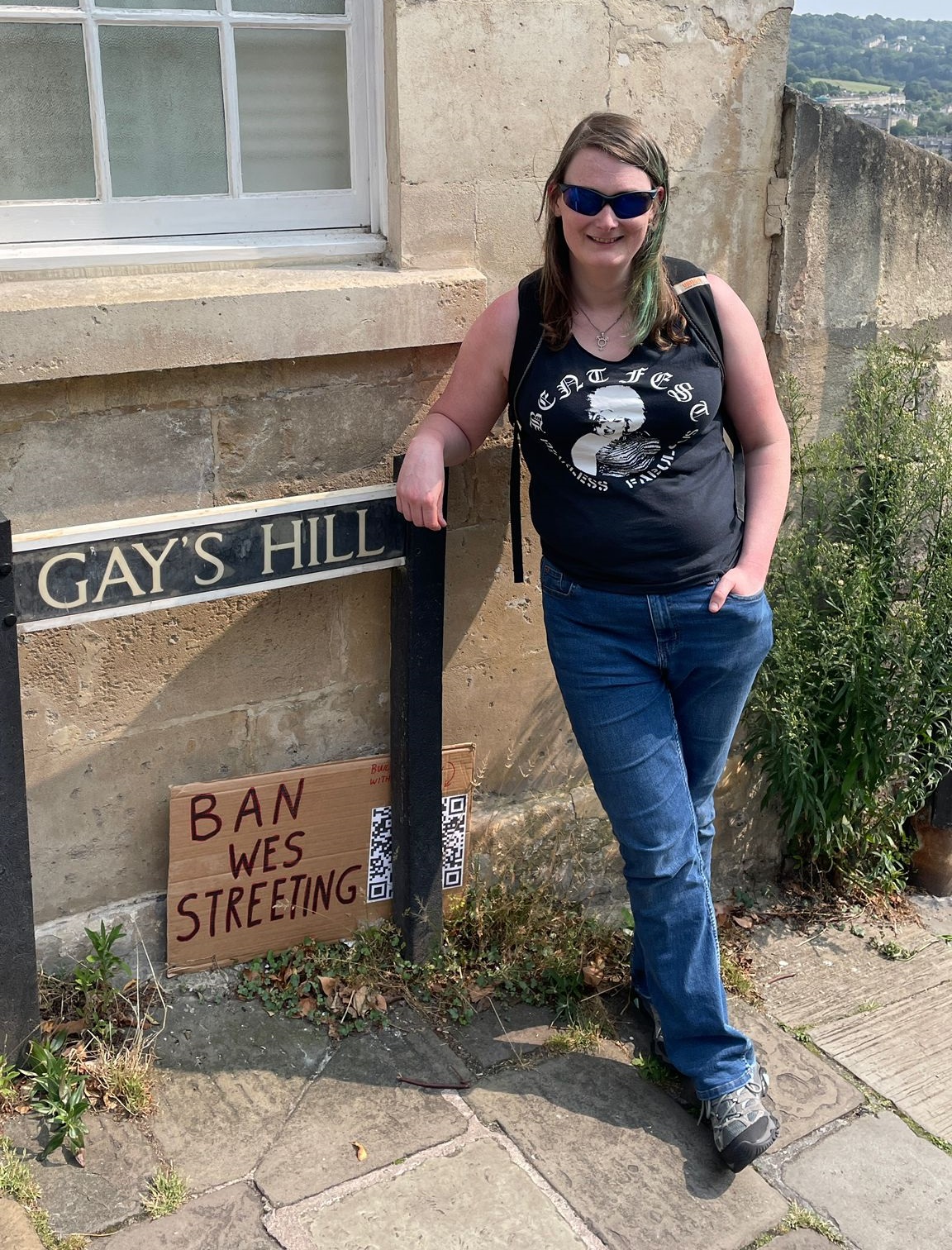
Photo of Ruth posing with a street sign for Gay's Hill, and a placard reading Ban Wes Streeting.


Just like every other part of the UK, more and more young people in Bath came out as lesbian, gay, bi, trans, queer, and/or asexual. Off The Record started up a dedicated LGBTQ+ youth group. In the mid-2010s, Bath had first a gay mayor and later a gay MP. From 2015, students at Bath Spa University organised their own Pride events, and in 2016, Bath Amnesty marked Pride month with a stall. In 2017, a Pride procession block joined the Bath Carnival.

I was nevertheless pretty surprised to see the first major, dedicated Bath Pride celebrations planned for this summer, on Sunday 18 August. For this to happen, you needed a critical mass of dedicated organisers, volunteers, and community members prepared to come together and make it happen. You needed enough people prepared to assemble and loudly celebrate and protest at a time of rising hatred and violence towards us. You needed to take all of this and put it on the streets of city known for its architecture, parks, and landscape, rather than any kind of political organising or protest culture.

So I returned home, to be a part of it.

Photo of four happy people at Pride.


Bath Pride was gentle, Bath Pride was beautiful, and Bath Pride was powerful. Bath Pride was a family picnic in the grounds of the Holburne Museum, a club night at Komedia, and a thousand people marching through the streets to demand our liberation.

Bath Pride was about community. I have so much respect for how much the organisers centred this in everything they did. There were no corporate floats, no major brands, no prioritising of some queer people over others. Most of the people in the march were just ordinary individuals, out solo or with their partners or friends. There was also a significant presence from groups including a local church, the city’s roller derby league, and the LGBTQ+ staff group from the Royal United Hospital. My mum volunteered as a steward.

Bath Pride was radical. It had never been done like this before, and it was done so well. While the overwhelming vibe was one of joy and celebration, this was very much a protest. Home-made placards abounded. NHS staff pointedly wore pro-trans t-shirts. A tall person with a stylish mustache wearing a cowboy hat, open pink cropped jacket and pink shorts waved a Palestinian flag in solidarity with the people of Gaza. This Pride was very Bath, but it was also about moving beyond tolerance, arguing for real liberation in a way that challenged the city’s cosy liberal consensus.

On some streets, people stood and waved or even joined in, with the march swelling as it went. On others, especially in busy shopping areas, I was reminded of the tension and threat inherent in Trans Pride, with confused or hostile looks directed our way. We were challenging people: with loud disco music, with political slogans, with our insistent presence. In the context of Bath’s politely commercial street culture, even thoroughly overbaked chants such as “trans rights are human rights” took on a new resonance. At a time when the NHS, schools, and new Labour government are actively attacking young trans people’s basic access to healthcare, education, and any level of personal autonomy, this kind of visibility couldn’t be more important.


After the march, my partner and I wandered the Holburne grounds. We admired stalls for local queer crafts, as well as community groups such as Bath Welcomes Refugees, The Diversity Trust, B&NES Fostering, and… Off The Record. I took the time to thank the people on this stall for the support I received from their organisation 20 years ago, and learned about what they are doing to support young people today.

And then we left the city centre – walking up Gay’s Hill, before taking time for a drink and apple pie at the Fairfield Arms. The pub, which has been run by a gay couple for many years now, was full of local people enjoying a Sunday roast or just hanging out in the pub garden. We had a chat with one of the landlords, who said he was a bit sad to miss the Pride event, but the weekend was always a busy time for them.

Queer lives are weaved through the very fabric of the city of Bath. We are always and have always been everywhere, quietly getting on with our day to day. But we also deserve love, recognition, community, and visibility on our own terms. That’s why Pride is so important.


Information on supporting or donating to Bath Pride, to ensure independent, and community-centred future events, can be found here.

Remembering Lynn Conway

Lynn Conway in 2006. Photo by Charles Rogers.

I was sad to hear last week of Lynn Conway’s passing, at the age of 86. Equally, I’m extremely glad she got to live such a long and impactful life. She was an important pioneer in the field of computer science, where her innovations contributed to the development of the microchips we use in so much of our technology. She also played a vital role in promoting women’s careers in STEM, and in providing information for trans people at the turn of the century.

During the early 2000s, Conway uploaded a substantial amount of information about trans lives and transition to her personal website. This material was hugely important to a great number of people, while also reproducing certain forms of transnormativity and stereotypical notions of “success”.

For example, while there was some diversity among the women listed on her pages of “transsexual women’s successes“, most are white, cis-passing, and occupied middle-class professions.

I came across Conway’s site around the time I was coming out to myself as a teenage trans girl. Having grown up in a void of information about trans people’s lives, her website both created a sense of possibility, and made transition seem more fantastical and distant.

Nevertheless, I’ll always remain grateful for what Conway did for trans people, as well as so many others. The resources she put online, for free, were created with love, care, and hope for the future. That’s an example I am committed to following through my own life.

New Year’s Resolution: Smash the new Section 28

This post is about the Department for Education’s December 2023 draft guidance on “Gender Questioning Children”. Advice on how you can take action can be found at the end. You can download a printable zine here.

The post was updated on 23 February 2024 to add information on the Further Education Residential Standards Consultation and the murder of trans student Nex Benedict in a school toilet.


Like many other young people, my first experience of sexual assault was in school.

I stood in the lunch queue at my school’s canteen, a boy my age behind me. Unexpectedly, he began to tenderly caress my back and my bum. Feeling extremely uncomfortable and vulnerable, I turned to confront him. He leered, laughed, then accusingly asked, “you gay?”

Sketch of an imposing school building

Like many queer students during the 1990s and 2000s, I was bullied viciously throughout my time in school. I was teased incessantly, beaten up, and on one occasion knocked unconscious in front of my entire year group. Later, since I started living as a girl, I’ve been groped by men many times in clubs and pubs. Yet that specific moment of abuse sticks with me especially.

So much can be said about it. I was a heavily closeted trans girl attending an all-boy’s comprehensive, and yet to admit I was also bisexual. I wonder of course about the sexuality of my harasser, who may have found bullying the only “safe” way to experiment with his own desires. But most important is the context of the wider school environment. Homophobia and ignorance about sexuality and gender was the norm; one that was not simply enacted between children, but also deeply rooted in policy and law.

Nothing was ever done about this sexual assault – in part because I didn’t for a moment consider telling anyone.

I attended school at the time of Section 28, a notorious anti-gay law enacted across Britain by Margaret Thatcher’s Conservative government. Section 28 was named for a clause in the Local Government Act 1988, in which local authorities (responsible for the management of state schools) were prohibited from “promoting homosexuality by teaching or by publishing material”, or promoting the “acceptability of homosexuality as a pretended family relationship”. It was introduced following a major moral panic in the media over homosexuality in the wake of the HIV/AIDS epidemic, plus the publication of a handful of short books and leaflets with advice on teaching young people about the existence of gay and lesbian families or historical figures. 

Section 28 would remain in force for over a decade. It was eventually repealed by the first Scottish Parliament in 2000, and in England and Wales by Tony Blair’s second Labour government in 2003, although its effects would linger for years to come. In addition to directly barring local authorities from introducing affirmative teaching material about lesbian, gay, and bi lives, Section 28 had the wider impact of stifling any real discussion around sexuality or gender difference. Teachers were afraid to talk about the issue, and books were banned from schools and libraries. Meanwhile, “gay” was the ultimate insult in the playground, a go-to word for any person, action, or object that was undesirable or bad.

Section 28 did not have anything specific to say about acknowledging that lesbian, gay, or bi people exist, or about homophobic bullying in school, let alone about trans or intersex matters. It didn’t need to. The vague prohibitions of the law, along with a more general culture of ignorance, silence, and fear promoted by politicians and journalists, meant that many people were uncertain where the boundaries of legality lay. Instead, there was a widespread feeling that you simply couldn’t talk about it.

The impact on entire generations of young lesbian, gay, bi, trans, intersex, and queer (LGBTIQ+) people was horrific. Many of my peers talk about the traumatic impact of growing up during this time, of struggling to come to terms with their desires and experiences, of failing to receive protection from adult authority figures or being abused directly by them. You can read more about this in accounts such as in Kestral Gaian’s book Twenty-Eight.

The worst thing for me about growing up under Section 28 was the utter lack of information. When it came to my sexuality and trans experience, I didn’t even know what I didn’t know. I had no easy way into understanding my own feelings and changing body, let alone the quiet but immense impact of a law I’d never heard of. I wrote a diary across several years chronicling my self-hatred and feelings of being ill, broken, wrong, a freak. I was extremely unusual in coming out as a girl during my teen years, in part because I had the luck to stumble across supportive US-based internet communities when I was 15, circa 2002. I wonder what information and support my harasser in the lunch queue ever had available to him. 

The first adult I came out to outside of the internet was our Religious Education teacher, Mrs Richards. In retrospect, she was clearly a rebel, with a deep sense of Christian conviction about social justice which meant she was prepared to risk her job to do the right thing. At the time, I was vaguely aware she had been in trouble with the headteacher for telling a sex education class that, statistically speaking, at least some of us were gay and we needed to be okay with that. I told her that I wanted to be a girl, and asked where I could find help.

Mrs Richards did the best she could for me at the time – she sent me somewhere safer. She said she couldn’t speak with me, but recommended a free counselling service in town. This provided the first supportive, affirmative space in which I could explore my gender in person, laying the groundwork for my eventual transition. At the same time, I regret that even the most rebellious teacher in my school didn’t feel she could even safely listen to or reassure me in an extremely vulnerable moment.

sketch of several condoms, a bunch of bananas, and a condom on a banana

After Section 28

Following the repeal of Section 28, many teachers remained unsure about what the law said and whether they were allowed to discuss LGBTIQ+ issues in the classroom. Nevertheless, there has been a gradual shift towards the explicit acknowledgement and inclusion of queer lives in curricula and pastoral support structures. In 2005, Schools Out launched the first LGBT History Month resources for schools. In my mid-20s, now a proudly out trans activist, I attended an event in Coventry about moving on from the legacy of Section 28. It was supported by the city council and attended by many teachers. A few years later, attempts to reintroduce Section 28-style policies at some academy schools were explicitly condemned by the Department for Education. The world was changing.

Meanwhile, LGBTIQ+ adults and young people were more visible in society than ever before. We were increasingly present on TV, in movies, and in the charts. The emergence of social media meant we began to find one another and create our own content on Myspace… then Facebook, Youtube Tumblr, Twitter, Twitch, and Tiktok. It became more normal to have an LGBTIQ+ friend, colleague, sibling, child, uncle, or parent. This created a virtuous cycle: the more we were out and visible in society, the easier it was to come out. There are now more openly lesbian, gay, bi, and trans young people in the UK than ever before. I hear about this a lot from friends who teach in secondary schools. Queer kids are increasingly just a normal part of school life. For those who need more support – often young trans people – there are often clubs or groups facilitated by teachers: something that would have been almost impossible under Section 28. 


The new moral panic

Social progress is never linear nor guaranteed. We must therefore always be prepared to defend the gains we have made.

Since 2017, the UK has been gripped by a wide-ranging moral panic over trans people’s existence, as part of a wider backlash to social progress which has also affected groups including migrants, racalised minorities, and LGBTIQ+ people more widely. One element of this has specifically targeted educational, pastoral, and media support for young trans and gender non-conforming people. Prominent anti-trans campaigners have sought to raise fears over the growing number of out and proud young trans people, portraying trans experiences as a “social contagion” among children and adolescents, arguing that this should be addressed through the “elimination of transgenderism” or otherwise “reducing or keeping down the number of people who transition”.

The violence of this language is reflected in the violence that too many young trans people continue to face from other children and adolescents, as well as the adults who are supposed to help them. But anti-trans campaigners continue to position young trans people themselves as the problem. 2020, Liz Truss (then Women and Equalities Minister) stated that trans people aged under 18 should be “protected” from “decisions they could make“, raising fears of a new Section 28.

That new Section 28 is now here, in the form of draft non-statutory guidance on “Gender Questioning Children” for schools in England, produced by the Department for Education at the behest of the UK’s Conservative government. This document, which is currently under consultation, threatens to significantly undermine the ability of young people to safely be themselves. And just like Section 28, while the draft guidance specifically targets one group, it threatens to cause harm far more widely.


What does the Department of Education guidance say about “Gender Questioning Children”?

I will not be providing a detailed breakdown of everything the guidance states – for this, I recommend alternative analyses such as Robin Moira White’s excellent commentary for TransLucent. However, key elements include the following:

  • Trans students are presented as an implicit danger to themselves and others. Schools are told to “safeguard” against young people coming out or transitioning, and the impact of this on other students.
  • Schools are told to out trans students both to their parents and to the “school community”. The guidance prioritises informing others over young people’s own right to safety, confidentiality, or self-determination.
  • Schools are encouraged to intentionally misgender students. Secondary schools are advised to consult parents and “only agree to a change of pronouns if they are confident that the benefit to the individual child outweighs the impact on the school community”. Primary schools are told that “children should not have different pronouns to their sex-based pronouns used about them”.
  • Schools are told to ban trans girls from girls’ toilets and changing rooms, and ban trans boys from boys’ toilets and changing rooms. The guidance advises that toilets access should be based on “biological sex”, with the possibility of an “alternative changing or washing facility” for individual students given special dispensation.
  • School uniforms should be worn according to “biological sex”: that is, trans girls are expected to wear boys’ uniforms, trans boys are expected to wear girls’ uniforms, and non-binary people are expected not to exist.
  • For sports, schools are told to “adopt clear rules which mandate separate-sex participation” where “physical differences between the sexes threatens the safety of children”.
  • The guidance entirely ignores legal protections for young trans people,most notably through excluding any discussion of “gender reassignment”, the category under which people who socially and/or medically transition are protected in the Equality Act 2010.
  • The guidance does not actually use the word “trans” once (let alone non-binary). The very language we use to describe our own lives is excluded from the document. Instead it refers to children being “gender questioning”, “gender distressed or confused”, experiencing “gender incongruence”, or “gender dysphoria”, or undergoing “social transition”, implying that this occurs as the result of a contested “ideology” or “belief.

In short, the proposed guidance aims to position young trans, questioning, and otherwise gender non-conforming people as a problem. If implemented, it would make it extremely difficult – if not impossible – for young people to be themselves in school, to trust teachers, or to seek support if they are subject to transphobic bullying from peers. As Gendered Intelligence observe, “What strikes us most about this guidance is the tone of cruelty and contempt towards children and educators throughout.”

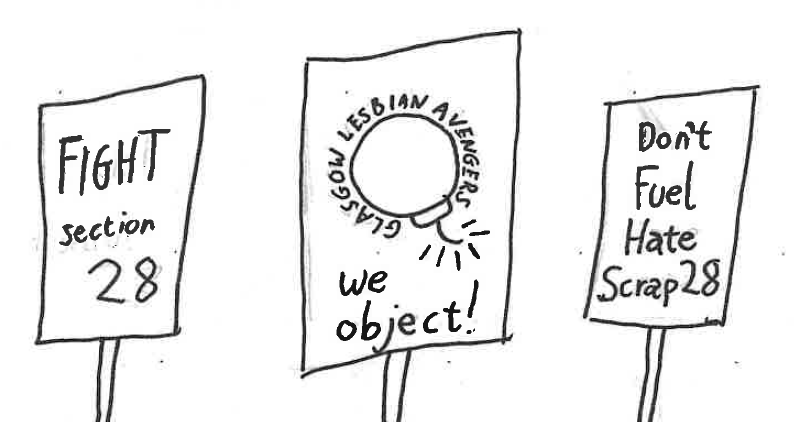
sketch of placards, reading Fight Section 28, Glasgow Lesbian Avengers: we object!, and Don't Fuel Hate Scrap 28

How dangerous is the Department for Education guidance?

In this post, I invoke the legacy of Section 28 very deliberately. The new proposed guidance on “Gender Questioning Children” is of course a very different document, produced in a different time, with a different response from civil society. However, I feel that understanding the guidance’s similarities to Section 28 is useful for analysing why it is so harmful, and understanding its differences can help us to map routes to resistance.

Like Section 28, the draft guidance is most dangerous in its vagueness. It does map out numerous ways to directly abuse young trans people, for example, through intentional misgendering and seeking to block social transition. However, it is the more general refusal to engage with the humanity and agency of young trans people – for example, through failing to even use the word “trans” once – which is most chilling.

While young trans people are of course the main target of the guidance on “gender questioning children”, the impact promises to be wider. As my own story shows, while Section 28 only explicitly targeted “homosexuality”, teachers or bullies didn’t tend to draw any distinction between gay, bi, queer, or trans experiences. Indeed, the atmosphere of ignorance and uncertainty made it difficult to event come to term with those differences. Many of us who went to school at that time struggled to come out because we had very little context for understanding ourselves. At my school, like many, boys were punished for painting their nails or growing hair past their neck. Similarly, the new guidance threatens to make life more difficult for any gender-nonconforming young person, regardless of whether they identify as trans. The point is to shore up and reinforce traditional understandings of sex and gender, in line with hardline conservative ideologies. Teachers, administrators, governors, and academy sponsors who actively wish to reinforce gender roles and make queer people’s lives more difficult will gain a powerful tool to legitimise sexist and homophobic policies, as well as transphobia.

However, homophobic bullying and ignorance also prospered under Section 28 because teachers were unsure about the limitations of the law and afraid to overstep. The new guidance’s insistence on entrenched biological essentialism could make even sympathetic teachers feel afraid to acknowledge queer and trans lives in their teaching, or otherwise put them under pressure from headteachers and governors. The whole point is to make LGBTIQ+ and especially trans students an impossibility: to enable incomprehension, to make them feel unwelcome, to “reduce” them in number, to make them disappear.

Where young queer and gender non-conforming people refuse to comply with this imperative to disappear – through coming out, through transition, through stubborn persistence – the guidance aims to make their lives immensely more difficult. They are to be outed to their peers, to their parents, to their peers’ parents. They are to be banned from wearing clothes associated with the “other sex”, barred from toilets and changing rooms, discouraged from using their own name and pronouns.

If enacted, this intentional targeting of trans and gender non-conforming lives and wellbeing will send an important message: it’s open season on the queers. As with Section 28, the guidance risks empowering bullies through fostering an atmosphere of institutionalised disrespect. The guidance states that “bullying of any child must not be tolerated”, but that statement feels pretty meaningless when the same document encourages schools to identify some children as different to their peers, and refuse their self-expression.

Normalising transphobia is extremely dangerous. We can see this, for example, in the murder of Brianna Ghey, a 16 year old trans girl who was stabbed to death in 2023 by two of her peers from school. Like many transphobic killings, her murder was extremely brutal. Prior to her death, the murderers shared numerous graphically violent messages about Brianna, using transmisogynist slurs and referring to her as “it”. This language and dehumanisation directly reflects discourses in society promoted online and in the press by gender-critical activists, journalists, and politicians from every major party. Brianna’s killers may have held the knife, but others with more power have repeatedly called for the “elimination of transgenderism”, and continue to do so. 

Edit: 23/02/24

Two recent events have further highlighted just how dangerous the Department for Education “Guidance for Schools and Colleges: Gender Questioning Children” really is.

Firstly, the Department for Education has quietly introduced a second consultation. This consultation is on a proposed change to the actual law for Further Education colleges providing residential accommodation for students aged under 18. The law currently states that sleeping accommodation should “provide appropriate privacy for all students”. The Government is proposing to replace this with a clause requiring that “gender questioning students” either be segregated and made to sleep in a room on their own, or otherwise forced to share a space with students assigned the same sex at birth, as “different legal sexes should not be sharing sleeping accommodation”. This intervention shows how the main guidance is just one part of a wider attempt to undermine young trans people’s dignity and safety.

Secondly, just days ago Nex Benedict, a trans student in the US state of Oklahoma, was murdered by cis girls in the school toilets. Nex and another trans student were violently assaulted just months after their home state introduced a law requiring all students to only use toilets that match the sex listed on their birth certificate. This horrific killing reflects what researchers have been telling us for years: trans and gender non-conforming people of all genders are most at risk of violence in gendered spaces, and enforcing strict rules only exacerbates these risks.


The good news

It is difficult to feel positive in the current moment. After years of anti-trans campaigning and threats, the Conservative party is acting to intentionally make life harder for young trans people, in a move that has far wider implications for student safety as well as queer and feminist initiatives in schools. The Department for Education’s proposed school guidance is not simply being championed by the Conservative government – its publication has been “welcomed” by the Labour party, and supported by liberal media outlets such as the Observer as well as the Tory press.

However, the legacy of Section 28 is once again useful for understanding what is happening here. The Conservatives are once again showing us who they really are – this is not new. The Labour leadership were just as useless in responding to the original Section 28, and the UK Labour government was in power for six years (most of my time in secondary school!) before they bothered to repeal the law in England and Wales. The liberal media was somewhat more opposed to Section 28 in the 1980s than they appear to be now, but ultimately it was neither journalists or politicians who created the pressure for repeal. It was LGBTIQ+ campaigners and our allies: especially young people from groups such as Queer Youth Network who worked ceaselessly to change the conversation and create a better environment in schools and beyond.

Moreover, there are two major differences between 1988 and 2024 which are important to highlight.

Firstly, the legal situation is radically different. Section 28 was written into law, and applied across Britain. By contrast, the new guidance is “non-statutory”, and applies only to England. This means that schools are not legally obliged to follow it, especially in elsewhere in the UK. The government’s proposals can therefore be ignored. In fact, ignoring the guidance might even be the wisest option even for transphobes, given that the government’s own lawyers have warned that those who follow it risk breaking the law, as the recommendations appear to directly contradict both the Equality Act and elements of safeguarding legislation. Moreover, the guidance is yet to be published in its final form, as it is under consultation until 12th March – meaning that you can tell the government exactly what you think about it. Edit: 23/02/24 – however, since this post was written the government is now also seeking to change the law through the FE Residential Standards Consultation.

Secondly, there appears to be way more support for trans and gender nonconforming young people now than there was for young gay people in the 1980s, perhaps especially among teachers. The world has changed. For example, I learned about the government lawyers’ warnings from Schools Week. The very day the draft guidance was published, their main headline was Trans guidance: DfE lawyers said schools face ‘high risk’ of being sued. Individual teachers are speaking out across social media to voice their disgust and opposition to the proposals, and teaching unions have also expressed their concerns. Furthermore, headteachers such as Kevin Sexton from Chesterfield High School in Liverpool are going public with their opposition, noting that inclusive policies that centre actual safeguarding for young trans people have been working perfectly well for years. The school has no intention of scrapping its gender-neutral uniforms, mixed-gender sports, or all-gender toilets it provides to young people who need them.

As such, we are in a strong position to fight back against the new Section 28.

sketch of a table with an old-fashioned telephone, piece of paper, and pen on it

How you can take action

The original Section 28 was defeated because countless ordinary people took action. That can be the case again. Of course, some people are better placed than others to fight this particular threat to young people (for example, if you work in education in England). However, there will be things you can do regardless of who you are, how old you are, and where you live.

If possible, act with others, rather than alone. We are always more powerful together.

IDEA 1: Resist the new Section 28 in schools

If you are currently a student, a teacher, a parent or carer, a school administrator, a governor, or even working for an educational company or charity (e.g. in teacher recruitment) you are particularly well-placed to fight back against the new Section 28.

We can see inspiring examples of this in current protests by students and teachers in the US state of Florida, where the government has introduced a slew of anti-LGBTIQ+ laws, including a trans sports ban and a Section-28 style “don’t say gay” law. Kayla Kumari Upadhyaya wrote in Autostraddle about the power of student-staff solidarity in one Florida school:

I know a high school walk out sounds like a small thing, but this is huge. It shows a two-fold approach to resistance happening in the state: First, the administrators and staff members who flouted the ban in the first place showed it’s totally an option to just…not enforce transphobic regulations. If more Florida school staff were willing to do this, it would make the ban difficult and maybe even impossible to reinforce. Second, the students showed their solidarity and support not just for this one trans athlete but all trans athletes, holding signs and chanting affirmations of support for trans lives everywhere and questioning the ban. It’s further evidence that the Florida legislation does not adequately represent the Florida people.

Here are some ideas for English and Welsh schools:

  • Non-compliance. As Upadhyaya observes, transphobic laws and guidance rely on people enforcing them. Headteachers, administrators, governors, and academy sponsors are of course in the best position to reject the new guidance should it be formally introduced following the government consultation. We can see this in the example of Chesterfield High School in Liverpool. But students and teachers can also take action, as can parents (regardless of whether or not your own child is trans). Anti-trans campaigners will be putting pressure on schools to enforce the new guidance, so every person who puts pressure on them to not do so will be important.
  • Implementing alternative guidance. Robin Moira White notes that examples of good practice already exist for supporting trans students in schools and colleges. These include the Scottish government’s guidance on Supporting Transgender Pupils in Schools and Brighton & Hove City Council’s Trans Inclusion Schools Toolkit, both published in 2021.  

Actions include:

  • Refuse to implement the UK government’s guidance on “Gender Questioning Children” if you are in a place to do so, and instead follow the advice of e.g. the Brighton & Hove guidance.
  • Write to the headteacher, Board of Governors, and/or academy sponsor, or ask for a meeting. Tell them that the school should ignore the UK government’s guidance and implement a better alternative. Highlight the danger posed to young people by the UK government’s proposed guidance, and the potential legal challenges the school may encounter if it follows that guidance.
  • Hold a meeting of your own with other students, parents, teachers, and/or administrators. Discuss how you might work together for non-compliance and/or introducing or defending a better alternative.

IDEA 2: Pile on the political pressure

You don’t need to work or study in a school to make a difference. Countless other organisations are in a position to make a difference, and you can put pressure on them to do so. People living throughout the UK are potentially in a good position to do this.

Actions include:

  • Write to your MP or councillor, or phone them up, or ask to meet them in person. Demand they put pressure on their party to actively oppose the UK government’s proposed guidance on “Gender Questioning Children”. This is particularly important for Labour representatives, as their party is likely to win the UK’s next general election.
  • Write to your union and ask them to take a strong stance on opposing the proposed guidance, for example through public statements and/or taking part in the consultation.
  • Write to local and national newspapers. Change the conversation by explaining why you think the government’s proposals pose a danger to the safe of young people.
  • Ban the Conservative and Labour parties from Pride. In this post-Section 28 age, politicians love to use events such as Pride to boost their public image. If you’re not already involved in your local Pride, consider getting involved, or hold a counter-protest within the parade to ensure that transphobic politicians feel unwelcome.
  • Stop giving money to transphobic media. Publishers such as the Guardian Media Group are always shilling for cash, claiming their journalism offers an important beacon of truth in a complex world. That’s not true if they’re constantly pushing hate. If a publication is publishing transphobia, don’t buy paper copies, don’t donate, don’t give them quotes or press releases, and at the very least install an ad block on your browser if you must keep reading.

IDEA 3: Take part in the consultation

I am less certain about this proposal than the others, but it is an obvious one to include. The UK government is holding a formal consultation on their proposed guidance for “Gender Questioning Children” in schools. Anyone can participate, and tell them what you think.

You can take part in the consultation here.

The upside of this is that it is an opportunity for us to speak back directly to the UK government and Department of Education. The downside is that there is a good chance we will be ignored. The past decade has seen more consultations on trans civil rights and healthcare than ever before – and overall, things have got a lot, lot worse. For example, a majority of respondents to the consultation on the Gender Recognition Act from both the UK and Scottish government supported reforms; those reforms are now thoroughly dead, at least for the time being. Trans communities have poured an enormous amount of time and energy into responding to malicious consultations when we could have been doing far more constructive things with our time.

However, in her post for TransLucent, Robin Moira White makes an important point. With the consultation closing on 12th March, the civil service may have little time to assess responses before a new general election is held. She therefore proposes that respondents request that the existing draft be “torn up and thrown away”, and new draft guidance be introduced, based on the Scottish and Brighton examples. If enough people and organisations argue for this, then it might put sufficient pressure on a new Labour government to do a better job.

A related approach was proposed by Edinburgh Action for Trans Health in response to an NHS consultation in 2017. They recommended “hostile participation in the form of direct submissions of demands that don’t react to the questions posed or restrict themselves to the scope imposed by the government”.

Actions therefore include:

  • Take part in the consultation yourself, demanding the government scrap the proposed guidance and introduce something better.
  • Encourage any relevant organisation you are part of to participate in the consultation (e.g. children’s and/or LGBTIQ+ charity, school, educational body, Pride organisation, university department) and ask for the same thing.

I won’t be producing any advice myself this time – instead, I hope this post will help people in thinking about wider routes to resistance. Edit 23/02/24 – However, the following guides have been produced by various organisations:

If you’re responding to consultations, don’t forget to also respond to the Department for Education’s deeply transphobic proposals regarding Further Education Residential Standards. This consultation closes 5 April 2024 so you have longer to respond.

IDEA 4: Support trans youth groups

Regardless of how things play out with the proposed guidance, young trans people are still having a hard time in schools.

There are a small handful of national bodies which support young trans people through advocacy and peer support: e.g. Gendered Intelligence, Colours Youth Network, and Mermaids operate across England. Perhaps more importantly, a lot of small, local youth groups exist specifically for queer and/or trans young people across the country. This was an unthinkable possibility when Mrs Richardson referred me to a local counselling service, so we really need to value and uplift these groups.

Actions include:

  • Find out what youth groups exist locally where you are, and how you can best support them. Some groups will benefit from publicity in the local area; others will want to keep a low profile given the current atmosphere of transphobic backlash. Many will benefit from volunteers – not just to work directly with young people, but also to do jobs such as fundraising, running social media, or designing websites. 
  • Donate money. Pretty much every trans-oriented organisation will benefit from donations, especially those working with young people. If you can afford it, consider setting up a standing donation.
  • Fundraise. If you can’t afford to donate, or want to do something more, you can do other things to raise money for trans youth organisations. Examples include: putting together a small gig, an art gallery, or a bake sale, or doing a sponsored activity.

IDEA 5: Plan a creative protest

Back in 1988, after the Conservative party introduced Section 28 and most Labour politicians refused oppose it, it would have been easy to despair. Instead, some extremely audacious actions took place in opposition to the law. Just after the House of Lords voted for the new law, members of the Lesbian Avengers abseiled into the debating chamber to protest it.

A few months later, another group of lesbian activists invaded a BBC studio during the Six O’Clock News, shouting “stop Section 28!”

While neither of these protests succeeded in blocking Section 28, they highlighted queer opposition to the new law, and inspired entire generations of new activists to fight back.

Actions include:

  • Get creative. Find or create a group of like-minded individuals and think about how you can protest against transphobia. Consider how your action might best attract attention to the cause or put pressure on a group or organisation to change their position on the government’s proposed guidance. Think also about how you will keep yourselves and others safe.

There are no doubt a whole host of actions and interventions I haven’t thought of. We are never powerless, even in the face of entrenched fear and hatred.

So now it’s your turn: how will you resolve to smash the new Section 28?

In memory of Ellinore Wilson

i.

I discovered recently that my friend Elli had passed away. She was just a few years older than me. I believe she lived a difficult life, but was always true to herself, and was good and kind to others. And meeting her as a teenager changed my world.

I first encountered Elli during the long, messy process of coming out to myself. We were both members of a small online community, created by a young trans person for other young trans people. There were a few of us there in our mid-late teens and early 20s, most of us struggling to imagine what it would be like to live authentically. There were a small handful of “allies” (at least two of whom would later coming out as trans and/or genderqueer themselves). And there were a couple of people who had already transitioned, including Elli.

I don’t think there is a word for people like Elli in the straight world, which can make it hard to express how important she was, even to myself. She was my not-very-much-older Elder. She was my possibility model. She helped to crack my egg. She was a nexus of social contagion, a superspreader in the psychic epidemic, a key trigger for my rapid onset.

Elli was a friendly, patient, community-minded person who showed up for others. She showed us that it was possible to be true to ourselves, to build a life on another side of the sex divide. She was honest and realistic about how difficult things could be, and full of constant reminders that there was, is, and will always be more to life than being queer. She loved ferrets and cats and anime, especially Naruto, because she was a massive nerd.

Elli wasn’t famous or well known. She wasn’t involved in any significant moment of history. She had small friendship circles online and offline. This, though, is how we build queer and trans community: through countless acts of care and mutual aid, rather than grand gestures.

ii.

I found out Elli had died through a mutual friend from the same old community. She had found out through Facebook – she went to look at Elli’s profile, and realised Elli had died months before.

I was horrified. I had spoken with Elli regularly while she was severely ill with covid, reaching out to tell her how much I cared about her, and share numerous pictures of my cat. We hadn’t spoken that regularly for the last decade, but it felt like every now and then we would touch base and check in on one another. I don’t use Facebook very often these days, but it can be a good way to find where long-term, long-distance friends like Elli are doing. After a lot of hardship, I’d been really excited to find out she had a new job where she felt happy and fulfilled, and a new apartment which she made into a real home. And when got sick, I decided to message her until she recovered.

Except. After she started getting better, after she got home from the hospital, I stopped messaging. I was busy and distracted, getting ready to start my new job at Glasgow. I’m aware that I’m a possibility model myself, now, and there’s a lot that comes with that. I regularly receive messages from people who say I helped then to come out, to be themselves, through being a visibly trans woman, and visibly “successful” in my chosen fields of work and activism. I am perpetually busy, and tired, and distracted.

I saw the occasional Facebook update from Elli suggesting a gradual recovery. And so, like before, I dropped contact, assuming that we’d chat again in a few weeks or months.

And of course, the algorithm never told me that she was no longer with us.

I’m not sure if there is a clear moral to all of this. I am trying not to blame myself – how could I know? And Facebook was the very medium by which we remained in touch long after our original community was no longer active.

These days I feel pulled in all directions by friends from different times and places, people I once knew well, people I wish I was better at staying in touch with, people who assume some kind of parasocial relationship with me on the basis of my public profile. Social media feels like the only reasonable way to stay on top of it all. Yet I regret relying on social media – and especially the exceptionally unreliable medium of the feed – to keep up with Elli. I could have just…messaged her, or checked how she was doing.

iii.

It feels like there are two stories here. But perhaps they are the same story.

My experiences of trans community life are pierced through with chance and tragedy: life-changing encounters, terrible losses, and the all-encompassing importance of the Internet. Elli is far, far from the first trans friend of mine to die young. I also know she won’t be the last. When you live in a community where healthcare and socio-economic inequalities are endemic, you are always surrounded by people who are very ill. That’s an inevitable consequence of the forces stacked against us. The least we can do for one another is to collectively find joy and meaning in the life we have, using whatever tools we have at our disposal.

I want to live up to Elli’s memory, and to everything that she gave me. I hope I can be a better friend to others, but also forgive myself for being just one person, in one place, with a limited amount of time available to me. And while I’m at it, you’d better believe I’m going to keep cracking eggs.

Photograph of four hen's eggs sitting in a straw nest.

Trans Visibility, Modelling Possibility

Lost for words

The first time I knowingly met someone who was almost certainly trans I didn’t have the language to understand what was happening. It was pretty awkward for us both.

I must have been 15 or 16 or so, circa 2002. I was at a house party where I didn’t know many people. I felt awkward and out of place. I’d turned up with a small group of friends who all seemed far cooler than I’d ever be, and they’d mostly wandered off to Do Gender and make out with each other heterosexually. I awkwardly wandered around, quietly observing people, far too shy to start a conversation. I have blurry memories of dark corridors, drunken teens, a small living room full of scary-looking hairy people listening to System of a Down.

And then I came across this…person.

I read her voice and appearance as male – but her friends used a female name and pronoun for her. Looking back, I’m pretty sure she was a trans girl early in transition, and all her cis mates had her back – as mine would a mere year or so later.

I saw something in her which I immediately recognised, but didn’t know what to call it. I desperately wanted to speak with her, but didn’t know what to say.

I think what I wanted to express was, “I am like you”. But dozens of awkward online searches for phrases like “boy who wants to be a girl” hadn’t quite yet led me to the magic word, transgender. So what I actually said was,

“So what’s with the boy-girl thing?”

Understandably, she didn’t really want to chat. If someone said the same to me after I came out to myself properly a few months later, I probably wouldn’t have wanted to speak with them either.

Portrait of the Artist as an Egg


Gerroff my lawn

The present moment is pretty awful for trans people. Here in the UK, we are now about four years into an extended moral panic over our very existence. It’s like a continual background noise we can never escape: constant misinformation from politicians and the press; attempts to ban us from sports, public toilets, women’s shelters, and rape crisis centres; unrelenting attacks on affirmative healthcare for trans people, especially trans youth.

I therefore often feel quite cynical about recent innovations such as Trans Day of Visibility (or TDOV, for those who enjoy a sexy acronym). As so many trans writers have observed, visibility is not always a positive thing for trans people, especially those such as Black trans women who face multiple marginalisation. The context of our visibility is shaped by neoliberal economics and the violent legacy of colonialism.

Visibility means danger. Visibility means we are seen by those who would cause us harm in the streets and in the halls of power. Visibility puts a target on our back.

Events such as TDOV can also serve as a site of tokenism and appropriation. Trans visibility all too easily becomes a commodity for those who wish to sell us ideas or products, or sell the idea of us to other people. For example, this morning Labour and the Women’s Equality Party released short, empty statements to “celebrate” TDOV, despite having allowed virulent transphobia to fester within their structures.

In the midst of all this, it can be easy to lose sight of just how far we have come – and how important visibility can be for our liberation.


Choosing visibility

When I first came out, I was lonely beyond words.

Part of the reason it took me so long was that there weren’t really any visible examples of trans lives available to me, let alone examples of trans art, culture, writing. It was so hard to find myself because it was so hard to find community. When I was at that party, and met that other trans girl, I knew I was something but it was hard to find what out what that thing was. We didn’t hear about people like us in school or on TV – unless I was somehow meant to be the pathetic sex-change taxi driver from The League of Gentlemen or the glamorous but deceptive villain from Ace Ventura.

Of course, vibrant trans communities long pre-dated the early 2000s, but there was no way for me to know that. They simply weren’t visible for me – until I finally stumbled onto transvestite and transsexual communities on the internet, and then eventually found other trans teens.

Online communities were a lifeline for me – but I still didn’t knowingly meet other trans people until several years into my transition (it did later turn out that one of my best friends was also trans, but that’s another story). I felt very held by the people around me, but also felt there was no-one to talk with in person who truly understood what was happening for me and why. When I turned to the NHS for help, I was refused a gender clinic referral until I was 18. It’s no wonder so many people from my generation who knew they were trans as kids didn’t come out until a lot later.

At 19, I went to university – and went stealth. I thought it was what we were supposed to do. I thought it was what I wanted. To be seen as a “real” girl, for no-one to know I was trans. In practice, it was…complicated. I certainly felt a lot safer, and experienced a lot less harassment. But I still didn’t get access to hormones until I was 20, and found it really scary hiding my body and my history when living in student halls. I disclosed my trans history to a few close friends, but was constantly worrying about who else “knew” and what that might mean for me.

One of the few places I disclosed my trans status was the student LGBTUA society. I joined as the only known trans member, and agreed to be a point of contact for other trans students on condition of anonymity. That, it turned out, was enough for me to finally find community.

I was barely visible – but visible enough. Other trans people made contact and started coming out on campus. We began to run our own events and put up posters with the trans symbol and an email address, emblazoned with the slogan “YOU ARE NOT ALONE”. I went to NUS conferences and met more trans people and we started campaigning for all-gender toilet provision and legal protections. The more visible we were, the more people came out, and the more people became involved in our communities and activism, which meant we became more visible again.

At 21, I decided to disclose my trans identity to everyone in my life. It was a personal decision – to move past the paranoia and shame of stealth and instead embrace trans pride. But it was also a political decision – to be more visible to other trans people.

Possibility models

Trans actress Laverne Cox has spoken extensively about “possibility models” – the idea that seeing other trans people shows you that trans life is possible. Not just in terms of being out, but in terms of doing things while trans. Unlike a “role model”, a possibility model gives people space to find their own path, their own possibilities, rather than base their ambitions directly on the achievements of another.

Leeds Pride 2019

For me, the real power of trans visibility lies in the potential we hold to build community, and to act as possibility models. To know we have value to one another. To know we have the potential to create and inspire: to write, to draw, to paint, to act, to speak, to love, to be loved, to simply be.

This isn’t about our potential value to cis culture, as scapegoats or inspiration porn. It’s about our actual value to one another.

This has to be a collective movement. If trans visibility is just about individual “success”, then inevitably many of the most visible trans people will be those who are more privileged. We have to lift one another up – and those of us who benefit from whiteness or citizenship or being middle-class or being abled need to think about how we can account for that, signal boost other people from our communities, or sometimes step aside from an opportunity. The whole point of trans visibility is for every trans person to see themselves as possible.

This is where the real potential lies with Trans Day of Visibility. I will never forget the overwhelming awkwardness of trying to speak yourself into existence when you simply don’t have the language available to you, when you don’t see anyone like you in the world to show that your future is possible. In spite of everything, the world has changed for the better for trans people over the last two decades. It’s no wonder that more of us are coming out than ever, at earlier ages too.

Let’s carry on changing the world together.

QUEERPOCALYPSE

QUEERPOCALYPSE

Today is Trans Day of Visibility, apparently. I have felt very strange about this day since it became a Thing over the last decade, as visibility is double-edged sword for many of us. With visibility comes community, and increased access to trans and queer arts, culture, politics, ideas. But in the last few years this has met with a cultural and ideological backlash. We are more visible to those who hate us, those who fear us, those who would cause us harm.

Last year I wrote some lyrics about this dichotomy, which are now part of a new song from noise/punk band Dispute Settlement Mechanism. It’s called Queerpocalypse.


One of the great things about being in a band is that the process of creation is always  collaborative. I like that this enables us to express ourselves, be that as queer, as trans, as woman, as people, in different ways that come together as a whole. Communicating through riffs and percussion which tell their own stories alongside lyrics and vocal performance.

This, at least as much as my research and formal writing, is the visibility that matters to me in 2020.

I fear your hate inside
I fear the turning tide
I fear your time will come
I fear you think you’ve won

moral panic
moral panic
moral panic
moral panic

you fear with desperate pride
you fear the turning tide
you fear our time will come
you fear that we have won

well guess what?

this world is ours
this world is ours
this world is ours
this world
is ours

Queerpocalypse is available as part of the compilation album Songs From The Vaults. All proceeds from digital sales of the album (available from £5) go towards supporting important Coventry venue and community centre The Tin Music and Arts through the COVID-19 crisis.

Fighting back in the precarious academy – FWSA address 2019

On 16 October I spoke at the 30th Anniversary event hosted by the Feminist and Women Studies Association UK and Northern Ireland (FWSA). This is the text of my short talk.

Thank you for having me, I am very honoured to be here today.

I was invited to speak about doing feminism in the academy through my research on trans experiences. I am a trans woman known for my research on trans health.

I am interested in how discourses of consent, autonomy, sex and gender circulate between patient communities, activists, and professionals, and how these are shaped by power relations. I also work on new approaches to healthcare that might centre patient knowledges, rather than patriarchal medical authority. At present, I am part of an international study of pregnancy and childbirth among trans men and non-binary people.

This research stems from my wider interest in gender, sexuality, and power relations within institutions. I have published empirical work on equality schemes in Higher Education, focusing specially on Athena SWAN. My research with Charoula Tzanakou shows how Athena SWAN places a burden on the very women it is supposed to help, through expecting them to participate in the extensive work of self-assessment.

I also have been involved in anti-casualisation campaigns, especially while working on hourly-paid contracts for six years at the University of Warwick. I feel it is important to recognise this as feminist academic work too, an argument I expand on shortly.

I am very often invited to speak about trans health. At least as often, I am invited to speak about being a trans woman.

I am very rarely been invited to speak about my wider feminist research or activism.

I know why this is. While our numbers are growing, there are very few trans people and especially trans women working in universities. I am used to being the only visible trans person in the room. I am painfully aware that I am frequently present as a token. I am also aware that if I am not present, often no trans voices are heard at all, let alone trans women’s voices.

I know it is important to talk about how a vast majority of trans staff and students face substantial barriers in Higher Education. These include rigid administrative procedures, plus high rates of verbal abuse, physical and sexual assault. I know it is important to talk about how transphobia is tied closely to misogyny, racialisation, ableism and class, and how the challenges we face are especially compounded for trans people who face intersecting forms of marginalisation, such as Black trans women and disabled trans people.

I know it is important to talk about how we currently face an unpreceded rise in open transphobia. Cis academics talk about stripping our legal rights in public lectures and newspaper columns. Trans studies scholars face constant abuse and harassment on social media, malicious freedom of information requests, and threats of legal action. I know it is important to talk about how anti-feminist talking points from the religious right, such as the supposed threat of ‘gender ideology’, are laundered through anti-trans groups.

Still, there are times I want to talk about other things.

There are times I want to talk about being a woman more than I want to talk about being trans. There are times when I want to talk about solutions as well as problems, about collectivity and solidarity rather than division.

New postgraduates frequently ask me for advice on surviving in departments where they are the only out trans person. My advice is always the same – build alliances across difference. You may be the only trans PhD student, but you will certainly not be the only student who faces marginalisation.

To quote Patricia Hill Collins: “Who has your back, and whose back do you have?

In 2015 the University of Warwick faced scrutiny over TeachHigher, a proposed wholly-owned subsidiary designed to facilitate the outsourcing of teaching at universities. These proposals were defeated by organised resistance within numerous academic departments, led primarily by casualised staff.

Our campaign relied on recognising how the economic precarity of casualization is also about the myriad ways in which many of us are additionally oppressed. As my comrade Christian Smith passionately argued, “TeachHigher is sexist, and TeachHigher is racist”. We knew that women and people of colour are disproportionately represented within the pool of casual labour on which our institutions rely. We knew that increased casualization only exacerbates conditions in which those who are already the most privileged are most likely to thrive. This was a feminist campaign, an anti-racist campaign, a campaign about class, a campaign against ableism, homophobia and transphobia.

In my department, where over 40% of teaching was undertaken by people on hourly-paid contracts, we organised a teaching boycott. None of us would sign up to teach the following year unless the department took an active stance against TeachHigher. This could only work if all of us agreed to openly sign a letter announcing the boycott – otherwise, we could be played off against one another. It took many careful meetings and discussions to organise. Many of us relied on this work to pay our bills, and in some cases, look after families.

In response to our letter, the Head of Department disparaged us in a departmental meeting, calling us “childish”. He proposed replacing our labour with PhD students from other universities. He said we would never win, that the university would never back down.

A week later, the university backed down.

So how do we claim space for feminism in the precarious academy?

By remaining aware of our differences, working with and across them to build alliances.

By campaigning through formal and informal unions as well as our research.

By speaking out and supporting our colleagues, especially if we are in a more secure position than them.

The university is not built for us. We know this in our hearts when we see the statues and paintings of worthy men around campus. We know this in our bones when we the climb steep steps to lecture theatres designed to centre a patriarchal pedagogy. We know this in the sharpness of our breath when men known for sexual abuse talk over us and claim responsibility for our work in departmental meetings.

It’s time for change on our campuses. Let’s make that change together.

EHAOIH6W4AAdiCi.jpg

Interview on Acadames podcast

webfront8Earlier this year I took part in an interview for Acadames, a super-cool podcast “that explores whether being a woman in academia is a dream, game, or scam”. The episode is now available! I really enjoyed speaking with Whitney  Robinson about my work, and hope you will enjoy our conversation just as much.

Today Whitney speaks with Dr. Ruth Pearce, a social researcher and feminist scholar based at the University of Leeds in the United Kingdom. Ruth discusses her current work with the Trans Pregnancy project, why gender equity schemes are so important in academia, and offers tips for resiliency when facing online harassment and political backlash. Along the way, she shares stories of her life as a trans woman, how academic institutions in the UK differ from those in the US, and the similarities between organizing a concert and organizing a conference.

Click here to listen.

How it feels to be a trans feminist academic in 2018

Trans feminist symbol, designed by Helen GThis piece is based on an email I wrote, in response to a message about “smear campaigns against gender critical academics” on a feminist academic mailing list.

I have updated and posted it here in the final day of the Gender Recognition Act consultation in order to give my cis readers some idea of how the past few months – and especially the last few weeks – have felt.

~

I would like to say something about how it feels to be a trans feminist academic right now, with the emergence of a growing number of “gender critical” voices in academia.

In the wake of Brexit and Trump, and with the renewed growth of far-right movements across the world, it seems that everyone feels empowered to speak out about their own personal prejudice. Trans issues are no exception.

When I first came out and transitioned as a teenager, almost two decades ago, one of the scariest things for me was using public toilets. Let that sink in for a moment. I was scared simply to use the toilet – for fear that people might shout at me, drag me out, maybe even beat me up. While that fear has dissipated for me, I have not been to a public swimming pool since my mid-teens, and have not even been swimming in the sea since my early 20s. This is because I am scared. I am scared of violent men, but I am also scared of violent women. Cis violence against trans people is a reality. I have an enormous amount of admiration and respect for trans people who are able to overcome this fear.

It was hard to come out in the early 2000s. There was an enormous amount of casual transphobia in the media. Guardian columnists wrote pieces such as “Gender Benders Beware”, TV programmes such as Little Britain and the League of Gentlemen were immensely popular, and 90s films such as Silence of the Lambs and Ace Ventura remained popular with my friends. Trans women were variously represented as a pathetic joke, as burly men in self-denial, deceptive liars or outright sexual predators.

Legislation such as the Gender Recognition Act 2004 and Equality Act 2010 was yet to see the right of day. It was therefore legal for employers and service providers to know all about my gender history; it was also legal to refuse to hire me because I was trans, fire me from a job because I was trans, deny me services and kick me out of shops, pubs, post offices, leisure centres (etc etc) because I was trans.

It was not easy to come out in this environment. There were exceptionally few openly trans people involved in public life – and none of them looked, sounded or acted much like me. I certainly hadn’t knowingly met any other trans people. I delayed coming out for years because I wasn’t sure if I was “really trans” (a phenomenon common among participants in my research). I thought that I might ruin my life. It was only the knowledge that my life would likely be ruined regardless, and the sheer awfulness of the alternative – becoming a man – that persuaded me to take the enormous step of coming out.

Consequently, I was very isolated during the first few years of my transition. I find it very hard to express how intensely lonely that experience was. Fortunately, my friends (mostly cis girls my own age) were immensely supportive, but it was difficult not to have any people with similar experiences to talk with. People with a very deep, complex relationship with our gendered movement through the social world, and/or our sexed bodies, such that we knew the assignation we received at birth was not right for us. People who felt a deep, deep relief upon transitioning socially and/or changing our bodies as appropriate.

It wasn’t until my 20s that I began to slowly, gradually meet trans people my own age – and what a relief that was! We could relax completely around one another, talk about our issues and experiences, reflect on our differences as well as our similarities. It was at this time that I encountered the term “trans bladder” – used to refer to the pain and urinary infections that could follow from not being able to use toilets outside of the home. Let that sink in.

I also began to realise the wider extent of the damage caused to other trans people by both external and internalised transphobia.

Many of my trans friends have attempted suicide, sometimes on multiple occasions. The first trans person I knew to take their own life was a member of a trans youth Internet message board I frequented when I was 16. Others would follow, including a housemate, whose body I discovered shortly before I was due to head into work to teach a class. When I see “gender critical” people disputing well-established trans suicide statistics, it feels like gaslighting. I know what happens in our communities when people are not affirmed and don’t have access to adequate support.

Other trans friends have experienced severe sexual violence, often in their youth, often in very public spaces such as school playgrounds. Trans people are at particular risk of various forms of sexual assault, violence, coercion and control – for example, 28% of trans respondents to a large Stonewall survey had experienced domestic abuse within the past year alone. When I see “gender critical” people talking about the supposed violent threat that trans women pose, I think about how when trans friends of mine are raped, our first conversation about accessing support is usually about whether or not it is safe for them to go to the local rape crisis centre. This is not something we can necessarily take for granted.

When academics and journalists “come out” as “gender critical”, scaremongering about changes to the law we have been fighting for for decades, representing trans women and girls as sexual predators, debating our access to legal rights and public spaces and women’s services, I wonder if they know who we are, what our stories are, what our experiences are like. Is it simply that they don’t know any trans people, that they are ignorant? Or is there a deeper cause for their hatred? Do they realise they sound less like feminists, and more like the fundamentalist religious right? (for an example of how fundamentalist Christians and “gender critical” feminists basically employ the same language and discursive anti-trans tropes, I recommend a look at the responses from organisations to the Scottish government’s recent consultation on gender recognition).

As for the notion that anti-trans campaigners are “gender critical”, and my use of inverted commas for this term – I spent an enormous amount of time thinking about gender, sex and sexism even as a teenager. I read about the social construction of gender, and it made sense to me as a concept, but it took me a long time and a lot of theorising to figure out how to make sense of that with relation to my own body and experiences. I began to figure out that sex was a social construct too, reflecting the construction of gender, many years before I would encounter the work of Emi Koyama and Judith Butler. In my 20s, I was heavily involved in the NUS Women’s Campaign, and I am now (among other things) a gender theorist. In recent years I have been interested as a scholar and campaigner in the drawbacks and possible benefits of gender equality schemes such as Athena SWAN, and the fight to tackle staff-on-student sexual misconduct.

People who object to pro-trans legislation and oppose our access to public space do not have a monopoly on being “gender critical”, any more than those who oppose abortion rights have a monopoly on being “pro life”.

The growing number of academics who hold “gender critical” positions wield an enormous amount of power over their trans students, and have the potential to cause an enormous amount of harm. There are more and more of these trans students every year – of course there are. The exponential growth in the visible trans population is an outcome of the assertiveness of trans activists, our increasing visibility in public life, and a more positive legislative environment. It was predicted on multiple occasions many years ago – by Lynn Conway in 2001, by GIRES in 2009 and 2011. This is the outcome of an invisible population gradually becoming visible – just as the number of young people prepared to be out as lesbian, gay and bisexual also continues to rise. This growth will, eventually, flatten out – but it will be a fair while before this happens, especially if the current backlash continues.

I hope that cis people reading this post reflect on what it feels like for me to be involved in feminist and women’s groups at this time, especially as “gender critical” conversations become more common. It feels terrifying. I am petrified about where the discourse is heading within feminism as well as within the wider social world, and I am very scared about what might happen next, what violence might be perpetuated or excused in the supposed name of women’s rights.

I am hardly alone in this: I see trans friends freaking out en-masse every time I sign into social media. We know our history. Some of us survived Section 28. A precious few survived the AIDS crisis and surrounding moral panic. Many are also black, or disabled, or gay, or bi, or Jews or Muslims, or migrants. We know what happens when minority communities are scapegoated, and we know that the rise in transphobia is not an isolated phenomenon. We know that the most vulnerable among us are the easiest targets for hatred.

I worry every time I see a post goes up or message is written on a feminist Facebook group or blog or academic mailing list, every time somebody organises a feminist seminar or conference. I fear that someone will start raising “reasonable” concerns about my existence or civil rights, or lying about the supposed threat that I and others like me pose. For all that I move through the world as a woman, for all that I am a woman and have lived my entire life as a woman, for all that I am subject to sexism by clueless male colleagues and internalise the need to constantly apologise for myself at work, for all that I am harassed in public by men and fear male violence every time I leave work after dark, I start wondering what place I have in these groups. I start to wonder how many cis women think that somehow I am more privileged than them even though I am subject to both sexism and transphobia. I wonder how many feminists hate me.

When “gender critical” blog posts are written or emails are sent, I feel like I have a choice. Either I respond – and it may well take the form of an essay like this – an enormous outflow of nervous energy, fear and anger, energy that I will not get back repeating stories I am quite frankly bored of telling. Or I may attempt to remain cool and rational, encouraging calm and thoughtful debate even as I attempt to stem the rising panic inside. Or I try to ignore the message, even as it plays on my mind for the rest of the day, rest of the week, rest of the month, knowing that the environment has become a little less safe for other trans people – and especially other trans women – and especially other trans women less privileged than myself.

Or I just leave these feminist groups and mailing lists and academic collectives, which is of course what “gender critical” women would like me to do.

But not today. Today I stay. Today I fight. And I do not do this alone. For I know also that the majority of women support our cause.

As ever, I do this with my sisters.

Solidarity.