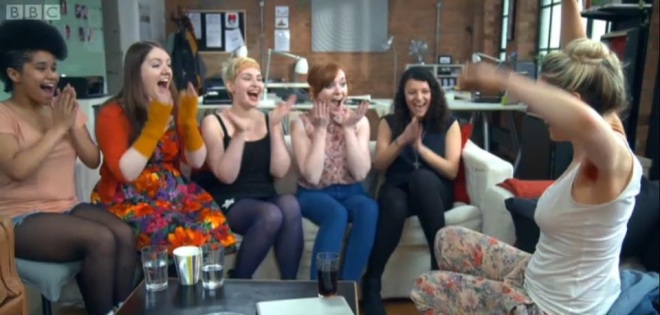
In praise of Coventry Rape and Sexual Abuse Centre

In the midst of all the comments and thoughts and responses whirling around my previous post, I’ve noticed that someone stumbled across this blog through the search term “uk trans friendly rape crisis“.

And you know what, I have my problems with individuals within feminism, and I certainly have my problems with Rape Crisis in the UK, but I’d really rather be talking about how we can come together and fight for a beautiful feminist future.

So it is with this in mind that I’d like to dedicate this brief post to Coventry Rape and Sexual Abuse Centre (CRASAC). This place offers a brilliant service to the local community – as do most rape crisis centres, women’s shelters and other related services – and as part of that I know through individuals close to me that they have done sterling work to support deeply vulnerable trans women. Because most cis feminists aren’t out to get trans people: they’re our allies and we can rely on them.

Thank you CRASAC. You are the most awesome wonderful feminist heroes.

​My message to those who would attend Radfem 2012

In you, I see the girls who spat in my face as I walked home from school.

In me, you see every man who has ever treated you like a lesser being.

In you, I see the boys who always wanted to pick a fight.

In me, you see someone who just won’t listen.

In you, I see my father, a man I’ve always considered to be wise and thoughtful, telling me that I’ll be outed by the press and kicked out of university for using the women’s toilets if I transition after my A-levels.

In me, you see a forceful male penetration into women’s spaces.

In you, I see a hundred tabloid headlines screaming “tranny”.

In me, you see a blind adherence to the oppressive system of binary gender.

In you, I see the doctor who tells me what I can and can’t do with my body.

In me, you see the stooge of a patriarchal medical system.

In you, I see friends who have been beaten or raped before being told by authority figures that they brought it on themselves.

In me, you see a systematic desire to control and define womanhood.

In you, I see a systematic desire to control and define womanhood.

How do we bridge this impossible divide?

My truth and your truth are both derived from a fierce feminism, but somehow remain diametrically opposed.  How is it that we can disagree so much over the existence of a feminist conference for “women born women living as women”?

I would tell you that my subconscious sex, the mental matrix that somehow marks the flesh I expect to see and feel when I behold myself, maps snugly onto the body I have inhabited since undergoing hormone therapy and genital reconstruction. I would tell you that for the last three years I have been happy and at ease with myself in a way I could never have been before.

I would tell you that I am a woman because I identify as a woman, I move through the world as a woman, and in this sense I have been a woman my entire adult life. I would tell you that I don’t even know what it’s like to be a man because that’s something I’ve simply never experienced. I do know what it’s like to be a teenage trans girl faking it as a boy though, and I can tell you that isn’t a whole lot of fun. I would tell you that trans women who transition later in life tend to encounter more significant challenges than I did, and that they are no less a woman for this.

I would tell you that yes, I agree that gender is a social construct that ascribes hegemonic power to the masculine. I would tell you that I, like you, am forced to negotiate a society where we cannot simply reject gender because we are gendered constantly by others. The body I inhabit, the things I enjoy, the manner in which I communicate, the clothes I prefer to wear fit better into the artificial category of “woman” than the artificial category of “man”.

I would tell you that “trans” is an aspect of my womanhood: womanhood is not an aspect of my transness. I am a woman who happens to be trans.

I would tell you that when I was with a woman, she loved me as a woman. Now I am with a man, he loves me as a man. I am entirely at ease with my bisexuality.

I would tell you that I reject outdated ideals of “appropriate” female behaviour. I don’t see why I should take on a submissive role within society, although I do feel it is important to recognise the voices of others and listen in a sisterly fashion. I  do not see why I should dress in a particular feminine fashion, wear make-up or force myself into uncomfortable shoes, but reserve the right to occasionally dress “femme” when the mood takes me.

I would tell you that I rage against sexism and misogyny at every possible opportunity. I have dedicated a great deal of time fighting in solidarity alongside my feminist sisters for equality, for liberation, for choice.

I would tell you that I, too am subject to sexism and misogyny in many of their vile forms. My transness does not spare me. I would also tell you that I have experienced worse for being trans than I have for being a woman, although these unpleasant experiences have been limited by the privileges that come with my class status and the colour of my skin.

I would tell you that I believe in the importance of women’s spaces. I would argue that no group of women should be rejected from such a space.

I would tell you that this is my truth, and that there is no universal trans truth. That some trans people feel their gender is essential and innate, whilst others reject gender entirely, and so many occupy a myriad of positions between these poles. I would ask you to acknowledge the diversity and complexity of trans truths.

And you would tell me your truth. You would tell me of the pain that comes from growing up as a girl and then a woman in a patriarchal world. You would tell me that I can never know what this is like, that I will always be a man, that my chromosomes and life experience alike cannot be erased. You would tell me that you have a right to organise without me. That I should just leave you alone.

And the argument could roll on for a long time. For instance, I might draw upon the wisdom of black feminist thinkers to argue that there is no universal experience of womanhood. And you might argue that I, nevertheless, will always have with me the male privilege that comes with being raised as a boy. And I would say yes, I accept that, but I seek to acknowledge and check this in the same way I seek to acknowledge and check my other privileges, and moreover this intersects complexly with the oppression I experienced growing up as a young trans person, unable to access hegemonic forms of masculinity.

Where does this leave us?

At the end of the day, we have to draw a line in the sand. So you have your conference, and I am explicitly excluded. But I necessarily object to your conference, because you not only reject me on grounds that trouble me, but you invite a speaker who actively opposes my liberation.

So I am left with no choice but to actively oppose the public manifestation of opinions that will do harm to myself and my friends and my trans sisters and my trans brothers and my queer and/or non-gender-specific trans siblings.

I oppose you not because I hate you, and certainly not because I oppose feminism. I oppose you because you would cause me harm.

And in doing so, you believe that I cause you harm.

And so the dance goes on.

TRIGGER WARNING:comments contain upsetting language, erasure etc.

All change at Press For Change

The long-serving trans campaigning group Press For Change has released a request for new board members and volunteers alongside the announcement of a two-day “organisational development conference” in Manchester at the end of the month.

I’ve been amongst those who have criticised the organisation at one time or another, but it’s undeniable that Press For Change has been a powerful advocate for political change. It played a key role in pushing for the Gender Recognition Act 2004 and trans inclusion in the Equality Act 2010. It has produced huge amounts of guidance and advice for public bodies, private companies and countless individuals (most notably in the groundbreaking Engendered Penalties). At the forefront of much of this has been Professor Stephen Whittle, who is about to step down from his role in managing the organisation.

I’m therefore cross-posting the below message, and urge you to do so also.

Urgently Needed – Board Members and Volunteers

Please re post this request as far and wide as possible

The Future of Press for Change (PFC) has been in the balance for some time, with a lot of uncertainty due to various issues with individual’s health and others been able to commit to the development of the organisation for various reasons.

Press for change are having an organisational development conference in Manchester on the 25th and 26th May to look at how the organisation can be re structured and developed for the benefit of the transgender community.

This is an opportunity for activists to become involved in a well-established organisation with 20 years standing, by helping to develop and run the organisation and get involved with national & local organisations promoting Trans equality.

PFC had intended to look for more board members and volunteers at a conference that will be held at a major health equality & empowerment conference that is in the process of been planned for Feb next year to mark its 21st birthday, once the organisation had been brought up to date and had got some more structure to it, however due to recent circumstances there is a need to get more people involved at an earlier stage if Press for Change is going to continue at all.

Press for Change are looking for individuals to undertake the following:

Management Board
Website development officer
People to attend National and Local meetings and promote trans equality and feedback information/ inelegance to the network on what is going on.
Deliver Trans awareness training
Supporting survivors of Hate Crime and Domestic violence and abuse.
Press and social media officer
Telephone support
Legal case workers

This list is not limited, all ideas welcome and appreciated

If you are interested in getting involved in developing Press for Change and re shaping this organisation to enable it to become fit for purpose and an effective organisation which can advance trans equality, then please e-mail a short statement of how you think you could fit in and what experience and qualifications you have to office@pfc.org.uk and we will get back to you.

Press for change will be able to fund a limited number of individuals to attend the development conference on the 25th and 26th of May.

If you are not invited to the conference it is only due to the lack of funds available to the organisation and should the organisation continue it will be looking for more people to be involved as it moves forward as soon as it is practical as we value any input individuals can give the organisation.

Please re post this request as far and wide as possible

Judicial review for zombie flashmob arrestees

Just under a year ago I wrote a report for Lesbilicious on the alleged sexual assault of two trans people following their arrest. They were apparently detained for the crime of carrying facepaint and flyers within just over a kilometre of the Royal Wedding.

It has been announced that the pair – along with others who were arrested on the day ahead of a planned “zombie flashmob” in Soho Square – are now pursuing legal action. They are seeking to bring sexual assault charges against the officers involved, and have also been awarded a judicial review.

From the Pageantry and Precrime web page:

Private or Civil Law claims would have likely resulted in an offer of compensation money before the case ever got to a judgement, but the claimants wanted a proper investigation and a judgement at the end of it to set a precedent for future policing. The claimants want to make sure that what happened to them cannot happen again.

Those involved hope to prove that there was (as the evidence seems to indicate) an over-arching policy of pre-emptive arrest that day. It is hoped that the Judicial Review will clarify that the Met’s policing of the royal wedding was illegal and that similar actions cannot be repeated.

It is especially concerning as it is believed in some circles that the royal wedding was used as a ‘dry-run’ for the policing tactics which will be used during the olympics and the jubilee in 2012.

Gender statistic guidelines revised by HESA

The Higher Education Statistics Authority (HESA) have announced a welcome revision of their new gender and sex categories for student records within Higher Education.

I originally posted about this issue after HESA’s original proposed revisions – which appeared to ask about “legal” or “birth” sex and removed any possibility for the recognition of non-binary genders and intersex bodies – caused confusion and concern.

An impressive lobbying campaign in which trans people and allies emailed and tweeted HESA to explain our concerns has now led to a change in policy.

The revised fields contain the following categories:

SEXID (sex identifier)

1 Male
2 Female
3 Other

This replaces the current options (male, female, indeterminate) and the original proposed revision (male, female).

It is important to note that HESA acknowledge for the first time that the “other” category might be used to record non-binary genders in their advice to institutions:

The use of ‘other’ is more appropriate for people who associate with the terms intersex, androgyne, intergender, ambigender, gender fluid, polygender and gender queer.

As Jane Fae explains, this is an enormous step forward.

It’s also worth noting that institutions may, if they wish, institute additional gender options in their student record surveys (e.g. genderqueer, androgyne) and map these options onto the third category (“other”) for the sake of data provision to HESA.

GENDERID (gender identity)

Suggested question:
Is your gender identity the same as the gender you were originally assigned at birth?

01 Yes
02 No
98 Information refused

These revisions are a massive improvement, representing a step forward from the existing guidelines as well as the flawed original revisions. HESA certainly deserve credit for listening carefully and responding positively to the complaints they received.

However, there is still some ambiguity in the SEXID question. No doubt some institutions will title this question “sex” whereas some may title it “gender”, and students may still experience uncertainty when formulating a response. For instance, how are intersex individuals who define as female or genderqueer individuals who wish to note that they have been assigned a male sex meant to respond to such a question?

Moreover, it is important that trans activists based within Higher Education continue to lobby institutions to recognise gender identity within student records purely on the basis of self-definition – a matter that is largely out of HESA’s hands.

Genderfork and trans feminism

I’ve just had an academic article published in MP: An Online Feminist Journal:

Inadvertent Praxis: What Can “Genderfork” Tell Us About
Trans Feminism?

The paper explores trans feminist perspectives on self-definition, body sovereignty and intersectionality in the context of the Genderfork community, and is based upon research I undertook for my MA in 2010.

NUS Women’s Campaign recognises gender complexity

I have a special place in my heart for the National Union of Students Women’s Campaign. The Campaign is (broadly speaking) a truly inclusive, progressive body. I met some amazing women and learned a great deal about the contemporary feminist movement during three years as an elected volunteer on the Women’s Campaign national committee.

However, I was disheartened to hear about the Campaign’s poor record on trans issues in the past year; most notably, a female-assigned genderqueer committee member’s very place in the Campaign was called into question after they explained to other committee members that they do not exclusively identify as a woman. The poor manner in which this democratically elected representative was treated flew in the face of both the spirit and the letter of trans-inclusive policy passed in 2009.

I therefore find it heartening to hear that NUS Women’s Conference 2012 today passed new policy to ensure that this never happens again. Delegates voted unanimously for a motion that will change the Women’s Campaign standing orders in order to permanently clarify the membership of this autonomous liberation campaign.

The motion, entitled “Gender complexity and inclusiveness in the NUS Women’s Campaign“, notes that:

That not all those who are oppressed as women necessarily identify exclusively as women, or would choose the word ‘woman’ or ‘female’ to encapsulate their gender identity […]

Whilst the NUS Women’s Campaign does not have a large amount of explicit policy on issues specifically related to people with complex gender identities who self-define into the campaign, it has a duty to make its spaces safe and welcoming for them.

The following is therefore added to the Women’s Campaign standing orders:

The NUS Women’s Campaign is open to all who self-define as women, including (if they wish) those with complex gender identities which include ‘woman’, and those who experience oppression as women. The NUSWC affirms that self-definition is at the sole discretion of the individual in question.

This really should have come about without an individual being treated poorly, but it’s great to see Women’s Conference so ready to address the Campaign’s mistakes. Full credit to everyone who voted through the change!

An observation on the growing importance of social media

I’m currently working on a document that explores the methodological approach I am planning for my research into trans experiences of (primary) health provision.

In the paragraph I’m currently working on, I note the increased importance of social media to activism within trans communities. I cite Trans Media Watch as an example, noting the popularity of their Facebook page and Twitter feed. I compare the number of people they can reach directly through social media (approximately 1000 “like” on Facebook, approximately 3500 “followers” on Twitter, acquired since the group was established in 2009) to the number of people on the mailing list Press For Change spent around a decade building (approximately 2000 members as of 2007, according to Engendered Penalties).

The point isn’t to praise Trans Media Watch for reaching a lot of people very quickly (although their impact in this respect has been very impressive!) and nor do I intend to critique Press For Change. Instead I note these figures to highlight how social media has helped transform the nature (and level of participation in) trans activism.

But then pace of change appears to be accelerating still. The figures I cite above for participation in Trans Media Watch were accurate a couple of weeks ago or so, when I last worked on this particular document (what can I say, it’s been a busy fortnight!) However, they’re now inaccurate: the group has gained around 100 Facebook “likes” and around 300 Facebook followers during this time.

No doubt the exposure Trans Media Watch have gained as a result of their participation in the Leveson Enquiry has contributed to this situation, but my first set of figures was taken some time after the group provided evidence. For all kinds of reasons Trans Media Watch is of increasing interest to an increasing number of people, and it’s social media that’s facilitating this.

I don’t really have any kind of real analysis to offer right now. I’d love to take a good look at what’s happening, but it’s sadly tangential to the general thrust of my own work. But gosh, isn’t this interesting?

In a gender liberated world…there would be no moral panic over trans parents or trans children

And so the Bizarrely Busy Month of Trans News rolls on.

On the subject of trans parents, the Daily Mail has effectively outed a trans father; on a slightly brighter note, Green MP Caroline Lucas has tabled an Early Day Motion condemning the ongoing media witch-hunt that’s currently targeting pregnant trans guys. Kudos once again to Trans Media Watch and Jane Fae for their ongoing work on this. Meanwhile, bookmakers Paddy Power are under fire for a transphobic advert, and today saw a five-year-old trans girl splashed all over the tabloids (including front page stories in the Metro and the Sun).

Paddy Power will no doubt defend their advert (basically a “spot the tranny” competition themed around Ladies’ Day at Cheltenham) on the grounds of humour: it’s just a laugh, right? Meanwhile the tabloids will continue to defend their almost fetishistic obsession with the private lives of trans people on the grounds of “public interest”. Both actions serve to dehumanise and objectify trans people even as they build public interest in the queer freak show we supposedly offer.

This is all, of course, of massive concern to the so-called trans community. But we’re not the only ones who are affected.

In today’s front-page article, the Metro quotes “social commentator” Anne Atkins (who?) Atkins – clearly a great expert on gender diversity – says:

“Between the ages of about five and eight, I wanted to be a boy more than anything in the world. Acute though my longing was, it was relatively shortlived. I am grateful to say that there was no one around at the time to diagnose me with GID [Gender Identity Disorder]”

If I had a pound for every well-meaning cis friend who’d told me this at the beginning of my transition…well, I wouldn’t have a huge amount of money, but I’d definitely be able to afford a better toaster. But my problem with this isn’t one of cis privilege. It basically runs as follows:

What’s intrinsically wrong with a kid spending part of their childhood as a “boy” and part of their childhood as a “girl”?

What’s intrinsically wrong with the idea of a man having a baby?

What’s intrinsically wrong with (or, for that matter, funny about)  gender being complex or fluid or aligned with their body in a non-normative fashion?

I’ve not come across a single answer to any of those questions that isn’t inherently sexist in one way or another. We shouldn’t have to subscribe to an ideology of gender difference that necessitates people being placed in boxes that restrict their self-expression. We shouldn’t have to rely on old-fashioned gender roles. At the same time, we shouldn’t have to demand that “gender” be obliterated altogether. Why can’t five-year-old Zach live as a girl? Why couldn’t Anne Atkins live as a boy for a few years before settling into womanhood?

In a gender liberated world, gender expression would be free and fluid. Adults could be men, women, genderqueer, polygendered or non-gendered as they desire. Children could be children, and explore gender as one set of social possibilities amongst many. And everyone benefits, not just trans people. We’d all have more space to be ourselves.

If you think this is hopelessly utopic and ultimately impossible, try dropping by spaces such as Genderfork and Wotever, where users/attendees are pioneering gender liberated approaches to language and social interaction.

We don’t need to do away with gender, but at the same time we don’t need to subscribe to fixed, binary ideals of gender in order to live in a decent world where people value one another’s work and care for one another.

In a gender liberated world, neither the media nor the medical world would care about five-year-old trans girl, a pregnant man or a trans person at Cheltenham because it simply wouldn’t be a big deal.

The trans girl could live out her childhood as she desired and privately transition physically – or not! – at an appropriate point in her teens. The man could access appropriate care during his pregnancy without fearing the consequences of doing so. And at Cheltenham…well, isn’t the very concept of “Ladies’ Day” totally regressive?

New title for this blog

I’m re-titling this blog ‘Trans Activist’. This has been coming for a while because – whilst I’m still rather young for an ‘out’ trans person – I’m now in my mid-twenties and no longer such an active part of the UK’s trans youth communities.

I’ve updated the header accordingly and intend to also update the “about” page soon, but ultimately it’s the same blog. Don’t expect anything much to change any time soon!

Whilst I’m writing more generally about the blog, I’d like to thank everyone who has started to follow me or has shared one of my entries over the past couple of weeks. A lot has happened and I, like so many others, am very cross about it all; I’m therefore really glad we can come together and discuss massive media failures in a productive way.

Finally, massive kudos to those who have been piling pressure upon everyone from the Press Complaints Commission to The Sun in the last few days! You’re my heroes.