Student medics push for trans on the curriculum

We seem to be quietly creeping towards a better situation for trans health.

There’s clearly a major problem. The Home Office’s informal e-surveys of trans experience indicated that the realm of “health” is a key concern for a great many of us, with almost half of respondents saying that they did not think their GP was doing a “good” or “excellent” job in addressing their health needs. Meanwhile the 2007 Engendered Penalties report (created by Press For Change for the Equalities Review) notes that 1 in 6 of respondents reported experiencing discrimination from medical professionals.

Issues of health access aren’t limited to those problems created by the referral and treatment process for medical transition. Many of us are still being treated inappropriately because we are trans, regardless of what treatment we’re seeking at any given time.

It’s heartening then to (finally!) see increasing willingness to do something on the part of medical professionals. Zoe O’ Connell describes the positive outcomes of a recent meeting between trans activists and the General Medical Council. And at the other end of the professional “scale”, last week saw the publication of an article in the Student Lancet calling for teaching on trans issues within the medical curriculum.

The Lancet article isn’t the intervention of one isolated student medic. Its author informs me that there is widespread anger (yes, anger!) about the lack of LGBT material on the curriculum amongst her peers at Warwick Medical School. They’re particularly unimpressed with how trans people are treated. The students in question feel they should be taught properly about all issues they might encounter as doctors, and are taking action to ensure this actually happens.

The staff-student liaison committee reps in my year have decided they want to push having teaching on LGB and especially T stuff added to the curriculum,” explains my informant. “I bashed out a quick petition over breakfast and floated it round my lecture theatre to collect signatures for them so they had a bit more clout – so they now have a petition signed by over half of my cohort telling them they should be teaching trans stuff.

Of course, this is just one small step towards the provision of appropriate health services for trans people. As the Student Lancet article concludes:

“I feel that this is a change which is urgently needed at an institutional level rather than at the level of individual medical schools. Only by taking a unilateral approach will we ever manage to change the perception of the NHS as a discriminatory institution. In order to effectively treat transgender individuals we need to prove to them that we are worthy of their trust.”

It’s about time we listened to intersex people

An article posted yesterday on The Intersex Network highlights intersex erasure* at a recent House of Lords event.

Report on the intersex inclusive House of Lords LGBTI event ‘Human Rights for Sexual Minorities’ on 24th January 2012

Activist Anis Akhtar explains how this “LGBTI” event focused almost exclusively upon the “LGBT”, with LGBT groups speaking and topics of discussion including LGBT History Month, homophobic and transphobic hate crime in the EU, the forced sterilisation of trans people in countries such as Sweden and the complex intersection of LGBTI experiences and religion/faith.

Akhtar concludes:

“I was not surprised that the focus was LGBT but glad that a few people did say LGBTI on the day. What is paramount is that intersex people in the UK now have a voice – the use of the acronym “LGBT+” by the Liberal Democrats may be a good start.

It is extremely important to spread the word of what intersex is and what we experience due to society’s ignorance, negligence and outright discrimination towards any person who supposedly differs from the “norm.”

Intersex people stand up for LGBT and it is time that LGBTs include us as LGBTI, or intersex people stand alone and continue to fight for our own equality globally.”

Akhtar’s experience reminds me of a “trans youth” (25 and under) consultation at the Government Equalities Office during the autumn of last year; part of the process that eventually led to the creation of the trans action plan. A few of us asked why intersex issues were not also on the agenda. We were told that intersex people are “not on the [current government’s] agenda” and the Government Equalities Office did not intend to tackle intersex issues until (at least) 2015.

This is quite frankly unacceptable. Intersex people aren’t about to magically disappear, and people aren’t about to start magically respecting intersex rights.

So how can those of us who aren’t intersex provide solidarity? There’s a long history of the people within the trans rights movement co-opting intersex issues for their own ends or erasing intersex experience by claiming that trans and intersex issues are “basically the same”. This is totally unacceptable and has to stop.

What we can do is be there for intersex activists when they ask for help, just as trans people would like cis allies to stand by us without telling us how we identify or how to run our campaigns.

When UK LGBT organisations attended the House of Lords LGBTI event, why did they not join intersex activists in asking the Government Equalities Office to get its act together? When a conference that promoted infant genital mutilation was held in London during September, where were the trans people, the queers, the feminists who should have been standing shoulder-to-shoulder with the intersex activists who called a demonstration?

We need to get our act together and support others as we’d like to be supported ourselves.

*Edit 16/2/12: I today recieved the below message from a correspondent who prefers to remain anonymous, and have appended it to this post for the sake of balance. I should also clarify that whilst Anis Akhtar’s blog was not my sole source, I was not present at the event myself.

Having read your blog about the UNA House of Lords event, I must point out that intersex identities were not erased, far from it. Intersex was included in the event rationale/publicity, intersex activists were suggested and considered as potential speakers, Oii was included in the mailing list, Anis was in email correspondence with the UNA Chair (David Wardrop) and the speakers before the event, Anis spoke at the event after the Q&A and got a very appreciative thanks from the Chair and a big clap from the audience, and two of the three international speakers explicitly mentioned intersex issues in their addresses. Do you really think that amounts to erasure? I see how you might reach that conclusion if Anis’s report was the only source, so I understand why you might say that, but to be fair I do not think ‘intersex erasure at the House of Lords’ is accurate or helpful. Erasure implies an absence or at least an attempt to censor, which is the opposite of what really happened. It’s a pity you were not there to see for yourself.

I have discussed this with the UNA Vice Chair who assures me that he will support my suggestion of a follow up event where intersex issues are discussed more fully and we get an intersex activist to be a main speaker.

In the meantime, I wonder if you would be so kind as to insert a correction into your blog or remove the ‘intersex erasure’ claim? Anis’s speech was brave and important because of what it took personally for him to get there and speak despite social phobia and visual impairment, and it deserves attention on it’s own terms, not because of some spurious claim that Anis stood up to people who wanted to erase the existence of intersex people. They didn’t – Anis was welcomed and applauded wholeheartedly.

The Sun’s hypocrisy laid bare

The Sun is in trouble. Years of journalistic malpractice are finally catching up with the venerable tabloid, with employees arrested en-masse on “suspicion” of corruption and bribery.

Associate editor Trevor Kavanagh is upset about this.  “Witch-hunt has put us behind ex-Soviet states on Press Freedom”, his editorial thunders. It goes on to detail the humiliation experienced by Sun journalists and their families:

Instead of being called in for questioning, 30 journalists have been needlessly dragged from their beds in dawn raids, arrested and held in police cells while their homes are ransacked. […]

Wives and children have been humiliated as up to 20 officers at a time rip up floorboards and sift through intimate possessions, love letters and entirely private documents. […]

Nobody has been charged with any offence, still less tried or convicted.

Yet all are now on open-ended police bail, their lives disrupted and their careers on hold and potentially ruined.

How awful! And it’s not like Sun journalists would ever do such a thing to others, is it?

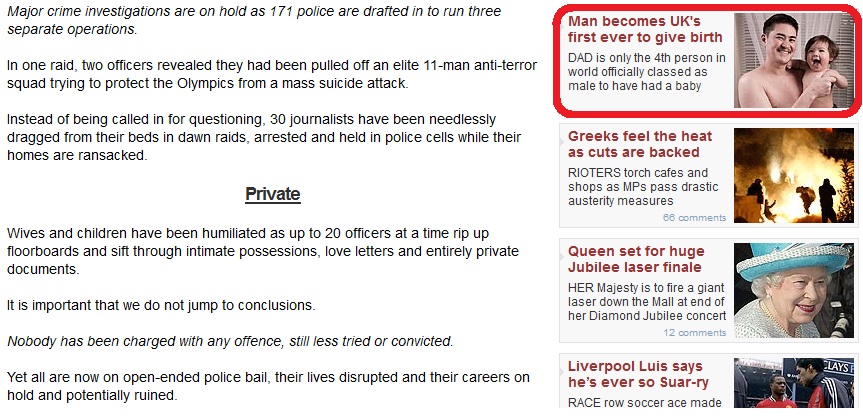
But wait! what’s this we see next to Kavanagh’s article in the online edition?

(click image for full size)

That’s right, it’s the Pregnant Man! Let’s take a look at his story.

Don’t forget kids, private lives are for News International employees, not for proles! Particularly queer proles.

Of course, it could be that the Sun is simply asking for contributions because all their journalists have been arrested…

(For more constructive commentary, see this powerful post by Ralph Francis Fox, as well as analyses from Jane Fae and Christine Burns.)

“Pregnant Man” story isn’t racy enough for The Telegraph

Yesterday, I noted a number of issues with the reporting of a British man’s pregnancy and the subsequent birth of his child. It seems, however, that the story simply wasn’t exciting enough for The Telegraph, who have revised their article somewhat overnight.

(click above for full-sized image)

The story itself remains largely unchanged: there is no new information. The only difference I could pick out was the introductory paragraph, which has changed one phrase in order to turn this somewhat inaccurate but broadly inoffensive sentence:

The man, who is believed to be in his 30s, was able to carry a child after taking female hormones to reverse the effects of his female-to-male sex change treatment.

…into something which takes that extra step to question the subject’s gender.

The ‘male mother’, who is believed to be in his 30s, was able to carry a child after taking female hormones to reverse the effects of his female-to-male sex change treatment.

Somewhat bizarrely, the original story remains online, possibly because The Telegraph wouldn’t dare offend the hundreds of readers who took time to comment on how disgusting it is that trans people want to mutilate their bodies.

Yesterday I was prepared to concede that Telegraph journalists were content to merely be stupid and lazy on trans issues. It turns out, however, that they’re actually prepared to put effort into their transphobic bigotry. Well done all.

British media in a tizzy over pregnant man

It’s finally happened: someone has noticed that a trans man in this country has had a baby. Of course the mainstream media, who between them seem utterly incapable of the slightest act of research, are responding in a predictable storm of inaccuracy and mild hysteria.

The facts appear to be as follows: some fellow – who quite understandably appears to desire anonymity – decided to have a child, and contacted the Beaumont Society for advice. The Beaumont Society don’t have a lot of knowledge in this area as they predominantly help out MtF spectrum individuals and their families, so they quite sensibly referred the individual in question on to GIRES. The grateful father later got back in contact with the Beaumont Society to thank them for their help, and everyone lived happily ever after.

Of course, that really isn’t a very exciting story. So the British media have taken a few steps to spice it up a little:

1) Exoticise trans pregnancy. Apparently this is the first British man to ever give birth. Except, of course, he isn’t. He’s just the first one they’ve noticed. There are a great many trans men in this country with children, but I suppose if you give birth before having a “sex change” (by which I believe the media mean taking hormones and/or having chest surgery) it doesn’t really count. I mean, you’ve got to be covered in hair to be a “real man”, right? There are probably also several trans guys who have had children prior to transition (at least one guy I know is planning this) but if the media doesn’t know about it, it ain’t happened. Even Pink News fall foul of this one.

2) On a related note: emphasise the international significance. Only around two or three men in the world have ever given birth before! I say “around” because there’s some confusion over this. The Telegraph uncritically quotes the Beaumont Society’s Joanna Darrell, who (purportedly) stated that one trans man gave birth in the United States (Thomas Beatie) and another in Spain. Meanwhile, the Metro states that an additional American and a guy in Israel gave birth after Beatie.

3) Highlight the risks. There is no evidence that trans children are in any particular danger from being born to trans parents, but gosh-darn it there might be! Right? According to the Telegraph: “Last night medical ethics experts called for a full inquiry into the issues surrounding transgender births, saying the interests of the child should not be risked to ‘fulfil the rights of an adult’.” At the heart of this is a very topical concern with trans fertility.

4) Finally, think of the children.  A number of sources are citing Trevor Stammers, Director of Medical Ethics at St. Mary’s University College. Stammers clearly isn’t a fan of queer families:  “The fact that the medical profession is facilitating and encouraging this is a serious problem. You are hardly going to end up with a baby that’s going to have a happy, productive and optimal childhood.

Of course, Stammers himself doesn’t appear to be a medical doctor. Now there’s a surprise.

Trans Media Watch at the Leveson Enquiry

Helen Belcher of Trans Media Watch provided an impressive array of evidence in relation to transphobia in the media during the Leveson Enquiry yesterday. Video footage and full transcripts in .pdf and .txt formats can be found here. Trans Media Watch’s full submission to the enquiry can be found here.

Unfortunately – if unsurprisingly – Belcher’s strong performance warranted little comment from the mainstream and “pink” media alike. Notable exceptions included the headline story in Gay Star News (Trans people victims of ‘horrific’ press coverage) and a comment piece in Pink News (Does today mean change for the trans community?). There have been just brief summaries of Belcher’s evidence (with little or nothing in the way of analysis) within articles that tackle Wednesday’s events more widely in The Guardian, The Telegraph and on the BBC website. Even the #Leveson hashtag on Twitter went relatively quiet as the majority of cis commentators lost interest.

Still, this was to be expected, and we shouldn’t underestimate the importance of Trans Media Watch’s role in compiling and presenting evidence to such a major inquiry. Belcher powerfully outlined a number of very important issues:

  • The consequences of negative media coverage can be extremely serious for trans people: examples include loss of work, death threats, and the necessity of relocation in order to avoid prejudice.
  • Dehumanising and Othering language is routinely used within news stories: “The Sun is basically saying trans people elicit horror, trans people are frauds“.
  • Stories (and pictures) are often published without any consultation with the subject, let alone permission.
  • Newspapers often rely upon false information, such as inaccurate figures about the cost of medical transition on the National Health Service.
  • The Press Complaints Commission is considered useless and toothless as complaints are regularly ignored: “The Press Complaints Commission is regarded as a useless joke by trans people”.
  • Victims of negative media coverage tend to let the issue slide: “[…] we find that individuals rarely want to pursue the case because they then become afraid of future
    harassment“.
  • There tends to be no real justification for most articles about trans people on the grounds of “public interest”.
  • The Sun continues to run transphobic pieces (contrary to the claims of Dominic Mohan during his evidence to the Leveson Enquiry on Tuesday).
  • The Daily Mail publishes six times more stories on trans people than any other UK newspaper(!)

Trans Media Watch also identified a number of common themes in confidential complaints they’d received from trans correspondents who had suffered negative media coverage:

“In each case, the subject of the story had their right to privacy grossly breached, often at a very vulnerable time, with no public interest being served whatsoever.

Was put in danger of public abuse and/or violence.

Is left with candid details of their personal affairs, including previous names, pictures, home or work, available on the Internet.

Often these details, including photographs, were acquired without the subject’s permission. Had to fight the press to force them to exercise restraint — often with no effect.”

Finally, Belcher made a number of recommendations:

  • That it should be possible for organisations to issue complaints on the behalf of vulnerable individuals.
  • Anonymity should be granted to all who pursue complaints; we shouldn’t have to rely on the limited protections offered by the likes of the Gender Recognition Act.
  • The complaints process for media malpractice should be free:
    A lot of trans people lose jobs, find it difficult to get jobs. There is evidence that the earnings of a trans person is significantly lower than they could expect if they weren’t trans. That is a further deterrent for them to seek any recompense. It actually pretty much prevents any trans person from pursuing any action against a newspaper in the courts.

10-year-old trans girl launches petition as Leveson Enquiry tackles transphobia

Jane Fae wrote a powerful post
today
highlighting the connection between two important events this week for trans people in the media.

The first of these events is the launch of a petition that calls upon the press to stop using dehumanising and othering language to describe trans people. The petition was started by the family of Livvy, a 10-year-old girl who became one of the most recent examples of trans children hounded by the news media.

They argue that transphobic language can ultimately kill:

People with gender identity issues are being murdered, beaten, threatened with their lives, bullied, teased, intimidated, disowned and are prone to suicide both attempted and successful and self harm. The Press being an extremely powerful medium has the responsibility to ensure they are not aiding peoples ignorance and hatred and increased lack of self esteem.

Meanwhile, the Leveson Enquiry is due to receive evidence  from Trans Media Watch this afternoon (a live video stream will be available here, as well as an archived video and transcript following the hearing). Josephine Shaw posted the following announcement on the group’s Facebook page:

“[…] Helen Belcher will be representing us at the Inquiry, next Wednesday – February 8th. She’ll be doing so following a detailed written submission made by TMW a few weeks ago, a public version of which is available via the downloads page of the TMW website.

There have been a very large number of written submissions to the Inquiry – only a small number have resulted in Lord Leveson calling witnesses in person. We’re absolutely delighted to be counted in that number […]

TMW’s aim next week is simple. To give voice to the pain and anger of all those trans and intersex people whose lives have been invaded, even ruined, without any cause or warning by the British press. Who deserved accuracy, dignity and respect. Or who simply deserved privacy. And to try and represent our community in calling for a profound change in the attitude of the press and an end to the incessant outrageous and unwarranted intrusion into the lives of innocent trans and intersex people.”

This week therefore sees two significant responses to the ongoing media assault upon trans lives. The two met this morning on the BBC’s Breakfast show, when Livvy and Trans Media Watch’s Paris Lees spoke about transphobia in the media.

It’s really heartening to see all of this happening. I agree with Jane that we have good reason to remain cynical, but equally we have plenty to celebrate at this juncture. For too long, journalists have been getting away with inflaming public opposition to trans liberation, and people in power are finally beginning to listen to our howls of outrage. This is an early step towards a more fair and friendly world, but an important one.

I was fortunate enough to meet Livvy a few months back and was inspired by the sheer determination of both her and her family; we have a lot to learn from them! I was also struck by my own surprise role in Livvy’s story via a sensationalist piece published by the Sun back in September:

But yesterday a row broke out after a parent claimed that kids as young as EIGHT at Livvy’s school were shown a film about sex-change surgery.

In the footage, made for the NHS website, Ruth’s Story describes how she was born a boy — but knew from the age of 16 she wanted to be a woman.

One parent said: “We are not against the child. It’s that the children are being asked to treat her differently and watch a transgender video without parents knowing.

The video in question was made for the NHS a few years back, and at the time I had no idea it could ever be shown to a primary school assembly! I would probably phrase a few things differently now but ultimately I’m still pleased with how it turned out. I became involved in the project by responding to an email from a mass trans mailing list: someone else could just have easily done it.

Ultimately I suppose my point is that every bit of effort counts. Every signature on Livvy’s petition, every angry letter to an editor, every trans awareness workshop and every intervention within public conversations. Let’s keep up the pressure, because it’s the only way we stand a chance of winning!

Update on the HESA gender statistics affair

Some clarification, new information and new developments have emerged since I posted about HESA’s gender statistic fail yesterday.

Background

The Higher Education Statistics Agency (HESA) is currently revising a number of data collection fields. The changes are not yet set in stone. 

Two new fields (student.SEX and student.GENDERID) will effectively replace the one existing field (student.GENDER) which is currently used to collect data on gender within higher education institutes (usually universities) in the United Kingdom.

The existing student.GENDER field has the following categories*:

1 Male
2 Female
9 Indeterminate

In regards to “Indeterminate”, HESA note that:

“Code 9 ‘Indeterminate’ means unable to be classified as either male or female. It should not be used as a substitute or proxy for ‘Not known’. The term ‘indeterminate gender’ is intended to identify those who are ‘intersex’ and is not related in any way to trans-gender.”

However, in practice a number of institutions have effectively mapped answers such as “other” and “prefer not to say” onto this third category within enrolment/re-enrolment forms in order to provide non-binary, genderqueer, intersex and other students to effectively “opt out” of the gender binary.

The new, compulsory student.SEX field has the following categories:

1 Male
2 Female

The new, optional (for institutions) student.GENDERID field has the following categories:

01 Yes
02 No
98 Information refused

A brief analysis of the harm in these changes can be found in my previous post.

Developments

It appears that HESA have received a number of queries and complaints from trans people: it’s uplifting to see so impressive and rapid a response!

The agency initially responded by noting that the changes were the result of “consultation with [the] HE sector and ECU“. Commentators noted that this consultation seemed to at no point involved actual trans students.

However, in the last hour HESA have provided the following statement from their Twitter account:

“Thanks for queries re. sex and gender in next year’s HESA record. Your input will help us get this right.”

The tweet links to correspondence conducted between HESA and trans activist Emma Brownbill – if you have the time, it’s worth a read!

Some key points include the following:

“The phrase ‘legal’ sex is only currently used in the Staff Record. The intention in the Staff Record is to match the data requirements of HMRC, which for tax and pension purposes only accept Female or Male.

The final coding manual and guidance for the Student Record in 2012/13 has not been published. From your own and other queries about the provisional guidance and consultation documents it is clear that the terminology of ‘legal’ sex may not be appropriate for the Student Record.

Similarly the binary choice of Female or Male, originally intended to match the Staff Record, is now the subject of further discussion with regard to the Student Record.”

So let’s keep at this – we’re really getting somewhere!

Also, thanks to everyone who commented on the previous post, your contributions were greatly appreciated.

Edit: the story has now hit Pink News.


*The numbers (e.g. 1, 2, 9, 98) are used within statistical analyses.


Gender recognition under threat in UK universities

I read a very disturbing internal email this afternoon. I’m not going to quote the majority of it in order to preserve anonymity, but the central content is of concern to any current or future trans student in Higher Education.

Earlier this year, HESA [Higher Education Statistics Agency] confirmed a series of changes that they would be making to the HESA Student Record for the 2012/13 academic year, which would have an impact on some of the questions that students are asked during the application and enrolment process. A number of these changes relate to equality issues and the 2010 Equality Act and I thought it would be prudent for us to consult […]

The key changes of relevance are as follows:

(1) There is an existing field Student.GENDER which will from 2012/13 be replaced with Student.SEX. The new Student.SEX field will reflect ‘legal’ biological sex at birth and we have been advised that there will be only two valid entries for this field, either Male or Female.

(2) To complement the new Student.SEX field there will also be an additional field, Student.GENDERID, which is intended to reflect the student’s gender identity based on their own self-assessment. A response to this question, should we choose to ask it, would be optional for students. The ‘suggested question’ from the Equality Challenge Unit for eliciting this information is “Is your gender identity the same as the gender you were originally assigned at birth?” and it would be possible for students to respond with ‘Yes’, ‘No’, or ‘Information Refused’.

At my university, the current student.GENDER field allows students to identify as “female”, “male”, “other” or “prefer not to say” following intervention from trans activists and past Students’ Union welfare officers. This system, and any similarly progressive approach from other institutions, will be overturned by the new HESA guidelines.

My concerns are as follows:

1) What is “legal” sex? Is it:
(a) my birth sex? (in which case I’m male)
(b) what’s on my passport? (in which case I’m female)
(c) whether or not I have a gender recognition certificate? (in
which case I’m male)

[edit: a skim of the HESA guidelines shows that (a) is not the case, with the university apparently using the phrase “sex at birth” in error]

2) If (a) or (c), then the University is going to revert my “sex” on its forms. This will disclose I am trans to anyone using their records.


3) If (b), then anyone wishing to update their gender will have to out themselves by walking into the university administrative building and presenting their passport.
I had to do this in 2005 and it caused all kinds of weird issues with the Students’ Union and my records. We changed the system in two stages (the last one is referred to in the letter) in order to prevent this from happening to anyone else.

4) The new system erases intersex people.

5) The new system erases people with a non-binary identity.

6) This whole approach has an extremely flawed methodology that will only invalidate the desired data!

I suspect my university doesn’t have much of a choice about how this is carried about, and neither will others. We urgently need to lobby HESA to reverse their policy on this.

I’ll aim to write a more coherent analysis of the situation (inc. the complex role of the Gender Recognition Act) when I’m feeling more coherent.

EDIT: HESA notes changes to the student.GENDER field here. Information on the new (binary) gender identity code can be found here.

Transgender action plan: an initial analysis

Advancing transgender equality: a plan for action” was today published on the Home Office website. The document is the latest step in a historic programme of trans engagement undertaken by the current government. So, how does it shape up?

THE GOOD

Regular readers of this blog will be quite aware of how much I distrust and dislike the Conservative-led government. Their work on trans equality (in a purely liberal sense) has, however, been quite impressive on the whole.

Under the leadership of Equalities Minister Lynne Featherstone – who has long been a trans ally in Parliament – the Home Office has pursued a programme of engagement and genuine consultation that quite outstrips anything achieved by the previous Labour government (who generally passed trans equality legislation only when ordered to by the European courts).

The action plan promises a robust response to needs expressed by the trans community on a whole variety of fronts. Most of the government’s promises involve the production guidance for various individuals, organisations and/or sectors: this may not sound like much, but the value of this documentation should not be underestimated. Some of the biggest challenges we face arise simply from the fact that doctors, civil servants and others simply don’t know what they’re doing when confronted with trans issues, so it’s good to see this addressed. Of course, we’ll have to see how these promises actually pan out.

So, what do we have?

The Headlines

  • The big news is arguably the
    introduction of trans hate crime legislation
    . The government plans to amend existing laws in order to provide for:

“[…] sentences to be aggravated for any offencemotivated by hostility towards the victim onthe grounds of being transgender, and for a30 year starting point for murders motivated by hostility towards the victim on the groundsof being transgender.”

  • The government has also promised to “review” how gender identity is represented in passport application forms, and in passports. It’s not inconceivable that this may lead to the introduction of gender-neutral passports, particularly as the IPS admitted in September that they are “considering” this option. The explicit recognition of “non-gendered” individuals in the action plan itself is also an interesting move on this front.

The nitty-gritty

Various government departments are assigned responsibility for a whole host of actions, including:

  • the issuing of statuatory guidance to increase head teachers’ power to tackle bullying (inc. transphobic bullying)
  • further emphasis upon “prejudice-based bullying” (inc. transphobic bullying) in Ofsted inspections*
  • working to build trans equality into existing practices within primary, secondary and further education (e.g. in PSHE lessons, teacher skills programmes, FE equalities training)
  • updating “advice for employers on recruiting and employing transgender employees”
  • revising guidance for Job Centre staff
  • additional “pre-employment support” for marginalised groups (inc. trans people)
  • clear guidance on trans pension rights on the DWP website, and better handling of pension claims
  • guidance on holding public sector bodies to account through the Equality Duty (an aspect of the Equality Act 2010)
  • “clear and concise” guidance  on transition treatment pathways for GPs and PCTs
  • information on trans health (including sexual health) on the NHS Choices website
  • ensuring that health consultations are trans-inclusive
  • updating privacy guidance within government departments (inc. provide better guidance on the use of privacy markers to protect privacy for employers and benefit claimants)
  • a guide to equality legislation and policy for trans people
  • community outreach on the democratic system and relevant government programmes
  • working with housing providers to produce best practice guidance on trans accomodation (inc. advice on tackling transphobic anti-social behaviour)
  • “Work[ing] with the transgender community” during the marriage equality consultation
  • continuing to play an active role in condemning transphobic violence and discrimination through the Council of Europe and the United Nations
  • providing better guidance on gender identity and trans individuals within the asylum system

Moreover, there a number of actions the government has already taken:

  • police forces have been required to collect data on transphobic hate incidences since April 2011
  • trans people are included (just about) in the Charter against homophobia and transphobia in sport
  • a module on gender identity has been launched as part ofthe training course for asylum decision-makers
  • transphobic bullying was included in an anti-bullying guidance for headteachers
  • UK diplomats worked to promote a historic United Nations Human Rights Council resolution condemning homophobic and transphobic violence and discrimination

THE BAD

My general impression of the document – and planned actions within – is broadly positive. However, there were a few items of concern within the action plan:

As part of the Government’s wider work to
develop a new NHS Commissioning System,
ensure greater consistency in commissioning
gender identity services, increased patient choice
and more cost effective treatment plans for
gender dysphoria.

The term “more cost effective treatment plans” certainly rings alarm bells. How many ways can transition become less expensive to the NHS whilst retaining an appropriate level of care? Moreover, “increased patient choice” definitely sounds like it’s part of the government’s dodgy privatization agenda. On the other hand, this point may simply entail a removal of bureaucratic barriers, and the “greater consistency” should, hopefully, be a positive development overall. Time will tell.

Deliver a framework for evaluating the Equality
Act, including the implementation of the
exceptions on gender reassignment.

Will this work to prevent companies from exploiting loopholes in order to discriminate against trans people, or will it help organisations such as Rape Crisis deny access to vital services?

Run a workshop for the transgender community
to increase their understanding of the public
sector Equality Duty and how they can hold
public bodies to account

A single workshop for the “transgender community”? I hope we’re all invited!

Finally, there’s a lot of talk about “considering” and things that might be “possible”. I do wonder how many of these points will be translated into firm action.

THE UGLY

Fortunately, there’s not too much of this, but there’s the odd action point that stinks. There have clearly been Tory spin-doctors at work on this document, because at times it’s clearly attempting to push the government’s agenda in a number of areas rather than, y’know, trans equality. Whether or not you agree with this agenda is up to you (personally, I’m against for all sorts of reasons) but surely this kind of action plan shouldn’t really be about pushing the government’s pet projects?

Some choice quotes (emphasis mine):

“Transgender people, from transsexual to nongendered,
want to be able to participate in and make their contribution to society and the economy.

Wait, I thought this was about equality and fairness, rather than corporate drone culture?

Equality of opportunity in employment is
fundamental to building a strong economy and
a fair society. We know that workplaces that are
more inclusive are also more productive.

Glad to see the government has its priorities sorted.

Take active measures to ensure that the views of
transgender users shape the Government’s Care
and Support White Paper and create a care
market that is more responsive to diverse needs.

Because “care” should be bought and sold, and markets are necessarily efficient.

Promote, via government information portals,
relevant funding streams to the transgender
community to ensure they are aware of funding
available to participate in the localism agenda.

That totally makes up for all the national funding that’s been cut, right?

Ensure that National Citizen Service (NCS) for
16 year olds is an inclusive and safe environment
for all participants, including transgender people,
by encouraging NCS providers to build equality
issues into their information and training for staff.

Another pet project! To be fair, at least they’re putting some effort into ensuring its actually accessible and all.

AND FINALLY…

An absolute howler courtesy of the “headline findings” from the community surveys that fed into the action plan:

Nearly two-thirds of respondents (47%) thought that intervention, such as guidance or training, would be best focussed in secondary school

And if that’s not confirmation that the government needs to invest properly in education, I don’t know what is.