New Year’s Resolution: Smash the new Section 28

This post is about the Department for Education’s December 2023 draft guidance on “Gender Questioning Children”. Advice on how you can take action can be found at the end. You can download a printable zine here.

The post was updated on 23 February 2024 to add information on the Further Education Residential Standards Consultation and the murder of trans student Nex Benedict in a school toilet.


Like many other young people, my first experience of sexual assault was in school.

I stood in the lunch queue at my school’s canteen, a boy my age behind me. Unexpectedly, he began to tenderly caress my back and my bum. Feeling extremely uncomfortable and vulnerable, I turned to confront him. He leered, laughed, then accusingly asked, “you gay?”

Sketch of an imposing school building

Like many queer students during the 1990s and 2000s, I was bullied viciously throughout my time in school. I was teased incessantly, beaten up, and on one occasion knocked unconscious in front of my entire year group. Later, since I started living as a girl, I’ve been groped by men many times in clubs and pubs. Yet that specific moment of abuse sticks with me especially.

So much can be said about it. I was a heavily closeted trans girl attending an all-boy’s comprehensive, and yet to admit I was also bisexual. I wonder of course about the sexuality of my harasser, who may have found bullying the only “safe” way to experiment with his own desires. But most important is the context of the wider school environment. Homophobia and ignorance about sexuality and gender was the norm; one that was not simply enacted between children, but also deeply rooted in policy and law.

Nothing was ever done about this sexual assault – in part because I didn’t for a moment consider telling anyone.

I attended school at the time of Section 28, a notorious anti-gay law enacted across Britain by Margaret Thatcher’s Conservative government. Section 28 was named for a clause in the Local Government Act 1988, in which local authorities (responsible for the management of state schools) were prohibited from “promoting homosexuality by teaching or by publishing material”, or promoting the “acceptability of homosexuality as a pretended family relationship”. It was introduced following a major moral panic in the media over homosexuality in the wake of the HIV/AIDS epidemic, plus the publication of a handful of short books and leaflets with advice on teaching young people about the existence of gay and lesbian families or historical figures. 

Section 28 would remain in force for over a decade. It was eventually repealed by the first Scottish Parliament in 2000, and in England and Wales by Tony Blair’s second Labour government in 2003, although its effects would linger for years to come. In addition to directly barring local authorities from introducing affirmative teaching material about lesbian, gay, and bi lives, Section 28 had the wider impact of stifling any real discussion around sexuality or gender difference. Teachers were afraid to talk about the issue, and books were banned from schools and libraries. Meanwhile, “gay” was the ultimate insult in the playground, a go-to word for any person, action, or object that was undesirable or bad.

Section 28 did not have anything specific to say about acknowledging that lesbian, gay, or bi people exist, or about homophobic bullying in school, let alone about trans or intersex matters. It didn’t need to. The vague prohibitions of the law, along with a more general culture of ignorance, silence, and fear promoted by politicians and journalists, meant that many people were uncertain where the boundaries of legality lay. Instead, there was a widespread feeling that you simply couldn’t talk about it.

The impact on entire generations of young lesbian, gay, bi, trans, intersex, and queer (LGBTIQ+) people was horrific. Many of my peers talk about the traumatic impact of growing up during this time, of struggling to come to terms with their desires and experiences, of failing to receive protection from adult authority figures or being abused directly by them. You can read more about this in accounts such as in Kestral Gaian’s book Twenty-Eight.

The worst thing for me about growing up under Section 28 was the utter lack of information. When it came to my sexuality and trans experience, I didn’t even know what I didn’t know. I had no easy way into understanding my own feelings and changing body, let alone the quiet but immense impact of a law I’d never heard of. I wrote a diary across several years chronicling my self-hatred and feelings of being ill, broken, wrong, a freak. I was extremely unusual in coming out as a girl during my teen years, in part because I had the luck to stumble across supportive US-based internet communities when I was 15, circa 2002. I wonder what information and support my harasser in the lunch queue ever had available to him. 

The first adult I came out to outside of the internet was our Religious Education teacher, Mrs Richards. In retrospect, she was clearly a rebel, with a deep sense of Christian conviction about social justice which meant she was prepared to risk her job to do the right thing. At the time, I was vaguely aware she had been in trouble with the headteacher for telling a sex education class that, statistically speaking, at least some of us were gay and we needed to be okay with that. I told her that I wanted to be a girl, and asked where I could find help.

Mrs Richards did the best she could for me at the time – she sent me somewhere safer. She said she couldn’t speak with me, but recommended a free counselling service in town. This provided the first supportive, affirmative space in which I could explore my gender in person, laying the groundwork for my eventual transition. At the same time, I regret that even the most rebellious teacher in my school didn’t feel she could even safely listen to or reassure me in an extremely vulnerable moment.

sketch of several condoms, a bunch of bananas, and a condom on a banana

After Section 28

Following the repeal of Section 28, many teachers remained unsure about what the law said and whether they were allowed to discuss LGBTIQ+ issues in the classroom. Nevertheless, there has been a gradual shift towards the explicit acknowledgement and inclusion of queer lives in curricula and pastoral support structures. In 2005, Schools Out launched the first LGBT History Month resources for schools. In my mid-20s, now a proudly out trans activist, I attended an event in Coventry about moving on from the legacy of Section 28. It was supported by the city council and attended by many teachers. A few years later, attempts to reintroduce Section 28-style policies at some academy schools were explicitly condemned by the Department for Education. The world was changing.

Meanwhile, LGBTIQ+ adults and young people were more visible in society than ever before. We were increasingly present on TV, in movies, and in the charts. The emergence of social media meant we began to find one another and create our own content on Myspace… then Facebook, Youtube Tumblr, Twitter, Twitch, and Tiktok. It became more normal to have an LGBTIQ+ friend, colleague, sibling, child, uncle, or parent. This created a virtuous cycle: the more we were out and visible in society, the easier it was to come out. There are now more openly lesbian, gay, bi, and trans young people in the UK than ever before. I hear about this a lot from friends who teach in secondary schools. Queer kids are increasingly just a normal part of school life. For those who need more support – often young trans people – there are often clubs or groups facilitated by teachers: something that would have been almost impossible under Section 28. 


The new moral panic

Social progress is never linear nor guaranteed. We must therefore always be prepared to defend the gains we have made.

Since 2017, the UK has been gripped by a wide-ranging moral panic over trans people’s existence, as part of a wider backlash to social progress which has also affected groups including migrants, racalised minorities, and LGBTIQ+ people more widely. One element of this has specifically targeted educational, pastoral, and media support for young trans and gender non-conforming people. Prominent anti-trans campaigners have sought to raise fears over the growing number of out and proud young trans people, portraying trans experiences as a “social contagion” among children and adolescents, arguing that this should be addressed through the “elimination of transgenderism” or otherwise “reducing or keeping down the number of people who transition”.

The violence of this language is reflected in the violence that too many young trans people continue to face from other children and adolescents, as well as the adults who are supposed to help them. But anti-trans campaigners continue to position young trans people themselves as the problem. 2020, Liz Truss (then Women and Equalities Minister) stated that trans people aged under 18 should be “protected” from “decisions they could make“, raising fears of a new Section 28.

That new Section 28 is now here, in the form of draft non-statutory guidance on “Gender Questioning Children” for schools in England, produced by the Department for Education at the behest of the UK’s Conservative government. This document, which is currently under consultation, threatens to significantly undermine the ability of young people to safely be themselves. And just like Section 28, while the draft guidance specifically targets one group, it threatens to cause harm far more widely.


What does the Department of Education guidance say about “Gender Questioning Children”?

I will not be providing a detailed breakdown of everything the guidance states – for this, I recommend alternative analyses such as Robin Moira White’s excellent commentary for TransLucent. However, key elements include the following:

  • Trans students are presented as an implicit danger to themselves and others. Schools are told to “safeguard” against young people coming out or transitioning, and the impact of this on other students.
  • Schools are told to out trans students both to their parents and to the “school community”. The guidance prioritises informing others over young people’s own right to safety, confidentiality, or self-determination.
  • Schools are encouraged to intentionally misgender students. Secondary schools are advised to consult parents and “only agree to a change of pronouns if they are confident that the benefit to the individual child outweighs the impact on the school community”. Primary schools are told that “children should not have different pronouns to their sex-based pronouns used about them”.
  • Schools are told to ban trans girls from girls’ toilets and changing rooms, and ban trans boys from boys’ toilets and changing rooms. The guidance advises that toilets access should be based on “biological sex”, with the possibility of an “alternative changing or washing facility” for individual students given special dispensation.
  • School uniforms should be worn according to “biological sex”: that is, trans girls are expected to wear boys’ uniforms, trans boys are expected to wear girls’ uniforms, and non-binary people are expected not to exist.
  • For sports, schools are told to “adopt clear rules which mandate separate-sex participation” where “physical differences between the sexes threatens the safety of children”.
  • The guidance entirely ignores legal protections for young trans people,most notably through excluding any discussion of “gender reassignment”, the category under which people who socially and/or medically transition are protected in the Equality Act 2010.
  • The guidance does not actually use the word “trans” once (let alone non-binary). The very language we use to describe our own lives is excluded from the document. Instead it refers to children being “gender questioning”, “gender distressed or confused”, experiencing “gender incongruence”, or “gender dysphoria”, or undergoing “social transition”, implying that this occurs as the result of a contested “ideology” or “belief.

In short, the proposed guidance aims to position young trans, questioning, and otherwise gender non-conforming people as a problem. If implemented, it would make it extremely difficult – if not impossible – for young people to be themselves in school, to trust teachers, or to seek support if they are subject to transphobic bullying from peers. As Gendered Intelligence observe, “What strikes us most about this guidance is the tone of cruelty and contempt towards children and educators throughout.”
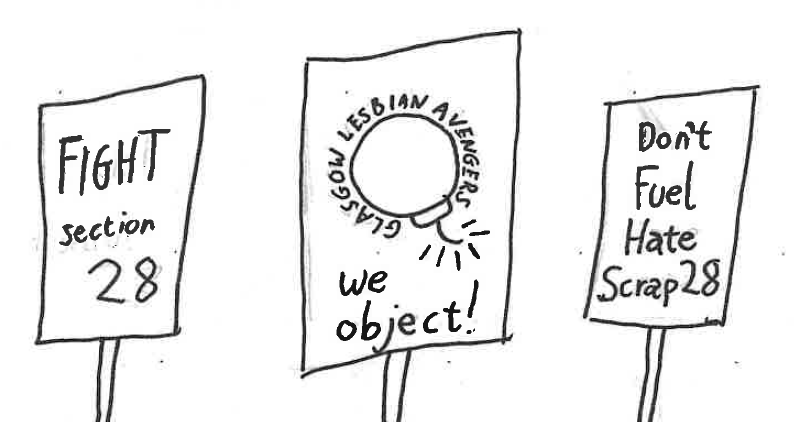
sketch of placards, reading Fight Section 28, Glasgow Lesbian Avengers: we object!, and Don't Fuel Hate Scrap 28

How dangerous is the Department for Education guidance?

In this post, I invoke the legacy of Section 28 very deliberately. The new proposed guidance on “Gender Questioning Children” is of course a very different document, produced in a different time, with a different response from civil society. However, I feel that understanding the guidance’s similarities to Section 28 is useful for analysing why it is so harmful, and understanding its differences can help us to map routes to resistance.

Like Section 28, the draft guidance is most dangerous in its vagueness. It does map out numerous ways to directly abuse young trans people, for example, through intentional misgendering and seeking to block social transition. However, it is the more general refusal to engage with the humanity and agency of young trans people – for example, through failing to even use the word “trans” once – which is most chilling.

While young trans people are of course the main target of the guidance on “gender questioning children”, the impact promises to be wider. As my own story shows, while Section 28 only explicitly targeted “homosexuality”, teachers or bullies didn’t tend to draw any distinction between gay, bi, queer, or trans experiences. Indeed, the atmosphere of ignorance and uncertainty made it difficult to event come to term with those differences. Many of us who went to school at that time struggled to come out because we had very little context for understanding ourselves. At my school, like many, boys were punished for painting their nails or growing hair past their neck. Similarly, the new guidance threatens to make life more difficult for any gender-nonconforming young person, regardless of whether they identify as trans. The point is to shore up and reinforce traditional understandings of sex and gender, in line with hardline conservative ideologies. Teachers, administrators, governors, and academy sponsors who actively wish to reinforce gender roles and make queer people’s lives more difficult will gain a powerful tool to legitimise sexist and homophobic policies, as well as transphobia.

However, homophobic bullying and ignorance also prospered under Section 28 because teachers were unsure about the limitations of the law and afraid to overstep. The new guidance’s insistence on entrenched biological essentialism could make even sympathetic teachers feel afraid to acknowledge queer and trans lives in their teaching, or otherwise put them under pressure from headteachers and governors. The whole point is to make LGBTIQ+ and especially trans students an impossibility: to enable incomprehension, to make them feel unwelcome, to “reduce” them in number, to make them disappear.

Where young queer and gender non-conforming people refuse to comply with this imperative to disappear – through coming out, through transition, through stubborn persistence – the guidance aims to make their lives immensely more difficult. They are to be outed to their peers, to their parents, to their peers’ parents. They are to be banned from wearing clothes associated with the “other sex”, barred from toilets and changing rooms, discouraged from using their own name and pronouns.

If enacted, this intentional targeting of trans and gender non-conforming lives and wellbeing will send an important message: it’s open season on the queers. As with Section 28, the guidance risks empowering bullies through fostering an atmosphere of institutionalised disrespect. The guidance states that “bullying of any child must not be tolerated”, but that statement feels pretty meaningless when the same document encourages schools to identify some children as different to their peers, and refuse their self-expression.

Normalising transphobia is extremely dangerous. We can see this, for example, in the murder of Brianna Ghey, a 16 year old trans girl who was stabbed to death in 2023 by two of her peers from school. Like many transphobic killings, her murder was extremely brutal. Prior to her death, the murderers shared numerous graphically violent messages about Brianna, using transmisogynist slurs and referring to her as “it”. This language and dehumanisation directly reflects discourses in society promoted online and in the press by gender-critical activists, journalists, and politicians from every major party. Brianna’s killers may have held the knife, but others with more power have repeatedly called for the “elimination of transgenderism”, and continue to do so. 

Edit: 23/02/24

Two recent events have further highlighted just how dangerous the Department for Education “Guidance for Schools and Colleges: Gender Questioning Children” really is.

Firstly, the Department for Education has quietly introduced a second consultation. This consultation is on a proposed change to the actual law for Further Education colleges providing residential accommodation for students aged under 18. The law currently states that sleeping accommodation should “provide appropriate privacy for all students”. The Government is proposing to replace this with a clause requiring that “gender questioning students” either be segregated and made to sleep in a room on their own, or otherwise forced to share a space with students assigned the same sex at birth, as “different legal sexes should not be sharing sleeping accommodation”. This intervention shows how the main guidance is just one part of a wider attempt to undermine young trans people’s dignity and safety.

Secondly, just days ago Nex Benedict, a trans student in the US state of Oklahoma, was murdered by cis girls in the school toilets. Nex and another trans student were violently assaulted just months after their home state introduced a law requiring all students to only use toilets that match the sex listed on their birth certificate. This horrific killing reflects what researchers have been telling us for years: trans and gender non-conforming people of all genders are most at risk of violence in gendered spaces, and enforcing strict rules only exacerbates these risks.


The good news

It is difficult to feel positive in the current moment. After years of anti-trans campaigning and threats, the Conservative party is acting to intentionally make life harder for young trans people, in a move that has far wider implications for student safety as well as queer and feminist initiatives in schools. The Department for Education’s proposed school guidance is not simply being championed by the Conservative government – its publication has been “welcomed” by the Labour party, and supported by liberal media outlets such as the Observer as well as the Tory press.

However, the legacy of Section 28 is once again useful for understanding what is happening here. The Conservatives are once again showing us who they really are – this is not new. The Labour leadership were just as useless in responding to the original Section 28, and the UK Labour government was in power for six years (most of my time in secondary school!) before they bothered to repeal the law in England and Wales. The liberal media was somewhat more opposed to Section 28 in the 1980s than they appear to be now, but ultimately it was neither journalists or politicians who created the pressure for repeal. It was LGBTIQ+ campaigners and our allies: especially young people from groups such as Queer Youth Network who worked ceaselessly to change the conversation and create a better environment in schools and beyond.

Moreover, there are two major differences between 1988 and 2024 which are important to highlight.

Firstly, the legal situation is radically different. Section 28 was written into law, and applied across Britain. By contrast, the new guidance is “non-statutory”, and applies only to England. This means that schools are not legally obliged to follow it, especially in elsewhere in the UK. The government’s proposals can therefore be ignored. In fact, ignoring the guidance might even be the wisest option even for transphobes, given that the government’s own lawyers have warned that those who follow it risk breaking the law, as the recommendations appear to directly contradict both the Equality Act and elements of safeguarding legislation. Moreover, the guidance is yet to be published in its final form, as it is under consultation until 12th March – meaning that you can tell the government exactly what you think about it. Edit: 23/02/24 – however, since this post was written the government is now also seeking to change the law through the FE Residential Standards Consultation.

Secondly, there appears to be way more support for trans and gender nonconforming young people now than there was for young gay people in the 1980s, perhaps especially among teachers. The world has changed. For example, I learned about the government lawyers’ warnings from Schools Week. The very day the draft guidance was published, their main headline was Trans guidance: DfE lawyers said schools face ‘high risk’ of being sued. Individual teachers are speaking out across social media to voice their disgust and opposition to the proposals, and teaching unions have also expressed their concerns. Furthermore, headteachers such as Kevin Sexton from Chesterfield High School in Liverpool are going public with their opposition, noting that inclusive policies that centre actual safeguarding for young trans people have been working perfectly well for years. The school has no intention of scrapping its gender-neutral uniforms, mixed-gender sports, or all-gender toilets it provides to young people who need them.

As such, we are in a strong position to fight back against the new Section 28.

sketch of a table with an old-fashioned telephone, piece of paper, and pen on it

How you can take action

The original Section 28 was defeated because countless ordinary people took action. That can be the case again. Of course, some people are better placed than others to fight this particular threat to young people (for example, if you work in education in England). However, there will be things you can do regardless of who you are, how old you are, and where you live.

If possible, act with others, rather than alone. We are always more powerful together.

IDEA 1: Resist the new Section 28 in schools

If you are currently a student, a teacher, a parent or carer, a school administrator, a governor, or even working for an educational company or charity (e.g. in teacher recruitment) you are particularly well-placed to fight back against the new Section 28.

We can see inspiring examples of this in current protests by students and teachers in the US state of Florida, where the government has introduced a slew of anti-LGBTIQ+ laws, including a trans sports ban and a Section-28 style “don’t say gay” law. Kayla Kumari Upadhyaya wrote in Autostraddle about the power of student-staff solidarity in one Florida school:

I know a high school walk out sounds like a small thing, but this is huge. It shows a two-fold approach to resistance happening in the state: First, the administrators and staff members who flouted the ban in the first place showed it’s totally an option to just…not enforce transphobic regulations. If more Florida school staff were willing to do this, it would make the ban difficult and maybe even impossible to reinforce. Second, the students showed their solidarity and support not just for this one trans athlete but all trans athletes, holding signs and chanting affirmations of support for trans lives everywhere and questioning the ban. It’s further evidence that the Florida legislation does not adequately represent the Florida people.

Here are some ideas for English and Welsh schools:

  • Non-compliance. As Upadhyaya observes, transphobic laws and guidance rely on people enforcing them. Headteachers, administrators, governors, and academy sponsors are of course in the best position to reject the new guidance should it be formally introduced following the government consultation. We can see this in the example of Chesterfield High School in Liverpool. But students and teachers can also take action, as can parents (regardless of whether or not your own child is trans). Anti-trans campaigners will be putting pressure on schools to enforce the new guidance, so every person who puts pressure on them to not do so will be important.
  • Implementing alternative guidance. Robin Moira White notes that examples of good practice already exist for supporting trans students in schools and colleges. These include the Scottish government’s guidance on Supporting Transgender Pupils in Schools and Brighton & Hove City Council’s Trans Inclusion Schools Toolkit, both published in 2021.  

Actions include:

  • Refuse to implement the UK government’s guidance on “Gender Questioning Children” if you are in a place to do so, and instead follow the advice of e.g. the Brighton & Hove guidance.
  • Write to the headteacher, Board of Governors, and/or academy sponsor, or ask for a meeting. Tell them that the school should ignore the UK government’s guidance and implement a better alternative. Highlight the danger posed to young people by the UK government’s proposed guidance, and the potential legal challenges the school may encounter if it follows that guidance.
  • Hold a meeting of your own with other students, parents, teachers, and/or administrators. Discuss how you might work together for non-compliance and/or introducing or defending a better alternative.

IDEA 2: Pile on the political pressure

You don’t need to work or study in a school to make a difference. Countless other organisations are in a position to make a difference, and you can put pressure on them to do so. People living throughout the UK are potentially in a good position to do this.

Actions include:

  • Write to your MP or councillor, or phone them up, or ask to meet them in person. Demand they put pressure on their party to actively oppose the UK government’s proposed guidance on “Gender Questioning Children”. This is particularly important for Labour representatives, as their party is likely to win the UK’s next general election.
  • Write to your union and ask them to take a strong stance on opposing the proposed guidance, for example through public statements and/or taking part in the consultation.
  • Write to local and national newspapers. Change the conversation by explaining why you think the government’s proposals pose a danger to the safe of young people.
  • Ban the Conservative and Labour parties from Pride. In this post-Section 28 age, politicians love to use events such as Pride to boost their public image. If you’re not already involved in your local Pride, consider getting involved, or hold a counter-protest within the parade to ensure that transphobic politicians feel unwelcome.
  • Stop giving money to transphobic media. Publishers such as the Guardian Media Group are always shilling for cash, claiming their journalism offers an important beacon of truth in a complex world. That’s not true if they’re constantly pushing hate. If a publication is publishing transphobia, don’t buy paper copies, don’t donate, don’t give them quotes or press releases, and at the very least install an ad block on your browser if you must keep reading.

IDEA 3: Take part in the consultation

I am less certain about this proposal than the others, but it is an obvious one to include. The UK government is holding a formal consultation on their proposed guidance for “Gender Questioning Children” in schools. Anyone can participate, and tell them what you think.

You can take part in the consultation here.

The upside of this is that it is an opportunity for us to speak back directly to the UK government and Department of Education. The downside is that there is a good chance we will be ignored. The past decade has seen more consultations on trans civil rights and healthcare than ever before – and overall, things have got a lot, lot worse. For example, a majority of respondents to the consultation on the Gender Recognition Act from both the UK and Scottish government supported reforms; those reforms are now thoroughly dead, at least for the time being. Trans communities have poured an enormous amount of time and energy into responding to malicious consultations when we could have been doing far more constructive things with our time.

However, in her post for TransLucent, Robin Moira White makes an important point. With the consultation closing on 12th March, the civil service may have little time to assess responses before a new general election is held. She therefore proposes that respondents request that the existing draft be “torn up and thrown away”, and new draft guidance be introduced, based on the Scottish and Brighton examples. If enough people and organisations argue for this, then it might put sufficient pressure on a new Labour government to do a better job.

A related approach was proposed by Edinburgh Action for Trans Health in response to an NHS consultation in 2017. They recommended “hostile participation in the form of direct submissions of demands that don’t react to the questions posed or restrict themselves to the scope imposed by the government”.

Actions therefore include:

  • Take part in the consultation yourself, demanding the government scrap the proposed guidance and introduce something better.
  • Encourage any relevant organisation you are part of to participate in the consultation (e.g. children’s and/or LGBTIQ+ charity, school, educational body, Pride organisation, university department) and ask for the same thing.

I won’t be producing any advice myself this time – instead, I hope this post will help people in thinking about wider routes to resistance. Edit 23/02/24 – However, the following guides have been produced by various organisations:

If you’re responding to consultations, don’t forget to also respond to the Department for Education’s deeply transphobic proposals regarding Further Education Residential Standards. This consultation closes 5 April 2024 so you have longer to respond.

IDEA 4: Support trans youth groups

Regardless of how things play out with the proposed guidance, young trans people are still having a hard time in schools.

There are a small handful of national bodies which support young trans people through advocacy and peer support: e.g. Gendered Intelligence, Colours Youth Network, and Mermaids operate across England. Perhaps more importantly, a lot of small, local youth groups exist specifically for queer and/or trans young people across the country. This was an unthinkable possibility when Mrs Richardson referred me to a local counselling service, so we really need to value and uplift these groups.

Actions include:

  • Find out what youth groups exist locally where you are, and how you can best support them. Some groups will benefit from publicity in the local area; others will want to keep a low profile given the current atmosphere of transphobic backlash. Many will benefit from volunteers – not just to work directly with young people, but also to do jobs such as fundraising, running social media, or designing websites. 
  • Donate money. Pretty much every trans-oriented organisation will benefit from donations, especially those working with young people. If you can afford it, consider setting up a standing donation.
  • Fundraise. If you can’t afford to donate, or want to do something more, you can do other things to raise money for trans youth organisations. Examples include: putting together a small gig, an art gallery, or a bake sale, or doing a sponsored activity.

IDEA 5: Plan a creative protest

Back in 1988, after the Conservative party introduced Section 28 and most Labour politicians refused oppose it, it would have been easy to despair. Instead, some extremely audacious actions took place in opposition to the law. Just after the House of Lords voted for the new law, members of the Lesbian Avengers abseiled into the debating chamber to protest it.

A few months later, another group of lesbian activists invaded a BBC studio during the Six O’Clock News, shouting “stop Section 28!”

While neither of these protests succeeded in blocking Section 28, they highlighted queer opposition to the new law, and inspired entire generations of new activists to fight back.

Actions include:

  • Get creative. Find or create a group of like-minded individuals and think about how you can protest against transphobia. Consider how your action might best attract attention to the cause or put pressure on a group or organisation to change their position on the government’s proposed guidance. Think also about how you will keep yourselves and others safe.

There are no doubt a whole host of actions and interventions I haven’t thought of. We are never powerless, even in the face of entrenched fear and hatred.

So now it’s your turn: how will you resolve to smash the new Section 28?

Politicians and journalists want to remove trans people from public life. Fuck that.

Politicians and journalists want to remove trans people from public life. Fuck that.

On 4th April 2023 the Equality and Human Rights Commission (EHRC) provided advice to the UK Government on “clarifying” the definition of sex in law. Specifically, they recommended the protected characteristic of sex in the Equality Act 2010 be re-defined as “biological sex”. The proposals have been welcomed by the Labour party as well as the Conservatives.

If adopted, the EHRC’s proposals would strip trans people of numerous legal protections currently afforded by the Equality Act as well as the Gender Recognition Act.

This is made extremely clear by the EHRC. Their own examples include the argument that it is a problem that trans women may be protected from sexism under current law, and (as “legal lesbians”) from homophobia if we have female partners. Most worryingly of all, they have doubled down on previous attacks on our right to access gendered spaces. If implemented, the proposals may result in the trans women being barred by law from women’s toilets, changing rooms, hospital wards, domestic violence shelters, rape crisis centres, and book clubs (the latter is a genuine example provided by the EHRC).

I am not going to get into the weeds with these proposals. Others will no doubt provide deep legal analyses. I have already seen “gender critical” commentators claiming that this will have no real effect on our lives in practice. To which I say: fuck you.

I am done with being polite, and reasonable, and rational. These proposals represent a blatant attack not just on our civil rights but also on our rights to exist as human beings in public. In practice, banning trans women from women’s toilets means that many if not most of us simply cannot use public toilets.

Trans women use women’s facilities because we are women. And when I say “trans women are women” I am not merely making some kind of abstract metaphysical claim. I am saying that we are structurally disadvantaged under patriarchy, and experience sexist violence every day from men. That is the material reality. Insisting that trans men use women’s toilets is equally stupid, especially if your supposed aim as a “gender critical” campaigner is to produce a space free of beards and penises.

But here I am disappearing once again into details. None of this is about details. It’s about terrorising trans people, and we are terrified.

It’s about making our lives impossible. Ideally, we will disappear; our oppressors don’t really care if we suffer or we die. And we know, trans people know, that people around us are suffering and dying because we are actually a part of that community. I’ve spent the past 13 years producing research that formally documents the oppression we face, because when we simply say what we know is true because we are living that truth every day, nobody in power gives a shit.

In the meantime, people in suits believe there are votes and clicks and money to be won through fighting culture wars, through distracting people from rising poverty and slow-burning climate collapse.

If you are cis, it is up to you, the reader, to do something about this. Over the past five years trans people have been systematically harassed and silenced by a hostile media. We have been pushed out of political parties and campaign groups. Supposed human rights protectors such as the EHRC have been institutionally captured by the far right. Academics happily write abstract theory about what a terrible danger we pose. Fascist groups are rallying against us in the streets, trans healthcare is under attack, and trans children are being told they must be outed to their parents, all with the support of Labour and Tory politicians as well as popular children’s authors.

Obviously we will fight for our own liberation. We have always fought. We are so beautiful and so powerful, especially here and especially now.

But we need you to fight with us.

Here are some things you can do. Write to your MP, and then do it again. Make sure they are sick of hearing from you and then keep going. Go to a protest. Engage in direct action. Maybe sign a petition if you’re into that kind of thing. If you are in a political party, fight like hell to ensure that party is actually on our side. Join a union and fight for us there. Join a human rights group. Join a small trans organisation and offer whatever you can, whether that’s volunteer time, small donations, or signal-boosting.

Think about how you or your organisation might productively break the law to help people. If the EHRC’s proposals actually make it through Parliament, we must make them unworkable. Section 28 was only successful because teachers, administrators, and local authorities collaborated with an openly homophobic government. That doesn’t have to be the case again.

If you need evidence to back you up, it is all over this website. Don’t ask me for advice – I am tired and burned out and have already done the work. Read TERF Wars, read my evidence to Parliament, read the report I wrote with Katharine Jenkins with a feminist perspective on sex, gender, and the Gender Recognition Act.

Finally, it’s important to note this is just the tip of the iceberg. Attacking trans people and defining women by “biological sex” are a part of a wider attempt to remove women’s reproductive rights. Our government is shredding the refugee convention and putting asylum seekers in camps. Our legal rights to protest and strike have been massively curtailed.

If you’ve ever wondered “what would I have done in the face of rising fascism?” then wonder no longer.

Your moment is here. The question is how you act.

edit 9/4/23 – read more here:

A pocket guide to escalation (Beth Gale)

Gender: the EHRC explain (jane fae)

The EHRC wants to redefine sex. Here’s what it means for trans people (Open Democracy)

Trans joy in hateful times

“We’re living in the future!”

I bounced up to an old friend to share this important insight. All around, queer bodies danced and swayed to furiously enthusiastic music. We have always sought refuge in one another, in our in our art, in utopic dancefloors and community care. But something felt different.

The collective energy of the crowd was wild, strong, cohesive. The entire room was dancing – and among us, so so many out, happy trans women and transfeminine people. On stage, a non-binary person sang explicitly about their experiences of gender to an assertive ska beat. It was a joyful moment – but the true wonder of it for me was that it was far from unique.

This was the last in a string of winter tour dates for my band wormboys, at the brilliant Queer As Punk event in Edinburgh. But I’d experienced similar in Dundee, in Glasgow, in Newcastle, in Hull, in Leeds. At every gig, trans women and non-binary people were scattered throughout the audience; at most, there were also several of us on stage through the night. It’s a world of difference from when I encountered just the occasional trans man playing gigs in the mid-2010s; let alone from when wrote a blog post titled Trans/queer rock music back in 2010, in which I desperately sought validation in questionable gender-bending tunes written by (largely) cis musicians.

While trans women (and trans people more broadly) have always been involved in DIY music, there’s a clear change taking place. We have taken our inheritance and run with it. There are more of us making our own art, telling our own stories, and celebrating one another more than ever before. We are more visible, we are more assertive, we are more respected within our scenes, and – collectively – we are having more fun.

Photo of three people from a band, rocking out in front of an audience in a darkened room
wormboys play Queer As Punk. Photo by Blanka Bandi.

The very night we enacted a better future on that dancefloor in Edinburgh, 16 year-old trans girl Brianna Ghey was stabbed to death in Warrington. Two other teenagers, a girl and a boy, have been charged with her murder.

For trans people across the UK – especially trans women and girls – this lethal attack was not unexpected. It feels like the culmination of a vicious hate campaign that permeates our media and politics. It’s also the tip of a vast iceberg of intentional violence and untimely death.

Suicide is endemic among trans youth driven to despair by the socially-sanctioned antagonism directed at them every hour of every day. I am tired of citing statistics. I have lost so many of my friends and peers. Words and numbers are insufficient for the raw anguish of my grief.

This is only compounded by the failures of bystanders who refuse to intervene, schools and employers who try to make us disappear, a National Health Service that inflicts harm upon us. England’s only child and adolescent gender clinic is due to close in a matter of weeks, with nothing ready to replace it. In an extraordinary open letter, the majority of clinical, research, and administrative staff at the clinic note an “increase in deaths related to the service” since the suspension of endocrine treatments in 2020.

Many of my friends have been threated or assaulted in broad daylight. One, for instance, had rocks thrown at her. Another was assaulted in front of the school gates. Another was raped by boys in the school playground. I frequently struggle with feelings of survivor’s guilt, having merely been publicly assaulted, stalked, harassed, and subject to threats of legal action and murder. Relatively minor matters, in the scheme of things.

Photograph of a large crowd in a narrow street in London, with occasional placards and a trans flag.
Vigil for Brianna Ghey outside the Department of Education, London. Photo by David Griffiths.

How to understand joy in the face of so much hate and despair?

This is a question I struggled with throughout our tour. The night before Brianna’s murder, 400 people rioted in Knowsley outside a hotel that houses asylum seekers, spurred on by the fascist group Patriotic Alternative. This horrific event, too, did not occur in a vacuum. Racist and anti-migrant sentiment has similarly been stirred up by cynical politicians and journalists, as asylum seekers, economic migrants, British Black and Asian people, Gypsies and Travellers are repeatedly failed or directly targeted by our authorities and institutions. Patriotic Alternative have also repeatedly targeted LGBTIQ+ communities, through their campaign against Drag Queen Story Hour.

The Sunday prior, a large rally was held in Glasgow by anti-trans group “Let Women Speak”, who have a long history of collaboration with white supremacists and antisemites. This event, supposedly organised in support of “women’s rights”, featured numerous flags in the suffragette colours of green, white, and purple, alongside massive black banners emblazoned with the slogan: “Woman (noun): Adult Human Female”. It was attended by Holocaust deniers, anti-migrant, and anti-abortion campaigners, and was described by supporters as an “undisputed Aryan victory”.

I could say so much more: about assaults on disabled people’s rights and livelihoods, about the demonisation of the poor, about attacks on pay, pensions, and the unions that attempt to defend them (I am writing this post while on strike). About how fascist violence is excused by sexist men in the name of “defending women and girls”. About how oppressed groups are played off against one another, while the effects of all this hateful discourse and action are felt most keenly at the intersection of multiple forms of persecution, such as by migrant trans women of colour.

Ultimately though, my point is this: what we are seeing is both a consequence of historic prejudices in our society, and of rising fascism.

Minority groups, women, migrants, and working class people in the UK have always faced a shared struggle against systemic discrimination and violence. Following a period of mild reform in the 1990s and 2000s, we are now experiencing a significant upswing in bold, blatant hate speech and violence,  effectively condoned by every major political party and the majority of mainstream media publications.

This is the context of trans joy in the 2020s – and the reason why that joy is so necessary and vital.

Our tour reminded me that art is resistance, and resistance is collective. In recent days I have felt myself marinading in my own fear, a recipe for passive inaction. If we cannot experience joy, we cannot dream; if we cannot dream, we cannot hope; if we cannot hope, we cannot fight back. In the face of a world that wants so many of us dead, it is vital that we create reasons to live, and to thrive.

In Leeds, wormboys played to a rammed room in Wharf Chambers, a triumphant hometown crowd. We invited the brilliant Punjabi-Celtic-indie fusion trio Kinaara and gorgeous queer folk duo Serin to support us, building new friendships and cementing old ones. In Hull we debuted at the New Adelphi, where now-legendary acts such as Lizzo, Manic Street Preachers, Pulp, Skunk Anansie, and PJ Harvey played before they were famous. We shared the stage with Sandbox Mode – a solo hip-hop artist making deeply honest and funny songs about mundanity and despair – and Baby Flowers, an exciting young grunge group playing their second ever gig. This was the least well-attended, most male-dominated, and least obviously queer gig on our tour. And yet: the mood was vibrant, I noted at least one other trans woman in the audience, and Baby Flowers’ bassist was showing off a well-placed trans rights sticker.

In Newcastle, we found ourselves in the Little Buildings, a venue which has miraculously survived Covid-19 despite being founded just the pandemic began. The event was hosted by new dance party Queer Love. We played alongside the incredible hardcore group Disciplinary with their two bass guitars, and also the feminist dance-punk phenomenon of Fashion Tips. The whole night was amazing, but Fashion Tips were particularly exciting for me. Frontwoman (and Queer Love organiser) Esmé Louise Newman has a long history of involvement in groundbreaking queer feminist punk, metal and no-wave groups, including Penance Stare and Etai Keshiki. The new band were just as brilliant, with aggressive guitars and vocals underpinned by a powerful rhythm section, heralding a new era of revolutionary dancefloor divination.

Next to Glasgow, where I organised a well-attended gig at The 13th Note in less than a week, after our original promoter pulled out at the last minute. We booked the astoundingly powerful riot grrrl group Brat Coven to play with us, along with HAVR, purveyors of gorgeous post-punk soundscapes. The latter band are fronted by Carrie Marshall, author of Carrie Kills A Man, who noted to cheers that she was a different gender the last time she played the venue. This was an event with plenty of trans women present, beaten only by brilliant gig in the same venue the very next night, which I went to see my soulful dyke folk pal Pictureskew play inbetween our own shows. That event might well be the first of its kind I’ve been to where there were at least as many trans women in attendance as anyone else. It was beautiful.

Then to Dundee, where Rad Apples and Make That A Take put anarchist theory into practice by actively working to provide a safer punk venue and events for women, queer people, and migrants, through simultaneously building a welcoming space and promoting a zero-tolerance attitude towards discrimination and abuse. There I had two totally new life experiences. First, I witnessed somebody crowdsurfing in a shopping trolley during a storming set from banjo punks Alldeepends. Then, we were subject to the well-organised chaos of the “crowd surfing machine” by jubilant anarcho-folk headliners Boom Boom Racoon (a variant on the sat-on-the-floor rowing boat dance associated with songs such as “Oops Upside Your Head” and “Rock The Boat”, but with audience members encouraged to take turns in crowdsurfing along the boat).

Through the tour, I’d been carrying a trans flag to drape over my bass amp, and have often said something about trans liberation from stage inbetween songs. wormboys are a political band, but not in the same way as more in-your-face punk groups I’ve previously fronted. I’ve reveled in the ability to just be a musician and make that – rather than my status as a trans woman – the focal point of my involvement, leaving most of the talking to dual vocalists duo Sop and Harry. In the current political environment, that has increasingly felt untenable. It seems important to speak out, make myself visible, be obviously a trans woman making music.

But at Rad Apples I didn’t need to. There was already a trans flag up. There were plenty of other trans people there. There were placards in the bar opposing Section 35. I could just be.

And so to Edinburgh, where I found myself living in the future during a joyous set from opening act Bufandas. A future in which we experience the true paradox of trans visibility, in that we are both uniquely vulnerable, and uniquely strong. No longer hiding in the shadows, we are easier targets for those who hate us, but also have so much more potential to build power together.

Brianna Ghey’s killers may be convicted and jailed, but that will do nothing to stop the violence we face across these islands, and across the wider world. We have learned that we cannot trust the police to save us, or the courts, or politicians, or journalists, or managers, or human resources departments. But we don’t need any of these people or organisations. We owe it to Brianna to continue the grassroots work she did to improve other people’s lives, because another world is possible.

The headliners at Queer as Punk in Edinburgh were the fiercely feminist disco punk group The Red Stains. Their set included several explicit statements of support for trans people and especially trans women and girls, reflecting the attitude of most women active within actual feminist movements. This was an important reminder that anti-trans movements do not speak for all women, and never will.

My experience of sharing a stage with so many amazing musicians, from so many backgrounds, featured many such reminders. I was reminded of the sheer depth and range of human creativity. I was reminded of how much we can be inspired by our differences as well as shared experience. I was reminded of how far we have come, as well as how far we have to go. 

There are so many of us. Today, we mourn. Tomorrow, we fight. Soon, we will win.

Let’s respond to the NHS consultation together!

A couple of days ago I joined Katy Montgomerie’s livestream to work through the current NHS England consultation on child and adolescent gender services. We discussed the background to the consultation, what the questions mean, and what some of the major issues are.

You can take part in the consultation here. It is open until 4th December 2022. Filling it in is a bit of an intense experience, but if you fancy some friendly company and catty cameos, I hope our video will help.

NHS England proposals put young people in danger

NHS England logo

Three weeks ago, I wrote to the NHS England Gender Programme Board (of which I am a former “patient public voice” member) to raise urgent concerns about their consultation on a new interim service specification for children and adolescents.

The proposed service specification is deeply transphobic on numerous levels – from the dearth of relevant treatment pathways, to the assertion that being trans is likely a “phase”.

It is also probable that if implemented, this service specification will impact other young people more widely – especially girls and LGBTIQ+ youth – by undermining principles of autonomy and respect.

You can read more about the service specification here.

The proposals have been condemned by UK and international experts including Dr Natacha Kennedy, Cal Horton, and the Australian Professional Association for Transgender Health. Their well-evidenced critiques are well worth a read, especially if you might consider participating in the consultation. Edit 26/11: the proposals have now also been condemned in a strongly-worded and well-evidenced statement from world professional bodies WPATH, ASIAPATH, EPATH, PATHA, and USPATH.

The consultation is open to anyone. If you have the time and energy, there is a guide to participating in the consultation here, prepared jointly by Gendered Intelligence, Stonewall, Mermaids, and the Trans Learning Partnership. If you are a community member, a healthcare practitioner, a researcher, or work with a relevant charity, it would be particularly useful for NHS England to hear from you.

Other things you could do to oppose the proposals include: organising a demonstration, raising awareness of this issue on social media, and/or writing to your MP or trade union and asking them to place pressure on NHS England to reconsider.

To date, I have not received a reply from NHS England. Given the danger the proposed service specification poses to the safety of young people, I have now decided to make my letter to them public.

~

Dear all,

I am emailing to share my great alarm at the proposed service specifications for child and adolescent gender dysphoria services. It is my expert opinion that, if implemented, these proposals will cause great harm to young people. Moreover, in opening such poorly designed and unevidenced specifications to consultation and media commentary, NHS England has already caused harm.

The fact that this consultation is happening at all represents an enormous failure on the part of every professional involved.

I stepped down from the Gender Programme Board earlier this month due to clashes with my teaching schedule. However, given the severity of this situation, I would be remiss in my ethical duties if I did not also email you directly to share my concerns.

My three main areas of concern are:

  1. Social transition should not be subject to medical oversight. This would represent a gross abuse of power on the part of commissioners and practitioners. Choosing to wear different clothes, and possibly use a different name and/or pronouns – is a personal, non-medical decision related to a person exploring their identity and/or coming out. Preventing a young person from choosing a social transition amounts to an attempted conversion practice.

  2. Punishing young people and their families by subjecting them to investigation if they access private services will not help them access healthcare. Young trans people who access private healthcare in the UK or abroad generally due so due to the severity of NHS failures.  It will increase the likelihood of young people hiding the fact they are accessing external treatment from NHS clinicians, and of people turning to black-market hormone providers rather than private doctors. I am not sure that members of the Gender Programme Board are fully aware of how prevalent and dangerous the home-made substances already in circulation can be.

  3. Requiring that young people become research subjects as a condition of accessing treatment is completely unethical. This is a well-established principle in the trans health literature. There is no way in which you can truly obtain informed consent for research participation from individuals who will be denied healthcare if they refuse to participate. I fully support the expansion of NHS-funded research into trans healthcare, but participants must not be recruited through coercion.

I will end by inviting all recipients of this email to reflect on what they do not experience, and what they do not know.

Most members of the Gender Programme Board have not experienced gender incongruence or gender dysphoria.

Most members of the Gender Programme Board are not members of a trans community. It is likely therefore that you – even if you are a clinician – have never found yourself in a position where you are confronted with the true impact of NHS failings on young trans people who rely on community support. You do not know what it is like to be trying to look after many extremely damaged members of your community dealing with complex trauma and self-harm from people who have been repeatedly abused by NHS clinicians and processes. We, in the community, are the ones left picking up the pieces of your failings, finding ourselves on constant suicide watch and scrabbling to keep people alive. Invitations onto bodies such as the Gender Programme Board, where we are expected to be polite while fighting for scraps – only to be ignored – do not right these overwhelming wrongs.

It is now on you to rebuild trust.

Sincerely,

Ruth

Understanding Trans Health on Philosophy Tube

My book Understanding Trans Health is cited prominently in the new Philosophy Tube video on complaint, systematic inflexibility, and England’s NHS trans health crisis.

It’s a great video, which manages to capture the sheer horror of NHS failings while still delivering silly jokes, ridiculous costumes, and a strong analysis. In addition to drawing on my work, Philosophy Tube’s Abigail Thorne consulted me on the script for this episode, and I appreciated the opportunity to use my research in this way.

I am personally more optimistic than Abigail about the opportunities offered by the four NHS England ‘pilot’ clinics. These are beginning to slash waiting times, and several are now effectively run by trans people, for trans people. However, I do think it’s important to still critique the very logic that underpins many trans healthcare systems, especially the highly questionable ways in which the medical diagnosis of ‘gender dysphoria’ is constructed, and used to try and control us.

You can buy Understanding Trans Health directly from Policy Press here. It’s also available from all major booksellers, plus many independent queer book stores (e.g. Leeds’ brilliant The Bookish Type). I have also written to my publisher for permission to put a chapter of the book online for free – watch this space! In the meantime, free links to much of my other academic writing can be found here.

Video: Reproductive Justice for Trans People

Earlier this year I did a talk for the University of Cambridge Reproductive Justice Research Network alongside my excellent colleague Francis Ray White.

We talked about research findings from the Trans Pregnancy and Improving Trans Experiences of Maternity Services projects, plus reflected on the wider context of reproductive justice for trans people, including media coverage, medical racism, abortion rights, and attacks on young trans people’s bodily autonomy.

You can watch a video of the talk here:

(as a quick aside, I’d like to thank my good friend Harry Tunnicliffe for last use minute of his office so I could do this talk while away from home!)

Cass Review GRA study an appalling breach of research ethics

Logo of the Cass Review

I was dismayed to read that the UK Government are amending the Gender Recognition Act. Specifically, they are removing the offence under section 22(1) of the Gender Recognition Act 2004 for the disclosure of protected information, to enable this disclosure where it is “necessary for the purposes of facilitating, assisting or undertaking relevant research”.

This amendment enables NHS England to obtain trans people’s confidential information about their medical treatment for the purpose of research into child and adolescent gender services by the Cass Review. Specifically, it enables the acquisition of information (a) that could contain personal identifying details, (b) without that person’s consent, and (c) for individuals who obtained specific legal protections with the reasonable belief that these would remain in place. There has been no community consultation ahead of this move.

As a social researcher and expert in ethical methodologies, I believe that any research undertaken under these circumstances would represent an enormous breach of the basic principles of research ethics. Moreover, it will could significantly undermine the already extremely low existing low level of trust between trans community members, researchers, and medical practitioners.

Finally, the amendment also represents a significant weakening of the Gender Recognition Act’s legal protections for trans people (although for a full and measured analysis, see this post by What The Trans).

I have therefore written to the NHS England’s Gender Identity Programme Board to express my concerns about this development. I also hope that any university or NHS ethical panel overseeing the approval of such research will prevent it from taking place.

You can read some of my published work on ethical research with trans populations here.

You can write to the Cass Review to express your concerns here.

Posted updated 2 July to include new details.

A brief history of all-gender toilets in UK universities

To celebrate this year’s umpteenth hit-piece on trans equality, I thought I might tell a little story about toilets.

On Friday, The Times reported that the University of Warwick has been “criticised for its ‘capture’ by Stonewall”, as evidenced by guidance asking people to challenge their biases, plus a proliferation of gender-neutral pronouns and toilets.

This coverage struck me as both unsurprising and bizarre. Unsurprising, as Stonewall have recently been subject to a barrage of homophobic and transphobic coverage from the likes of The Times, the BBC, The Guardian, the Telegraph, the Daily Mail etc etc. But also bizarre, as this is simply not news – all of the initiatives described have been underway for many years now, and they were hardly introduced by Stonewall.

As such, this feels like a good opportunity to explore the forgotten history of one of these initiatives: the introduction of all-gender toilets at Warwick, and in UK universities more widely.

I first became involved in campaigning for all-gender toilets in 2007. Using public toilets was a huge fear for me when I first transitioned. Fortunately, it turned out I was able to use women’s toilets without any trouble, but many of my queer siblings were not so lucky. I met and read about many trans people and other gender-nonconforming individuals, especially butch lesbians, who faced abuse and harassment in toilets due to their appearance. All-gender toilets offer a level of safety and access for people who don’t necessarily tick binary gendered boxes.

I was inspired therefore to learn about campaigns for all-gender bathrooms in US universities, through blogs, forums, and the 2004-05 TV documentary TransGeneration. I teamed up with some friends to write a motion for the 2007 National Union of Students (NUS) LGBT conference, calling on the NUS LGBT to campaign for equal toilet access. The motion passed with a near-unanimous vote, and you can see the text of the resulting policy below:

Conference believed:
1. Gender is self-defined according to an individual's gender identity.
2. That a large number of people who may be identified as trans have a gender identity or gender presentation that is
ambiguous or confusing to others.
3. That gender presentation and gender identity do not necessary fit within a simple male/female binary.
4. A lack of awareness regarding such issues means that trans people have difficulties in areas of life others would take for
granted.
5. That trans people are often inappropriately forced to use disabled toilets or (more often) gender-specific facilities in which
they may face serious discrimination.
Conference further believed:
1. That trans people should have the right to use facilities that they feel most comfortable with, free of discrimination and
harassment.
2. Many trans students would benefit from the availability of gender-neutral toilets, which may exist alongside the genderspecific
amenities currently available.
3. That educational institutions are environments in which trans students should be able to feel as comfortable in themselves
as anyone else.
4. That motions in favour of gender-neutral toilets in universities such as the University of Bradford provide a positive
precedent.
Conference resolved:
1. To mandate a national drive by the NUS LGBT liberation campaign for the establishment of gender-neutral toilet facilities
2. To encourage student LGBT groups and student unions to fight for gender-neutral toilet facilities in their educational
establishments and student union buildings by producing a briefing pack offering support, advice, and educational
literature to these organizations.
3. To mandate the LGBT Officers and committee to produce an online briefing for constituent members on the issue of
gender neutral toilets, including best practice policy, examples of constituent members who have successfully passed
policy in favour of gender neutral facilities and strategies for winning the arguments.
4. To encourage student LGBT groups and student unions to fight for gender-neutral toilet facilities in their educational
establishments and student union buildings, and to offer support, advice, and educational literature to these
organisations.
5. To offer support for trans students so that they can use the facilities that they feel most comfortable with - whether
gender-neutral or gender specific -free of discrimination and harassment.

Of course, we were hardly the first people to undertake such campaigns in the UK. In 2002, Benjamin Cohen wrote an (unsuccessful) motion in favour of gender-neutral toilets for the King’s College London Student Representative Council. In 2005, an NUS LGBT briefing stated that ‘ideally a unisex toilet would […] be provided for those who feel uncomfortable defining into male or female’. Plus, throughout the 2000s “unisex” toilets were introduced in many UK nightclubs, although their owners were generally not so interested in the welfare of clubbers.

Buoyed by the success of our NUS LGBT motion, I took a similar proposal to the Students’ Union (SU) Council at the University of Warwick later in 2007. The motion was passed, albeit with an amendment to say that we would “investigate the possibility” of providing accessible toilet facilities for trans people, instead of committing to actually providing them. I invited Riley Coles, a student campaigner from the University of Bradford, down to Coventry to speak in support of the motion as they had recently introduced all-gender toilets at Bradford SU (you can hear Riley’s side of the story here). In turn, I was invited to speak in support of all-gender toilet policies at various Student Unions, including at Manchester and Sheffield as well as Bradford.

Trans Access Needs

Proposer: Ruth Pearce
Seconder: [name redacted]

This Union Notes

1)	Its own equal opportunities policy.
2)	The Sex Discrimination Act 1976, that makes its unlawful to discriminate against gender, and the Sex Discrimination Regulations 1999, that make it unlawful to discriminate against people intending or undergoing gender reassignment.
3)	Sex, biologically, is not a straightforward issue as many are born with an ambiguous sex and gender is not binary.
4)	That gender is self-defined, as recognised by Union institutions.
5)	That trans people are widely discriminated against, facing ignorance, harassment and sometimes violence.
6)	Warwick has a hidden population of trans students, including those who are transsexed and those who identify as genderqueer, and there are no doubt also intersex students.
7)	Trans students at Warwick are currently forced to use gender specific facilities when some have an ambiguous appearance that invites discrimination, whilst others do not identify within the gender binary.
8)	That the NUS LGBT liberation campaign recently passed a motion to campaign for gender-neutral toilets in all educational institutions and student unions.

This Union Believes

1)	Trans people should have the right to use the facilities they are most comfortable with, free of discrimination and harassment.
2)	Confining gender to a binary distinction discriminates against students unable to define as only either male or female.
3)	The availability of gender-appropriate facilities is an access issue, as trans students may be reluctant to make use of the Student Union buildings due to a lack of facilities that they would feel safe and comfortable using.
4)	Both those trans students who identify as neither male nor female and those transsexed students who are transitioning in their social role from one apparent gender to another would benefit greatly from the existence of gender-neutral toilets.
5)	That gender-neutral toilets may also be made use of by cisgender (non-trans) students.
6)	That moves towards making gender-neutral toilets available by student bodies in USA institutions and UK universities such as Bradford and Sussex provide a positive precedent that deserves following.
7)	That the redevelopment of Union South provides an unapparelled opportunity for the provision of gender-neutral toilets in the Students’ Union, given the extortionate cost of creating them under normal circumstances.

This Union Resolves

1)	To provide accessible toilet facilities for trans people as well as exploring the possibility of gender-neutral toilet facilities.
2)	To publicise the existence of these provisions, their locations, and the reasons for them at the beginning of every year.
3)	To make feminine hygiene services available in these facilities in a similar manner to in the female toilets, for those trans students with particular needs associated with the female sex, and female students who choose to use  them.
4)	To mandate the Students’ Union to campaign for the provision of gender-neutral toilet facilities in the University.
5)	To support all trans students who wish to use the facilities appropriate to their gender, whether these facilities are gender-neutral or gender-specific.

What we rapidly realised was that having a policy isn’t the same as achieving an outcome. NUS LGBT introduced numerous policies at its conference every year, and student officers simply didn’t have time to campaign on all of them. Moreover, at the time the campaign was dominated primarily by cis gay men and lesbians. Consequently, all-gender toilets were not to become an NUS LGBT campaign priority until the 2010s.

Similarly, having a policy at Warwick SU did not translate into the immediate introduction of all-gender toilets in the SU building, let alone across the university campus. It took a concerted campaign across many years to make that happen, involving innumerable staff and students. All-gender toilets were first introduced in odd corners of the SU building, then occasionally elsewhere on campus, and then gradually in new buildings before being more widely rolled out. This process took well over a decade.

In opening up new conversations about toilets, we rapidly realised that all-gender toilets were not just beneficial to trans and gender non-conforming people. For example, single parents benefited from being able to accompany young children of a different gender into facilities, and carers could do the same with people they cared for.

Equally, we knew that all-gender toilets were not appropriate for all people. Some women and men do not share gendered spaces for religious reasons. Women and girls who have experienced male harassment and violence may also not wish to share spaces with men. We therefore campaigned for an “additive” approach, with all-gender toilets available alongside women’s and men’s facilities: the approach eventually adopted by the University of Warwick.

Additionally, some service providers sought to introduce all-gender toilets at the expense of disabled people, much to our frustration. If single-cubicle “accessible” toilets are the only all-gender toilets available, it can increase the number of people using these facilities, to the detriment of disabled people who require them. We therefore urged university bodies that this was not an adequate solution.

These issues were explored in detail in a briefing published by West Midlands Area NUS (WMANUS) in 2007. This document also included a series of sample arguments in favour of all-gender toilets, case study examples of their implementation, and model motions for Students’ Unions. I also included a section on toilets in the Under Construction: Trans Students guide I wrote for the NUS in 2008.

By 2009 I started my postgraduate studies and took a step back from toilet campaigns. However, there was no shortage of new activists to step into the breach. There are too many to name them all, but one of the key figures has been Sam Parr, who continues to push for more accessible toilets for all on the University of Warwick campus through endless meetings and consultation exercises.

By the mid-2010s, all-gender toilets could be found on many university campuses and other public buildings, including at Warwick. In 2017, when I organised a conference about the gender equality scheme Athena SWAN, I was delighted hear a conversation among a group of cis equality and diversity workers about how best to make the case for all-gender toilet provision at their institution.

Meanwhile, when I spoke to a new generation of student activists, I began to hear complaints around how some campaigners focused too much on toilets as an “easy” campaign priority, rather than tackling issues such as trans healthcare, employment, and housing. Certainly, an all-gender toilet will not put food on your plate or a roof above your head. They must be part of a wider struggle for liberation.

Still, that struggle continues. So I was delighted to hear from colleagues this week that sanitary bins will soon be available in all toilets across campus at the University of Warwick, especially for the benefit of trans and/or disabled men who might require them in men’s facilities. You can see a reference to this idea in our original 2007 policy, albeit with some pretty awkward phrasing!

Trans histories tend to be forgotten. They are frequently not written down, and are often lost due to a lack of intergenerational contact. The only way we can change that is through sharing our stories and building back our history. I hope this post can help with that a little.

I have not named numerous individuals involved in the campaigns I describe in this post as I am aware that doing so could result in harassment. However, if you see yourself in this story and would like to be named, please let me know and I will gladly edit this post to credit your work!

Trans inequalities in English perinatal care

About a month ago I participated in the TPATH conference. This groundbreaking online event centred trans healthcare practice, research, and activism by and for trans people.

I was very impressed with the measures taken by TPATH organisers to ensure the conference was accessible to as many people as possible from around the world. They organised live translation to and from English, French, and Spanish, provided live captioning, encouraged presenters to speak slowly and clearly to enable lipreading, and ensured that generous scholarships were available for those who would not otherwise afford to attend. Most of the event was recorded, and videos are gradually being uploaded to the TPATH Youtube channel.

At the conference I joined Tash Oakes-Monger from NHS England to present initial findings from the ITEMS project (Improving Trans Experiences of Maternity Services). The ITEMS team, led by Michael Petch from the LGBT Foundation, ran a survey in early 2021 to explore the experiences of trans people (including non-binary people) who give birth in England. I supported the design and dissemination of the survey through my former role with the Trans Learning Partnership.

Bar chart indicating that increasing numbers of trans and non-binary people are giving birth in England every year.
Bar chart indicating growth in number of trans people giving birth in England each year.


There is some really exciting information emerging from the ITEMS data. For example, it appears that more trans people are giving birth than ever before (see above). However, it was also apparent that trans people face substantial inequalities.

Many of the questions in the ITEMS survey used comparable wording to the CQC Maternity Survey – from this we can see that trans people appear more likely to have negative experiences in NHS maternity services than cis women across the board. Even more disturbing is that 30% of trans respondents gave birth without the support of an NHS or private midwife (rising to 46% among trans people of colour). This indicates a lack of trust in midwifery services among prospective trans birth parents, with potentially lethal consequences for both parent and baby.

To learn more, you can watch our presentation on the TPATH Youtube channel.

A formal report of ITEMS findings should be published in the coming months.