In January, I received an unexpected message. And at first, I thought I was being scammed.
Actually, I received several unexpected messages, over a couple of weeks. These comprised direct messages to my social media accounts, a comment on this blog, and – eventually – an email to my work account.
The purported person urgently trying to contact me was Mieke Verloo, Professor of Comparative Politics and Inequality Issues at Radboud University in the Netherlands, and Permanent Fellow at the Institute for Human Sciences in Vienna, Austria. I was familiar with her extensive feminist scholarship, especially her work on gender equality policies and anti-gender movements. Given the overlap in our interests, I wasn’t surprised she reached out. I speak with a lot of other researchers and activists on a pretty much daily basis. What was surprising was how keen and persistent she was to speak with me.
As a social researcher, my work is all about people – and our interactions with policy, institutions, and community organisations. To do my job well, I need to speak with people, all the time. Outside of teaching, this can consist of formally conducting a research interview, sharing advice or information, or just having a chat to maintain a relationship. I’m grateful that my research been highly read and impactful: that has happened because I have worked closely with others the whole time, to inform, design, undertake, and share my studies.
The problem is that academic employment does not leave much time and space for this people work. I do it on top of my teaching and administration load, plus reading, planning, writing, and so on. So I squeeze it in: a meeting here, a blether there. It’s increasingly difficult. I have a growing list of people who want to speak with me about their project idea, the latest insider scoop on NHS policy, next steps for their organisation, or their proposed PhD or postdoc. It takes me increasingly long to reply to emails, and I’m booking meetings months in advance. I am, to put it bluntly, overwhelmed.
So that’s a normal academic problem. It’s even worse for those of us working in fields such as gender studies at a time of far-right backlash. I have started to develop a trauma response to opening my emails. I am always anticipating the next terrible news, the next round of harassment, the next legal threat from a “gender critical” scholar who has decided I am a problem. There is, sadly, a reason why my work email can no longer be found on my university profile. Like many minoritised scholars, I have removed it, making it harder for hostile individuals to contact me.
This is a systemic issue, not just a “me” issue. Universities like to say that they value community engagement and impact. But we are never really provided time for it in our workload, especially if we are part of a targeted minority group. I feel like a one-woman gender clinic, gradually amassing my own ridiculous waiting list.
Professor Verloo did not want to wait. Her numerous messages indicated that what she wanted was clearly very important. I wondered, is this actually the real Mieke Verloo? Is this part of some elaborate harassment campaign? Am I being catfished?
Eventually, I set aside a bit of time, and asked Mieke to prove her identity – which, very kindly, she did. As a leading feminist academic who has studied anti-gender movements, she got it.
I had a flexible hour the next day, so I set up a Zoom meeting, to see what I could help her with.
On receiving awards
I don’t do the work I do to win prizes. I am not saying this to be humble – I am saying this because it true, and realistic.
While some of my work is highly-read, I think the most impactful things I’m involved in tend to be invisible. And that’s okay. I organise with others, and share ideas and information with various people and groups, without any of this ever being visible to the wider world (let alone seeing academic publication). This is the work of social movements, and untold millions of us do it.
Meanwhile, on the occasions when I have sought academic awards, it has been very difficult. I’ve really struggled to land research funding, in spite of my profile, in spite of cis mentors pulling baffled faces and saying things like “I have never seen a proposal this strong fail in the first round”, over and over again. Again, this is a systemic issue. I’ve seen enough trans studies scholars go through the same to know that we are being quietly discriminated against. The same is true of other marginalised groups, such as academics who are Black and people of colour.
I have also, very occasionally, won something that feels entirely hollow. A few years ago I received an “LGBT+ Advisor Award” from NHS England. This was announced in a ceremony I wasn’t invited to, and was not publicised outside of a tweet from someone who was there. I received a small badge in the post, which is now displayed on my office pinboard, a focal point for conflicted emotion. For several years, I put enormous amounts of time and energy into working for a more trans-friendly NHS. Now, many of the very NHS commissioners and policymakers I used to meet with are mainstreaming pseudoscienceand conversion practices. It hurts.
So when I asked what I could help Mieke Verloo with, and she said, “we would like to give you a prize”, I went into shock.
Recognition and recovery
I think I have become too acculturated to the idea that there is no external recognition for trans liberation work. This is an important reminder that people outside of trans communities care about us, and care about our role in wider struggles for social justice.
I have been a part of a feminist movements my entire adult life. For many years I have campaigned for and within women’s services and women’s political spaces, and fought back against systemic sexism and misogyny. Nevertheless, as the anti-trans movement has grown more powerful, I have felt the walls closing in. Powerful forces are trying to separate women like me from our sisters in struggle.
In a world of divide-and-rule, it matters that we extend recognition to one another, in whatever ways we can. Often, this means just telling someone that they are seen, and that their work matters. It means so much when I hear this, and I try to make a practice of doing the same for others.
But Mieke Verloo is part of the FLAX Foundation, a Dutch organisation with some funding for Europe-wide feminist research awards. It seems that FLAX seeks to extend recognition in ways that are as useful as possible for prize recipients.
The recognition alone is the most powerful and beautiful thing about the Emma Goldman. I think it will provide me with greater strength going forward, a sense of togetherness with other feminist activist-researchers across Europe.
However, the award also comes with funding. So I will also be considering how best to use this to support my work going forward. My hope is to focus on finding more time and space for restoration and slowing down, for existing collaborations and research dissemination rather than starting something new. I hope to focus on writing up findings from work undertaken with colleagues in the Trans Learning Partnership, and finish my next book. I will also look into paying for services that might help me better manage my experiences of overwhelm, ideally in a way that puts money back into queer and trans communities. It is rare indeed to obtain funding for this purpose.
The Emma Goldman Award
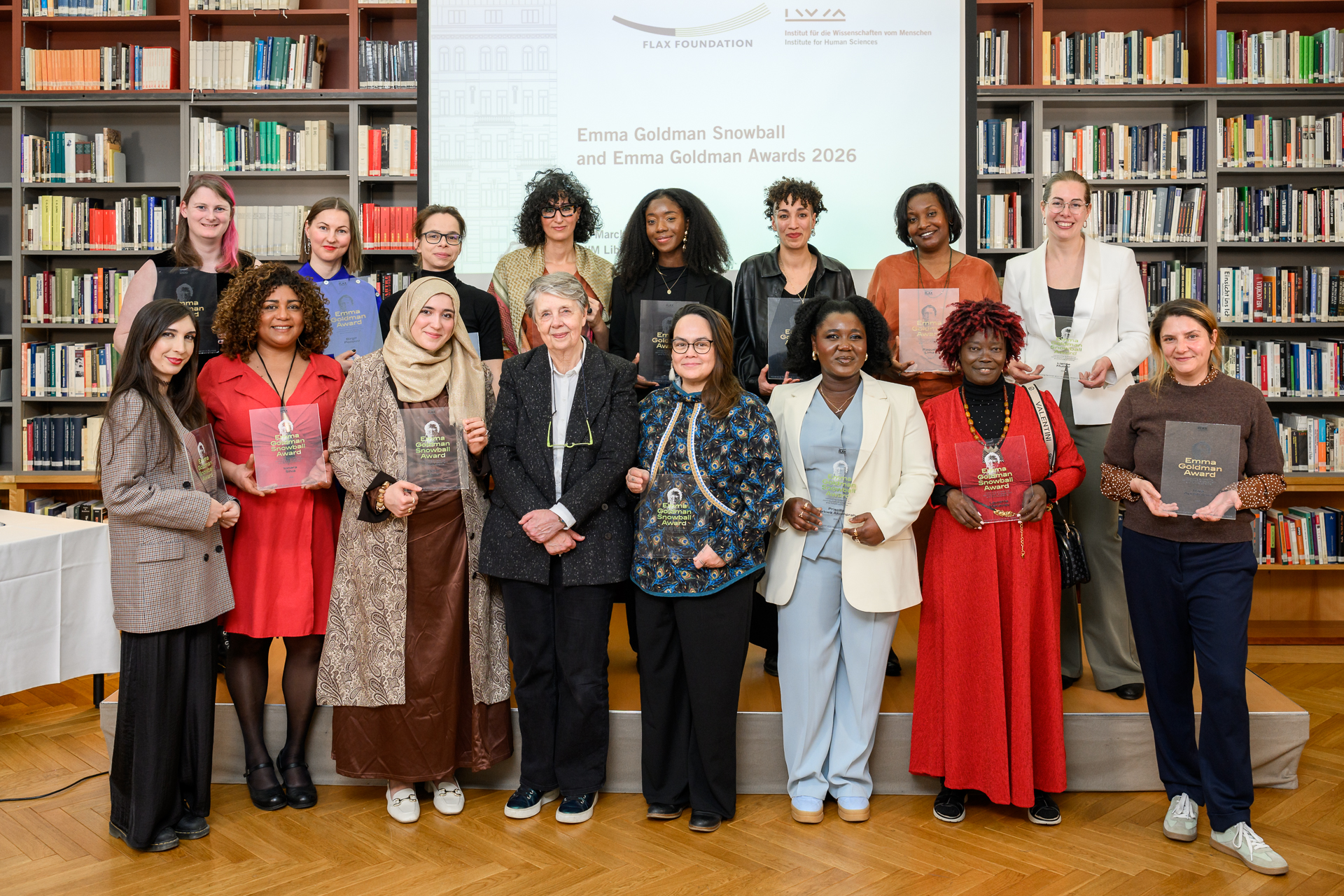
Every year, between five and ten people receive an Emma Goldman Award. Several more can win a different prize given by the FLAX Foundation, the Snowball Award. Two weeks ago, we gathered in Vienna for an awards ceremony, and for a budgeting workshop to support the best use of the funding we have received.
It was quite overwhelming to be in a room with a group of such highly accomplished women. We came from a great range of backgrounds, in terms of nationality, heritage, culture, discipline, field, and medium. It was amazing to hear about the work everyone was doing: as academics, as journalists, as filmmakers, as comic artists – and, inevitability, as collaborators and organisers. Every one of us was involved in community-building in one way or another. And everyone seemed pretty shocked to be receiving an award, because each one of us feels the pain of oppression, and none of us do what we do to win prizes.
The award ceremony was filmed, and I’ve put a link to the youtube video at the bottom of this post. It’s worth a watch simply to hear about the exciting things every single award winner is up to. It expanded my sense of possibility, of what is happening in the world and can happen in the world, and who I might work with or be inspired by going forward.
It meant a great deal just to spend time with each other outside of the formal sessions, speaking and listening and learning together, building new friendships. This is something I have taken away from my time in Vienna, something I will sit with for a long time. I believe this is another intention of the Emma Goldman and Snowball Awards: to go beyond themselves, to support networks of research and activism, to enable new connections and collaborations across borders. In this sense, the prize couldn’t be better named.
The thing that struck me most after the award ceremony – and I mean this in a really good way – is that it made our collective achievements feel unexceptional. I don’t say that to talk down myself, or any other winner. Quite the opposite: I feel that recognising this kind of work collectively reminded me that none of us are alone, that we are part of a movement.
It is enough for any of us to simply do the work – of fighting for a better world.
Last week I attended a workshop in Switzerland on standards of evidence in sex and gender research (more on that soon!) During my trip, I had my standard out-of-office auto-reply set up for my email account, informing people of my absence so they wouldn’t expect any immediate engagement from me.
I would typically switch off that auto-reply on my return to work as normal. However, in the wake of last week’s Supreme Court judgement, there is simply no more “work as normal” for me or any other trans person living in the UK.
As such, I have written a new auto-reply, which will be sent to everyone internal to my workplace who emails me. It is impossible for me to forget what is happening to trans people and especially trans people in the UK, so I will ensure it is impossible for my colleagues to forget this also. Equally, my intention is to transform bad feelings into understanding, and practical action. We have always been powerful when we work together and build movements.
I am sharing the text of the auto-reply here in case it is of use to anyone wishing to do similar.
You may be aware that the UK’s Supreme Court has initiated a mass rollback of trans people’s civil rights. In light of this, I am uncertain if it will continue to be safe for women and people like me to continue working at the University of Glasgow.
You can read more about the judgment and its implications here:
While the judgment itself does not require organisations to act in a prejudiced manner, numerous politicians and policymakers have indicated that they intend to make discrimination mandatory. My friends have reported increased street harassment, as the ruling is seen to position trans women as legitimate targets for misogyny and violence. Trans people of all genders are already even more likely to experience public harassment, sexual assault and rape than cis women (see e.g. https://bulletin.appliedtransstudies.org/article/3/1-2/3/), and this is likely to get worse.
The Chair of the Equality and Human Rights Commission (EHRC), Baroness Falkner, has promised to revise guidance to encourage employers to discriminate against trans people in the workplace. For example, she told Radio 4: “if a service provider says we’re offering a women’s toilet, that trans people should not be using that single-sex facility.”
If you are concerned about the safety, wellbeing, and continued access to employment and education for women and trans people such as myself, you can take one or more of the following actions:
Write to members of the Senior Management Team at the University of Glasgow, especially the Equality Champions, and ask what they will do to protect trans staff and students, including through ensuring continued access to women’s and men’s facilities as relevant. Find their contact details there <link removed for blog post>.
Write to your Head of School and ask what pressure they will be putting on the Senior Management Team to do the same.
Write to your MP and MSPs. Explain exactly why you are concerned, and demand action to protect trans people’s civil rights. For example, you could ask for new primary legislation to protect trans people, ask why the UK is no longer complying with the European Convention on Human Rights, or demand the dismissal of biased commissioners from the EHRC. You do not have to write a perfect letter and it is okay to be emotional and express sorrow or anger, so long as you are not aggressive or mean. Advice on writing letters is linked here: https://bsky.app/profile/whatthetrans.com/post/3lnf4sadrjs2p. You can find contact details for your representatives here: https://www.theyworkforyou.com/.
Support trans people materially, through providing time, resources, and/or money to community initiatives. Examples include: Glasgow Trans Collective (fundraising for emergency support to people facing an immediate danger of threat to life, https://linktr.ee/glasgowtranscollective); Trans Harm Reduction (supporting harm reduction for people self-medicating in the absence of NHS treatment, https://transharmreduction.org); and Five for Five (donating money every month to a range of trans women’s causes, https://www.fiveforfive.co.uk).
Check in on your trans friends and colleagues. Make sure they are okay, and do what you can to be there for them. But do your own research on what you can do to help: don’t put this burden on us. Some good places for information include the websites and social media channels for TransActual, What The Trans, QueerAF, Trans Safety Network, and Trans Writes.
This auto-response is inspired by bell hooks’ comments in her book Teaching to Transgress:
“When education is the practice of freedom, students are not the only ones who are asked to share, to confess […] empowerment cannot happen if we refuse to be vulnerable while encouraging students to take risks. [Lecturers] who expect students to share confessional narratives but are themselves unwilling to share are exercising power in a way that could be coercive. In my classrooms, I do not expect students to take any risks I would not take, to share in any way that I would not share. […] It is often productive if [lecturers] take the first risk, linking confessional narratives to academic discussions so as to show how experience can illuminate and enhance our understanding[.]”
I will not necessarily respond to any replies you send to this automated message, as I am trying to stay focused on teaching, admin, and research. But regardless, thank you.
It’s difficult to put into words what an enormous experience the 2nd International Trans Studies Conference was: the power of being in community with other trans scholars, the benefits of sharing ideas across disciplines and borders, the frustrations that arose with technical difficulties and the academy’s complicity in so many forms of violence. I intended to reflect on some of these matters further in a final blog post, but for now suffice to say that I was by turns exhausted, joyous, and hopeful throughout the fourth and final day of the event.
On being a target: How trans studies scholars and practitioners can survive hate and harassment
Saturday morning featured a session I had put together, focusing on strategies for survival in trans studies at a time of increased negative attention on our work. I approached several colleagues who have encountered substantial challenges from anti-trans campaigns, three of whom kindly agreed to join me to talk about what we might do about this.
Asa Radix of Callen-Lorde Community Health Center (USA) and Samantha Martin of Birmingham City University (UK) were sadly not able to join us in person, but recorded brilliant videos describing practical and theoretical responses to their experiences of being targeted by hate movements, both externally and within the institutions in which they worked. Florence Ashley of the University of Alberta (Canada) brought their irrepressible physical presence to the room, exploring in a short talk how proposed police monitoring of their law classes threatened to undermine the academic freedom of their students.
I wrote my own short presentation based on my experiences, explaining the abuse and harassment that continues to disrupt my research, and ways in which I have sought to counter this in practice. Drawing on my 2020 article “A Methodology for the Marginalised”, I argued that it should not be our individual responsibility to look after ourselves. Rather, we need practical support from the employers who benefit from our work. We also gain from building communities and networks of mutual support among marginalised academics, both within and beyond trans studies. A copy of my slides can be found here.
For me the most important part of the session was not what the speakers said, however: it was the opportunity for attendees to discuss their own experiences and strategies for navigating institutional barriers and opportunities for support. Whereas most of the conference consisted of several academic presentations followed by a short Q&A, we intentionally structured this session to enable as much conversation as possible, with questions fielded by anyone and everyone in the room rather than just looking to the speakers as experts. As a lecturer in community development, I found myself almost surprised by the rigidity of the traditional conference format, and was glad that attendees felt they benefited from our more open-ended approach, and the opportunity to discuss and sit with ideas.
Sadly, our online attendees did not have the same experience as those in the room. Like many other sessions at the conference, ours was plagued with technical difficulties due to problems with the digital conference software Ex Ordo. Given this possibility, and the fact that our session featured two video presentations, I turned up early in the morning to strategise with our amazing technical assistant, Srishti Chatterjee. Unfortunately, the session before ours ended up overrunning due to their own technical issues, meaning that we no time to properly set things up. Under pressure, we managed to get the videos working, but weren’t able to monitor the online chat while this was happening, not realising until afterwards that they were not visible for those outside the room. It would have undoubtedly been worse if Srish was not present, highlighting the importance of having trained people with initiative on hand to respond to problems as they arise.
You can read a third party account of our session on Amy Ko’s blog (thanks Amy!)
Trans Synths and Synthetic Sounds
After our intense discussion of hate and safety, I sought refuge in a more joyous session. And so to synths, and synthetic sounds: to trans pop and hyperpop, music that brings me immense joy.
This session began with a talk titled Switched-On Reality: The Synthesizer and Trans Subjectivity, by Westley Montgomery of Stanford University (USA). Montgomery highlighted the enormous contributions to music made by two pioneering synthesiser artists: Wendy Carlos and Sylvester.
Carlos is famous for her arrangements of Bach for the Moog synthesiser, as well as her film scores for A Clockwork Orange, The Shining, and Tron. Sylvester was a member of the drag theatre group The Cockettes, before becoming known as the “Queen of Disco” with hits such as “You Make Me Feel (Mighty Real)”. Both are therefore remembered for their major contributions to 20th Century popular music, but as Montgomery observed, can also be seen as “bad trans objects”.
Carlos transitioned in the 1960s and disclosed her trans history in the late 1970s, following her rise to prominence. In this way she became an extremely high profile trans musician. However, she also distanced herself actively from trans liberation movements, enabled by her relative privilege as a highly educated, white, middle-class woman. Montgomery wryly observed that people have asked ‘“where was Wendy Carlos [who lived in New York at the time] during Stonewall?’”, noting that, “the answer is most likely at home, playing Bach”. Sylvester, a Black middle-class person with an ambivalent public relationship to gender, famously proclaimed “If I want to be a woman, I can be a woman. If I want to be a man, I can be one”. However, Sylvester actively rejected transsexual identification, was uninvolved in the civil rights movement, and would later also reject disco music as it waned in popularity.
Both Wendy Carlos and Sylvester can therefore be understood as assimilationist figures who do not live up to liberatory ideals. But Montgomery argued that they must be understood within the context of the material conditions in which they lived. Moreover, their musical contributions are historically significant regardless, especially in terms of synthesiser use. Montgomery posited that the mainstream emergence of the synthesiser and of women and queer musicians happened in tandem, enabling a resignification of womanhood. Montgomery ended the talk by Hannah Baer, who argues moreover that the synthesiser is inherently not cisgender: “a synthesiser’s shape is not in any way where the sound comes from, and there’s something so free and trans in that. You have no idea what sound is going to come out of this thing. And maybe I don’t either!”
The next few talks shifted the focus to 21st Century synthetic sounds in the context of hyperpop. In Gender Knobs: Transgender Expression through Vocal Filtering Technology in Drag, Hyperpop Music and Beyond, Jordan Bargett of Southern Illinois University at Carbondale (USA) looked at the gendering of voice through pitch filtering. Her story began with the vocoder, originally invented to extend bandwidth in telefony, and later adapted for encryption in World War 2 before being adapted for popular music by artists including Wendy Carlos and Laurie Anderson. Anderson in particular used pitch filtering for gender drag in “O Superman”, using it to perform a masculine “voice of authority”. In the 2000s and 2010s pitch-shifting gained popularity with nightcore, setting the scene for trans-specific experimentation within hyperpop.
With hyperpop, Bargett explained that filtered vocals could be used for more nuanced gender expression as well as drag. They introduced the examples of trans women artists SOPHIE and Laura Les, who both used pitch filtering to create more “feminine” singing voices. In this context, authentic trans voices might be understood as both “synthesised and authentic”. At the same time, Bargett cautions that pitch alone does not, of course, gender a voice, and that hyperpop artists tend to be well aware of this. She presented the example of SOPHIE’s music video “It’s Okay to Cry”, in which the artist’s voice and body are “undressed”: an expression of trans vulnerability. The talk concluded with a screening of Bargett’s own short film “Transistor”, which explored how “technology can be an extension of the trans self and body”.
We heard more about SOPHIE from Gabriel Fianderio of the University of Wisconsin-Madison (USA), in Interpretation and articulation: Transphobia and Dysphoria Through SOPHIE’s “L.O.VE.”. Fianderio began by noting that “BIPP”, the opening track on SOPHIE’s debut EP PRODUCT, promises to make us “feel better”. But “L.O.V.E”, the closing track on the EP, is difficult to listen to due to the hostile noise of the dentist’s drill that recurs throughout the song. How to make sense of this disjuncture?
Fianderio posits that SOPHIE’s music provides a context in which we can move from “interpretation” (one truth) to “articulation” (space for multiplicity). Interpretation is often a problem with trans people. Citing Salamon, Fianderio noted that “trans panic” defences for the murder of trans women often depend on the interpretation of gender expression as “an aggressive act, akin to a sexual advance or sexual assault”. Similarly, dysphoria can entail a range of complex feelings and sensations relating to ourselves and others. Forms of interpretation centring pain, disgust, and distress ignores the complexity of ambivalence, and the possibility for accompanying euphoria.
Fianderio’s argument was that “L.O.V.E.” problematises interpretation through its use of the drill sound. They drew on internet commentary to show how the sound is often described by listeners as a physical experience (e.g. “This unblocks my nose”). Complex textures underlie this painful sound of the drill, and complex articulations are subsequently appreciated by listeners who spend time with the song and come to enjoy it. In this context, “L.O.V.E.”’s rejection of singular interpretation enables listeners to read conflicting emotions into the same form, and hence articulate complex feelings around euphoria and dysphoria. This can take place with and through the drill sound itself, and/or the song structure itself, with its synthesised vocals and moments of relief and beauty.
The final talk in the session, by Lee Tyson of Ithaca College (USA), was titled Trans Hyperpop and the Synthetic Authenticity of the Digital Voice. Tyson asked how and why trans hyperpop artists are positioned as “authentic”. Their talk began again with SOPHIE, noting that she was widely celebrated for her “authenticity” following her accidental death in 2021, which appeared to potentially contract with the experimental approach and ironic sincerity she employed in much of her music. Tyson describes this as a form of “synthetic authenticity” that can be found among many trans hyperpop musicians.
Tyson returned to the topic of vocal manipulation, quoting Laura Les’ comments on her earlier work, in which she explained she altered her vocals because “it’s the only way I can record, I can’t listen to my regular voice, usually” [my note: interestingly, the most recent material from Les’ band 100 gecs features much less processing on her vocals]. By contrast, Dorian Electra artificially inflates the character of their voice: “My music is simultaneously artificial and authentic. It’s just as authentic to use the same sappy love song language that’s been used in a million ways. A person singing a love song is still putting on a character”.
Tyson contextualised these comments by noting that voice manipulation can be understood as part of a wider technological field, as with (for example) hormone therapy, surgeries, and voice training. Within this field, hyperpop can be understood as a form of simultaneous deconstruction/reconstruction [note: I have also written on this as a feature of trans music!] This is not always liberatory: Tyson outlined the examples of the commercialisation of hyperpop, and the white appropriation of tropes of Black soul music by artists such as SOPHIE. At the same time, by finding something “more real” in artificial sounds, hyperpop offers a productive challenge to contemporary trans advocacy strategies and neoliberal imperatives of self-actualisation which rely on norms of intelligibility.
Overall, this was one of my favourite sessions of the conference. Like much of the music under discussion, it was self-knowingly silly and playful – yet stuffed full of surprising depth and interesting ideas. I only wish that the presenters had spent less time critiquing the whiteness of hyperpop, and more time considering the work of groundbreaking artists of colour such as underscores. Meanwhile, I don’t think music in and of itself can change the world, but it can help change the way we think, and that’s powerful and important.
Caucuses
After lunch, I spent most of the afternoon in a range of caucus sessions. These actually ran throughout the conference, and offered more open discussion spaces for people to have conversations on the basis of shared personal/demographic experiences or disciplinary interests. For example, there was an Asian scholars’ caucus, and a caucus for people studying trans healthcare.
Unfortunately, the schedule for the event was so jam-packed that each of the caucuses took place alongside multiple parallel presentation sessions. As such, I didn’t get around to attending any of the ones relevant or open to me until the final afternoon, when I managed to go to three in succession.
The first of these was the Palestinian caucus. This was an informal but very well-attended event arranged by attendees who wanted to organise collectively against the ongoing genocide in Gaza. This felt particularly urgent at the conference given the absence of Palestinian speakers, the presence of corporations who invest financially in the Israeli regime, and the suspension of Northwestern University professor Steven Thrasher following his support for a student encampment.
The second was the trans women and transfeminine scholars’ caucus. I recommended this take place and volunteered to chair it after a callout for volunteers from the conference organisers. Like many trans professional and trans studies spaces, the conference was dominated by men and transmasculine people. One joke often repeated at the conference was that “trans studies is mostly trans men who talk about trans women to cis women”: it felt very different to consider the repercussions of this within a woman and transfeminine only space. I found it very meaningful and refreshing to connect with colleagues in this context, and there is at least one very cool idea which might come out of our conversations, so watch this space.
Finally, I attended a caucus on publicly engaged scholarship. This turned out to be a small number of us swapping career advice, which is perhaps not what I originally intended, but felt very productive nonetheless!
Closing plenary
The conference closed with a plenary titled Whither Trans Studies? Towards a Future for the Field.
First, organiser TJ Billard took to the stage to make some closing comments. They thanked their fellow organisers, plus the conference’s steering group and sponsors, reflecting on how important it is that various university departments (especially at Northwestern) and research institutions support trans studies. They then reflected on the conference’s ambitious approaches to accessibility and inclusion, which faced some significant hitches in practice.
Billard thanked conference attendees for being patient and forgiving when things went wrong, and encouraged future organisers to “learn from the things that we tried to do, learn that the things that we failed to do, shortcomings both technical and intellectual”. They noted, echoing the complaints of the Palestinian caucus, that this included the absence of Palestinian scholars at a time of ongoing scholaricide, and apologised for the organisers’ failings in this regard.
We then heard reports from a small number of the caucuses. The graduate student caucus asked, “where is trans studies going? There was lots of discussion, and no consensus”. The Asian scholars’ caucus noted how the needs of Asian scholars are not necessarily met in “standard” Anglophone trans studies classes or syllabi, and reflected on the importance of building a network and not being alone.
The most extensive report came from the disabled scholars’ caucus, and these reflected many of the major strengths and failings of the conference I and others have written about recently. For many disabled scholars, we heard, this was a first opportunity to know of one another’s existence. Nevertheless, “the absences at this conference [were] as significant as the presences”: a comment that reflected Kai Pyle’s statements on the absence of Indigenous scholars in the opening plenary. Disabled people were absent due to numerous barriers to participation: this included the extreme circumstances facing those experiencing disablement through genocidal actions note just in Gaza, but also in Sudan and Congo.
In this context, the disabled trans scholars who were present were broadly “grateful and somewhat okay with the access we have experienced this week”. However, we were left with a number of thoughts which will be vital for future organisers: “Access is about justice, and justice is about accountability […] Access is not simply a matter of getting into a building. It is about interrogating why a building is inaccessible in the first place”.
Then the conference closed with a barnstorming final speech from the legendary Susan Stryker. She began by thanking all the people who had approached her throughout the event to thank her for her significant body of work: “I appreciate that something that I did landed with you in some way”. She then turned to think through the purpose and importance of trans studies.
Stryker started by looking to the roots of her own oppression. She explained that this has informed her analysis of body politics that positions people within specific, given social roles. She argued that while this body politics is a lynchpin of the Eurocentric social order, it has not always been this way, and it does not have to by this way.
What does it mean to be trans in this oppressive social order? Stryker proclaimed that “transness is an affective experience, driven by suffering and drawn by desire […] it is a practice of freedom”. This presents the possibility of alliance across multiple liberation movements. As Black trans studies has shown, transness is not just about sex/gender, but also at least as much about race, and the ways that certain bodies are racialised through gendering and gendered through racialisation. It is also vital that trans people understand their commonality with feminism. Insofar as feminism defies biological determination, “feminism can be considered a trans practice of freedom”. What brings us together is our movement across the boundary of categories designed to restrict freedom: “it is wrong to believe that embodiment must be a trap”.
Consequently, trans studies is about the pursuit of freedom, and should be a liberatory practice. Stryker cautioned us that creating an institutionalised form of trans studies does not solve the actual problems we face. She wryly insisted that we learn from the student movements of the 1960s, which did not achieve revolution, but instead “achieved ethnic studies departments”. She encouraged us to consider how we might use what positions we have in the academy to create space for struggle: “If we are so damn radical, if we are so dangerous, why has the field not been oppressed more brutally?” Stryker explained that she wasn’t trying to deny the real oppression we face – but rather, to acknowledge that as we sat gathered in the state of Illinois, certain things were possible for us which are not necessarily possible elsewhere.
At this juncture, Stryker reminded us of Stephen Thrasher’s suspension for visiting a student camp that supported the Palestinian struggle against genocide. She invited us to consider what it is about a trans studies conference – sponsored by the very institution that suspended Thrasher – that makes us more acceptable than voicing support for people facing death in Gaza?
Stryker shared several concerns raised at the Palestinian caucus with the rest of the conference, asking: what might a post-disciplinary trans studies look like in light of an absence of meaningful, substantive engagement with the genocide in Gaza? Drawing on a statement put together by the caucus, she noted that the conference was not BDS compliant, that attendees were not made aware of Northwestern University’s complicity in genocide, that there was no explicit discussion of the scholarcide in Gaza in the official programming, and that there was no formal engagement with the large Palestinian diaspora community living near to the campus. She argued that a shared liberatory goal for trans studies should include solidarity with Palestine, and future organising should undertake a good faith effort to foreground Palestinian scholars and be BDS compliant. Stryker invited scholars to raise their hands if they were supportive of these statements of solidarity: a majority of the room immediately did so.
Finally, Stryker formally proposed the creation of a new International Trans Studies Association, as a context for trans studies scholars to organise for freedom. As the “largest, most diverse gathering of trans studies scholars to date”, she stated her belief that the conference had a mandate to make a decision on the creation of this new association. She proposed that this process begin by taking advantage of the international steering group assembled for the 2nd International Trans Studies Conference, with this group invited to create proposed bylaws for the new organisation, and all conference attendees invited to join as founding members and vote on the proposed bylaws. Stryker asked if the room was in favour of this process, and asked us to raise our hands if so: once again, there was an overwhelming expression of support.
And that was it!
I’m really grateful to everyone who has written to say how they have found this series of blog posts interesting or useful. I think it’s really important to share material from conferences with people who are unable to attend. I used to regularly livetweet, but this no longer feels like a productive form of engagement. Writing up my notes ended up taking a lot longer than anticipated, and the length of some of these posts has felt a bit unwieldy. It’s also a bit frustrating to be finishing off the series over a month after the conference ended! Still, it feels really important to have some kind of record.
I’m hoping to write a final post on the Trans Studies Conference, reflecting more broadly on my experiences and questions of accessibility and resourcing, possibly comparing and contrasting with the 2024 WPATH Symposium in Lisbon. Let’s see how I do!
Earlier this year I took part in an interview for Acadames, a super-cool podcast “that explores whether being a woman in academia is a dream, game, or scam”. The episode is now available! I really enjoyed speaking with Whitney Robinson about my work, and hope you will enjoy our conversation just as much.
Today Whitney speaks with Dr. Ruth Pearce, a social researcher and feminist scholar based at the University of Leeds in the United Kingdom. Ruth discusses her current work with the Trans Pregnancy project, why gender equity schemes are so important in academia, and offers tips for resiliency when facing online harassment and political backlash. Along the way, she shares stories of her life as a trans woman, how academic institutions in the UK differ from those in the US, and the similarities between organizing a concert and organizing a conference.
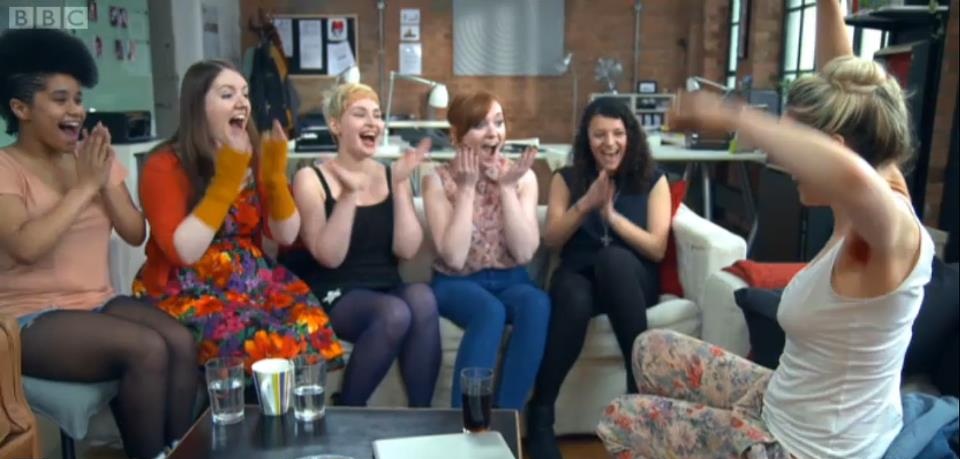
Several months ago, a friend of mine sent out message inviting participation in a new feminist video-blogging project. This seed of an idea grew into Those Pesky Dames, in which five women say awesome things about body autonomy, self-care, inspirations, intersectionality and pop culture. And then this week, the Dames stepped beyond the realm of YouTube (and Facebook, and Twitter and Tumblr…) to appear on the good ol’ fashioned television.
The Dames’ contribution to the programme is fantastic: they talk about how body hair is entirely natural, and shouldn’t be regarded as unfeminine. Why should women have to spend hours shaving in order to conform to the beauty myth? Why should we feel bad about baring our natural fluff in public? And why regard hairy women as unhygienic, but not hairy men?
I was so happy not only to see my friends on TV, but to see them discussing a vital feminist issue. Michel Foucault came up with this idea known as “governmentality” to describe the relationship between individual people and social rules. We enforce social norms through self-governance, tailoring our actions and behaviour to uphold the status quo. We police our own conformity through the application of self-esteem (when we conform) and shame (when we fail to conform). I felt that the programme beautifully highlighted the governmentality at play in the maintenance of female body hair: our self-esteem depends greatly upon our lack of hair, and when our legs or armpits are hairy in public we feel shame. In this way, women come to enforce sexist ideals of appropriate female behaviour. We can escape by embracing an alternative, feminist ethic of selfhood whereby shaving is not required. I went to bed reflecting happily upon this liberatory potential.
The next day was warm and sunny, and I planned to see my friends in town. I pulled on my shorts…and then took them off again and wore jeans instead, because I didn’t want the world to see my hairy legs. My boyfriend insisted that my short, very thin crop of leg hair wasn’t even visible and that it really didn’t matter. The rational part of my brain agreed wholeheartedly. I still couldn’t do it.
A great part of this response was no doubt down to your bog-standard governmentality at work. I was ashamed at the thought of being an Inappropriate Woman, and tailored my behaviour accordingly. Knowing that you’re a sucker in this way only gives you so much power! But there was an additional element at play: my fear of not passing.
I feel that being trans greatly complicates body hair issues. I don’t really fear being read as different or somewhat deviant, and happily flaunt my subcultural identity as a rocker on an everyday basis. I don’t worry too much about looking feminine or conforming to female stereotypes. But at the same time, I don’t want anyone thinking I’m not a woman, and I certainly don’t want anyone thinking I’m a man. I spent 18 years of my life being read as male, and those 18 years were quite enough.
My fear is not that people will look at my hairy legs and think “urgh, a hairy woman”. My fear is that people will look at my hairy legs and thinking “urgh, she’s actually a man!” This is somewhat irrational given how well I pass as cis, but the fear is real, and powerful.
The problem is that passing as a cs woman is important to me. Not because I think it’s better to look cis than trans (I most certainly don’t!) Not because I aspire to some outdated, patriarchal ideal of womanhood. It’s because I hate being heckled on the street, and I fear the violence that can come with transphobic responses. I realise that I’m deeply unlikely to suffer an assault in broad daylight in my home town, but past experiences of violence – however minor – can exert a powerful control. I aim to pass for my own mental and physical well-being.
And so I shave my legs and my armpits when I think they’ll be seen in public, because I’d rather be seen as an Acceptable Woman than not be seen as a woman at all.
The thing is, I hope this might change with time. At the start of my transition, I used to wear eye make-up and straighten my hair daily. I used to shun baggy clothes, instead aiming to highlight what curves I had. As time has gone on, I’ve become more and more relaxed about my appearance. This is partly because I’ve become generally more chilled with time: I’m no longer bothered about people who know me being aware of my trans status, and this blog is hardly anonymous these days. But it’s also because of the impact of hormones, meaning that I pass more easily as a cis woman regardless of how I dress. I now wear make-up and dress in a more feminine manner on special occasions, when I want to put on a certain appearance: in this way, I’m now doing these things for me, rather than for others.
One of things I really like about the kind of feminism espoused by Those Pesky Dames is that it leaves room for all these complications. There wasn’t really time for an exploration of this in How to Get a Life, but it’s all there in their vlogs. They argue for a feminism in which you shouldn’t have to shave your body hair…but you should be able to if it’s the appearance you’re going for. A feminism in which you don’t have to wear make-up, but should feel empowered to do so on your own terms. A feminism that accepts that some of us really want to escape the governmentality that leads us to shave our legs, but for now, we remain constrained.
As such, I’m going to keep shaving my legs, despite acknowledging that (in my case) I’m not really doing it for me. Meanwhile, I’m going to celebrate the achievements of those who aim to break down this norm.
And so the Bizarrely Busy Month of Trans News rolls on.
On the subject of trans parents, the Daily Mail has effectively outed a trans father; on a slightly brighter note, Green MP Caroline Lucas has tabled an Early Day Motion condemning the ongoing media witch-hunt that’s currently targeting pregnant trans guys. Kudos once again to Trans Media Watch and Jane Fae for their ongoing work on this. Meanwhile, bookmakers Paddy Power are under fire for a transphobic advert, and today saw a five-year-old trans girl splashed all over the tabloids (including front page stories in the Metro and the Sun).
Paddy Power will no doubt defend their advert (basically a “spot the tranny” competition themed around Ladies’ Day at Cheltenham) on the grounds of humour: it’s just a laugh, right? Meanwhile the tabloids will continue to defend their almost fetishistic obsession with the private lives of trans people on the grounds of “public interest”. Both actions serve to dehumanise and objectify trans people even as they build public interest in the queer freak show we supposedly offer.
This is all, of course, of massive concern to the so-called trans community. But we’re not the only ones who are affected.
In today’s front-page article, the Metro quotes “social commentator” Anne Atkins (who?) Atkins – clearly a great expert on gender diversity – says:
“Between the ages of about five and eight, I wanted to be a boy more than anything in the world. Acute though my longing was, it was relatively shortlived. I am grateful to say that there was no one around at the time to diagnose me with GID [Gender Identity Disorder]”
If I had a pound for every well-meaning cis friend who’d told me this at the beginning of my transition…well, I wouldn’t have a huge amount of money, but I’d definitely be able to afford a better toaster. But my problem with this isn’t one of cis privilege. It basically runs as follows:
What’s intrinsically wrong with a kid spending part of their childhood as a “boy” and part of their childhood as a “girl”?
What’s intrinsically wrong with the idea of a man having a baby?
What’s intrinsically wrong with (or, for that matter, funny about) gender being complex or fluid or aligned with their body in a non-normative fashion?
I’ve not come across a single answer to any of those questions that isn’t inherently sexist in one way or another. We shouldn’t have to subscribe to an ideology of gender difference that necessitates people being placed in boxes that restrict their self-expression. We shouldn’t have to rely on old-fashioned gender roles. At the same time, we shouldn’t have to demand that “gender” be obliterated altogether. Why can’t five-year-old Zach live as a girl? Why couldn’t Anne Atkins live as a boy for a few years before settling into womanhood?
In a gender liberated world, gender expression would be free and fluid. Adults could be men, women, genderqueer, polygendered or non-gendered as they desire. Children could be children, and explore gender as one set of social possibilities amongst many. And everyone benefits, not just trans people. We’d all have more space to be ourselves.
If you think this is hopelessly utopic and ultimately impossible, try dropping by spaces such as Genderfork and Wotever, where users/attendees are pioneering gender liberated approaches to language and social interaction.
We don’t need to do away with gender, but at the same time we don’t need to subscribe to fixed, binary ideals of gender in order to live in a decent world where people value one another’s work and care for one another.
In a gender liberated world, neither the media nor the medical world would care about five-year-old trans girl, a pregnant man or a trans person at Cheltenham because it simply wouldn’t be a big deal.
The trans girl could live out her childhood as she desired and privately transition physically – or not! – at an appropriate point in her teens. The man could access appropriate care during his pregnancy without fearing the consequences of doing so. And at Cheltenham…well, isn’t the very concept of “Ladies’ Day” totally regressive?
The Sun is in trouble. Years of journalistic malpractice are finally catching up with the venerable tabloid, with employees arrested en-masse on “suspicion” of corruption and bribery.
Associate editor Trevor Kavanagh is upset about this. “Witch-hunt has put us behind ex-Soviet states on Press Freedom”, his editorial thunders. It goes on to detail the humiliation experienced by Sun journalists and their families:
“Instead of being called in for questioning, 30 journalists have been needlessly dragged from their beds in dawn raids, arrested and held in police cells while their homes are ransacked. […]
Wives and children have been humiliated as up to 20 officers at a time rip up floorboards and sift through intimate possessions, love letters and entirely private documents. […]
Nobody has been charged with any offence, still less tried or convicted.
Yet all are now on open-ended police bail, their lives disrupted and their careers on hold and potentially ruined.“
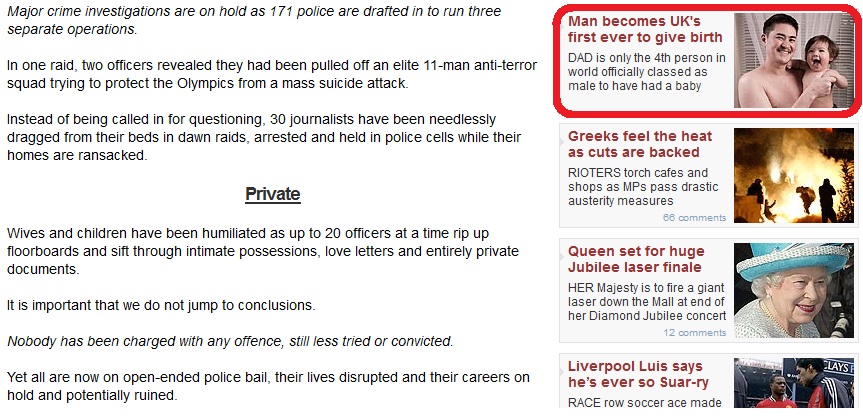
Yesterday, I noted a number of issues with the reporting of a British man’s pregnancy and the subsequent birth of his child. It seems, however, that the story simply wasn’t exciting enough for The Telegraph, who have revised their article somewhat overnight.
(click above for full-sized image)
The story itself remains largely unchanged: there is no new information. The only difference I could pick out was the introductory paragraph, which has changed one phrase in order to turn this somewhat inaccurate but broadly inoffensive sentence:
“The man, who is believed to be in his 30s, was able to carry a child after taking female hormones to reverse the effects of his female-to-male sex change treatment. “
…into something which takes that extra step to question the subject’s gender.
“The ‘male mother’, who is believed to be in his 30s, was able to carry a child after taking female hormones to reverse the effects of his female-to-male sex change treatment.“
Somewhat bizarrely, the original story remains online, possibly because The Telegraph wouldn’t dare offend the hundreds of readers who took time to comment on how disgusting it is that trans people want to mutilate their bodies.
Yesterday I was prepared to concede that Telegraph journalists were content to merely be stupid and lazy on trans issues. It turns out, however, that they’re actually prepared to put effort into their transphobic bigotry. Well done all.
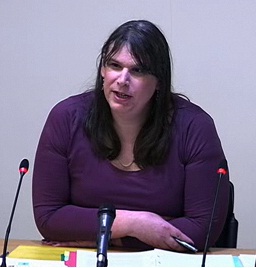
Helen Belcher of Trans Media Watch provided an impressive array of evidence in relation to transphobia in the media during the Leveson Enquiry yesterday. Video footage and full transcripts in .pdf and .txt formats can be found here. Trans Media Watch’s full submission to the enquiry can be found here.
Unfortunately – if unsurprisingly – Belcher’s strong performance warranted little comment from the mainstream and “pink” media alike. Notable exceptions included the headline story in Gay Star News (Trans people victims of ‘horrific’ press coverage) and a comment piece in Pink News (Does today mean change for the trans community?). There have been just brief summaries of Belcher’s evidence (with little or nothing in the way of analysis) within articles that tackle Wednesday’s events more widely in The Guardian, The Telegraph and on the BBC website. Even the #Leveson hashtag on Twitter went relatively quiet as the majority of cis commentators lost interest.
Still, this was to be expected, and we shouldn’t underestimate the importance of Trans Media Watch’s role in compiling and presenting evidence to such a major inquiry. Belcher powerfully outlined a number of very important issues:
The consequences of negative media coverage can be extremely serious for trans people: examples include loss of work, death threats, and the necessity of relocation in order to avoid prejudice.
Dehumanising and Othering language is routinely used within news stories: “The Sun is basically saying trans people elicit horror, trans people are frauds“.
Stories (and pictures) are often published without any consultation with the subject, let alone permission.
Newspapers often rely upon false information, such as inaccurate figures about the cost of medical transition on the National Health Service.
The Press Complaints Commission is considered useless and toothless as complaints are regularly ignored: “The Press Complaints Commission is regarded as a useless joke by trans people”.
Victims of negative media coverage tend to let the issue slide: “[…] we find that individuals rarely want to pursue the case because they then become afraid of future harassment“.
There tends to be no real justification for most articles about trans people on the grounds of “public interest”.
The Sun continues to run transphobic pieces (contrary to the claims of Dominic Mohan during his evidence to the Leveson Enquiry on Tuesday).
The Daily Mail publishes six times more stories on trans people than any other UK newspaper(!)
Trans Media Watch also identified a number of common themes in confidential complaints they’d received from trans correspondents who had suffered negative media coverage:
“In each case, the subject of the story had their right to privacy grossly breached, often at a very vulnerable time, with no public interest being served whatsoever.
Was put in danger of public abuse and/or violence.
Is left with candid details of their personal affairs, including previous names, pictures, home or work, available on the Internet.
Often these details, including photographs, were acquired without the subject’s permission. Had to fight the press to force them to exercise restraint — often with no effect.”
Finally, Belcher made a number of recommendations:
That it should be possible for organisations to issue complaints on the behalf of vulnerable individuals.
Anonymity should be granted to all who pursue complaints; we shouldn’t have to rely on the limited protections offered by the likes of the Gender Recognition Act.
The complaints process for media malpractice should be free:
“A lot of trans people lose jobs, find it difficult to get jobs. There is evidence that the earnings of a trans person is significantly lower than they could expect if they weren’t trans. That is a further deterrent for them to seek any recompense. It actually pretty much prevents any trans person from pursuing any action againsta newspaper in the courts.“
I found myself filling in a campus safety survey for my university’s Student Union yesterday. As I began the form, I thought about how safe I feel on campus.
I have this arguably unhealthy tendency to wander around all kinds of places alone at night, but inevitably feel a bit on edge and on guard in town and city centres. By contrast, I always feel comfortable on campus. I mean, this place is full of busy academic types during the day and feels quiet yet friendly at night. During the early years of my transition in particular the place was like a safe haven.
Moreover, I’ve always felt that I got off pretty lightly compared to many of my trans friends: I’m lucky really. I mean, I don’t get pestered by transphobic morons on a regular basis, and I’ve never been physically or sexually assaulted. At least, not since all those times I was beaten up as a teenager. But that was ages ago, and they had no idea I was trans (…right?)
Yet as I continued with the survey, I began to realise how much being trans causes us to redefine what counts as “lucky”, and, for that matter, what counts as a normal experience.
Firstly, there were the questions on physical attacks. Of course I’ve never been physically attacked! Oh wait, there was that time that someone threw a mysterious object at the back of my head outside the Union nightclub. Yeah, that time when the security guys clearly couldn’t care less and gave me some hassle because I immediately approached them and asked for help. Still, that was just the one time, right?
So, on to harassment. I know some trans people on campus who have had all kinds of horrible experiences in halls and suchforth but again, I’ve been pretty lucky. Except for that time I was subject to some totally inappropriate questioning during a club night at the Union: good thing my friends were there to stand up for me. And that time I was pestered by a chaser. And that time I was kicked off a bus and told to “cut my hair” after I got confused over the fare. And the time a woman refused to sell me a banana because she wouldn’t accept my gender(!) Huh, how these incidents build up…
These incidents are extremely infrequent, leading me to think that I’m lucky. This thought process points to the normalisation of transphobia: I’m entirely used to the idea that people will treat me like crap because of who I am. It’s something we all get used to, to one extent or another.
This normalisation then leads me to redefine safety. A safe place becomes a place where I experience minimal harassment, rather than somewhere I don’t expect to be harassed at all. I suppose I always expect to be harassed to some extent.
Of course, this is all par for course in the UK if you’re not a visibly abled middle-class white guy. Ho hum.





 Dr Ruth Pearce