I’m currently in the middle of a busy fortnight for work-related travel (more on that soon!) But last night, I managed to make the most of a brief return to Glasgow.
The occasion was There Will Be Blood! a fundraiser at Stereo for the brilliant group Trans Healthcare Access Glasgow. They are helping to provide free laboratory testing for bloods. This is really important for trans people on HRT who are increasingly denied monitoring by GPs. If you couldn’t make it but would still like to donate, you can do so here.
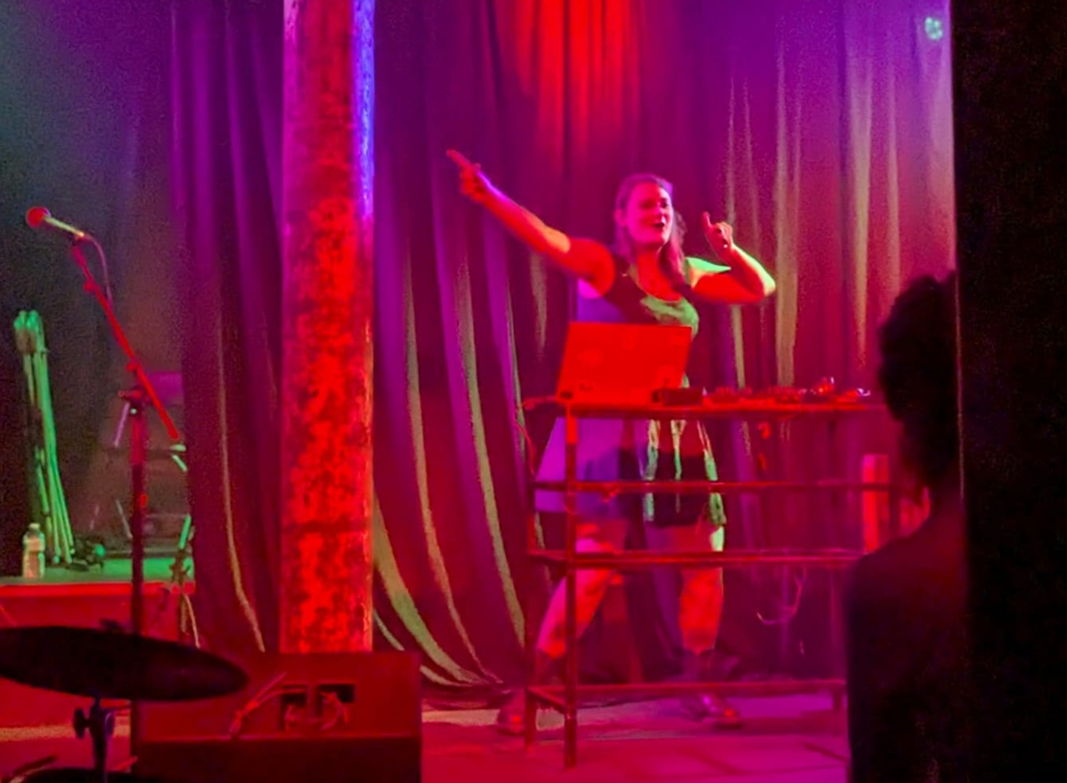
The organisers put together a fantastic lineup and there was a great turnout – especially for a Monday night. It was exciting to see so much talent from within our community, and loads of people come out to support both the cause and a pretty eclectic collection of artists. And exciting for me to be a part of it, performing a DJ set as ROGD.
In which I am going for it. Photo by Onni Gust.
The night kicked off with a luscious set from singer-songwriter and drag artist Sersi. He’s probably the first person I’ve ever seen sport a Britney mic at a DIY gig, which was very cool but sadly couldn’t quite capture the sheer dynamic range of his vocals on the night. At the same time, it enabled him to completely own the stage for a series of ballads that were by turns beautiful and strange. Sersi was ably supported by a pal with a laptop, and Johanna Kirkpatrick (of trad folk bands Chanterelle and Madderam) looking dead dykey on acoustic guitar.
Next to take the stage were Deep Filff. I hadn’t had a chance to look them up before the gig so had zero idea what to expect, although they did arrive with an absolutely enormous inflatable swan. Deep Filff turned out to be a two piece, with Nadia Fiffsky playing bass and belting out epic sun-baked vocals, while Jenny Tingle methodically destroyed the drumkit. As purveyors of some of the dirtiest psychedelic grunge-punk riffs I think I’ve ever heard, they were extremely well-named. It was engrossing, hypnotic stuff. Eventually the swan came out and bounced around the audience, most likely representing a serious hazard to some of the important-looking wires and glitterball hanging from the ceiling.
Local heroes comfortnever fail to disappoint, and this evening they truly tore up the stage as the final live act of the evening. The sibling duo have a truly unique sound, with Natalie’s staccato vocals punctuating a skitterish soundscape of totally artificial electronic sounds, underpinned by Sean’s assertive drumming. It was impossible not to dance. My favourite moments came whenever the band’s weird, abrasive noise would suddenly gave way to a transcendentally beautiful synth melody for a minute or two, before we all dived collectively back into the tumult.
Finally, following a quick raffle, I was up! The gig was due to end at a remarkably civilised 10pm, so I had a tight half hour DJ set.
I’ve thought a lot since returning to DJing that the landscape of queer and feminist music and activism has completely changed. Back in the day, I used to do quite a few “Women’s Voices” DJ sets, especially for feminist events such as Reclaim The Night afterparties, and the woman-only Women’s Aid and NUS Women’s Conference discos. The idea was that every song played (sometimes for sets of up to four or five hours) had a woman on lead vocals, and ideally women also playing instruments. Finn Mackayalways used to refer to me as “feministDJRuthPearce” (all in one breath!) which was never failed to be delightful.
Unfortunately, many of the people who were only too happy to join the dancefloor for those events are now either actively backing trans-exclusionary politics and the grossest forms of transmisogyny, or otherwise failing to speak out again them. (Junior equalities minister Liv Bailey, I’m looking at you – remember when you hoped I’d DJ your wedding one day?!) It’s odd to reflect on just how normal it was for trans women to be involved in woman-only politics spaces in the UK, given the extremity of the post-2017 moral panic.
Anyway, I digress.
Another thing that has happened over the last decade is the enormous influx of excellent trans artists to both underground and mainstream music scenes. We live in an age where I listened to jasmine.4.tfor the first time because my mum told me she’d done a good interview with Craig Charles on BBC 6 Music(!) So, while I’d like to do more Women’s Voices DJ sets in the future, for the first time it felt realistic to put together a Trans Voices set, with a mixture of tunes fronted by trans women and men, and/or non-binary, genderqueer, or genderfluid people, that I could reasonably expect a large number of people in the audience to be familiar with.
So, here’s what I played:
Shopping – The Hype My Chemical Romance – Teenagers 100 gecs – mememe SOPHIE – Immaterial underscores – Locals (Girls Like Us) [with gabby start] Kae Tempest – Move Ada Rook – BURY YOURSELF Janelle Monáe – Make Me Feel jasmine.4.t – Guy Fawkes Tesco Dissociation G.L.O.S.S. – Outlaw Stomp Against Me! – True Trans Soul Rebel
Obviously I could have kept going a lot longer, but I’ve got to say, it was one heck of a half hour. I have such enormous love for everyone who joined me to dance their arse off on a Monday night. And if you’d like me to DJ your event – I’m officially back behind the decks, so do get in touch!
This week I took the long train down to the south of England for my friend Robyn’s funeral. She died very suddenly three weeks ago, aged just 32.
Robyn gave so much love to the world, and was so loved in turn. Around a hundred and fifty people crammed into a small building for the service. There weren’t enough seats for everyone, so many stood at the back and sides of the room. I sat on the floor. More attended online.
We shared stories from Robyn’s life, learned from each other, cried together. Like many funerals, especially for young trans people, it was absolutely gutwrenching. It also helped move us towards closure. It was good to be in community together, to think and speak not just of Robyn’s past, but of our collective futures. Robyn lived life to the absolute maximum. Surely we could take inspiration from her example.
Robyn at Manchester Punk Festival 2024. Photo by Chris Bethell for The Guardian(!)
After the funeral, I stayed the night with queer friends in rural Surrey. We went for a curry, toasted Robyn, caught up about our lives. We talked about work and about books and about art and about holidays we wanted to take. That evening I felt tentatively more at peace with the world.
And then I looked at my phone. And I learned that another young friend, Jessica, had also just died.
***
It’s a shit time to be trans. Many people are saying this.
But then again, when has it not been a shit time?
Eight years of moral panic have taken an enormous toll. In the UK, as in many other countries, our civil rights and our access to public services, public spaces, and public life are all being rapidly rolled back. Politicians and influencers fall over themselves to promote anti-trans violence and praise one another’s incendiarytakes. We are less safe at work, at home, in hospitals, in schools, and in the streets.
Trans people often die young, including too many of my friends. Sometimes (all too often) we die by suicide, driven to despair in a world full of hate and malice. Sometimes (mercifully less often in the UK) we are murdered, usually in incredibly violent ways. Other times, it’s more complicated. I think of Denise, who died a sudden death from melanoma. I think about Elli, who died of Covid-19. And now I also think about Robyn and Jessica, who each died suddenly of apparently natural or accidental causes.
These days, the high rate of untimely trans death can feel like a consequence of the trans panic. Certainly I believe it’s making things worse. However, this phenomenon pre-dates the current political situation. Trans people disproportionately died young in the 2010s, at the time of the so-called “tipping point“. Trans people disproportionately died young before this too. Sociological theory can tell us why.
A decade or so ago, I worked for a couple of years in Warwick Medical School. I was there to teach medical students about social determinants of health. The basic concept is that our general health is affected enormously by the context in which we live. This includes factors such as the resources and services we do and do not have access to, and barriers we might face in attempting to access healthcare services or otherwise look after ourselves
So, it’s not a coincidence that – for example – life expectancies are shorter in poorer neighbourhoods, or that Black women are more likely to die in childbirth. There is nothing inevitable or biological about any of this, something intrinsically different about poor people or Black people. The issue is that entire groups of people are more likely to experience particular kinds of illness, and more likely to die of things others might survive. This is because of the social disadvantages they face, and because of the discrimination they experience at the hands of bigoted doctors and nurses.
There is a massive scientific literature on social determinants of health. I’ve contributed to it myself, co-authoring a recent study showing an association between transphobic microaggressions and poor mental health among trans people. For this reason, I know it’s no coincidence that so many of my trans friends have died untimely deaths. Trans people are more likely to have worse health because of transphobia. They are less likely to receive timely and effective treatment because of transphobia. This means when trans people are seriously ill, we are on average less likely to survive. I see this when I look at the academic literature, and I see this every day in the lives trans people I know.
I see the impact of transphobia when I look at Robyn’s life and death. Her health deteriorated significantly in her final years. She was afraid to seek help from doctors though: and for good reason, given the discrimination she and many of her friends experienced in NHS services. I wrote my entire goddamn PhD thesis on this problem.
Things were even worse for Jessica. I witnessed so many organisations and institutions in her home city of Coventry failing her time and time again. I could fill whole books with accounts of the violence done against her. She was failed by her school, her church, a political party she gave so much energy to, the council, the local hospital, the psychiatric ward, the housing association. Just last year I sat helplessly on the other end of the phone while she attempted suicide, doing the best I could in this moment to ensure that she was not alone.
The institutional failings experienced by Robyn and Jessica and so many others are the result not just of ignorance, but of actively malicious transphobia and transmisogyny. I believe these factors contributed significantly to their untimely deaths.
How can any of us expect to find hope and purpose in the face of such violence?
***
In recent months I have noticed an uptick in trans doom-posting. By this I mean trans social media posts, blog posts, and videos which dwell entirely on negative feelings and convey a sense of hopelessness.
A prominent example is Shon Faye’s recent essay, well, it’s over, which she describes as “a brief eulogy for the ‘trans rights’ movement”. Shon observes that powerful transphobic movements in the USA and UK are succeeding in many of their aims. They have spread fear and disinformation far and wide, made allies of mainstream politicians and media platforms, and enacted bans on trans healthcare. Now they are attempting to criminaliseour very existence, as part of a campaign to eliminate us altogether.
Shon’s conclusion appears to be: well, that’s it. We’re all fucked.
“Today I doubt I will see another progressive measure (either in legislation or healthcare policy) put in place for trans people in my lifetime. Who knows what may yet be taken away.”
I very much empathise with her account of trying to talk about this in any way with cis friends and family:
“their instinct is to try and generate hope or minimise despair [which] typically minimises the gravity of the situation and the depth of my grief and exhaustion and fear – increasing my resentment.”
Shon concludes that she doesn’t want to hear “fucking platitudes” – “there’s time for hope later”. For now, she wants time to grieve. I’ve seen similar sentiments shared by other authors on various social media platforms, including posts from extremely popular trans meme accounts.
I understand intimately where all of this is coming from. Just look at everything I said earlier about social determinants of health. I recognise the violence we are subject to, and its costs. This post too is written from a place of deep grief.
But there is also the question of where and how we grieve. We do need space to vent and to despair. But we also need space to process, and figure out what happens next. Ideally, we need places and times we can do this collectively, rather than just being isolated as individuals. Robyn’s funeral offered this.
I’m not saying we shouldn’t talk about what is happening to us. What I am concerned about is the individualising effect of public platforms, and the parasocial relations we hold with high-profile accounts. We tend to consume doom-posting on our own, on a phone. We often have no-one to process it with, and little context beyond the content in front of us. In this way, doom-posting offers only a partial account of reality, and no way out from despair.
And there is a way out. We find it in community.
***
Look, I have a great deal of respect for Shon Faye. I have a hard enough time navigating the consequences of my own very minor microcelebrity. Shon has to tackle a great deal more attention: from trans people looking for someone to idolise and/or tear down, from cis readers who project heroic expectations onto her, and from haters who see her as the antichrist or something. She’s great on camera, and a brilliant writer. I would recommend her book The Transgender Issue to literally any cis reader. I also recognise that her blog post comes from a place of incredible pain.
At the same time, I am concerned that many trans people and allies are putting way too much energy into engaging mainstream institutions and liberal systems on their own, individualistic terms, rather than looking to the alternative power and support we can build in our communities. Notably, a lot of Shon’s post talks about civil society, legislation, lobbying, and the role of organisations such as Stonewall. This is definitely a realm in which “trans rights” face a seemingly terminal decline. But it is also not the first place I would look for real, grounded hope.
You can find a similar energy in Jules Gill-Peterson’s dire essay Reject Trans Liberalism, which is referenced by Shon. Jules’ piece simultaneously criticises the trans liberation movement for being about more than transition, while also insisting that preparing ideologically sound documents for the US supreme court is a radical act. It posits a false and ahistorical dichotomy between transsexuals (good, pure, radical) and transgenders (bad, elitist, liberal). The essay does not consider how gender diverse people might work together or support one another across our differences. This contrasts with existing critiques of trans liberalism already advanced by activist-scholars such as Nat Rahaand Mijke van der Drift. Again, don’t get me wrong, I’m a huge fan of Jules’ previous work. But as trans people, and especially as trans women, we owe each other so much more than this.
Now, I’m hardly without fault. This very blog is replete with examples of myself and others putting untold hours into lobbying politicians, participating in public consultations, advising the National Health Service and so on and so forth. In her post Stepping Over The Line, Josie Giles, who once again I admire greatly (look, I just fucking love trans women) argues that:
“Theoretically, an army of well-resourced energetic activists could simultaneously engage in state-centred advocacy and also do grassroots politics. In practice, it doesn’t happen. In practice, state-centred pseudo-organising dominates the social media feeds and the limited energy reserves of an already depleted community, and absorbs what little money is available to pay for the salaried self-licking ice-cream cone of the lobbying profession.”
Sick burn!
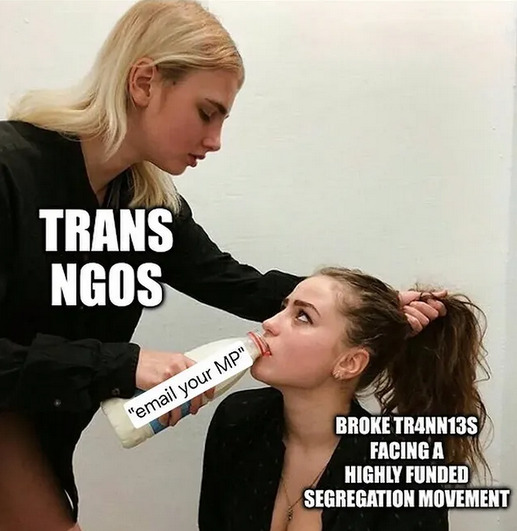
Meme acquired via one of them social media platforms we’ve all heard so much about.
I do disagree with Josie a little. Unlike Shon and Jules and also Josie, I transitioned in the early 2000s. This was well before the tipping point, and before most trans civil rights even existed in law. I remember how we fought successfully for changes that genuinely improved many people’s lives. I feel it will always be worthwhile to use what levers we can to minimise the harm caused by those who have power over us. Lobbying is the most accessible form of activism for some people. I still have an auto-reply on which encourages every damn cis person who emails me at work to contact their MP.
But Josie is completely right that many if not most trans people can and should be putting a lot more of our energy into grassroots politics. This must necessarily involve re-imagining what our worlds could look like, using what we already have as a basis from which to build. I know from lived experience that we can not only survive in the absence of certain civil rights and recognition, but also see material improvements in our lives when we come together. I met Jessica because we built trans-led community services in Coventry from the ground up.
Similar points are made by Roz Kaveney, who first came out over 50 years ago. In her criminally underrated 2022 poetry collection, The Great Good Time, Roz does reflect on the violence faced by young trans women in her youth. However, she also details the vibrant lives they lived together, the joys they experienced, how they shared housing and clothes and had each others’ backs. In a short forward to the book, she notes:
“I observed a lot of bleakness creeping into trans social media and thought it my job as a community elder to remind young people that things have been, if not worse, then at least as bad in different ways”.
As Josie states in Stepping Over The Line, white, middle-class trans people in particular need to understand in this current moment that we are as disposable to the ruling classes as any other minoritised individual. Our strength lies in practical solidarity with others subject to the violence of corporations, fascist movements, and the state. To once again reiterate the point, we need to be in community with one another.
Both Robyn and Jessica’s lives offered perfect models for this.
***
Every single speaker at Robyn’s funeral talked about how much time and energy she put into punk and folk music, building and fixing things, and caring for others. She was a loud, proud butch who was incredibly committed to sustaining community wherever she went. When she saw a need, she sought to meet it. Many of us only wished that she was better at asking for or accepting help herself.
If a trans person needed somewhere to stay, Robyn would put them up. If a trans person needed to move house, or was being evicted or was fleeing a violent relationship, Robyn would turn up with a van. If a trans person was having trouble at work, Robyn would show up online or in person with sensible advice. This attitude inspired Robyn to volunteer with groups such as Reading Red Kitchen, a grassroots project which provides a social foodbank and free community meals for asylum seekers experiencing food poverty. For Robyn, radical politics could never simply be about slogans and demonstrations: it was about cooking, connecting with others, and washing the dishes.
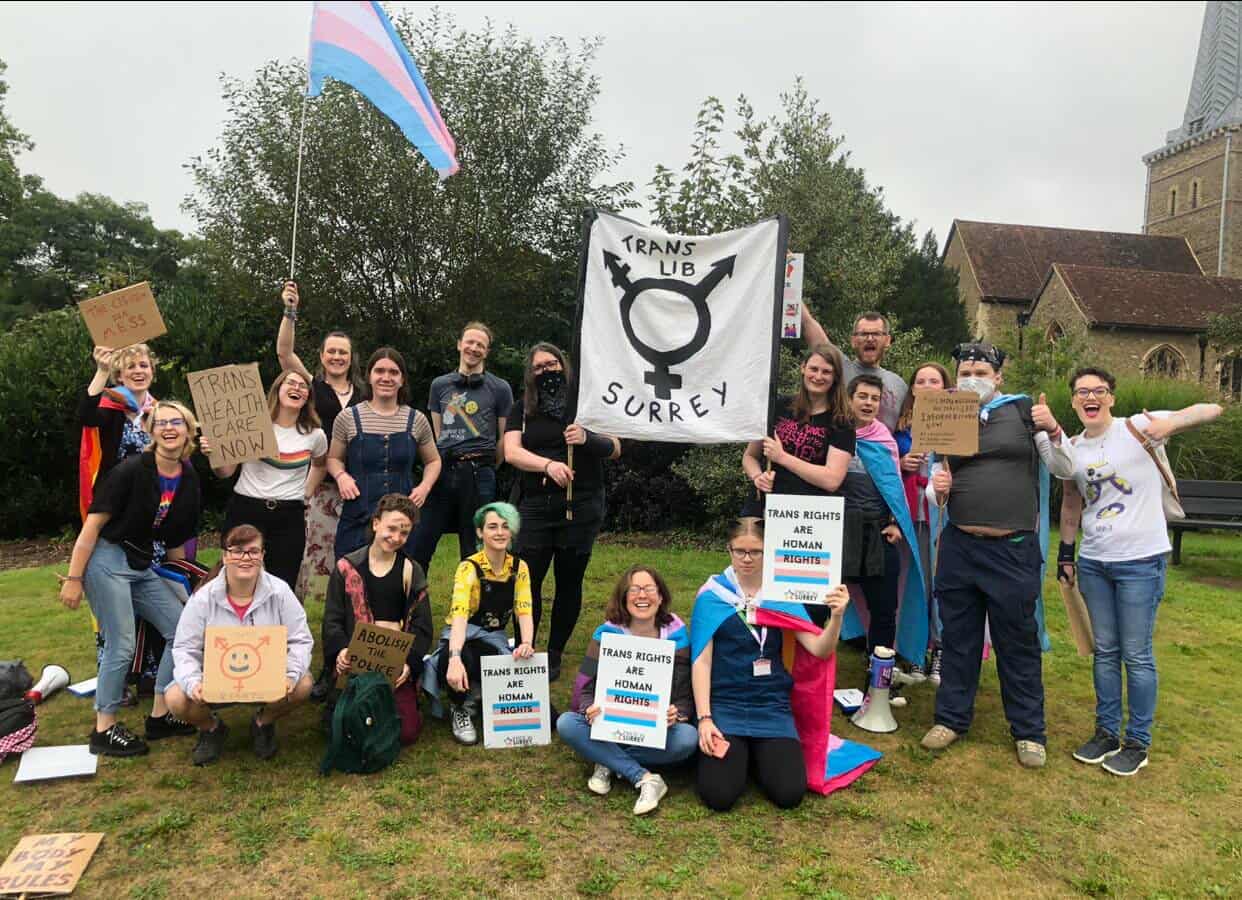
None of this is to say that Robyn was never found at a protest: quite the opposite. When I lived in the south we co-founded Trans Liberation Surrey, a collective which worked to oppose transphobia in a county hardly known for its activist movements. My most treasured memory of Robyn is from this time, when we attended a small anti-fascist demonstration in Wokingham. A coalition of neo-nazis, anti-vaxxers, and climate conspiracists descended on the town to protest a drag queen storytime event for young children. Robyn and I joined other locals outside the library to wave rainbow flags and play upbeat music, enabling families to attend the event without disruption.
Trans Liberation Surrey, at Surrey Pride 2021.
Jessica was also extremely motivated to help others, in spite of her own difficult circumstances. Like Robyn, she was a committed trade unionist. For many years she was also involved in a small political party, before eventually being ejected for challenging the leadership. Her motivation for this was a genuine belief in the possibility of positive political change, and in the potential for people to come together and make that change happen. Later in life she would rediscover her Christian faith as alternative vehicle for community action.
After hearing of Jessica’s death, our mutual friend Charlotte reached out, and we asked one another how we knew her. It turned out Charlotte had also been a member of that political party, and reconnected with Jessica several years later as they both sought new ways to make a difference in the world. In turn, I explained how Jessica and I met while lived in Coventry, and was myself involved in organising trans community social events, meals, and punk nights. Charlotte and I also both knew Robyn. “Christ Ruth,” said Charlotte, “trans lives are so entangled and we often don’t even realise”.
So it is. Right now, Jessica’s Facebook wall is replete with people thanking her for being there as a friend, for providing them with advice, for helping them come out.
In a hostile world, we are everything to one another. In the face of the most horrific hate, our love is so powerful. Such love survives death.
Selfie taken by Jessica.
***
This is where I find hope. At protests and demonstrations, sure, but more importantly in the contexts where we give each other’s lives meaning.
I find hope in community meals, mutual aid, queer bars and queer bookshops and queer gigs. I find hope in small parties, in big Pride events, in quiet meetings at work, in food pantries. I find hope in housing projects and healthcare projects, and in the Glasgow Electrolysis Project, which has created actual jobs for trans women and a vital new service for hundreds of us across the city. We know we are failed constantly by mainstream institutions: rather than seek incremental change, is it not time to re-imagine the clinic, re-think the workplace? Our problems will not be solved by refusing to engage with existing services, nor by creating trans charities that replicate existing hierarchies. We need to find ways to build something new entirely.
I find hope in the fact there are more of us out than ever, more connected than ever. These collective endeavors are all so much more important than anything I personally might write, any research I might do, and certainly any “progressive” policy I might influence.
Doom-posting and finger-pointing cannot deliver any of these things. We need to take the time to connect with one another, especially outside the internet. Yes we need to grieve, but we need so much more than this. We need to actively look after one another, and provide space for rest and recuperation. We need to have each others’ backs. We need to connect across difference, and not (re)create hierarchies of oppression or need.
These are no fucking platitudes. This is my life. This is the lifeblood of our shared communities. This is how we create better social determinants for our goddamn health.
In recent years I’ve provided a few written endorsements for cool books and other publications. I’ve decided to start sharing them to this site so more people are aware of these works!
I’m starting off with the first issue of Writing Badly. This is a new journal of letters, written by and for trans women on the subjects of misogyny and feminism. It is – intentionally – only available in print.
Here’s what I had to say about issue 1 of Writing Badly:
“Throw away your phone and read this instead. From cookery to consciousness-raising, from deep theory to casual misandry, from practical advice to impractical advice, the essays and letters of Writing Badly will help you build new worlds.
Imagine deep conversation with the cleverest women you know. Imagine organising with the coolest women you know. Imagine arguing with the most annoying women you know. Imagine being in community with women who will always have your back.
By turns profound and infuriating, beautiful and devastating, this collection has it all.“
On publication, I supported Writing Badly through buying myself a copy from my local independent bookshop, for the grand price of a tenner. They didn’t have a copy when I first went in, so I asked them if they could order one in for me. They instead ordered in a load, and now have them on the shelf for other women (and other people). Maybe you can do the same! Alternatively, it’s available to order online through ebay.
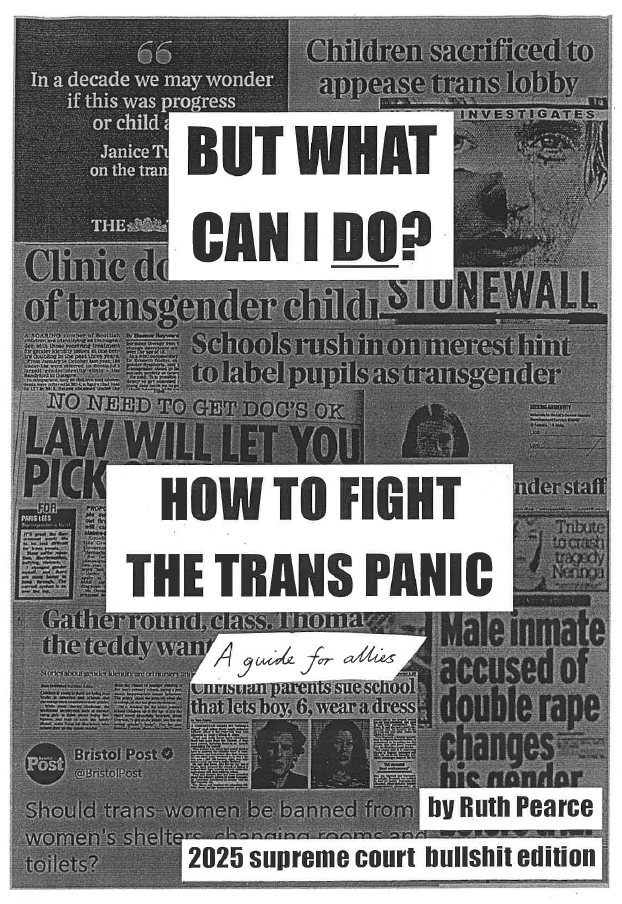
This is the latest version of a zine I have distributed at wormboysgigs over the last couple of years. I’ve recently updated it to address recent events, including the April 2025 Supreme Court ruling.
The zine is written particularly with allies in mind. It provides some background information on the UK’s anti-trans moral panic, and offers some suggestions for easy things people can do. These include: changing the conversation in everyday settings; making complaints or compliments; writing to politicians; introducing pro-trans policies; refusing to comply with anti-trans policies; supporting small trans organisations; and supporting trans creators.
This zine is intended to be freely copied and distributed. Please feel free to download and share the PDF. If you want to print it as an A5 booklet, simply select “print as booklet” and print onto A4 paper, then fold it in half.
I am once again distributing the zine at wormboys shows in coming months, as well as queer bookshops such as Category Is Books in Glasgow. However, if you want copies in your area, the best thing to do is to download the PDF and print some off.
I bounced up to an old friend to share this important insight. All around, queer bodies danced and swayed to furiously enthusiastic music. We have always sought refuge in one another, in our in our art, in utopic dancefloors and community care. But something felt different.
The collective energy of the crowd was wild, strong, cohesive. The entire room was dancing – and among us, so so many out, happy trans women and transfeminine people. On stage, a non-binary person sang explicitly about their experiences of gender to an assertive ska beat. It was a joyful moment – but the true wonder of it for me was that it was far from unique.
This was the last in a string of winter tour dates for my band wormboys, at the brilliant Queer As Punk event in Edinburgh. But I’d experienced similar in Dundee, in Glasgow, in Newcastle, in Hull, in Leeds. At every gig, trans women and non-binary people were scattered throughout the audience; at most, there were also several of us on stage through the night. It’s a world of difference from when I encountered just the occasional trans man playing gigs in the mid-2010s; let alone from when wrote a blog post titled Trans/queer rock musicback in 2010, in which I desperately sought validation in questionable gender-bending tunes written by (largely) cis musicians.
While trans women (and trans people more broadly) have always been involved in DIY music, there’s a clear change taking place. We have taken our inheritance and run with it. There are more of us making our own art, telling our own stories, and celebrating one another more than ever before. We are more visible, we are more assertive, we are more respected within our scenes, and – collectively – we are having more fun.
wormboys play Queer As Punk. Photo by Blanka Bandi.
—
The very night we enacted a better future on that dancefloor in Edinburgh, 16 year-old trans girl Brianna Ghey was stabbed to death in Warrington. Two other teenagers, a girl and a boy, have been charged with her murder.
For trans people across the UK – especially trans women and girls – this lethal attack was not unexpected. It feels like the culmination of a vicious hate campaign that permeates our media and politics. It’s also the tip of a vast iceberg of intentional violence and untimely death.
Suicide is endemic among trans youth driven to despair by the socially-sanctioned antagonism directed at them every hour of every day. I am tired of citing statistics. I have lost so many of my friends and peers. Words and numbers are insufficient for the raw anguish of my grief.
This is only compounded by the failures of bystanders who refuse to intervene, schools and employers who try to make us disappear, a National Health Service that inflicts harm upon us. England’s only child and adolescent gender clinic is due to close in a matter of weeks, with nothing ready to replace it. In an extraordinary open letter, the majority of clinical, research, and administrative staff at the clinic note an “increase in deaths related to the service” since the suspension of endocrine treatments in 2020.
Many of my friends have been threated or assaulted in broad daylight. One, for instance, had rocks thrown at her. Another was assaulted in front of the school gates. Another was raped by boys in the school playground. I frequently struggle with feelings of survivor’s guilt, having merely been publicly assaulted, stalked, harassed, and subject to threats of legal action and murder. Relatively minor matters, in the scheme of things.
Vigil for Brianna Ghey outside the Department of Education, London. Photo by David Griffiths.
—
How to understand joy in the face of so much hate and despair?
This is a question I struggled with throughout our tour. The night before Brianna’s murder, 400 people rioted in Knowsley outside a hotel that houses asylum seekers, spurred on by the fascist group Patriotic Alternative. This horrific event, too, did not occur in a vacuum. Racist and anti-migrant sentiment has similarly been stirred up by cynical politicians and journalists, as asylum seekers, economic migrants, British Black and Asian people, Gypsies and Travellers are repeatedly failed or directly targeted by our authorities and institutions. Patriotic Alternative have also repeatedly targeted LGBTIQ+ communities, through their campaign against Drag Queen Story Hour.
I could say so much more: about assaults on disabled people’s rights and livelihoods, about the demonisation of the poor, about attacks on pay, pensions, and the unions that attempt to defend them (I am writing this post while on strike). About how fascist violence is excused by sexist men in the name of “defending women and girls”. About how oppressed groups are played off against one another, while the effects of all this hateful discourse and action are felt most keenly at the intersection of multiple forms of persecution, such as by migrant trans women of colour.
Ultimately though, my point is this: what we are seeing is both a consequence of historic prejudices in our society, and of rising fascism.
Minority groups, women, migrants, and working class people in the UK have always faced a shared struggle against systemic discrimination and violence. Following a period of mild reform in the 1990s and 2000s, we are now experiencing a significant upswing in bold, blatant hate speech and violence, effectively condoned by every major political party and the majority of mainstream media publications.
This is the context of trans joy in the 2020s – and the reason why that joy is so necessary and vital.
—
Our tour reminded me that art is resistance, and resistance is collective. In recent days I have felt myself marinading in my own fear, a recipe for passive inaction. If we cannot experience joy, we cannot dream; if we cannot dream, we cannot hope; if we cannot hope, we cannot fight back. In the face of a world that wants so many of us dead, it is vital that we create reasons to live, and to thrive.
In Leeds, wormboys played to a rammed room in Wharf Chambers, a triumphant hometown crowd. We invited the brilliant Punjabi-Celtic-indie fusion trio Kinaara and gorgeous queer folk duo Serinto support us, building new friendships and cementing old ones. In Hull we debuted at the New Adelphi, where now-legendary acts such as Lizzo, Manic Street Preachers, Pulp, Skunk Anansie, and PJ Harvey played before they were famous. We shared the stage with Sandbox Mode – a solo hip-hop artist making deeply honest and funny songs about mundanity and despair – and Baby Flowers, an exciting young grunge group playing their second ever gig. This was the least well-attended, most male-dominated, and least obviously queer gig on our tour. And yet: the mood was vibrant, I noted at least one other trans woman in the audience, and Baby Flowers’ bassist was showing off a well-placed trans rights sticker.
In Newcastle, we found ourselves in the Little Buildings, a venue which has miraculously survived Covid-19 despite being founded just the pandemic began. The event was hosted by new dance party Queer Love. We played alongside the incredible hardcore group Disciplinary with their two bass guitars, and also the feminist dance-punk phenomenon of Fashion Tips. The whole night was amazing, but Fashion Tips were particularly exciting for me. Frontwoman (and Queer Love organiser) Esmé Louise Newman has a long history of involvement in groundbreaking queer feminist punk, metal and no-wave groups, including Penance Stareand Etai Keshiki. The new band were just as brilliant, with aggressive guitars and vocals underpinned by a powerful rhythm section, heralding a new era of revolutionary dancefloor divination.
Next to Glasgow, where I organised a well-attended gig at The 13th Note in less than a week, after our original promoter pulled out at the last minute. We booked the astoundingly powerful riot grrrl group Brat Covento play with us, along with HAVR, purveyors of gorgeous post-punk soundscapes. The latter band are fronted by Carrie Marshall, author of Carrie Kills A Man, who noted to cheers that she was a different gender the last time she played the venue. This was an event with plenty of trans women present, beaten only by brilliant gig in the same venue the very next night, which I went to see my soulful dyke folk pal Pictureskew play inbetween our own shows. That event might well be the first of its kind I’ve been to where there were at least as many trans women in attendance as anyone else. It was beautiful.
Then to Dundee, where Rad Apples and Make That A Takeput anarchist theory into practice by actively working to provide a safer punk venue and events for women, queer people, and migrants, through simultaneously building a welcoming space and promoting a zero-tolerance attitude towards discrimination and abuse. There I had two totally new life experiences. First, I witnessed somebody crowdsurfing in a shopping trolley during a storming set from banjo punks Alldeepends. Then, we were subject to the well-organised chaos of the “crowd surfing machine” by jubilant anarcho-folk headliners Boom Boom Racoon (a variant on the sat-on-the-floor rowing boat dance associated with songs such as “Oops Upside Your Head” and “Rock The Boat”, but with audience members encouraged to take turns in crowdsurfing along the boat).
Through the tour, I’d been carrying a trans flag to drape over my bass amp, and have often said something about trans liberation from stage inbetween songs. wormboys are a political band, but not in the same way as more in-your-face punk groups I’ve previouslyfronted. I’ve reveled in the ability to just be a musician and make that – rather than my status as a trans woman – the focal point of my involvement, leaving most of the talking to dual vocalists duo Sop and Harry. In the current political environment, that has increasingly felt untenable. It seems important to speak out, make myself visible, be obviously a trans woman making music.
But at Rad Apples I didn’t need to. There was already a trans flag up. There were plenty of other trans people there. There were placards in the bar opposing Section 35. I could just be.
—
And so to Edinburgh, where I found myself living in the future during a joyous set from opening act Bufandas. A future in which we experience the true paradox of trans visibility, in that we are both uniquely vulnerable, and uniquely strong. No longer hiding in the shadows, we are easier targets for those who hate us, but also have so much more potential to build power together.
Brianna Ghey’s killers may be convicted and jailed, but that will do nothing to stop the violence we face across these islands, and across the wider world. We have learned that we cannot trust the police to save us, or the courts, or politicians, or journalists, or managers, or human resources departments. But we don’t need any of these people or organisations. We owe it to Brianna to continue the grassroots work she did to improve other people’s lives, because another world is possible.
The headliners at Queer as Punk in Edinburgh were the fiercely feminist disco punk group The Red Stains. Their set included several explicit statements of support for trans people and especially trans women and girls, reflecting the attitude of most women active within actual feminist movements. This was an important reminder that anti-trans movements do not speak for all women, and never will.
My experience of sharing a stage with so many amazing musicians, from so many backgrounds, featured many such reminders. I was reminded of the sheer depth and range of human creativity. I was reminded of how much we can be inspired by our differences as well as shared experience. I was reminded of how far we have come, as well as how far we have to go.
There are so many of us. Today, we mourn. Tomorrow, we fight. Soon, we will win.
This piece is based on an email I wrote, in response to a message about “smear campaigns against gender critical academics” on a feminist academic mailing list.
I have updated and posted it here in the final day of the Gender Recognition Act consultation in order to give my cis readers some idea of how the past few months – and especially the last few weeks – have felt.
~
I would like to say something about how it feels to be a trans feminist academic right now, with the emergence of a growing number of “gender critical” voices in academia.
In the wake of Brexit and Trump, and with the renewed growth of far-right movements across the world, it seems that everyone feels empowered to speak out about their own personal prejudice. Trans issues are no exception.
When I first came out and transitioned as a teenager, almost two decades ago, one of the scariest things for me was using public toilets. Let that sink in for a moment. I was scared simply to use the toilet – for fear that people might shout at me, drag me out, maybe even beat me up. While that fear has dissipated for me, I have not been to a public swimming pool since my mid-teens, and have not even been swimming in the sea since my early 20s. This is because I am scared. I am scared of violent men, but I am also scared of violent women. Cis violence against trans people is a reality. I have an enormous amount of admiration and respect for trans people who are able to overcome this fear.
It was hard to come out in the early 2000s. There was an enormous amount of casual transphobia in the media. Guardian columnists wrote pieces such as “Gender Benders Beware”, TV programmes such as Little Britain and the League of Gentlemen were immensely popular, and 90s films such as Silence of the Lambs and Ace Ventura remained popular with my friends. Trans women were variously represented as a pathetic joke, as burly men in self-denial, deceptive liars or outright sexual predators.
Legislation such as the Gender Recognition Act 2004 and Equality Act 2010 was yet to see the right of day. It was therefore legal for employers and service providers to know all about my gender history; it was also legal to refuse to hire me because I was trans, fire me from a job because I was trans, deny me services and kick me out of shops, pubs, post offices, leisure centres (etc etc) because I was trans.
It was not easy to come out in this environment. There were exceptionally few openly trans people involved in public life – and none of them looked, sounded or acted much like me. I certainly hadn’t knowingly met any other trans people. I delayed coming out for years because I wasn’t sure if I was “really trans” (a phenomenon common among participants in my research). I thought that I might ruin my life. It was only the knowledge that my life would likely be ruined regardless, and the sheer awfulness of the alternative – becoming a man – that persuaded me to take the enormous step of coming out.
Consequently, I was very isolated during the first few years of my transition. I find it very hard to express how intensely lonely that experience was. Fortunately, my friends (mostly cis girls my own age) were immensely supportive, but it was difficult not to have any people with similar experiences to talk with. People with a very deep, complex relationship with our gendered movement through the social world, and/or our sexed bodies, such that we knew the assignation we received at birth was not right for us. People who felt a deep, deep relief upon transitioning socially and/or changing our bodies as appropriate.
It wasn’t until my 20s that I began to slowly, gradually meet trans people my own age – and what a relief that was! We could relax completely around one another, talk about our issues and experiences, reflect on our differences as well as our similarities. It was at this time that I encountered the term “trans bladder” – used to refer to the pain and urinary infections that could follow from not being able to use toilets outside of the home. Let that sink in.
I also began to realise the wider extent of the damage caused to other trans people by both external and internalised transphobia.
Many of my trans friends have attempted suicide, sometimes on multiple occasions. The first trans person I knew to take their own life was a member of a trans youth Internet message board I frequented when I was 16. Others would follow, including a housemate, whose body I discovered shortly before I was due to head into work to teach a class. When I see “gender critical” people disputing well-establishedtrans suicidestatistics, it feels like gaslighting. I know what happens in our communities when people are not affirmed and don’t have access to adequate support.
Other trans friends have experienced severe sexual violence, often in their youth, often in very public spaces such as school playgrounds. Trans people are at particular risk of various forms of sexual assault, violence, coercion and control – for example, 28% of trans respondents to a large Stonewall survey had experienced domestic abuse within the past year alone. When I see “gender critical” people talking about the supposed violent threat that trans women pose, I think about how when trans friends of mine are raped, our first conversation about accessing support is usually about whether or not it is safe for them to go to the local rape crisis centre. This is not something we can necessarily take for granted.
When academics and journalists “come out” as “gender critical”, scaremongering about changes to the law we have been fighting for for decades, representing trans women and girls as sexual predators, debating our access to legal rights and public spaces and women’s services, I wonder if they know who we are, what our stories are, what our experiences are like. Is it simply that they don’t know any trans people, that they are ignorant? Or is there a deeper cause for their hatred? Do they realise they sound less like feminists, and more like the fundamentalistreligiousright? (for an example of how fundamentalist Christians and “gender critical” feminists basically employ the same language and discursive anti-trans tropes, I recommend a look at the responses from organisations to the Scottish government’s recent consultation on gender recognition).
As for the notion that anti-trans campaigners are “gender critical”, and my use of inverted commas for this term – I spent an enormous amount of time thinking about gender, sex and sexism even as a teenager. I read about the social construction of gender, and it made sense to me as a concept, but it took me a long time and a lot of theorising to figure out how to make sense of that with relation to my own body and experiences. I began to figure out that sex was a social construct too, reflecting the construction of gender, many years before I would encounter the work of Emi Koyama and Judith Butler. In my 20s, I was heavily involved in the NUS Women’s Campaign, and I am now (among other things) a gender theorist. In recent years I have been interested as a scholar and campaigner in the drawbacks and possible benefits of gender equality schemes such as Athena SWAN, and the fight to tackle staff-on-student sexual misconduct.
People who object to pro-trans legislation and oppose our access to public space do not have a monopoly on being “gender critical”, any more than those who oppose abortion rights have a monopoly on being “pro life”.
The growing number of academics who hold “gender critical” positions wield an enormous amount of power over their trans students, and have the potential to cause an enormous amount of harm. There are more and more of these trans students every year – of course there are. The exponential growth in the visible trans population is an outcome of the assertiveness of trans activists, our increasing visibility in public life, and a more positive legislative environment. It was predicted on multiple occasions many years ago – by Lynn Conway in 2001, by GIRES in 2009 and 2011. This is the outcome of an invisible population gradually becoming visible – just as the number of young people prepared to be out as lesbian, gay and bisexual also continues to rise. This growth will, eventually, flatten out – but it will be a fair while before this happens, especially if the current backlash continues.
I hope that cis people reading this post reflect on what it feels like for me to be involved in feminist and women’s groups at this time, especially as “gender critical” conversations become more common. It feels terrifying. I am petrified about where the discourse is heading within feminism as well as within the wider social world, and I am very scared about what might happen next, what violence might be perpetuated or excused in the supposed name of women’s rights.
I am hardly alone in this: I see trans friends freaking out en-masse every time I sign into social media. We know our history. Some of us survived Section 28. A precious few survived the AIDS crisis and surrounding moral panic. Many are also black, or disabled, or gay, or bi, or Jews or Muslims, or migrants. We know what happens when minority communities are scapegoated, and we know that the rise in transphobia is not an isolated phenomenon. We know that the most vulnerable among us are the easiest targets for hatred.
I worry every time I see a post goes up or message is written on a feminist Facebook group or blog or academic mailing list, every time somebody organises a feminist seminar or conference. I fear that someone will start raising “reasonable” concerns about my existence or civil rights, or lying about the supposed threat that I and others like me pose. For all that I move through the world as a woman, for all that I am a woman and have lived my entire life as a woman, for all that I am subject to sexism by clueless male colleagues and internalise the need to constantly apologise for myself at work, for all that I am harassed in public by men and fear male violence every time I leave work after dark, I start wondering what place I have in these groups. I start to wonder how many cis women think that somehow I am more privileged than them even though I am subject to both sexism and transphobia. I wonder how many feminists hate me.
When “gender critical” blog posts are written or emails are sent, I feel like I have a choice. Either I respond – and it may well take the form of an essay like this – an enormous outflow of nervous energy, fear and anger, energy that I will not get back repeating stories I am quite frankly bored of telling. Or I may attempt to remain cool and rational, encouraging calm and thoughtful debate even as I attempt to stem the rising panic inside. Or I try to ignore the message, even as it plays on my mind for the rest of the day, rest of the week, rest of the month, knowing that the environment has become a little less safe for other trans people – and especially other trans women – and especially other trans women less privileged than myself.
Or I just leave these feminist groups and mailing lists and academic collectives, which is of course what “gender critical” women would like me to do.
But not today. Today I stay. Today I fight. And I do not do this alone. For I know also that the majority of women support our cause.
There are a couple of looks I am very familiar with as a trans person.
One is primarily a look of confusion. It is the kind of look you might expect to receive if you were wearing a boot on your head. You have disrupted the everyday order of things, and people don’t know how to respond.
One is primarily a look of disapproval, communicating a barely-contained sense of disgust or revulsion. It is the kind of look you might expect to receive if you have smeared shit all over your face and are walking down the street as if nothing is wrong. You have disrupted the everyday order of things, and people are very unimpressed, but perhaps aren’t quite yet ready to shout or spit at you. But you imagine that they would quite like to.
I’m very used to these looks because I have received them a lot over the course of my life. More often when I was younger, my face and body as yet unchanged by oestrogen. But I still receive such looks now and again to this day, particularly when I put less effort into conforming to stereotypical expectations about how a woman should look or carry herself. Perhaps I have put on less makeup, or I am wearing baggy clothes, or I haven’t brushed my hair for a couple of hours.
Other trans people – particularly other trans women, and especially trans women of colour – are less fortunate than me. People don’t just look at them. The looks are merely where it starts. Then people shout at them, or spit, or throw stones. People pinch their arses or grope their breasts. I hear these stories from my trans friends pretty regularly. It’s like everyday sexism with the volume turned up.
Other trans people – particularly other trans women, and especially trans women of colour – are less fortunate still. People stalk them. People assault them. People rape them. People kill them.
They do this because we are revolting.
It starts with a look. Call it the cis gaze.
~
Today I saw so many looks of confusion and disapproval. I felt the revulsion. It was visceral. It was contained. It could not harm me. I was amongst hundreds like me.
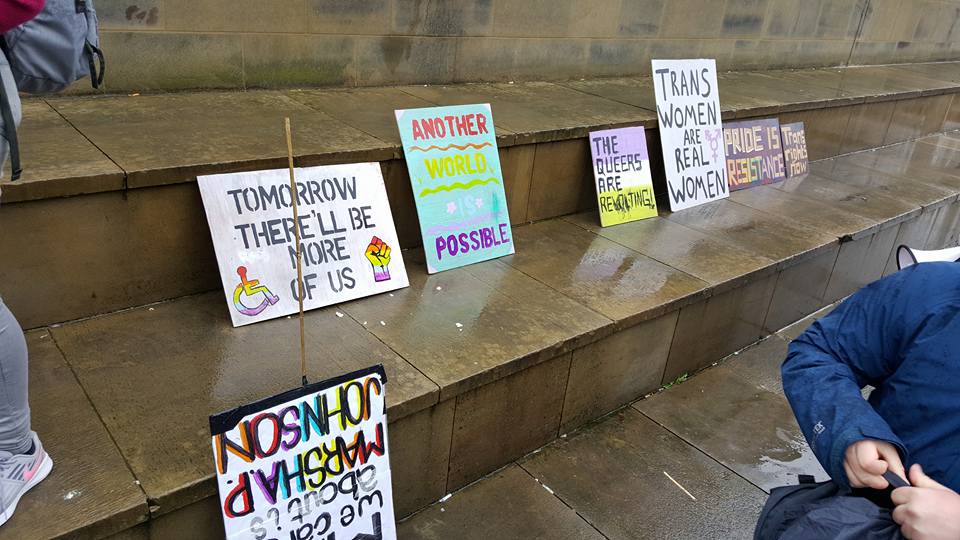
Today I took part in a Trans Pride march for the first time.
Waiting for a bus before the march. Photo by Sophie Wilson.
Trans people have, of course, taken part in LGBT Pride marches for as long as they have existed. Trans Pride marches, however, are a relatively new phenomenon. The first Trans Pride in the UK took place in Brighton in 2013. I attended Trans Pride Leeds, which is in its first ever year.
I have previously marched in LGBT Pride parades in Birmingham and London, and attended Pride parties in Coventry and Leamington Spa. On these occasions, people throng the streets. There is a sense of celebration. There is a giant street party. People come out to see the happy gays. They mostly look on with enjoyment. It is a family affair.
At Birmingham Pride one year, I was stopped by a “community safety officer”, who objected to my placard. It was not family friendly, he said. If I didn’t destroy or cover it up, he would call a police officer and I would be arrested. At London Pride one year, some people sought to control entry to a women’s toilet, ejecting at least one trans woman in the process.
Trans people are not necessarily welcome at LGBT Pride events. Or, if we are, we are not as welcome as many of our cis gay, lesbian, bi and queer siblings. Or, if we are, we are not seen or celebrated in the same way. We are not as safely contained.
But: there are a lot more cis gay, lesbian bi and queer people at LGBT Pride than there are trans people. We disappear into the crowd. We cause less confusion. We bring less disapproval. We do not so easily revolt.
This is why Trans Pride is important. This is why Trans Pride is necessary.
Photo by Kayleigh Brooks
Photo by Ruth Pearce
Photo by Natacha Handley
Photo by Ruth Pearce
~
Today is Trans Day of Visibility, apparently. In the UK, trans people are more visible than ever.
Visibility has brought new dangers. We are currently subject to an unprecedented hate campaign in the media, spearheaded by “respectable” publications such as The Times and The New Statesman. On the Internet, we have attracted the dangerous attentions of a resurgent neo-nazi movement, their anti-trans campaigns bolstered by useful idiots who claim to oppose trans rights in the name of feminism.
Visibility has brought new opportunities. We see more of one another. We are more organised than ever. We have grassroots organisations in every city. We are producing art, music, plays, and films that speak to our own interests and concerns. We are marching in protest, we are marching in Pride. We seek gender liberation.
It will be a very long, very hard fight, but we are going to change the world.
We are revolting.
~
Today I saw so many looks of confusion and disapproval. I returned the gaze. I held my placard high. I shouted, joyously. They could not harm me. I was amongst hundreds like me.
I could not, would not be shamed, for I felt the power of Pride.





 This piece is based on an email I wrote, in response to a message about “smear campaigns against gender critical academics” on a feminist academic mailing list.


 Dr Ruth Pearce